Blog

Explore expert tips and tricks to maximize your platform usage.
Thank you! Your submission has been received!
Oops! Something went wrong while submitting the form.
GetHookd Ads Library vs Facebook Ads Library
Gethookd vs Meta Ads Library
-
January 29, 2026

AdSpy vs BigSpy vs GetHookd: Pricing, Features & Reviews

Key Takeaways

  • GetHookd combines ad research with AI-powered creative tools, enabling you to move from finding a winning ad to launching testable variations in minutes.
  • AdSpy's $149/month price is a steep commitment, especially since it covers only Facebook and Instagram and offers no AI features or ad-savings capabilities.
  • BigSpy offers broader platform coverage, but the data freshness issues and steep jump from $9 to $99/month limit its practicality for growing teams.
  • Neither AdSpy nor BigSpy includes AI script generation, creative cloning, or performance-based filtering, which are essential for marketers who need to move fast and test at scale.
  • For e-commerce brands and dropshippers seeking the best value, GetHookd delivers ad intelligence, AI creative tools, and funnel templates for $19/month, with a 7-day free trial.

AdSpy vs BigSpy vs GetHookd: What Actually Helps You Scale

For ecommerce brands and performance marketers, speed matters. AdSpy, BigSpy, and GetHookd are popular tools for researching competitor ads, but not all of them help you act on that research quickly.

In this article, we compare AdSpy, BigSpy, and GetHookd to show where each tool excels, where they fall short, and which delivers the fastest path from competitor insights to live, testable ads.

GetHookd: Turn Competitor Intelligence Into Your Next Winning Ad

65M+ Ads Analyzed | 4.8★ G2 Rating | 4.4★ Trustpilot Rating

Stop Guessing. Start Scaling:

GetHookd reveals which ads your competitors are actively scaling—not just running. Spy on their best-performing creatives, landing pages, and traffic strategies, then turn proven concepts into testable campaigns in seconds with AI-powered script generation and creative cloning.

What You Get:
  • ✓ Brand Spy to decode competitor ad strategies in real-time
  • ✓ AI script generation and ad cloning for instant variations
  • ✓ Performance scoring based on actual ad behavior, not vanity metrics
  • ✓ Creative Analyzer to identify and scale your top performers
Replace guesswork with intelligence. Build profitable ads that actually convert.

GetHookd Overview

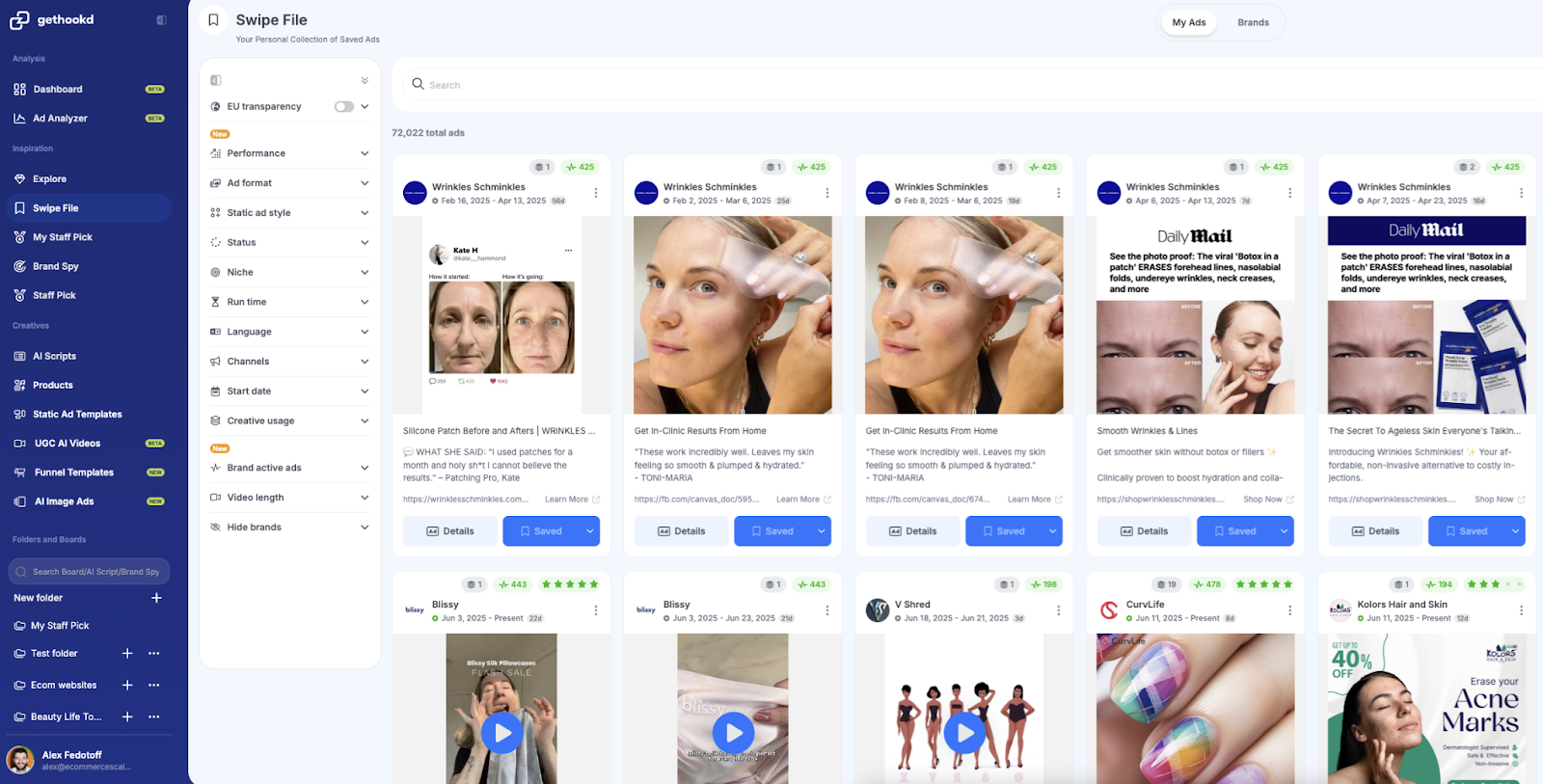
GetHookd lets you filter 65M+ ads by platform, niche, and scaling status to find winners fast.

GetHookd is a comprehensive ad research and creative platform built for marketers, ecommerce brands, and dropshippers who need to find winning ads and move fast. 

What sets our platform apart is what happens after you find an ad. Most ad spy tools stop at saving and organizing. The built-in AI tools let you transcribe scripts, generate new hooks and angles, and clone winning creatives without leaving the platform. You can go from spotting a competitor's top performer to having testable variations ready in minutes.

Key Features of GetHookd

1. Explore Ads

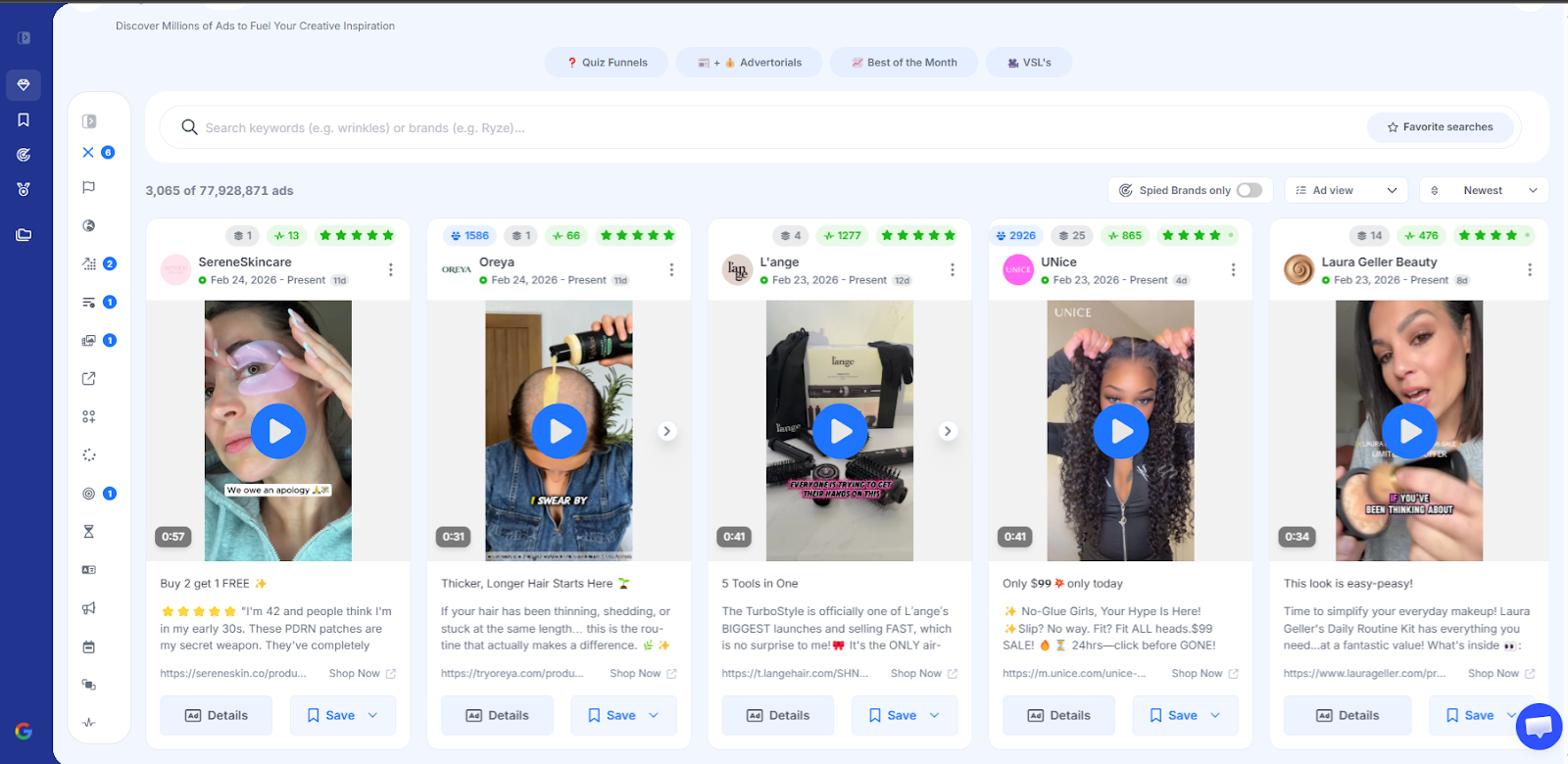
The ad library includes over 65 million ads across Meta and Google. You can filter by niche, industry, format, platform, and performance status to find ads relevant to your products and audience. Unlike libraries that prioritize high volume over high quality, Explore Ads lets you filter for high-quality, curated ads rather than sorting through outdated campaigns.

2. Brand Spy

Brand Spy enables you to track competitor ad activity over time. You can see which creatives a brand is running, how long they've been active, and which ads are receiving the most spend. The key difference is visibility into what's scaling versus what's just running. 
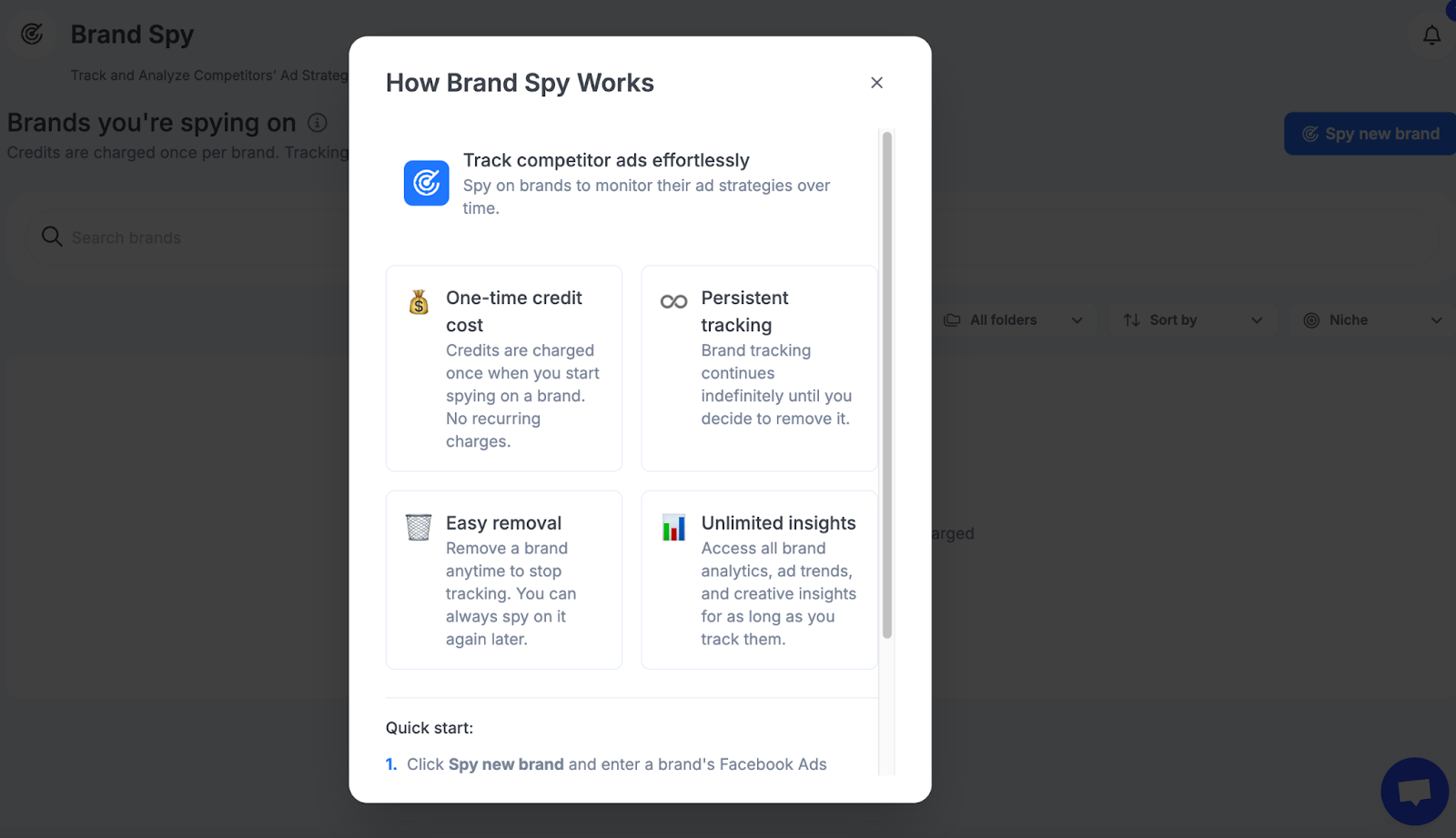
The Brand Spy feature helps you identify winning ads faster and understand the creative strategy behind your competitors' top performers.

3. AI Script Generation

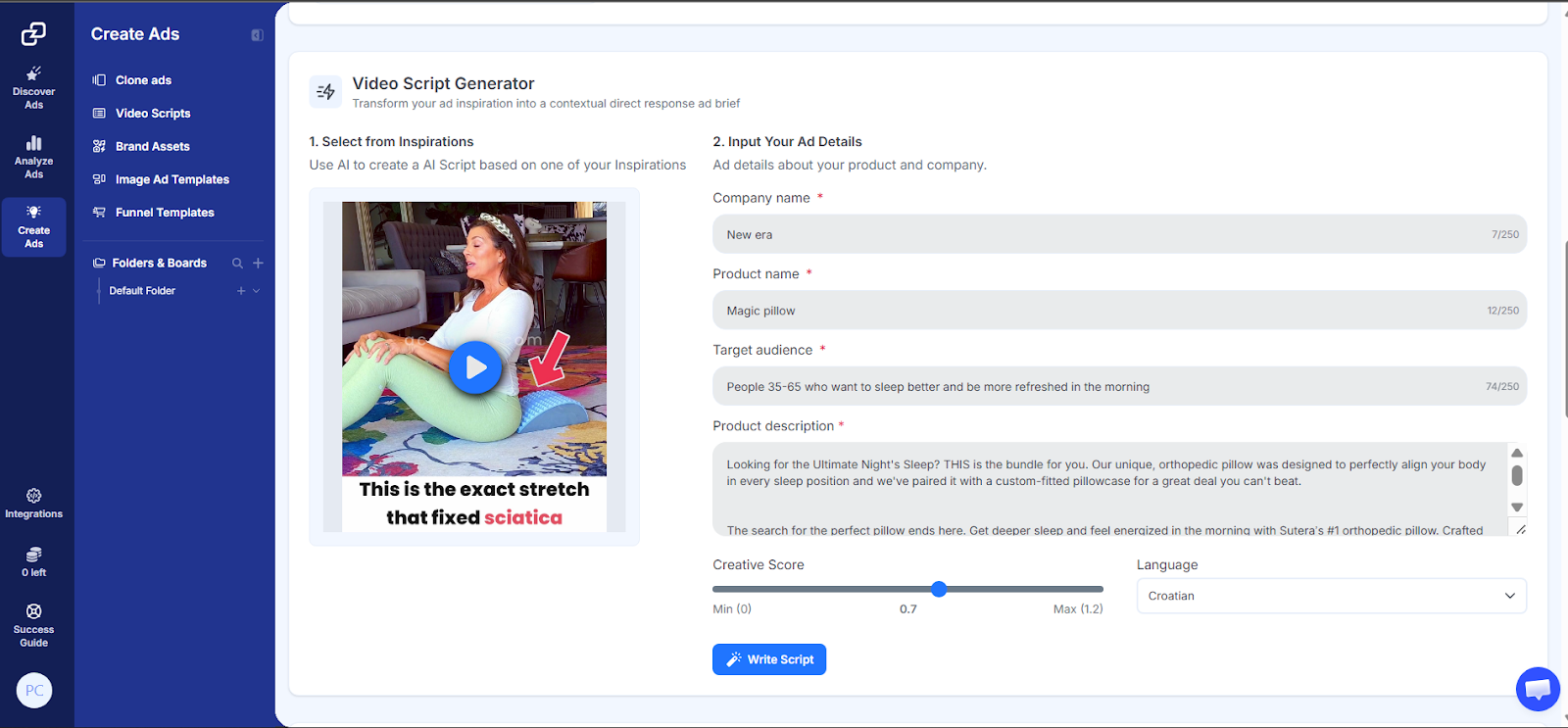
AI Script Generation transcribes any video ad and generates new hooks, angles, and full scripts based on what's working. You can take a competitor's winning ad and create original variations tailored to your product in minutes. This eliminates the manual work of watching ads, taking notes, and rewriting scripts from scratch. You go from research to a ready-to-shoot script without switching tools.

4. Clone Ads

Clone Ads instantly creates visual variations of static image ads. You can adjust colors, swap avatars, and test different formats without needing a designer or editing software. This is especially useful for rapid testing. Instead of waiting days for new creatives, you can generate multiple variations and launch them the same day.

5. Creative Analyzer

Creative Analyzer breaks down what's working across ad formats, styles, and messaging. It identifies patterns in high-performing ads so you can apply those elements to your own campaigns. Rather than guessing why an ad works, you get a clear breakdown of the hooks, visuals, and copy that drive engagement, making it easier to replicate success.

6. Save Ads

Save Ads lets you keep any ad in your library permanently, even after the original campaign goes offline. You can organize saved ads by niche, format, or performance status for quick reference. This addresses a common issue with Meta's Ad Library: inactive ads disappear. With Save Ads, your research stays intact and accessible whenever you need it.

Positives of GetHookd

AI-Powered Creative Tools

Our AI tools assist users at every stage of the creative process, from research to ready-to-launch ads. AI Script Generation is particularly useful for turning competitor insights into original creative. The AI copywriter was built using frameworks developed by 8-figure direct-response marketers, so its output follows proven structures that drive conversions.

You can transcribe any winning ad, then generate new hooks, angles, and full scripts tailored to your product. Clone Ads generates image variations in seconds, and Creative Analyzer breaks down exactly what's working so you're not guessing. This end-to-end AI workflow is what separates our platform from tools that stop at research.

Landing Page & Funnel Intelligence

Our platform shows you where competitors are sending traffic. With Brand Spy, you can see which landing pages are receiving the most spend, so you understand the full funnel behind competitor campaigns.

We also include plug-and-play funnel templates based on landing pages and checkout flows, used to scale multiple 7–8-figure brands. Instead of guessing how to structure your pages, you can start with proven frameworks and customize from there.

Static Ad Templates

You also get ready-to-use templates for static image ads, so you can launch creatives without having to start from scratch. When combined with Clone Ads, you can generate multiple variations across different colors, formats, and styles. This gives you more assets to test without waiting on a designer.

Seamless Collaboration

Our platform’s workspace makes it easy to collaborate with up to 10 team members on ad research and creative development. You can share saved ads, briefs, and competitor insights without juggling separate tools or chasing down files across email threads and chat apps. 

This keeps everyone involved in the creative process aligned and informed, whether you're working with an in-house team, remote collaborators, or external clients.

GetHookd Pricing Options

We offer flexible pricing with monthly and annual billing options. All plans come with a 7-day free trial. 

  • Launch: The Launch plan costs $19/month ($14.25/month billed annually) and includes 1 seat with 40 monthly credits. This plan is ideal for solopreneurs and early-stage brands testing product ideas and building their creative workflow.
  • Grow: The Grow plan costs $59/month ($44.25/month billed annually) and includes 3 seats with 200 monthly credits. It's designed for teams scaling their ad efforts and needing more creative power and competitor research capacity.
  • Scale: The Scale plan costs $149/month ($111.75/month billed annually) and includes 10 seats with 800 monthly credits. This plan is built for agencies and high-volume advertisers managing multiple brands or clients.
  • Enterprise: Enterprise pricing is custom and includes unlimited seats, expanded credits, and dedicated support. This plan is suited for large-scale teams with advanced needs.

GetHookd Customer Reviews

Our tool has strong ratings across review sites such as Trustpilot and G2, with reviewers highlighting its value for competitor research, creative inspiration, and ease of use. Users frequently mention how quickly they can identify winning ad angles and turn them into scalable campaigns. The onboarding process and intuitive interface also received praise, with several reviewers noting they could get up and running without a steep learning curve.
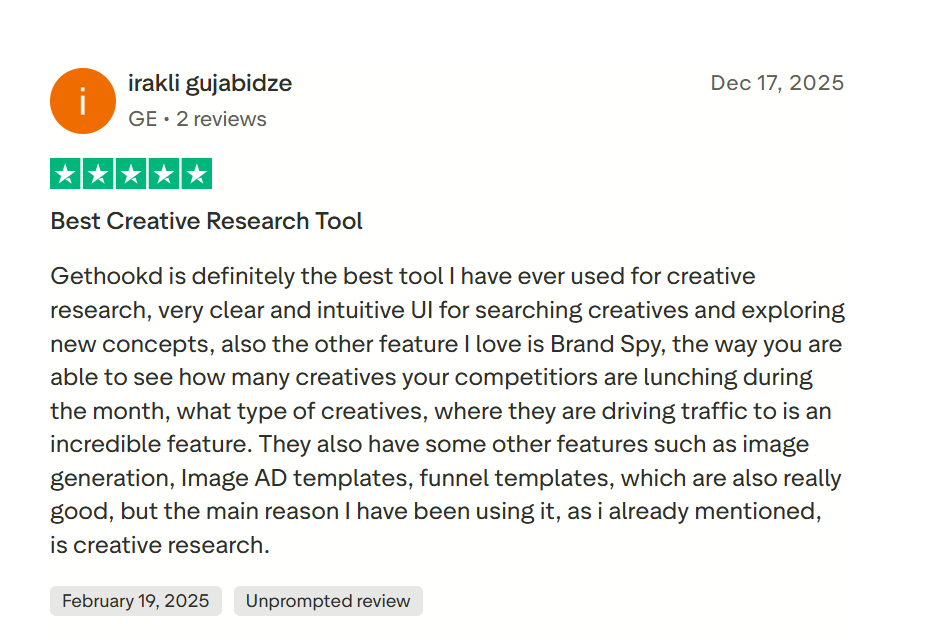
Our users consistently highlight the speed of finding winning angles, the depth of competitor insights, AI-powered features, and the simplicity of the interface.

AdSpy Overview

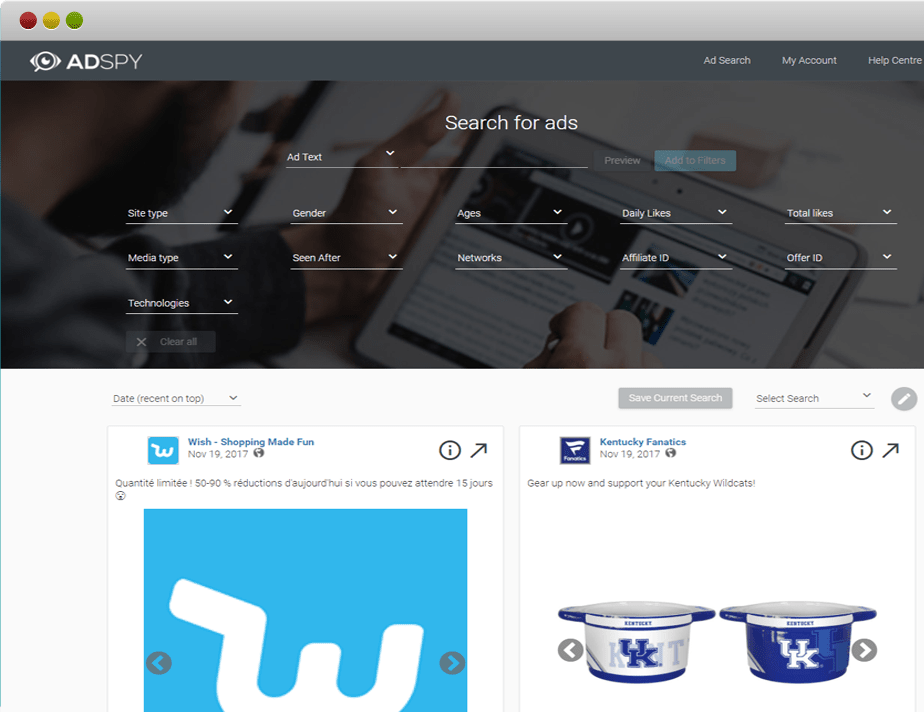
AdSpy's filtering system lets you search by keywords and engagement. (Image source: AdSpy)

AdSpy is an ad intelligence tool focused on Facebook and Instagram ads. The platform offers a large database of ads with filtering options for keywords, engagement metrics, demographics, and landing pages. It's designed for marketers who want to research competitors' creative assets and identify trends within the Meta ecosystem.

Key Features of AdSpy

1. Ad Search & Filtering

AdSpy lets you search ads by keywords, advertiser name, ad text, and URL. You can filter results by country, language, ad type, and engagement metrics like likes, comments, and shares. Demographic filters for age and gender help narrow results to specific audiences.

2. Landing Page Access

The platform captures landing-page snapshots of ads in the database. This lets you see where competitors are sending traffic, even after the original ad stops running. You can study competitor funnels without manually clicking through every ad.

3. Comment Search

AdSpy includes a comment search feature that lets you find ads based on user comments. This can surface ads generating strong reactions or specific feedback, which can be useful for understanding audience sentiment.

Limitations of AdSpy

No AI-Powered Insights

AdSpy provides research data but lacks the AI-powered insights found in newer tools. There's no creative scoring, performance predictions, or automated analysis to help you interpret what's working. 

Users must develop their own frameworks for analyzing competitive intelligence, which adds time to the research process. Tools like GetHookd automate much of this analysis, surfacing patterns and recommendations without the manual work.

No Ad Saving or Organization

The platform doesn't offer built-in features to save, organize, or tag ads for later reference. You'll need to rely on screenshots or external tools to build a swipe file.

AdSpy Pricing Options

AdSpy offers a single pricing tier at $149/month, which is a significant commitment to testing the platform. There is no permanent free plan, but some offers and coupon codes provide a limited trial with a set number of ad views (e.g., 1,000–2,000) before you must subscribe.

AdSpy Customer Reviews

AdSpy has mixed feedback from users. Some praise the database size and the depth of the filtering options for Facebook ad research. However, some reviews mention frustration with the user interface and learning curve, particularly from newer users or those with limited time for research. Others cite the high price point, lack of a free trial, and limited platform coverage as drawbacks. The absence of ad-saving and AI features is often cited as a gap relative to newer tools in the space.

BigSpy Overview
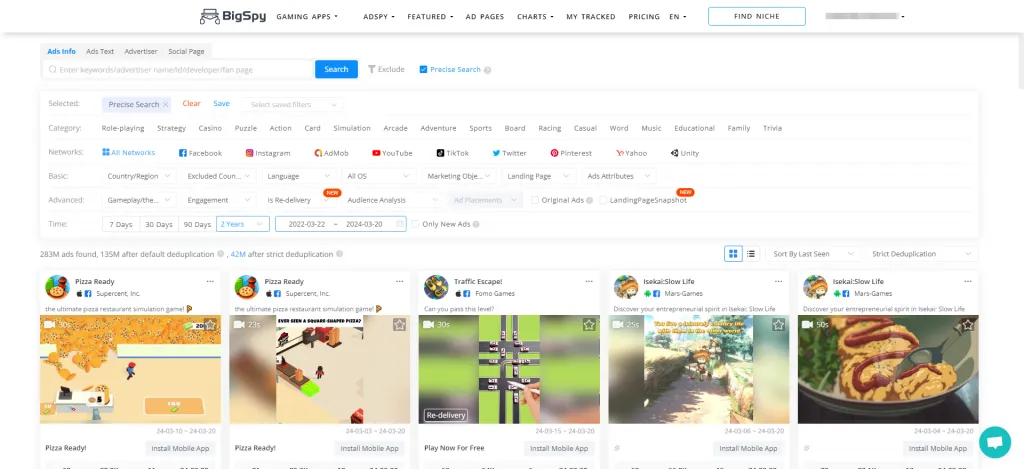
BigSpy offers ad search and alerts for tracking competitor campaigns. (Image source: BigSpy)

BigSpy is an ad spy tool that helps marketers and advertisers research competitor ads across platforms like Facebook, YouTube, Instagram, and more. It provides insights into competitor strategies and surfaces top-performing ad creatives to help users identify winning concepts for their own campaigns.

Key Features of BigSpy

1. Ad Search and Analysis

BigSpy's ad search and analysis capabilities enable users to discover competitor ads using filters for keywords, advertisers, platforms, and countries. The platform maintains a large database of active ads and updates it regularly. Its search functionality balances depth with usability, allowing users to quickly find relevant inspiration.

2. Landing Page Insights

The landing page inspection feature provides insights into post-click strategies, helping marketers understand the complete funnel their competitors have created. This functionality allows users to see how ads connect to landing pages and what conversion elements successful advertisers implement.

3. Ad Alerts

BigSpy also offers customizable alerts that notify users of new competitive ads matching specified criteria. These automated monitoring tools alert marketers to industry trends without requiring constant manual checks.

Limitations of BigSpy 

Data Freshness 

Some users report occasional delays in ad database updates compared to premium competitors. For marketers in fast-moving industries where being first to market with new approaches delivers significant advantages, these delays could potentially impact competitive positioning.

Limited AI Tools

The platform's analytics capabilities, while useful, lack some of the advanced  AI and creative features. There's no script generation, creative cloning, or automated recommendations. You'll need separate tools to turn research into ready-to-test ads. Platforms like GetHookd include these AI features natively.

BigSpy Pricing Options

BigSpy offers four pricing tiers with a free plan available:

  • Free: 5 daily queries, 20 downloads, Facebook and Instagram only
  • Basic: $9/month, 20 daily queries, 25 downloads, Facebook and Instagram only
  • Pro: $99/month, unlimited queries, 250 downloads, 9 platforms, landing page insights
  • VIP Enterprise: $2,000+/year, unlimited everything, all platforms, team support

BigSpy Customer Reviews

Users appreciate BigSpy's multi-platform coverage, with several reviewers noting the convenience of researching across platforms in a single interface. Some advanced users note limitations in data depth and analytics capabilities. Common complaints include slow loading times and the steep price jump between plans. Some users also mention that the data isn't always up to date, with "active" ads sometimes already offline.

AdSpy vs BigSpy vs GetHookd: Comparison Table

Feature GetHookd AdSpy BigSpy
Free Trial ✓ 7-day full access trial (completely free, all features unlocked) No permanent free plan (some online coupons can give 1,000–2,000 free ad views) $1 for 3-day Pro trial (paid, limited duration)
AI Script Generation Transcribe ads and generate hooks, angles, and scripts Not available Not available
Ad Saving & Organization Save ads permanently; accessible even after ads go offline No built-in saving or organization features Save and download ads with daily limits based on the plan
AI Ad Cloning Create color, avatar, and format variations of static ads Not available Not available
Creative Analyzer Breaks down what's working across formats, styles, and messaging Not available Not available
Brand/Competitor Tracking Brand Spy shows which ads are actively scaling, not just running Basic competitor search by advertiser name Track competitors and set up alerts for new ads
Funnel Templates Plug-and-play templates from 7–8 figure brands Not available Not available

Find Your Next Winning Ad with GetHookd

GetHookd is an ad research and creative platform built for ecommerce brands, dropshippers, and performance marketers.

After comparing these leading ad intelligence platforms across features, pricing, and user experience, GetHookd stands out as the most comprehensive solution in the market for actionable creative insights. 

Ad spy tools help you see what competitors are running, but most stop there. You're left with screenshots and spreadsheets, still unsure how to proceed with the research. GetHookd closes that gap by combining ad intelligence with AI-powered creative tools on a single platform.

With our tool, you can spot which ads competitors are actively scaling, transcribe winning scripts, generate new hooks and angles, and clone static creatives, all without switching between tools. The workflow is built for speed, so you spend less time researching and more time launching ads that convert.

For ecommerce brands, dropshippers, and performance marketers who need to test fast and scale what works, GetHookd delivers the full workflow in one place. No more stitching together separate tools for research, scripting, and creative production.

Try GetHookd Now →

Frequently Asked Questions (FAQs)

What is an ad spy tool, and how does it work?

An ad spy tool collects ads running across platforms like Facebook, Instagram, and Google, then organizes them into a searchable database. You can filter by keywords, engagement, ad format, and country to find ads relevant to your niche. Most ad spy tools also let you save ads and view landing pages.

What is the difference between BigSpy and AdSpy?

AdSpy focuses solely on Facebook and Instagram, offers a large database and detailed filtering, but costs $149/month with no free trial. BigSpy covers more platforms, including YouTube, and starts at $9/month, but has strict limits on lower plans. Neither offers AI tools for ad creation.

Is AdSpy free to use?

No, AdSpy is not free to use. It’s a paid advertising intelligence tool that costs about $149 per month for full access to its Facebook and Instagram ad database, and it does not offer a permanent free version. There may be limited trial credits (typically 1,000–2,000 ad views) available through online promotions. 

Is BigSpy worth the investment?

BigSpy can be worth the investment for marketers who need ad research and competitor insights without the high cost of premium enterprise tools, especially if you plan to use it regularly for campaign planning. But BigSpy is not worth it if you’re looking for a tool that also helps create or optimize ads, since it focuses purely on ad research rather than execution.

How is GetHookd different from AdSpy and BigSpy?

AdSpy and BigSpy are ad research tools. They help you find and filter competitor ads, but stop there. GetHookd includes the research plus AI-powered creative tools to transcribe scripts, generate hooks, and clone winning ads without leaving the platform. For marketers who want to move fast, it's the most complete solution at the most accessible price point.

*Note: Pricing and/or product availability mentioned in this post are subject to change. Please check our website for current pricing and stock information before making a purchase.

Ad Strategy
Ad Strategy
-
January 23, 2026

Best Meta Ad Library Scraper Tools

Key Takeaways

  • Meta Ad Library scraper tools like GetHookd automate competitive research, replacing hours of manual browsing with organized, searchable databases of competitor creatives, copy, and landing pages.
  • When choosing the best scrapers, look for features such as performance scoring, landing page tracking, and hook extraction to help you identify which ads are actually worth replicating.
  • Meta Ad Library scraper tools deliver powerful ad intelligence with an intuitive interface that anyone can use without technical setup.
  • Unlike Meta's Ad Library, where inactive ads eventually disappear, scraper tools preserve creatives, copy, and metadata even after campaigns stop running.
  • GetHookd bridges the gap between research and execution. With AI script generation, creative cloning, and Brand Spy built into one platform, you can move from competitor insight to a testable ad in minutes.

How Ad Library Scraper Tools Enable Competitor Analysis

The fastest way to build high-performing Facebook and Instagram ads is to study what's already working. Meta Ad Library scraper tools let you swipe winning creatives, analyze competitor strategies, and build a research-backed library of proven concepts you can adapt for your own campaigns.

The right Meta Ad Library scraper reveals exactly what your competitors are running, how long their ads have been active, and which creatives they're scaling. From dissecting hooks and copy angles to tracking landing page strategies, these tools turn competitor research into actionable insights for your next campaign.

GetHookd: Turn Competitor Intelligence Into Your Next Winning Ad

65M+ Ads Analyzed | 4.8★ G2 Rating | 4.4★ Trustpilot Rating

Stop Guessing. Start Scaling:

GetHookd reveals which ads your competitors are actively scaling—not just running. Spy on their best-performing creatives, landing pages, and traffic strategies, then turn proven concepts into testable campaigns in seconds with AI-powered script generation and creative cloning.

What You Get:
  • ✓ Brand Spy to decode competitor ad strategies in real-time
  • ✓ AI script generation and ad cloning for instant variations
  • ✓ Performance scoring based on actual ad behavior, not vanity metrics
  • ✓ Creative Analyzer to identify and scale your top performers
Replace guesswork with intelligence. Build profitable ads that actually convert.

Top 3 Meta Ad Library Scraper Tools

1. GetHookd

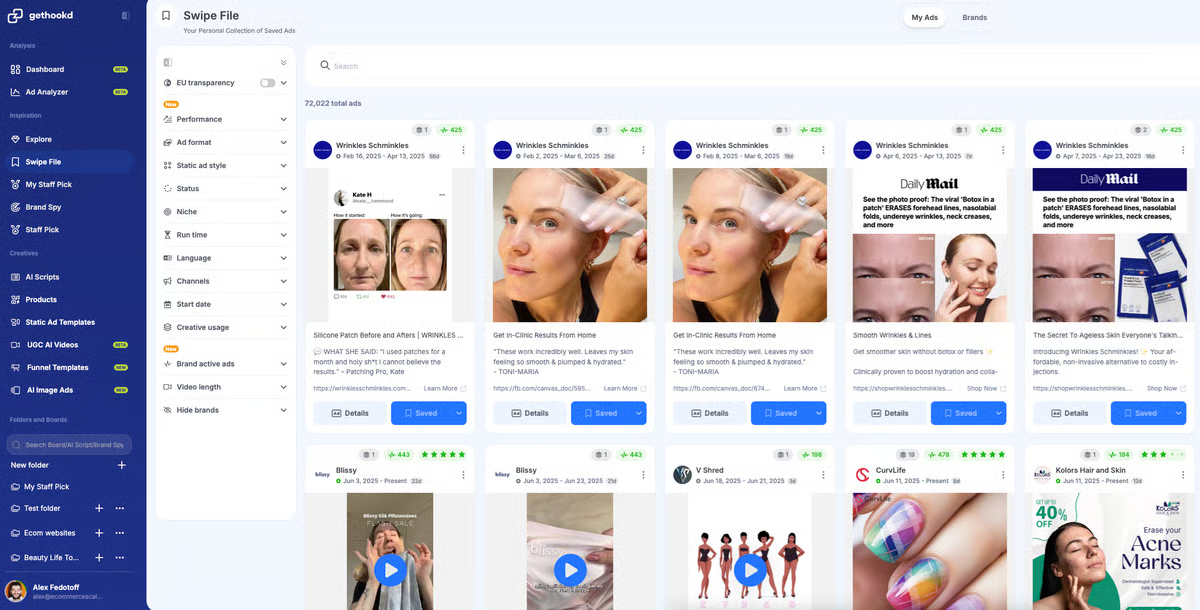
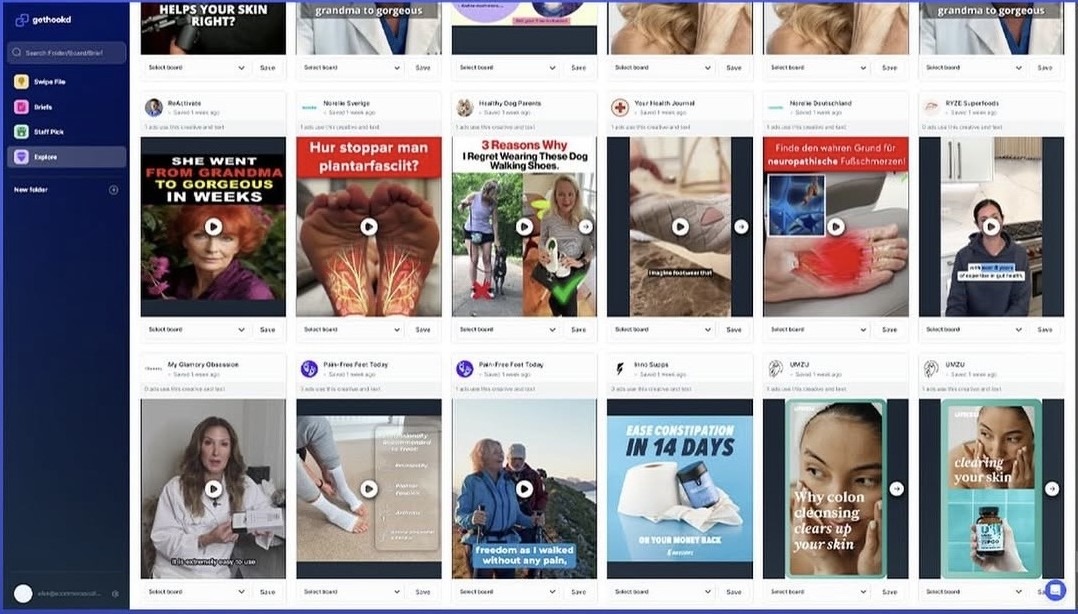
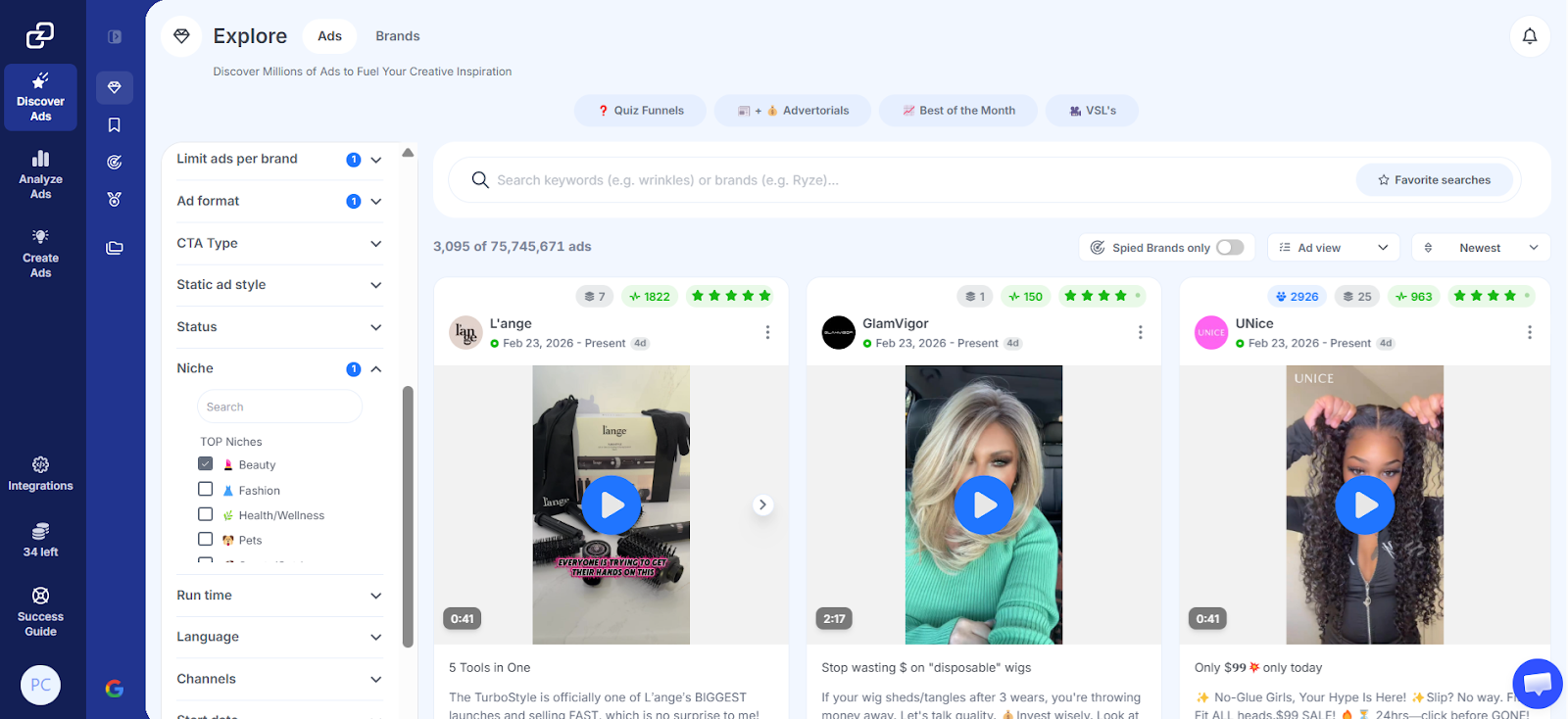
GetHookd's Explore feature lets you browse millions of ads across Facebook and Google. Filter by niche, format, or performance to find winning creatives in seconds.

GetHookd combines Meta Ad Library scraping with AI-powered ad creation in a single platform. With a library of over 65 million ads across Facebook, Instagram, and other networks, you can research competitors, save winning creatives, and generate new ads from the same dashboard.

Unlike traditional scraper tools that stop at data collection, we bridge the gap between competitive research and campaign execution. Our Brand Spy feature lets you track any competitor’s ad account and view their complete creative library, including which ads they’re actively scaling, their top-performing hooks, and the landing pages driving traffic.

Once you find an ad worth replicating, you can transcribe the video to extract hooks and CTAs, then use AI Script Generation to create new angles tailored to your product in minutes. Saved ads stay in your library permanently, even after campaigns stop running on Meta. 

User Reviews: GetHookd has earned high ratings on G2 and Trustpilot, with users frequently praising the platform’s ease of use and the time it saves on creative production. Many customers highlight how our Brand Spy feature has replaced hours of manual competitor research, while our AI tools significantly reduce the time it takes to turn insights into testable ad campaigns.

Key Features:

  • Ad Library Access: Browse 65+ million ads filtered by niche, format, and performance.
  • Brand Spy: Track competitor ad accounts to see their complete creative library, top ads, hooks, and landing page traffic.
  • AI Script Generation: Upload a winning ad and generate hooks, angles, and complete scripts tailored to your product.
  • AI Image Ads: Clone competitor creatives or your own top performers. New colors, avatars, formats, and styles generated in seconds.
  • Creative Analyzer: Break down ad creatives to see what's working across formats, styles, and messaging.
  • Permanent Saves: Ads you save stay accessible forever, even after they're removed from Meta's Ad Library.
  • 100+ Templates: Ready-to-use static ad and funnel templates designed for quick launches.

Pricing: Starts at $19/month. Each plan includes monthly credits for Brand Spy, Transcriptions, AI Scripts, AI Image Ads, and Creative Analyzer. 7-day free trial available.

2. AdSpy

AdSpy's granular filtering system lets you search by engagement metrics, demographic targeting, and affiliate networks.

AdSpy offers a large database of Facebook and Instagram ads. The platform includes landing page snapshots, so you can study competitor funnels even after an ad stops running. 

The filtering system lets you search by keywords, engagement metrics, and demographic targeting. However, the platform focuses more on library size than on keeping ads up to date. Its library skews toward older ads rather than what's currently scaling.

User Reviews: AdSpy users appreciate the platform’s extensive database and advanced filtering options, which make it easier to search through ads. At the same time, some reviewers mention that the interface can feel outdated. Since AdSpy does not include AI-powered creative tools, research must be combined with other platforms to execute campaigns.

Key Features:

  • Advanced Search: Search keywords across ad text, comments, vendor names, and landing page URLs to find relevant ads fast.
  • Engagement Filtering: Sort and filter ads by likes, shares, comments, and other engagement metrics to surface top performers.
  • Demographic Targeting: Narrow results by age, gender, and geographic location to see how competitors target specific audiences.

Pricing: $149/month for unlimited access to Facebook and Instagram ads. No free trial is available, so it's a significant commitment before you can test the platform.

3. Foreplay

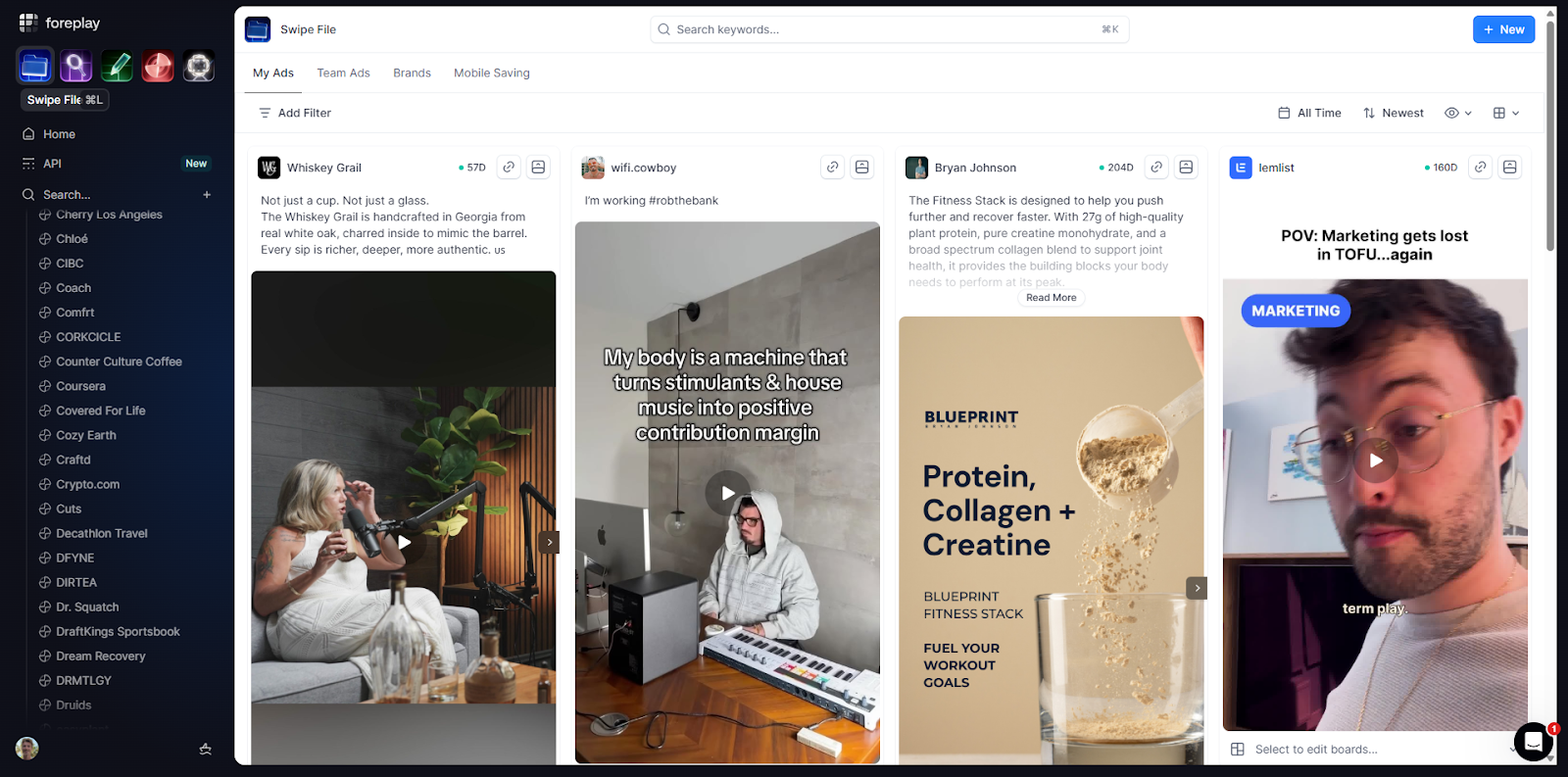
Foreplay's Swipe File organizes saved ads by brand, making it easy to track competitor creative strategies over time.

Foreplay is a popular Meta Ad Library scraping solution, particularly for marketers focused on competitor tracking and creative research. Its Spyder tool automates monitoring competitor ads, saving every ad they launch along with enriched metadata.

Foreplay offers solid automation features, but its interface can feel overwhelming for teams seeking a streamlined workflow. Some users also report slow load times and occasional bugs that interrupt their process. 

User Reviews: Foreplay users often highlight the platform’s automation and swipe-file organization, which make it easier to track competitor creatives over time. However, users note that the experience feels a bit limited, and it's not the cheapest tool. Some also mention occasional bugs that interrupt the workflow.

Key Features:

  • Automated Scraping: Captures every ad your competitors launch, complete with metadata and landing page screenshots.
  • Automatic Hook Extraction: Transcribes and analyzes the first few seconds of video ads so you can quickly browse winning hooks.
  • Landing Page Archiving: Saves mobile and desktop versions of competitor landing pages for full-funnel analysis.

Pricing: Starts at $49/month. The Full Workflow plan at $99/month adds AI briefs and scripts, which are significantly more expensive than those offered by platforms like GetHookd, which provide better functionality at a fraction of the cost.

Best Meta Ad Library Scraper Tools: Summary Table

Feature GetHookd AdSpy Foreplay
Overview Combines Meta Ad Library scraping with AI-powered ad creation in a single platform Advanced search and filtering for Facebook and Instagram ads Automated competitor tracking and swipe file organization
Competitor Tracking Brand Spy tracks ad accounts, surfaces top performers, and shows scaling activity Search competitor ads via filters and keywords Spyder tool captures new ads with metadata
AI Script Generation Built-in AI generates hooks, angles, and full scripts from any saved ad Not available Available on Full Workflow plan
Performance Scoring / Insights Shows which ads competitors are actively scaling Limited; focuses on engagement metrics Focuses on capturing and organizing ads
Ad Saves Permanent saves with full metadata, accessible after ads stop running Permanent saves with landing page snapshots Permanent saves with tagging and board organization
Pricing (starting at) $19/month $149/month $49/month

Why GetHookd is the Best Meta Ad Library Scraper Tool

Most ad scraping tools stop at collection. They help you save ads, browse libraries, and build swipe files, but leave you guessing which creatives are actually worth replicating. At GetHookd, our platform is built for ecommerce brands, dropshippers, and performance marketers who need to make decisions, not just gather inspiration.

The Brand Spy feature shows you which ads competitors are actively scaling, not just running. Combined with landing page insights that reveal where traffic is being driven, you get a complete picture of what's working and why. This is competitive intelligence that actually informs your next test, rather than a folder of screenshots you'll forget about.

Where we pull ahead is the workflow from research to execution. Once you find a winning ad, you can transcribe the video to extract hooks and CTAs, generate new scripts with AI, or clone the creative with fresh visuals in under a minute. Fewer tools, faster launches, and less wasted ad spend on concepts that were never validated in the first place.

GetHookd gives you access to 65+ million ads across Facebook and other social networks, plus AI-powered creation tools that most competitors charge significantly more for. For solopreneurs, small teams, and agencies looking to scale creative output, the value is hard to beat.

Try GetHookd Now →

Frequently Asked Questions (FAQs)

How do Meta Ad Library scraper tools work?

Meta Ad Library scraper tools automatically collect publicly available ads from Facebook and Instagram. They organize these ads into searchable databases, allowing marketers to study competitors’ creatives, copy, and landing pages. Tools like GetHookd also offer filters, performance scoring, and AI features to make research actionable.

How does GetHookd help with Meta Ad research?

GetHookd turns competitor research into ready-to-test creatives. After finding a winning ad, you can transcribe the script instantly, generate new hooks and angles with AI Script Generation, and create visual variations using Clone Ads. The Creative Analyzer also breaks down what's working across formats and styles, so you're not guessing what to replicate. Users go from spotting a top performer to having new creatives ready in minutes.

What is AdSpy used for?

AdSpy is a competitive research tool that lets marketers search Facebook and Instagram ads using keywords, filters, and engagement metrics. It helps uncover competitors' ad strategies, copy, and creatives. Plans start at $149/month for unlimited access to its Facebook and Instagram ad database.

Why is GetHookd the best choice for Meta ad research?

GetHookd combines ad library research with AI-powered creation tools at one of the lowest entry prices in the market ($19/month). Unlike tools focused solely on scraping or analytics, GetHookd users can spy on competitors, transcribe winning ads, generate AI scripts, and clone ad creatives in a single workflow. For performance marketers who need to move from insight to execution fast, it eliminates the gap between research and production.

*Note: Pricing and/or product availability mentioned in this post are subject to change. Please check our website for current pricing and stock information before making a purchase.
GetHookd Ads Library vs Facebook Ads Library
Gethookd vs Meta Ads Library
-
January 22, 2026

Foreplay vs Atria vs MagicBrief vs GetHookd

Key Takeaways

  • GetHookd's AI-powered platform delivers 3X faster ad creation, powered by proven templates and competitor insights to maximize your ROAS.
  • Atria and Foreplay offer ad libraries and workflow features, but come with higher price points, steeper learning curves, and platform limitations.
  • MagicBrief focuses on team collaboration and briefing. It requires a 3-month commitment and pricing scales with ad spend.
  • Choosing the right marketing tool can increase your ROAS by streamlining creative workflows and providing data-driven insights.
  • The right AI ad tool depends on your team size, workflow needs, and budget, with GetHookd offering the best all-around solution for marketing teams.

Why AI Ad Tools Matter for Performance Marketers

The fastest way to create high-converting ads is to study what's already working and replicate it. AI ad tools automate this process by scraping competitor ads, identifying winning patterns, and helping you generate new creatives based on proven concepts. 

The result is less guesswork, faster creative production, and more ad spend going toward ideas that actually convert. In this article, we’ll break down the key differences between Foreplay, Atria, MagicBrief, and GetHookd to help you choose the right tool for your team.

GetHookd: Turn Competitor Intelligence Into Your Next Winning Ad

65M+ Ads Analyzed | 4.8★ G2 Rating | 4.4★ Trustpilot Rating

Stop Guessing. Start Scaling:

GetHookd reveals which ads your competitors are actively scaling—not just running. Spy on their best-performing creatives, landing pages, and traffic strategies, then turn proven concepts into testable campaigns in seconds with AI-powered script generation and creative cloning.

What You Get:
  • ✓ Brand Spy to decode competitor ad strategies in real-time
  • ✓ AI script generation and ad cloning for instant variations
  • ✓ Performance scoring based on actual ad behavior, not vanity metrics
  • ✓ Creative Analyzer to identify and scale your top performers
Replace guesswork with intelligence. Build profitable ads that actually convert.

GetHookd

GetHookd lets you filter saved ads by winning status, format, and niche so you only see creatives worth replicating.

GetHookd is an all-in-one AI creative platform built for performance marketers, eCommerce operators, and agencies who need to move from research to execution fast. 

Unlike platforms focused purely on inspiration or analytics, our platform combines a 65 million+ ad library with AI-powered creation tools that let you generate scripts, clone winning ads, and produce creative variations without leaving the platform. The goal is to eliminate creative guesswork and reduce wasted ad spend by showing you what's already working, then helping you replicate it.

The Brand Spy feature reveals competitors' top-performing ads, landing pages, and traffic sources. From there, you can transcribe winning video ads, generate AI scripts based on proven hooks, or use Clone Ads to create image variations with different avatars, colors, and formats. 

Our platform includes ready-to-use static ad and conversion funnel templates. For lean teams managing significant ad spend, GetHookd replaces the patchwork of spreadsheets, swipe files, and disconnected tools with a single workflow.

Key Features

  • Explore Ads: Browse 65 million+ high-performing ads across Facebook and Google. Filter by niche, format, and performance signals to find what's working.
  • Save Ads: Save ads permanently (even after they go offline) and organize by niche, format, or performance. Chrome extension available for saving directly from ad libraries.
  • Brand Spy: Deep competitor intelligence showing top ads, landing pages, and traffic sources. Uses credits per brand analyzed.
  • Video Scripts: AI script generator trained on 8-figure direct response ads. Upload a winning ad, add your product info, and generate hooks, angles, and scripts.
  • Clone Ads: AI-powered image generation that creates ad variations from existing creatives. Change colors, avatars, formats, and styles.
  • Ads Transcription: Automatically transcribe video ads to extract copy, hooks, and CTAs.
  • Creative Analyzer: Analyze creatives to understand what works across formats, styles, and messaging. Available on Grow (1 account) and Scale (5 accounts) plans.
  • Static Ad Templates: Library of ready-to-use Canva templates proven to convert.
  • Funnel Templates: Access landing page and checkout flow templates from 7–8 figure brands.

Pricing

We offer three tiers with a 7-day free trial:

  • The Launch plan costs $19/month ($14.25/month annually) and includes 1 seat, 40 credits/month, and access to all core features.
  • The Grow plan costs $59/month ($44.25/month annually) and includes 3 seats, 200 credits/month, Creative Analyzer (1 account), and standard support.
  • The Scale plan costs $149/month ($111.75/month annually) and includes 10 seats, 800 credits/month, Creative Analyzer (5 accounts), premium 24/7 support, and Slack access to the team.
  • Enterprise plans are available with custom limits, tailored features, and dedicated support.

Best For

GetHookd is built for ecommerce brands and dropshippers who need to find winning ads fast and scale what works. Our AI tools let you transcribe competitor ads, generate new scripts and hooks, and clone winning creatives in minutes. Unlike platforms that focus on organizing research or aligning teams, GetHookd is designed to get you from insight to testable ads as quickly as possible.

Want to see how the Brand Spy feature works for your niche? Start a 7-day free trial and spy on your first competitor in minutes.

Foreplay

Foreplay's Swipe File lets you save and organize ads from competitors.

Launched as a simple swipe file tool, Foreplay has evolved into a system for saving, organizing, and acting on ad inspiration. It also allows competitor ad tracking, creative analytics, and AI-powered brief creation. 

The interface prioritizes organization over speed, which can slow down teams focused on rapid creative iteration. Users also report occasional bugs and slow load times when working with larger swipe files.

Key Features

  • Swipe File: Save unlimited ads and organize with boards, folders, custom tags, and ratings.
  • Discovery: Search millions of ads using AI-powered filters. Sort by longest-running ads, emotional analysis, persona targeting, and more.
  • Spyder: Track competitor ad activity in real time. Access up to 3 years of ad history, landing page insights, and media mix analysis.
  • Lens: Creative analytics dashboard that scores ad performance, identifies top-performing hooks, and supports white-label reporting.
  • Briefs: AI script generator, storyboard builder, and modular brief creation. Share briefs publicly with branded pages.

Pricing

Foreplay offers three pricing tiers with a 7-day free trial:

  • The Basic plan costs $59/month ($49/month annually) and includes 1 user with access to Swipe File, Discovery, and Briefs.
  • The Workflow plan costs $175/month ($149/month annually) and includes up to 5 users, Spyder competitor tracking (15 brands), and Lens analytics (1 ad account).
  • The Agency plan costs $459/month ($389/month annually) and includes up to 10 users with expanded Spyder (50 brands) and Lens (10 ad accounts).
  • Enterprise pricing is available for teams needing unlimited users and priority support.

Limitations

Foreplay focuses on research and organization but lacks creative cloning tools. It is less suited for marketers who need AI ad generation or landing page creation tools.

Atria

Atria's Radar grades your creatives on ROAS, hook strength, and retention, then tells you which ads to iterate on next.

Atria positions itself as an AI-powered creative intelligence platform that combines ad inspiration, competitor research, analytics, and content generation in one environment. The platform generates ad concepts, scripts, hooks, and image ads trained on performance data.

Atria also lets you follow up to 200 competitor brands (depending on plan) with AI-tagged insights on their top hooks, personas, and creative themes. However, it does not provide ad intelligence coverage for Google Ads or YouTube. 

Key Features

  • Radar: AI strategist that surfaces top performers, identifies iteration opportunities, and provides actionable recommendations.
  • Ad Library: Access to an ad library with AI-powered search, filters by theme/format/industry, and ad sorting.
  • Competitor Tracking: Follow 50–200 brands (by plan) with AI-tagged insights on hooks, ad angles, personas, USPs, and creative themes.
  • AI Creation Tools: Generate ad concepts, scripts, ad copy, and image ads. Clone existing ads using AI.
  • Analytics Dashboard: Customizable reports, comparison reports, custom attribution windows, and AI creative tagging.

Pricing

Atria offers three main tiers plus Enterprise, with a 7-day free trial:

  • The Core plan costs $159/month ($129/month annually) and includes 5 seats, 4,000 AI credits, 50 brand follows (no AI insights), and 5 ad accounts.
  • The Plus plan costs $329/month ($269/month annually) and includes 8 seats, 10,000 AI credits, 100 brand follows with AI insights, and 10 ad accounts.
  • The Business plan includes custom pricing, 15 seats, 25,000 AI credits, 200 brand follows with AI insights, and 25 ad accounts.
  • Enterprise pricing is available for teams needing custom limits, end-to-end creative delivery, and dedicated support.

Limitations

Atria leaves gaps for teams running Google or YouTube campaigns. The learning curve is steeper than that of simpler swipe file tools, and the entry price ($129–159/month) may be high for solo operators or teams that only need basic inspiration.

MagicBrief

MagicBrief's creative analytics syncs with your ad accounts to surface top performers by spend, ROAS, and engagement scores.

MagicBrief is a creative analytics and research platform that combines an ad library with performance reporting, competitor tracking, and collaborative briefing tools.

The platform generates automated summaries of performance and competitor activity, helping teams make faster decisions without wading through spreadsheets. However, its strength lies more in reporting and team alignment than in helping users quickly create new ads from competitor research.

Key Features

  • Creative Analytics: Build visual reports comparing formats, creators, angles, and more. 
  • Ad Library: Search 12M+ ads and filter by themes, hooks, and copy.
  • Competitor Tracking: Follow any brand running ads. See which themes, hooks, and copy are working. Get summaries of competitor activity to stay ahead.
  • Briefing System: Modular brief builder with storyboarding, asset uploads, and script generation informed by performance data. Public share links for client collaboration.
  • Collaboration: Real-time editing, timeline commenting, custom tags, and Slack integration.

Pricing

MagicBrief uses ad spend-based pricing with custom quotes:

  • Pro starts at $249/month, with custom tracking for brands, seats, and ad account connections.
  • Creative Intelligence is custom-priced for larger teams and includes unlimited tracked brands, unlimited seats, and unlimited ad account connections.
  • All plans include a 7-day free trial (creative intelligence features are limited during trial). 

Limitations

MagicBrief's $249/month minimum and ad spend-based pricing make it one of the more expensive options in this category. The platform lacks AI ad generation and creative cloning tools that help marketers move quickly from research to testable creatives.

Foreplay vs Atria vs MagicBrief vs GetHookd: Comparison Table

Feature GetHookd Foreplay Atria MagicBrief
Starting Price $19/month $59/month $159/month $249/month
Free Trial 7 days 7 days 7 days 7 days (limited)
Primary use case Competitive intelligence and execution Creative inspiration Data-driven creative strategy Curated inspiration and briefs
Competitor Tracking Brand Spy (credit-based, unlimited brands) Spyder (15–50 brands by plan) Follow 50–200 brands by plan Custom tracked brands
AI Creative Generation Yes (scripts, images, variations) Limited Yes Limited
Templates Static ad & funnel templates (plug-and-play) Creative brief template Canva templates for various ads Modular creative brief builder
Chrome Extension Yes Yes Yes Yes

Why GetHookd Stands Out as the Best AI Ad Engine

For performance marketers drowning in disconnected tools, GetHookd offers something the competition doesn't: a direct path from research to execution. 

You're not just browsing ads for ideas. Instead, you're extracting what works, generating scripts, cloning winning creatives, and launching campaigns in the same session. That closed loop between insight and action is what separates us from tools designed primarily for research or reporting.

At $19/month, our entry plan costs less than a single month of any competitor's cheapest tier. But low cost doesn't mean limited capability. Our Launch tier includes access to 65+ million ads, Brand Spy competitor intelligence, AI-generated scripts, ad transcription, and Clone Ads image generation. 

Where GetHookd truly differentiates is in AI-powered creative production. The Clone Ads feature lets you take any winning static and generate dozens of variations with different avatars, colors, formats, and styles in seconds. Pair that with video scripts trained on 8-figure direct response campaigns and ready-to-use templates, and you have a system that multiplies creative output in minutes. 

For teams running high-volume creative, this is the difference between scaling profitably and spending on ads that don’t convert.


Try GetHookd Now →

Frequently Asked Questions (FAQs)

How much does GetHookd AI cost? 

GetHookd offers three pricing tiers. The Launch plan costs $19/month and includes 1 seat, 40 credits/month, and access to all core features, including the 65M+ ad library, Brand Spy, AI script generation, and Clone Ads. The Grow plan costs $59/month and adds 3 seats, 200 credits, and Creative Analyzer. The Scale plan costs $149/month with 10 seats, 800 credits, and premium support. All plans include a 7-day free trial.

How much does Foreplay AI cost? 

Foreplay's pricing starts at $59/month for the Basic plan, which includes 1 user with access to Swipe File, Discovery, and Briefs. The Workflow plan costs $175/month and adds up to 5 users, Spyder competitor tracking for 15 brands, and Lens analytics. The Agency plan costs $459/month with up to 10 users and expanded tracking limits. A 7-day free trial is available.

What is Atria AI used for? 

Atria AI is a creative intelligence platform that combines ad research, competitor tracking, analytics, and AI-powered ad generation. Its Radar feature acts as an AI creative strategist, scoring your ads on metrics like ROAS, hook strength, and retention, then recommending which creatives to iterate on.

How does MagicBrief work?

MagicBrief is an AI-powered creative workflow platform that lets teams save, organize, and analyze ads from major social platforms. It uses data-driven insights to help plan, optimize, and scale high-performing campaigns.

Is GetHookd AI legit? 

Yes, GetHookd is a legitimate ad intelligence platform with verified user reviews. It holds 4.8 and 4.4 stars on G2 and Trustpilot, respectively. The platform is used by e-commerce brands, dropshippers, and performance marketing agencies for competitor research and AI-powered ad creation. Users consistently highlight the speed at which the platform moves from research to testable creatives as its main advantage.

*Note: Pricing and/or product availability mentioned in this post are subject to change. Please check our website for current pricing and stock information before making a purchase.

Ad Strategy
Ad Strategy
-
July 29, 2025

4 Best AI Ad Video Generators in 2026: Features and Pricing Compared

Key Takeaways

  • The best AI video ad generator depends on your biggest gap: scripting what to say, producing the footage, or creating a talking-head presenter without hiring talent.
  • Most AI video generators start from a blank canvas, but without knowing what's already converting in your market, you're guessing at scripts, hooks, and angles.
  • AI avatar tools like Synthesia and HeyGen eliminate the need for on-camera talent, but they don't tell you what messaging or creative direction will actually perform.
  • Text-to-video platforms like InVideo AI make production fast and accessible, but the output is only as strong as the brief you feed it.
  • GetHookd lets you research winning video ads across 65M+ Meta ads, extract proven hooks and scripts with AI, and build the strategic foundation you need to produce ads that convert.

What Makes the Best AI Video Ad Generator?

The best AI video ad generator depends on which part of the production process slows you down the most. For some teams, it's knowing what to say; for others, it's the production itself.

Tools like Video AI turn text prompts into complete video ads. Synthesia and HeyGen let you create talking-head videos using AI avatars. But production speed only matters if you're building the right ad. GetHookd solves the problem that comes before rendering: figuring out what your video ad should actually say and why. 

By researching which video ads are already scaling in your niche and extracting the hooks, scripts, and copy behind them, you're building every video on a foundation of proven performance.

GetHookd: Turn Competitor Intelligence Into Your Next Winning Ad

65M+ Ads Analyzed | 4.8★ G2 Rating | 4.5★ Trustpilot Rating

Stop Guessing. Start Scaling:

GetHookd reveals which ads your competitors are actively scaling—not just running. Spy on their best-performing creatives, landing pages, and traffic strategies, then turn proven concepts into testable campaigns in seconds with AI-powered script generation and creative cloning.

What You Get:
  • ✓ Brand Spy to decode competitor ad strategies in real-time
  • ✓ AI script generation and ad cloning for instant variations
  • ✓ Performance scoring based on actual ad behavior, not vanity metrics
  • ✓ Creative Analyzer to identify and scale your top performers
Replace guesswork with intelligence. Build profitable ads that actually convert.

4 Best AI Ad Video Generators in 2026

1. GetHookd

Browse video ads across niches with engagement metrics, run times, and landing page details.

GetHookd provides the research and scripting layer that should come before you open any video generator. Our platform helps performance marketers, ecommerce brands, and agencies answer the question every video ad starts with: what should this ad actually say?

With access to over 65 million high-performing ads across Meta, GetHookd lets you see which video ads competitors are actively putting budget behind. You can filter by niche, format, and engagement signals to pinpoint the creatives worth studying. 

From there, our AI tools extract the specific elements that make those ads work and help you build your own versions. Instead of starting a video script from scratch, you're starting with data: real hooks that stopped the scroll, CTAs that drove clicks, and copy frameworks that converted.

Key Features of GetHookd

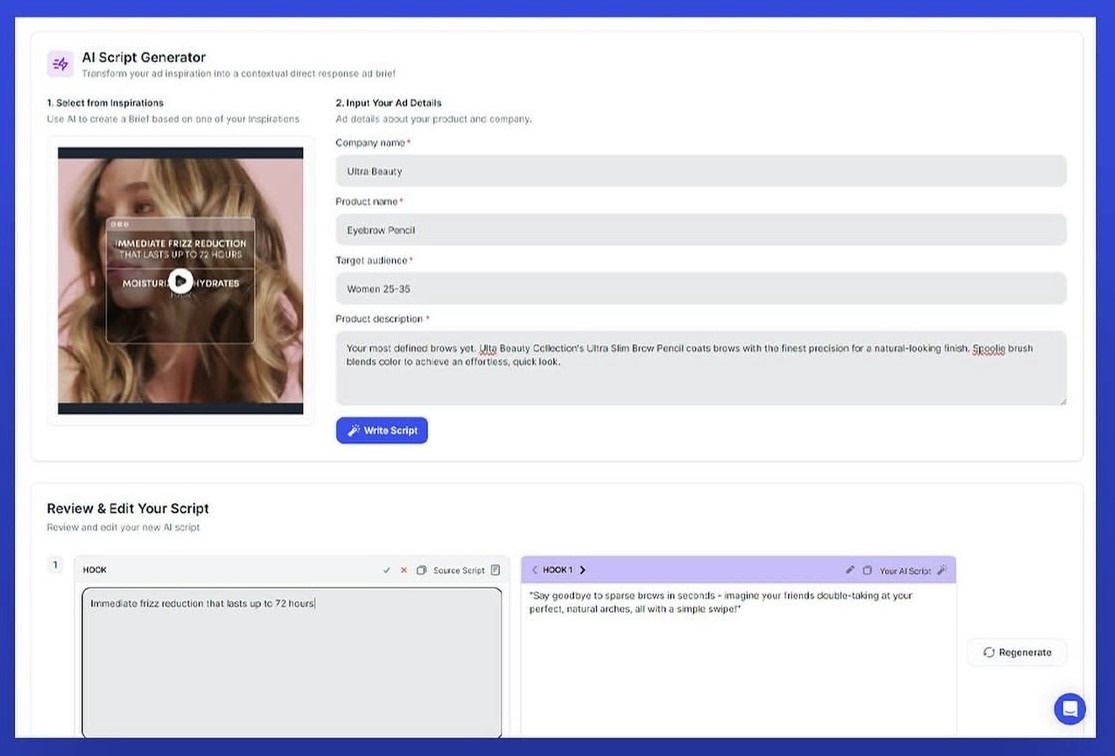
Generate AI video scripts by selecting an inspiration ad and inputting your product details.
  • Explore Ads: Browse 65M+ Meta ads filtered by niche, format, engagement, country, and demographics to find video ad concepts that are actively performing.

  • Brand Spy: Monitor competitor ad accounts to see which video creatives they're scaling, how long they've been running, and where they're sending traffic.

  • Ads Transcription: Convert any winning video ad into text. Pull out the exact hooks and copy so you can study the framework behind what's converting.

  • Video Scripts: Feed in a winning video ad concept, and your product details, and our AI generates fresh hooks, angles, and complete scripts proven to convert in your niche.

  • Save Ads: Build a permanent video ad swipe file organized by brand, niche, or campaign type. Every ad you save stays accessible even after it stops running elsewhere.

  • Clone Ads: Generate AI-powered visual variations of any high-performing static creative with new colors, avatars, formats, and styles.

  • Creative Analyzer: Link your Meta ad account to track which of your own video ads are delivering results and which need to be replaced.

GetHookd Pricing

GetHookd plans start at $19/month with a 7-day free trial and full feature access. Annual billing saves you 25%.

2. InVideo AI

InVideo AI generates complete videos from text prompts. (Image source: InVideo)

InVideo AI is a text-to-video platform that turns prompts into complete videos. You describe what you want, and the AI assembles a draft you can refine through text-based editing commands.

InVideo pulls from millions of stock assets, generates scripts from your prompts, and offers AI voiceover in multiple languages. That said, InVideo AI's output depends entirely on the quality of your input. 

If your prompt is vague or your creative direction isn't grounded in what's working in your market, the result will look polished but may not perform. Pairing it with a research tool that tells you what hooks and angles are converting before you generate a single frame is where the real advantage lies.

Key Features of InVideo AI

  • Text-to-Video Generation: Describe your idea in a text prompt, and InVideo AI produces a complete video.

  • Magic Box Editing: Make changes to your generated video using simple text commands.

  • AI Twins: Create a digital avatar clone from a 30-second video clip for scaled, personalized video production across multiple languages.

  • Stock Media Library: Access royalty-free images, videos, and music tracks that the AI selects automatically, or you can search and replace manually.

InVideo AI Pricing

InVideo AI offers a free plan with limited generation and watermarked exports. Paid plans start at $28/month, and annual billing saves up to 20%.

3. Synthesia

Synthesia turns text scripts into AI avatar videos. (Image source: Synthesia)

Synthesia is an AI avatar platform that turns text scripts into presenter-style videos. You write or paste a script, choose from hundreds of avatars, and the platform generates a video where the avatar delivers your message with lip-synced speech and natural gestures.

The platform's strength is in multilingual, scalable content. For ad-specific use cases, it works best when you need a talking-head format, such as product explainers or testimonial-style ads. However, the avatars can sometimes feel artificial, which may not suit every audience or ad placement. 

Like most video generators, Synthesia doesn't help you determine what your script should say. It simply delivers whatever you write.

Key Features of Synthesia

  • AI Avatars: Choose from stock avatars or create a custom digital twin. Avatars can be customized with different clothing colors and environments.

  • Multilingual Video: Support for multiple languages with one-click translation, AI dubbing, and voice cloning.

  • Text-to-Video Engine: Convert scripts, documents, or website URLs into editable video drafts.

  • Templates & Customization: Access pre-designed video templates, add branded elements, upload custom fonts, and build branded video pages.

Synthesia Pricing

Synthesia offers a free Basic plan with 3 minutes of video per month. Paid plans start at $29/month.

4. HeyGen

HeyGen's Video Agent lets you create avatar-based videos from text prompts. (Image source: HeyGen)

HeyGen is an AI video platform focused on avatar-based video creation for marketing and ecommerce use cases. Like Synthesia, it lets you generate talking-head videos from text scripts.

The platform offers avatars with natural motion and gesture control, and the ability to create a custom avatar from a short video clip. Its video translation feature supports multiple languages and includes lip-synced dubbing.

That said, HeyGen handles video production once you have a script, but it doesn't offer any tools for researching what's working in your market or generating ad scripts grounded in performance data.

Key Features of HeyGen

  • AI Avatars & Motion Control: Choose AI avatars with customizable gestures or create a personal avatar clone from a short video clip.

  • Video Translation: Translate videos into multiple languages with lip-synced dubbing.

  • AI Video Generator: Generate complete video ads from text prompts with avatar selection, voiceover, and scene composition.

HeyGen Pricing

HeyGen offers a free plan with up to 3 videos per month, while the creator plan starts at $29/month.

Best AI Ad Video Generators in 2026 Compared

Feature GetHookd InVideo AI Synthesia HeyGen
Best For Video ad research, scripting, and creative strategy Text-to-video ad production from prompts AI avatar presenter videos and multilingual content Avatar-based ad creation and personalized video outreach
Paid Plans $19/month $28/month $29/month $29/month
Ad Research Yes No No No
Video Ad Transcription Extracts hooks, CTAs, and copy structure from high-performing videos Not available Not available Not available
AI Features Video Scripts, Clone Ads, Brand Spy, Creative Analyzer, and Explore Ads Text-to-video, Magic Box editing, AI Twins, AI voiceover AI avatars, one-click translation, AI dubbing, voice cloning AI avatars, motion control, lip-synced dubbing, video translation
Best Use Case Research-first creative workflow (connect competitor insights to AI script generation) Produce video ads from text prompts Scalable talking-head content Ad-focused avatar videos

GetHookd: The Research-to-Script Platform for Video Ads

InVideo AI, Synthesia, and HeyGen each solve a real production problem by turning scripts into rendered videos. But they all share the same starting point: a blank script editor that you must fill in. GetHookd is built for what comes before that moment. The best video campaigns begin with competitive intelligence, not scripting.

Our platform connects you to high-performing ads across Meta so you can see which video ads are actively scaling in your industry. When you find a winning ad, our Ads Transcription tool breaks those winners down into their hooks, CTAs, and copy structures. You can also use Video Scripts to generate fresh angles and complete scripts matched to your product.

The result is that every video you produce, regardless of which tool renders it, starts with a creative direction backed by market data rather than intuition. For ecommerce brands, agencies, and media buyers who want to create video ads that convert, GetHookd is where the workflow begins.

Try GetHookd Now →

Frequently Asked Questions (FAQs)

Do I need editing skills to use AI video generators?

No, you don’t. Most AI video tools like InVideo AI are built for non-technical users. You can edit through simple text commands and generate videos directly from scripts. GetHookd's research and AI scripting tools need no design or production skills.

Which is the best AI video generator currently?

The best AI Ad video generator depends on what you need. For text-to-video production, InVideo AI is one of the accessible options. For AI avatar-based videos, Synthesia and HeyGen are available platforms. 

But if your goal is producing video ads that actually convert, the best results come from pairing a research-to-script tool like GetHookd with a rendering platform, so your creative direction is grounded in what's proven to convert.

How long does it take an AI tool to generate a finished ad video?

Most AI video generators can produce a finished draft in minutes, depending on the video length, complexity, and the platform's processing speed. 

Short-form ad videos under 60 seconds are typically the fastest to generate. The longer time investment is usually in deciding what your video should say.

How does GetHookd help with video ad scripts?

GetHookd offers two independent tools for video ad scripting. Ads Transcription extracts the hooks, CTAs, and copy structure from any video ad in our 65M+ Meta ad database, so you can study exactly what's working. 

Video Scripts lets you input your product details and generate fresh hooks, angles, and complete scripts using AI trained on high-converting direct-response frameworks. You can use either tool on its own or both as part of your creative process.

*Note: Pricing and/or product availability mentioned in this post are subject to change. Please check our website for current pricing and stock information before making a purchase.

Ad Strategy
Ad Strategy
-
July 27, 2025

AI Generated Content Regulations: How to Ensure Compliance in UGC

Key Takeaways

  • AI-generated UGC is now subject to FTC enforcement and disclosure timing is the most common compliance gap brands overlook. Place the label before the consumer engages, not buried after the "see more" cutoff.
  • The FTC's disclosure trigger is how content functions in front of an audience, not how much human editing follows generation.
  • Purely AI-generated content has no copyright protection in the United States and can be freely copied or redistributed by anyone.
  • If your content reaches EU audiences, comply with the EU AI Act standard across all markets rather than managing separate protocols by jurisdiction.
  • Before you build anything, study what's already running. GetHookd gives you access to 65M+ Meta ads through Explore Ads and Brand Spy, so you can see exactly how brands in your niche are structuring and disclosing AI-assisted creatives. 

What Counts as AI-Generated UGC

Ensuring compliance with AI-generated UGC regulations comes down to three obligations: disclose AI involvement clearly and early, document the human creative decisions in your process, and keep pace with FTC and platform policy updates as they evolve. The distinction that matters legally is not whether AI was involved at all, but how much human creative decision-making shaped the final output.

Staying compliant comes down to three things: disclose AI involvement clearly and early, document your process, and keep up with FTC and platform updates. The sections below break each one down. A video script in which a human used AI as a drafting tool and then rewrote 70% of it is in a very different legal position than a five-star review generated entirely from a prompt and published under a fictional customer name. Understanding where your content falls on that spectrum is the starting point.

GetHookd: Turn Competitor Intelligence Into Your Next Winning Ad

65M+ Ads Analyzed | 4.8★ G2 Rating | 4.5★ Trustpilot Rating

Stop Guessing. Start Scaling:

GetHookd reveals which ads your competitors are actively scaling—not just running. Spy on their best-performing creatives, landing pages, and traffic strategies, then turn proven concepts into testable campaigns in seconds with AI-powered script generation and creative cloning.

What You Get:
  • ✓ Brand Spy to decode competitor ad strategies in real-time
  • ✓ AI script generation and ad cloning for instant variations
  • ✓ Performance scoring based on actual ad behavior, not vanity metrics
  • ✓ Creative Analyzer to identify and scale your top performers
Replace guesswork with intelligence. Build profitable ads that actually convert.

What Does the FTC Actually Require for AI-Generated Content?

The Federal Trade Commission has been the most active U.S. regulatory body on AI content standards. Its focus is on transparency and consumer protection, specifically preventing audiences from being misled about the nature of the content they are consuming.

The FTC's position builds on its endorsement and testimonial guidelines, which have been updated to explicitly address AI-generated content. The core principle is simple: 

  • If content could mislead a consumer, it requires disclosure. AI-generated reviews, testimonials, and sponsored posts fall into this category.
  • AI-generated testimonials must be clearly identified as artificial rather than real customer experiences. 
  • Endorsements produced or amplified by AI must disclose that AI was involved. 

Disclosures must be clear and conspicuous, meaning buried text, small-print labels, or end-of-caption placements do not meet the standard. 

The FTC has explicitly called out fake reviews generated by AI as a deceptive practice subject to enforcement action.

The practical trigger for disclosure is audience perception. Ask whether a reasonable consumer would believe this content reflects a genuine human experience or opinion. If yes, disclosure is required regardless of how much human editing was applied after generation.

Facebook displays a "Made with AI" label directly on posts containing AI-generated content. (Source: Facebook)

On placement: the FTC requires disclosure to appear before the consumer engages with the content. 

  • On a social post, that means the first line, not after the "see more" cutoff. 
  • On a video, it means an on-screen label in the opening seconds, not the description box. This single adjustment closes the most common FTC compliance gap brands don't know they have.

The FTC finalized its rule targeting fake reviews, including AI-generated testimonials, in August 2024, with the rule taking effect in October 2024. It applies to both brands and the agencies creating content on their behalf.

Copyright Rules for AI-Generated Content

AI-generated content with no human authorship has no copyright protection, leaving it open to free use by anyone.

The U.S. Copyright Office has been explicit: AI alone cannot hold copyright. Content generated entirely by AI with no human creative input has no copyright protection, meaning anyone can legally copy, repurpose, or redistribute it freely. Content where a human made meaningful creative selections, edits, or arrangements may qualify for protection, but only for those human-authored elements.

This was established through the Zarya of the Dawn case, where copyright was granted only to the human-written text of an AI-assisted comic, not to the AI-generated images. The Copyright Office has since reinforced that prompts alone do not constitute sufficient human authorship, regardless of how detailed or iterative the prompting process was.

Document every step of your process: save your original prompts, keep version histories showing your edits, and note which elements were AI-generated versus human-written. That paper trail is the evidence you would need if your content is ever copied or disputed.

Does Your Content Reach EU Audiences? Here's What That Means for Compliance

If your content reaches audiences outside the United States, you are operating under multiple regulatory frameworks at once.

The EU AI Act entered into force on August 1, 2024, with phased enforcement obligations beginning in February 2025. It is the most comprehensive AI regulation currently in force, classifying AI systems by risk level and imposing strict transparency obligations on applications that influence consumer behavior. Content creators targeting EU audiences must disclose when content is AI-generated, particularly in advertising contexts.

The UK applies existing consumer protection and advertising standards frameworks rather than AI-specific legislation. However, the Advertising Standards Authority has made clear that misleading AI-generated ads are treated the same as any other deceptive advertising. 

The most practical approach for brands operating internationally is to comply with the strictest applicable standard and apply it uniformly. When your content meets the highest bar, it meets most bars by default.

How to Build a Simple AI UGC Compliance Process

Building a compliance process means documenting what went into every piece of AI-generated content.

1. Conduct an AI Usage Audit

Start by mapping every point in your content workflow where AI tools are currently being used, including text generation, image creation, voiceover synthesis, and video editing. 

List the specific platforms and note what type of content each produces. This gives you a clear picture of your actual compliance exposure, which is almost always different from what teams assume.

2. Set Up a Documentation System

Once you know where AI is being used, capture human creative involvement at each stage. A shared folder structure with naming conventions that include dates, version numbers, and a brief note on what was AI-generated versus human-edited is enough to establish a defensible record. 

For teams producing at scale, a simple logging template covering the tool used, the original prompt, the edits made, and the final published version creates an audit trail that supports both copyright and FTC compliance requirements.

3. Train Your Team

Train your team on why the rules exist. A short session covering FTC disclosure requirements, copyright basics, and your documentation system is enough to align a team.

Refresh this training every six months. Regulations have moved quickly enough that guidance from a year ago may no longer hold.

4. Set a Quarterly Review Schedule

Set a quarterly reminder to review FTC guideline updates, platform policy changes on the channels where you publish most, and any new legislation in jurisdictions where your audience is concentrated. This takes roughly an hour per quarter and prevents policy drift from turning into violations you didn't see coming.

Create Smarter AI-Generated Content With GetHookd

You now have the framework: disclose early, document everything, and review quarterly. The harder part is knowing what compliant AI content actually looks like in your category before you produce it. That's where GetHookd's Explore Ads feature gives you a direct advantage: 65M+ Meta ads searchable by niche, format, and performance signal, so you can study how brands in your market are structuring and disclosing AI-assisted creatives before you build your own. 

Brand Spy shows you which ads competitors are actively scaling and which landing pages they drive to, giving you real market context that informs both your creative direction and your understanding of the disclosure standards in your category.

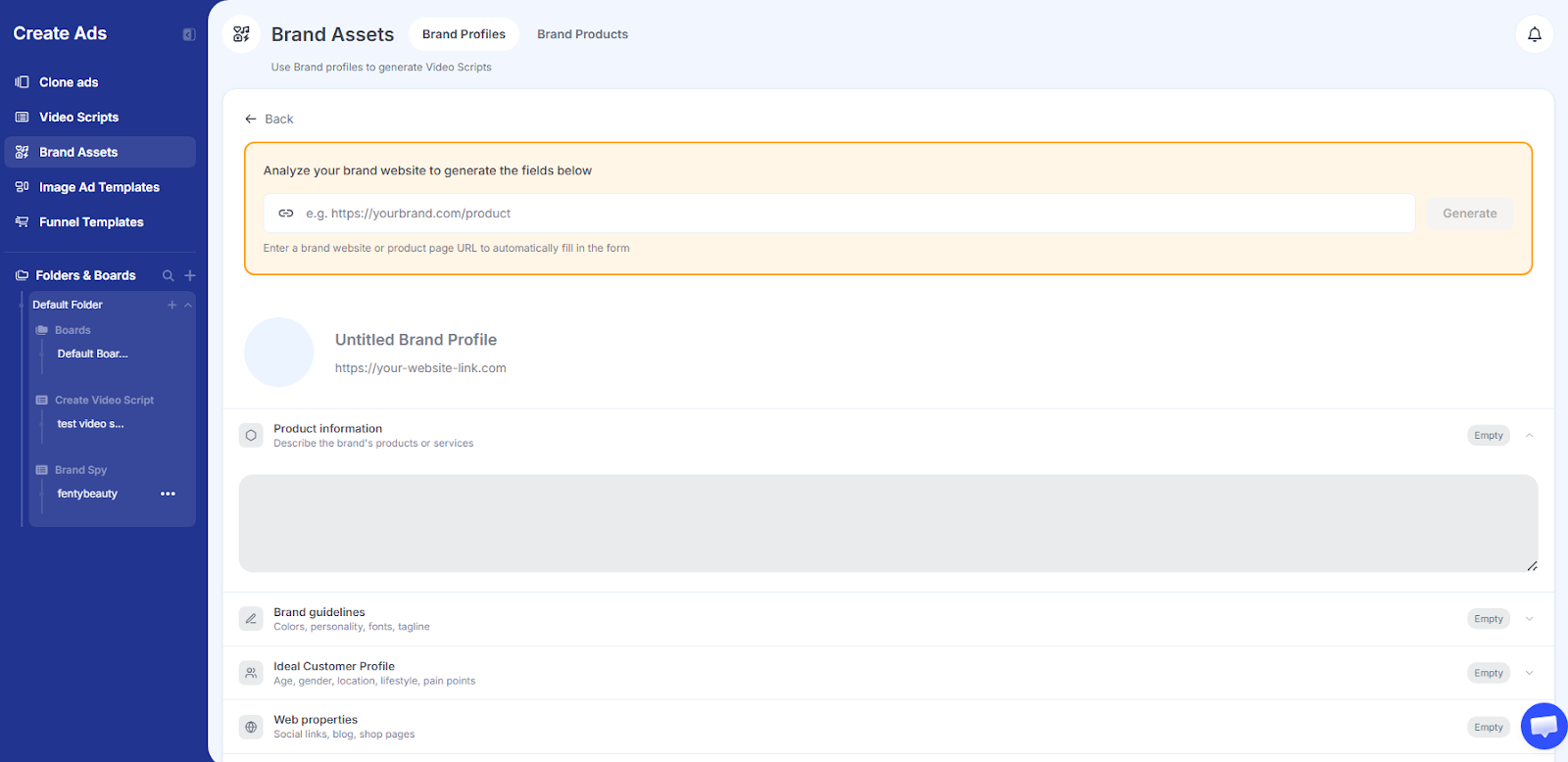
When you move into production, our Video Script Generator starts from your documented brand profile and audience parameters rather than an open-ended prompt, making your human review step faster and your output easier to account for.

Start your GetHookd free trial today.

Frequently Asked Questions (FAQs)

What counts as AI-generated UGC for compliance purposes?

Any content where an AI system played a significant role in creating the final output, including text, images, video, and audio, counts. The compliance threshold is not binary. The closer the content sits to being fully AI-generated, particularly when it functions as a review or testimonial, the more clearly disclosure and documentation requirements apply.

Does the FTC require disclosure for all AI-generated content?

No. FTC disclosure requirements are triggered specifically by content that functions as an endorsement, testimonial, or review, or content that could mislead consumers about its origin. General informational content produced with AI assistance does not automatically require disclosure, but if AI-generated content promotes a product or simulates a customer experience, disclosure is required regardless of how much human editing follows.

Can AI-generated content be copyrighted in the United States?

Purely AI-generated content with no human creative authorship cannot be copyrighted. Content that involves substantial human creative input alongside AI tools may qualify for protection, but only for the human-authored elements. If you publish fully AI-generated content without meaningful human involvement, anyone can copy or redistribute it freely.

Where should AI disclosure labels be placed to meet platform requirements?

The FTC standard applies regardless of platform: clear and conspicuous, before the consumer engages with the content. On social posts, disclosure belongs in the first line. On video, it belongs as an on-screen label in the opening seconds. 

Can I use GetHookd to research what disclosed AI-generated ad content looks like?

Yes. GetHookd’s Explore Ads feature gives you access to 65M+ Meta ads searchable by niche, format, and performance signals. You can use it to study how brands in your category are structuring their ad content, including how they are handling disclosures on AI-assisted or synthetic creatives. 

*Note: Pricing and/or product availability mentioned in this post are subject to change. Please check our website for current pricing and stock information before making a purchase.
Ad Strategy
Ad Strategy
-
July 25, 2025

UGC Automation: Tips, Best Practices & Tools

Key Takeaways

  • UGC automation significantly reduces per-unit production costs, allowing teams to test more creative variations without expanding budgets or headcount.
  • AI tools compress the traditional UGC pipeline from weeks to minutes, but volume without direction produces content that does not convert.
  • Strong brand guidelines are the foundation of effective UGC automation; vague inputs produce generic outputs, and generic content does not perform in a competitive feed.
  • GetHookd gives performance marketers a single platform to go from competitor research to publish-ready creatives.

What UGC Automation Actually Is

UGC automation is the use of AI and software to create, collect, organize, and publish user-generated content at scale, without manually coordinating every piece from scratch. 

The goal is to remove the production bottlenecks that slow down and make UGC ads expensive to maintain.

The old workflow required finding creators, negotiating briefs, waiting on deliverables, and managing revisions. AI UGC automation compresses that entire process into minutes. 

You define your tone and product details, and the platform generates video or written content that mirrors the authentic, conversational style audiences respond to.

GetHookd: Turn Competitor Intelligence Into Your Next Winning Ad

65M+ Ads Analyzed | 4.8★ G2 Rating | 4.5★ Trustpilot Rating

Stop Guessing. Start Scaling:

GetHookd reveals which ads your competitors are actively scaling—not just running. Spy on their best-performing creatives, landing pages, and traffic strategies, then turn proven concepts into testable campaigns in seconds with AI-powered script generation and creative cloning.

What You Get:
  • ✓ Brand Spy to decode competitor ad strategies in real-time
  • ✓ AI script generation and ad cloning for instant variations
  • ✓ Performance scoring based on actual ad behavior, not vanity metrics
  • ✓ Creative Analyzer to identify and scale your top performers
Replace guesswork with intelligence. Build profitable ads that actually convert.

The Real Benefits of Automating UGC

Production Costs Come Down Significantly

Hiring UGC creators through platforms or agencies carries real costs. Factor in creator fees, revision rounds, usage rights, and production time, and a single piece of quality UGC content can run into hundreds of dollars. 

AI UGC tools reduce that per-unit cost substantially, allowing teams to generate dozens of creative variations at a fraction of the price. Your testing budget stretches further, and winning ads get found faster.

Speed: From Weeks to Minutes

The traditional UGC pipeline, from outreach and briefing through filming, editing, and delivery, easily runs two to four weeks per batch. AI UGC tools compress that cycle entirely. You can go from a product brief to a publish-ready video ad in under an hour, which matters when you are responding to a trend or replacing a fatigued creative before it affects your ROAS.

Speed also changes how you test. Rather than committing to three or four creatives per month, you can run 20 or 30 variations across different hooks, angles, and CTAs and let performance data decide what converts.

Scaling Output Without Scaling Headcount

One of the most practical advantages of UGC automation is that creative output can grow without adding team members. A two-person marketing team can operate with the output of a full creative studio, producing and distributing content across multiple campaigns simultaneously. 

For lean eCommerce brands and agencies managing multiple clients, that kind of advantage changes what is achievable with a given budget.

Top UGC Automation Tools by Use Case

Content Discovery & AI Video Generation

For brands focused on generating UGC-style video ads at scale, the tools in this category handle everything from script generation to publish-ready creative output.

GetHookd's Explore Ads gives you instant access to millions of active UGC ads filterable by niche, format, and performance.

GetHookd is built specifically for performance marketers running ads on Meta. With 65M+ ads analyzed, our platform connects competitive research directly to creative production, so every piece of content is informed by what is already working in your market rather than a blank brief.

Key features relevant to UGC automation include:

  • AI Video Scripts: Input your product details, and GetHookd's AI generates hooks, angles, and full scripts modeled after top-performing ad formats, ready to hand to a creator or record directly.
  • Ads Transcription: Upload any competitor UGC video ad and extract the exact hook structure, copy flow, and CTA so you can adapt proven formats for your own product without starting from scratch.
  • Clone Ads: Take a winning static creative and generate multiple visual variations in seconds, new colors, formats, and styles.
  • Static Ad & Funnel Templates: Access hundreds of proven templates covering ad creatives and full landing page flows, so your UGC sits within a tested end-to-end campaign structure rather than driving traffic to an unproven page.
GetHookd's Video Script Generator turns an ad inspiration and your product details into a ready-to-record UGC script in minutes.

Other tools in this category, including MagicUGC, Creatify, and Arcads, focus primarily on AI video generation from a product brief. They cover the production side of the workflow but do not connect to competitive research or performance analysis.

Creator & Campaign Management

Once you are producing UGC at scale, keeping track of every asset, brief, and approval becomes its own challenge. GetHookd's Save Ads feature gives you a built-in creative library. Save your favourite ads permanently, even after they go offline, and organize them by niche, format, or performance so your team always has a clear reference point when briefing new content.

For broader workflow management, tools like ClickUp and Airtable can handle the operational side: assigning tasks, managing review stages, and moving content through approval pipelines. They are not built specifically for UGC, but work well as a backbone for teams coordinating across multiple campaigns or clients.

Performance Tracking & Analytics

Knowing which UGC creatives are driving results is what closes the loop on the entire automation workflow. Tools like Triple Whale give you attribution data at the creative level. They track metrics like hook rate, hold rate, and cost per acquisition per individual asset across campaigns.

For teams running Meta campaigns, GetHookd's Creative Analyzer connects to your Meta ad account and gives you a clear read on creative performance across your campaigns, so you know exactly where to double down and where to pull spend.

Once your Meta Business Manager is connected, GetHookd pulls your campaign data so every creative decision is backed by performance numbers.

Best Practices for Managing Automated UGC

A few clear practices applied consistently will keep your automated UGC performing well and protect your brand from the most common pitfalls.

Set Clear Brand Guidelines Before You Automate Anything

Before generating any AI UGC, document your tone of voice, visual style, messaging priorities, prohibited language, and platform-specific requirements. The more specific your inputs, the more on-brand your outputs. Vague guidelines produce generic content, and generic content does not convert.

Specific, well-documented guidelines also reduce moderation time significantly. When your team has a clear reference point, content either meets the standard or it does not. Approval becomes faster because the criteria are objective rather than subjective.

Keep a Human in the Loop

AI tools are good at producing volume and maintaining structural consistency, but they miss cultural nuances, emerging sensitivities, and subtle tone issues that a person catches immediately. 

Build a final human review step into your workflow before any automated UGC goes live. That one checkpoint prevents the kind of brand missteps that take far longer to recover from than the time saved by skipping it.

Audit Content Regularly for Accuracy & Tone

Product details change, pricing shifts, and cultural context evolve. Without routine checks, you risk running ads with outdated claims or content that no longer accurately reflects your brand.

A simple audit cadence keeps things clean:

Audit Area What to Check Frequency
Tone & Voice Does content match brand personality? Every batch
Factual Accuracy Are product claims and pricing current? Weekly
Compliance Is AI usage disclosed where required? Every publish cycle
Performance Relevance Is underperforming content being retired? Bi-weekly
Cultural Sensitivity Does the content conflict with current events? Ongoing

Set a recurring reminder to review active content at least bi-weekly, retire pieces that are underperforming, and flag anything that needs updating. Think of it as content maintenance rather than quality control.

The Biggest UGC Automation Mistakes to Avoid

The most damaging mistake is treating automation like a vending machine. A weak creative brief produces weak content at scale. The quality of your inputs determines the quality of your outputs every single time.

A second common mistake is ignoring AI disclosure requirements. As AI-generated content becomes more prevalent, platforms and regulators increasingly require transparency about when content is AI-produced. Non-compliance is a compliance risk that can get ads pulled or accounts flagged. Build disclosure into your standard publishing checklist so it never gets missed.

The last trap worth calling out is treating automation as a passive process once it is running. AI tools do not get better on their own. 

Without regular creative direction, automated content drifts toward the generic, and generic content does not perform in a crowded feed. The brands producing results with UGC automation are actively steering the system, not merely watching it run.

GetHookd: Where UGC Automation Meets Creative Intelligence

Automating UGC production solves a volume problem. But volume without direction produces a lot of content that does not convert. GetHookd connects both sides of that equation. Our Brand Spy feature surfaces what competitors are actively running on Meta, including the hooks, formats, and landing pages behind their campaigns, so your creative briefs are informed by real market data rather than assumptions. 

Ads Transcription extracts the exact copy structure and hook angles from any video UGC ad, giving your team proven frameworks to build from rather than starting from scratch every production cycle. Once you know what to produce, our AI tools handle the execution. Video Scripts generate hooks, angles, and full ad scripts from your product details in minutes. Clone Ads turns a single winning creative into multiple ready-to-test variations without a design tool.

For eCommerce brands, media buyers, and agencies running Meta campaigns, that kind of visibility at every stage is what makes UGC automation a genuine growth system rather than a content treadmill.

Start your GetHookd free trial today!

Frequently Asked Questions (FAQs)

What is UGC automation, and how does it work?

UGC automation uses AI tools and software to create, manage, and distribute user-generated style content at scale without manually producing every piece from scratch. You feed the platform your brand inputs, including product details, tone guidelines, and campaign goals, and it generates video or written content that mirrors the conversational style audiences trust. The output is designed to feel authentic while being produced at a fraction of the time and cost of traditional UGC workflows.

How to create UGC using AI? 

Start with a clear product brief including your tone, hook angle, and target audience. Feed those inputs into an AI UGC tool and generate multiple video or static ad variations from a single prompt. From there, run a human review pass, publish your strongest variations, and use performance data to inform the next production cycle.

What is the best AI tool for UGC? 

The right tool depends on what stage of the workflow you need help with. For teams running Meta campaigns who want competitive research, AI script generation, and creative production in one place, GetHookd covers the full cycle from understanding what is working in your market to producing and testing content without switching platforms.

Do I need technical skills to use GetHookd?

No. GetHookd is built for marketers, not designers or developers. Our platform guides you from competitive research through to creative production without requiring any design software, coding knowledge, or technical setup. If you can fill in a product brief, you can produce publish-ready ad creatives.


*Note: Pricing and/or product availability mentioned in this post are subject to change. Please check our website for current pricing and stock information before making a purchase.
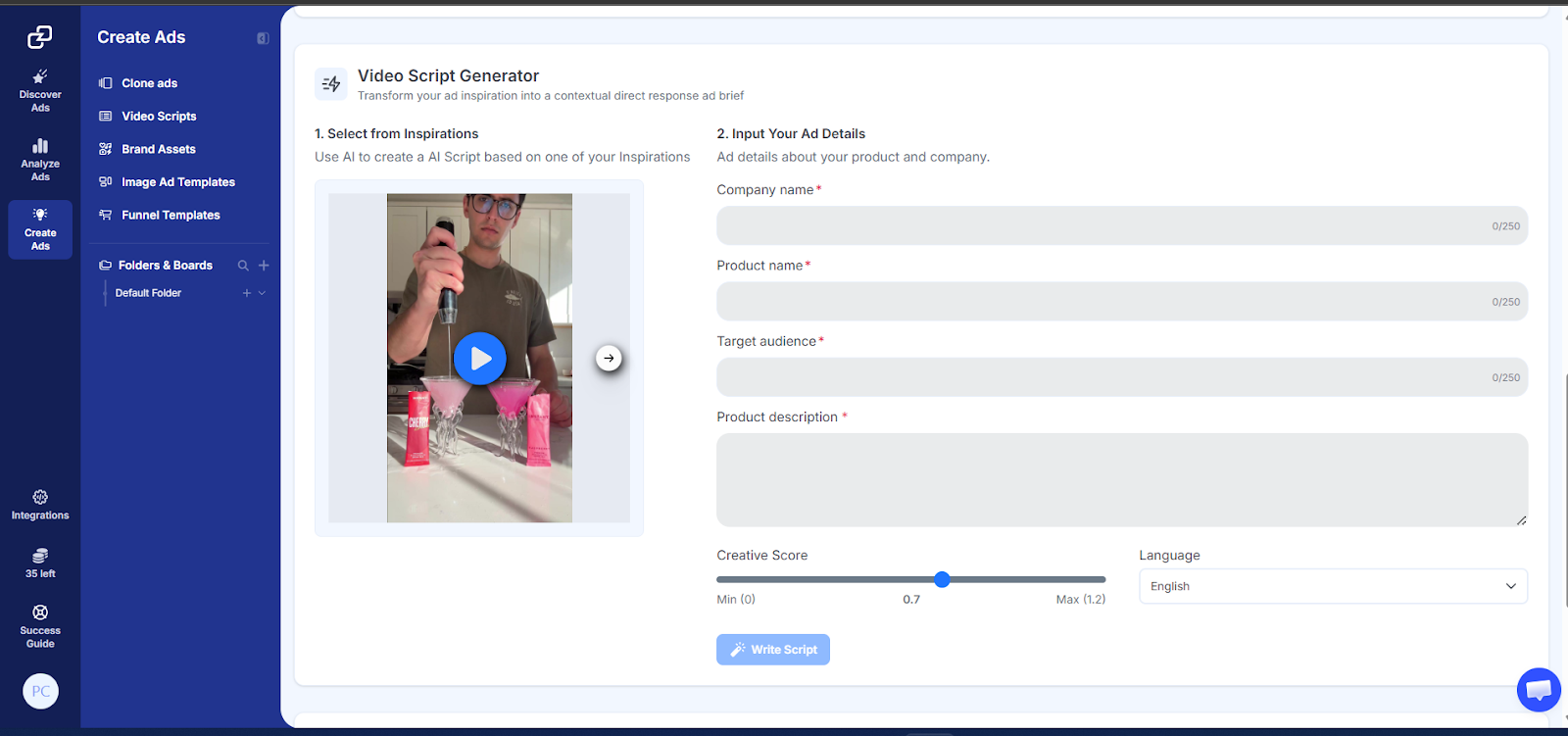
Ad Strategy
Ad Strategy
-
July 23, 2025

6 Common Problems with AI Generated Content and How to Fix Them

Key Takeaways

  • Most AI content problems come from the same two sources: prompts that lack context and output that ships without human review. Fix those two things first.
  • Run a manual read after every AI draft for unnatural keyword repetition, passive constructions, and filler phrases, then replace them with specific data points and original observations.
  • Fact-check every AI-generated claim against a primary source before publishing. Hallucinated statistics and fabricated citations are common and hard to spot without deliberate verification.
  • A documented brand voice guide and a standardized prompt template are the two fastest fixes for inconsistent tone across AI-generated content.
  • GetHookd's Brand Assets and Video Script Generator give AI the brand context, audience details, and product information it needs to produce conversion-focused output.

Better Prompts & Human Oversight Are the Real Fix for AI Content Problems

AI-generated content has become a core part of how performance marketers and creative teams produce ads, scripts, and campaign copy at scale. With that volume comes a predictable set of problems, most of which go unnoticed until they start affecting results.

The underlying cause is almost always the same. Weak prompts going in and no human review coming out. Tighten those two things, and AI becomes a reliable production tool rather than a source of errors you have to clean up after every batch.

Below are the six most common AI content problems and the exact fix for each.

GetHookd: Turn Competitor Intelligence Into Your Next Winning Ad

65M+ Ads Analyzed | 4.8★ G2 Rating | 4.5★ Trustpilot Rating

Stop Guessing. Start Scaling:

GetHookd reveals which ads your competitors are actively scaling—not just running. Spy on their best-performing creatives, landing pages, and traffic strategies, then turn proven concepts into testable campaigns in seconds with AI-powered script generation and creative cloning.

What You Get:
  • ✓ Brand Spy to decode competitor ad strategies in real-time
  • ✓ AI script generation and ad cloning for instant variations
  • ✓ Performance scoring based on actual ad behavior, not vanity metrics
  • ✓ Creative Analyzer to identify and scale your top performers
Replace guesswork with intelligence. Build profitable ads that actually convert.

1. Over-Optimized Content That Reads Like a Keyword List

AI writing tools are trained to optimize. Feed them a target keyword, and they will work it into every other sentence without any sense of how that reads to a human. 

The result is content that technically checks SEO boxes but feels mechanical, with phrases repeated unnaturally and headings that exist solely as keyword containers.

How to Fix It: Balance Keywords With Natural Language

Rather than instructing the AI to write about a keyword, give it context about who the reader is, what problem they are trying to solve, and what tone to use. This shifts the output from keyword-focused to reader-focused. 

After generation, do a manual read specifically looking for unnatural repetition and replace those instances with synonyms, related phrases, or restructured sentences.

2. Prioritizing Top-of-Funnel Content Over Content That Converts

AI gravitates toward informational content. Ask it to write a blog post, and it will produce something educational and useful for awareness-stage readers, but it will not move anyone closer to a purchase. 

Conversion-focused content requires understanding buyer psychology and the specific friction points that stop someone from taking action. These are context-specific judgments that do not emerge from a standard AI prompt.

How to Fix It: Build a Balanced Content Funnel

Map your content against the three stages of the buyer journey and identify where the gaps are. If your AI output is heavily weighted toward awareness-stage content, that is a strategy issue, not a tool problem. 

Deliberately prompt AI to create consideration and decision-stage content, such as comparison articles, objection-handling FAQs, and benefit-driven landing page copy. 

Give the AI the context it needs to write persuasively by including your unique value proposition, the top objections your audience raises, and the primary action you want the reader to take.

GetHookd's Video Script Generator takes your product details, target audience, and a winning ad as inspiration to generate conversion-focused scripts from the start.

Tools like GetHookd's Video Scripts feature generate hooks, angles, and complete scripts from your product details using direct-response frameworks. This ensures the output is built around conversion from the start rather than defaulting to generic informational content.

3. Lack of Originality

AI models are trained on massive datasets of existing content, which makes them very good at producing content that feels polished on the surface but says nothing new.

Beyond clichés, AI pulls patterns from what already exists online. It cannot generate new perspectives, draw from personal experience, or offer a take that has not already been expressed somewhere in its training data.

How to Fix It: Add Unique Angles, Data, & Human Perspective

Use AI as a first draft engine rather than a finished product. After generation, add what AI cannot: proprietary data, client case studies, personal experience, or a take that pushes back on conventional thinking.

Why Does AI-Generated Content Get Facts Wrong?

AI language models do not know facts. They predict text based on patterns and, when they lack reliable data, generate information that sounds credible rather than acknowledging uncertainty. 

Publishing hallucinated content can seriously damage brand credibility. A fake statistic in a high-traffic article can spread across the web before anyone catches it, and in industries like healthcare, finance, or law, the consequences extend well beyond reputational damage.

How to Fix It: Fact-Check Every Claim Before Publishing

Every statistic, citation, and named source in AI-generated content must be manually verified before publication. That means cross-referencing claims against primary sources, not just other web articles that may have repeated the same hallucinated figure. Build fact-checking into your content workflow as a fixed, required step.

4. Inconsistent Tone & Brand Voice

Ask an AI to write ten pieces without detailed instructions, and you will get ten different brand voices. The problem compounds when multiple team members use AI tools independently, each with their own prompting style, resulting in a fragmented content library. 

Readers notice this even if they cannot articulate why, and an inconsistent tone signals unreliability to readers, even when they cannot name exactly why.

How to Fix It: Use Style Prompts & Brand Voice Guidelines

Create a documented brand voice guide and include key excerpts directly in every AI prompt you use. Specify tone descriptors, reading level, sentence length preferences, and words or phrases to avoid. For teams using AI at scale, create a standardized prompt template that everyone uses as a starting point.  

GetHookd lets you store your brand and product details, so every video script and AI image generation is on-brand.

GetHookd's Brand Assets feature allows you to establish both brand profiles and brand products. Brand profiles store your guidelines, ideal customer profile, and product information to generate on-brand video scripts. Brand products store your product details for use in AI image generation, so every creative output uses your brand context.

5. Contextual Errors & Misunderstood Audience Needs

AI does not know your target audience. Without explicit context in the prompt, it defaults to writing for a generic, middle-of-the-road reader, which means content that is too basic for experts, too vague for decision-makers, and too broad to drive action.

How to Fix It: Write Smarter Prompts With Audience Context

Every prompt should answer three questions before asking the AI to write anything: who is this for, what do they already know, and what do they need to do after reading this. Include a one-sentence audience description and relevant context about where it sits in the buyer journey. 

GetHookd's Video Script Generator prompts you to define your target audience and product details before generating a script.

GetHookd's Video Script Generator includes a dedicated target audience field alongside your product details and company name, so audience context is part of the generation process by default, not an afterthought.

What Are the Most Common AI Content Problems and How Do You Fix Them?

Problem How to fix
Over-optimized content that reads like a keyword list Give AI context about the reader and their problem, rather than just a target keyword
Prioritizing top-of-funnel content over content that converts Deliberately prompt for consideration and decision-stage content with your value proposition and top objections included
Lack of originality Use AI for the first draft only and layer in proprietary data, case studies, and original perspective after generation
Factual errors and AI hallucinations Cross-reference every statistic, citation, and named source against a primary source
Inconsistent tone and brand voice Build a standardized prompt template with your tone descriptors and make it the starting point for every team member
Contextual errors and misunderstood audience needs Answer who the content is for, what they already know, and what they need to do next before every prompt

Create Smarter AI Ad Content With GetHookd

Every problem covered in this article comes back to the same root cause: AI gets bad inputs and ships without review. Fix the inputs, build in the review, and the output changes.

GetHookd is built for exactly that workflow. Brand Assets stores your brand profile and product details centrally so every script starts from your actual context. The Video Script Generator prompts you for target audience and product details before generating — so audience context is built in, not bolted on. And Explore Ads and Brand Spy show you what is already converting in your niche before you write a single word, so your AI content starts from intelligence instead of guesswork.

Start your GetHookd free trial today.

Frequently Asked Questions (FAQs)

Does AI-generated content hurt SEO rankings?

AI-generated content is not penalized as long as it is helpful, accurate, and written for humans. The problem is that most AI output published without editing fails that standard through thin content, keyword stuffing, and factual inaccuracies, all of which are known negative ranking signals.

How do I make AI-generated content sound more human?

After generating a draft, replace vague generalizations with specific data points, swap passive constructions for active ones, vary sentence length deliberately, and inject at least one original observation per major section. Human writing is full of concrete details, real examples, and personal perspectives that AI naturally glosses over. 

What is AI hallucination in content writing?

AI hallucination occurs when a language model generates information that appears factually correct but is entirely fabricated, including fake statistics, nonexistent studies, and false attributions. The model predicts what a plausible answer looks like based on patterns in its training data, with no built-in mechanism to verify truth. Every specific claim in an AI draft needs to be manually verified against a primary source before publishing.

How often should I fact-check AI-generated content?

Every single time without exception. Hallucinations are most dangerous precisely because they look credible, so fact-checking should be a hard rule in your workflow rather than an optional quality check. Pay particular attention to statistics, percentages, dates, named individuals, and any claim that includes a specific number or attribution.

Can AI tools maintain a consistent brand voice across multiple pieces of content?

Yes, but only with deliberate, structured prompting. A standardized prompt template that includes your brand voice descriptors, tone guidelines, and examples of existing content ensures output starts from the same baseline regardless of who on your team is doing the prompting. GetHookd's Brand Assets lets you store your brand profile centrally, so every piece of content generated through the platform pulls from the same brand context automatically.

*Note: Pricing and/or product availability mentioned in this post are subject to change. Please check our website for current pricing and stock information before making a purchase.
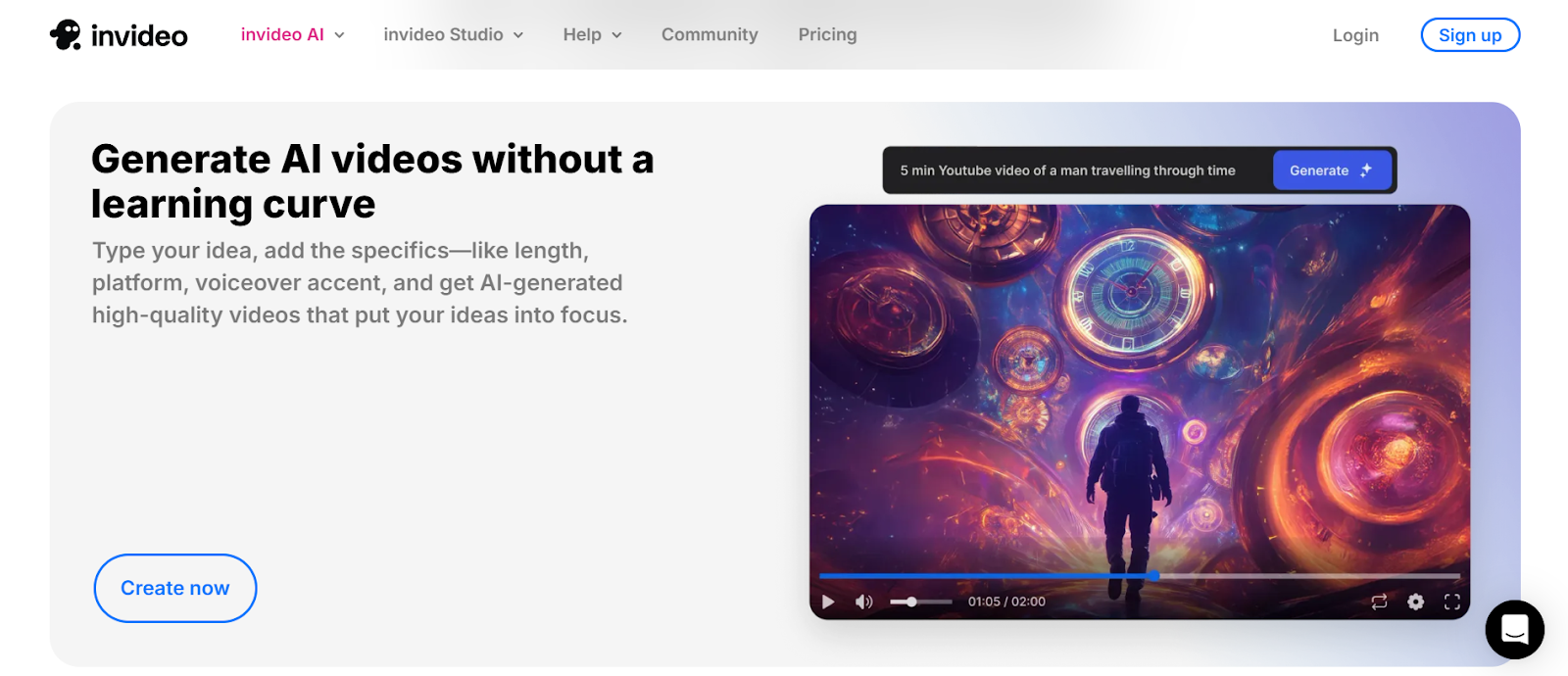
Ad Strategy
Ad Strategy
-
July 21, 2025

7 Best UGC Video Ads: Examples to Try in 2026

Key Takeaways

  • UGC video ads outperform polished creative because they feel native to the feed, and the moment the content looks produced, it gets treated as an ad.
  • Some of the best UGC video ads include unboxing reactions, testimonials, and before-and-after transformations, each built around a different mechanism for earning trust before asking for the sale.
  • The first two to three seconds determine whether the rest of the video gets watched: hook structure matters more than production value.
  • The best UGC video ads follow a simple structure: a relatable hook, an honest demonstration, and a CTA that sounds like a recommendation rather than a pitch.
  • GetHookd's Explore Ads and Brand Spy show which UGC formats competitors are actively scaling on Meta, so every brief is grounded in real performance data rather than guesswork.

Why UGC Video Ads Work in 2026

UGC video ads work because they do not look like ads. Filmed on phones, set in real environments, and delivered in a conversational tone, they blend into the feed rather than interrupt it.

The best-performing formats include unboxing reactions, before-and-after transformations, product demos in real-life settings, talking head testimonials, day-in-the-life videos, and tutorial-style content.

The brands getting the most from UGC are doing more than producing content. They are studying which formats, hooks, and styles are already performing in their niche. Below are the best UGC video ads, each with a breakdown of what makes it effective and how to apply it.

GetHookd: Turn Competitor Intelligence Into Your Next Winning Ad

65M+ Ads Analyzed | 4.8★ G2 Rating | 4.5★ Trustpilot Rating

Stop Guessing. Start Scaling:

GetHookd reveals which ads your competitors are actively scaling—not just running. Spy on their best-performing creatives, landing pages, and traffic strategies, then turn proven concepts into testable campaigns in seconds with AI-powered script generation and creative cloning.

What You Get:
  • ✓ Brand Spy to decode competitor ad strategies in real-time
  • ✓ AI script generation and ad cloning for instant variations
  • ✓ Performance scoring based on actual ad behavior, not vanity metrics
  • ✓ Creative Analyzer to identify and scale your top performers
Replace guesswork with intelligence. Build profitable ads that actually convert.

7 Best UGC Video Ads

1. Unboxing & First Reaction Videos

Blissy's unboxing ad leads with a personal story and closes on a sensory detail. (Source: Facebook)

Unboxing videos work because genuine first reactions cannot be faked, and viewers know it. When a creator opens a package in real time and reacts honestly, that authenticity translates directly into purchase intent for people on the fence about the same product.

The best versions close on a sensory detail, the weight, the texture, the packaging quality, that a product page photo simply cannot communicate.

How to apply it: Keep it unscripted. Lead with why you ordered it, not the brand name. End on one specific detail that makes the product feel tangible through a screen.

2. Before & After Transformation Videos

Sephora and Quenblackwell's before-and-after Reel shows hair product transformation in the same setting, letting the result do the selling. (Source: Instagram)

Before-and-after content is one of the oldest persuasion formats in advertising, and in UGC video forms, it hits harder than ever. The format works across skincare, fitness, hair care, home organization, and cleaning products, anywhere a visible result can be shown.

What makes UGC before-and-after ads uniquely powerful is the credibility of the person showing the transformation. When a real customer documents their own journey with honest commentary and a real timeline, it is far more believable than a polished campaign with a "results not typical" disclaimer.

How to apply it: The starting point and the process in between are what make the transformation believable, so document them honestly and let the creator's own words carry the story rather than a voiceover or text overlay.

3. Product Demo in Real-Life Settings

A product demo filmed in a real kitchen, garage, or gym carries a weight that a studio demonstration cannot match. The environment does half the selling. When viewers see a product performing in a context that mirrors their own life, the mental leap from "interesting product" to "I could use that" shrinks dramatically.

The strongest real-life demo UGC ads solve a specific problem on camera. Broad appeal is the enemy of great UGC creative. Niche scenarios consistently outperform generic ones because specificity is what drives the click.

How to apply it: Put the product in the messiest, most relatable version of the environment it belongs in. The more the setting mirrors the viewer's actual life, the less selling the creator has to do.

4. Talking Head Testimonial Videos

One person, speaking directly to the camera about their experience. The viewer is reading micro-expressions and making an instinctive judgment about whether the person is being genuine, which is exactly why it works so well when the creator actually is.

First takes with natural pauses, stumbled words, and unscripted reactions will outperform polished deliveries because audiences recognise the difference between a rehearsed script and a genuine thought.

How to apply it: Brief creators to lead with the specific problem they had, the specific reason they were skeptical, and the specific result they got. Then remind them that the stumbles and pauses are what make it worth watching.

5. Day-in-the-Life Videos

Sephora's after-hours Reel with Claudia Sulewski embeds the brand naturally into a shopping experience. (Source: Instagram)

Day-in-the-life UGC ads embed a product naturally into a creator's real routine, making it feel less like an advertisement and more like a lifestyle snapshot. This format works well for products with a habitual use case: supplements, fitness gear, skincare, productivity tools, and meal prep products all thrive here.

The key is seamless integration. The product appears because it is genuinely part of the day, not because the creator paused their routine to hold it up to the camera. 

How to apply it: Creators should treat the product as part of their day, not the point of the video. The less it feels like an ad, the harder it works as one.

6. Problem-Solution Story Format 

This format mirrors how people make purchasing decisions: identify a problem, find a solution, evaluate it, and buy. A UGC ad that follows that same path removes friction at every step.

The structure that works: open with the pain point in relatable terms. Briefly agitate the frustration, introduce the product as something the creator found rather than something being sold, show a specific result, and close with a soft CTA. 

Most brands rush past the agitation phase, but those five to eight seconds are what build the emotional case for everything that follows.

How to apply it: Give creators permission to sit with the problem before introducing the product. The viewer needs to feel the question before they're ready for the answer.

7. Tutorial & How-To UGC Ads

Fenty Beauty's tutorial Reel shows the product in use, letting the application do the selling. (Source: Instagram)

Tutorial-style UGC ads deliver immediate value before asking for anything in return, which is why they perform well at the top and middle of the funnel. When someone learns something useful in the first ten seconds, they associate that positive feeling with the product being demonstrated.

The most effective how-to UGC reels are specific and slightly surprising. A generic "here's how to use this face wash" tutorial scrolls past unnoticed. "Here's the 60-second routine that cleared my skin in two weeks using only three products" creates urgency, specificity, and curiosity simultaneously. The product becomes the vehicle for the transformation rather than the subject of the ad.

How to apply it: Give creators a specific outcome to demonstrate and a realistic timeframe to work within. Mistakes and adjustments along the way are worth keeping in; they make the process feel achievable rather than aspirational.

Top 7 UGC Video Ads: Summary Table

Ad Format Core Tactic Best For
Unboxing & First Reaction Real-time opening with honest sensory detail Building purchase intent with undecided buyers
Before & After Transformation Creator-documented journey with visible result Products where the outcome speaks for itself
Product Demo in Real-Life Settings Problem solved on camera in a relatable environment Shortening the gap between curiosity and consideration
Talking Head Testimonial Direct-to-camera specificity over superlatives Building trust with cold audiences
Day-in-the-Life Product embedded naturally into a real routine Habitual-use products targeting lifestyle-driven buyers
Problem-Solution Story Pain point, agitation, product as discovery, soft CTA High-friction purchases where emotion drives the decision
Tutorial & How-To Specific outcome demonstrated within a tight timeframe Top and mid-funnel audiences who need to see it work

Find Winning UGC Video Ads with GetHookd

Seven formats, each with a different mechanism for earning attention and driving action. The challenge for most teams is knowing which ones are working in their specific niche right now and producing enough variations to find out.

GetHookd's Explore Ads gives you access to 65M+ Meta ads so you can see which UGC styles competitors are actively putting budget behind before committing to production. Our Brand Spy feature surfaces the full picture behind any competitor's ad strategy, from the hooks they keep reusing to the landing pages their best performers point to.

Once you know what to produce, Ads Transcription extracts the copy structure and hook angles from any video ad, giving your team a proven framework to build from. Video Scripts generate hooks, angles, and full ad scripts from your product details in minutes.

Every round of UGC you launch without that intelligence is budget spent teaching yourself lessons your competitors already learned.

Start your GetHookd free trial today!

Frequently Asked Questions (FAQs)

What are UGC video ad examples? 

UGC video ads include unboxing reactions, before-and-after transformations, talking head testimonials, product demos in real-life settings, day-in-the-life routines, problem-solution stories, and tutorial-style content. 

The common thread is that they are filmed and delivered in a way that feels native to the feed rather than produced for it.

How do you make UGC video ads? 

Start with a clear brief that includes the problem the product solves, the specific outcome to demonstrate, and the tone you want the creator to take. 

Keep the hook in the first two to three seconds, let the creator speak in their own voice, and resist over-editing. The more it feels like organic content, the better it performs as a paid ad.

What makes good UGC ad content? 

Specificity makes good UGC content. A creator who says, "I've been dealing with dry skin for three years, and this is the first moisturizer that actually held up through a full workday," will always outperform one who says, "I love this moisturizer I just got." 

GetHookd's Ads Transcription lets you extract the exact hook structures and copy angles from competitor UGC ads that are already converting, so you can study what specificity looks like in your niche before briefing creators.

*Note: Pricing and/or product availability mentioned in this post are subject to change. Please check our website for current pricing and stock information before making a purchase.

Ad Strategy
Ad Strategy
-
July 15, 2025

UGC Ad Optimization: Best Practices, Examples & Tools

Key Takeaways

  • Define the funnel stage before briefing UGC creators; an awareness ad and a retargeting ad require completely different hooks, pacing, and CTAs.
  • Write and test at least three hook variations per creative to isolate what is driving completion rate for your specific audience.
  • Brief creators to lead with specific results, timelines, and product comparisons: vague social proof does not convert.
  • Format every UGC ad for the platform it will run on: vertical video, ideal length, and native CTA style are not optional adjustments.
  • Use GetHookd's Explore Ads and Brand Spy to research what UGC ads are already converting in your category.

Why UGC Ad Optimization Matters More Than Ever

The average person is exposed to thousands of ads every day across social platforms. UGC works because it mirrors the organic content people actually want to consume, and that familiarity earns attention that traditional ad formats no longer can.

But the field is getting more competitive. More brands are using UGC, which means the baseline quality expectation is rising. Simply having UGC in your ad mix is no longer enough. 

How you optimize it is what separates the ads that convert from the ones that drain budget quietly—whether you are a dropshipper testing new products, an e-commerce brand scaling proven offers, or an agency managing creative across multiple client accounts.

GetHookd: Turn Competitor Intelligence Into Your Next Winning Ad

65M+ Ads Analyzed | 4.8★ G2 Rating | 4.5★ Trustpilot Rating

Stop Guessing. Start Scaling:

GetHookd reveals which ads your competitors are actively scaling—not just running. Spy on their best-performing creatives, landing pages, and traffic strategies, then turn proven concepts into testable campaigns in seconds with AI-powered script generation and creative cloning.

What You Get:
  • ✓ Brand Spy to decode competitor ad strategies in real-time
  • ✓ AI script generation and ad cloning for instant variations
  • ✓ Performance scoring based on actual ad behavior, not vanity metrics
  • ✓ Creative Analyzer to identify and scale your top performers
Replace guesswork with intelligence. Build profitable ads that actually convert.

Best Practices for UGC Ad Optimization

Set Clear Goals Before You Launch

Every UGC ad needs a defined objective, whether that is driving purchases, generating leads, boosting brand awareness, or reducing cart abandonment. Without a clear goal, there is no benchmark to optimize against.

A UGC video aimed at awareness looks completely different from one designed to convert a warm retargeting audience. The tone, pacing, CTA, and creator profile should all align with where the ad sits in the funnel. Mixing these up is one of the most common and costly mistakes brands make.

Hook Viewers in the First Three Seconds

Users decide within the first two to three seconds whether they will keep watching. A weak opening is a guaranteed scroll. Strong UGC hooks are immediate, specific, and either spark curiosity or address a pain point directly.

Four hook formats worth testing:

  • Problem-first: "I tried every skincare product for dry skin, and nothing worked until this."
  • Contrarian: "Stop buying expensive gym equipment. Here is what actually works."
  • Result-first: "I lost 12 pounds in six weeks using just this one app."
  • Direct address: "If you work from home, you need to hear this."

Testing multiple hooks against the same underlying creative isolates the opening as the variable, giving you clean data on what captures attention for your specific audience.

GetHookd's Video Scripts feature generates ready-to-use hook variations from any ad inspiration combined with your product details.

Use Social Proof Strategically

People trust other people far more than they trust brands, but not all social proof carries the same weight. Vague claims like "thousands of happy customers" get ignored. Specific proof converts. 

Encourage creators to include specifics: how long they have used the product, measurable results, or comparisons to alternatives they have tried.

Write CTAs That Drive Action

A weak CTA at the end of a strong UGC ad wastes everything that came before it. Generic lines like "check us out" give the viewer no reason to move. 

The best-performing CTAs tell the viewer exactly what to do and what they will get when they do it. The creator delivering the CTA in their own voice also matters. A scripted, stilted close breaks the authenticity of the entire ad.

Match the UGC Format to the Platform

Forcing the same creative across all channels tanks performance. Each platform has its own native content style and technical requirements.

Platform Best UGC Format Ideal Length Key Optimization Focus
Facebook Feed Square or vertical video, testimonial-style 30–60 seconds Captions, social proof elements
Instagram Reels Vertical video 15–30 seconds Visual quality, on-screen text
Facebook Stories Vertical video, conversational 15–20 seconds Hook strength, minimal text
YouTube Ads Story-driven, horizontal, or vertical 15–60 seconds Skip-proof first five seconds
Instagram Stories Vertical, product-focused 10–20 seconds Clear CTA, product visibility

UGC Ad Examples That Work & Why

These four examples show how different brands apply UGC ad principles across formats and tactics, and what specifically makes each one convert.

1. The Low-Pressure Testimonial

A creator speaks directly to the camera, no studio lighting, no script that sounds like a script, and walks through how a product fits into a real morning routine. The CTA lands as a suggestion rather than a pitch.

Why it works: The format removes every visual cue that signals to a viewer that they are watching an ad. Completion rates hold because there is nothing to skip past. The CTA earns trust before it asks for action, which is the opposite of most paid creative.

2. Before & After With Receipts

A creator names a specific problem in the hook ("I had hormonal acne for three years"), documents consistent product use across a timeline, and shows the result without overstating it.

Why it works: The before-and-after structure gives viewers a reason to keep watching because the payoff is built into the premise. Naming a specific problem in the hook filters for exactly the audience most likely to convert.

3. Product Demo in Context

A creator films the product being used in a real setting, narrating naturally as they go rather than reciting a script. The focus stays on the experience of using it, not the features behind it. The brand is present but never dominant.

Why it works: Demonstration beats description every time. Showing the product under real conditions answers the question a buyer actually has faster and more credibly than copy ever could. The format also travels well because viewers share it as content, not advertising.

Product demos build trust faster than any ad copy because viewers see the product working in real time.  (Source: Instagram)

4. The Comment Reply

A creator opens the ad with a skeptical viewer comment on screen. Something like "does this actually work or is it just marketing?"  then addresses it directly to the camera. The product is not mentioned until the objection has been answered.

Why it works: The hook borrows credibility from the skepticism itself. A viewer who shares that doubt immediately recognizes the setup and keeps watching to hear the answer. It also removes the need for a traditional pitch structure because the question frames the entire video. 

Tools for UGC Ad Optimization

1. GetHookd

GetHookd's Explore Ads surfaces top-performing creatives across any niche, and Swipe File lets you save the ones worth referencing.

GetHookd gives performance marketers a single platform to go from competitor research to publish-ready UGC creatives. With 65M+ ads analyzed, key features include:

  • Explore Ads: Surfaces what is actively running on Meta by niche, format, and engagement level.
  • Brand Spy: Shows which UGC formats competitors are scaling and which hooks they keep returning to
  • Ads Transcription: Breaks down winning video scripts word for word
  • Video Script Generator: Turns research insights into ready-to-brief creative direction
  • Creative Analyzer: Identifies what is working in your existing library so you know what to scale and what to cut before budget gets wasted on the wrong formats

2. Triple Whale

Triple Whale handles attribution and spend tracking across channels. It is useful for understanding which UGC creatives are driving revenue rather than just clicks, but it does not show you what competitors are running or why a specific format is working. Best used as a measurement layer once the research and creative decisions have already been made.

3. Motion

Motion surfaces creative fatigue and format-level performance trends across your ad account. Where it adds value is in flagging when a UGC format is wearing out before spend starts dropping off. Like Triple Whale, it works from your own data only, so it does not replace a competitive research layer.

Create UGC Ads That Convert With GetHookd

Most brands hit a wall with UGC ads not because the content is bad, but because the system behind it is broken. No clear goals or feedback loop between data and creative. Just a cycle of producing content and hoping something sticks.

GetHookd gives performance marketers the research layer that most UGC workflows are missing. Explore Ads shows what is actively running on Meta across any niche. Brand Spy surfaces the formats and hooks competitors keep returning to. 

Ads Transcription breaks down exactly what winning scripts say and how they say it. And Creative Analyzer tells you which of your own creatives are worth scaling before more budget gets committed to formats that have already stopped performing.

The brands that consistently win with UGC are the ones that brief from evidence and cut fast when something is not working. GetHookd is built for that process from the first search to the final decision.

Start your GetHookd free trial today!

Frequently Asked Questions (FAQs)

What is UGC ad optimization?

UGC ad optimization is the process of improving the performance of user-generated content ads through structured testing, creative analysis, and data-driven decision-making. It covers everything from how a hook is written and which format is used to how long the video runs and where the CTA lands. 

The goal is to identify what is driving results at the creative level and use that information to brief better content and scale what is working.

How much does a UGC ad cost?

It depends on whether you are working with organic customers, paid creators, or AI-generated content. Paid UGC creators can charge anywhere from $100 to $500+ per video, depending on experience and deliverables. 

AI avatar tools reduce that further but introduce trade-offs in authenticity. Costs can also add up quickly when briefs are vague and multiple rounds of revision are needed, which is why starting with clear creative direction saves more than it costs.

How do you create a UGC ad strategy?

Start by identifying which formats are already working in your category, then build briefs around specific hooks, formats, and CTAs rather than leaving creative direction open-ended. 

Test variations systematically, track performance, and use what converts to inform the next round of briefs. GetHookd's Explore Ads and Brand Spy give you the competitor data to ground every brief before production.

How does GetHookd's AI help with UGC ad creation?

GetHookd's Video Scripts feature lets you upload a winning ad, add your product details, and generate hooks, angles, and full scripts in seconds. 

Ads Transcription breaks down exactly what winning video scripts say and how they say it, giving you a repeatable brief structure grounded in what is already converting in your category, not guesswork.

*Note: Pricing and/or product availability mentioned in this post are subject to change. Please check our website for current pricing and stock information before making a purchase.
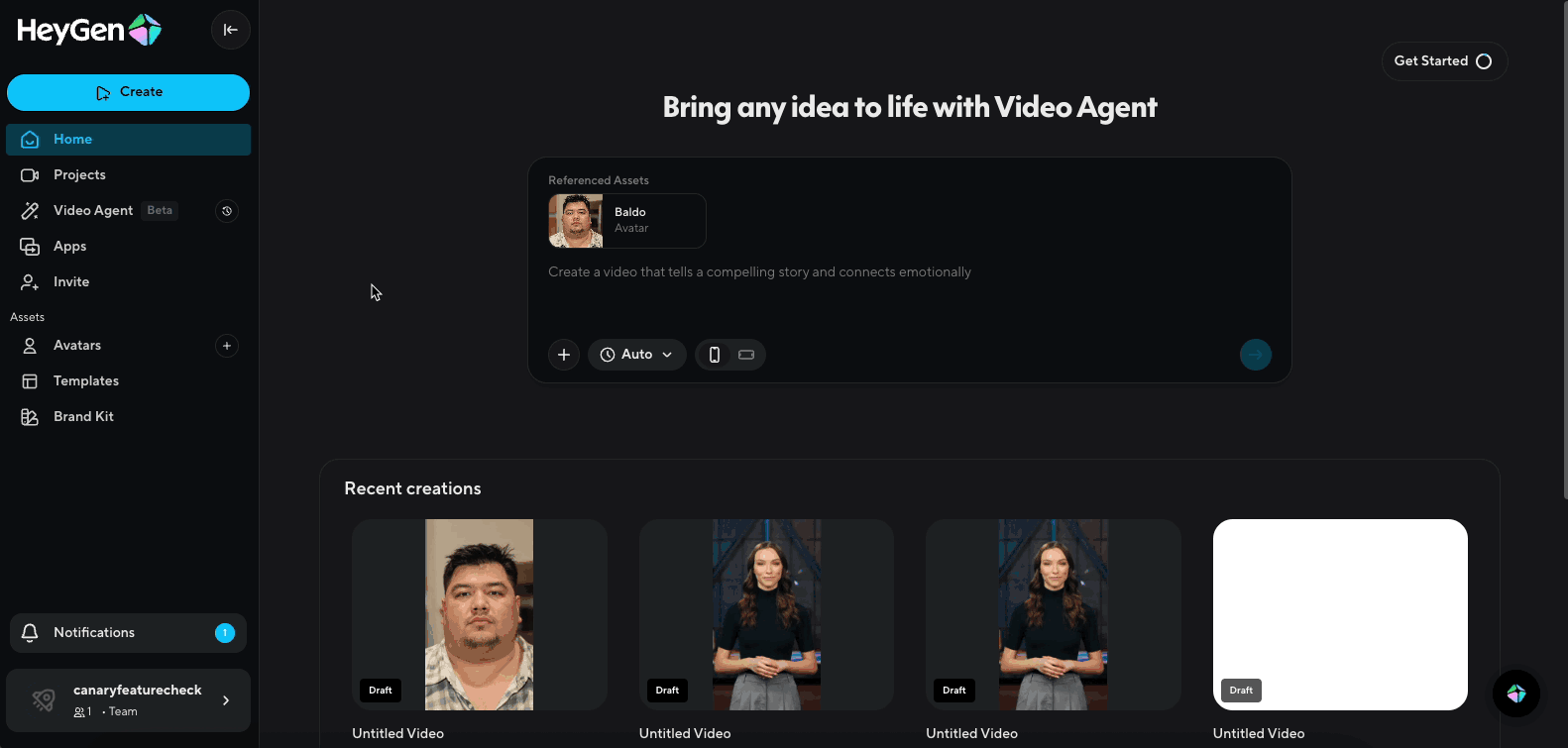
AI in Advertising
AI in Advertising
-
July 13, 2025

Customer Trust Issues With AI Marketing

AI has a serious trust problem when it comes to advertising.

There's a massive gap between how businesses are using AI to create ads and how consumers actually feel about AI generated marketing content.

Honestly, you can't really blame people for being skeptical.

Your audience is getting bombarded with obviously fake, spammy AI ads that look terrible and sound robotic. No wonder they're developing trust issues with anything that feels artificial.

But here's the thing, if you're using AI to create your marketing content (which you probably should be), you need to make sure your ads don't feel like the garbage that's turning everyone off.

Why People Don't Trust AI Generated Ads

The biggest problem is that most AI generated ads look and sound pretty terrible.

People can spot fake, robotic content from a mile away. When your ad sounds like it was written by a machine or your UGC video looks obviously synthetic, you've already lost them.

Plus, consumers have been burned by misleading ads before. They're naturally suspicious of anything that doesn't feel completely authentic.

These aren't unreasonable concerns. When your competition is flooding the market with low quality AI content, people become skeptical of everything.

But here's the plot twist. You can absolutely build trust with AI generated content when you do it right.

The key is making your AI content so authentic and valuable that people never question whether it's real.

How to Make AI Generated Ads That People Actually Trust

You have to focus on authenticity above everything else. This isn't about being transparent that you're using AI, it's about making AI content that feels completely real.

Effectively optimizing UGC ads means creating content that passes the authenticity test every single time.

Your AI generated ads need to sound like real people talking. Your product demos need to feel natural and unscripted. Your brand messaging needs to connect with actual human experiences.

Focus on solving real problems that your audience actually has. When your ads speak directly to genuine pain points and offer real solutions, people trust the message.

Most importantly, your visuals and audio need to be flawless. Any hint of that uncanny valley effect or robotic speech patterns can hurt credibility.

Steps to Build Trust Through Authentic AI Content

Here's exactly how to create AI marketing content that builds trust instead of destroying it:

Perfect Your Rendering Quality: Make sure your AI generated videos look completely realistic. Natural movements, proper lip sync, realistic lighting. If it looks fake, game over.

Use Human-Like Scripts: Your AI copywriting needs to sound conversational and natural. Avoid robotic language, corporate jargon, or anything that sounds like it came from a machine.

Tell Real Stories: Base your AI content on genuine customer experiences and real use cases. Even if the person in the video is synthetic, the story needs to be authentic.

Test for Authenticity: Before launching any AI generated content, test it with real people. If they can tell it's AI, you need to go back to the drawing board.

Avoid Common AI Tells: Stay away from perfect lighting, overly polished delivery, or anything that screams "this was made by a computer."

Making these small adjustments can completely transform how your audience perceives your brand. Instead of looking like another spammy AI advertiser, you'll stand out as authentic and trustworthy.

It can be very helpful to use AI and avoid human UGC video production pain points like inconsistent quality and long turnaround times, but the points above must be followed to see success.

Why Most AI Marketing Fails at Building Trust

Look, the internet is flooded with terrible AI generated ads that are destroying consumer trust in anything artificial.

These ads are obviously fake, poorly executed, and feel completely disconnected from real human experiences.

But that doesn't mean you should avoid AI altogether. That would be like avoiding video marketing because some videos are terrible.

The brands that win with AI marketing are the ones that invest in quality tools and take the time to create content that actually feels authentic.

Gethookd focuses on creating AI generated content that passes the authenticity test. Our AI UGC generator creates videos that are designed to look and sound like real people sharing genuine experiences.

We help you avoid the common pitfalls that make AI content feel fake and spammy.

The Bottom Line

Trust issues with AI marketing are real, but they're completely solvable.

The brands that succeed are the ones that create AI content so authentic and valuable that customers never question its legitimacy.

Don't join the flood of obviously fake AI ads that are turning everyone off. Create content that stands out for all the right reasons.

When your AI generated marketing feels more authentic than your competitors' human-created content, you've won.

Ready to see how authentic AI marketing can build stronger relationships with your audience than traditional approaches?

Start your 14 day free trial with Gethookd today.

Ad Strategy
Ad Strategy
-
July 9, 2025

How to Make Successful UGC Ads: Strategy, Examples, and AI Tools

Key Takeaways

  • UGC ads outperform traditional brand creative because they look like organic content, which lowers audience resistance and holds attention longer on social feeds.
  • The strongest UGC ads combine a specific, pain-point-driven hook in the first three seconds with genuine delivery and a clear, conversational CTA at the close.
  • AI tools have made UGC production significantly faster; the most effective use is hook testing, where you generate multiple variations cheaply before investing in full creator production.
  • Branding in UGC ads works best when it is subtle and placed toward the end, after the creator has already built trust with the viewer.
  • GetHookd gives performance marketers the competitive intelligence and AI production tools to build UGC campaigns grounded in real market data rather than guesswork.

How to Make Successful UGC Ads

Successful UGC ads begin with a strong hook in the first few seconds, usually tied to a specific pain point or curiosity trigger. The creator should present the product in a natural, conversational way rather than sounding scripted. This authenticity helps the ad blend into social feeds and prevents the “obvious ad” effect that causes people to scroll past branded content.

Next, structure the ad around a simple narrative: problem, experience, and outcome. Show the product in real use, highlight a clear benefit, and keep branding subtle until trust is established. The final seconds should include a clear and conversational call to action that tells viewers exactly what to do next.

This guide covers what makes UGC ads work, different examples, and the tools that give performance marketers an edge.

GetHookd: Turn Competitor Intelligence Into Your Next Winning Ad

65M+ Ads Analyzed | 4.8★ G2 Rating | 4.5★ Trustpilot Rating

Stop Guessing. Start Scaling:

GetHookd reveals which ads your competitors are actively scaling—not just running. Spy on their best-performing creatives, landing pages, and traffic strategies, then turn proven concepts into testable campaigns in seconds with AI-powered script generation and creative cloning.

What You Get:
  • ✓ Brand Spy to decode competitor ad strategies in real-time
  • ✓ AI script generation and ad cloning for instant variations
  • ✓ Performance scoring based on actual ad behavior, not vanity metrics
  • ✓ Creative Analyzer to identify and scale your top performers
Replace guesswork with intelligence. Build profitable ads that actually convert.

Examples of UGC Ads & When to Use Each 

Short-Form Video Ads 

Short-form UGC video ads work because they look like recommendations from a friend. (Source: Facebook)

Short-form video is the dominant UGC format right now. A 15 to 60-second video of a real person demonstrating, reviewing, or reacting to a product is the closest thing to a personal recommendation that paid advertising can deliver. 

These ads perform best when they look like organic content. Shoot vertically on a smartphone, with natural lighting and genuine energy in the delivery.

Customer Testimonial Ads 

Testimonial ads bring the classic customer review to life on video or static creative. They work best at the middle and bottom of the funnel, where a potential buyer knows the product but needs social proof to convert. 

The most effective testimonials are specific: a real problem, a real outcome, a real timeframe. That specificity is what builds credibility. Static versions, where a customer quote is paired with a product image, are low-cost to produce and easy to test across audience segments. 

Always secure written permission before using a customer's words or likeness in a paid ad, even if they originally posted it publicly.

Influencer Collaboration Ads 

Influencer collaboration ads sit at the intersection of UGC and influencer marketing. A brand works with a creator who posts content to their own channel, then uses that same content as a paid ad. 

The result carries both the social proof of a genuine creator endorsement and the scalability of a paid placement.

Social Proof & Review-Based Ads 

Review-based ads take your best written or video reviews and turn them directly into ad creative. A five-star review with a specific outcome, pulled from your product page and formatted into a clean ad, can outperform weeks of carefully produced brand content. 

These work across every major platform and are especially powerful for eCommerce brands where purchase decisions depend on what other customers experienced.

Apple Instagram post featuring a Shot on iPhone photo. (Source: Instagram)

Apple's Shot on iPhone campaign is one of the clearest examples of this principle at scale. Rather than producing studio content, Apple features photos taken by iPhone users, crediting the actual people behind each shot. 

The campaign works because the proof is built in. That is UGC at its most effective: real users and real results.

AI Tools That Make UGC Ad Creation Faster

1. GetHookd

Scroll through millions of active Meta ads to find UGC concepts worth testing in your own campaigns.

GetHookd is the strongest option for performance marketers who want AI-powered UGC creation built into a competitive research and analytics workflow. Rather than generating content in isolation, our platform connects the entire process, from studying what competitors are actively scaling to generating scripts, hooks, and visual variations from winning ad concepts. 

Key features for UGC production include:

  • Explore Ads: Browse a library of 65 million-plus Meta ads to find UGC-style creatives that are already performing in your niche.
  • Save Ads: Save any UGC ad worth referencing (even after it goes offline) and organize it by niche or format for your next creative brief.
  • Video Scripts: Feed in a winning ad, and your product details, and GetHookd's AI produces ready-to-use hooks, angles, and full scripts tailored to your campaign.
  • Ads Transcription: Break down any video ad into its core copy elements: hooks, body, and CTA, so you can adapt what is already converting in your market.
  • Clone Ads: Take any high-performing image ad and generate multiple creative variations across different formats, colors, and styles without starting from scratch.
  • Image Ad Templates: Access a library of proven static ad templates across niches, each editable directly in Canva.
  • Funnel Templates: Pick from high-converting landing page formats and customize for your offer.
  • Creative Analyzer: Identify which of your own UGC ads are driving results and understand why, so you can scale what's working and cut what isn't.

2. HeyGen

HeyGen focuses on AI-avatar video generation, enabling brands to produce presenter-style video ads without a camera or a creator. It is useful for rapid hook testing at low cost, though the output lacks the raw authenticity that makes the strongest UGC ads convert.

3. Creatify

Creatify generates UGC-style video ads directly from a product URL, making it an option for brands with limited production resources. Like most AI video tools, it works best as a testing instrument rather than a primary creative source.

Strategies for High-Performing UGC Ads

Authentic Visuals That Feel Unscripted 

High-performing UGC ads are deliberately imperfect. Natural lighting, real environments, and genuine delivery outperform studio setups because they preserve the sense that a real person is sharing their experience. 

Brief your creators on key messages and outcomes, but give them room to express it in their own voice. The moment an ad looks too polished, it stops working like UGC.

Branding That Blends In 

Your brand needs to show up in the ad, but it should not dominate it. The most effective approach is subtle: a product label visible in a natural shot, a creator mentioning the brand name in conversation, or a clean end card in the final two seconds.

Front-loading logos and brand colors signal "ad" to an audience that is actively trying to scroll past ads. Test a branded end card against a non-branded version in your ad sets and let the data decide.

A Hook That Stops the Scroll

Your opening line, visual, or on-screen text has to create enough curiosity or relevance to earn the next few seconds. The strongest hooks are specific to a pain point, genuinely surprising, or visually arresting. 

Test hook variations systematically by keeping everything else constant and changing only the opening three seconds.

A CTA That Drives Immediate Response

A UGC ad without a clear CTA is content, not a conversion tool. For cold traffic, low-friction CTAs like "see how X works" outperform aggressive purchase prompts because they meet the audience where they are. 

For warm retargeting audiences, a direct "shop now" is the nudge they need. Place the CTA verbally in the final seconds and reinforce it with on-screen text. Keep the language conversational and consistent throughout.

Start Running UGC Ads That Convert with GetHookd

Most teams waste budget producing UGC creative that was never going to work because they skipped the research stage. GetHookd removes that problem. We give performance marketers, eCommerce brands, and agencies the intelligence to know what is already converting in their market before going into production.

GetHookd connects research and execution in one place. Our Brand Spy feature surfaces what competitors are actively running on Meta, including the hooks, formats, and landing pages behind their best campaigns. Ads Transcription extracts the exact copy structure and hook angles from any video UGC ad, giving your team proven frameworks to build from rather than starting from scratch each production cycle.

Once you know what to make, our AI tools handle the rest. For teams running Meta campaigns at scale, that kind of visibility at every stage is what turns UGC from a content exercise into a revenue system. 

Start your GetHookd free trial today.

Frequently Asked Questions (FAQs)

What makes a good UGC ad? 

A good UGC ad looks and feels like organic content. It opens with a hook that speaks directly to a pain point, builds trust through genuine delivery, and closes with a clear and conversational CTA. 

Specificity separates high-converting UGC from generic content. Ads that reference real problems and outcomes and maintain a natural voice throughout earn attention.

How do you make a UGC ad? 

Start by researching what formats and hooks are already performing in your niche. Brief a creator or use an AI tool to generate scripts and variations, then refine the output before launch. 

Test multiple hooks against the same audience, identify the top performer, and iterate from there. The process works best when research informs every creative decision upfront.

What is the best AI tool for UGC ads? 

GetHookd is the most complete option for performance marketers. It covers the full UGC workflow from competitor research and hook analysis to AI script generation and creative variation, and every production decision is backed by real ad data.

*Note: Pricing and/or product availability mentioned in this post are subject to change. Please check our website for current pricing and stock information before making a purchase.
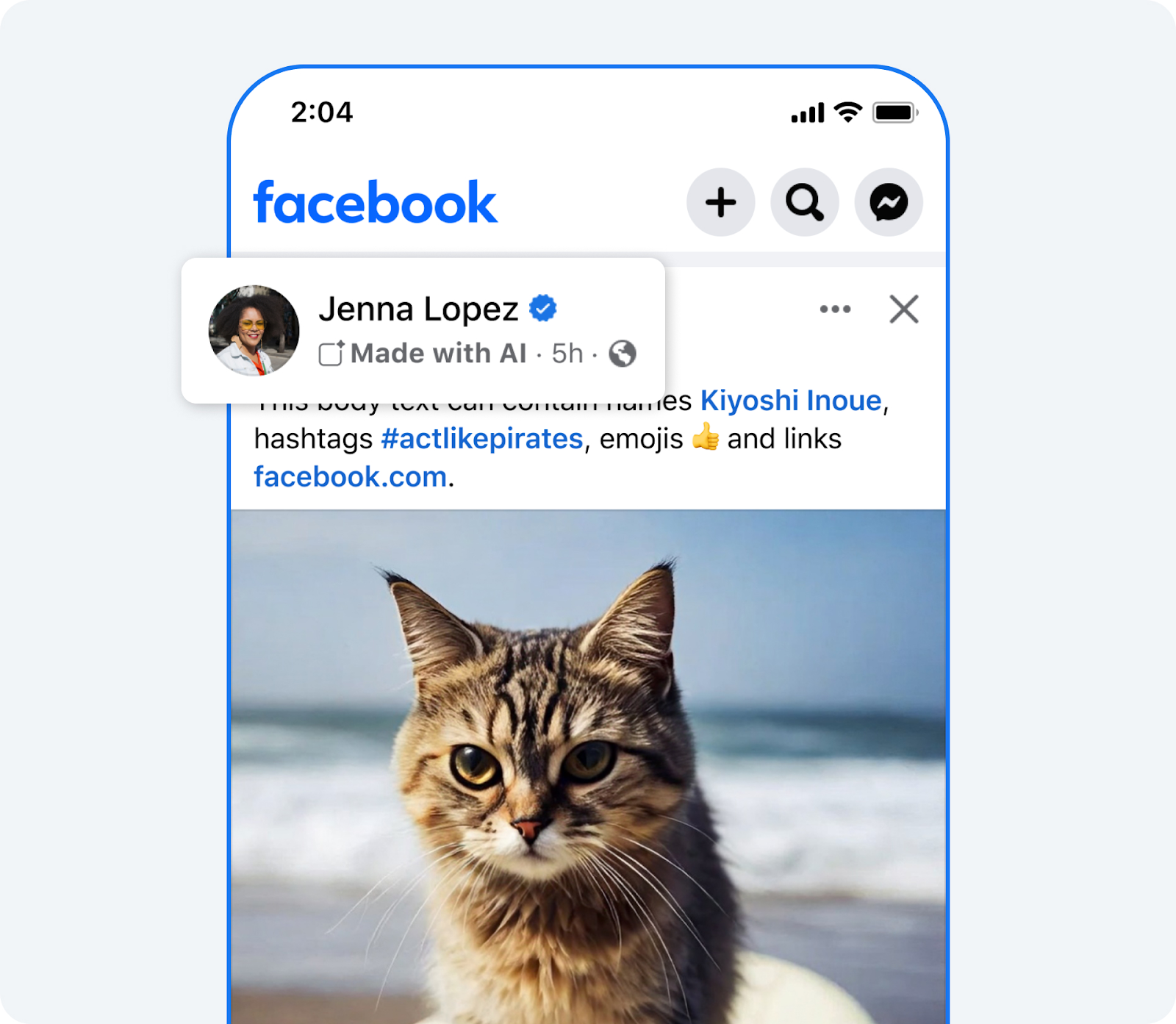
AI in Advertising
AI in Advertising
-
July 7, 2025

AI UGC Generator Comparison

Here's the thing about AI UGC generators: they're definitely not all created equal.

You want your AI tool to produce compelling, relatable content that looks and feels like it was created by actual humans. Text, visuals, video, audio, the whole package.

But choosing the right tool is where most people screw up.

To make sure you pick a winner, you need to identify your goals, investigate your options, and do a proper AI UGC generator comparison.

Don't just grab the first shiny tool you see and hope for the best. You can also try AI content tools for beginners.

Figure Out What You Actually Need

AI UGC creators can pump out massive quantities of content for advertising, social media, e-commerce platforms, and pretty much any other purpose you can think of.

But here's the key question: what do you specifically want your tool to accomplish?

If you're looking at an unconventional approach, ask for examples of other clients who've successfully used the tool in a similar way.

Different platforms have completely different capabilities and user interfaces.

You want something that's easy to use, allows team collaboration, and lets you repurpose content across different channels without starting from scratch every time.

Depending on your needs, you might want to create avatars based on real people, enhance and personalize generated content, or embed voiceovers that don't need human speakers.

Make sure whatever tool you choose integrates with the social media platforms and marketing tools you're already using.

You don't want to recreate the wheel just because your new AI tool doesn't play nice with your existing setup.

What Separates Winners from Losers

Depending on your technical abilities and individual needs, different features are gonna matter more or less.

For some brands, cost and customer support are the most critical factors. Makes sense if you're just getting started or have a tight budget.

For others, it might be scalability, the ability to handle large scale campaigns, or pure ease of use.

Maybe the level of customization available matters most to you. Or the variety of styles and backgrounds to choose from. Multi language capabilities. The ability to edit and refine content easily.

Here's what should matter to everyone: scrutinize the quality and realism of the AI generated content.

To actually connect with your audience, content needs to be easily customizable with your branding. And rendering times should stay under fifteen minutes, because nobody has time to wait around.

Must Have Features That Actually Move the Needle

Before you commit to any AI UGC tool, make sure you understand what features will actually improve your ad performance.

Look for tools that offer a variety of creative templates, high quality export options, and seamless integration with ad platforms like TikTok, Instagram, Meta, and Google Ads.

Customizability is absolutely key.

Does the platform let you fine tune content with your brand tone, visual assets, and messaging guidelines? Can you generate multiple formats like short form videos, static ads, and reels from the same prompt?

Ad generator with personalization features

Look for tools that use real time trend data to shape your creative direction. This way you can stay ahead of what's actually working right now, not what worked six months ago.

It's also worth considering how transparent the tool is about the AI's role in the content process.

Platforms that offer side by side editing tools or let you compare multiple versions make it way easier to control the final output without starting from scratch.

Why Gethookd Crushes the Competition

What makes Gethookd different from other tools on the market is its focus on data driven creativity.

Gethookd pulls from a constantly updated library of winning ads across industries and uses that insight to generate fresh content tailored specifically to your brand.

You're starting with a framework that has a proven track record, not just hoping your content will work.

competitor ads library

It also goes way beyond basic content generation.

Gethookd combines scripting, visual generation, editing, and optimization all in one place. Instead of jumping between different tools or outsourcing to multiple freelancers, you can manage the entire creative cycle in minutes.

Even if you have zero technical experience.

You can spy on your competitors' successful campaigns, see exactly what's working in your niche, and create your own versions that convert even better.

Spy on competitors

Plus, you get AI scripts that are prompted by 8 figure direct response marketers, AI UGC video creation that looks incredibly realistic, and performance tracking that shows you exactly which creatives are printing money.

The Bottom Line

Most AI UGC generators are just fancy content mills that spit out generic garbage.

They might look impressive in demos, but when you actually try to scale profitable campaigns with them, they fall apart.

Gethookd is built specifically for brands that want to test creatives like mad scientists and scale like savages.

It's not just about creating content. It's about creating content that converts, based on what's actually working in the wild right now.

If you're serious about dominating your niche with AI UGC that actually drives results, Gethookd needs to be at the top of your comparison list.

Ready to see how data driven AI UGC can transform your creative performance and ROAS?

Start your 14 day free trial with Gethookd today.