6 Best Facebook Image Ads Examples for 2026
Key Takeaways
- Static image ads remain one of the most cost-efficient and high-performing formats on Meta in 2026, delivering low CPMs and strong click-through rates when executed well.
- The best-performing Facebook image ads in 2026 share five traits: a scroll-stopping visual, a benefit-driven headline, a clear CTA, social proof, and authenticity over polish.
- Meta’s Andromeda algorithm now treats creative as the primary targeting signal. Diverse image ad formats feed the algorithm better than running the same visual with different copy.
- Use the 4:5 vertical format (1080 x 1350 px) for feed image ads to claim maximum screen real estate on mobile. Square (1:1) remains a reliable fallback across all placements.
- GetHookd lets you search over 65 million ads across Meta to find proven image ad concepts in your niche, then clone or remix them with AI in seconds.
Facebook Image Ads in 2026: What’s Working Right Now
Video gets the headlines, but static image ads keep quietly delivering results on Facebook. They’re fast to produce, cheap to test, and load instantly across every placement Meta offers.
With Meta’s Andromeda update now using your creative as the primary targeting signal, the brands winning in 2026 aren’t the ones with the biggest budgets. They’re the ones running diverse, high-quality image ads across proven formats: clean product shots, UGC testimonials, comparison layouts, and urgency-driven offers.
Below, we’ve broken down 6 of the best Facebook image ad styles currently working, each with a real-world example, an explanation of why it converts, and actionable tips you can apply today.
GetHookd: Turn Competitor Intelligence Into Your Next Winning Ad
65M+ Ads Analyzed | 4.8★ G2 Rating | 4.4★ Trustpilot Rating

Stop Guessing. Start Scaling:
GetHookd reveals which ads your competitors are actively scaling—not just running. Spy on their best-performing creatives, landing pages, and traffic strategies, then turn proven concepts into testable campaigns in seconds with AI-powered script generation and creative cloning.
What You Get:
- ✓ Brand Spy to decode competitor ad strategies in real-time
- ✓ AI script generation and ad cloning for instant variations
- ✓ Performance scoring based on actual ad behavior, not vanity metrics
- ✓ Creative Analyzer to identify and scale your top performers
6 Best Facebook Image Ads Examples for 2026
1. The Clean Product Shot
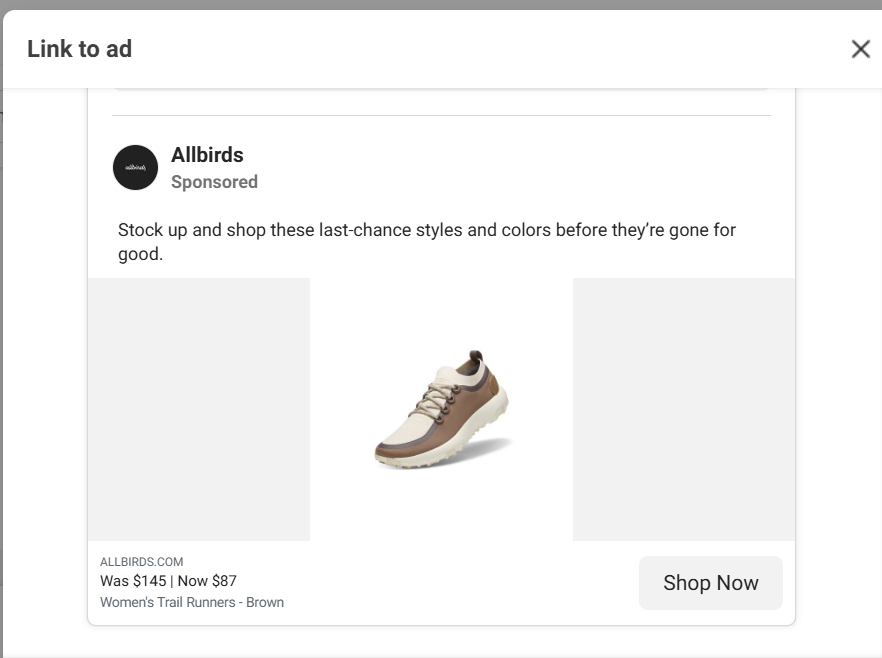
Sometimes the product is the hero, and the smartest thing you can do is get out of its way. Allbirds regularly runs image ads featuring a single product on a clean, minimalist background, accompanied by a short headline and a “Shop Now” CTA.
This format works because it removes all friction from the buying decision. The viewer sees the product, understands the offer, and knows exactly what to do next. There’s no competing message, no cluttered layout, no visual noise. For eCommerce brands with a strong product, this is the format to test first.
What Makes It Convert
- High-quality product photography on a neutral or branded background.
- One clear value proposition in the headline (e.g., “Was $145 | Now $87”).
- Minimal text overlay so the visual does the work.
- Direct CTA button aligned with the campaign objective.
2. The UGC Testimonial Static
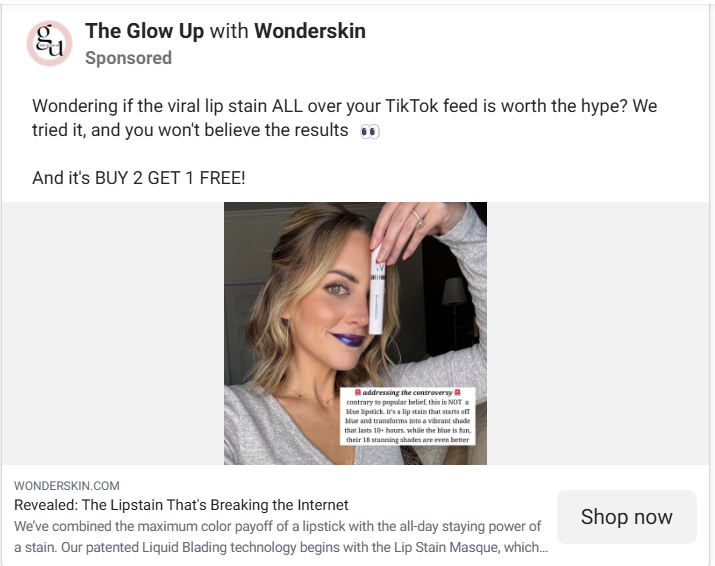
The best-performing Facebook ads in 2026 are often the ones that don’t look like ads at all. This Wonderskin ad is a perfect example. A selfie-style image of someone holding the product, text overlay that reads like a creator addressing their audience, and copy that leads with viral social proof (“the viral lip stain ALL over your TikTok feed”). It feels like a friend’s recommendation, not a sponsored post.
What Makes It Convert
- Authentic, selfie-style visuals that feel user-generated rather than studio-produced.
- Copy that references social proof or virality to build instant credibility.
- A clear offer or promotion layered in to convert the attention into action.
3. The “Us vs. Them” Comparison
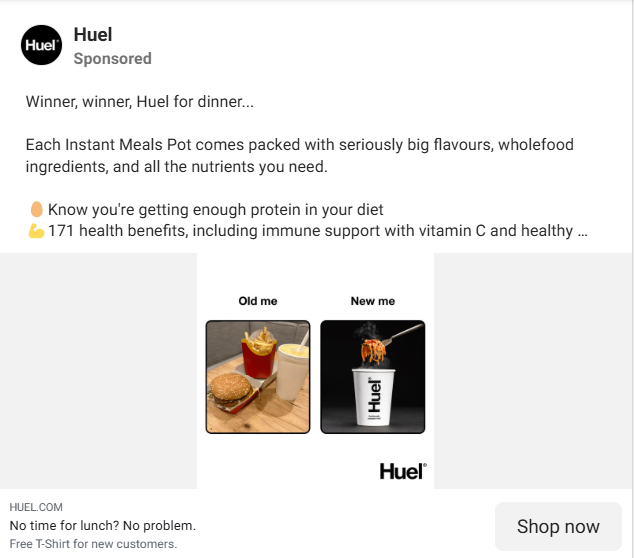
Comparison ads are among the oldest direct-response tactics, and they’re still undefeated in 2026. Huel’s Instant Meals Pot ad uses the trending “Old me / New me” meme format to position fast food side by side with its product.
Burgers and fries on the left, a Huel pot on the right. No data tables, no nutrition labels. Just a visual that makes the upgrade feel obvious. The ad copy does the heavy lifting on specifics and benefits, while the creative stays clean and scroll-stopping. It’s a comparison ad that doesn’t feel like one.
What Makes It Convert
- A clear visual split between the “before” (competitor or category alternative) and the “after” (your product).
- A meme-native format that blends into organic content instead of screaming “ad.”
- Supporting copy that layers in the specific benefits without cluttering the image.
If your product is an upgrade from a common alternative, this layout sells the transformation at a glance. Keep the image simple and let your primary text handle the details.
Also, choose your comparison target carefully. Comparing against a generic category (fast food, old habits) is just as effective as naming a competitor and avoids potential issues.
4. The Multi-Product Grid
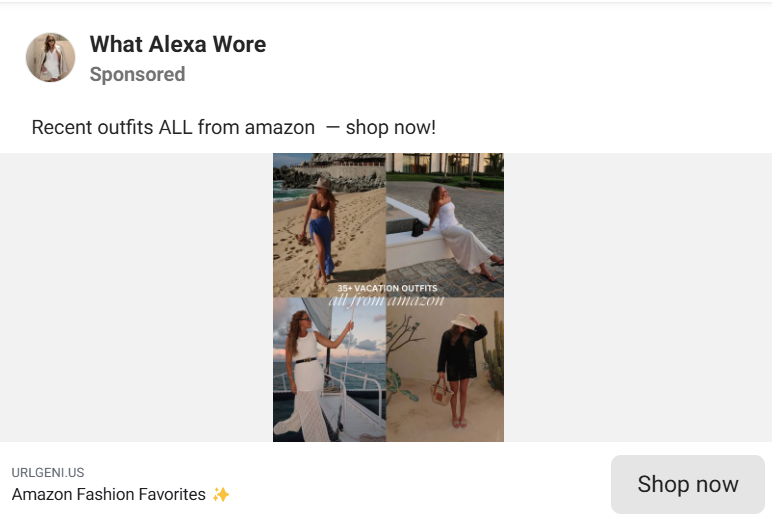
A multi-product grid works because it increases the odds that at least one product catches the viewer’s eye, while also communicating range and variety at a glance. Beauty brands, fashion retailers, and food and beverage companies use this format consistently because it mirrors how people browse, scanning options before zeroing in on one.
A well-composed grid of your bestsellers or a curated collection can outperform a single hero product shot, especially in prospecting campaigns where you’re reaching people who don’t yet know your brand.
What Makes It Convert
- A clean, balanced layout where each product has equal visual weight and breathing room.
- Consistent photography style across all items so the grid looks intentional, not thrown together.
- A unifying theme that ties the products together, whether that’s a seasonal collection, a color palette, a “best sellers” grouping, or a bundle offer.
5. The Lifestyle-in-Use Shot
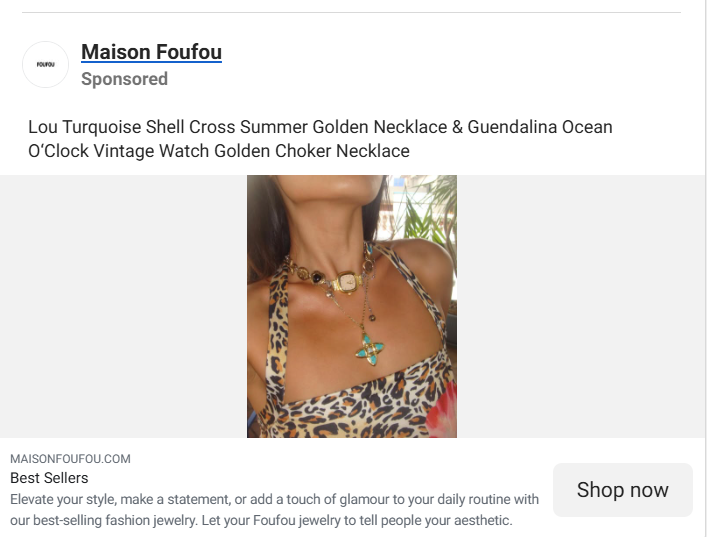
Certain products sell themselves when you simply show them being worn, used, or experienced. This Maison Foufou ad does exactly that. A close-up of someone wearing layered gold jewelry in a natural, sun-lit setting. No text overlay on the image, no complicated messaging. The product is the entire ad, and the visual does all the selling.
This format dominates the fashion, beauty, and accessories verticals because purchase decisions are emotional, not logical.
What Makes It Convert
- A real person wearing or using the product in a natural, aspirational setting.
- The product is clearly visible and central to the image, with zero text overlay competing for attention.
- Copy that reinforces the lifestyle angle. Maison Foufou’s “Let your Foufou jewelry tell people your aesthetic” ties the product to identity, not just function.
Want to find which lifestyle ads are being scaled in your niche? GetHookd’s Brand Spy shows you exactly that.
6. The Urgency-Driven Offer
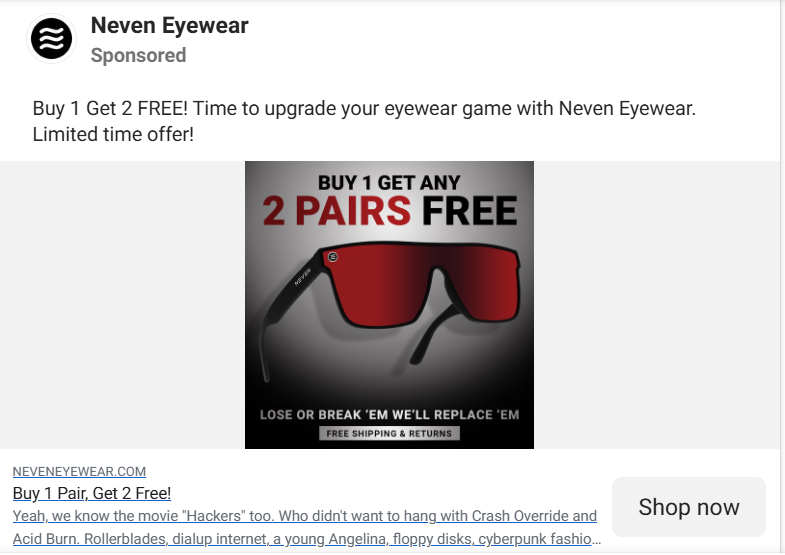
An image ad with a time-limited offer and a clear discount creates immediate purchase intent. This is a direct response at its most fundamental: give people a reason to buy now instead of later.
The most effective urgency ads in 2026 combine a strong visual of the product with a clear, prominent discount or deadline. Think bold text reading “Buy 1, Get Any 2 Pairs Free” overlaid on a lifestyle product image, paired with a “Shop Now” CTA.
What Makes It Convert
- A specific, believable deadline (not vague “limited time” language).
- The discount or offer is prominently visible in the image itself, not just the copy.
- An action-oriented CTA that matches the urgency (e.g., “Shop Now” or “Claim Your Discount”).
Top Examples of Facebook Image Ads: Summary Table
| Ad Style | Core Concept | Why It Works |
|---|---|---|
| The Clean Product Shot | Single product, minimal background, short headline, “Shop Now” CTA | Removes friction, viewer sees product, understands offer, knows what to do next |
| The UGC Testimonial Static | Selfie-style image, creator-tone text overlay, social proof copy | Feels like a friend’s recommendation, not a sponsored post |
| The “Us vs. Them” Comparison | “Old me / New me” meme format, visual split between alternative and product | Meme-native format makes the upgrade feel obvious at a glance |
| The Multi-Product Grid | 2×2 grid of products with consistent photography style | Increases odds of catching the viewer’s eye; communicates range and variety |
| The Lifestyle-in-Use Shot | Close-up of product being worn in natural, aspirational setting | Triggers emotional purchase decisions; product is the entire ad |
| The Urgency-Driven Offer | Bold discount/deadline overlaid on product image with action CTA | Creates immediate purchase intent with a specific, believable deadline |
Facebook Image Ad Quick Reference: Specs for 2026
Before you start designing, make sure your image ads meet Meta’s current specifications. Getting this right prevents cropping issues, slow load times, and rejected ads.
| Spec | Feed (Recommended) | Stories / Reels |
|---|---|---|
| Resolution | 1080 x 1350 px (4:5) | 1080 x 1920 px (9:16) |
| Aspect Ratio | 4:5 (vertical) or 1:1 (square) | 9:16 (full screen) |
| File Format | JPG or PNG | JPG or PNG |
| Max File Size | 30 MB | 30 MB |
| Primary Text | 125 characters (visible before “See more”) | 125 characters max |
| Headline | 40 characters (≈27 visible on smaller screens) | 40 characters max |
Find Winning Facebook Image Ads with GetHookd
Studying ad examples is a great starting point, but the real competitive advantage is knowing which ones are actually being scaled in your niche. The Meta Ad Library will show you what brands are running, but it won’t tell you what’s working. You’re left scrolling through hundreds of ads, guessing which ones are winners and which ones got killed after two days of testing.
That’s why we built GetHookd. Our platform analyzes over 65 million ads and surfaces those that show real performance signals. With Brand Spy, you can track any competitor’s ad account and see which creatives they’re actively spending on, their top-performing hooks, and the landing pages driving traffic. Its competitive intelligence tells you what’s converting, not just what’s live.
But where our platform really pulls ahead is the workflow from research to execution. Once you find a winning image ad, our Clone Ads feature lets you generate dozens of variations with new colors, styles, and formats in seconds. You can also choose from any of our ready-to-use static ad and funnel templates designed for quick ad launches. We built GetHookd to take you from spotting the best creative to launching your own testable version in minutes, not days.
Start your GetHookd free trial today!
Frequently Asked Questions (FAQs)
Are static image ads still effective on Facebook in 2026?
Yes. Static image ads remain one of the most efficient ad formats on Meta, delivering consistently low CPMs and strong performance in retargeting and direct-response campaigns. They’re also faster and cheaper to produce than video, which means you can test more variations in less time.
What size should my Facebook image ads be?
For feed placements, use 1080 x 1350 pixels (4:5 aspect ratio) to maximize mobile screen space. For Stories and Reels placements, use 1080 x 1920 pixels (9:16). Square images (1080 x 1080) are supported across most feed-based placements, making them a safe universal fallback.
How do I find winning Facebook image ads in my niche?
The free Facebook Ad Library (Meta Ad Library) lets you see what brands are running, but it doesn’t show performance data. For actual competitive intelligence, GetHookd’s Explore feature lets you search over 65 million ads filtered by niche, format, and performance signals. Brand Spy shows which ads competitors are actively scaling, not just testing.
Do I need design skills to create quality Facebook image ads?
Many of the best-performing ad styles we’ve covered in this article require minimal design work. GetHookd’s Clone Ads feature lets you upload any image ad, whether it’s a competitor’s top performer or one of your own, and generate dozens of variations with new colors, avatars, formats, and styles in seconds. On top of that, we offer 100+ ready-to-use static ad and funnel templates designed for quick launches, so even if you’ve never opened a design tool in your life, you can go from idea to testable image ad in minutes.
*Note: Pricing and/or product availability mentioned in this post are subject to change. Please check our website for current pricing and stock information before making a purchase.