Key Takeaways
- AI-generated ads excel at speed, volume, and variation, making them the stronger choice when creative testing and production scale are the priority.
- Human-created ads carry emotional depth, cultural nuance, and brand storytelling that some AI tools struggle to replicate without editorial direction.
- The highest-performing teams use AI to handle production volume while human marketers direct strategy, refine output, and make the final call on what goes live.
- The right choice between AI ads vs human-created ads depends on your campaign goal, audience, and the creative complexity the format demands.
- GetHookd gives performance marketers a research foundation that makes both AI and human creative decisions sharper, starting with 65M+ high-performing Meta ads and competitor intelligence.
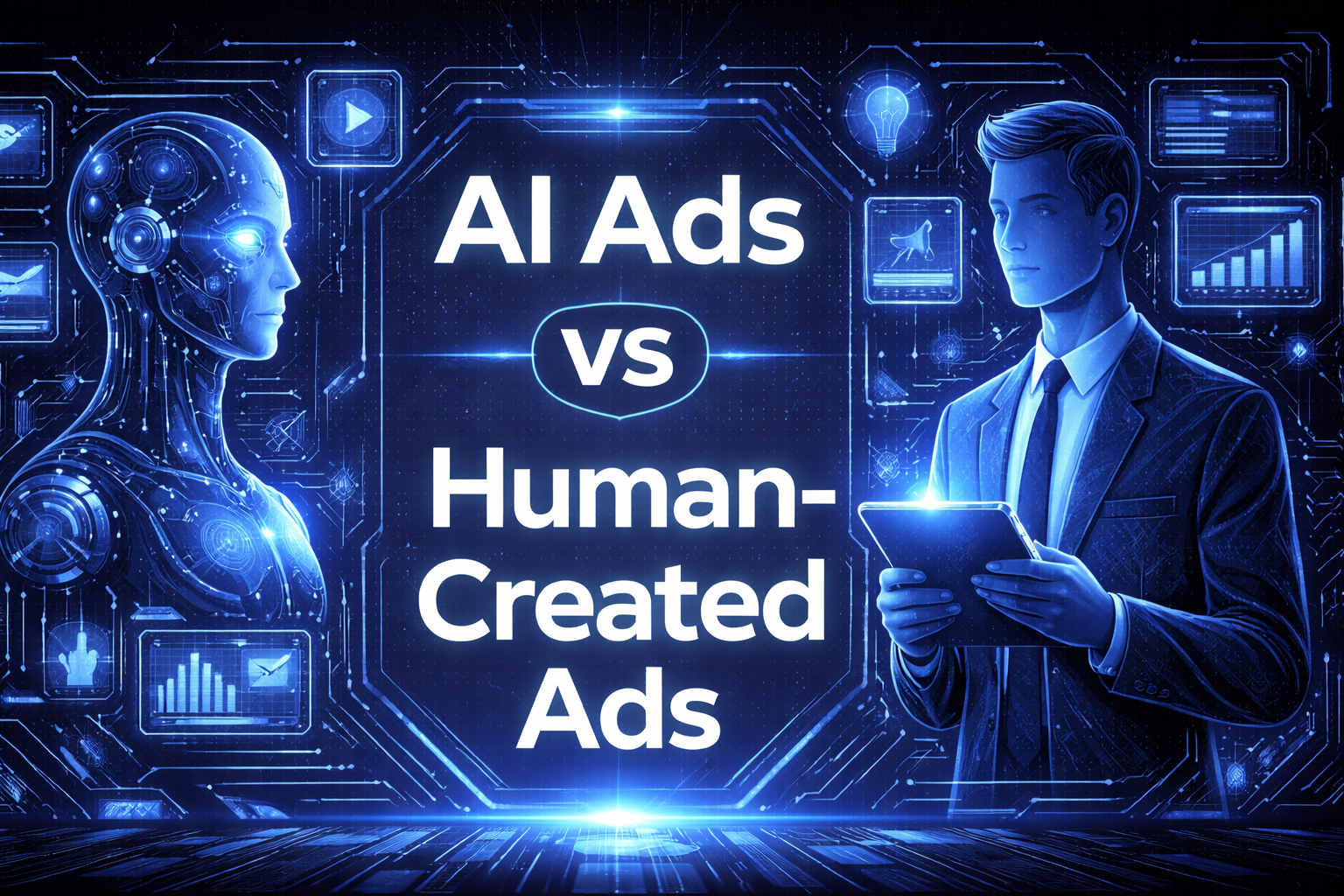
AI Ads vs Human-Created Ads: Finding the Right Balance
The question is no longer whether AI belongs in ad creative. Most marketing teams have already answered that.
Creative is the single biggest variable in ad performance, and the teams consistently winning are not choosing between AI and human creative. They are using each where it has a clear edge.
This article breaks down exactly where those edges are, with real examples across static, video, and copy formats.

GetHookd: Turn Competitor Intelligence Into Your Next Winning Ad
GetHookd reveals which ads your competitors are actively scaling—not just running. Spy on their best-performing creatives, landing pages, and traffic strategies, then turn proven concepts into testable campaigns in seconds with AI-powered script generation and creative cloning.
What You Get:- ✓ Brand Spy to decode competitor ad strategies in real-time
- ✓ AI script generation and ad cloning for instant variations
- ✓ Performance scoring based on actual ad behavior, not vanity metrics
- ✓ Creative Analyzer to identify and scale your top performers
GetHookd: Turn Competitor Intelligence Into Your Next Winning Ad
65M+ Ads Analyzed | 4.8★ G2 Rating | 4.5★ Trustpilot Rating
Stop Guessing. Start Scaling:
GetHookd reveals which ads your competitors are actively scaling—not just running. Spy on their best-performing creatives, landing pages, and traffic strategies, then turn proven concepts into testable campaigns in seconds with AI-powered script generation and creative cloning.
What You Get:
- ✓ Brand Spy to decode competitor ad strategies in real-time
- ✓ AI script generation and ad cloning for instant variations
- ✓ Performance scoring based on actual ad behavior, not vanity metrics
- ✓ Creative Analyzer to identify and scale your top performers
What Are AI-Generated Ads?
AI-generated ads are creative assets produced with AI tools handling some or all of the production process. This includes static image variations generated from a product input, video ads built around AI avatars and scripts, and ad copy produced from a brief or URL.
The degree of human involvement varies. Some teams use AI to generate a first draft and then heavily edit it. Others use AI to produce finished variations at scale with minimal review.
Pros of AI-Generated Ads
1. Production Speed
Production speed is the most immediate advantage. A creative concept that once required a designer, writer, and review cycle can now produce testable variations in minutes.
For performance marketers who need to keep fresh creative rotating across active campaigns, that compression of the production timeline is a meaningful operational gain.
2. Creative Testing at Scale
Scale is the second advantage. AI enables teams to test more creative variables simultaneously without proportionally increasing headcount or spend. More tests run faster means faster learning, which compounds over time into a cleaner understanding of what actually drives conversions in a given niche.
3. Lower Production Cost
Cost efficiency follows from both. Lower production costs per creative mean a lower barrier to testing, so more of the budget goes toward media rather than production.
Cons of AI-Generated Ads
AI output is only as strong as the AI tool, input, and editorial judgment applied to it. Without a clear brief, a strong research foundation, and human review before anything goes live, AI-generated ads default to generic.
Emotional resonance is also a consistent weakness. AI can structure an ad around a proven framework, but the creative instinct that makes an ad feel genuinely surprising, funny, or moving still requires a human to direct.
What Are Human-Created Ads?
Human-created ads are produced through a traditional creative process in which strategists, copywriters, and designers make core decisions about concept, messaging, and visual direction.
A human creative team might use AI tools for research or iteration while keeping strategic and executional ownership entirely with people.
Pros of Human-Created Ads
1. Brand Voice
Brand voice is where human-created ads have a clear and consistent advantage. A skilled copywriter understands the specific tone, cadence, and cultural references that make a brand feel distinct rather than interchangeable. That kind of creative specificity may be difficult to replicate through prompts alone.
2. Complex Storytelling
Complex storytelling is a second strength. Campaigns built around a narrative arc, a character, or an emotionally layered message require creative judgment that AI tools currently cannot provide without extensive human direction.
3. Human Creative Judgment
Human creatives also catch things AI misses. A piece of copy that is technically accurate but culturally tone-deaf, a visual that will read differently to a specific audience segment, or a hook that lands wrong in a particular context. These are judgment calls that still require a person in the loop.
Cons of Human-Created Ads
Speed and cost are the clearest constraints. A human creative process takes longer and costs more per asset than AI production, which creates a ceiling on how much creative testing is practical within a given budget cycle.
Scalability is the other limitation. A human team can only produce so many variations per week, which means fewer tests, slower learning cycles, and more reliance on each individual creative to perform rather than letting data surface winners across a larger batch.
AI Ads vs Human-Created Ads: Side-by-Side Examples
Static Image Ads
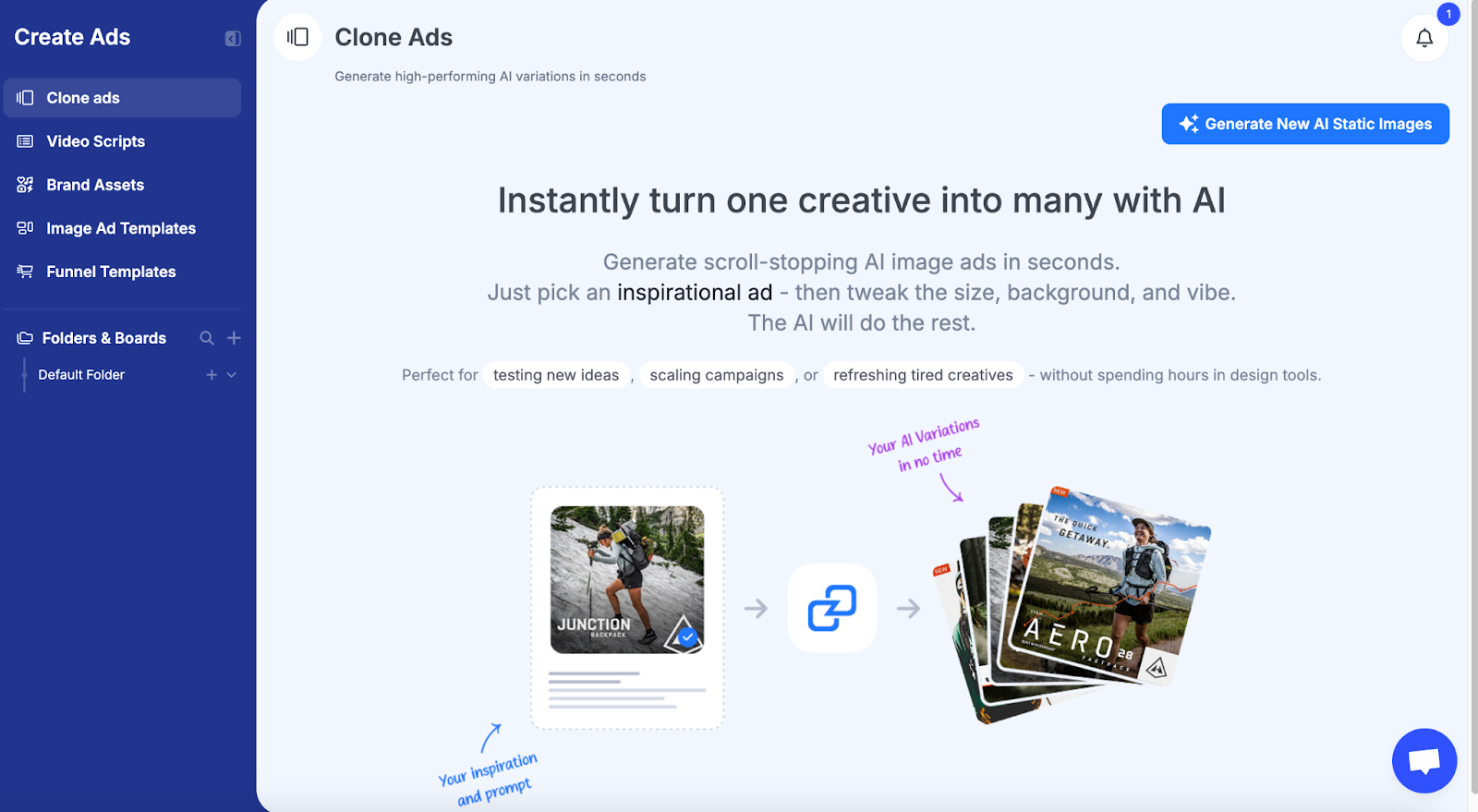
AI-generated static ads excel at producing multiple variations of a proven concept quickly. A supplement brand can take a single winning layout and generate ten color and copy variations in minutes for simultaneous testing.
Human-created static ads tend to lead when the visual concept requires genuine creative thinking, a comparison layout that uses cultural references, an illustration style that feels distinctly on-brand, or a bold typographic treatment that reflects a specific brand voice.
These are creative decisions that benefit from a human who understands the brand and the audience, rather than a model that pattern-matches against historical ad data.
Video Ads
AI video tools can produce UGC-style content at scale, which is valuable for quickly testing hooks and formats without a production crew. However, the tool you choose here significantly affects the ad’s authenticity. AI avatars are increasingly realistic, but audiences are becoming more sensitive to content that feels manufactured rather than genuine.
Human-produced video ads carry a credibility advantage precisely because they feel real. A founder speaking directly to the camera, a genuine customer testimonial, or a creator-produced Reel that reflects an authentic experience all carry a trust signal that AI-generated video cannot match consistently.
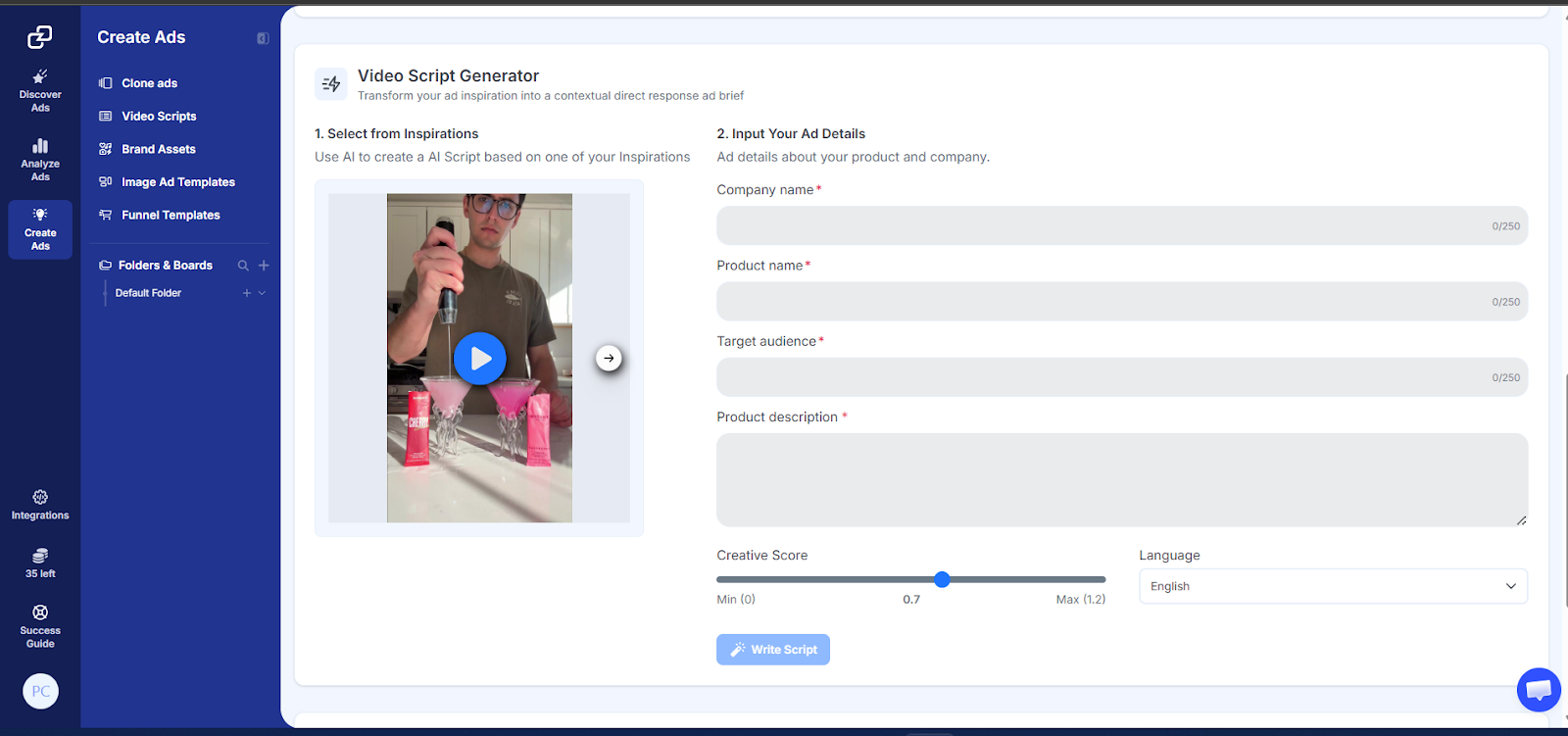
For teams producing AI or human-led video ads, GetHookd’s Video Scripts bridges the gap between research and production.
Built on an 8-figure AI copywriter framework, it generates hooks, angles, and complete scripts from your product details and target audience in seconds, so you are delivering a message grounded in what is already converting in your market.
Ad Copy & Headlines
AI performs well at generating copy variations within a proven structure. Given a strong brief and a clear audience, AI tools can produce multiple headline options and body copy variations that are functional and conversion-oriented.
Human copywriters write the headlines that stop people because they break the pattern. The unexpected angle, the counterintuitive framing, the line that feels like it was written for exactly this person at exactly this moment. That kind of specificity still requires human creative judgment.
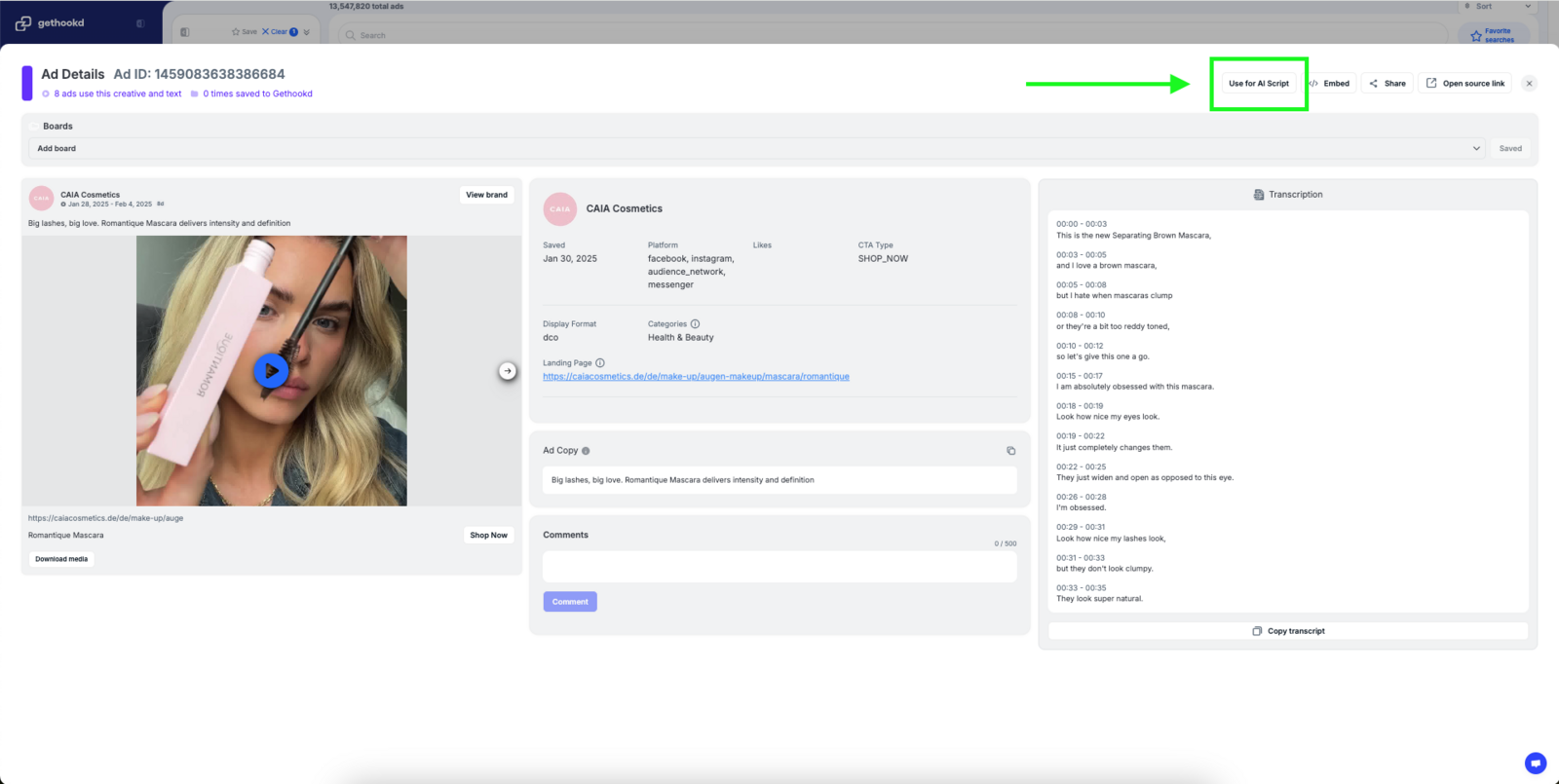
GetHookd’s Ads Transcription extracts the exact hooks, copy structure, and CTAs from ads that are already earning that response in the market, giving teams a real reference point rather than writing from assumption. It supports the human creative process rather than replacing it.
AI Ads vs Human-Created Ads: Comparison Table
| Factor | AI-Generated Ads | Human-Created Ads |
|---|---|---|
| Production Speed | Minutes | Days to weeks |
| Cost Per Asset | Low | Higher |
| Creative Scale | High volume, easy variation | Limited by team capacity |
| Brand Voice | Inconsistent without strong direction | Consistent with skilled team |
| Emotional Depth | Structurally sound, rarely surprising | Strong when concept is well developed |
| Cultural Nuance | Frequently misses without human oversight | Human strength |
| Best For | Testing, volume, variation, performance creative | Brand campaigns, complex storytelling |
Research Winning Ads & Scale Faster with GetHookd
Teams that lean toward AI production, human craft, or a combination of both all benefit from a research layer that determines the strength of the output. Creative decisions made without visibility into what is already working in your market are slower to validate and more expensive to test.
Our Explore Ads feature gives you access to 65M+ scored ads drawn from the Facebook Ad Library and beyond, filtered by niche, format, and performance signals. So every creative brief, whether handed to an AI tool or a human copywriter, starts from real market intelligence. Brand Spy shows which concepts competitors are actively allocating budget to, so you are not building in a vacuum, regardless of how the final asset is produced.
When you are ready to produce, Video Scripts and Clone Ads handle AI-powered creative generation directly inside the platform. Our ready-to-use static ad and funnel templates give you proven starting points for launching faster without having to build from scratch.
Once campaigns are live, connect our Creative Analyzer tool to your Meta ad account to surface which creatives are driving results, so the feedback loop between research, production, and performance stays closed.
Start creating winning ads with GetHookd today.
Frequently Asked Questions (FAQs)
Can AI-generated ads perform as well as human-created ads?
In performance-focused campaigns where the goal is testing, volume, and conversion optimization, AI-generated ads regularly match and sometimes outperform human-created ads.
The advantage shifts toward human creativity when the campaign requires emotional depth, cultural nuance, or storytelling. The most consistent results come from teams using both, with AI handling production scale and humans directing strategy and refining output.
What types of businesses benefit most from AI ad generators?
eCommerce brands, dropshippers, and performance marketing agencies see the clearest gains because their workflows depend on high creative volume, frequent testing, and fast iteration.
Any business running campaigns at scale where creative fatigue is a recurring problem benefits from AI production tools.
What is the best AI tool for generating ads in 2026?
The best AI tool depends on what your workflow needs most. For teams that need competitor intelligence alongside creative production, GetHookd is the strongest option.
Our platform combines a 65M+ ad database, Brand Spy for competitor scaling intelligence, AI-powered creative tools, and Creative Analyzer for performance insights, all in one place.
Can I use GetHookd to spy on competitor ads?
Yes. GetHookd’s Brand Spy is built specifically for this. It shows you which ads your competitors are actively scaling, including their top creatives, landing pages, and traffic sources.
This way, you can reverse-engineer what is working in your market and apply those signals to your own campaigns.
*Note: Pricing and/or product availability mentioned in this post are subject to change. Please check our website for current pricing and stock information before making a purchase.