Key Takeaways
- AI-generated UGC is now subject to FTC enforcement and disclosure timing is the most common compliance gap brands overlook. Place the label before the consumer engages, not buried after the “see more” cutoff.
- The FTC’s disclosure trigger is how content functions in front of an audience, not how much human editing follows generation.
- Purely AI-generated content has no copyright protection in the United States and can be freely copied or redistributed by anyone.
- If your content reaches EU audiences, comply with the EU AI Act standard across all markets rather than managing separate protocols by jurisdiction.
- Before you build anything, study what’s already running. GetHookd gives you access to 65M+ Meta ads through Explore Ads and Brand Spy, so you can see exactly how brands in your niche are structuring and disclosing AI-assisted creatives.
What Counts as AI-Generated UGC
Ensuring compliance with AI-generated UGC regulations comes down to three obligations: disclose AI involvement clearly and early, document the human creative decisions in your process, and keep pace with FTC and platform policy updates as they evolve. The distinction that matters legally is not whether AI was involved at all, but how much human creative decision-making shaped the final output.
Staying compliant comes down to three things: disclose AI involvement clearly and early, document your process, and keep up with FTC and platform updates. The sections below break each one down. A video script in which a human used AI as a drafting tool and then rewrote 70% of it is in a very different legal position than a five-star review generated entirely from a prompt and published under a fictional customer name. Understanding where your content falls on that spectrum is the starting point.
GetHookd: Turn Competitor Intelligence Into Your Next Winning Ad
65M+ Ads Analyzed | 4.8★ G2 Rating | 4.5★ Trustpilot Rating

Stop Guessing. Start Scaling:
GetHookd reveals which ads your competitors are actively scaling—not just running. Spy on their best-performing creatives, landing pages, and traffic strategies, then turn proven concepts into testable campaigns in seconds with AI-powered script generation and creative cloning.What You Get:
- ✓ Brand Spy to decode competitor ad strategies in real-time
- ✓ AI script generation and ad cloning for instant variations
- ✓ Performance scoring based on actual ad behavior, not vanity metrics
- ✓ Creative Analyzer to identify and scale your top performers
Replace guesswork with intelligence. Build profitable ads that actually convert.
What Does the FTC Actually Require for AI-Generated Content?
The Federal Trade Commission has been the most active U.S. regulatory body on AI content standards. Its focus is on transparency and consumer protection, specifically preventing audiences from being misled about the nature of the content they are consuming.
The FTC’s position builds on its endorsement and testimonial guidelines, which have been updated to explicitly address AI-generated content. The core principle is simple:
- If content could mislead a consumer, it requires disclosure. AI-generated reviews, testimonials, and sponsored posts fall into this category.
- AI-generated testimonials must be clearly identified as artificial rather than real customer experiences.
- Endorsements produced or amplified by AI must disclose that AI was involved.
Disclosures must be clear and conspicuous, meaning buried text, small-print labels, or end-of-caption placements do not meet the standard.
The FTC has explicitly called out fake reviews generated by AI as a deceptive practice subject to enforcement action.
The practical trigger for disclosure is audience perception. Ask whether a reasonable consumer would believe this content reflects a genuine human experience or opinion. If yes, disclosure is required regardless of how much human editing was applied after generation.
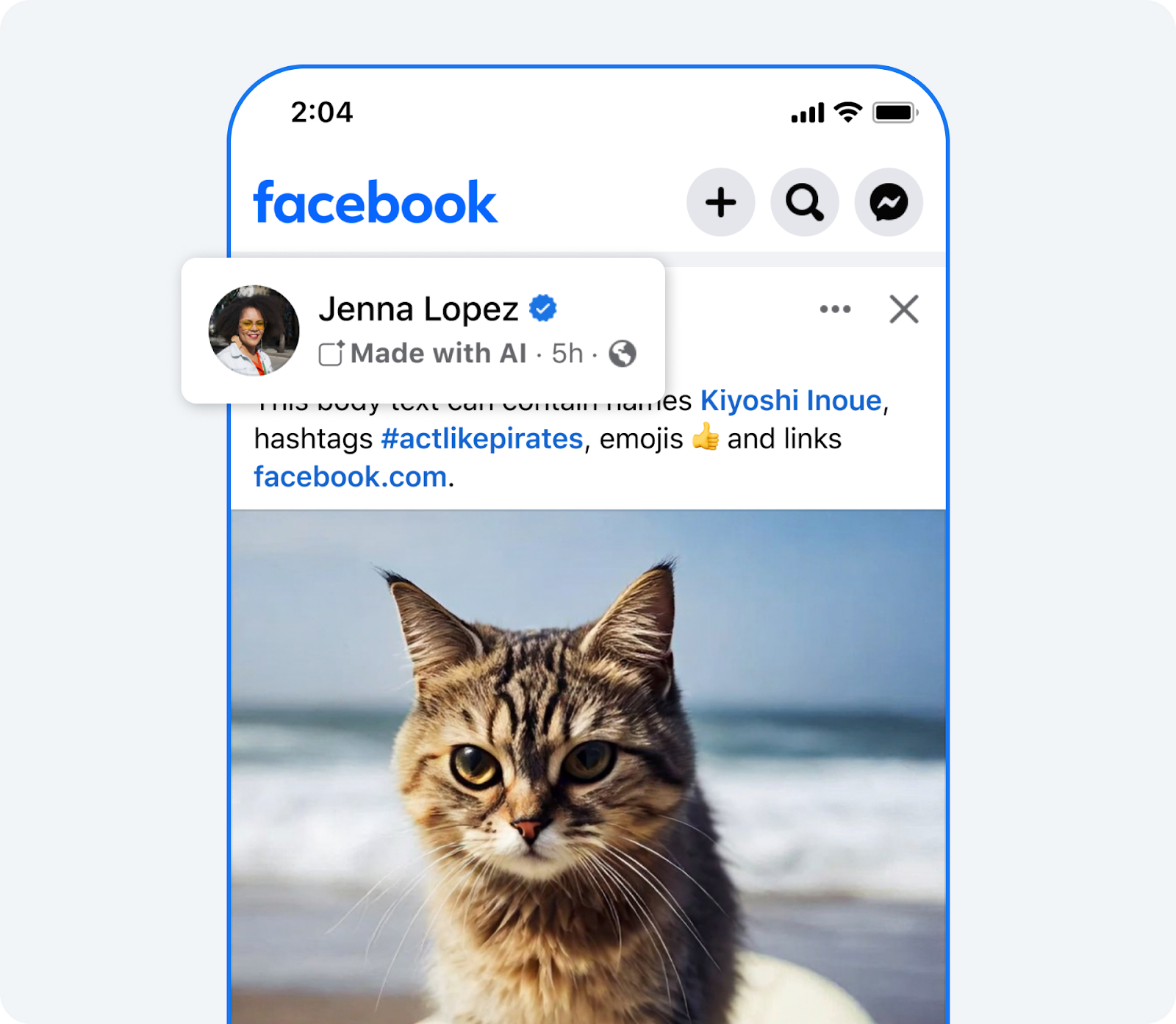
On placement: the FTC requires disclosure to appear before the consumer engages with the content.
- On a social post, that means the first line, not after the “see more” cutoff.
- On a video, it means an on-screen label in the opening seconds, not the description box. This single adjustment closes the most common FTC compliance gap brands don’t know they have.
The FTC finalized its rule targeting fake reviews, including AI-generated testimonials, in August 2024, with the rule taking effect in October 2024. It applies to both brands and the agencies creating content on their behalf.
Copyright Rules for AI-Generated Content
The U.S. Copyright Office has been explicit: AI alone cannot hold copyright. Content generated entirely by AI with no human creative input has no copyright protection, meaning anyone can legally copy, repurpose, or redistribute it freely. Content where a human made meaningful creative selections, edits, or arrangements may qualify for protection, but only for those human-authored elements.
This was established through the Zarya of the Dawn case, where copyright was granted only to the human-written text of an AI-assisted comic, not to the AI-generated images. The Copyright Office has since reinforced that prompts alone do not constitute sufficient human authorship, regardless of how detailed or iterative the prompting process was.
Document every step of your process: save your original prompts, keep version histories showing your edits, and note which elements were AI-generated versus human-written. That paper trail is the evidence you would need if your content is ever copied or disputed.
Does Your Content Reach EU Audiences? Here’s What That Means for Compliance
If your content reaches audiences outside the United States, you are operating under multiple regulatory frameworks at once.
The EU AI Act entered into force on August 1, 2024, with phased enforcement obligations beginning in February 2025. It is the most comprehensive AI regulation currently in force, classifying AI systems by risk level and imposing strict transparency obligations on applications that influence consumer behavior. Content creators targeting EU audiences must disclose when content is AI-generated, particularly in advertising contexts.
The UK applies existing consumer protection and advertising standards frameworks rather than AI-specific legislation. However, the Advertising Standards Authority has made clear that misleading AI-generated ads are treated the same as any other deceptive advertising.
The most practical approach for brands operating internationally is to comply with the strictest applicable standard and apply it uniformly. When your content meets the highest bar, it meets most bars by default.
How to Build a Simple AI UGC Compliance Process

1. Conduct an AI Usage Audit
Start by mapping every point in your content workflow where AI tools are currently being used, including text generation, image creation, voiceover synthesis, and video editing.
List the specific platforms and note what type of content each produces. This gives you a clear picture of your actual compliance exposure, which is almost always different from what teams assume.
2. Set Up a Documentation System
Once you know where AI is being used, capture human creative involvement at each stage. A shared folder structure with naming conventions that include dates, version numbers, and a brief note on what was AI-generated versus human-edited is enough to establish a defensible record.
For teams producing at scale, a simple logging template covering the tool used, the original prompt, the edits made, and the final published version creates an audit trail that supports both copyright and FTC compliance requirements.
3. Train Your Team
Train your team on why the rules exist. A short session covering FTC disclosure requirements, copyright basics, and your documentation system is enough to align a team.
Refresh this training every six months. Regulations have moved quickly enough that guidance from a year ago may no longer hold.
4. Set a Quarterly Review Schedule
Set a quarterly reminder to review FTC guideline updates, platform policy changes on the channels where you publish most, and any new legislation in jurisdictions where your audience is concentrated. This takes roughly an hour per quarter and prevents policy drift from turning into violations you didn’t see coming.
Create Smarter AI-Generated Content With GetHookd
You now have the framework: disclose early, document everything, and review quarterly. The harder part is knowing what compliant AI content actually looks like in your category before you produce it. That’s where GetHookd’s Explore Ads feature gives you a direct advantage: 65M+ Meta ads searchable by niche, format, and performance signal, so you can study how brands in your market are structuring and disclosing AI-assisted creatives before you build your own.
Brand Spy shows you which ads competitors are actively scaling and which landing pages they drive to, giving you real market context that informs both your creative direction and your understanding of the disclosure standards in your category.
When you move into production, our Video Script Generator starts from your documented brand profile and audience parameters rather than an open-ended prompt, making your human review step faster and your output easier to account for.
Start your GetHookd free trial today.
Frequently Asked Questions (FAQs)
What counts as AI-generated UGC for compliance purposes?
Any content where an AI system played a significant role in creating the final output, including text, images, video, and audio, counts. The compliance threshold is not binary. The closer the content sits to being fully AI-generated, particularly when it functions as a review or testimonial, the more clearly disclosure and documentation requirements apply.
Does the FTC require disclosure for all AI-generated content?
No. FTC disclosure requirements are triggered specifically by content that functions as an endorsement, testimonial, or review, or content that could mislead consumers about its origin. General informational content produced with AI assistance does not automatically require disclosure, but if AI-generated content promotes a product or simulates a customer experience, disclosure is required regardless of how much human editing follows.
Can AI-generated content be copyrighted in the United States?
Purely AI-generated content with no human creative authorship cannot be copyrighted. Content that involves substantial human creative input alongside AI tools may qualify for protection, but only for the human-authored elements. If you publish fully AI-generated content without meaningful human involvement, anyone can copy or redistribute it freely.
Where should AI disclosure labels be placed to meet platform requirements?
The FTC standard applies regardless of platform: clear and conspicuous, before the consumer engages with the content. On social posts, disclosure belongs in the first line. On video, it belongs as an on-screen label in the opening seconds.
Can I use GetHookd to research what disclosed AI-generated ad content looks like?
Yes. GetHookd’s Explore Ads feature gives you access to 65M+ Meta ads searchable by niche, format, and performance signals. You can use it to study how brands in your category are structuring their ad content, including how they are handling disclosures on AI-assisted or synthetic creatives.
*Note: Pricing and/or product availability mentioned in this post are subject to change. Please check our website for current pricing and stock information before making a purchase.