How to Improve CTR on Facebook Ads: Tips & Strategies
Key Takeaways
- CTR directly influences your Engagement Rate Ranking in Meta’s ad auction, meaning stronger rankings lower costs and improve delivery.
- Cold, warm, and hot audiences need different creative approaches. Running the same ad to all three kills CTR.
- Your opening line of copy and first three seconds of video do most of the work. If the hook fails, the rest never gets seen.
- High CTR without post-click conversions is wasted budget. Track click depth, not just the raw number.
- GetHookd lets you research which creatives are already earning clicks across 65M+ Meta ads, extract proven hooks, and produce fresh variations so every test is grounded in real data.
What Is CTR & Why Does It Matter?
CTR stands for Click-Through Rate. It measures the percentage of people who saw your ad and clicked on it. The formula is straightforward: (Total Clicks ÷ Total Impressions) × 100. If 10,000 people saw your ad and 200 clicked, your CTR is 2%.
CTR is more than a percentage. It’s a performance signal that affects nearly every other metric in your campaign. When your CTR is high, Meta interprets that as a sign your ad is relevant to its audience. In return, you get lower Cost Per Click (CPC), more efficient delivery, and better distribution across placements. When CTR is low, you pay more for less.
Meta also evaluates your ads through Ad Relevance Diagnostics, which compares your ad against others competing for the same audience across three metrics: Quality Ranking, Engagement Rate Ranking, and Conversion Rate Ranking.
CTR most directly influences your Engagement Rate Ranking. When that ranking is strong, your ad’s total value in the auction increases, meaning you can win placements without having to outbid competitors on price alone.
GetHookd: Turn Competitor Intelligence Into Your Next Winning Ad
65M+ Ads Analyzed | 4.8★ G2 Rating | 4.4★ Trustpilot Rating

Stop Guessing. Start Scaling:
GetHookd reveals which ads your competitors are actively scaling—not just running. Spy on their best-performing creatives, landing pages, and traffic strategies, then turn proven concepts into testable campaigns in seconds with AI-powered script generation and creative cloning.
What You Get:
- ✓ Brand Spy to decode competitor ad strategies in real-time
- ✓ AI script generation and ad cloning for instant variations
- ✓ Performance scoring based on actual ad behavior, not vanity metrics
- ✓ Creative Analyzer to identify and scale your top performers
Strategies for Improving CTR on Facebook Ads
There’s no single lever that fixes a low CTR. It’s a combination of creative decisions, targeting precision, copy strategy, and technical setup.
1. Match Your Creative to the Right Audience Temperature
Audience temperature refers to how familiar someone is with your brand. Cold audiences have never heard of you. Warm audiences have visited your site or engaged with your content. Hot audiences have already purchased or are close to converting.
Running the same creative to all three is one of the most common CTR mistakes advertisers make.
- Cold audiences need pattern interruption and curiosity. Lead with a bold claim, a surprising statistic, or an emotionally resonant hook.
- Warm audiences respond better to social proof, urgency, and direct offers because trust has started to build.
- Hot audiences are close to a decision, so address objections, offer a direct incentive, or use testimonials that eliminate final hesitation.
2. Write Ad Copy That Stops the Scroll in the First Line
On Facebook, only the first one to two lines of your ad copy are visible before the “See More” prompt. If your opening line doesn’t earn that tap, your CTR is already lost.
The strongest opening lines do one of three things: call out the audience directly (“If you’re running Facebook ads and your CTR is below 1%…”), lead with a counterintuitive statement (“Your best-performing ad is probably killing your results.”), or open a loop that can only be closed by reading further.
Pair that with specificity. “Struggling to get results from your ads?” outperforms “Looking to improve your marketing?” every time because it speaks to a concrete pain point.
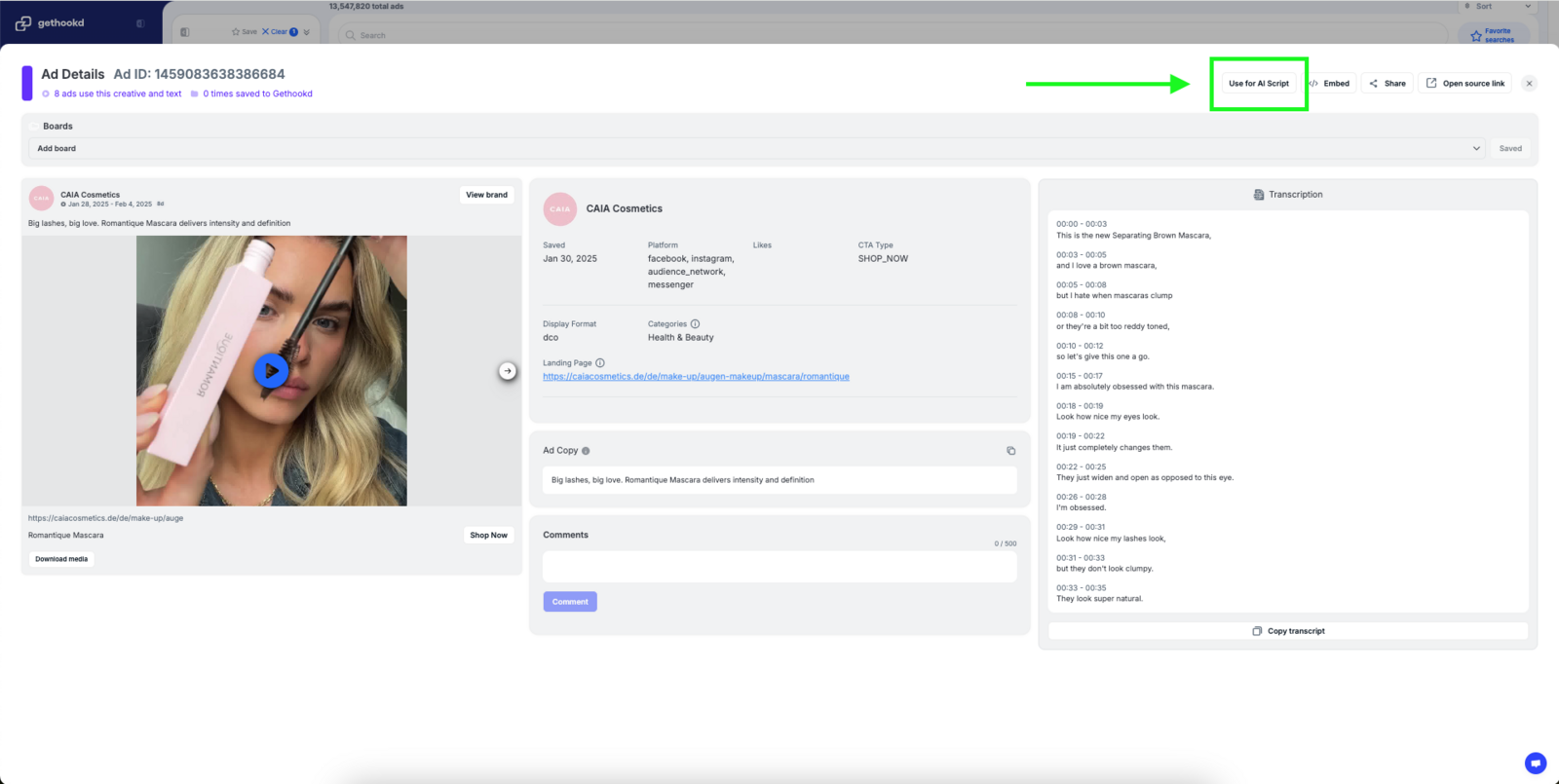
GetHookd’s Ads Transcription lets you extract the opening lines, hooks, and CTAs from competitor video ads scaling on Meta. Instead of writing hooks from scratch, you can study what’s already earning clicks in your niche and adapt proven openers for your own creative.
3. Use Visuals That Earn the Click
Video ads consistently drive stronger CTR than static images when the first three seconds are compelling. Lead with movement, a surprising visual element, or someone speaking directly to the camera.
Static images work best when they feature real people. Use bold contrast and minimal text, and avoid Facebook’s native blue and white color scheme.
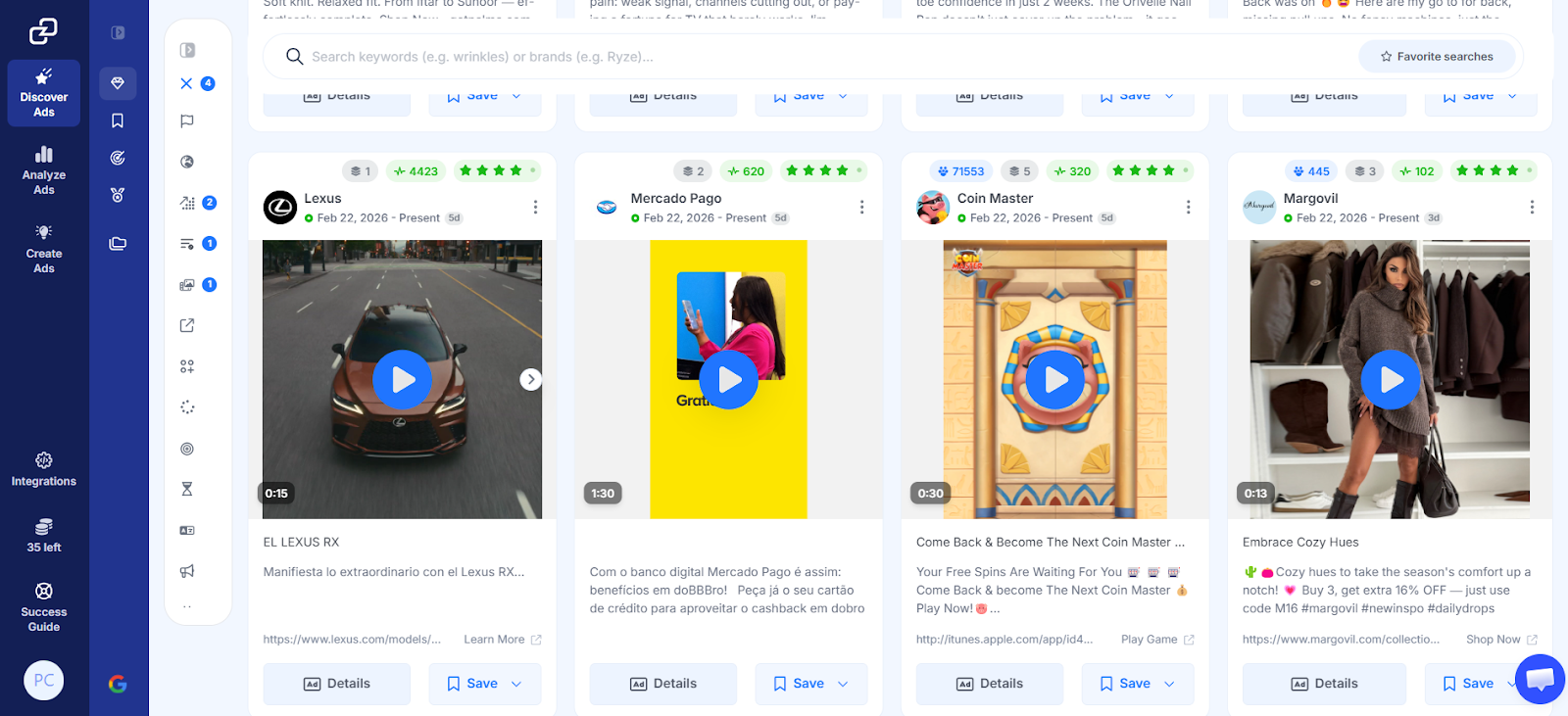
GetHookd’s Explore Ads lets you filter 65M+ Meta ads by format and niche to see which visual styles are performing right now. You can study the creative patterns driving engagement in your market before producing anything.
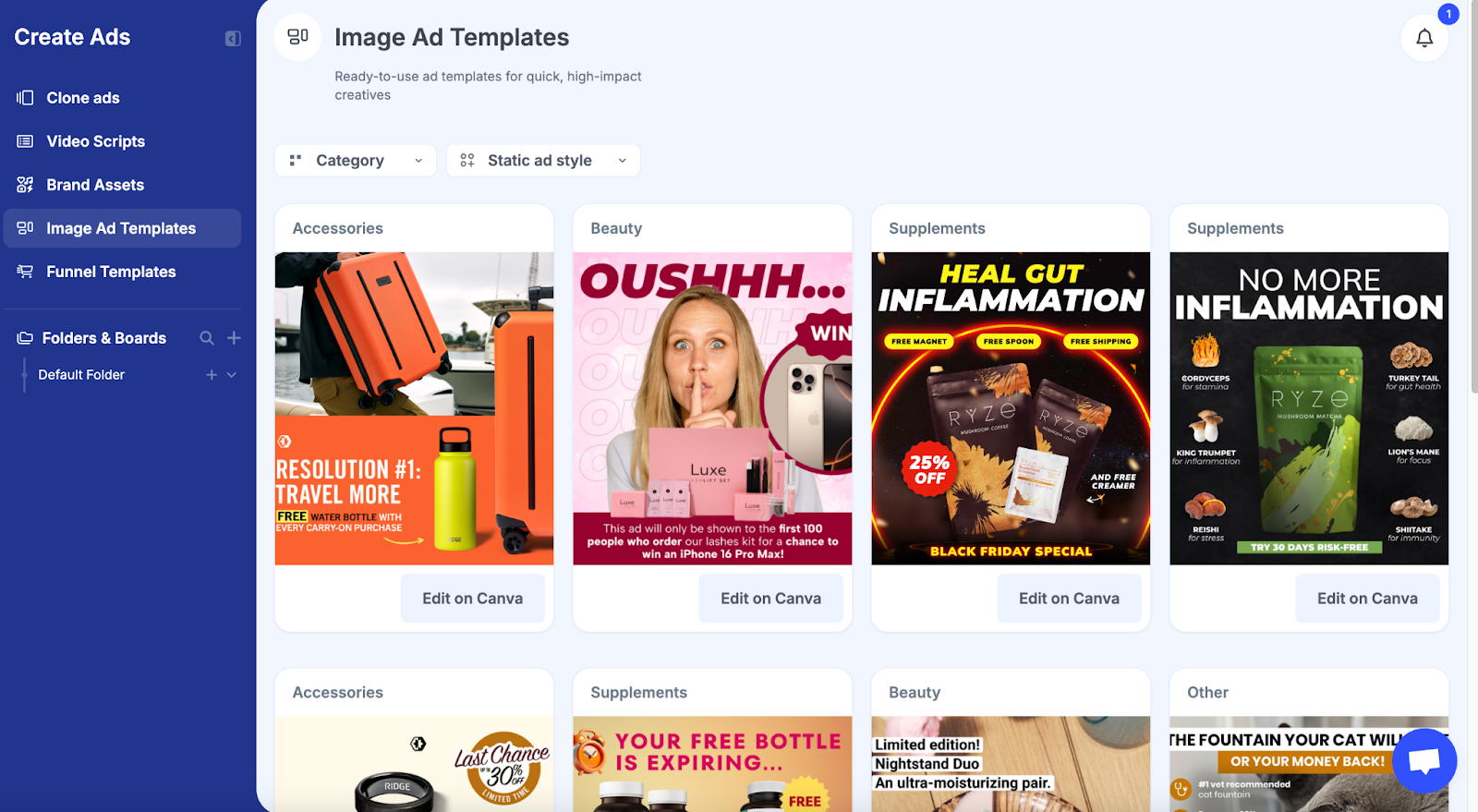
Image Ad Templates also gives you ready-to-use static ad designs across dozens of niches that you can edit directly in Canva.
4. Align Your Campaign Objective, Optimization Event, and CTA
When your campaign objective, optimization event, and CTA button are misaligned, you create friction that confuses both the algorithm and the user. Meta’s delivery system optimizes to find people most likely to complete your chosen objective. If that objective doesn’t match your actual desired action, you’re feeding the algorithm the wrong signal.
For top-of-funnel CTR testing, run a Traffic objective optimized for Link Clicks or Landing Page Views, paired with a CTA like “Learn More.” This tells Meta to find people who naturally click.
Landing Page Views is the stronger option of the two, since Meta only counts a view when the destination page actually loads, filtering out accidental or low-intent clicks.
Moving to a Sales objective too early narrows your audience and can suppress CTR even when your creative is strong. Once you’ve identified your highest-CTR creatives using a traffic-focused setup, migrate those winners into a Sales campaign optimized for conversions.
5. Test Smarter, Not More
Smart testing means isolating one variable at a time and letting each test reach statistical significance. Use Meta’s A/B Test feature rather than duplicating ad sets manually, which causes audience overlap and contaminates results.
Prioritize testing in this order for the fastest CTR gains: the opening hook, creative format (video vs. static vs. carousel), headline text, CTA button text, and visual style (UGC vs. branded vs. lifestyle).
6. Track Click Depth, Not Just CTR
A 4% CTR that sends users to a page they immediately bounce from is worth less than a 1.8% CTR that delivers visitors who convert. Use Meta Pixel event tracking and GA4 session data to understand post-click behavior.
If CTR is strong but conversions are low, the disconnect is almost always in one of three places: the landing page doesn’t match the ad’s promise, the audience clicking isn’t the audience that buys, or the offer needs refinement.
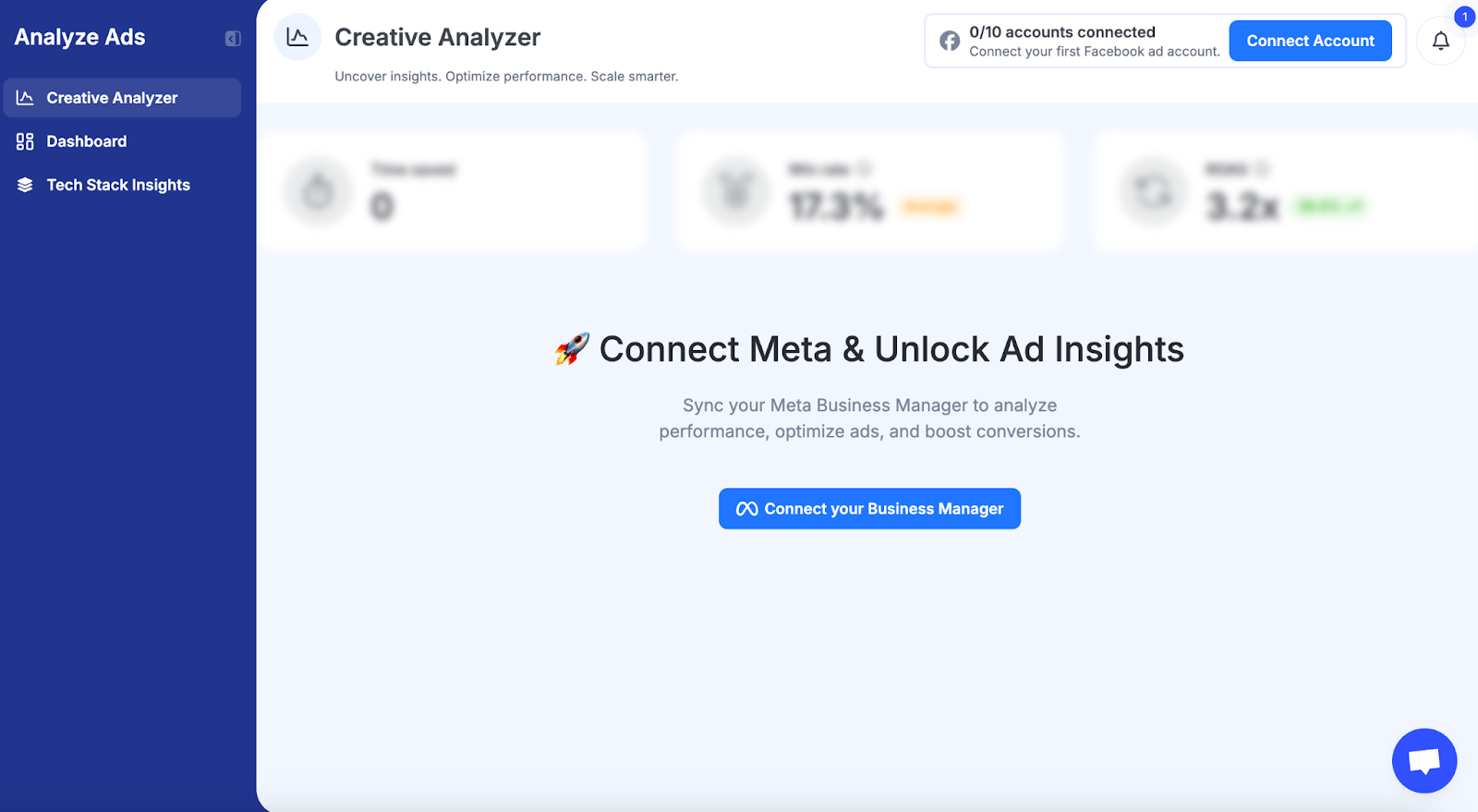
GetHookd’s Creative Analyzer connects to your Meta ad account and shows which of your creatives are driving real results, so you can separate high-CTR winners from high-CTR vanity performers.
Improve Your Facebook Ad CTR with GetHookd
Higher CTR starts with understanding what’s already earning attention in your market. Our Explore Ads tool gives you access to 65M+ Meta ads with granular filters, so you can pinpoint the creative patterns behind the strongest performers.
With Brand Spy, you can monitor the exact campaigns your competitors are investing in and monitor their strategies. Once you spot a high-performing concept, Ads Transcription breaks down the video ad into its component parts: the hook, the script flow, and the CTA, so you can see exactly what’s driving clicks.
On the static side, Clone Ads lets you spin up multiple variations of a single winning creative in different colors, layouts, and styles, while Image Ad Templates provides professionally designed starting points across dozens of niches.
And because CTR only matters if it leads to conversions, our Funnel Templates give you pre-built landing pages modeled on high-converting DTC flows, so the traffic your ads earn lands somewhere built to close the sale.
Start your GetHookd free trial today!
Frequently Asked Questions (FAQs)
How do I improve CTR in Facebook ads?
Start by matching your creative to your audience’s level of awareness. Cold audiences need curiosity-driven hooks, while warm audiences respond to social proof and direct offers.
From there, write opening copy that earns the “See More” tap, use scroll-stopping visuals, and make sure your campaign objective, optimization event, and CTA button are aligned so Meta delivers your ad to the right people.
What is the 3-2-2 method of Facebook ads?
The 3-2-2 method is a dynamic creative testing framework where you combine three creative variations (images or videos), two primary text options, and two headlines in a single ad set.
Meta’s algorithm then mixes and matches these elements to find the best-performing combination for each user. It’s a structured way to test multiple variables without creating dozens of separate ads or splitting your budget too thin.
What is a good CTR for Facebook ads?
A good CTR for Facebook ads depends on your campaign objective. Most marketers consider anything between 1% and 2% healthy, with 2.5% and above considered strong.
The more useful benchmark is your own historical data. If your CTR is improving while cost per result stays flat or drops, your ads are moving in the right direction.
Can I use GetHookd to test and refresh ad creatives faster?
Yes. GetHookd’s Video Scripts feature generates fresh hooks and complete scripts from your product details, so you always have new concepts to test. Clone Ads produces multiple AI variations of any winning static creative, and Image Ad Templates gives you ready-to-use designs across dozens of niches.
You can also connect Creative Analyzer to your Meta ad account to see which creatives are driving results, so you know exactly when to refresh and what to replace.
*Note: Pricing and/or product availability mentioned in this post are subject to change. Please check our website for current pricing and stock information before making a purchase.