
Key Takeaways
- Carousel ads typically win on conversion rate and ROAS, while video ads win on engagement and click-through rate. Videos get the click, but carousels close the sale more often.
- The funnel stage determines the right format. Use carousels in the mid- and bottom-funnel for retargeting, multi-product showcases, and feature breakdowns. Use video at the top of the funnel for prospecting, demos, and brand storytelling with cold audiences.
- Cost differences are significant. Video ads cost 24% more per purchase than image-based formats and incur higher production costs, while carousels often deliver the lowest customer acquisition cost when paired with a clear offer.
- The most reliable answer for any specific audience is to run both formats in parallel against the same offer for 72 hours, with sufficient spend to achieve statistical clarity. Format opinions mean less than what the data actually shows.
- At GetHookd, we help media buyers spot which formats competitors are actively scaling across 65M+ Meta ads, so you stop guessing and start testing what already converts.
Picking the Right Meta Ad Format at a Glance
Carousel ads win on conversion rate and ROAS; video ads win on engagement and click-through rate. The format you choose should be dictated by where the buyer sits in your funnel, not by which one your team is more comfortable producing; a mismatch is one of the most common reasons Meta campaigns underdeliver.
The deeper trade-off most marketers miss is signal quality. Video gives Meta richer optimization data (3-second views, 10-second views, completion rate), while carousels generate swipe and link-click events. That difference is why video tends to find new buyers faster on cold traffic, while carousels squeeze more revenue out of warm audiences who already know you.
Below, we break down the performance gaps, exact use cases, and a side-by-side comparison table, plus how GetHookd lets you see which format competitors are actually scaling in your niche before you commit budget.

GetHookd: Turn Competitor Intelligence Into Your Next Winning Ad
GetHookd reveals which ads your competitors are actively scaling—not just running. Spy on their best-performing creatives, landing pages, and traffic strategies, then turn proven concepts into testable campaigns in seconds with AI-powered script generation and creative cloning.
What You Get:- ✓ Brand Spy to decode competitor ad strategies in real-time
- ✓ AI script generation and ad cloning for instant variations
- ✓ Performance scoring based on actual ad behavior, not vanity metrics
- ✓ Creative Analyzer to identify and scale your top performers
What Are Facebook Carousel Ads?
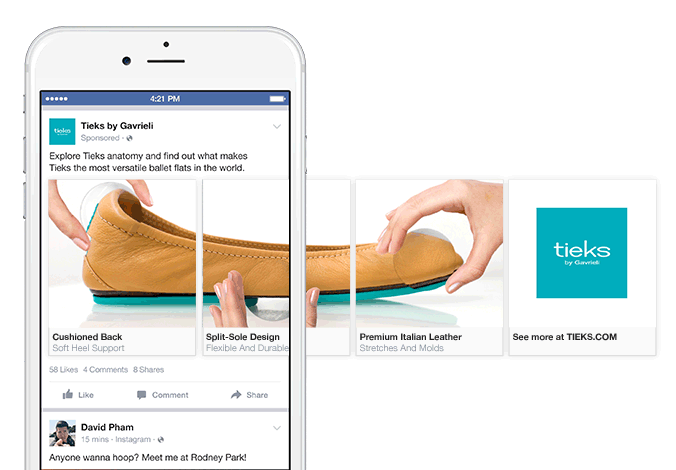
Meta carousel ads are a swipeable format that display 2 to 10 images or videos within a single ad unit across Facebook, Instagram, Messenger, and the Audience Network. Each card includes its own headline, description, link, and call to action, letting advertisers showcase multiple products or tell a sequential story.
Carousels work well because users actively interact with them. Swiping creates engagement events that signal interest to Meta’s delivery system, and every card gives the viewer another chance to click through. Three to five cards typically hit the sweet spot for storytelling and interaction, though the optimal count varies by offer and placement.
Common use cases include:
- Product catalogs with multiple SKUs
- Feature or benefit breakdowns for a single product
- Step-by-step tutorials or how-it-works sequences
- Before-and-after comparisons
- Retargeting sequences with multiple offers
What Are Facebook Video Ads?
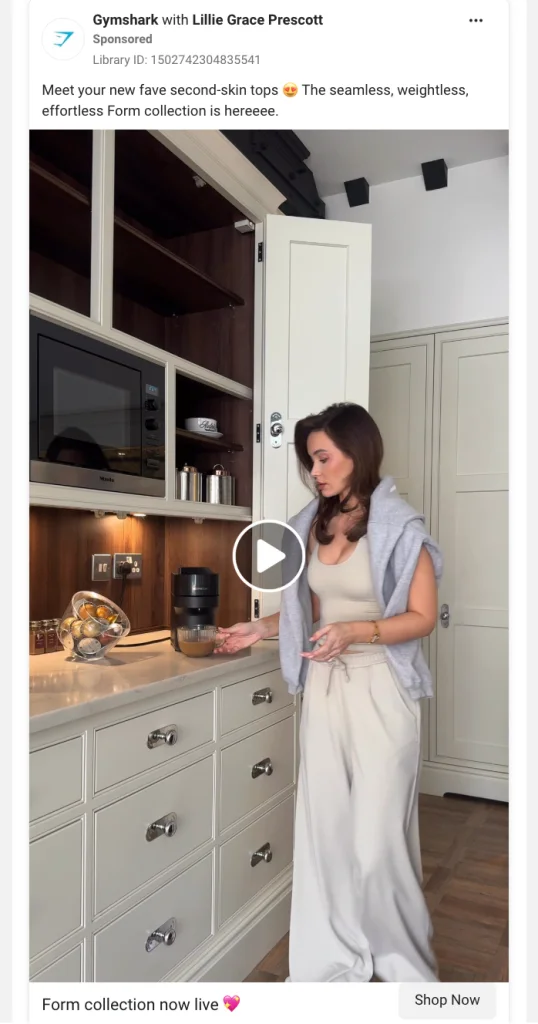
Video ads play a single clip in any Meta placement, typically running 6-60 seconds in paid social. They rely on motion, sound, captions, and pacing to grab attention in the first few seconds and keep viewers watching long enough to convert.
Video gives Meta richer optimization signals (3-second views, 10-second views, completion rate) than static formats, while carousels generate swipe engagement events that signal interest. That signal density is one reason video performs well with cold-prospecting audiences, where Meta needs more data to find your buyer.
Video also excels at user-generated content (UGC), demos, founder-led talking head ads, and emotional storytelling. The trade-off is production. Filming, editing, and iterating on video creative costs more time and money than producing a four-card carousel.
Carousel vs Video Facebook Ads: Performance Differences
Performance benchmarks across the industry show a consistent pattern. Video ads drive the most engagement due to their dynamic nature, with carousel ads following closely behind. Carousel ads outperform both image and video ads in conversion rate and ROAS, as they showcase multiple products or features in a single ad, increasing the likelihood of conversion. Video ads, despite having the highest CTR, deliver the lowest ROAS, indicating that engagement does not always translate into profitability.
Put plainly: video gets the click, but carousel often closes the sale. Three core differences explain why.
1. Engagement & Click-Through Rate
Video ads consistently win on thumb-stop rate and CTR because motion captures attention faster than a static image. Carousels still outperform single-image ads on click-through rate by a wide margin, with engagement levels significantly higher than regular picture ads. Each swipeable card is its own clickable surface, which multiplies entry points into your funnel.
2. Conversion Rate & ROAS
Carousels typically convert better for direct-response campaigns. The format lets you stack proof points, show product variations, or walk a buyer through features without forcing them off the ad. Video can convert well, too, but it often carries higher CPMs and longer production cycles, which raise the bar for ROAS.
3. Cost Per Acquisition
Video ads, on average, have a higher cost-per-purchase than image-based ads, and according to a Confect analysis of 12.7B+ Meta ad impressions, video ads cost roughly 24% more per purchase than image-based format, particularly for higher-production clips. Carousels sit in the middle of CPM but often deliver the lowest customer acquisition cost when paired with a clear offer.
Carousel vs Video Facebook Ads: When to Use Each Format
Choosing between the two comes down to your funnel stage, offer type, and creative budget.
When to Use Carousel Ads
Carousels are strongest in the middle and bottom of the funnel, where the buyer already knows you and needs reasons to convert. Reach for carousels in these situations:
- You sell multiple products in the same category and want to highlight several SKUs in one ad.
- Your product has several features or benefits that need separate explanation.
- You are running retargeting campaigns and want to surface different offers to warm audiences.
- You have static assets ready but no video production budget.
- You want to tell a sequential story without filming a clip.
When to Use Video Ads
Video earns its spot at the top of the funnel, where you need to stop the scroll, build trust, and introduce your brand to cold audiences. Use video when:
- You are prospecting a cold audience that has never heard of your brand.
- Your product needs a demonstration to make sense (software, supplements, tools).
- You have strong UGC, founder content, or customer testimonials.
- You want to retarget viewers based on how much of the video they watched.
- Your offer benefits from emotional storytelling rather than feature listing.
Best Practices for Both Formats
Whichever format you run, a few rules apply across both.
- Hook fast. Your first card or your first three seconds is doing most of the work. Test multiple hooks against the same offer to identify which one stops the scroll.
- Match the format to the message. A demo belongs in a video. A product range belongs in a carousel. Forcing the wrong format onto the wrong message kills performance regardless of how good the creative looks.
- Test both in parallel. The most reliable answer for your specific audience is to run a carousel and a video against the same offer for 72 hours, with enough daily spend to achieve statistical clarity. Let the numbers, not opinions, decide.
- Study what already works. Before you write a brief, look at what your competitors are scaling. Long-running ads are the clearest signal of profitability you can find without access to someone’s ad account.
Carousel vs Video Facebook Ads: Comparison Table
| Factor | Carousel Ads | Video Ads |
| Best For | Mid and bottom funnel, retargeting, multi-product | Top of funnel, prospecting, demos, storytelling |
| Engagement | High (swipe interactions) | Highest (thumb-stop, view duration) |
| Click-Through Rate | High | Highest |
| Conversion Rate | Typically highest | Moderate |
| ROAS | Typically strongest | Lower on average |
| Production Cost | Low to medium | Medium to high |
| Optimization Signals to Meta | Swipe events, link clicks | View duration, completion, engagement |
| Card or Length Range | 2 to 10 cards | 6 to 60 seconds (paid) |
| Ideal Number of Variants per Test | 3 to 5 first-card variations | 3 to 5 hook variations |
How GetHookd Helps You Pick the Right Format Faster
The clearest signal of what works in your niche is what your competitors keep running. Carousel vs. video debates often stall because teams rely on general benchmarks rather than on the formats that are actually scaling in their own market. At GetHookd, we give media buyers and ecommerce operators direct access to that intelligence so format decisions become a research question, not a gut call.
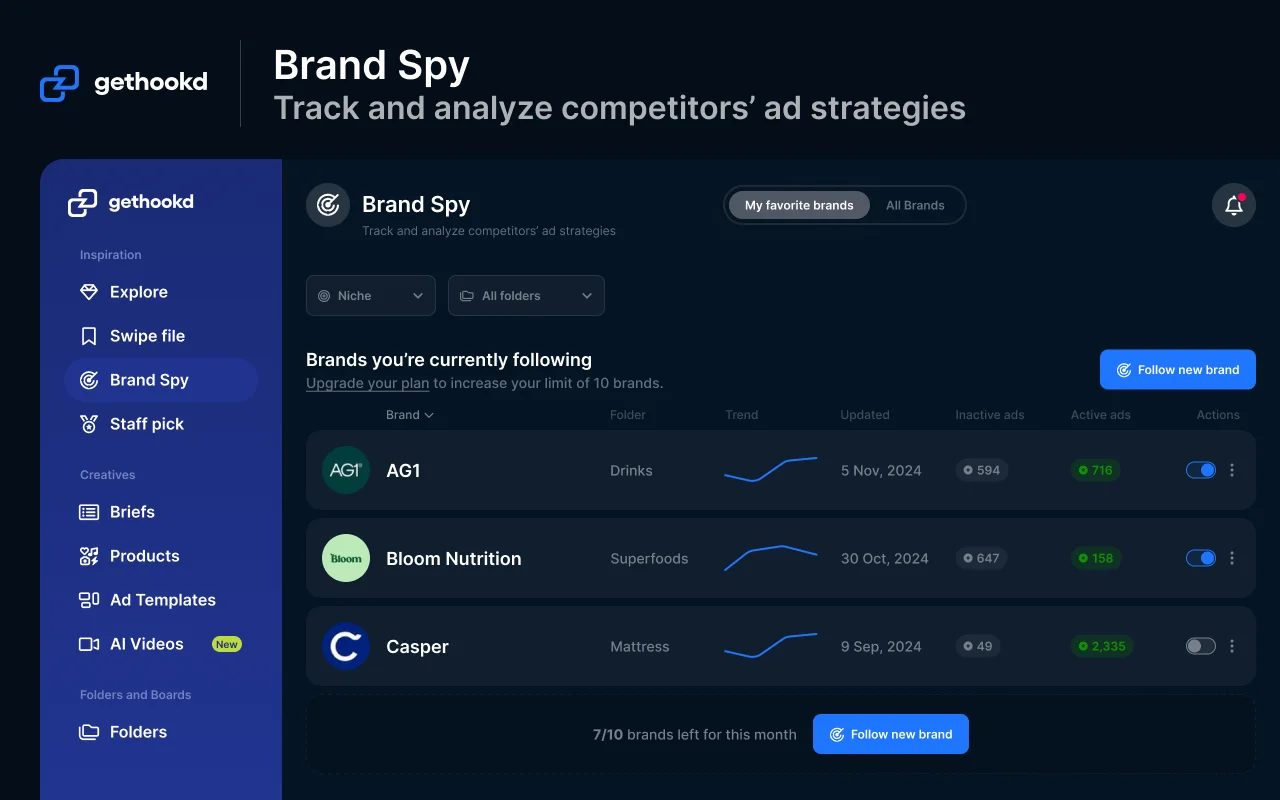
Our Brand Spy feature surfaces competitor ads with the longest run times, sorted by format, so you can see whether carousels or videos are dominating your space right now. From there, our Creative Analyzer connects to your Meta ad account to pinpoint which formats are pulling weight in your rotation, while Clone Ads and AI Video Scripts turn proven concepts into testable variations in minutes.
Start your GetHookd free trial today!
Frequently Asked Questions (FAQs)
Should I run carousel and video ads simultaneously?
Yes. Running both in parallel inside the same ad set or campaign gives Meta more creative variety to test against your audience. Format diversity often improves overall campaign performance because Meta can serve the format each user responds to best across placements.
How many cards should a Facebook carousel ad have?
Most performance marketers see the best results with three to five cards. Two cards feel incomplete, and going beyond seven often dilutes the message. Test card counts as variables in your creative experiments to find the right number for your offer.
Do video ads work better in Reels or Feed?
It depends on the creative. Vertical, fast-paced UGC and demos perform best in Reels and Stories. Longer, dialogue-heavy ads usually convert better in Feed, where users expect to watch with sound. Always shoot or crop video for the placement you are buying.
Can I automatically turn a carousel into a video?
Yes. Meta offers a setting that converts your static carousel into a video slideshow for the Facebook Feed placement. This gives you an extra creative variant from existing assets without having to film anything new.
How does GetHookd help me find winning carousel or video ads?
GetHookd gives you access to over 65 million Meta ads with filters for format, niche, and scaling signals, so you can see which carousels and videos competitors are running for the longest. GetHookd’s Brand Spy, Creative Analyzer, and AI script tools turn that intel into testable creatives in minutes.
*Note: Pricing and/or product availability mentioned in this post are subject to change. Please check our website for current pricing and stock information before making a purchase.