Carousel vs Single Image Facebook Ad: Benefits, Cost & Examples
Key Takeaways
- Carousel ads support up to 10 cards to showcase multiple products, tell a story, or highlight different features.
- Single-image ads work best for direct-response campaigns, brand awareness, or when you have a single clear message and limited creative resources.
- Carousel ads typically deliver higher conversion rates, while single-image ads are faster to produce and easier to test.
- The right format depends on your campaign objective, audience, and creative quality, not just the format itself.
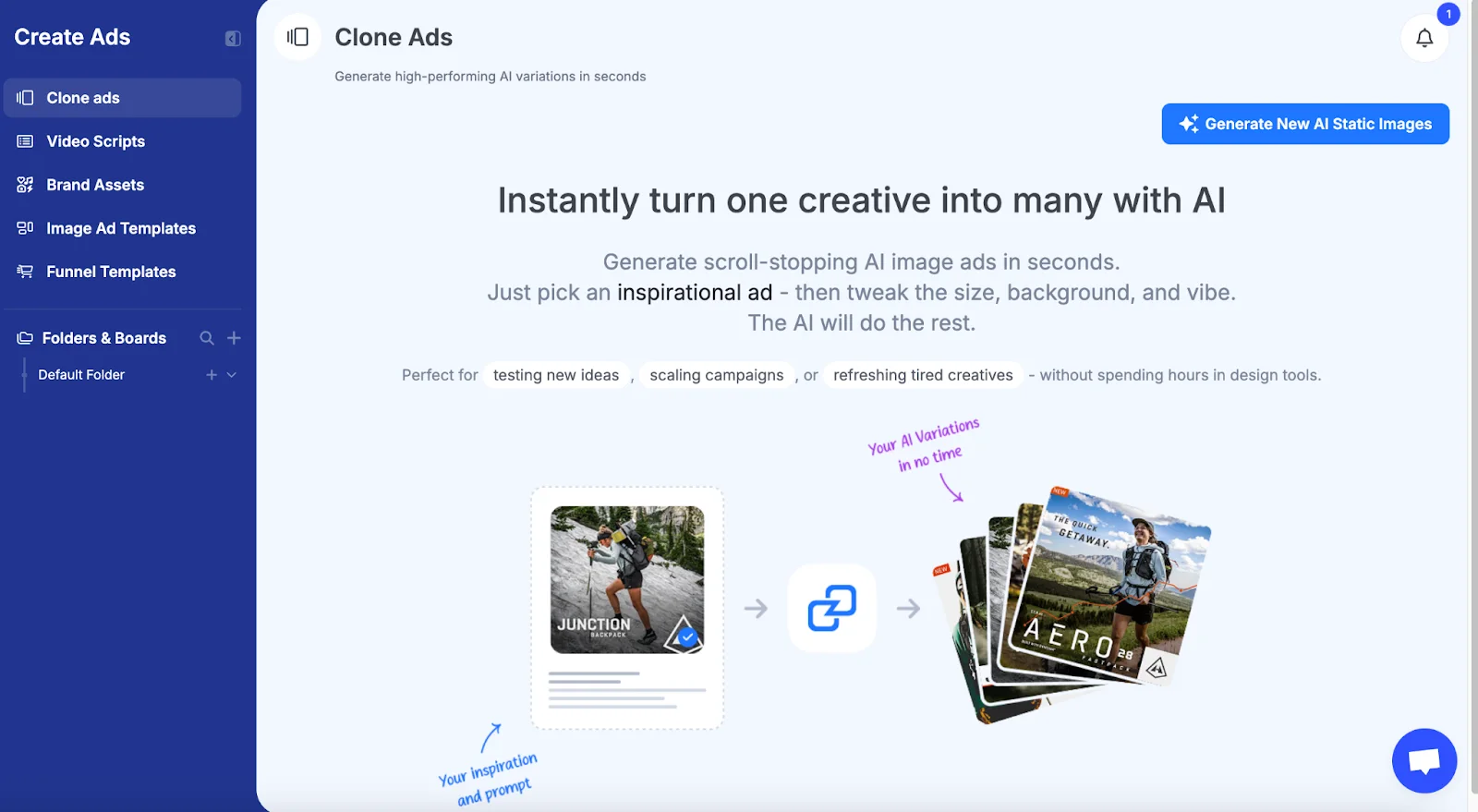
- With GetHookd, you can see which carousel and single image ads are performing in your niche, then use our AI-powered tools like Clone Ads and Image Ad Templates to create variations without starting from scratch.
Carousel vs Single Image Facebook Ad Explained
Carousel ads let you display multiple images or videos in a single swipeable unit, making them ideal for showcasing multiple items, features, or a step-by-step process. Each card includes its own headline and URL, enabling users to navigate to specific pages and supporting deeper storytelling or a purchase journey.
Single-image ads focus on a single clear visual and message, helping users understand the offer instantly. They load quickly, require minimal production, and are easy to test and iterate. For simple promotions, brand awareness pushes, or campaigns built around a single value proposition, they often perform well.
In comparison, carousel ads work best when you want users to explore options or understand variety, while single-image ads are stronger when you need speed, simplicity, and a focused pitch. The right format depends on whether your goal is a detailed showcase or immediate clarity.
GetHookd: Turn Competitor Intelligence Into Your Next Winning Ad
65M+ Ads Analyzed | 4.8★ G2 Rating | 4.4★ Trustpilot Rating

Stop Guessing. Start Scaling:
GetHookd reveals which ads your competitors are actively scaling—not just running. Spy on their best-performing creatives, landing pages, and traffic strategies, then turn proven concepts into testable campaigns in seconds with AI-powered script generation and creative cloning.
What You Get:
- ✓ Brand Spy to decode competitor ad strategies in real-time
- ✓ AI script generation and ad cloning for instant variations
- ✓ Performance scoring based on actual ad behavior, not vanity metrics
- ✓ Creative Analyzer to identify and scale your top performers
4 Benefits of Carousel Ads
1. Showcase Multiple Products in One Ad
Carousel ads let you display multiple products in a single ad unit. Customers can browse a mini-collection within your ad, increasing the likelihood they’ll find something relevant.
You can also group related products, such as complete outfits, furniture sets, or complementary accessories, so customers can visualize items in context. Feature different angles or color variations of the same product to mimic the in-store experience of examining items before purchase.
2. Tell a Sequential Story
Carousel ads work well for narrative-driven marketing that unfolds across multiple frames. Guide users through a problem-solution sequence, build anticipation, or create emotional connections through progressive imagery.
3. Highlight Different Features of One Product
For products with multiple selling points, carousels let you dedicate each card to a specific feature rather than cramming everything into a single image. This works particularly well for tech products, software, or services with multiple components.
Each card highlights a distinct capability, while the carousel maintains a cohesive look, so potential customers can focus on the features most relevant to them.
4. Create Interactive Experiences
The swipeable format encourages interaction and keeps users engaged longer than a static image. Each swipe is an active choice that signals interest rather than passive scrolling.
Some brands take this further with panoramic images split across cards or “choose your own adventure” style experiences; ads that users want to engage with rather than skip past.
3 Benefits of Single Image Ads
1. Run Direct Response Campaigns With One Clear CTA
When your campaign centers on a single action, such as app downloads, webinar registrations, or lead generation, single-image ads eliminate distractions and keep the focus on your call to action. One message, one image, one next step. Users quickly understand the offer without having to process multiple cards or options.
This clarity works well for direct response because there’s no competition between products or features for attention. You have just one offer paired with one clear action.
2. Build Brand Awareness With Minimal Messaging
For upper-funnel campaigns, single-image Facebook ads deliver memorable impressions efficiently. The format compels you to distill your brand into a single powerful visual, which can create stronger first impressions and better recall.
This works especially well with distinctive, emotion-driven imagery that communicates brand values without explanation. If you’re introducing your brand to a new audience, the uncluttered format ensures your core message isn’t diluted across multiple frames.
3. Launch Quickly With Limited Creative Resources
Single-image ads require less production time than carousel ads with multiple cards, and they support consistent branding and coordinated messaging. This makes them practical when you’re short on time or working with a small team.
The simpler format also makes A/B testing easier. You can test multiple single-image variations instead of investing all your resources in a single complex carousel.
Tools like GetHookd further accelerate this with Image Ad Templates and Clone Ads, which let you generate fresh variations from winning ads without starting from scratch.
Carousel Facebook Ad Examples
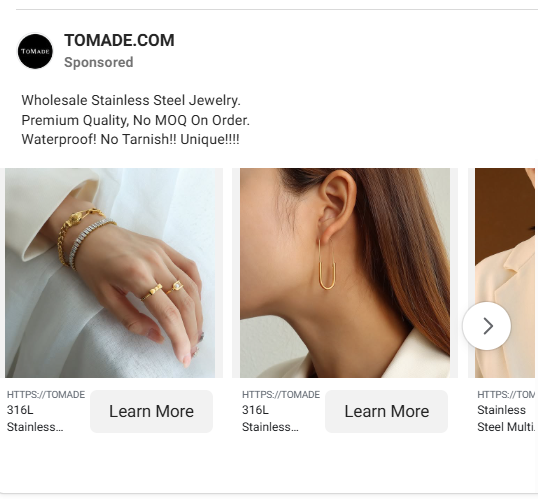
TOMADE uses a carousel to display different product categories: bracelets, earrings, and rings, without forcing users to visit separate pages. Each card highlights a different style, letting wholesale buyers browse the range quickly. The consistent aesthetic across cards (neutral backgrounds, similar lighting) keeps the ad cohesive while the variety encourages swipes.
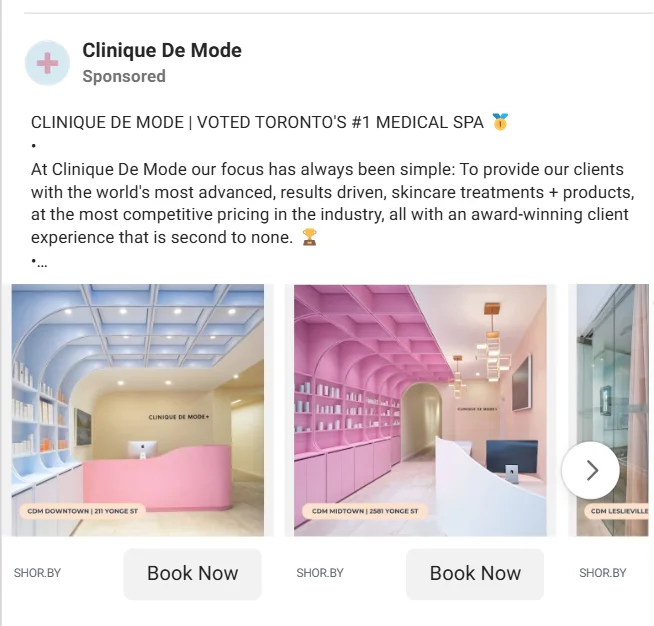
This medical spa uses carousel cards to showcase three different Toronto locations. Each card displays the interior design of a specific clinic, including its address, making it easy for users to find the nearest one. For service businesses with multiple locations, this format converts a single ad into a location selector. Users swipe to the most convenient option and book directly.
Single Image Facebook Ad Examples
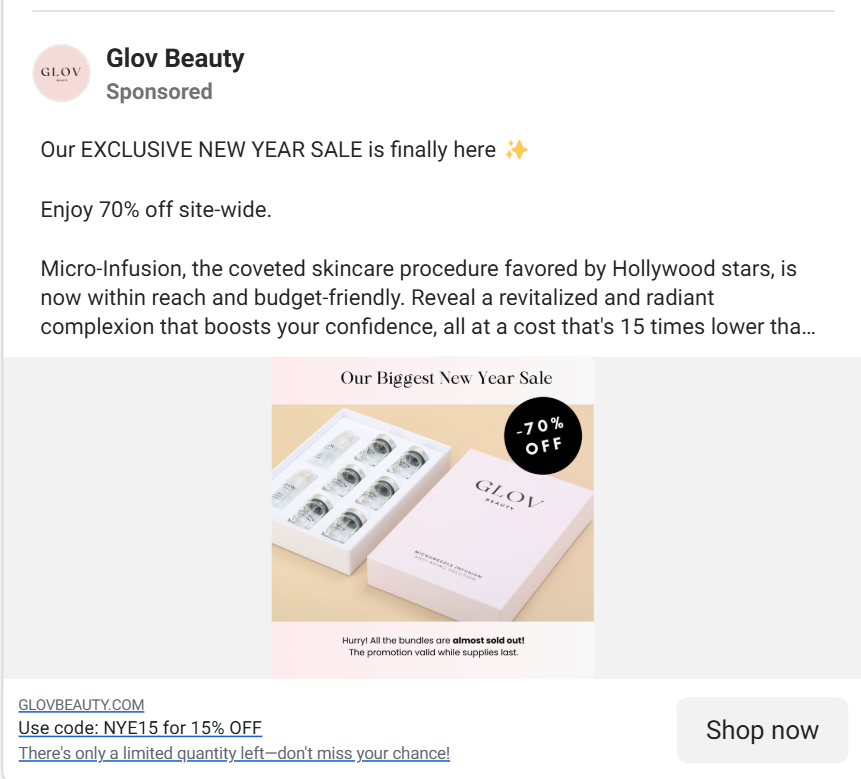
Glov Beauty runs a classic direct-response ad: big discount (70% off), promo code, and scarcity messaging (“almost sold out”). A single image keeps the focus on the offer rather than product variety. The visual shows the product packaging clearly, and every element, from the headline and image to the description, reinforces the same sale message. When the goal is conversions from a single promotion, a single image keeps the path simple.
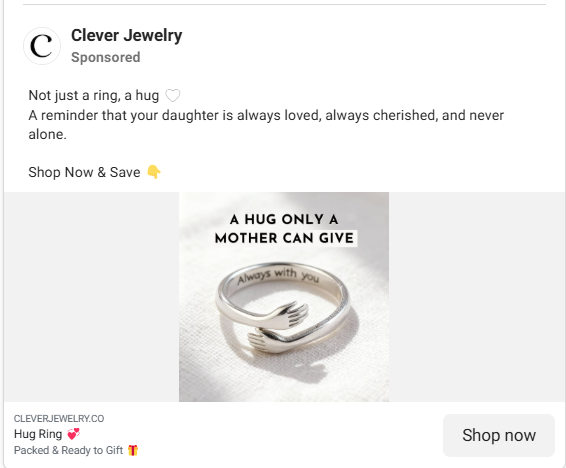
Clever Jewelry puts all attention on a single product: the “Hug Ring.” The image does the storytelling, while the copy reinforces the emotional angle (“A reminder that your daughter is always loved”). No distractions, no product grid. Just one ring, one message, and one CTA. This approach works when the product itself carries enough meaning to stand alone.
Cost Comparison: Carousel vs Single Image Facebook Ad
Ad costs depend on your industry, audience, creative quality, and campaign objective. But carousel ads typically deliver better cost efficiency for conversions. They generate up to 1.6x more clicks than single-image ads, with users swiping through an average of 3.2 cards per impression.
Carousel ads give users more content to engage with. More cards mean more chances to find something relevant, and more opportunities for Facebook’s algorithm to optimize delivery based on which cards perform best.
Single-image ads tend to convert less efficiently when the goal is purchases or leads. Where single-image ads shine is in simplicity: they’re faster to produce, easier to test, and often sufficient for brand awareness or single-offer promotions, where one strong visual is enough.
Since costs vary by niche and audience, the best way to evaluate which format delivers better ROI is to see what’s already working. GetHookd lets you filter ads by performance signals, so you can base decisions on real-world results rather than industry averages.
Carousel vs Single Image Facebook Ad: Comparison Table
| Factor | Carousel Ads | Single Image Ads |
|---|---|---|
| Best for | Multiple products, features, or storytelling | Single offers, promotions, and brand awareness |
| Production effort | Higher (multiple images, headlines per card) | Lower (one image, one message) |
| Conversion efficiency | Higher for e-commerce and lead generation | Moderate, but sufficient for simple campaigns |
| A/B testing ease | More complex (multiple variables per ad) | Simpler (one image, faster iterations) |
| Creative fatigue risk | Lower (more content keeps ads fresh longer) | Higher (single visual wears out faster) |
Find Winning Ads for Both Formats with GetHookd
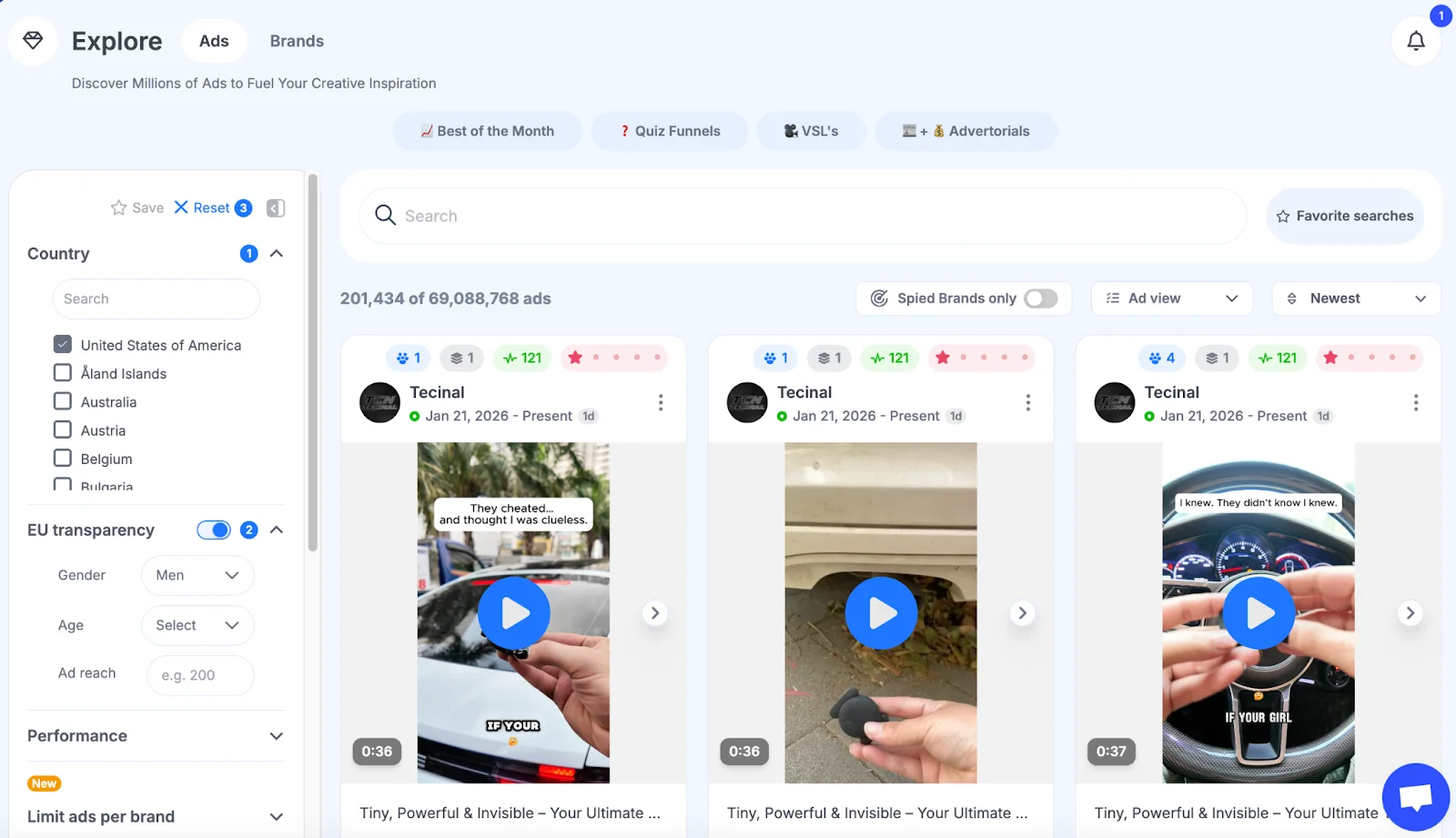
We built GetHookd for e-commerce brands, dropshippers, and agencies that want greater confidence in their creative decisions and less wasted on untested concepts. With our Explore Ads feature, you get access to over 65 million high-performing ads across Meta. You can filter by format, niche, and ROAS benchmarks to find proven examples without manually digging through Facebook Ad Library.
Use our Brand Spy feature to track competitors and see which formats they’re actively scaling. If a brand has been running the same carousel ad for months, that’s a signal. You can also see their landing pages and traffic sources to understand the full funnel, not just the creative.
Once you’ve found winning ads, you can save them to your Swipe File or act on them without leaving the platform. Clone Ads lets you replicate a winning ad, yours or a competitor’s, and tailor it to your promotion. You can generate dozens of variations with new colors, avatars, formats, and styles in seconds. If you’d rather not start from scratch, our Image Ad Templates give you proven static ad formats used by top brands across hundreds of niches.
For video ads, our AI Video Scripts feature writes high-converting scripts based on your product info. And if you find a video ad that’s clearly working, Ads Transcription pulls the hooks, copy, and CTAs so you can apply the same structure to your campaigns.
Frequently Asked Questions (FAQs)
How many images can I include in a Facebook carousel ad?
Facebook carousel ads can include between 2 and 10 images or videos. Each card can have its own headline, description, and destination URL.
The ideal number depends on your campaign objective. For product showcases, you can use 3 to 5 cards, while storytelling sequences may benefit from more cards to develop a complete narrative.
Do carousels perform better than single photos?
Carousels generally perform better in conversion-focused campaigns because they provide users with more content to engage with and more opportunities to click.
However, for brand awareness, single photos often work well due to their simplicity. The right choice depends on your audience, offer, and creative quality.
What is the difference between carousel and single image?
Carousel ads let users swipe through multiple images or videos within a single ad unit, while single-image ads feature one visual.
Carousels provide more space to showcase multiple products, tell a story, or highlight features. They also allow different destination URLs per card. Single-image ads deliver a more focused message and direct all traffic to one location.
What is the best image format for Facebook ads?
Use JPG or PNG files with a resolution of at least 1080 x 1080 pixels. Facebook recommends square images (1:1 aspect ratio) for most placements to ensure compatibility across devices.
Landscape format (1.91:1) also works for single-image ads. Keep text minimal on images. While there’s no hard limit, heavy text can reduce delivery.
Can GetHookd help me create carousel and single-image ads?
Yes. GetHookd gives you access to over 65 million ads across Meta, so you can see which carousel and single image ads are performing in your niche.
Our Brand Spy feature lets you track competitors and identify which formats they’re scaling. Once you find a winning ad, Clone Ads lets you generate brand-tailored variations or use our Image Ad Templates to launch proven static ad formats in minutes.
*Note: Pricing and/or product availability mentioned in this post are subject to change. Please check our website for current pricing and stock information before making a purchase.