Key Takeaways
- Facebook ads are working when Return on Ad Spend (ROAS) sits above break-even, Cost Per Acquisition (CPA) stays at target, and both hold as spend rises, not when reach and likes climb.
- Key Performance Indicator (KPI) monitoring means tracking a fixed set of numbers on a set schedule so you catch performance changes while you still have budget to correct them.
- The KPIs that matter fall into three groups: cost, creative, and conversion, covering measures such as cost per mille, hook rate, and conversion rate.
- Rising Cost Per Mille (CPM) with falling Click-Through Rate (CTR) and climbing frequency signals creative fatigue, while strong CTR paired with weak conversion rate points to the landing page instead.
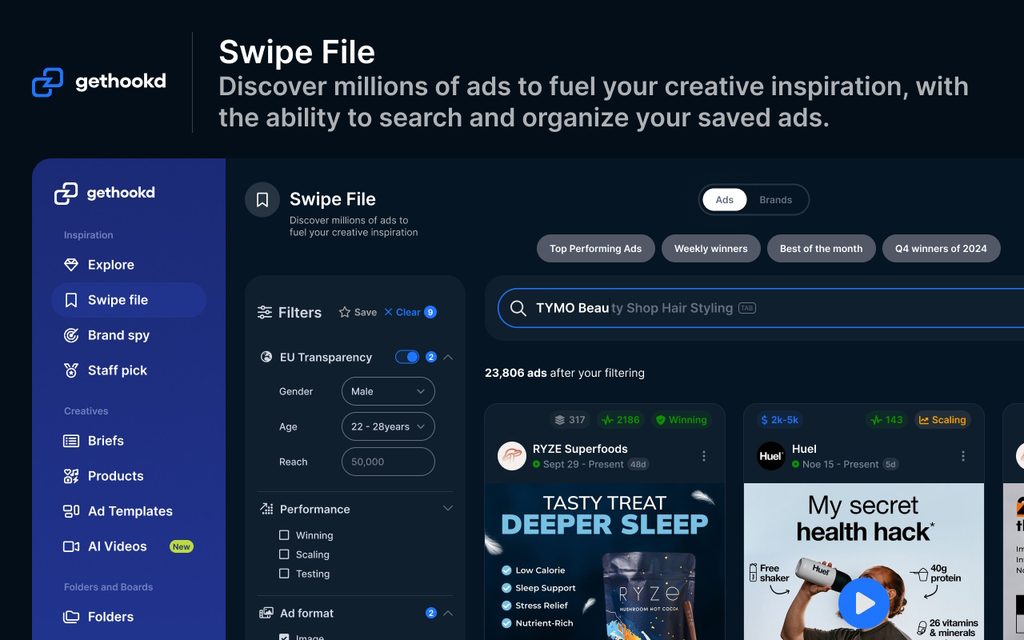
- GetHookd’s Brand Spy shows which competitor Facebook ads are receiving sustained spend, so you can swap fatigued creative for an angle already proven in the auction.
What Counts as a Working Facebook Ad?
A Facebook ad is working when it returns more revenue than it costs and keeps doing that as the daily budget grows. Return on Ad Spend (ROAS) and Cost Per Acquisition (CPA) answer that question directly, while likes, reach, and video views only measure attention. An ad can rack up strong numbers on all three of those and still lose money on every sale.
Most advertisers catch this too late because Meta’s dashboard reports revenue at the moment of purchase, before it subtracts refunds and returns. A campaign can look profitable in Ads Manager for weeks while the store’s actual numbers tell a different story. That gap only shows up when someone compares the two.
A dashboard full of accurate KPIs still leaves one gap: it flags the failing ad but not the replacement. GetHookd solves that by surfacing the competitor ads on Facebook that are pulling real, sustained spend right now, so your next test isn’t a blind guess against an audience that already tuned out the last one.

GetHookd: Turn Competitor Intelligence Into Your Next Winning Ad
GetHookd reveals which ads your competitors are actively scaling—not just running. Spy on their best-performing creatives, landing pages, and traffic strategies, then turn proven concepts into testable campaigns in seconds with AI-powered script generation and creative cloning.
What You Get:- ✓ Brand Spy to decode competitor ad strategies in real-time
- ✓ AI script generation and ad cloning for instant variations
- ✓ Performance scoring based on actual ad behavior, not vanity metrics
- ✓ Creative Analyzer to identify and scale your top performers
How to Know if Your Facebook Ads Are Working?
Check 1: Is Your Tracking Reporting Accurately?
Confirm the Meta Pixel and Conversions API are both firing, and that purchase events are deduplicated. A duplicated event doubles reported revenue and keeps a losing campaign looking profitable for weeks.
Re-check after every theme update, checkout change, or app install. Tracking can break silently, and the dashboard reports missing conversions as a performance drop rather than a data problem.
Check 2: Is ROAS Above Break-Even?
Break-even ROAS is average order value divided by gross profit per order. A campaign below that number buys revenue at a loss, no matter how healthy total sales look.
Compare against your own break-even ROAS, not an industry average. A 2.1 ROAS can be profitable for a high-margin product but unprofitable for a thin-margin one.
Account for refunds and returns before treating the figure as final. Ads Manager reports revenue at the point of purchase, so categories with high return rates show a ROAS well above what the business actually kept.
Check 3: Is CPA at or Below Target?
Cost per acquisition divides spend by purchases or leads. Set the target before launch, because targets set afterward tend to move to match whatever the campaign produced.
Cold prospecting and retargeting need separate targets. Retargeting sells to an audience that already knows the brand, so its CPA should sit lower and its ROAS higher.
Businesses with repeat purchases can set CPA against customer lifetime value instead of first-order profit. That permits a higher acquisition cost, provided the repeat rate behind the calculation is measured rather than assumed.
Check 4: Do the Numbers Hold as Spend Rises?
A Facebook ad campaign that only works at a low daily budget is not a working campaign. Increase spend in steps of no more than 20% and watch ROAS and CPA over the following week.
Stable or improving results at higher spend mean the ads work. Results that fall as budget rises mean the campaign found a small pocket of cheap conversions and has now exhausted it.
Give each increase a full week before the next one. Larger jumps push the ad set back into learning, which causes a temporary drop that’s easy to mistake for a real ceiling.

Facebook Ads KPI Monitoring Explained
KPI monitoring is the practice of tracking a defined set of advertising metrics at a set interval to see how campaigns are performing and why. The KPIs fall into three groups, and the group a problem appears in points to where the fix belongs. For businesses that need more comprehensive reporting, Power BI Dashboards can bring marketing performance data together into interactive reports, making it easier to monitor trends and support data-driven decisions.
Cost KPIs
CPM is the cost per thousand impressions. It reflects auction competition, seasonal demand, and how well the ad holds attention, since Meta charges less to distribute creative people engage with.
Cost per click comes from CPM and click-through rate. A rising CPC against a flat CPM means the creative is losing appeal rather than the auction becoming more expensive.
Frequency counts average views per person in a given window. Past roughly two to three in seven days on a cold audience, CPM usually starts climbing, and CTR starts falling.
Creative KPIs
Link CTR counts clicks that reach your site, excluding clicks on the page name, comments, or profile. Use it rather than all-clicks CTR, which flatters ads that generate engagement without traffic.
For video, hook rate is three-second plays divided by impressions, and hold rate is the share of those who stopped scrolling who were still watching fifteen seconds in. A weak hook rate means the opening frame failed, and a weak hold rate means the body lost viewers the opening had already won.
Thumb-stop performance varies by placement, so compare like with like. Feed and Reels produce different hook rates for the same creative, and a blended figure hides which placement is carrying the ad.
Conversion KPIs
Conversion rate separates the site from the ad. High link CTR with low conversion rate means the creative delivered traffic, but the page failed to convert.
Add-to-cart rate narrows it further. Carts filling without purchases points to checkout, shipping cost, or payment rather than the creative or the product page.
Cost per add-to-cart is an early signal for new campaigns. It accumulates faster than purchase data, so it flags a failing test days before the purchase figures reach a reliable volume.
How Often to Check Each Group
Check daily for delivery errors, rejected ads, and spend pacing. Those need same-day attention and say nothing about performance.
Judge performance weekly on a rolling seven-day window at campaign level, dropping to ad set and ad level only when the campaign figure falls outside target. Daily performance decisions respond to random variance and produce edits that stop campaigns from stabilizing.
New ad sets need roughly 50 conversion events before their numbers mean anything. Edits made before that point restart the learning phase and discard the data already gathered.

What Failing Facebook Ad KPIs Are Telling You
Creative Fatigue
Falling ROAS with rising CPM and climbing frequency is the standard fatigue pattern. The audience has already decided about the ad, and the auction charges more to keep serving it.
Targeting changes rarely fix this. The creative is the variable that stopped working, so replacing it is the fix.
A Downstream Problem
A strong link CTR with a weak conversion rate moves the diagnosis past the ad. The page, the offer, or the checkout is losing traffic the creative already qualified.
Add-to-cart data locates it precisely. Carts filling without purchases points at the final steps, while a low add-to-cart rate points at the product page or the offer itself.
Budget Fragmentation
High spend with almost no conversions in the opening days usually means budget is split across too many ad sets for any to gather clean data. None exit learning, so none optimize.
Consolidating into fewer, better-funded ad sets resolves this more reliably than adjusting targeting. The remaining ad sets reach the conversion threshold faster.
Know Your Numbers, Then Let GetHookd Find Your Next Ad
Working Facebook ads hold their Return on Ad Spend and Cost Per Acquisition as spend increases, and consistent KPI monitoring is what catches the moment they stop. Knowing which numbers to check, and on what schedule, turns a vague sense that performance dropped into a specific, fixable diagnosis rather than a guess.
We built GetHookd to handle the next step: replacing a fatigued creative. Our Brand Spy shows which competitor ads on Facebook are pulling sustained spend rather than running once. Start a 7-day free trial and pull your next test from an angle already proven.
Frequently Asked Questions (FAQs)
How long should I run a Facebook ad before deciding if it works?
Give an ad three to seven days and enough budget for around 50 conversion events. Shorter windows reflect the delivery system still learning rather than real performance. Editing during that period restarts the learning phase and discards the data already gathered.
What is a good ROAS for Facebook ads?
There is no universal figure, since the answer depends on margin. Divide average order value by gross profit per order to find break-even, and treat anything above it as profitable. Physical product brands commonly target 2.5 to 4, while high-margin digital products can work below 2.
Why have my Facebook ads stopped working?
Sudden drops usually trace to creative fatigue, a seasonal rise in auction competition, a broken pixel or tracking event, or an edit that returned an ad set to learning. Check tracking first, then frequency and CPM, before adjusting targeting or budget.
Does iOS tracking loss make Facebook ad KPIs unreliable?
Attribution windows shortened and some conversions now go unreported, so in-platform figures often understate results. Compare Ads Manager against your own store or CRM totals, and watch the direction of change rather than treating any single reported number as exact.
How does GetHookd help once my Facebook ad KPIs show a creative has failed?
GetHookd identifies which competitor ads across Meta are running sustained rather than posted once, along with the landing pages behind them. That distinction shows which angles are surviving the same auction conditions your own creative just lost to.
*Note: Pricing and/or product availability mentioned in this post are subject to change. Please check our website for current pricing and stock information before making a purchase.