5 Best Dental Facebook Ads Examples to Try in 2026
Key Takeaways
- Dental Facebook ads that book appointments target a specific patient decision stage: cost barrier, visual proof, dental anxiety, emergency urgency, or cosmetic aspiration. Matching the format to the stage is what separates ads that convert from ads that get scrolled past.
- Most dental practices run one or two ad formats and cycle the same creative until performance drops. The formats that consistently drive bookings are new patient offers, before-and-after visuals, video testimonials, emergency availability ads, and cosmetic service spotlights, each with a different job to do.
- GetHookd gives media buyers and dental marketing agencies a 65M+ Meta ad database to see which dental creatives competitors are actively scaling right now, so you can build tested variations instead of starting from scratch.
- Emergency and same-day ads convert at the fastest rate because the patient decision cycle collapses to minutes. Before-and-after ads using real patient photos, even phone-recorded ones, consistently outperform polished alternatives because they read as credible rather than staged.
- GetHookd’s Brand Spy feature shows you which competitor dental ads are driving real spend on Meta, so you know what to model before you spend a dollar on testing.
What Makes a Dental Facebook Ad Actually Book Appointments?
If you want dental Facebook ads that book appointments rather than collect impressions, GetHookd’s ad database shows which creatives competitors are actively scaling, and the five formats in this post show you exactly how those ads are built. New patient offers, before-and-after visuals, video testimonials, emergency availability ads, and cosmetic service spotlights each target a different point in the patient decision process. The creative does the heavy lifting. Facebook’s targeting gets your ad in front of the right person, but the format and message decide whether they act.
Facebook gives dental practices precise control over who sees an ad, by location, age, and interest, but targeting alone does not fill appointment books. The five examples below show exactly what high-converting dental ad creative looks like in practice: what each ad contains, why it converts, and what separates a version that books patients from one that gets ignored.

GetHookd: Turn Competitor Intelligence Into Your Next Winning Ad
GetHookd reveals which ads your competitors are actively scaling—not just running. Spy on their best-performing creatives, landing pages, and traffic strategies, then turn proven concepts into testable campaigns in seconds with AI-powered script generation and creative cloning.
What You Get:- ✓ Brand Spy to decode competitor ad strategies in real-time
- ✓ AI script generation and ad cloning for instant variations
- ✓ Performance scoring based on actual ad behavior, not vanity metrics
- ✓ Creative Analyzer to identify and scale your top performers
5 Dental Facebook Ad Examples That Work in 2026
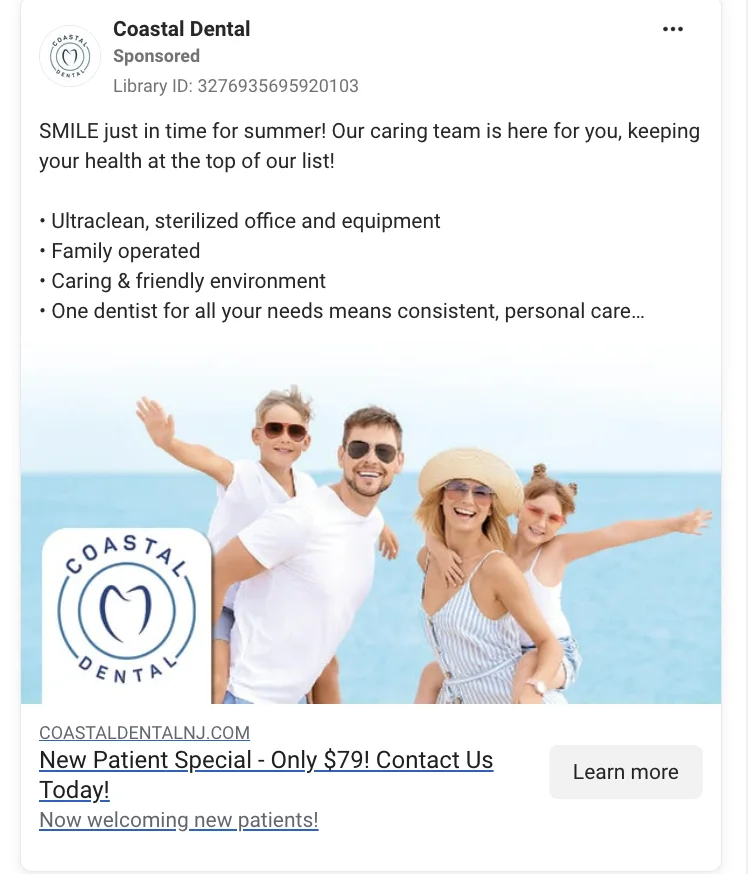
1. New Patient Special Offer Ad
What the ad looks like: A clean, single-image ad with a bold headline such as “Free New Patient Exam + X-Rays” or “$99 Complete Cleaning and Consultation.” The image features a smiling patient or a welcoming practice environment. Copy is minimal, the offer is front and center, and the CTA button reads “Book Now” or “Claim Offer.”
Why it works: First-time patients carry a trust barrier. They do not know the staff, pricing, or what to expect. A low-risk or no-cost entry offer eliminates the biggest hesitation before the prospect has to make a decision. This format consistently outperforms general awareness ads because it gives someone a specific, immediate reason to act rather than “consider” the practice.
What makes it convert: The offer must be visible without scrolling and tied to a single action. Ads that list multiple services or ask viewers to “learn more” about the practice lose the moment. The strongest-performing versions pair the offer with a brief trust signal, such as a star rating or a short line like “Rated #1 Dental Practice in [City],” to close the credibility gap fast.
2. Before-and-After Transformation Ad
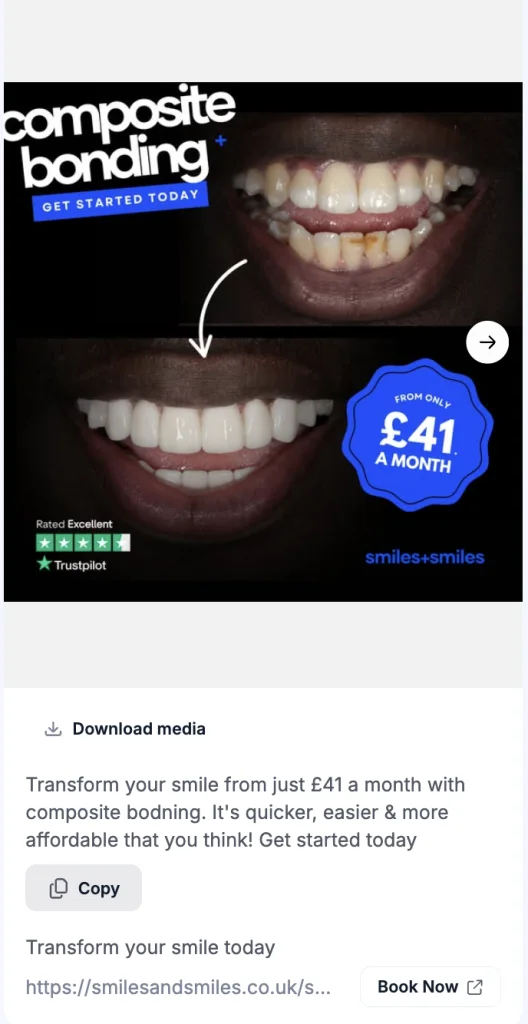
What the ad looks like: A side-by-side static image or short carousel showing a real patient’s smile before and after a procedure, most commonly teeth whitening, veneers, Invisalign, or implants. The headline is results-focused: “See What 3 Weeks of Invisalign Looks Like” or “Your New Smile in One Visit.” Copy stays minimal; the visual carries the message.
Why it works: For cosmetic procedures, patients need to see a believable outcome before committing to a consultation. Before-and-after creative delivers that proof without a lengthy pitch. It also stops the scroll because the visual contrast creates immediate curiosity even before the viewer reads a single word.
What makes it convert: Authenticity matters more than production quality here. Ads using real patient photos, even if not professionally shot, tend to outperform heavily edited alternatives because they feel credible rather than staged. Always obtain written patient consent, and pair the visual with a specific CTA like “See If You Qualify” to attract prospects who are already persuaded by what they saw.
3. Video Testimonial Ad
What the ad looks like: A 30-to-60-second video of a real patient describing their experience at the practice. The video does not need high production value. A phone-recorded clip of a patient speaking directly to camera, describing what they feared before and how the visit changed their mind, performs well consistently. Captions are essential for silent scrollers.
Why it works: Dental anxiety is common, and it keeps patients from booking even when they know they need care. A testimonial that addresses that fear directly, told by another patient rather than by the practice itself, carries far more persuasive weight than any copy the practice could write about itself. Social proof in video format is harder to dismiss than text-based reviews.
What makes it convert: The testimonial should address a specific concern: fear of pain, unexpected costs, or a long-overdue procedure the patient kept putting off. Generic praise for a “friendly team” performs weaker than an authentic story about overcoming a real hesitation. Open with the most compelling statement, keep the video under 60 seconds, and close with a clear appointment CTA.
4. Emergency and Same-Day Appointment Ad
What the ad looks like: A direct, high-urgency ad targeting people experiencing dental pain or an acute issue. The headline is unambiguous: “Tooth Pain? We Have Same-Day Appointments Available.” The image shows a clean, calm practice environment rather than anything clinical. The CTA links to a direct booking page or opens Messenger for fast communication.
Why it works: Emergency dental patients are high-intent. They are not comparing options the way a cosmetic prospect might; they need help now. An ad that appears at the right moment with the right message, same-day availability and easy contact, can convert at rates well above standard dental ads because the need is immediate and the decision cycle is very short.
What makes it convert: Speed of response is the critical variable. Ads that open a Messenger chat or trigger a click-to-call function consistently outperform those sending the prospect to a website form, because someone in pain wants direct contact, not a multi-step form to fill out. Keeping geographic targeting within five to ten miles of the practice keeps ad spend tight and the audience relevant.
5. Cosmetic Service Spotlight Ad
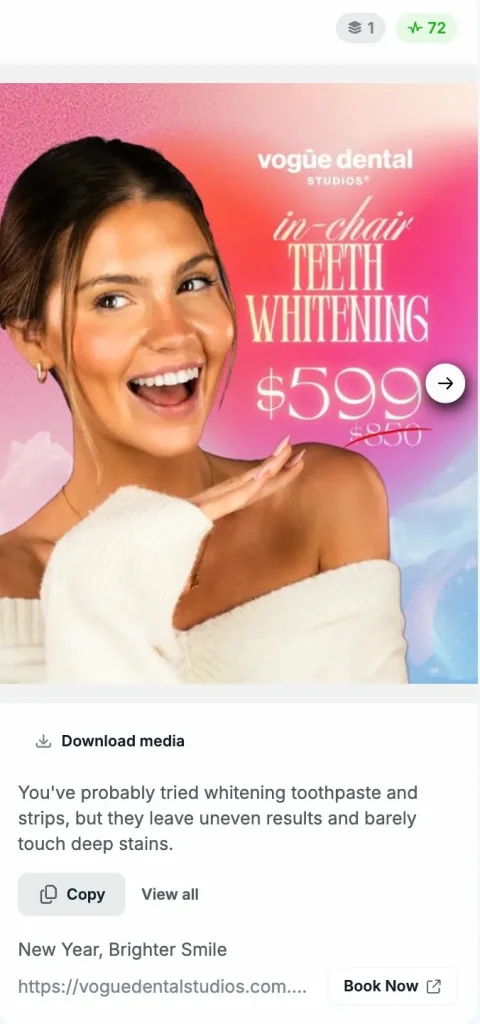
What the ad looks like: A service-specific ad dedicated to a single cosmetic procedure, most often Invisalign, professional whitening, or veneers. Creative focuses on the lifestyle benefit rather than the clinical process. Headlines like “Straighter Teeth Without the Metal” or “Whiten Your Smile Before the Holidays” link the procedure to a desirable outcome. Carousel and short video formats both perform well here.
Why it works: Cosmetic procedures have longer decision cycles than emergency visits or routine cleanings. Patients need to see the benefit, understand the cost range, and feel confident the result is achievable for them. A dedicated ad for one procedure gives the message room to address all three without competing with general practice content.
A limited-time offer or seasonal angle adds urgency to a category where patients often defer decisions. A free consultation CTA lowers the barrier while filtering for serious prospects. Pairing this ad format with interest-based targeting such as “cosmetic dentistry” or “teeth whitening” alongside a local radius keeps the audience relevant and the cost per lead manageable.
How Does GetHookd Help You Find Winning Dental Facebook Ad Examples?
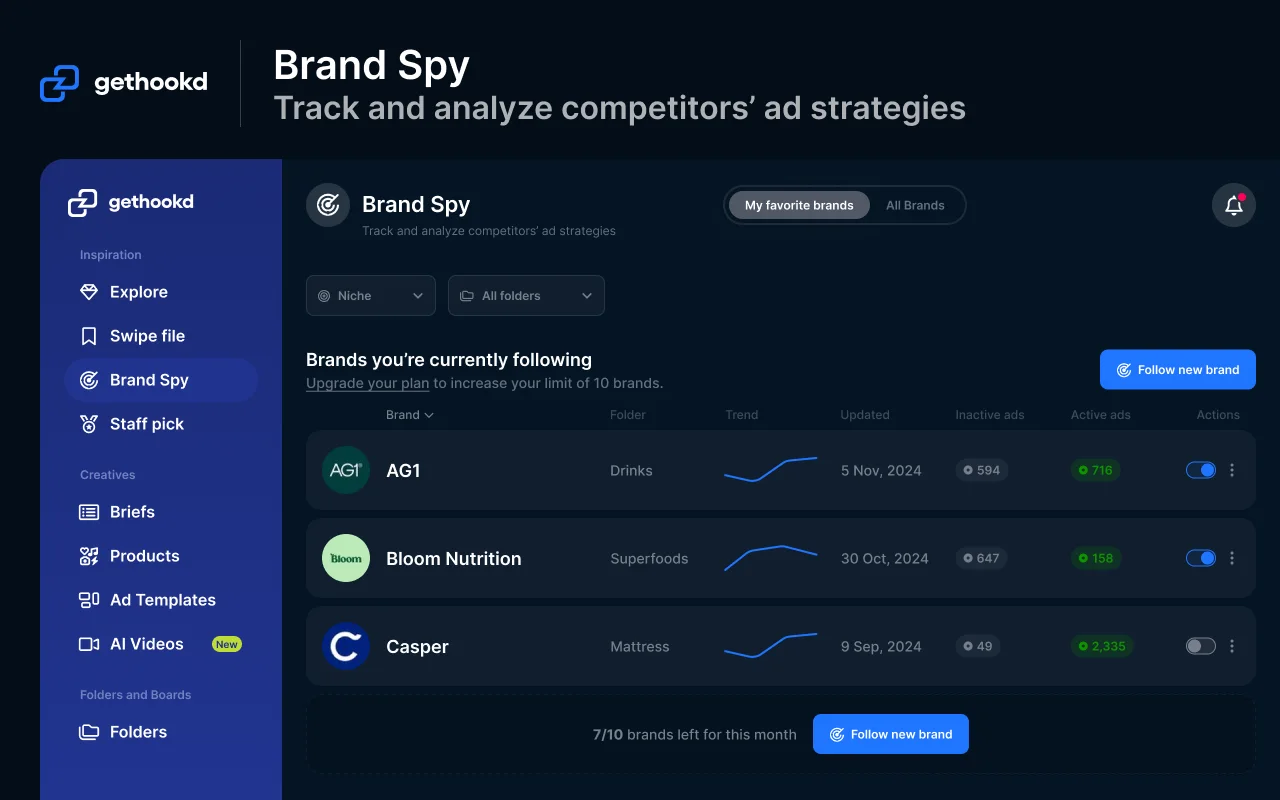
Knowing which ad formats work is the starting point. The harder challenge is knowing which specific creatives, copy angles, and offers are performing in your exact market right now.
At GetHookd, the platform’s searchable database of 65M+ Meta ads covers active dental campaigns across dozens of markets. Media buyers and dental marketing agencies can filter by niche, run time, and performance signals to surface what practices are actually scaling, not just testing. The Brand Spy feature shows you which competitor ads are driving real spend, so you can focus your creative budget on what has already proven itself. Once you identify a winning concept, the AI Script Generator and Clone Ads tool let you build a testable variation in minutes, all within one platform.
Start your GetHookd free trial today
Frequently Asked Questions (FAQs)
What type of Facebook ad works best for a dental practice?
New patient special offer ads and before-and-after transformation ads are the two highest-converting formats for most dental practices. Offer ads remove the first-visit cost barrier, while transformation ads provide visual proof for cosmetic procedures. The best format depends on the service and the specific patient segment being targeted, but both address the two core patient concerns: trust and value.
How much should a dental practice spend on Facebook ads?
Most practices see consistent lead flow starting at $1,000 per month per campaign objective, such as general new patients, Invisalign leads, or implant inquiries. Budgets below $500 per month rarely generate enough data for Facebook’s algorithm to optimize effectively. The right approach is to start with one campaign and one audience, measure cost per lead, and scale based on results.
How often should dental Facebook ad creatives be refreshed?
A practical guideline is to rotate creatives every 4 to 6 weeks, or sooner if ad frequency rises above 3.0, meaning the same person has seen the ad 3 or more times. Stale creatives lead to ad fatigue, which drives up cost per result. Running two to three ad variations simultaneously helps extend a campaign’s life without requiring constant new creative builds.
What causes a dental Facebook ad to stop performing?
Ad fatigue is the most common cause. When the same creative is shown too frequently to the same audience, click-through rates drop, and costs rise. Other contributing factors include targeting audiences that are too narrow, running a landing page that does not match the ad offer, or using a generic message that fails to address a specific patient concern. Testing one variable at a time, image, headline, or CTA, makes it easier to pinpoint what needs changing.
Can GetHookd help me find winning dental Facebook ad examples for my campaigns?
Yes. At GetHookd, our 65M+ ad database covers active campaigns across every major niche, including dental and healthcare. You can filter by engagement level, run time, and performance signals to see which dental ads competitors are scaling on Meta right now. Our Brand Spy feature lets you track specific practices, monitor what top performers are running, and build your own variations using our AI Script Generator and Clone Ads tools without ever leaving the platform.