Blog

Explore expert tips and tricks to maximize your platform usage.
Thank you! Your submission has been received!
Oops! Something went wrong while submitting the form.
Ad Strategy
Ad Strategy
-
February 20, 2026

Carousel vs Single Image Facebook Ad: Benefits, Cost & Examples

Key Takeaways

  • Carousel ads support up to 10 cards to showcase multiple products, tell a story, or highlight different features.
  • Single-image ads work best for direct-response campaigns, brand awareness, or when you have a single clear message and limited creative resources.
  • Carousel ads typically deliver higher conversion rates, while single-image ads are faster to produce and easier to test.
  • The right format depends on your campaign objective, audience, and creative quality, not just the format itself.
  • With GetHookd, you can see which carousel and single image ads are performing in your niche, then use our AI-powered tools like Clone Ads and Image Ad Templates to create variations without starting from scratch.

Carousel vs Single Image Facebook Ad Explained

Carousel ads let you display multiple images or videos in a single swipeable unit, making them ideal for showcasing multiple items, features, or a step-by-step process. Each card includes its own headline and URL, enabling users to navigate to specific pages and supporting deeper storytelling or a purchase journey.

Single-image ads focus on a single clear visual and message, helping users understand the offer instantly. They load quickly, require minimal production, and are easy to test and iterate. For simple promotions, brand awareness pushes, or campaigns built around a single value proposition, they often perform well.

In comparison, carousel ads work best when you want users to explore options or understand variety, while single-image ads are stronger when you need speed, simplicity, and a focused pitch. The right format depends on whether your goal is a detailed showcase or immediate clarity.

GetHookd: Turn Competitor Intelligence Into Your Next Winning Ad

65M+ Ads Analyzed | 4.8★ G2 Rating | 4.4★ Trustpilot Rating

Stop Guessing. Start Scaling:

GetHookd reveals which ads your competitors are actively scaling—not just running. Spy on their best-performing creatives, landing pages, and traffic strategies, then turn proven concepts into testable campaigns in seconds with AI-powered script generation and creative cloning.

What You Get:
  • ✓ Brand Spy to decode competitor ad strategies in real-time
  • ✓ AI script generation and ad cloning for instant variations
  • ✓ Performance scoring based on actual ad behavior, not vanity metrics
  • ✓ Creative Analyzer to identify and scale your top performers
Replace guesswork with intelligence. Build profitable ads that actually convert.

4 Benefits of Carousel Ads

1. Showcase Multiple Products in One Ad

Carousel ads let you display multiple products in a single ad unit. Customers can browse a mini-collection within your ad, increasing the likelihood they'll find something relevant.

You can also group related products, such as complete outfits, furniture sets, or complementary accessories, so customers can visualize items in context. Feature different angles or color variations of the same product to mimic the in-store experience of examining items before purchase.

2. Tell a Sequential Story

Carousel ads work well for narrative-driven marketing that unfolds across multiple frames. Guide users through a problem-solution sequence, build anticipation, or create emotional connections through progressive imagery.

3. Highlight Different Features of One Product

For products with multiple selling points, carousels let you dedicate each card to a specific feature rather than cramming everything into a single image. This works particularly well for tech products, software, or services with multiple components.

Each card highlights a distinct capability, while the carousel maintains a cohesive look, so potential customers can focus on the features most relevant to them.

4. Create Interactive Experiences

The swipeable format encourages interaction and keeps users engaged longer than a static image. Each swipe is an active choice that signals interest rather than passive scrolling.

Some brands take this further with panoramic images split across cards or "choose your own adventure" style experiences; ads that users want to engage with rather than skip past.

3 Benefits of Single Image Ads

1. Run Direct Response Campaigns With One Clear CTA

When your campaign centers on a single action, such as app downloads, webinar registrations, or lead generation, single-image ads eliminate distractions and keep the focus on your call to action. One message, one image, one next step. Users quickly understand the offer without having to process multiple cards or options.

This clarity works well for direct response because there's no competition between products or features for attention. You have just one offer paired with one clear action.

2. Build Brand Awareness With Minimal Messaging

For upper-funnel campaigns, single-image Facebook ads deliver memorable impressions efficiently. The format compels you to distill your brand into a single powerful visual, which can create stronger first impressions and better recall.

This works especially well with distinctive, emotion-driven imagery that communicates brand values without explanation. If you're introducing your brand to a new audience, the uncluttered format ensures your core message isn't diluted across multiple frames.

3. Launch Quickly With Limited Creative Resources

Single-image ads require less production time than carousel ads with multiple cards, and they support consistent branding and coordinated messaging. This makes them practical when you're short on time or working with a small team.

The simpler format also makes A/B testing easier. You can test multiple single-image variations instead of investing all your resources in a single complex carousel.

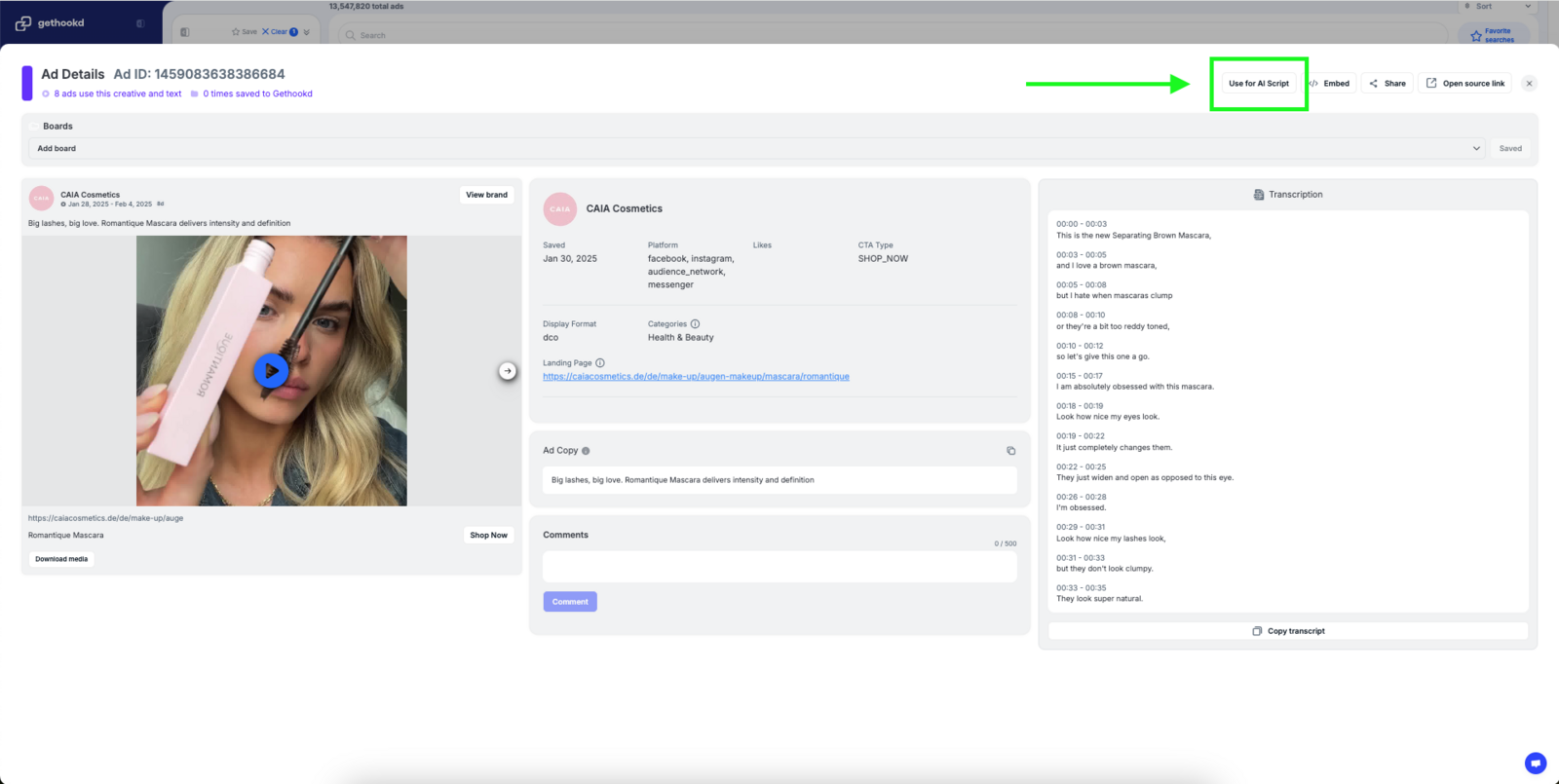
Tools like GetHookd further accelerate this with Image Ad Templates and Clone Ads, which let you generate fresh variations from winning ads without starting from scratch.
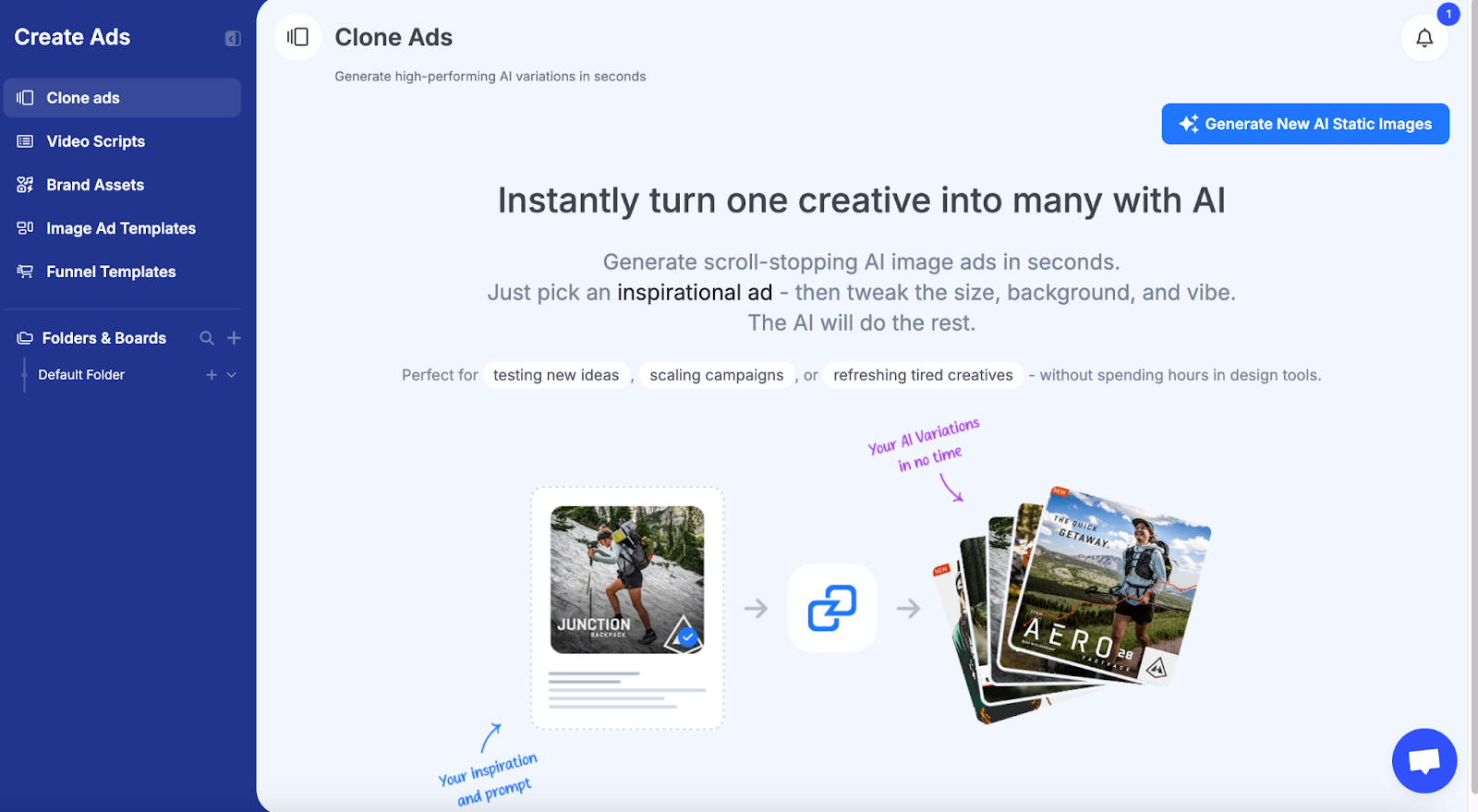
GetHookd's Clone Ads lets you generate ad variations in seconds.

Carousel Facebook Ad Examples

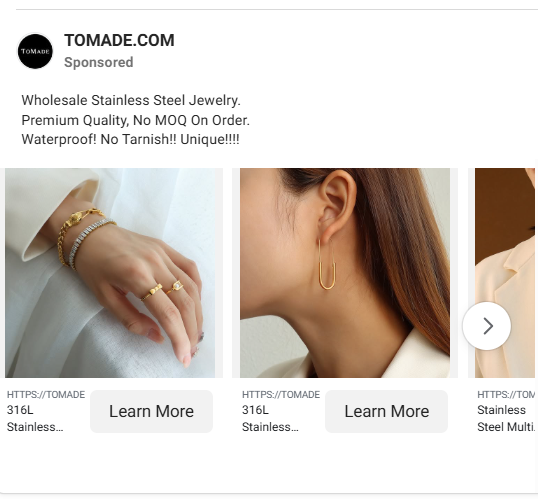
TOMADE's carousel ad showcases multiple jewelry pieces in a single ad. (Source: Facebook)

TOMADE uses a carousel to display different product categories: bracelets, earrings, and rings, without forcing users to visit separate pages. Each card highlights a different style, letting wholesale buyers browse the range quickly. The consistent aesthetic across cards (neutral backgrounds, similar lighting) keeps the ad cohesive while the variety encourages swipes.
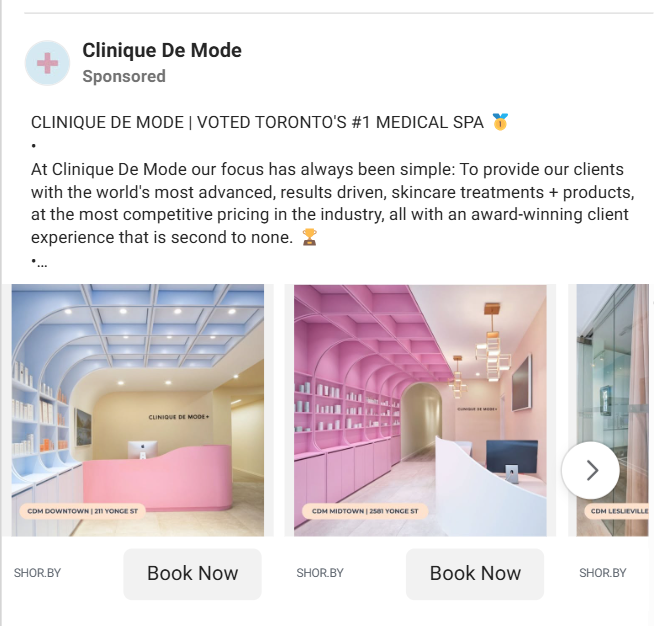
Clinique De Mode's carousel ad features multiple spa locations. (Source: Facebook)

This medical spa uses carousel cards to showcase three different Toronto locations. Each card displays the interior design of a specific clinic, including its address, making it easy for users to find the nearest one. For service businesses with multiple locations, this format converts a single ad into a location selector. Users swipe to the most convenient option and book directly.

Single Image Facebook Ad Examples
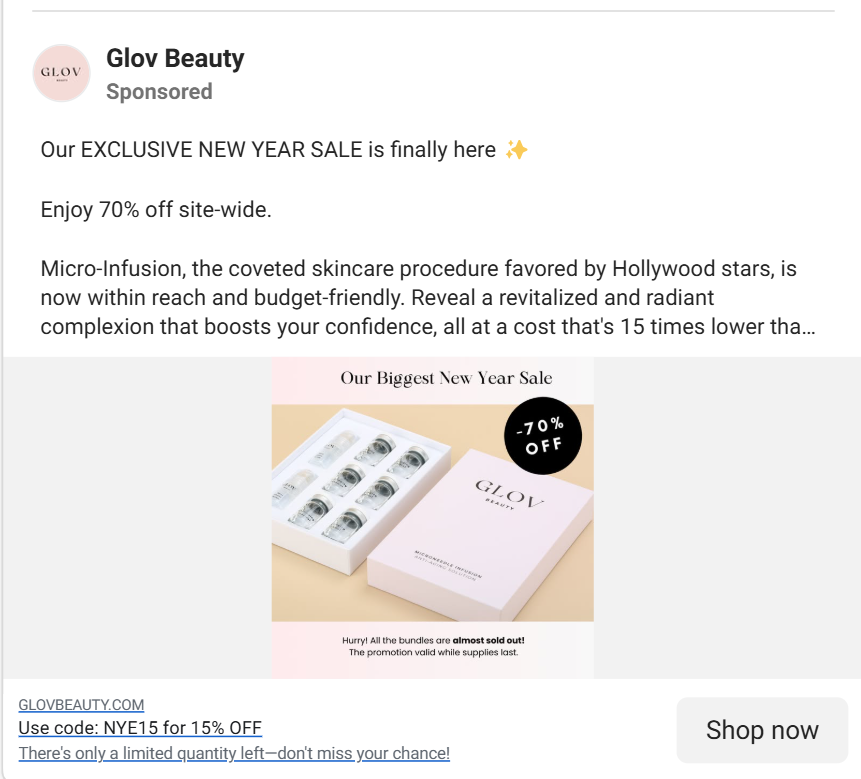
Glov Beauty's single-image ad promotes a limited-time sale with urgency messaging. (Source: Facebook)

Glov Beauty runs a classic direct-response ad: big discount (70% off), promo code, and scarcity messaging ("almost sold out"). A single image keeps the focus on the offer rather than product variety. The visual shows the product packaging clearly, and every element, from the headline and image to the description, reinforces the same sale message. When the goal is conversions from a single promotion, a single image keeps the path simple.
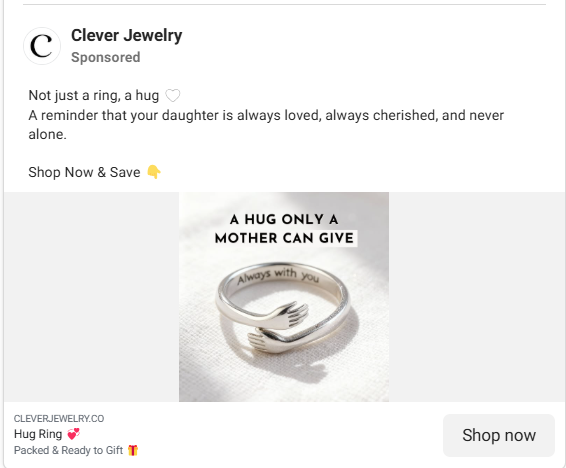
Clever Jewelry's single-image ad focuses on one product with an emotional hook. (Source: Facebook)

Clever Jewelry puts all attention on a single product: the "Hug Ring." The image does the storytelling, while the copy reinforces the emotional angle ("A reminder that your daughter is always loved"). No distractions, no product grid. Just one ring, one message, and one CTA. This approach works when the product itself carries enough meaning to stand alone.

Cost Comparison: Carousel vs Single Image Facebook Ad

Ad costs depend on your industry, audience, creative quality, and campaign objective. But carousel ads typically deliver better cost efficiency for conversions. They generate up to 1.6x more clicks than single-image ads, with users swiping through an average of 3.2 cards per impression.

Carousel ads give users more content to engage with. More cards mean more chances to find something relevant, and more opportunities for Facebook's algorithm to optimize delivery based on which cards perform best.

Single-image ads tend to convert less efficiently when the goal is purchases or leads. Where single-image ads shine is in simplicity: they're faster to produce, easier to test, and often sufficient for brand awareness or single-offer promotions, where one strong visual is enough.

Since costs vary by niche and audience, the best way to evaluate which format delivers better ROI is to see what's already working. GetHookd lets you filter ads by performance signals, so you can base decisions on real-world results rather than industry averages.

Carousel vs Single Image Facebook Ad: Comparison Table

Factor Carousel Ads Single Image Ads
Best for Multiple products, features, or storytelling Single offers, promotions, and brand awareness
Production effort Higher (multiple images, headlines per card) Lower (one image, one message)
Conversion efficiency Higher for e-commerce and lead generation Moderate, but sufficient for simple campaigns
A/B testing ease More complex (multiple variables per ad) Simpler (one image, faster iterations)
Creative fatigue risk Lower (more content keeps ads fresh longer) Higher (single visual wears out faster)

Find Winning Ads for Both Formats with GetHookd
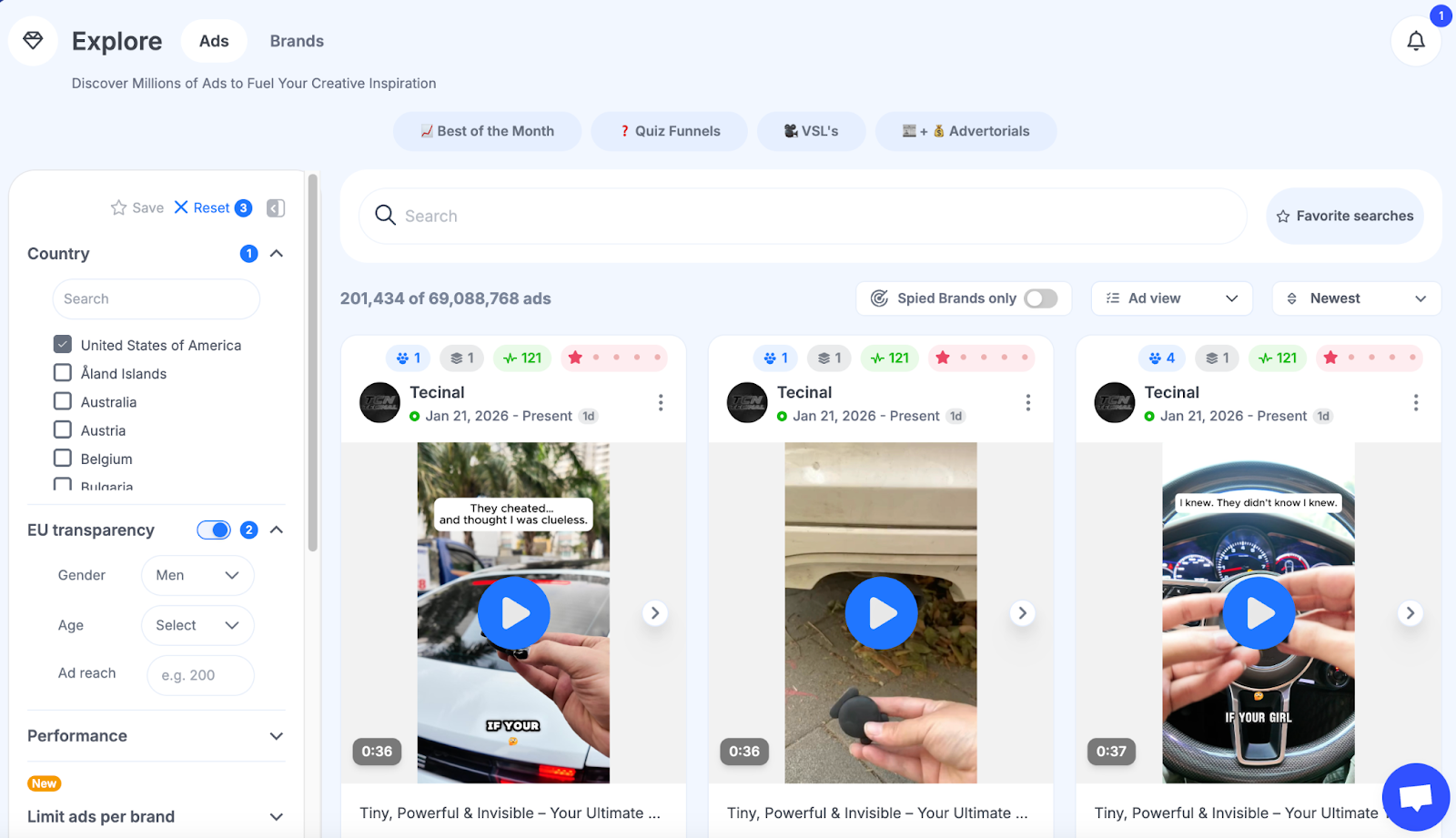
GetHookd's Explore Ads lets you filter millions of ads by format, niche, and performance.

We built GetHookd for e-commerce brands, dropshippers, and agencies that want greater confidence in their creative decisions and less wasted on untested concepts. With our Explore Ads feature, you get access to over 65 million high-performing ads across Meta. You can filter by format, niche, and ROAS benchmarks to find proven examples without manually digging through Facebook Ad Library.

Use our Brand Spy feature to track competitors and see which formats they're actively scaling. If a brand has been running the same carousel ad for months, that's a signal. You can also see their landing pages and traffic sources to understand the full funnel, not just the creative.

Once you've found winning ads, you can save them to your Swipe File or act on them without leaving the platform. Clone Ads lets you replicate a winning ad, yours or a competitor's, and tailor it to your promotion. You can generate dozens of variations with new colors, avatars, formats, and styles in seconds. If you'd rather not start from scratch, our Image Ad Templates give you proven static ad formats used by top brands across hundreds of niches.

For video ads, our AI Video Scripts feature writes high-converting scripts based on your product info. And if you find a video ad that's clearly working, Ads Transcription pulls the hooks, copy, and CTAs so you can apply the same structure to your campaigns. 

Try GetHookd Now →

Frequently Asked Questions (FAQs)

How many images can I include in a Facebook carousel ad?

Facebook carousel ads can include between 2 and 10 images or videos. Each card can have its own headline, description, and destination URL. 

The ideal number depends on your campaign objective. For product showcases, you can use 3 to 5 cards, while storytelling sequences may benefit from more cards to develop a complete narrative.

Do carousels perform better than single photos?

Carousels generally perform better in conversion-focused campaigns because they provide users with more content to engage with and more opportunities to click. 

However, for brand awareness, single photos often work well due to their simplicity. The right choice depends on your audience, offer, and creative quality.

What is the difference between carousel and single image?

Carousel ads let users swipe through multiple images or videos within a single ad unit, while single-image ads feature one visual. 

Carousels provide more space to showcase multiple products, tell a story, or highlight features. They also allow different destination URLs per card. Single-image ads deliver a more focused message and direct all traffic to one location.

What is the best image format for Facebook ads?

Use JPG or PNG files with a resolution of at least 1080 x 1080 pixels. Facebook recommends square images (1:1 aspect ratio) for most placements to ensure compatibility across devices. 

Landscape format (1.91:1) also works for single-image ads. Keep text minimal on images. While there's no hard limit, heavy text can reduce delivery.

Can GetHookd help me create carousel and single-image ads?

Yes. GetHookd gives you access to over 65 million ads across Meta, so you can see which carousel and single image ads are performing in your niche. 

Our Brand Spy feature lets you track competitors and identify which formats they're scaling. Once you find a winning ad, Clone Ads lets you generate brand-tailored variations or use our Image Ad Templates to launch proven static ad formats in minutes.

*Note: Pricing and/or product availability mentioned in this post are subject to change. Please check our website for current pricing and stock information before making a purchase.


Ad Strategy
Ad Strategy
-
February 19, 2026

Marketing Brief vs Creative Brief: Differences, Examples & Templates

Key Takeaways

  • Marketing briefs provide strategic direction for campaigns, focusing on business objectives, target audience, and competitive landscape, while creative briefs translate that strategy into specific creative elements.
  • Marketing briefs typically come first in the project workflow and are created by marketing managers, while creative briefs follow and are developed by creative directors or account managers.
  • A well-structured marketing brief includes business context and campaign goals, whereas a creative brief includes specific tone, message, and design guidelines.
  • Using both briefs in tandem aligns strategic objectives with creative execution, leading to more successful marketing campaigns.
  • GetHookd helps you build stronger creative briefs by showing competitors’ top ads, extracting useful hooks and CTAs from winning creatives, and generating scripts using a database of more than 65 million Meta ads.

Marketing Brief vs Creative Brief Explained

A marketing brief outlines the strategic foundation of a campaign by defining its goals, target audience, competitive context, KPIs, budget, and timelines. It explains why the campaign exists and what the business needs it to achieve, giving all stakeholders a shared understanding before any creative work begins.

A creative brief builds on the marketing brief by turning that strategy into an executional direction. It focuses on how the campaign will come to life, detailing the messaging, tone, visual approach, deliverables, and any constraints the creative team must follow. This ensures the final assets align with the strategy.

In simple terms, the marketing brief sets the objectives and guardrails, while the creative brief translates those objectives into actionable guidance for designers, writers, and producers. Both documents work together to keep strategy and creative output aligned throughout the campaign.

GetHookd: Turn Competitor Intelligence Into Your Next Winning Ad

65M+ Ads Analyzed | 4.8★ G2 Rating | 4.4★ Trustpilot Rating

Stop Guessing. Start Scaling:

GetHookd reveals which ads your competitors are actively scaling—not just running. Spy on their best-performing creatives, landing pages, and traffic strategies, then turn proven concepts into testable campaigns in seconds with AI-powered script generation and creative cloning.

What You Get:
  • ✓ Brand Spy to decode competitor ad strategies in real-time
  • ✓ AI script generation and ad cloning for instant variations
  • ✓ Performance scoring based on actual ad behavior, not vanity metrics
  • ✓ Creative Analyzer to identify and scale your top performers
Replace guesswork with intelligence. Build profitable ads that actually convert.

Differences Between Marketing & Creative Briefs

Marketing teams define the strategy while creative teams bring it to life.

Purpose: Strategic Planning vs. Creative Direction

Marketing briefs establish the strategic framework by defining business objectives, market positioning, and insights into the target audience. They answer why a campaign exists and what it needs to accomplish from a business perspective.

Creative briefs provide specific guidance for creative execution. They translate business objectives into direction for tone, messaging, and visual elements. Marketing briefs focus on outcomes; creative briefs focus on outputs or the tangible assets that will be created.

Timing: When Each Brief Enters the Process

The marketing brief initiates the campaign planning process, appearing during the strategy development phase before any creative ideation begins. The creative brief is developed after strategic approval and before production begins.

This sequence matters. Creative work without strategic direction risks becoming visually appealing but ineffective. Strategic plans without creative interpretation may never connect with the target audience.

Audience: Who Needs to See & Approve Each Brief

Marketing briefs circulate broadly, reaching C-suite executives, marketing directors, and stakeholders who approve strategic direction. They align different departments around common business objectives.

Creative briefs target the creative team: designers, copywriters, art directors, and production specialists. Marketing briefs require approval from business leaders; creative briefs need sign-off from both marketing leaders and creative directors to ensure alignment between strategy and execution.

Detail Level: High-Level Goals vs. Specific Guidelines

Marketing briefs provide high-level strategic guidance, focusing on business objectives and market positioning. They establish the "what" and "why" without prescribing the "how."

Creative briefs dive into specifics: color palettes, typography, photography style, messaging tone, and other execution details. Marketing briefs create the strategic boundaries; creative briefs define how to work within them.

Content Focus: What Each Brief Prioritizes

Marketing briefs prioritize business metrics, competitive analysis, and audience insights. They focus on market positioning, value proposition, and strategic approach.

Creative briefs emphasize concept development, messaging frameworks, visual direction, and brand voice. Where marketing briefs describe the target audience in demographic and psychographic terms, creative briefs translate those insights into practical guidance for reaching that audience through specific creative approaches.

A clear handoff from marketing brief to creative brief keeps teams aligned throughout the campaign.

How Marketing & Creative Briefs Work Together

The marketing brief should inform every aspect of the creative brief. If the marketing brief identifies sustainability as a key differentiator, the creative brief should establish visual and messaging guidelines that emphasize that attribute. This alignment ensures creative work advances business goals.

The workflow typically follows a linear progression: strategic planning leads to the marketing brief, which informs the creative brief, and both guide production. But the process often includes feedback loops where creative insights refine strategic thinking. 

Effective collaboration between marketing strategists and creative teams, through brief translation meetings or regular check-ins, helps identify disconnects before they impact production.

Marketing Brief Template & Example

The following template covers the essential elements of a marketing brief. Keep it concise. Two to three pages are typically enough to communicate strategic direction without overwhelming readers.

  • Project Overview: Brief description of the campaign or initiative
  • Business Context: Market conditions, competitive landscape, business challenges
  • Campaign Objectives: Specific, measurable goals for the campaign
  • Target Audience: Detailed profile including demographics, psychographics, and behaviors
  • Value Proposition: Why the audience should choose your product/service
  • Key Messages: Primary points the campaign should communicate
  • Budget: Available resources for campaign development and execution
  • Timeline: Key milestones and deadlines
  • Success Metrics: How campaign effectiveness will be measured
  • Approval Process: Who needs to review and approve campaign elements

Example of a Marketing Brief

Here's what a marketing brief looks like in practice:

Marketing Brief: Q3 Electric Spin Scrubber Launch

  • Project Overview: A paid social campaign on Meta to drive sales of a cordless electric spin scrubber targeting homeowners and renters who hate manual scrubbing. The campaign will rely on short-form video creatives optimized for impulse purchases.
  • Business Context: Electric spin scrubbers are trending across TikTok and Meta, with dozens of dropshippers running similar offers. Several competitors are scaling aggressively with UGC-style before-and-after demos. Winning will come down to stronger hooks, better creative angles, and a landing page that converts above the category average; the product itself is widely available.
  • Campaign Objectives: Hit a 3x minimum ROAS within the first 14 days of testing, generate at least 500 purchases in the first month, and identify two to three scalable ad creatives worth pushing to $500+ per day in spend.
  • Target Audience: Women aged 25–45, homeowners or renters, interested in cleaning hacks, home organization, and time-saving household products. They follow pages like CleanTok, watch "satisfying cleaning" content, and are motivated by visual transformations, social proof, and limited-time deals.
  • Value Proposition: A cordless, rechargeable scrubber with interchangeable heads that does the hard scrubbing for you in bathrooms, kitchens, tile, and grout, in half the time and with zero effort.
  • Key Messages: Stop scrubbing on your hands and knees. This tool does the work for you in minutes. Over 10,000 five-star reviews. Order now before the summer restock sells out.
  • Budget: $10,000 for the initial testing phase, scaling to $30,000 per month if ROAS targets are met.
  • Timeline: Creative production from July 1–10, ad testing begins July 12, scaling decisions made by July 25.
  • Success Metrics: ROAS, cost per purchase, click-through rate, landing page conversion rate, and hook rate on video ads.
  • Approval Process: Store owner reviews and approves all creatives and landing page copy before launch.

Creative Brief Template & Example

The creative brief builds on the marketing brief, translating strategy into specific creative guidance. It should inspire creativity while establishing clear parameters. Aim for 1–2 pages, approved by both marketing and creative leaders before production begins.

  • Project Background: Summary of relevant information from the marketing brief
  • Creative Objective: What the creative assets need to accomplish
  • Target Audience Insights: Deeper understanding of audience motivations and behaviors
  • Single-Minded Proposition: The one thing the audience should take away
  • Tone and Voice: How the brand should sound and feel in this campaign
  • Visual Direction: Style, imagery, color considerations
  • Mandatories: Required elements (logos, disclaimers, calls to action)
  • Deliverables: Specific assets needed with formats and specifications
  • Timeline: Due dates for concepts, revisions, and final deliverables
  • Reference Materials: Examples, inspiration, previous campaigns

Example of a Creative Brief

Here's what a creative brief looks like in practice:

Creative Brief: Q3 Electric Spin Scrubber Meta Ad Creatives

  • Project Background: The marketing brief calls for a Meta-focused campaign selling a cordless electric spin scrubber to women aged 25–45 who are tired of manual cleaning. The market is saturated with similar offers, so creative differentiation is the primary lever. The goal is to find scalable creatives that hit a 3x ROAS within two weeks.
  • Creative Objective: Produce thumb-stopping video ads that showcase the scrubber's cleaning power within the first three seconds, build trust through visible results and social proof, and drive clicks to the product landing page.
  • Target Audience Insights: These buyers are drawn to satisfying cleaning transformations. They trust UGC and real-home footage over polished brand content. They're skeptical of "too good to be true" products, so showing the scrubber working on genuinely dirty surfaces (grout, soap scum, stovetops) is more persuasive than a staged demo. Urgency and peer validation ("I bought this because of TikTok and it actually works") drive conversions.
  • Single-Minded Proposition: This scrubber does the hard part for you; sparkling clean surfaces with zero elbow grease.
  • Tone and Voice: Casual, relatable, slightly amazed. Think someone is filming a product that actually exceeded their expectations. The copy should feel like a genuine review, not a sales pitch. Example: "Okay, I was skeptical, but LOOK at this grout."
  • Visual Direction: UGC-style footage shot on a phone in real bathrooms and kitchens. Prioritize dramatic before-and-after reveals, close-up scrubbing shots, and split-screen transformations. Text overlays should be bold, high-contrast, and readable on mobile without sound. Natural lighting preferred.
  • Mandatories: Product link in CTA, "satisfaction guarantee" mention, star rating or review count shown on at least one visual, subtitles on all video content, and a clear shot of the interchangeable brush heads.
  • Deliverables: Three UGC-style video ads (15–30 seconds each, one focused on bathroom, one on kitchen, one on "five ways to use it"), two static image ads with before-and-after splits and testimonial overlays, and one landing page hero image. All assets optimized for Meta placements, including Feed, Stories, and Reels.
  • Timeline: Scripts and storyboards due July 3, first cuts by July 7, final assets delivered by July 10.
  • Reference Materials: Top-performing competitor spin scrubber ads identified through GetHookd Brand Spy, hooks and CTAs extracted via Ads Transcription from the highest-scaling competitor creatives, supplier product photos and demo clips, and approved customer testimonials.

Marketing Brief vs Creative Brief: Comparison Table

Here's a side-by-side summary of the key differences:

Feature Marketing Brief Creative Brief
Primary Purpose Define strategic objectives and business goals Provide creative direction and execution guidelines
Created By Marketing managers or directors Creative directors or account managers
Primary Audience Executives, stakeholders, marketing team Designers, copywriters, production team
Timing in Process Beginning of campaign planning After strategy approval, before production
Content Focus Market analysis, business objectives, KPIs Tone, messaging, visual direction, deliverables
Level of Detail High-level strategic guidance Specific creative guidelines

Build Stronger Creative Briefs with GetHookd

GetHookd's Video Scripts feature generates hooks and scripts based on your product info and winning ad concepts.

A creative brief is only as good as the references and direction it provides. Telling your team to "make it punchy" doesn't give them much to work with. Concrete examples, including actual creatives working in your niche, make briefs clearer and execution faster.

At GetHookd, we give you access to over 65 million winning ads across Meta. Use our Explore Ads feature to filter by niche, format, and performance signals to surface creatives worth studying. With Brand Spy, you can track competitors and see which content they're actively scaling, not just running.

Once you find creatives worth referencing, save them to your Swipe File so they're organized and accessible when you're building briefs. If you find a winning video ad, our AI-powered Ads Transcription pulls the hooks, CTAs, and copy structure so you can include specific messaging examples in your brief. If your brief calls for a video script, our Video Scripts feature generates hooks, angles, and full scripts based on your product information and proven ad concepts.

Instead of handing your creative team vague direction, give them real examples and frameworks they can act on.

Try GetHookd Now →

Frequently Asked Questions (FAQs)

What is the difference between a marketing brief and a creative brief?

A marketing brief outlines the strategic foundation of a campaign, focusing on business objectives, target audience, and market positioning. It establishes the "why" behind marketing initiatives and typically comes first in the project workflow. 

A creative brief provides specific direction for creative execution, including tone, messaging guidelines, and visual elements. It translates strategic objectives into creative guidance and is used primarily by the production team to develop campaign assets.

What is included in a marketing brief?

A marketing brief typically includes business context, campaign objectives, target audience information, competitive analysis, budget constraints, timeline, and success metrics. 

It focuses on strategic elements rather than creative execution.

What is a creative brief?

A creative brief is a document that translates marketing strategy into specific creative direction. It includes project background, creative concept, tone and voice guidelines, visual direction, messaging framework, deliverable specifications, and production timelines. 

It builds on the marketing brief, providing specific guidance to the creative team while maintaining alignment with strategic objectives.

How can I find references and examples for my creative brief?

With GetHookd, you can explore over 65 million ads across Meta, filter by niche and format, and see which ads competitors are actively scaling. 

Use Ads Transcription to pull hooks and CTAs from winning video ads, or Video Scripts to generate script frameworks based on proven concepts. Save everything to your Swipe File so real examples, not guesswork, back your briefs.

*Note: Pricing and/or product availability mentioned in this post are subject to change. Please check our website for current pricing and stock information before making a purchase.
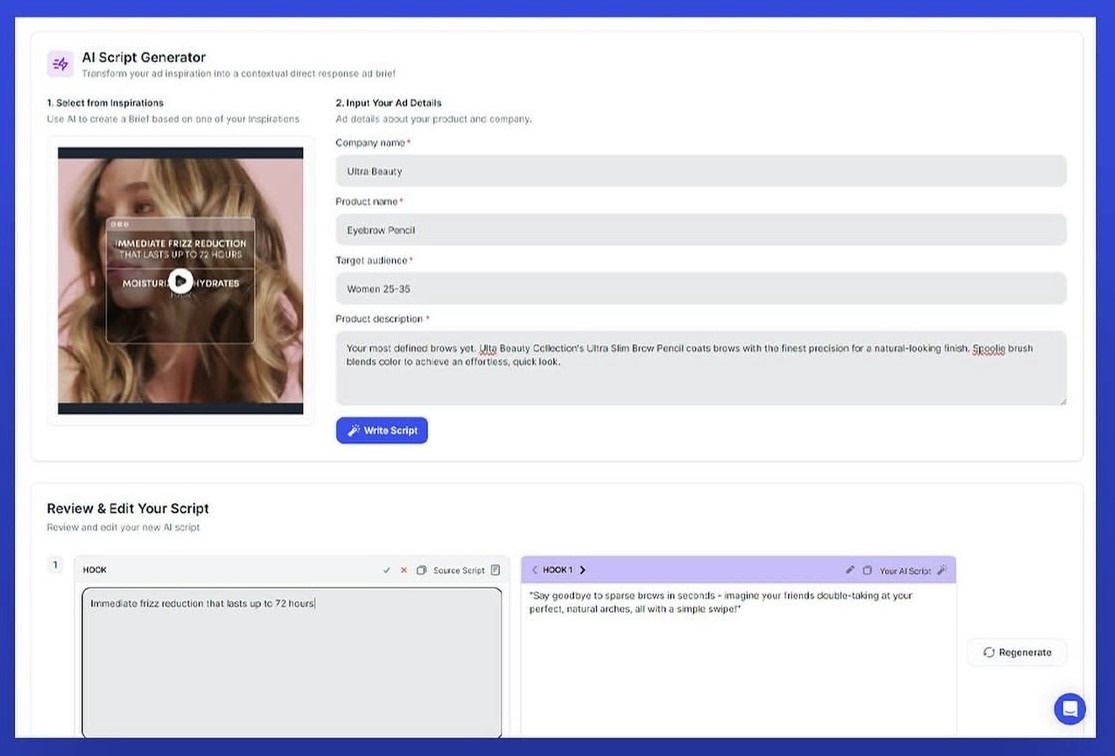
GetHookd Ads Library vs Facebook Ads Library
Gethookd vs Meta Ads Library
-
February 18, 2026

Hyros Reviews, Pricing & Alternatives: Is This Ad Tracking Software Legit?

Key Takeaways

  • Hyros is an AI-powered ad tracking and attribution platform that maps customer journeys across multiple touchpoints and ad platforms.
  • Hyros reviews praise its tracking accuracy and dedicated support, but users cite opaque pricing, a steep learning curve, and high minimum requirements that shut out smaller brands.
  • Hyros’ pricing starts at $230/month on an annual plan and scales based on tracked monthly revenue. There is no free trial, and a required demo call is required to get started.
  • GetHookd is a powerful Hyros alternative that offers creative intelligence, AI-powered ad creation, and performance analytics, giving brands the tools to find, create, and optimize winning ads starting at $19/month.

Hyros Overview: Is This Ad Tracking Software Legit?

Hyros is a legit ad-tracking platform that helps identify which ads drive sales. It follows customers across Facebook, Google, and other platforms, so you know where your revenue is coming from. That said, Hyros is built for larger operations. You'll typically need at least $40K in monthly revenue and $10K+ in ad spend to get value from the platform.

Where Hyros falls short is in scope. It answers one question well: which ads drove the sale? But it doesn't help you determine which ads to create, which competitors are scaling, or how to generate new creative variations.

GetHookd: Turn Competitor Intelligence Into Your Next Winning Ad

65M+ Ads Analyzed | 4.8★ G2 Rating | 4.4★ Trustpilot Rating

Stop Guessing. Start Scaling:

GetHookd reveals which ads your competitors are actively scaling—not just running. Spy on their best-performing creatives, landing pages, and traffic strategies, then turn proven concepts into testable campaigns in seconds with AI-powered script generation and creative cloning.

What You Get:
  • ✓ Brand Spy to decode competitor ad strategies in real-time
  • ✓ AI script generation and ad cloning for instant variations
  • ✓ Performance scoring based on actual ad behavior, not vanity metrics
  • ✓ Creative Analyzer to identify and scale your top performers
Replace guesswork with intelligence. Build profitable ads that actually convert.

Hyros Core Features

Hyros focuses on tracking ad performance across platforms. (Image source: Hyros)
  • Ad Attribution: Tracks conversions across Facebook, Google, and other networks using multi-touch attribution.
  • AI Ad Optimization: Hyros sends its tracking data back to ad platforms so their algorithms have more conversion information to work with when deciding who to show your ads to.
  • Customer Journey Mapping: Follows individual users across ads, emails, website visits, and purchases, sometimes over weeks or months.
  • Revenue Forecasting: Hyros uses your historical tracking data to project future ad performance and estimate how much revenue a campaign is likely to generate.

Hyros Pricing

Hyros offers a single plan starting at $230/month on annual billing. Pricing scales based on tracked monthly revenue, with tiers ranging from $20K to $1M+. Separate pricing exists for Shopify-specific setups and agencies, but exact costs aren't publicly listed.

The lack of transparent, self-serve pricing is a consistent friction point. You can't see what you'll pay until you've completed the sales process, which can be a barrier for smaller brands trying to evaluate fit before committing time to a call.

Hyros User Experiences

User feedback on Hyros is polarized. On the positive side, users mention its tracking accuracy and hands-on onboarding support. Recurring criticisms surface around pricing opacity and accessibility. The required demo call creates friction, and several reviews mention difficult cancellation processes. 

The learning curve is also a factor. While the UI is clean, the volume of data and configuration options can overwhelm teams without dedicated analytics resources.

The most fundamental limitation isn't about Hyros itself. It's about what it doesn't do. Hyros tracks and attributes, but it doesn't discover winning ads, generate creative, or help you build the next campaign.

Top 2 Hyros Alternatives Worth Considering

1. GetHookd

GetHookd's Explore Ads feature lets you search over 65 million ads across Meta, filtered by country, gender, performance, and niche.

GetHookd is a creative intelligence platform designed for e-commerce brands, dropshippers, and media buyers who need to move from ad research to live campaigns without stitching together multiple tools. Where Hyros focuses on what happened after an ad ran, we help you determine what to run, produce it faster, and track which creatives perform.

We also provide access to more than 65 million ads in the Meta ad library. But discovery is only one piece. Our users get access to AI-powered creative production tools, including script generation, ad cloning, and ad transcription, so you can act on research immediately.

GetHookd Core Features

Our Funnel Templates give you ready-made landing page layouts modeled on proven formats from 7- and 8-figure brands.
  • Explore Ads & Swipe File: Browse 65 million+ curated ads across Meta. Save winning creatives to organized folders that remain accessible even when offline.
  • Brand Spy: Track competitor ad activity. See which creatives they're scaling, how long campaigns have been running, and where they're sending traffic.
  • Creative Analyzer: Connect your Meta ad account to track creative-level performance. Spot winners, flag underperformers, and generate AI variations.
  • Clone Ads: Upload a high-performing image ad and generate dozens of AI-powered variations with new colors, avatars, formats, and styles.
  • Video Scripts: Input a winning ad and your product details to generate hooks, angles, and full scripts built on proven frameworks.
  • Ads Transcription: Automatically extract hooks, CTAs, and copy from winning video ads.
  • Customizable Templates: Access ready-to-use templates for image ads and high-converting landing pages.

GetHookd Pricing

We offer different pricing tiers with a 7-day free trial. At $19/month, our Launch plan gets you the ad library, Swipe File, Brand Spy, transcription, and AI script generation, enough to start researching and building immediately. Grow plan ($59/month) adds the Clone Ads and our Creative Analyzer, so you can start generating variations and tracking performance against your own Meta account. You save 25% by choosing annual plans.  

2. Triple Whale

Triple Whale is an analytics and attribution platform for e-commerce stores. (Image source: Triple Whale)

Triple Whale is an analytics and attribution platform built for e-commerce stores. It pulls your ad performance data from Meta, Google, and other channels into a single dashboard so you can see what's working and where your budget is going. If you run ads across multiple platforms and want a single place to check results instead of logging into each one separately, that's the problem Triple Whale is designed to solve.

That said, Triple Whale shares the same core limitation as Hyros: it tracks and reports. It doesn't help you discover competitors' strategies, generate creative ideas, or build scripts. For teams that need to move from research to live creatives, not just dashboards, tools like GetHookd cover that entire workflow in one place.

Triple Whale Core Features

  • Attribution Dashboard: See all your ad spend, revenue, and returns in one place instead of checking each platform separately.
  • Creative Cockpit: Shows which ads, visuals, and copy are driving the best results across your campaigns.
  • Summary Page: A real-time profit-and-loss view that pulls data from your ad platforms and store.
  • AI (Moby): Ask questions about your ad data in plain English and get answers without checking reports.

Triple Whale Pricing

Triple Whale offers a free dashboard, though it's limited to basic reporting with only first-click and last-click attribution. None of the core features, such as Creative Cockpit or AI, is included. Paid plans start at around $129/month and scale with your store's revenue. Costs climb quickly as you grow. Mid-sized brands can expect to pay upward of $1,000/month for advanced plans.

Hyros Alternatives Comparison Table

Feature GetHookd Triple Whale Hyros
Primary Focus AI ad research, creative production & performance analytics Ad attribution & reporting Ad tracking & attribution
Ad Discovery 65M+ ads from the Meta & Facebook Ad Library with filters by niche, format, and keyword Not available Not available
AI Creative Tools Clone Ads, AI Video Scripts, Ads Transcription Not available Not available
Ad Templates Ready-made, customizable templates for image ads and landing pages Not available Not available
Competitor Research Brand Spy monitors competitor ads, landing pages, and scaling activity Not available Not available
Creative Analytics Creative Analyzer connects to your Meta account to track performance by ad and generate AI variations Creative Cockpit Basic creative reporting
Save & Organize Ads Swipe File with folders is where saved ads stay accessible even after going offline Not available Not available
Landing Page Insights See where competitors drive traffic and which pages they're scaling Not available Not available
Starting Price $19/month ~$129/month (paid plans) $230/month (annual)

Why GetHookd is the Best Hyros Alternative

Hyros tells you which ad drove the sale. That's useful, but only after you've already created the ad, spent the money, and waited for results. It doesn't help you determine what to run in the first place to increase revenue. For most e-commerce brands, dropshippers, and media buyers, that's the actual bottleneck.

GetHookd handles the full creative workflow in one place. You can spy on competitors with Brand Spy to see what they're actively scaling, browse over 65 million ads from the Meta Ad Library to find proven concepts in your niche, generate scripts and image variations with AI, and then track how your own creatives perform through our Creative Analyzer, without switching tools or platforms.

And where Hyros locks you into a $230/month minimum with no trial, we start at $19/month with a 7-day free trial. You can be inside the platform researching your competitor and launching the next winning ad in minutes, not weeks.

Try GetHookd Now →

Frequently Asked Questions (FAQs)

How much does Hyros cost? 

Hyros starts at $230/month on an annual plan. The exact price depends on the amount of revenue you're tracking. They use tiers that range from $20K to over $1M in monthly tracked revenue. There's no public pricing page with exact numbers. Users must book a demo call to receive a quote.

How does Hyros tracking work? 

Hyros places tracking scripts on pages such as websites, landing pages, and checkout pages. When someone visits a site, Hyros assigns them a unique ID and tracks their activity, including which ads they clicked, which emails they opened, which pages they visited, and whether they ultimately made a purchase. It connects the dots across platforms like Facebook and Google so you can see which ads led to sales.

Is Hyros worth it? 

If you run complex, multi-step funnels and need to track customers across platforms, Hyros may help with that. But if your main concern is knowing which ads are winning and what to create next, GetHookd lets you see what competitors are actively scaling, find proven concepts across millions of ads, and turn them into ready-to-test creatives instantly.

How often should I check for competitors' Facebook ads? 

For most active campaigns, once a week is a good rhythm. That's enough to catch new trends and spot which creatives competitors are pushing without falling into analysis paralysis. During heavy testing cycles or seasonal pushes like Black Friday, checking every other day can help you stay ahead. Brand Spy makes this easy. You can look up specific brands and see their latest ad activity in one view instead of manually scrolling through the Facebook Ad Library.

*Note: Pricing and/or product availability mentioned in this post are subject to change. Please check our website for current pricing and stock information before making a purchase.

GetHookd Ads Library vs Facebook Ads Library
Gethookd vs Meta Ads Library
-
February 17, 2026

Cometly Reviews, Pricing & Alternatives: Is This Ad Tracker Worth It?

Key Takeaways

  • Cometly is a marketing attribution platform that tracks which ads drive conversions to improve optimization.
  • Cometly reviews highlight accurate tracking and improved ROAS visibility, but users cite a complex setup, outdated documentation, and a lack of pricing transparency as drawbacks.
  • Cometly’s pricing isn't publicly listed, and you'll need to book a demo. Cometly reviews indicate that plans start at around $199–$500/month and scale with ad spend.
  • Most Cometly alternatives, like Triple Whale and Hyros, are known for attribution; they lack comprehensive AI creative tools to help you build winning ads from the start.
  • GetHookd is a powerful Cometly alternative that gives brands access to 65+ million ads, AI-powered creative tools, and performance analytics, enabling them to research, create, and optimize ads on one platform.

Cometly Overview: Is This Ad Tracker Worth It?

Cometly is a marketing attribution platform that helps advertisers see which ads and campaigns drive revenue. It captures conversion data that native ad platforms often miss and sends it back to platforms like Meta and Google to improve ad performance.

The platform consolidates data from multiple ad accounts into a single dashboard, enabling you to compare performance across channels without switching between platforms. Whether it's worth it depends on how much you're spending on ads and how much inaccurate tracking is costing you.

GetHookd: Turn Competitor Intelligence Into Your Next Winning Ad

65M+ Ads Analyzed | 4.8★ G2 Rating | 4.4★ Trustpilot Rating

Stop Guessing. Start Scaling:

GetHookd reveals which ads your competitors are actively scaling—not just running. Spy on their best-performing creatives, landing pages, and traffic strategies, then turn proven concepts into testable campaigns in seconds with AI-powered script generation and creative cloning.

What You Get:
  • ✓ Brand Spy to decode competitor ad strategies in real-time
  • ✓ AI script generation and ad cloning for instant variations
  • ✓ Performance scoring based on actual ad behavior, not vanity metrics
  • ✓ Creative Analyzer to identify and scale your top performers
Replace guesswork with intelligence. Build profitable ads that actually convert.

Cometly Core Features

Cometly Ads Manager showing campaign performance, budget, and net profit tracking. (Image source: Cometly)

Multi-Touch Attribution

Cometly tracks every touchpoint in the customer journey, not just the last click. It offers multiple attribution models, including first-touch, last-touch, linear, time-decay, and position-based, so you can see which channels actually drive conversions. This helps with budget allocation across awareness, consideration, and conversion campaigns.

Conversion Tracking & Sync

The platform captures conversion data and sends it back to ad platforms like Meta and Google to improve ad optimization. It's designed to work even when tracking is blocked by ad blockers or privacy restrictions.

AI Ads Manager

Cometly includes an AI-powered ads manager that shows which campaigns, ad sets, and ads drive results. You can manage budgets and turn campaigns on or off directly from the platform. The AI provides recommendations on what to scale and what to cut.

Analytics & Reporting

Cometly consolidates data from multiple ad accounts into one dashboard. You can build custom reports by source, campaign, or any metric you choose. It also lets you compare different attribution models side by side.

Cometly Pricing

Cometly doesn't list pricing publicly on its website. You'll need to book a demo to get a quote, which is typically based on your monthly ad spend and tracking volume.

However, based on customer reviews and feedback, plans reportedly start around $199–$500/month for smaller teams, with mid-tier plans around $500–$1,000/month.

Cometly User Experiences

Feedback from G2, Trustpilot, and other independent sources was reviewed to give you a realistic picture of what users say about Cometly.

What Users Like

Users frequently cite Cometly's tracking accuracy as a reason for choosing the platform. Many report better visibility into true ROAS compared to native ad platform reporting, and marketers appreciate seeing the full customer journey rather than isolated touchpoints.

Common Complaints

The most frequent criticism concerns the setup complexity for users with advanced systems. While many find the initial configuration straightforward, those with complex setups report needing more time to get everything working properly.

Documentation is another pain point. Some users note that guides don't always stay current with platform updates, leading to reliance on support tickets for questions that could be answered by better documentation.

Pricing is another concern. Users mention pricing is steep for smaller businesses. Additionally, there’s a lack of transparency. Cometly doesn't publish pricing or provide a public range; you need to request a demo to get a quote. 

3 Top Cometly Alternatives for Different Needs

1. GetHookd

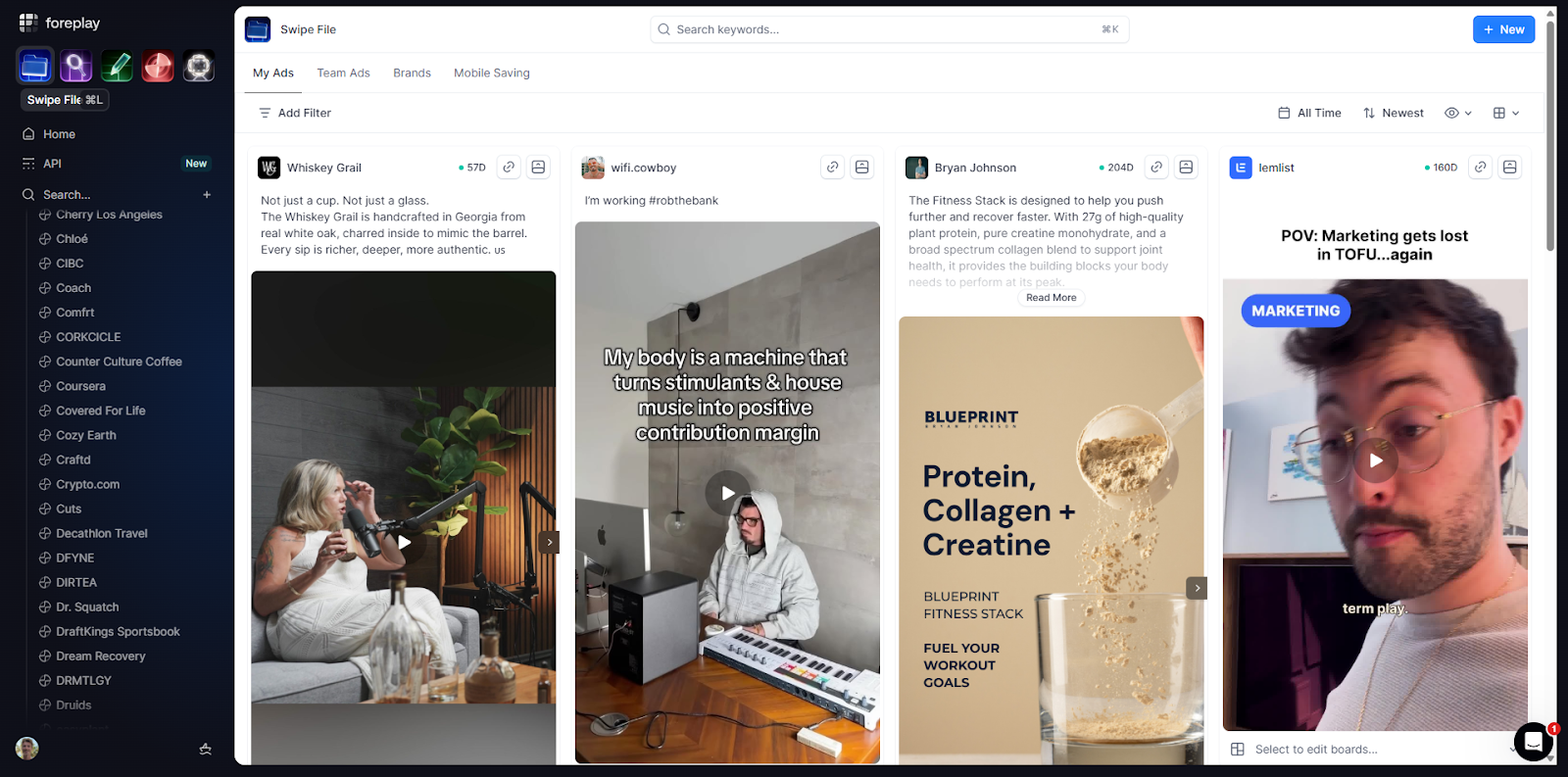
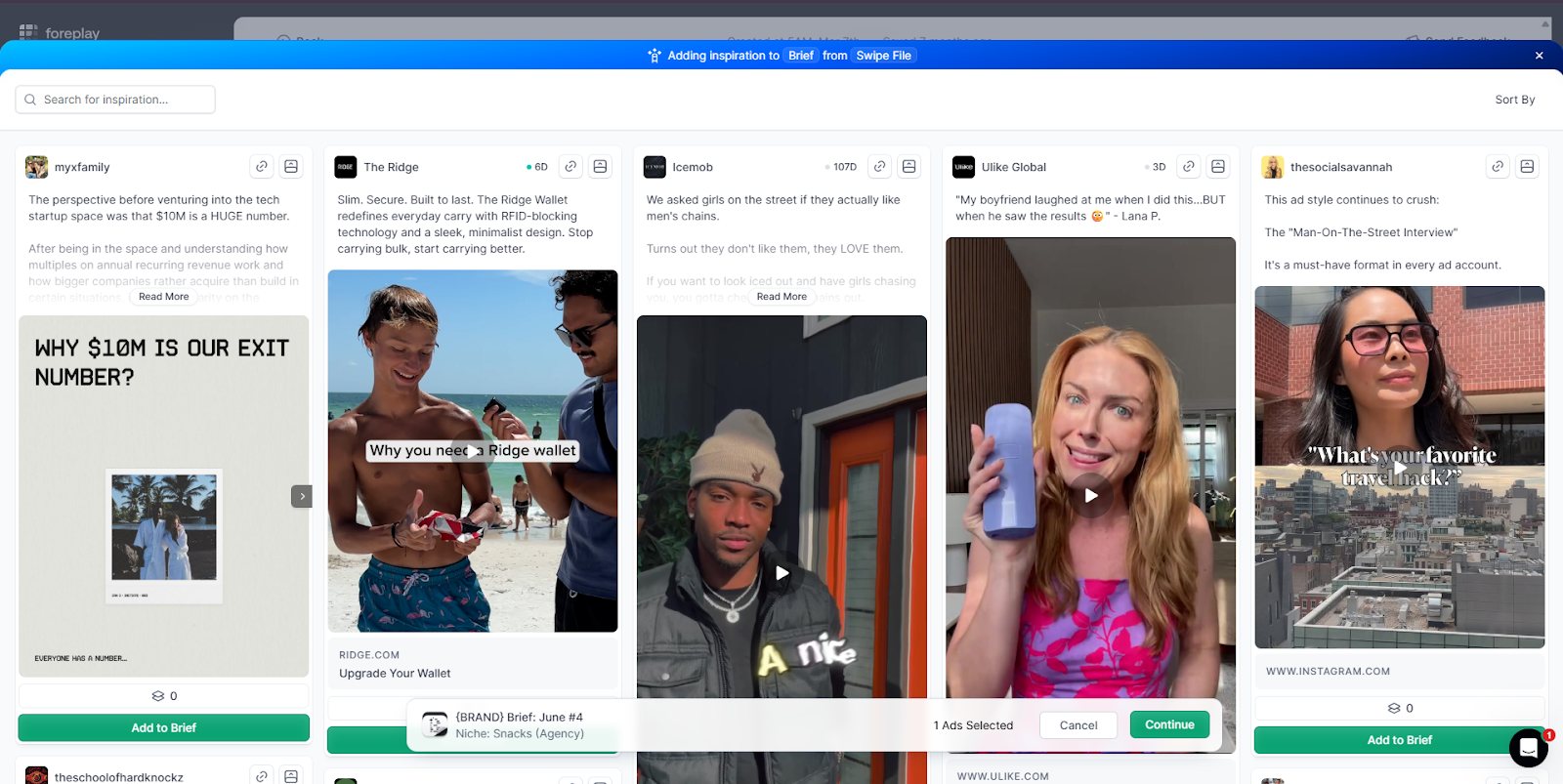
GetHookd Swipe File lets you save winning ads and organize them by folder for future reference.

GetHookd is a creative intelligence platform built for e-commerce brands, dropshippers, and media buyers who want to improve ad performance through better creatives, not just better tracking. While Cometly focuses on attribution (tracking which ads drive revenue), GetHookd starts with helping you find what makes ads work in the first place.

Beyond ad creatives, you can see where competitors are driving traffic and which landing pages receive the most visits, so you understand the full funnel, not just the ad. We also offer Creative Analyzer, which displays your performance metrics, so you can scale what’s working and replace what’s not.

GetHookd Core Features

  • Explore Ads & Save Ads: Browse over 65 million ads across Meta; filter by niche, format, or keyword, and save winning creatives to your Swipe File for future reference.
  • Brand Spy: Track competitor ad activity and see which creatives are being scaled over time.
  • Clone Ads: Turn top-performing images into new winners. Generate dozens of variations (new colors, avatars, formats, and styles) almost instantly with AI.
  • Ad Templates: Access ready-made templates for image ads and landing pages to launch campaigns faster.
  • Video Scripts: Create ad scripts for your campaign based on proven frameworks and hooks.
  • Ads Transcription: Automatically pull hooks, CTAs, and copy from winning video ads.
  • Creative Analyzer: Connect your Meta ad account to analyze performance by creative. Spot underperformers and generate new AI variations to replace them.
GetHookd’s Creative Analyzer lets you connect your Meta ad account to track performance and boost conversions.

GetHookd Pricing

We offer three pricing tiers for customers of all sizes:

  • Launch ($19/month): Explore Ads, Save Ads, Brand Spy, Ads Transcription, and Video Scripts. 
  • Grow ($59/month): Everything in Launch plus Clone Ads, Creative Analyzer.
  • Scale ($149/month): Full access to all features, including Creative Analyzer for up to 5 accounts and premium 24/7 support.

All three plans include a 7-day free trial, and choosing annual billing saves you 25%.

2. Triple Whale

Triple Whale positions itself as a complete intelligence platform for analytics and automation. (Image source: Triple Whale)

Triple Whale is an analytics and attribution platform built for e-commerce stores. It consolidates data from your ad platforms, email/SMS tools, and storefront into a single dashboard, giving you a clearer picture of what's driving revenue.

Triple Whale Core Features

  • Multi-Touch Attribution: Choose from different attribution models, including first-click, last-click, and linear.
  • Creative Cockpit: Analyze which ad creatives, images, and copy are driving conversions.
  • Cohort & LTV Analysis: Track repeat customer behavior and understand lifetime value by acquisition source.

Triple Whale Pricing

Triple Whale uses GMV-based pricing, meaning costs scale with your revenue. Paid plans start at $149–$199/month for smaller brands, with mid-tier plans ranging from $500–$1,100+/month, depending on your GMV bracket. 

GMV-based pricing can become expensive quickly as your business grows. Users also report a learning curve when setting up their accounts. While Triple Whale has added creative tools and access to the Meta Ads Library through Moby, these features are less comprehensive than dedicated AI creative platforms such as GetHookd.

3. Hyros

Hyros offers ad tracking and AI remarketing to help advertisers attribute conversions. (Image source: Hyros)

Hyros is an ad tracking and attribution platform. Unlike tools that rely on last-click data, Hyros uses what it calls "print tracking" to follow customers across devices, platforms, and touchpoints. It also feeds this data back into ad platforms such as Meta and Google to improve their targeting algorithms.

Hyros Core Features

  • Print Tracking: Proprietary tracking that follows customers across the entire journey, from first click to final sale.
  • Multi-Touch Attribution: Choose from first-click, last-click, linear, and time-decay models to see which ads drive conversions.
  • AI Ad Optimization: Uses your tracking data to help ad platforms target better and suggests which campaigns to scale or cut.

Hyros Pricing

Hyros uses revenue-based pricing. Plans start at around $230/month with annual billing for businesses tracking up to $20K in monthly revenue; costs increase as your tracked revenue grows.

Hyros requires a demo to get started, so there's no self-serve signup. The setup process can be complex. It's also built for advertisers with significant ad spend; smaller brands may find it overkill for their needs. Like Cometly, Hyros focuses solely on attribution. There are no ad research or creative generation tools.

Cometly Alternatives Comparison Table

Feature GetHookd Foreplay MagicBrief
Starting Price $19/month $59/month $249/month
Primary Focus Competitive intelligence and creative execution Creative inspiration and swipe files Creative briefing and team workflow management
Competitor Tracking Brand Spy (unlimited brands on higher plans) Spyder (limited brands based on plan) Custom tracked brands
Ad Saving Unlimited and permanent Unlimited and permanent Unlimited and permanent
AI Script Generation Yes (hooks, angles, and full scripts) Limited (via brief templates) Limited (via brief templates)
Ad Cloning Yes (color, avatar, and style variations) No No
Static Ad Templates Yes (proven direct response templates) No No
Best For Marketers who want to research and produce ads in one tool Strategists focused on organization and inspiration Teams prioritizing creative briefs and collaboration

GetHookd: Best Cometly Alternative for Creative Intelligence

Cometly helps you track which ads drive revenue. But tracking alone doesn't solve the bigger challenge most advertisers face: creating ads that actually convert. With GetHookd, instead of just measuring performance after the fact, we help you build better creatives from the start. With access to over 65 million ads across Meta, you can see exactly what's working in your niche: what hooks are landing, what formats are scaling, and what your competitors are running right now.

Our AI tools take it further. You can generate variations of winning creatives, build ad scripts based on proven frameworks, and pull hooks and CTAs from top-performing videos. When you're ready to analyze your own ads, Creative Analyzer connects to your Meta account and shows you performance by creative, so you can spot underperformers and replace them with stronger variations.

Unlike attribution-only tools like Cometly, GetHookd gives you everything you need to research, create, and optimize ads on one platform, making it the only tool serious advertisers need for creative performance.

Try GetHookd Now →

Frequently Asked Questions (FAQs)

What is Cometly used for?

Cometly is a marketing attribution platform that tracks which ads drive conversions and revenue. It’s used to consolidate data from multiple ad accounts, understand true ROAS, and make better decisions about where to allocate ad spend.

What is the alternative to Cometly?

GetHookd stands out as the best alternative to Cometly if your priority is creative performance rather than attribution. While the others focus on tracking where revenue comes from, GetHookd helps you research winning ads, generate new creatives with AI, and analyze what's working in your own ad account, all on one platform.

Can I analyze my own ad performance with GetHookd?

Yes. Creative Analyzer syncs with your Meta ad account so you can see which creatives are driving results and which ones need replacing. This gives you a clear picture of what to double down on and where to improve. You can also generate new AI variations for underperforming ads without leaving the platform.

What's the difference between Cometly and GetHookd?

Cometly is an attribution platform. It tracks which ads drive conversions to help improve targeting. GetHookd is a creative intelligence platform that covers the full creative workflow: research competitor ads in your niche, spy on brands scaling winning creatives, generate ad variations and scripts with AI, and analyze your own ad performance with Creative Analyzer.

*Note: Pricing and/or product availability mentioned in this post are subject to change. Please check our website for current pricing and stock information before making a purchase.

GetHookd Ads Library vs Facebook Ads Library
Gethookd vs Meta Ads Library
-
February 16, 2026

MagicBrief Reviews, Pricing & Alternatives: Is This AI Ads Tool Actually Good?

Key Takeaways

  • MagicBrief is a creative workflow platform with an ad library, briefing tools, and analytics for marketing teams.
  • MagicBrief reviews highlight useful collaboration features, but users cite a smaller ad library, limited creative production tools, and pricing that scales quickly for teams.
  • Pricing starts at $249/month based on ad spend and team size, with custom quotes required for all plans.
  • GetHookd is a powerful alternative with access to 65+ million ads (5x larger than MagicBrief's database), AI-powered creative tools, and performance analytics, giving brands everything they need to find, create, and optimize winning ads. 

MagicBrief Overview: Is This AI Ads Tool Actually Good?

MagicBrief is a research platform designed to help teams collect and analyze ad creatives. It provides access to over 12 million ads from platforms such as Facebook and Instagram, which is significantly smaller than GetHookd's 65+ million ad database. You can save ads using a Chrome extension, organize them into boards, and collaborate with teammates in real time. 

However, it's important to note that MagicBrief's pricing scales with your advertising spend and team size, and all plans require a custom quote. This makes it out of reach for smaller operations and solo marketers, who may value platforms with transparent pricing or more comprehensive, all-in-one capabilities.

GetHookd: Turn Competitor Intelligence Into Your Next Winning Ad

65M+ Ads Analyzed | 4.8★ G2 Rating | 4.4★ Trustpilot Rating

Stop Guessing. Start Scaling:

GetHookd reveals which ads your competitors are actively scaling—not just running. Spy on their best-performing creatives, landing pages, and traffic strategies, then turn proven concepts into testable campaigns in seconds with AI-powered script generation and creative cloning.

What You Get:
  • ✓ Brand Spy to decode competitor ad strategies in real-time
  • ✓ AI script generation and ad cloning for instant variations
  • ✓ Performance scoring based on actual ad behavior, not vanity metrics
  • ✓ Creative Analyzer to identify and scale your top performers
Replace guesswork with intelligence. Build profitable ads that actually convert.

MagicBrief Main Features

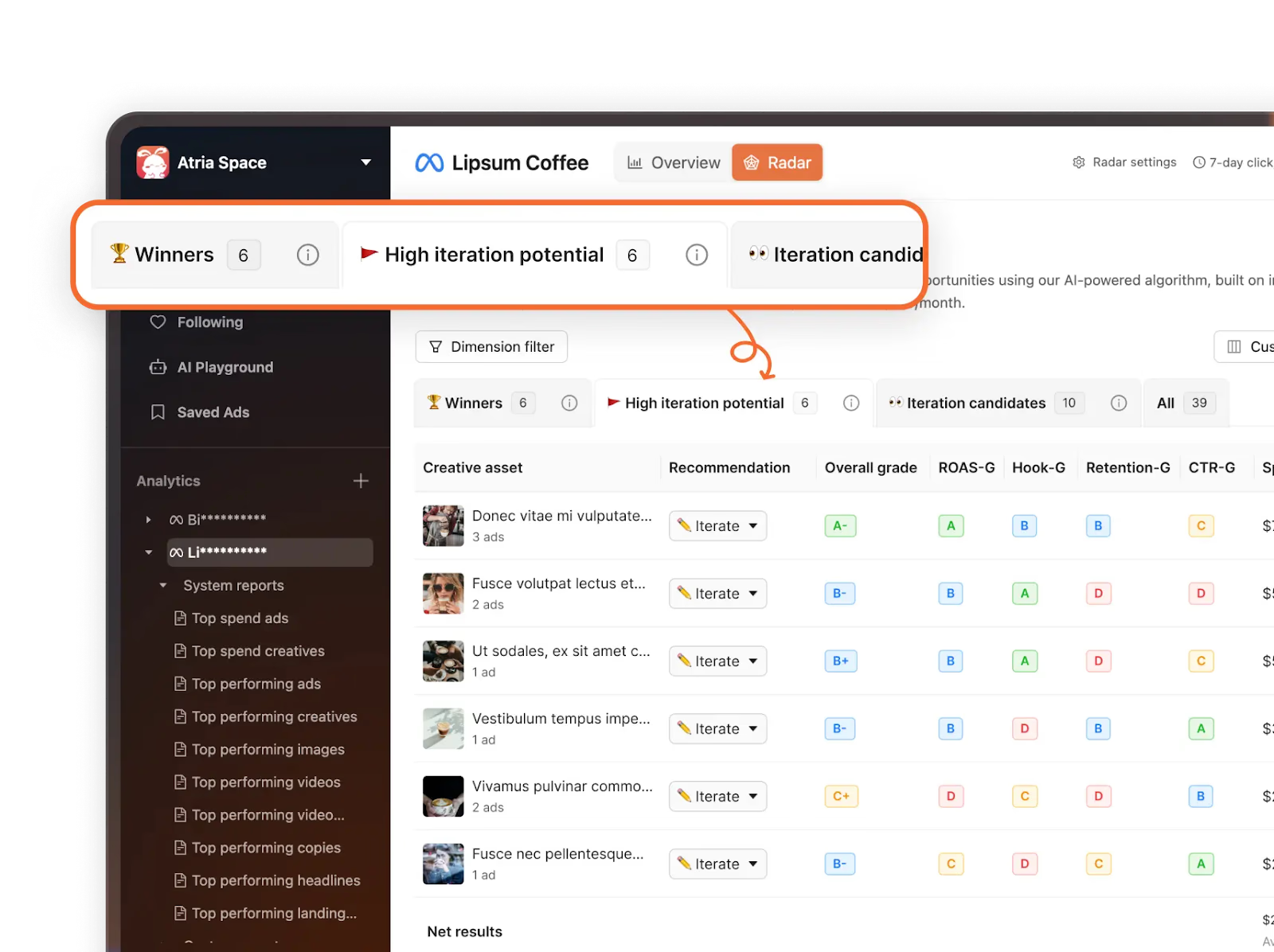
MagicBrief's Insights dashboard helps teams visualize creative performance at a glance. (Image source: MagicBrief)
  • Ad Library: You can search for ads by keyword, filter by theme, and save them to your personal Swipe File using the Chrome extension. Saved ads stay accessible even after they go offline.
  • Creative Briefing: The platform includes an editor for creating detailed creative briefs. You can add references and scripts to a single document. 
  • Creative Analytics: MagicBrief syncs with your Meta ad accounts to pull performance data. You can see which creatives drive results and compare formats and angles.
  • Competitor Tracking: You can follow brands and monitor their ad activity over time. MagicBrief shows which ads competitors are running, how long they've been active, and performance estimates.

MagicBrief Pricing

MagicBrief uses ad spend-based pricing, starting at $249/month for its Pro plan. Exact costs are customized based on your ad spend and team size, so please submit your details to receive a quote. 

For larger organizations, MagicBrief offers a Creative Intelligence tier with unlimited seats, tracked brands, ad account connections, and invoice-based billing.

MagicBrief User Experiences

Analyzing feedback from current users reveals consistent themes about MagicBrief's strengths and limitations. Users appreciate MagicBrief's briefing tools and collaboration features. The ability to save ads, build storyboards, and share briefs with creators in one place is also highlighted.

That said, the most frequent criticism involves pricing. Starting at $249/month with no transparent pricing tiers, MagicBrief feels expensive for smaller teams or solo marketers, especially since you have to go through a custom quoting process just to determine your actual cost. The ad library, while useful, contains significantly fewer ads than some competitors', which can limit options in niche industries.

Top 3 MagicBrief Alternatives Worth Considering

1. GetHookd

GetHookd's Explore feature lets you browse millions of ads and save winning creatives to organized boards.

GetHookd is a creative intelligence platform built for e-commerce brands, dropshippers, and media buyers who need to find winning ads and create variations fast, while tracking performance.

We provide access to over 65 million ads across Meta, which is more than 5x the size of MagicBrief's database. You can filter by niche, format, or keyword to discover what's performing in your market. Our Chrome extension lets you save ads from the Meta Ad Library directly to your Swipe File with one click. 

While MagicBrief helps with research and briefing, you'll need separate tools to actually produce ads. GetHookd handles the entire workflow, from winning ad discovery to AI-powered creative analysis and ad creation. Our AI ad discovery system helps you find winning creatives faster, while our AI creative analysis tools identify patterns in top-performing ads.

GetHookd Core Features

GetHookd's Image Ad Templates give you customizable designs for quick, high-impact creatives.
  • Explore Ads & Swipe File: Search through 65+ million curated ads. Save winning creatives to your Swipe File and organize them by folder for easy reference. Just like MagicBrief, your saved ads remain accessible even if they become inactive.
  • Brand Spy: Monitor competitor ad activity. See which creatives they're scaling, how long ads have been running, and where traffic is going.
  • Clone Ads: Generate AI-powered variations of high-performing ads to speed up testing and production.
  • Video Scripts: Build ad scripts using proven frameworks and hooks. No need to start from scratch.
  • Ads Transcription: Automatically pull hooks, CTAs, and copy from winning video ads.
  • Customizable Templates: Access ready-made templates for image ads and high-converting landing pages to launch faster.
  • Creative Analyzer: Sync your Meta ad account to see performance by creative. Identify what's working, spot underperformers, and generate new AI variations to replace them.

GetHookd Pricing

We offer three pricing plans starting at $19/month for the Launch tier, which includes access to the ad library, Swipe File, Brand Spy, Ads Transcription, and Video Scripts. The Grow plan at $59/month includes AI creative tools such as Clone Ads and Creative Analyzer. 

The Scale plan at $149/month unlocks full access to all features, with Creative Analyzer supporting up to 5 ad accounts. All plans include a 7-day free trial. 

Compared to MagicBrief's $249/month starting price, our platform delivers more comprehensive features, including AI creative production, at a fraction of the cost.

2. Motion

Motion's dashboard displays creative performance metrics to help teams identify winners. (Image source: Motion)

Motion overlaps with MagicBrief in creative analytics and performance reporting. Where Motion falls somewhat short compared to MagicBrief is in its collaborative features. While it offers basic sharing capabilities, it lacks the robust brief builder and team workflow tools. 

Additionally, Motion is primarily for finding top creative analytics. It doesn't incorporate the sophisticated AI creation capabilities that GetHookd offers. You will need another tool to make variations of your own winning ads. 

Motion Core Features

  • Creative Analytics: Visual dashboards that show which ads perform best across platforms. Filter by format, naming convention, or AI-generated tags.
  • AI Insights: Motion's AI analyzes your creatives and provides recommendations on what to improve or iterate.
  • Frame-by-Frame Analysis: Break down video ads to see where viewers drop off and which moments drive engagement.
  • Team Reporting: Build shareable reports with live data. Schedule automated delivery via Slack or share links with clients.

Motion Pricing

Motion starts at $250/month for its Starter plan, which covers brands spending up to $50K/month on ads and includes AI tags, creative analytics, unlimited seats, and in-app chat support. Pro and Growth tiers are available for brands with higher ad spend, but pricing requires a demo call.

Motion is built for larger teams with significant ad budgets. Smaller brands, dropshippers, or those just starting with paid ads may find the entry price and minimum spend requirements limiting. The platform also focuses primarily on analytics, which limits it to brands that need a comprehensive platform that spans research through production.

3. AdSpy

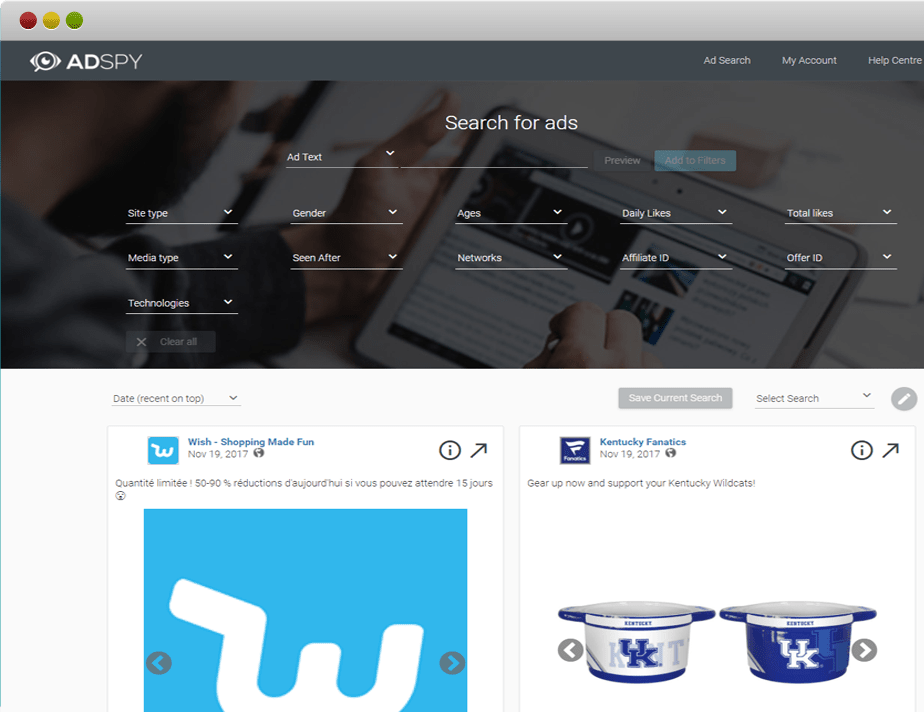
AdSpy's database is large, but finding current, relevant ads requires extra filtering through historical data. (Image source: AdSpy)

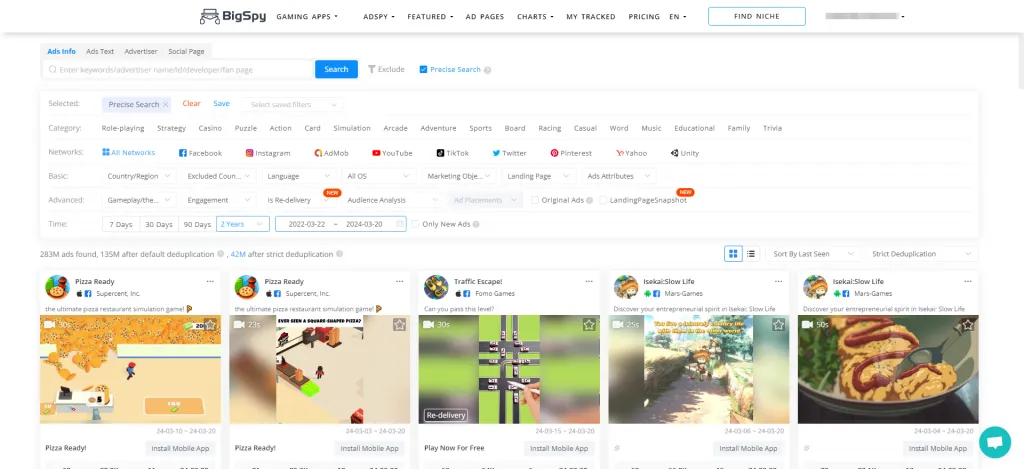
AdSpy is one of the older ad intelligence platforms. It provides access to millions of ads across Facebook and Instagram with granular search filters, though much of its database consists of outdated ads that are no longer running. This platform is designed specifically for research and competitor tracking.

AdSpy Core Features

AdSpy lets you filter ads by keywords, advertiser name, engagement metrics, demographics, call-to-action type, media type, and more. You can also search for comments to identify creatives that generate strong audience reactions. The platform includes landing page screenshots linked to each ad, which stay accessible even after the original page goes offline.

AdSpy Pricing

AdSpy offers a single plan at $149/month with no lower-tier options. For a research-only tool, the price can feel steep for solo marketers and smaller teams who need more than just a search engine for ads. 

While AdSpy has a large database, a significant portion of it is historical, meaning many indexed ads are no longer running. Finding current, relevant campaigns takes extra filtering and manual effort. The platform also lacks AI creative tools, so there's no script generation, ad cloning, or creative analysis to help turn research into production-ready ads.

MagicBrief Alternatives Comparison Table

Tool Core Strength Limitations Best For
GetHookd Ad research + creative production in one platform. Find winning ads, transcribe them, generate scripts, clone variations. No campaign management Ecommerce brands, agencies, and media buyers who need to research winning concepts and produce high-performing ads before testing
Birch (Revealbot) Rule-based automation for scaling and budget adjustments Steep learning curve, no creative research or production tools Teams seeking to automate campaigns
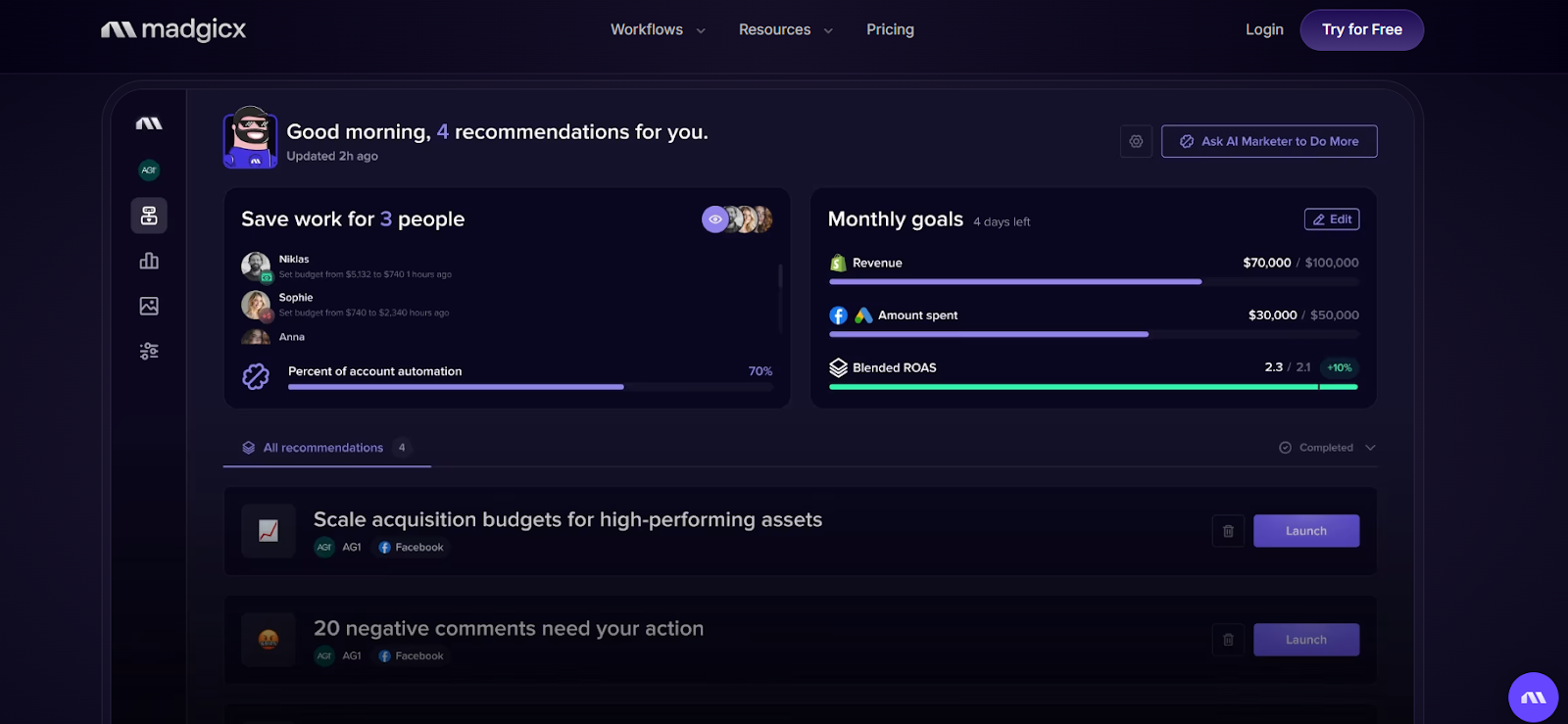
Madgicx AI-powered optimization with creative analysis Learning curve, Meta-only, assumes you already have creatives worth testing Meta advertisers looking for hands-off optimization
Smartly.io Automation and cross-platform campaign management Enterprise pricing; complex for smaller teams, no ad research features Brands with significant ad budgets

Why GetHookd is the Best MagicBrief Alternative

MagicBrief helps teams organize research and build briefs, but the workflow stops there. You still need separate tools to actually create ready-to-use ads, generate scripts, and analyze performance.

What sets GetHookd apart is its end-to-end workflow, which eliminates the need to juggle tools. Our platform includes advanced AI creative generation capabilities that automatically produce variations from top-performing ads. This allows marketers to quickly implement insights at higher volumes. It also significantly accelerates testing cycles and reduces the technical complexity of handling multiple tech stacks.

With transparent pricing starting at just $19/month (vs. MagicBrief's $249/month baseline), 5x more ads in our database, and comprehensive features spanning both analytics and production, GetHookd delivers significantly more value per dollar than MagicBrief's research-focused approach.

For teams looking to improve creative performance at scale, GetHookd shortens the path from research to launch. Instead of building a library of inspiration you'll never use, you can go from research to profitable creatives in minutes.

Try GetHookd Now →

Frequently Asked Questions (FAQs)

How does MagicBrief do?

MagicBrief lets you discover ads from its library, save them to organized boards, and turn your research into creative briefs for your team or external creators. Its block-based editor lets you build detailed briefs, including references, storyboards, scripts, and technical specifications, in a single document. 

That said, MagicBrief is primarily a research and briefing tool. Once you've built your brief, you still need separate tools to actually create the ads. GetHookd handles both research and production on a single platform.

What are the benefits of using MagicBrief?

MagicBrief centralizes creative research and simplifies communication between strategists and creators. The AI analysis tool helps identify what makes winning ads work, and the briefing tools keep teams aligned on creative direction.

However, MagicBrief stops at this briefing stage. You still need separate tools to produce the actual ads. GetHookd goes further by combining research with AI-powered creative production. You can generate ad variations, scripts, and images directly from your findings, plus track your own ad performance. It's the full workflow from insight to execution, not just research you'll hand off to someone else.

How does GetHookd’s Brand Spy work for competitor research?

Brand Spy lets you track any brand's ad activity over time. You can see which creatives they're running, how long ads have been active, which ones are being scaled, and where they're driving traffic. It's a straightforward way to monitor competitors and identify winning strategies before testing them yourself.

Do I need technical skills to use GetHookd?

No. GetHookd is built for marketers and dropshippers, not developers. You can browse ads, save creatives, generate scripts, and analyze performance without any coding or technical setup. 

*Note: Pricing and/or product availability mentioned in this post are subject to change. Please check our website for current pricing and stock information before making a purchase.
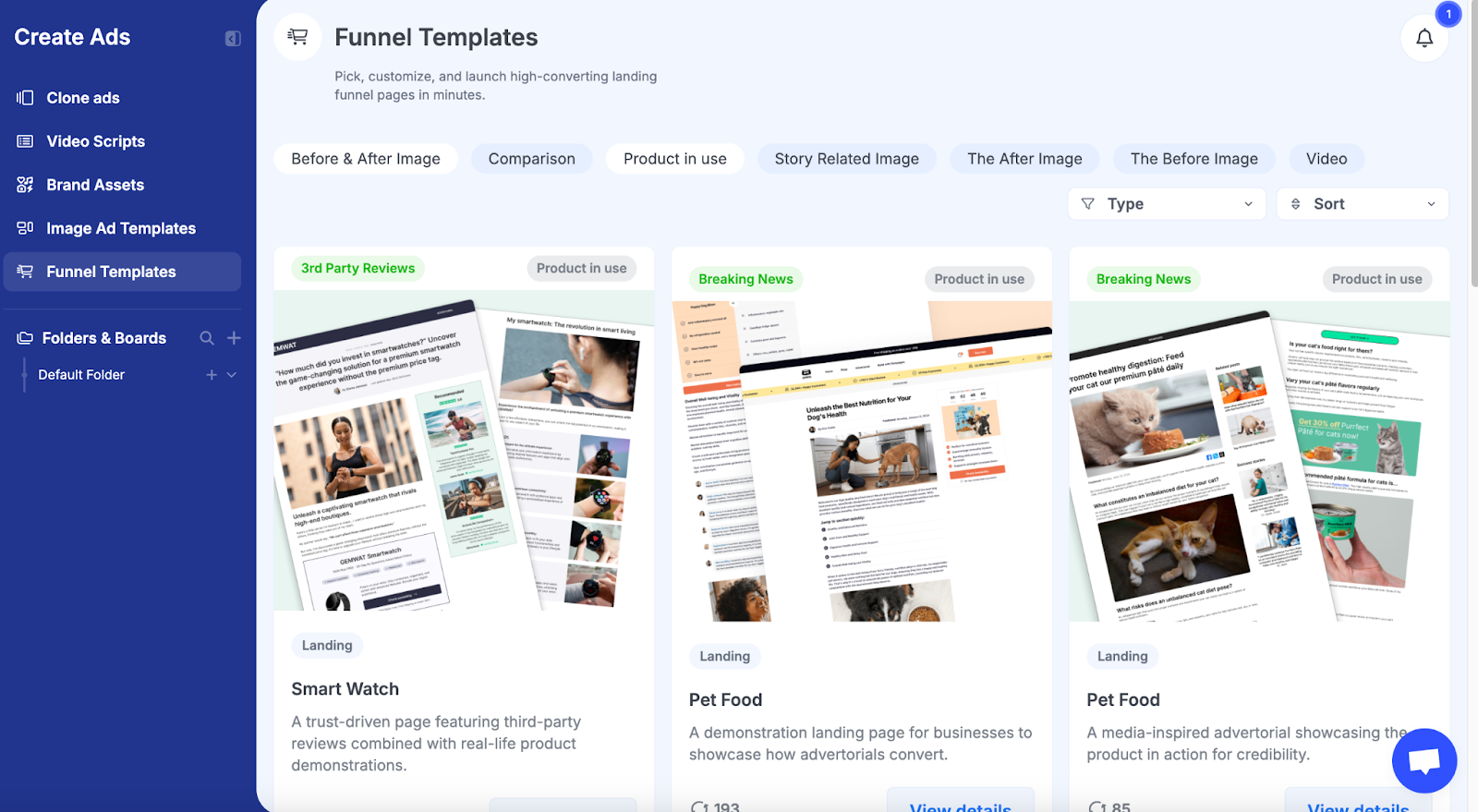
GetHookd Ads Library vs Facebook Ads Library
Gethookd vs Meta Ads Library
-
February 15, 2026

Ad Creative AI Reviews, Pricing & Alternatives: Is It Actually Good?

Key Takeaways

  • Ad Creative AI is built to generate ads quickly but lacks competitive research, landing page insights, and deep performance data.
  • Ad Creative AI pricing starts at $39/month, with higher tiers at $249/month and $599/month; costs add up fast for teams with high creative volume.
  • While user-friendly for beginners, creative customization options are limited; teams with specific design standards may find the output repetitive.
  • GetHookd combines ad intelligence with AI creative tools, allowing you to research competitors' scaling ads and create your own variations on one convenient platform.
  • For media buyers, dropshippers, and e-commerce teams, starting with proven concepts beats guessing; GetHookd makes that possible with competitive pricing plans.

Ad Creative AI: Is It Good for Your Campaigns?

Ad Creative AI is an ad generation platform that uses artificial intelligence to create banner ads, video ads, product photoshoots, and ad copy. Rather than functioning as a general-purpose design tool, it focuses on producing conversion-optimized creatives for platforms such as Meta and Google.

With features ranging from AI-generated visuals to performance scoring, Ad Creative AI promises to help teams scale their creative output. But does it actually deliver results for e-commerce brands, agencies, and media buyers? More importantly, can it help you identify what's already working before you start creating?

In this review, we'll break down its core features, pricing, and how it compares to alternatives, so you can decide whether it's the right fit for your ad workflow.

GetHookd: Turn Competitor Intelligence Into Your Next Winning Ad

65M+ Ads Analyzed | 4.8★ G2 Rating | 4.4★ Trustpilot Rating

Stop Guessing. Start Scaling:

GetHookd reveals which ads your competitors are actively scaling—not just running. Spy on their best-performing creatives, landing pages, and traffic strategies, then turn proven concepts into testable campaigns in seconds with AI-powered script generation and creative cloning.

What You Get:
  • ✓ Brand Spy to decode competitor ad strategies in real-time
  • ✓ AI script generation and ad cloning for instant variations
  • ✓ Performance scoring based on actual ad behavior, not vanity metrics
  • ✓ Creative Analyzer to identify and scale your top performers
Replace guesswork with intelligence. Build profitable ads that actually convert.

Core Features of Ad Creative AI

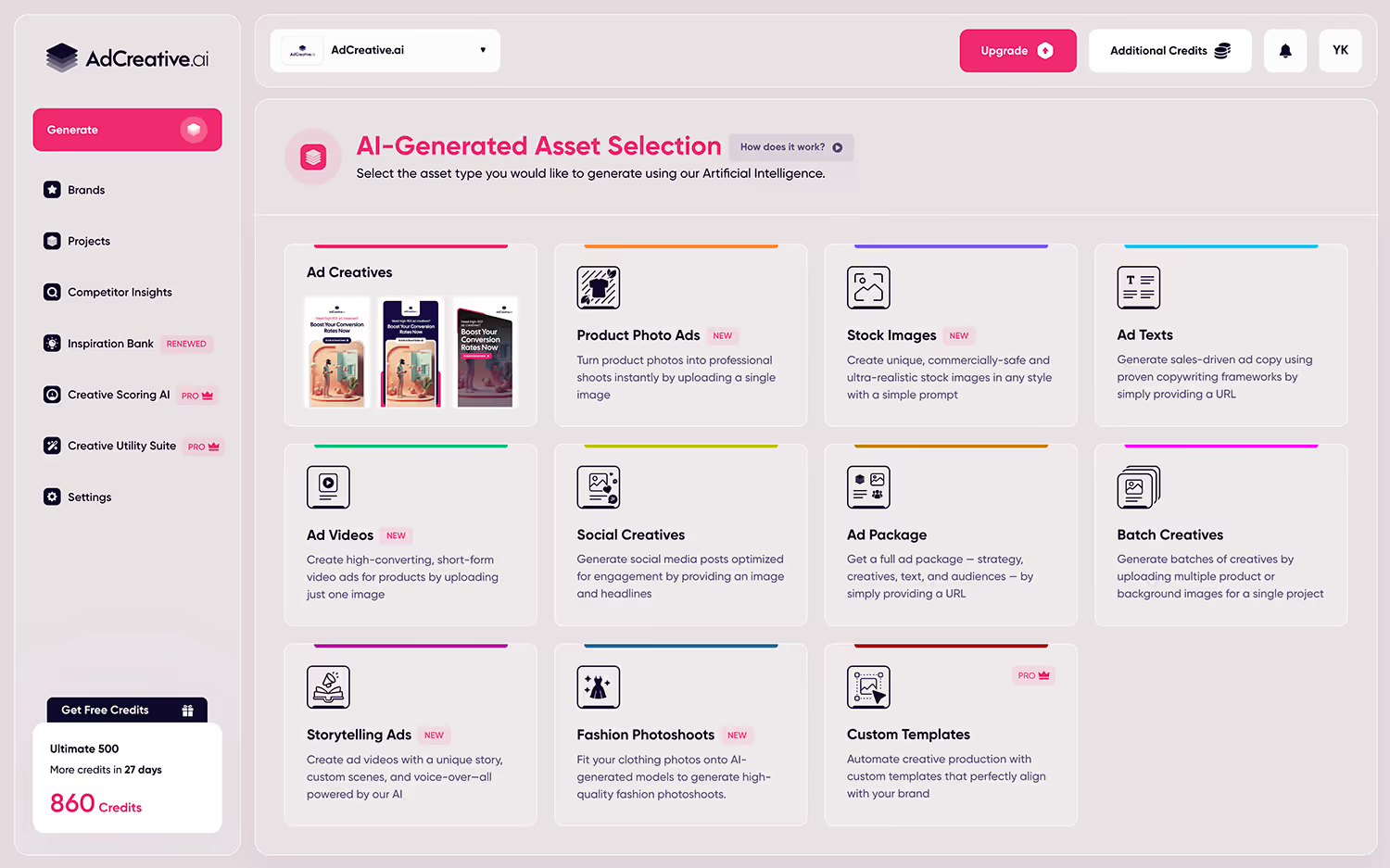
Ad Creative AI offers multiple asset types, but no ad research is built in. (Image source: Ad Creative AI)

AI Ad Creative Generation

Ad Creative AI's core function is producing ad banners, display creatives, and ad copy using AI. Users input brand details, product information, and campaign goals, and the platform generates multiple ad variations across formats. The built-in text generator handles headlines, descriptions, and CTAs, while custom templates let users lock in brand elements for consistency across campaigns.

AI Product Visuals & Video

The platform offers tools for generating product photoshoots, video ads, and UGC-style content. Product Photoshoots AI transforms basic product images into polished visuals with AI-generated backgrounds.

Creative Insights & Competitor Analysis

Users can connect ad accounts to access Creative Insights, a dashboard that highlights top-performing creatives and identifies patterns across campaigns. The platform also offers Competitor Insights for viewing competitor ads, but it provides only surface-level visibility rather than deeper research into which ads are actively scaling, where traffic is going, or which landing pages competitors are using.

Ad Creative AI Pricing

Ad Creative AI offers tiered pricing based on credits and download limits rather than unlimited generation. All plans include a 7-day free trial with 10 credits.

  • Starter Plan ($39/month): Covers core features including AI creative generation, text generator AI, Creative Insights, ad platform integrations, and access to iStock's image library.
  • Professional Plan ($249/month): Unlocks Pro features including custom templates, enhanced creative insights, competitor insights, and priority support.
  • Ultimate Plan ($599/month): Targets agencies and larger teams with higher creative volume. Adds expanded collaboration tools, advanced analytics, and full Pro feature access.
  • Enterprise Plan (Custom pricing): For large organizations needing tailored solutions, dedicated account management, and unlimited brands and users.

Ad Creative AI Reviews

Ad Creative AI reviews are mixed but skew positive. Marketers frequently cite the platform's intuitive interface and time-saving capabilities as its main strengths, and the AI-generated copy generally produces platform-appropriate messaging without requiring extensive editing.

However, several limitations appear consistently in user feedback. Customization options feel restrictive for teams trying to create distinctive visual concepts. Once the AI generates a creative, editing flexibility is limited. Some users also report inconsistent output quality, with only a portion of the generated creatives usable without rework. 

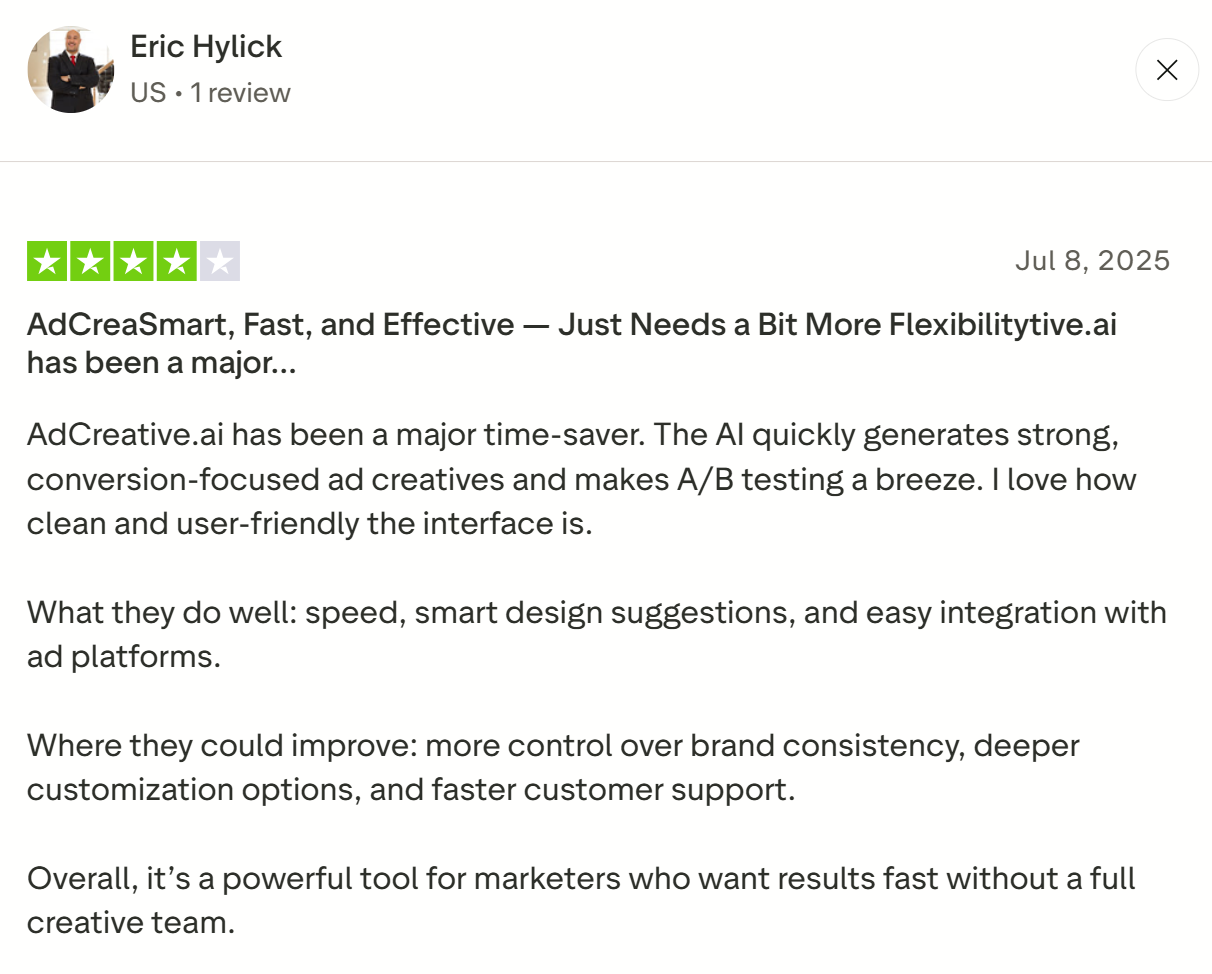
One user said that AdCreative.ai is fast and easy to use but needs better brand-consistency controls, deeper customization, and faster customer support.

Billing practices are another recurring concern. Reviews across Trustpilot and Reddit mention unexpected charges after the free trial, unclear cancellation flows, and slow refund processing. Support responsiveness varies. Some users report quick resolutions, while others cite delays or unresolved tickets.

Limitations of Ad Creative AI

No Deep Ad Intelligence

Ad Creative AI is built to create ads, not to research what's already winning in the market. There's no database of high-performing ads to browse, no visibility into landing pages or funnel strategies, and no insight into traffic sources. 

Teams that rely on competitive research to inform their creative direction will need to supplement with another tool.

Shallow Competitor Research

The platform's Competitor Insights feature shows competitor ads without performance signals or scaling data. There's no way to track which ads competitors are actively scaling versus just running, and no permanent ad-saving functionality to build a reference library over time. 

For media buyers and e-commerce teams who rely on competitive intelligence to shape creative decisions, this limits the platform's usefulness as a standalone solution.

Limited Customization

While the AI generates creatives quickly, editing flexibility is restricted. Users can't make deep adjustments to layouts, fonts, or element spacing, and templates can start to feel repetitive after extended use. For brands with specific design standards or teams looking to create highly distinctive visuals, this can be a bottleneck.

For teams focused solely on generating ad variations, Ad Creative AI may work. But performance marketers who rely on competitive intelligence and proven concepts to inform creative decisions will need a platform that combines research with creation, like GetHookd.

Top 2 Ad Creative AI Alternatives

1. GetHookd

GetHookd lets you save and organize winning ads with detailed performance data.

GetHookd stands out as a top Ad Creative AI alternative, combining AI-powered creative generation with sophisticated ad intelligence and competitor research. 

Unlike Ad Creative AI, which focuses primarily on creating ads from scratch, our platform enables marketers, dropshippers, and media buyers to identify high-performing ad concepts already proven in their industry and then customize them with AI assistance. 

This approach significantly reduces the testing phase by starting with concepts that already demonstrate market resonance.

GetHookd Key Features

  • Explore Ads: AI-powered ad discovery gives you access to over 65 million creatives across Meta, including Facebook ads, so you can see what's working in your niche and fuel your next campaign.
  • Brand Spy: See exactly what competitors are doing: their top ads, landing pages, traffic sources, and more. Understand which ads are actively scaling, not just running. Where Ad Creative AI shows surface-level competitor ads, Brand Spy reveals which creatives are actually gaining traction and why.
  • Save Ads: Build a permanent swipe file of winning ads, organized by niche, format, or performance. Your saved ads stay accessible even after they go offline.
Connect your ad account to see what's working and optimize your ads.
  • Creative Analyzer: An AI-powered feature that shows which creatives are performing best and identifies opportunities to optimize.
  • Ads Transcription: Transcribe video ads to quickly extract hooks, CTAs, and copy frameworks for your own campaigns.
  • Video Scripts: Upload a winning ad, add your product info, and let our AI copywriter generate hooks, angles, and scripts in seconds.
  • Clone Ads: Turn top-performing images into new variations instantly.

We offer flexible plans starting at $19/month. All plans include access to the ad database, Brand Spy, and AI-powered scripting tools. A 7-day free trial is available to explore the platform before committing, and annual plans include a 25% discount.

2. Foreplay

Foreplay's Swipe File organizes inspiration, but stops short of creative generation.

Foreplay is primarily a swipe file and ad workflow tool for saving, organizing, and sharing ad inspiration. It also allows competitor tracking and basic creative analytics. 

However, Foreplay lacks AI-powered creative generation. While it can help you organize inspiration and brief your team, you'll need separate tools to actually produce ready-to-use ad variations or visuals.

Foreplay Key Features

  • Swipe File: Save ads and organize them into boards with custom tags.
  • Discovery: Browse a community-curated ad library with AI-powered search and filtering.
  • Spyder: Track competitor brands and receive alerts when they launch new ads.
  • Briefs: Turn saved ad inspiration into creative briefs and storyboards.
  • Lens: Basic creative analytics for reviewing ad performance across accounts.

Foreplay's Basic plan starts at $59/month, with the Workflow plan at $175/month. A 7-day free trial is also available.

Ad Creative AI & Alternatives At a Glance

Feature GetHookd Foreplay Ad Creative AI
Primary Focus Ad intelligence + creative analysis + AI creative generation Ad inspiration organization + swipe files AI ad generation
Ad Database Size 65M+ Meta ads Community-curated library Not applicable
Competitor Tracking Brand Spy shows which ads are actively scaling, not just running Spyder tracks when competitors launch ads (requires Workflow plan or higher) Surface-level visibility only
Landing Page Insights Full visibility into competitor landing pages and traffic sources Landing page screenshots only No landing page insights
Performance Signals Real-world scaling signals show which ads are gaining traction Lens provides basic analytics Predictive scoring before launch
AI Ad Generation Clone Ads for instant variations with new colors, avatars, formats, and styles No AI generation; briefs only Banners, product photoshoots, ad copy
Video Scripts AI copywriter generates high-converting hooks, angles, and scripts for your products in seconds No script generation Basic ad copy generation
Ad Transcription Transcribe video ads to extract hooks, CTAs, and copy frameworks Available Not available
Save Ads Permanently Ads saved forever, even after they go offline Ads saved permanently with custom tags and boards No ad-saving functionality
Best For Media buyers, dropshippers, and e-commerce teams who need research and creation in one workflow Teams focused on organizing inspiration and briefing Teams needing fast ad generation without competitive research
Starting Price $19/month $59/month $39/month

Find Winning Ads & Create Faster with GetHookd

Ad Creative AI can generate creatives quickly, but without market intelligence, you're testing blind. That means wasted budget, failed tests, and no clear path to what actually converts.

GetHookd takes a different approach. Instead of starting from scratch, you start with proof. Browse over 65 million high-performing Meta ads to see which creatives competitors are actively scaling, and understand the landing pages and funnels driving their results. With our Brand Spy feature, you're not just seeing which ads exist; you're also seeing which are actually gaining traction.

Once you've identified winning concepts, you can move from research to execution in seconds. Use Clone Ads to generate fresh variations of top-performing images. Upload a winning ad and let the AI copywriter produce hooks, angles, and video scripts tailored to your product. 

For media buyers and marketers who need to move fast, GetHookd closes the gap between finding winning ads and creating your next one.

Try GetHookd Now →

Frequently Asked Questions (FAQs)

What is Ad Creative AI? 

Ad Creative AI is an ad generation platform that uses artificial intelligence to create banner ads, video ads, product photoshoots, and ad copy. It's designed to help marketers produce conversion-optimized creatives for platforms like Meta and Google.

Is Ad Creative AI good for beginners? 

Ad Creative AI has an intuitive interface that makes it accessible for beginners who need to produce ad creatives quickly. However, the platform's limited customization options can be frustrating for users still learning what works.

How much does Ad Creative AI cost? 

Ad Creative AI’s paid plans start at $39/month for the Starter plan, which includes 10 credits per month. Higher-tier plans with more credits and features range from $249/month to $599/month, with custom pricing available for enterprise needs. Ad Creative AI also offers a 7-day free trial with 10 credits.

What is the alternative to Ad Creative AI? 

GetHookd is the strongest alternative to Ad Creative AI for performance marketers. Unlike Ad Creative AI's generation-only approach, GetHookd combines a 65M+ ad database with competitor intelligence and AI creative tools. See what's actually scaling in your niche, then create your own variations, all in one platform. 

Does GetHookd have creative AI tools for ads? 

Yes. GetHookd includes several AI-powered tools for ad creation, including Clone Ads, Video Scripts, and Ads Transcription. These tools work alongside ad research features, so you can move from finding profitable concepts to creating your own ads in one workflow.

*Note: Pricing and/or product availability mentioned in this post are subject to change. Please check our website for current pricing and stock information before making a purchase.
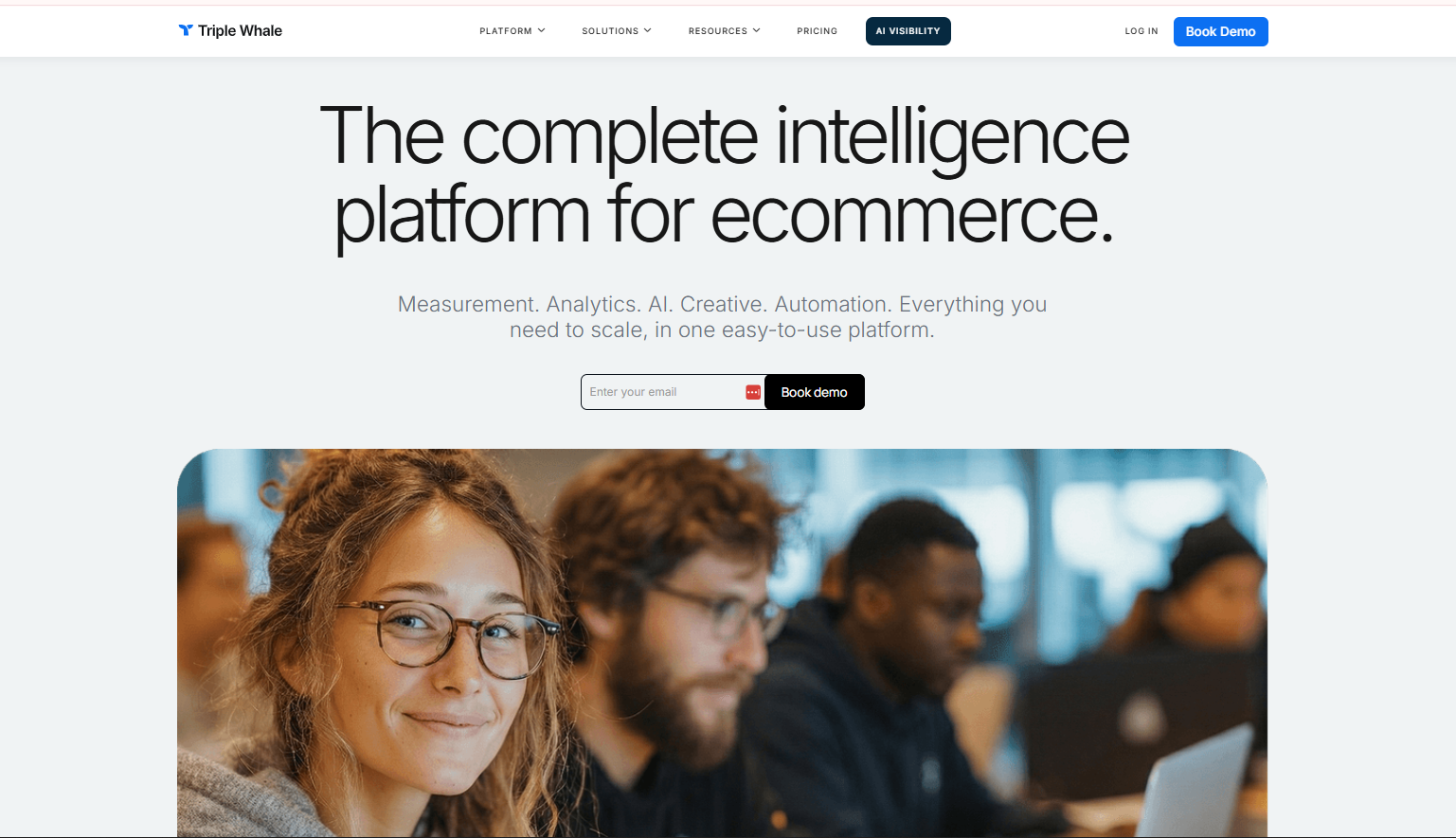
GetHookd Ads Library vs Facebook Ads Library
Gethookd vs Meta Ads Library
-
February 14, 2026

Atria AI Reviews, Pricing & Alternatives: Is This Facebook Ad Tool Legit?

Key Takeaways

  • Atria AI offers ad research and creative analytics, but pricing starts at $159/month, making it pricier than some alternatives.
  • Atria has limited public reviews, with users citing high pricing, a steep learning curve, and slow support.
  • GetHookd's Brand Spy is available on all plans, while Atria limits competitor tracking by tier.
  • Foreplay offers swipe file organization and briefing, but lacks creative production features such as ad cloning and image generation.
  • GetHookd is Atria's strongest competitor, offering robust AI features at a more accessible price point for businesses.

Atria AI: Is This Facebook Ad Tool Legit?

Atria AI is a creative management platform for performance marketers. It targets teams and agencies that want guidance on their ad creatives. 

Atria emphasizes its AI capabilities: the system scores ads, surfaces optimization opportunities, and generates scripts or concepts based on patterns it identifies. 

But does Atria deliver on these promises, and is it the right fit for your workflow? This article covers the features, pricing, real user feedback, and alternatives worth considering.

Atria AI Core Features

Atria's Radar feature scores creative assets based on performance. (Image source: Atria)

Here are some of the key features of Atria AI:

  • Ad Library & Discovery: Atria offers a library of 25M+ ads. Users can search by brand, theme, format, or hook style, then save ads to boards for later reference. 
  • Radar AI: The Radar feature grades creatives on metrics such as hook effectiveness, retention, and ROAS, then surfaces recommendations on what to scale or improve. 
  • Review Mining: Atria can pull customer reviews from product pages and extract ad angles, pain points, and emotional triggers. This is meant to inform creative direction by showing what language resonates with buyers.
  • AI Script & Image Generation: The platform generates ad scripts, hooks, and concepts based on prompts or reference ads. It also offers image ad cloning: just upload a winning static image and generate variations with different layouts or compositions.
  • Creative Analytics: Atria's analytics dashboard tracks performance across connected ad accounts.

GetHookd: Turn Competitor Intelligence Into Your Next Winning Ad

65M+ Ads Analyzed | 4.8★ G2 Rating | 4.4★ Trustpilot Rating

Stop Guessing. Start Scaling:

GetHookd reveals which ads your competitors are actively scaling—not just running. Spy on their best-performing creatives, landing pages, and traffic strategies, then turn proven concepts into testable campaigns in seconds with AI-powered script generation and creative cloning.

What You Get:
  • ✓ Brand Spy to decode competitor ad strategies in real-time
  • ✓ AI script generation and ad cloning for instant variations
  • ✓ Performance scoring based on actual ad behavior, not vanity metrics
  • ✓ Creative Analyzer to identify and scale your top performers
Replace guesswork with intelligence. Build profitable ads that actually convert.

Atria AI Pricing Breakdown

Atria offers four main pricing tiers with graduated access to features and usage limits. All plans include access to the core ad library and Radar AI scoring, and come with a 7-day free trial. The prices below are for monthly plans, and annual billing includes a 20% discount.

  • The Core plan costs $159/month and includes 5 seats, 4,000 AI credits, and tracking for 50 brands.
  • The Plus plan costs $329/month and includes 8 seats, 10,000 AI credits, and 100 brands tracked.
  • Business and Enterprise plans carry custom pricing. Business includes 15 seats, 25,000 AI credits, 200 brands, unlimited ad spend tracking, and features like custom metrics. Enterprise adds dedicated support, custom limits, and early access to new features.

Atria AI Reviews: What Are Users Saying?

Atria has fewer public reviews than more established Facebook ad tools, but some feedback is positive. Users note that the Radar feature reduces manual ad analysis. The interface has also been described as relatively intuitive.

On the critical side, some users say the pricing is too high for beginners and solo marketers. Others report that the free trial feels limited, with key features triggering unexpected upgrades. The learning curve keeps coming up: reviewers point out that Atria assumes you already have campaigns running or a baseline understanding of creative strategy.

One user found the platform usable but missing key research tools, felt the pricing was high for beginners, and noted they were charged after forgetting to cancel, though support resolved it.

Top 3 Alternatives to Atria AI

1. GetHookd

Choose from ready-made templates, customize, and launch ads in minutes.

We built GetHookd for marketers, dropshippers, and ecommerce teams who want to move from competitor research to creative production without switching tools. Our Meta ad library indexes 65M+ ads, more than double what Atria offers. 

Beyond research and winning ad creation, GetHookd offers powerful AI tools to generate scripts, transcribe video ads, and clone high-performing creatives. We also provide pre-built templates that you can customize for your ads and landing pages. Our users are not just gathering inspiration; they’re also producing high-volume creative assets ready to test.

GetHookd Key Features

  • Explore Ads: Search our library of 65M+ Facebook ads. Filter by niche, ROAS benchmarks, and visual styles to find what's performing in your market.
  • Brand Spy: Enter any brand and see their active Facebook ads, landing pages, and traffic sources. We surface their longest-running creatives, so you know what's actually converting.
  • Save Ads: Build your own swipe file. Saved ads stay accessible forever even after the original campaign goes offline.
Upload one winning ad and generate dozens of variations with no design skills needed.
  • Clone Ads: Turn one creative into dozens of variations in new colors, layouts, and compositions without design software.
  • Ads Transcription: Pull text from video ads to quickly extract hooks, copy, and CTAs for your own campaigns.
  • Video Scripts: Upload a winning ad or add your product details, and our AI copywriter generates hooks, angles, and full scripts in seconds.
  • Creative Analyzer: Connect your ad account and see what's working across formats, styles, and messaging.

GetHookd Pricing

Paid monthly plans start at $19 per month, and annual billing includes a 25% discount. For context, Atria's cheapest plan starts at $159/month, which is more than eight times GetHookd's entry price. 

Even at GetHookd’s entry plan, you get access to Explore Ads, Brand Spy, Video Scripts, and Ads Transcription. For users who want powerful tools without the inflated price tag, GetHookd delivers.

2. Foreplay

Foreplay lets you save ads and use them as inspiration for scripts, but lacks creative cloning tools. (Image source: Foreplay)

Foreplay is a swipe file and ad research tool for creative strategists and agencies. The platform focuses on saving, organizing, and briefing rather than analytics. 

Foreplay allows users to share boards, add comments, and embed saves into tools like Notion. Unlike GetHookd and Atria, it doesn't generate images or clone ads. It stops at research and briefing, not creative production.

If you want to move from inspiration to finished assets in one place, you'll need a separate tool. 

Foreplay Key Features

  • Swipe File: Save ads and organize with custom tags, boards, and folders. Saved ads stay accessible even after the original campaign ends.
  • Discovery Library: Browse ads from 200K+ brands. Filter by niche, platform, format, or performance to quickly find creative inspiration.
  • Spyder: Automatically track competitor brands and get alerts when they launch new ads. 
  • AI Brief Builder: Turn saved ad inspiration into structured briefs and storyboards. Includes AI script writing and scene-by-scene breakdowns for pre-production.
  • Lens Analytics: Analyze creative performance across your connected ad accounts without pricing based on ad spend.

Foreplay Pricing

The Basic plan starts at $59/month and includes access to 500K+ curated ads, expert swipe files, and unlimited ad saves. The Workflow plan at $175/month includes AI-powered search, filtering, and brief-building tools. Foreplay also offers a 7-day free trial on paid plans.

3. Minea

Minea pairs ad spying with product research tools for sellers. (Image source: Minea)

Minea is an ad spy and product research platform that tracks ads across Facebook and other social networks. It pairs ad research with product discovery tools, helping sellers identify winning products alongside the ads promoting them. 

Minea attempts to connect product research with ad discovery, though it lacks the AI-powered creative tools that help users move from research to production. The platform also includes store analysis to reveal competitor product catalogs, pricing, and bestsellers.

Minea Key Features

  • Ad Spy: Search ads across Facebook ads and filter by engagement, country, ad format, language, and date range to find what's performing.
  • Product Research: Discover trending products using AI-powered analysis. Filter by price range, engagement thresholds, and time since first seen to catch trends early.
  • Shop Spy: Analyze competitors’ stores to see their product catalogs, pricing, and bestsellers.
  • Competitor Tracking: Monitor specific brands and get updates when they launch new ads or products.

Minea Pricing

Paid plans start at $49/month for Starter (limited platform access), $99/month for Premium (full access to all ad networks), and $399/month for Business. Minea also provides 200 free credits to test the platform.

Unlike GetHookd and Atria, Minea doesn't offer AI script generation, video transcription, or creative cloning tools. It stops at research and doesn't help you produce assets. Pricing also scales steeply beyond the Starter tier.

Atria AI vs. Alternatives At a Glance

Feature GetHookd Foreplay Minea Atria AI
Starting Price $19/month $59/month $49/month $159/month
Free Trial 7 days 7 days 200 free credits (no time-based trial) 7 days
Primary Use Case Ad research, creative analysis + creative production at scale Swipe file organization + briefing Ad spy + product research Ad research + analytics
Competitor Tracking Brand Spy Spyder Shop Spy Limited
AI Script Generation Yes - 10x faster script generation with AI copywriter prompted by 8-figure direct response marketers. Yes (via brief builder) No Yes
Ad Cloning / Image Generation Yes No No Yes
Templates Static ad + funnel templates Creative brief templates No Canva templates
Best For Marketers, dropshippers, and ecommerce teams who want research and creative production in one place Creative strategists focused on organization and team collaboration Ecommerce sellers and dropshippers sourcing products Teams optimizing existing campaigns with AI insights

Why Teams Are Choosing GetHookd Over Atria

Atria provides competitor analysis and performance insights on existing campaigns. But at $159/month with a steep learning curve, many teams are finding better alternatives that deliver more at a fraction of the cost.

GetHookd gives you access to 65M+ ads refreshed regularly, so you're seeing what's converting now, not last quarter. Our interface is built for speed and simplicity. No technical skills required. Whether you're a solo media buyer or managing creative for multiple clients, you can spy on winning ads and start producing your own within minutes.

At $19/month to start, GetHookd costs a fraction of Atria's entry price and less than most competitors. But lower pricing doesn't mean fewer features. You get everything you need to move from research to ad production in one place: high-quality feed, video scripts, ad cloning, and templates proven to convert. Brand Spy is also included on every plan; no need to upgrade just to track competitors. You can spy on any brand's ads and landing pages from day one, unlike Atria, which limits this by tier.

For teams looking to consolidate research and creative production in one place, GetHookd offers a streamlined alternative.

Try GetHookd Now →

Frequently Asked Questions (FAQs)

What is Atria AI?

Atria AI is an ad research and creative workflow platform for advertisers and brands. It helps teams discover winning ads in their niche, extract scripts, and write AI-assisted ad copy, with pricing starting at $159/month.

How is GetHookd better than Atria AI?

GetHookd offers a larger ad database (65M+ vs. Atria's 25M+), more affordable pricing, and a simpler interface with no learning curve. GetHookd also offers more comprehensive tools for ad research and creative production. Brand Spy is available on all plans (unlike Atria's limited competitor tracking) and provides robust insights into any brand's top ads, landing pages, and traffic sources.

Can I generate ad creatives with GetHookd? 

Absolutely. GetHookd provides AI tools that generate video scripts based on winning ads or your product details, and Clone Ads lets you turn a single static image into multiple variations with different colors, layouts, and styles. We also offer ready-made templates you can customize and export in minutes.

*Note: Pricing and/or product availability mentioned in this post are subject to change. Please check our website for current pricing and stock information before making a purchase.
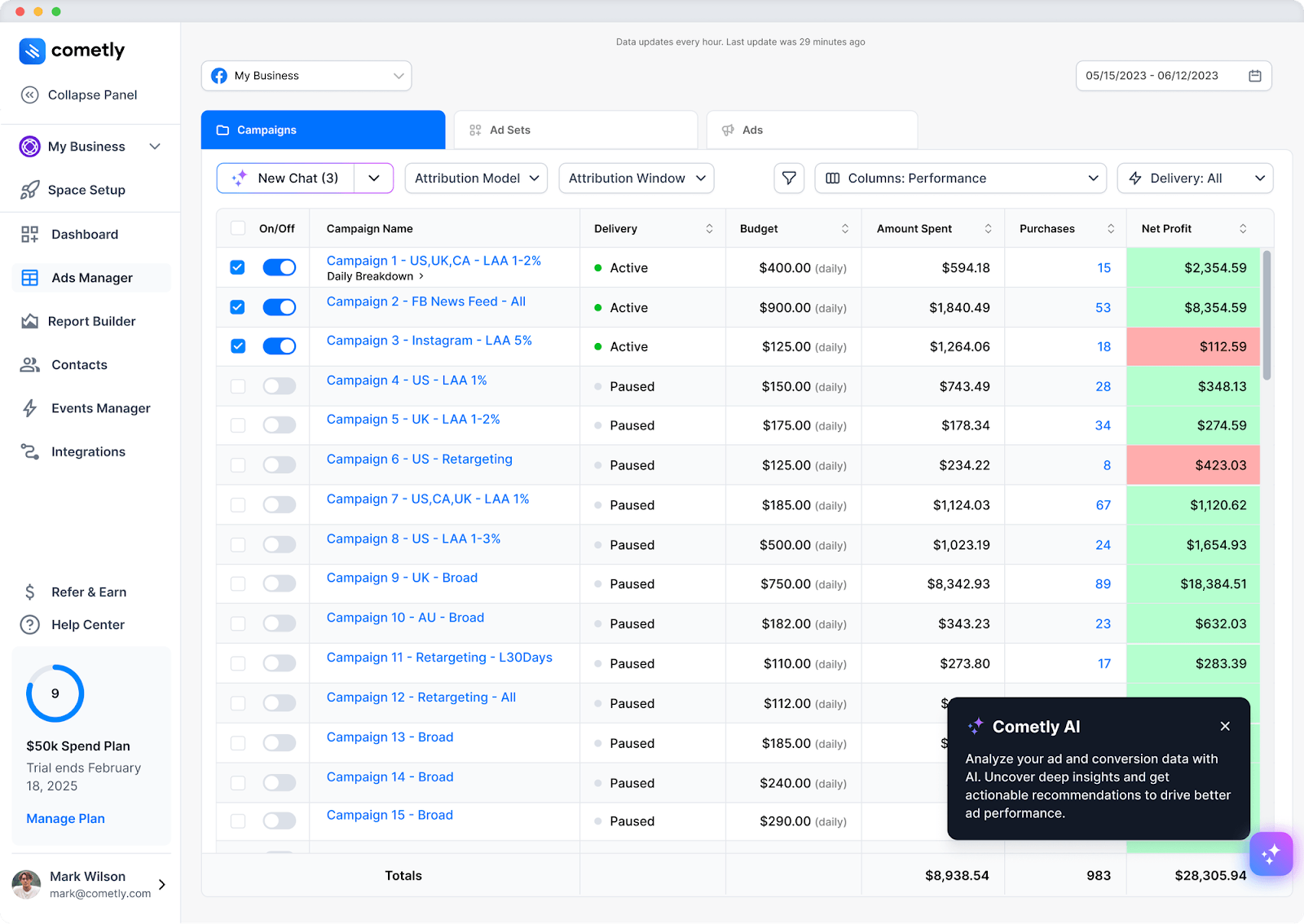
GetHookd Ads Library vs Facebook Ads Library
Gethookd vs Meta Ads Library
-
February 13, 2026

4 Best AdEspresso Alternatives in 2026

Key Takeaways

  • AdEspresso supports campaign management and A/B testing, but lacks creative research, competitor intelligence, and AI-powered ad generation that performance marketers now need.
  • GetHookd is the leading alternative for teams looking to find winning ad concepts and produce creatives before testing.
  • Birch (Revealbot) and Madgicx automate post-launch optimization, but they assume you already have strong creatives worth testing.
  • GetHookd's Brand Spy feature reveals which ads competitors are actively scaling (not just running), giving marketers confidence in what to test.

Why AdEspresso Users Are Looking for Alternatives

AdEspresso simplifies campaign management and A/B testing. However, several limitations have prompted users to explore alternatives.

Pricing is a major friction point. Plans start at $49/month and scale with ad spend, which can get expensive for smaller teams. Also, competitors have moved faster on AI. Different platforms now offer more advanced tools, leaving AdEspresso feeling dated by comparison. 

Keep reading to learn about the best AdEspresso alternatives and what makes them the top competitors.

Users on Reddit discuss the limitations of AdEspresso for Facebook ad management, highlighting the need for more advanced alternatives. (Image source)

GetHookd: Turn Competitor Intelligence Into Your Next Winning Ad

65M+ Ads Analyzed | 4.8★ G2 Rating | 4.4★ Trustpilot Rating

Stop Guessing. Start Scaling:

GetHookd reveals which ads your competitors are actively scaling—not just running. Spy on their best-performing creatives, landing pages, and traffic strategies, then turn proven concepts into testable campaigns in seconds with AI-powered script generation and creative cloning.

What You Get:
  • ✓ Brand Spy to decode competitor ad strategies in real-time
  • ✓ AI script generation and ad cloning for instant variations
  • ✓ Performance scoring based on actual ad behavior, not vanity metrics
  • ✓ Creative Analyzer to identify and scale your top performers
Replace guesswork with intelligence. Build profitable ads that actually convert.

4 Best AdEspresso Alternatives to Try in 2026

Alternative #1: GetHookd

GetHookd's Explore Ads lets you search 65M+ ads and save winning creatives to organized boards.

AdEspresso helps you test and optimize campaigns. GetHookd, on the other hand, addresses what comes before that: figuring out what's worth testing in the first place.

We built GetHookd to combine ad research with AI creative production on a single platform. Our tool indexes 65M+ winning ads across Meta, searchable by vertical, format, engagement signals, and visual style. 

When you find a winning ad, you can use it as a starting point for new creatives. Research and execution take place on the same dashboard.

GetHookd Key Features

Explore Ads

Search through 65M+ ads and filter by vertical, media format, engagement indicators, and visual style. You can narrow results to specific categories, like skincare, fitness, or SaaS, and filter by whether the ad is static, video, or carousel. The platform also lets you cap how many ads appear from any single brand, so your research doesn't get dominated by one big advertiser. 

Brand Spy

Enter any brand name and see every Facebook ad they're currently running. The platform highlights which creatives have been active the longest, a reliable signal that they're performing well enough to keep spending on. You can also study which hooks they repeat across campaigns, which formats they favor, and where each ad drives traffic. Brand Spy turns competitor research from guesswork into a structured workflow.

GetHookd's template library gives you a starting point so you're not designing ads from scratch.
Ad Templates

The template library includes ready-made designs organized by industry and use case. Each template opens directly in Canva, where you can replace your product images, edit the copy, and adjust colors and fonts to match your brand. Once you're done, export as JPG or PNG and upload to your ad platform.

Save Ads & Swipe File

Any ad you find can be saved to a personal library organized by boards and folders. Unlike screenshots or bookmarks, these ads remain in your swipe file even after the original campaign ends, and they are no longer available in the ad library. This means you can build a long-term reference archive of winning creatives sorted however makes sense for your workflow.

Ads Transcription

Turn any saved video ad into a readable script with a single click. The transcription includes timestamps, so you can correlate specific moments in the video with the exact words being spoken. Instead of rewatching a 30-second ad five times to catch the opener, you can read it and use it as the foundation for your own scripts.

AI Script Generation

Feed the AI a reference ad or your product details, and it generates hooks, angles, and full scripts in seconds. The system is trained on high-performing direct-response frameworks, so its output follows proven structures rather than generic copy.

Clone Ads

Take a single winning static image and generate dozens of variations without opening design software. This lets you test visual changes at volume without waiting on a designer or learning Photoshop. When you find a static ad that's working, Clone Ads helps you extend its lifespan by creating fresh versions before creative fatigue sets in.

GetHookd Pricing

We offer a 7-day free trial with full access to all features in the selected plan. Paid plans start at $19/month (Launch), with Grow at $59/month and Scale at $149/month for agencies managing multiple brands. Annual billing saves you 25%.

Alternative #2: Birch (Revealbot)

Birch automates budget adjustments, targeting, and campaign scaling. (Image source: Birch)

Birch, formerly known as Revealbot, is an ad automation platform for managing campaigns across Meta, Google, and social networks. The platform focuses on rule-based automation, such as scaling the budget or adjusting bids based on real-time metrics. 

That said, some users report the platform has a steep learning curve, especially when building advanced rules with multiple conditions. While Birch automates what happens after your ads launch, it won't help you determine what to create next.

Birch Key Features

  • Automated Rules: Create custom rules using AND/OR logic, custom metrics, and flexible timeframes. 
  • Bulk Creation: Build multiple ad variations at once from existing Facebook posts or from scratch, accelerating launch.
  • Custom Metrics: Define your own formulas to create metrics tailored to your KPIs, then use them to trigger automation rules.
  • Budget & Bid Management: Automate budget adjustments and bid changes across campaigns without manual intervention.

Birch Pricing

Birch offers a 14-day free trial with full access to all features. Paid plans are based on monthly ad spend across connected accounts: Essential starts at $49/month, Pro at $99/month, and Enterprise pricing is custom.

Alternative #3: Madgicx

Madgicx's AI Marketer audits your account and recommends what to scale. (Image source: Madgicx)

Madgicx is built primarily for advertisers who want to optimize campaigns without manually adjusting bids and audiences every day. It includes an AI Marketer that audits your account, identifies weaknesses, and recommends next steps. 

The platform also offers creative analysis tools that show which ad elements are driving performance. While it helps with optimization, Madgicx assumes you already have creatives worth optimizing. If the bottleneck is generating winning concepts, GetHookd addresses it earlier in the workflow.

Madgicx Key Features

  • AI Marketer: Audits your ad account and provides actionable recommendations for improving performance.
  • Automation Tactics: Pre-built and custom automation rules that adjust budgets, pause underperformers, and scale winners based on real-time data.
  • Creative Insights: Analyzes your ad creatives to identify which visuals, copy, and formats drive the best results.
  • Audience Targeting: Uses AI to build and test audience segments, including lookalikes based on top-performing ads.

Madgicx Pricing

Madgicx offers a 7-day free trial. Paid plans are based on your monthly Meta ad spend, starting around $29/month for smaller budgets and scaling up as spend increases. Tracking Pro, an add-on for advanced attribution, costs $49/month. 

Alternative #4: Smartly.io

Smartly.io centralizes creative automation and budget allocation. (Image source: Smartly.io)

Smartly is designed for managing high ad spend across multiple channels. The platform combines creative automation, campaign management, and cross-platform reporting into a single interface.

Teams can build dynamic ad templates, automate creative rotation to combat ad fatigue, and launch campaigns. However, smaller teams or those with modest budgets may find Smartly more complex and expensive than necessary. 

And while the platform helps produce and manage ad variations, it doesn't include competitor research or ad discovery. If you need to see what's working in your market before building creatives, GetHookd covers that earlier step.

Smartly.io Key Features

  • Creative Automation: Build dynamic templates that automatically generate personalized ad variations at scale.
  • Ad Rotation & Refresh: AI-powered tools automatically rotate creatives and refresh ads based on performance triggers.
  • Predictive Budget Allocation: Automatically distributes budget toward top-performing ads and audiences in real time.
  • Reporting & Analytics: Centralizes performance data across all connected ad accounts with visualization tools and exportable reports.

Smartly.io Pricing

Smartly uses custom pricing based on a percentage of your monthly ad spend across connected accounts. There are no publicly listed price tiers; users should contact their sales team for a quote. A free demo is available, but there's no free trial.

4 Best AdEspresso Alternatives At a Glance

Tool Core Strength Limitations Best For
GetHookd Ad research + creative production in one platform. Find winning ads, transcribe them, generate scripts, clone variations. No campaign management Ecommerce brands, agencies, and media buyers who need to research winning concepts and produce high-performing ads before testing
Birch (Revealbot) Rule-based automation for scaling and budget adjustments Steep learning curve, no creative research or production tools Teams seeking to automate campaigns
Madgicx AI-powered optimization with creative analysis Learning curve, Meta-only, assumes you already have creatives worth testing Meta advertisers looking for hands-off optimization
Smartly.io Automation and cross-platform campaign management Enterprise pricing; complex for smaller teams, no ad research features Brands with significant ad budgets

GetHookd: A Smarter AdEspresso Alternative

AdEspresso simplified campaign management and A/B testing. But as creative performance has become the biggest lever in paid advertising, the gap in AdEspresso's offering has become harder to ignore. You can test and optimize all day, but if your starting creatives aren't strong, optimization only gets you so far.

That's where GetHookd comes in. We built the platform to solve the step most ad tools skip: knowing what's actually worth building. The Brand Spy feature reveals which ads competitors are actively scaling, not just running, giving you proven concepts to build from. Ad research and production happen in the same place, which means less time juggling tools and more time launching ads that have a real shot at working.

If your bottleneck isn't campaign management but creative output, GetHookd is built for that problem. Our platform compresses what used to take hours, or a full creative team, into a faster, more direct workflow. Find what's working, build from it, and move on to testing with confidence.

Try GetHookd Now →

Frequently Asked Questions (FAQs)

What is AdEspresso used for?

AdEspresso is a campaign management tool for Facebook, Instagram, and Google Ads. It lets you create multiple ad variations and automatically split traffic between them. The platform also includes analytics dashboards, campaign optimization suggestions, and reporting features.

Is AdEspresso worth it?

AdEspresso is worth it for teams that want a simple way to manage and test social ads with dependable support. Still, it may feel limited or overpriced for marketers who need more advanced features or need to keep costs low.

How is GetHookd different from AdEspresso?

AdEspresso focuses on what happens after you create ads: testing, optimizing, and managing campaigns. GetHookd focuses on what happens before. With GetHookd, you can research competitor ads, identify winning concepts, and produce new creatives without starting from scratch. AdEspresso assumes you already have strong creatives to test. GetHookd helps you build them.

*Note: Pricing and/or product availability mentioned in this post are subject to change. Please check our website for current pricing and stock information before making a purchase.
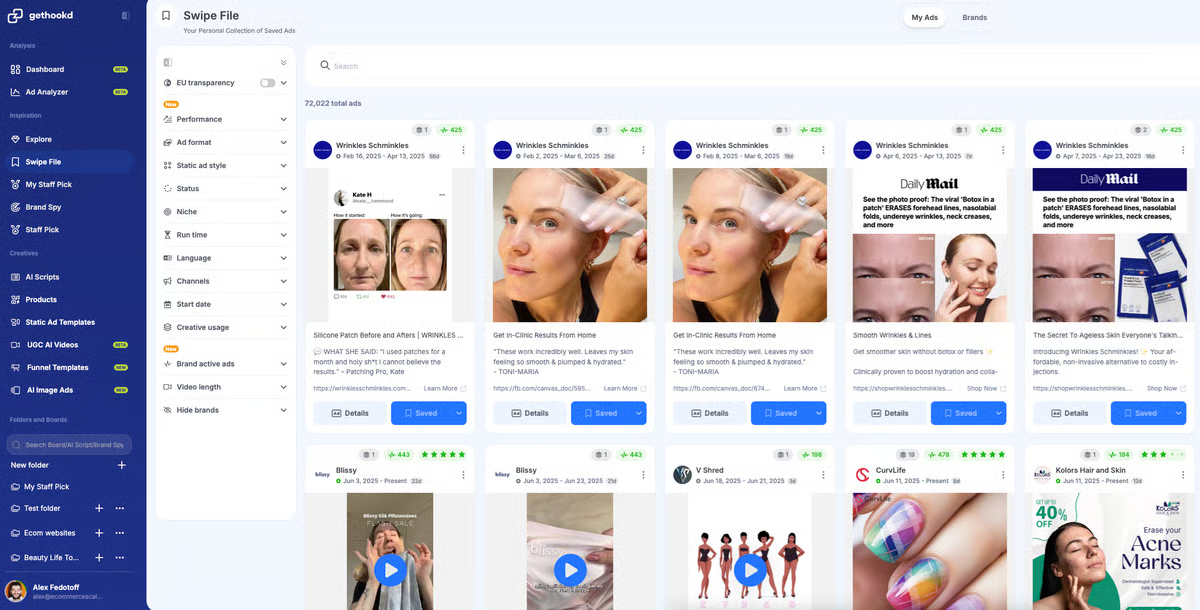
GetHookd Ads Library vs Facebook Ads Library
Gethookd vs Meta Ads Library
-
February 12, 2026

4 Best Free Facebook Ad Library Tools in 2026

Key Takeaways

  • Facebook's Ad Library offers essential competitor research for free, but specialized tools can enhance your intelligence gathering.
  • GetHookd provides advanced performance metrics beyond Meta's basic library, including Brand Spy, clone ads, and ad templates.
  • Free tiers of premium Facebook ad library tools like Minea and BigSpy offer insights, but strategically limit functionality to upsell paid plans.

What Can Free Facebook Ad Library Tools Actually Do?

Free Facebook ad library tools let you browse competitor ads, see what creatives brands are running, and get a general sense of what's working in your niche. Most offer basic search and filtering, so you can quickly pull up ads without paying for a subscription. 

The tradeoff is depth. Free tools typically limit the number of ads you can view, restrict advanced filters, and don't offer features such as extracting scripts and hooks from video creatives. For ongoing competitor tracking, creative production, or team collaboration, you'll eventually hit a wall.

Here are the best free Facebook ad library tools to try, along with what you can realistically expect from each.

GetHookd: Turn Competitor Intelligence Into Your Next Winning Ad

65M+ Ads Analyzed | 4.8★ G2 Rating | 4.4★ Trustpilot Rating

Stop Guessing. Start Scaling:

GetHookd reveals which ads your competitors are actively scaling—not just running. Spy on their best-performing creatives, landing pages, and traffic strategies, then turn proven concepts into testable campaigns in seconds with AI-powered script generation and creative cloning.

What You Get:
  • ✓ Brand Spy to decode competitor ad strategies in real-time
  • ✓ AI script generation and ad cloning for instant variations
  • ✓ Performance scoring based on actual ad behavior, not vanity metrics
  • ✓ Creative Analyzer to identify and scale your top performers
Replace guesswork with intelligence. Build profitable ads that actually convert.

4 Best Free Facebook Ad Library Tools to Try in 2026

1. GetHookd

Here’s how the GetHookd Explore Ads dashboard looks.

GetHookd is an ad intelligence and creative production platform built for marketers, dropshippers, and ecommerce teams. Our database includes high-quality 65M+ high-performing ads across Meta platforms, including Facebook, to help you find proven concepts fast. 

But unlike most Facebook ad library tools, GetHookd doesn't stop at research. We built tools to help you act on what you find: save ads to a permanent swipe file, extract scripts from video ads, generate hooks and angles using frameworks from 8-figure campaigns, and clone winning creatives with AI-powered variations.

We offer a 7-day free trial with full access, so you can test everything before committing. If you're serious about reducing wasted ad spend and creative guesswork, GetHookd gives you the research and production tools to scale profitably.

Key Features That Set GetHookd Apart

Brand Spy

Analyze any competitor's ad strategy in one view. See their full Facebook ad library, top converting creatives, hooks, formats, landing page destinations, and how often they're launching new ads. Know what's winning before you spend a dollar.

Explore Ads

Browse over 65 million high-performing ads on Facebook. Filter by niche, format, benchmarks, and style to find what's converting in your market. There’s also a "limit ads per brand" feature that keeps your feed clean, so there’s no endless scrolling through the same advertiser.

Save Ads & Swipe File 

Build a personal library organized by folders and boards. Your saved ads stay accessible forever, even after they disappear from the original ad library.

Ads Transcription

Convert winning Facebook video ads to text and extract the hooks, CTAs, and messaging that make them work. Skip the manual note-taking and get straight to the structure behind high performers.

AI Script Generation

Upload a winning ad, add your product details, and let the AI copywriter (trained on frameworks from marketers who've driven millions of dollars in sales) generate hooks, angles, and scripts in seconds.

Clone Ads

Turn one winning image into dozens of variations. New colors, avatars, formats, and styles, almost instantly, without touching design software.

Ad Templates & Funnel Templates

Plug-and-play designs modeled after million-dollar campaigns. Swap in your product, adjust the copy, and launch without a designer or dev team.

Connect your Meta account to GetHookd's Creative Analyzer and analyze performance in real time.

Who GetHookd Is Best For

If you've been using Meta's free Ad Library but find yourself copying links into spreadsheets, saving screenshots to random folders, or rewatching video ads just to write down the hook, GetHookd is built for you. 

Ecommerce brands, media buyers, and agencies who need more than a search bar get a full system: organized swipe files, transcriptions, competitor tracking, and AI tools to turn research into ready-to-test creatives.

2. Meta Ad Library

Meta Ad Library search results with basic filters. (Image source: Meta Ad Library)

Meta Ad Library is the official, completely free tool for browsing ads running across Facebook and Instagram. Anyone can access it without creating an account. 

You can search by advertiser name, keyword, or category, and filter by country or platform. It's the most direct way to see what a competitor is currently running, and because it's Meta's own transparency tool, the data is up to date.

Meta Ad Library is built for transparency, not research workflows. There are no folders, organization tools, transcription, or performance indicators. 

Meta Ad Library Key Features

The native Meta Ad Library provides comprehensive coverage across Facebook, Instagram, Messenger, and Audience Network. You can search any brand's complete portfolio, view historical campaigns dating back several years, and download media for reference. For political and social issue ads, spending ranges and impression data are also visible.

Meta Ad Library Limitations

Meta's free library has several significant limitations that specialized tools address. The most frustrating is the lack of performance indicators. You can see every ad, but have no way to determine which ones are actually successful without external signals.

The search functionality is also quite basic, limiting your ability to find ads by specific targeting parameters, objectives, or performance metrics. This often results in time-consuming manual scrolling through large ad sets to find relevant examples. 

Once you've found ads worth studying, you'll need separate tools to transcribe scripts, generate variations, or create new concepts from what you've learned. Platforms like GetHookd eliminate that gap by combining research and creative production in a single platform.

3. Minea

Minea Meta ad library interface. (Image source: Minea)

Minea is an ad spy tool built primarily for ecommerce sellers looking to find winning products. It offers a free plan with 200 credits, providing access to its Facebook and Instagram ad database and basic filters. 

For users focused on product discovery, Minea enables browsing ads and identifying trending items. Unlike GetHookd, it does not offer creative production tools.

Minea Key Features

The free version provides access to basic product and ad discovery features, though with significant limitations. 

  • Cross-Platform Coverage: Tracks ads across Facebook and Instagram.
  • Product Focus: Organized around products rather than advertisers or creative approaches.
  • Store Analysis: Provides insights into stores running successful product campaigns.
  • Engagement Data: Shows limited engagement metrics on the free plan.
  • Trending Products: Highlights items gaining traction based on advertising activity.

Minea Limitations

The free version of Minea includes substantial limitations to showcase the platform's capabilities while encouraging upgrades. The credit system depletes quickly with regular use, particularly when accessing detailed ad information or loading more results. 

The platform also provides limited historical data on the free tier, making trend analysis difficult without upgrading. For marketers who want to study ad creatives, save them permanently, and build on them, GetHookd offers a workflow designed to support that goal.

4. BigSpy

BigSpy offers filters, but the cluttered interface takes getting used to. (Image source: BigSpy) 

For marketers who want a no-commitment way to browse competitors’ Facebook ads and get a feel for what's running, BigSpy provides basic free access.

The free plan includes up to 5 searches per day and lets you view up to 25 ads per search, which is sufficient for casual browsing but quickly runs out during serious research sessions.

BigSpy's interface is packed with filters and data, though some users find it cluttered compared to more streamlined alternatives.

BigSpy Key Features 

The free version provides limited but functional access to BigSpy's ad database. You can browse Facebook ads using basic keyword and advertiser filters, with up to 5 searches per day and 25 ads visible per search. The platform allows up to 20 ad downloads daily for offline reference, and you can sort results by country, ad type, and engagement metrics.

BigSpy Limitations

The free plan is designed more as a trial than a sustainable research tool. Five daily searches with 25 results each means you'll hit the ceiling fast if you're tracking multiple competitors or exploring different niches. 

Landing page insights, featured ads, and ad ideas are locked behind paid plans, so you're seeing creatives without the context of where they're driving traffic.

For marketers who want organized research, saved swipe files, and tools to actually build from what they find, BigSpy's free tier leaves significant gaps that platforms like GetHookd are designed to fill.

Best Free Facebook Ad Library Tools At a Glance

Tool Free Access Key Features Limitations Best For
GetHookd 7-day Free trial (full access) 65M+ ads, Brand Spy, Ads Transcription, Save Ads & Swipe File, AI Script Generation, Clone Ads, Ad & Funnel Templates Trial period only Marketers, dropshippers, and ecommerce teams who want to research, save, and create ads from one platform
Meta Ad Library Completely free Search by advertiser/keyword, filter by country and platform, view active ads, and download media No save or organize features, no performance data, ads disappear when campaigns end, manual tracking required Quick competitor checks and verifying what's currently running
Minea 200 free credits Facebook ad search, basic filters, Chrome extension, trending products Credits deplete quickly, product-focused, not creative-focused, no swipe file or AI tools, limited historical data Teams focused on product discovery
BigSpy Free plan (5 searches/day, 25 ads per search) Facebook ad search, basic filters, ad downloads, engagement metrics Strict daily limits, cluttered interface, no landing page insights on free plan, data freshness delays Casual browsing and beginners testing ad research tools

Why GetHookd Outperforms Free Facebook Ad Library Tools

Facebook ad library tools serve a general purpose: they let you browse what competitors are running and get a surface-level view of the market. But browsing isn't a strategy. Eventually, you're left with screenshots scattered across folders, URLs copied into spreadsheets, and no clear system for turning research into results. 

GetHookd solves this problem. We built a platform where research and creative production happen in the same place. You're not just looking at Facebook ads. You're also saving time by analyzing what works and creating new variations without switching tools or hiring a designer.

Every feature is designed to move you from insight to execution faster than your regular Facebook ad library tools allow. For ecommerce brands, media buyers, and marketing teams tired of jumping between ad libraries, transcription tools, and design software, GetHookd brings everything under one roof. 

Try GetHookd Now →

Frequently Asked Questions (FAQs)

Are Facebook Ad Library tools completely free to use?

Meta Ad Library is free and requires no account, but it only lets you browse and search for ads. There's no way to save, organize, or analyze what you find, and ads disappear once campaigns stop running. For marketers who need more than basic browsing, GetHookd offers a 7-day free trial with full access to research tools, video transcription, and AI-powered creative features.

What features should I prioritize in a Facebook ad library tool?

Look for search filters that let you narrow results by niche, format, and engagement. A save-or-swipe file feature is essential for organizing research without relying on screenshots and spreadsheets. Transcription tools help you quickly extract hooks and CTAs from video ads. And if you're running ads at volume, AI-powered creative tools save hours of manual work.

What are some of the best tools for Facebook/Meta Ads currently?

The best tool depends on whether you want to browse ads or take action on what you find. Most free options stop at search; you can view ads, but there's no system for analyzing or building on them. If you're looking for a tool that supports the full workflow from research to usable ad creatives, GetHookd is built for that.

*Note: Pricing and/or product availability mentioned in this post are subject to change. Please check our website for current pricing and stock information before making a purchase.

GetHookd Ads Library vs Facebook Ads Library
Gethookd vs Meta Ads Library
-
February 11, 2026

3 Best Triple Whale Alternatives in 2026

Key Takeaways

  • Triple Whale and similar attribution tools track which of your ads drive sales, but they don't help you create the next winning ad.
  • With 65M+ winning ads across Meta, Brand Spy competitor tracking, and AI creative tools, GetHookd lets you go from research to ready-to-test ads in minutes.
  • Hyros and Cometly only track your existing ads; neither helps you research competitors or create new winning creatives.
  • For teams tired of guessing what ad to launch next, GetHookd is the best alternative to Triple Whale, built for ad creative production.

Why Ecommerce Brands Are Switching From Triple Whale

Triple Whale built its reputation on helping ecommerce brands centralize their data and track attribution across ad platforms. For many Shopify stores and Direct-to-Consumer (DTC) brands, understanding which campaigns were driving revenue is helpful. 

But Triple Whale's revenue-based pricing can become expensive as you scale, and users frequently report a steep learning curve, data delays, and dashboards that feel more complex than actionable.

This guide breaks down 3 Triple Whale alternatives worth considering. Hyros and Cometly offer streamlined attribution for brands focused on tracking. GetHookd takes a different route: helping teams find winning ads, analyze competitors, and produce fresh creatives faster.

GetHookd: Turn Competitor Intelligence Into Your Next Winning Ad

65M+ Ads Analyzed | 4.8★ G2 Rating | 4.4★ Trustpilot Rating

Stop Guessing. Start Scaling:

GetHookd reveals which ads your competitors are actively scaling—not just running. Spy on their best-performing creatives, landing pages, and traffic strategies, then turn proven concepts into testable campaigns in seconds with AI-powered script generation and creative cloning.

What You Get:
  • ✓ Brand Spy to decode competitor ad strategies in real-time
  • ✓ AI script generation and ad cloning for instant variations
  • ✓ Performance scoring based on actual ad behavior, not vanity metrics
  • ✓ Creative Analyzer to identify and scale your top performers
Replace guesswork with intelligence. Build profitable ads that actually convert.

3 Best Triple Whale Alternatives in 2026

1. GetHookd

GetHookd's Explore feature lets you browse and filter millions of ads by niche, format, and engagement.

GetHookd is an ad research and creative production platform built for marketers who need to move fast. We help ecommerce brands, agencies, and media buyers find winning ad concepts, track competitor strategies, and produce ready-to-test creatives.

With access to 65M+ winning ads across Meta, you can filter by niche, format, engagement, and demographics to surface what's actually working in your market. Brand Spy gives you full visibility into competitor accounts, including their top-performing ads, landing pages, and traffic sources. And when you're ready to act, our AI tools let you generate scripts, clone winning visuals, and launch new concepts in minutes.

We built GetHookd for teams tired of guessing what to test next. Instead of spending hours in ad libraries or waiting on creative teams, you get a complete research-to-creative system that replaces guesswork with intelligence.

Core Features of GetHookd

Ad Discovery 

Our discovery tools give ecommerce brands and dropshippers direct access to top-performing ads. Instead of manually scrolling through the Facebook Ad Library or guessing what competitors are running, you can surface proven concepts in seconds.

  • Explore Ads: Search and filter ads by niche, format, engagement, country, and demographics to quickly find winning concepts.
  • Brand Spy: Track competitor stores and DTC brands to monitor their top-performing ads, landing pages, and traffic sources in real time.
  • Save Ads: Build a personal swipe file of winning ads organized by product, client, or campaign that stays intact even after ads go offline.
Ad Analysis 

Knowing what ads are running is only half the picture. Our analysis tools help media buyers and scaling teams break down why certain creatives convert, so you can replicate winning patterns rather than testing blindly.

  • Creative Analyzer: Spot patterns across ad formats, hooks, and messaging to understand what's driving clicks and conversions.
  • Ads Transcription: Pull the exact copy, hooks, and CTAs from video ads so you can adapt proven scripts for your own products.
AI Creative Tools 
Our AI creative tools help you generate scripts, clone winning ads, and launch new variations in minutes.

Waiting on designers and copywriters slows down your testing cycles and limits how fast you can scale. Our AI tools help ecommerce teams and agencies turn insights into creative in minutes, without outsourcing or starting from scratch.

  • AI Script Generation: Generate fresh hooks, angles, and full scripts based on proven 8-figure ad frameworks.
  • Clone Ads: Create instant visual variations of winning creatives in different colors, formats, and styles.
  • Image Ad Templates: Access ready-to-edit static ad templates across niches, designed for fast launches.
  • Funnel Templates: Use pre-built landing page templates modeled on high-converting funnels from top DTC brands.

Who is GetHookd For

We built GetHookd for ecommerce brands, dropshippers, and media buyers who need to move fast without sacrificing creative quality. Triple Whale can tell you which ads converted, but it won't help you build the next winning creative. 

GetHookd fills that gap by showing you what's already working in your niche, why it's working, and giving you the AI tools to produce your own high-performing variations before competitors catch on. If you're spending on ads but still guessing what to test next, this is the platform that turns research into results.

GetHookd Pricing

We offer straightforward pricing that scales with your needs. Every plan includes a 7-day free trial, and annual billing saves you 25%.

  • Launch ($19/month): Best for solo marketers and dropshippers just getting started with ad research.
  • Grow ($59/month): Best for growing brands and media buyers who need higher limits and full access to AI creative tools.
  • Scale ($149/month): Best for agencies and teams managing multiple brands or high-volume creative production.
  • Enterprise (Custom pricing): Tailored solutions for larger organizations with specific requirements.

2. Hyros

Hyros focuses on ad tracking and attribution, helping you see which ads drive sales, but it does not tell you what to create next. (Image source: Hyros)

Hyros is an ad-tracking tool that helps businesses identify which ads drive sales. It emerged after Apple's iOS 14 update made standard Facebook and Google tracking less reliable. The platform tracks customer journeys across multiple touchpoints, such as ads, emails, and calls, and attributes revenue to the original source.

Hyros positions itself as an attribution solution and integrates with Facebook, Google, and other networks, sending sales data back to help those platforms optimize targeting. There's no self-serve signup, so you'll need to book a demo to get started.

Core Features of Hyros

  • Multi-Touch Attribution: Tracks customer interactions across ads, emails, and calls, then ties revenue back to the original source, even for longer sales cycles.
  • Print Tracking: Hyros' proprietary tracking method that claims to capture more sales data than standard ad platform pixels.
  • AI Ad Optimization: Sends sales data back to platforms like Facebook and Google to help their algorithms improve targeting.

Hyros Pricing

Hyros uses revenue-based pricing tied to your monthly tracked revenue. Plans start at $230/month (billed annually) for businesses tracking up to $20k in monthly revenue, with costs increasing as revenue grows. 

For Shopify stores, pricing starts lower, around $99/month for stores tracking up to $5k in monthly revenue. All plans require a demo call to get started, and there's no free trial. Hyros does offer a 90-day money-back guarantee.

Hyros Limitations 

Hyros focuses on tracking what's already happening, but it won't help you figure out what to run next. There's no ad library, no competitor research, and no creative tools. 

For ecommerce brands and dropshippers who need help producing winning ads (not just measuring them), Hyros leaves a gap that platforms like GetHookd are built to fill. The demo-only signup process also adds friction for teams that want to test the tool before committing.

3. Cometly

Cometly tracks which of your ads are converting, but doesn't help you research winning creatives or create new ones. (Image source: Cometly)

Cometly is an ad-tracking platform that helps businesses identify which ads drive sales. It connects with Facebook, Google, and other ad networks to track customer journeys and attribute revenue back to the right campaigns. The platform also sends sales data back to ad platforms to help improve targeting over time.

Cometly is an attribution platform targeting ecommerce brands and agencies. Plus, it offers an AI chat feature that lets you ask questions about your ad performance and get recommendations.

Core Features of Cometly

  • Multi-Touch Attribution: Understand which marketing channels contribute to each sale, whether it's paid ads, organic traffic, email, or SMS.
  • Server-Side Tracking: Built-in tracking that bypasses browser limitations and ad blockers.
  • Conversion Sync: Sends accurate sales data back to ad platforms like Facebook and Google to improve their targeting algorithms.

Cometly Pricing

Cometly doesn't publish fixed pricing on its website. You'll need to book a demo to receive a quote tailored to your ad spend and business needs. The platform does offer a free trial with 10 AI credits to test the features before committing.

Cometly Limitations 

Cometly helps you understand which ads are converting, but it stops there. There's no ad library, no competitor research, and no tools to help you create new ads. For ecommerce brands and dropshippers who struggle with the creative side of scaling, Cometly doesn't address the full picture.

3 Best Triple Whale Alternatives: Summary Table

Feature GetHookd Hyros Cometly
Best For Ad research, competitor tracking, and AI creative production Attribution tracking only Attribution tracking only
Starting Price $19/month $230/month (based on tracked revenue) Demo required
Free Trial 7-day free trial No Yes (with 10 AI credits)
Ad Library 65M+ ads across Meta platforms Not available Not available
Competitor Research Brand Spy with ads, landing pages, and traffic sources Not available Not available
AI Creative Tools Script generation, Clone Ads, image templates Not available Not available
Attribution Tracking Not available Multi-touch attribution with AI optimization Multi-touch attribution with conversion sync
Best Use Case Finding winning ads and launching profitable creatives faster Tracking which ads drive revenue Tracking your ad performance across channels

GetHookd: The Smarter Alternative to Triple Whale

Triple Whale, Hyros, and Cometly all focus on the same thing: tracking which of your ads are driving sales. That's useful, but it only helps after you've already created something worth running. For ecommerce brands and dropshippers struggling to develop winning ad concepts, attribution tools don't solve the real problem.

We built GetHookd to fill that gap. Instead of tracking your own ads, we help you research what's already working for other brands in your niche, break down why it's converting, and create AI-driven variations. With access to 65M+ ads, Brand Spy competitor tracking, and tools like AI Script Generation and Clone Ads, you can go from idea to usable creatives at high volumes in minutes.

If you're tired of launching ads that don't perform, GetHookd replaces guesswork with proven ad intelligence and AI-powered creative production.

Try GetHookd Now →

Frequently Asked Questions (FAQs)

Who are Triple Whale competitors?

Triple Whale alternatives such as Hyros and Cometly are direct competitors, offering similar features: tracking ad performance and attributing revenue to your campaigns. GetHookd takes a different approach by helping you research winning ads, spy on competitor strategies, and use AI to produce profitable creatives faster. Instead of just measuring what's working, GetHookd helps you build ads that actually win.

How much is Triple Whale per month?

Triple Whale's pricing starts at around $129/month for its basic plan, with costs increasing based on features and annual gross merchandise volume (GMV). Higher-tier plans with advanced attribution and analytics can run several hundred dollars per month. Pricing may vary, so it's best to check their website for current rates.

How does GetHookd work?

GetHookd helps you research, analyze, and create ads on a single platform. Start by exploring our database of 65M+ high-performing ads across Meta to see what's working in your niche. Use Brand Spy to track competitor strategies, including their top ads, landing pages, and traffic sources. When you find a winning concept, use our AI tools to generate scripts, clone ad visuals, or build new creatives from templates.

*Note: Pricing and/or product availability mentioned in this post are subject to change. Please check our website for current pricing and stock information before making a purchase.
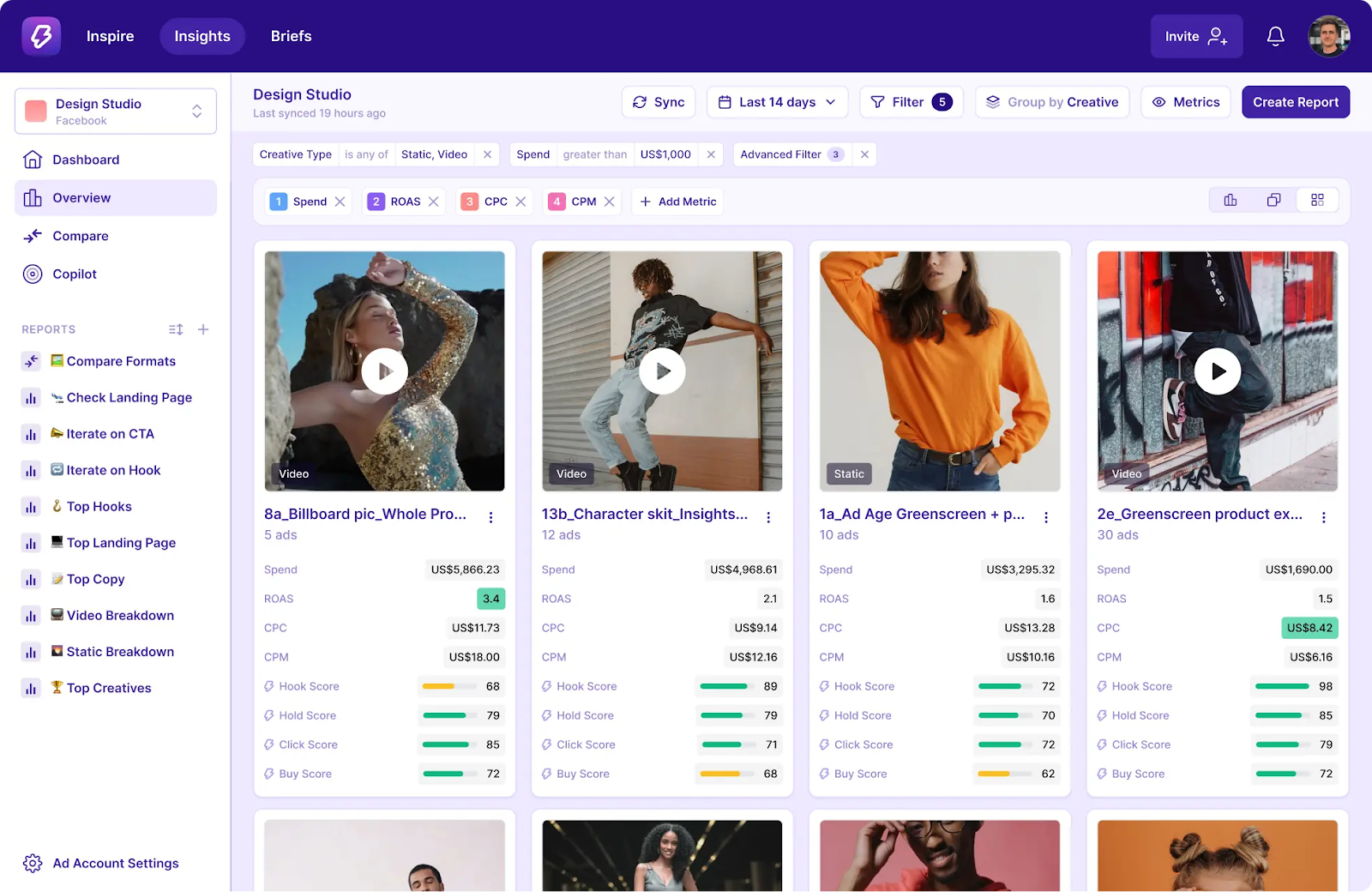
GetHookd Ads Library vs Facebook Ads Library
Gethookd vs Meta Ads Library
-
February 10, 2026

3 Best Free Ads Spy Tools in 2026

Key Takeaways

  • The most effective free ad spy tools offer essential features such as cross-platform monitoring, competitive analysis, and basic filtering.
  • GetHookd stands out among ad spy tools for its AI-powered creative analysis and actionable insights that bridge the gap between research and implementation.
  • Other free ad-spy tools with strong features include Meta Ad Library and BigSpy. 
  • While free versions have limitations in data refresh rates and search volume, they still provide valuable competitive intelligence that can transform your advertising strategy.

Why Marketers Are Turning to Ad Spy Tools

Running ads without knowing what's already working in your market is expensive guesswork. You can spend weeks testing hooks, formats, and angles, only to find out a competitor cracked the formula months ago.

Ad spy tools change that. They let you see what competitors are running right now, how long those ads have been active, and which creatives are getting the most push. 

Free versions of these tools won't give you everything. But they provide enough to validate ideas and identify creative angles. Keep reading to find the best free ads spy tools in 2026.

GetHookd: Turn Competitor Intelligence Into Your Next Winning Ad

65M+ Ads Analyzed | 4.8★ G2 Rating | 4.4★ Trustpilot Rating

Stop Guessing. Start Scaling:

GetHookd reveals which ads your competitors are actively scaling—not just running. Spy on their best-performing creatives, landing pages, and traffic strategies, then turn proven concepts into testable campaigns in seconds with AI-powered script generation and creative cloning.

What You Get:
  • ✓ Brand Spy to decode competitor ad strategies in real-time
  • ✓ AI script generation and ad cloning for instant variations
  • ✓ Performance scoring based on actual ad behavior, not vanity metrics
  • ✓ Creative Analyzer to identify and scale your top performers
Replace guesswork with intelligence. Build profitable ads that actually convert.

Top 3 Best Free Ad Spy Tools in 2026

1. GetHookd Overview

Filter 65M+ ads to surface winning creatives in seconds.

We built GetHookd for dropshippers, ecommerce brands, agencies, and media buyers who need to move fast. 

Unlike traditional ad spy tools that stop at research, GetHookd combines ad intelligence with AI-powered creative tools, so you're not just finding ads or spying on competitors. We provide tools to help you create your own and double down on what’s working. You can filter our database of 65M+ ads by niche, format, engagement, demographics, and run time to find exactly what's working in your market.

Instead of saving screenshots and manually rewriting scripts, you get a complete workflow: research, transcription, script generation, and creative cloning all in one place. Our 7-day free trial gives you full access to every feature in your plan.

GetHookd Key Features

Explore Ads

Our searchable database includes over 65 million ads across Meta platforms, updated regularly to surface what's working now. You can filter by niche, format, engagement, demographics, run time, and more, making it easy to find relevant ads without scrolling through irrelevant results.

Save Ads & Swipe File

Every ad you find can be saved permanently to your personal swipe file. Organize saved ads by brand, niche, client, or campaign type to keep your research structured and accessible. Unlike platforms where bookmarks disappear or clutter up, GetHookd keeps your library intact and easy to navigate.

Brand Spy & Competitor Tracking

Track competitor ad activity in real time. See which creatives a brand is running, how long they've been active, and which ads are receiving the most spend. Brand Spy shows you what's scaling, not just what's live.

Launch high-converting landing pages in minutes with plug-and-play funnel templates.
Landing Page & Funnel Intelligence

We provide full visibility into competitor landing pages so you can understand the complete customer journey from ad to conversion. View page structure, copy, design elements, and conversion strategies. We also offer winning funnel templates ready to use as a foundation for your own campaigns.

Video Scripts

Our AI transcription tool converts video ads into text and then suggests fresh hooks, angles, and scripts based on proven 8-figure frameworks. This helps advertisers quickly extract what's working from top-performing ads and turn it into new creative concepts without starting from scratch.

Clone Ads

Clone Ads uses AI to generate visual variations of successful creatives in seconds. Select an ad, tweak the size, background, and tone, and the AI generates multiple versions ready for testing. It's built for marketing teams, dropshippers, and ecommerce brands who want to scale campaigns or refresh fatigued creatives without spending hours in design tools.

Creative Analyzer

Connect your Meta ad account to see which of your own creatives are performing best. Creative Analyzer breaks down formats, styles, and elements so you can identify what's driving results, then generate new test variations powered by AI.

Ready-To-Use Template Library

Skip the blank canvas. Our template library offers static ad designs tested and proven by top-performing brands across hundreds of niches. Pick a template, customize it to your offer, and launch with no design skills required.

2. Meta Ad Library Overview

Meta Ad Library shows active and inactive ads, but offers no way to organize or analyze performance. (Image source: Meta Ad Library)

Meta Ad Library is a free, public database showing active ads across Facebook, Instagram, Messenger, and the Audience Network. Originally launched in 2019 for political ad transparency, it's now used as a starting point for competitive research.

You can search by advertiser name, keyword, or topic, and view ad creatives, copy, CTAs, and how long each ad has been running.

The platform is completely free with no account required. But it was never built for marketing optimization. While you can browse ads, there's no way to see performance data, organize your research, or turn what you find into actionable creatives. For marketers who need to move fast, those gaps add up quickly.

Meta Ad Library Key Features

Search by Advertiser or Keyword

Type in a brand name, product category, or keyword to see all active ads matching your search. You can filter by country, platform, and ad category.

Ad Creative & Copy Details

View the full ad creative, including images, videos, carousels, the headline, body copy, and CTA button. You can also see the landing page URL for most ads.

Ad Longevity Tracking

Each ad shows when it started running and whether it's still active. Ads running for weeks or months are often a sign they're performing well, but without engagement or spend data, you're left guessing.

Meta Ad Library Limitations

Meta Ad Library shows you what's running, but not what's working. There are no engagement metrics, spend data, or conversion insights, so you're left guessing which ads are actually performing. 

You also can't save, tag, or organize ads for later reference, and once a campaign goes inactive, it disappears from the library entirely. The filter options are basic and inflexible, often requiring multiple searches to piece together a competitor's strategy. The lack of organizational tools means marketers waste hours recreating spreadsheets and losing track of saved ads.

The bigger gap is what happens after you find an ad. Meta Ad Library is a research tool, not a creative workflow. There's no script generation, creative cloning, or performance analysis. You're on your own to interpret what's working and recreate it from scratch. 

GetHookd closes that gap by letting you filter ads by performance status, save research permanently, and use AI tools to transcribe winning ads, generate new hooks, and clone static creatives without leaving the platform.

3. BigSpy Overview

BigSpy covers multiple platforms, but the free plan limits you to 5 queries per day. (Image source: BigSpy)

BigSpy is a multi-platform ad spy tool that covers Facebook, Instagram, YouTube, and more. It offers a free plan with limited search results, making it accessible to marketers who want to explore before committing.

The platform has a large ad database with filtering options for keywords, engagement, ad type, CTA, country, and more. It's useful for spotting trends and finding creative inspiration across multiple networks.

However, the free plan is heavily restricted. Most users find it only useful as a brief trial. Like other ad spy tools, BigSpy focuses solely on research.

BigSpy Key Features

Ad Database & Search Filters

Search by keyword, advertiser, domain, engagement, ad format, CTA type, and country. You can combine filters to narrow results to exactly what you're looking for.

Ad Tracking & Alerts

Track specific ads or advertisers over time to see how campaigns evolve. You can also set up alerts for new ads matching your criteria.

Trending Ads

BigSpy highlights trending ads and top-performing creatives picked by their algorithm. Useful for spotting what's gaining traction, but you'll still need to manually analyze why they work.

BigSpy Limitations

BigSpy's database updates lag behind real-time activity, meaning you may be analyzing ads that stopped performing days ago. For marketers in fast-moving industries, stale data can mean chasing trends that have already peaked. 

The free tier allows only 5 queries per day and provides restricted access. To get real value, you'll need to upgrade to a Pro plan.

BigSpy is also a research-only tool. There's no script generation, creative cloning, or automated analysis. Once you find a winning ad, you're on your own to figure out why it works and how to recreate it. GetHookd's AI tools automate this process by allowing you to transcribe any video ad, generate new hooks and angles, and clone static creatives in minutes.

3 Best Free Ads Spy Tools: Summary Table

Feature GetHookd Meta Ad Library BigSpy
Free Access Free trial (full features) Completely free Limited free plan
AI Creative Tools Script generation, ad cloning, creative analysis None None
AI-Powered Workflow Research → Transcribe → Generate → Clone (all in one platform) Research only; manual creative work required Research only; manual creative work required
Save & Organize Ads Permanent swipe file with folders and tags No saving; ads disappear when inactive Save with daily download limits
Performance Insights Filter by scaling status and engagement Shows ad longevity only; no engagement or spend data Basic engagement metrics
Funnel Intelligence Landing pages, traffic sources, funnel templates Landing page URLs only Landing page insights (Pro plan)
Best For Research + AI creative tools in one platform Basic competitor browsing Cross-platform research

Turn Competitor Insights Into Ready-to-Launch Ads with GetHookd

Free ad spy tools like BigSpy and Meta Ad Library are a good starting point, but they only take you so far. Meta Ad Library lets you browse what's running, and BigSpy gives you cross-platform coverage on a budget, but neither helps you act on what you find. You're left with screenshots, spreadsheets, and the manual work of turning research into something you can actually test.

That's the gap we built GetHookd to close. Our platform combines a 65M+ high-performing ad database with AI-powered creative tools, so you can go from spotting a winning ad to launching your own variation in minutes. Transcribe competitor scripts, generate new hooks and angles, clone static creatives, and analyze what's working, all without switching tools or waiting on a creative team.

For dropshippers, ecommerce brands, agencies, and media buyers who need to test fast and scale what works, GetHookd delivers the full workflow in one place. Start your 7-day free trial and see how much faster you can move when ad research and AI creation live on the same platform.

Try GetHookd Now →

Frequently Asked Questions (FAQs)

What are ad spy tools, and how do they work?

Ad spy tools are platforms that collect and organize ads running across networks like Facebook, Instagram, and Google into searchable databases. They let you filter by keyword, niche, engagement, ad format, and country to find competitor creatives, study what's working, and gather inspiration for your own campaigns. Some tools stop at research, while platforms like GetHookd also include AI creative tools to help you act on what you find.

How do I spy on competitor ads?

Ad spy tools let you search for ads by advertiser name, keyword, niche, or product category to find relevant creatives. Look for ads that have been running for weeks or months; longevity is often a sign of performance. GetHookd's Brand Spy feature lets you track competitor ad activity over time. You can see which creatives a brand is running, how long they've been active, and which ads are receiving the most spend.

Are ad spy tools legal?

Yes. Ad spy tools collect data from publicly available sources, such as Meta's Ad Library and Google's Ads Transparency Center. They don't access private user data or violate platform policies. You're simply viewing ads that are already public.

What's the difference between free and paid ad spy tools?

Free tools like Meta Ad Library provide basic access to active ads but lack performance data, organizational features, and AI tools. Platforms like GetHookd offer larger databases, advanced filtering, permanent ad storage, and creative tools, including script generation and ad cloning. You also get a 7-day free trial with full access to features.

How does GetHookd's ad spy work?

GetHookd's Brand Spy feature tracks competitor ad activity in real time across Meta platforms. Enter any brand name to see which ads they're currently running, how long each creative has been active, and which ones are receiving the most spend. Unlike basic ad libraries, GetHookd shows you which ads competitors are actively scaling (not just what's live) so you can identify proven winners worth testing in your own campaigns.

*Note: Pricing and/or product availability mentioned in this post are subject to change. Please check our website for current pricing and stock information before making a purchase.

Ad Strategy
Ad Strategy
-
February 9, 2026

4 Best Descript Alternatives to Try in 2026

Key Takeaways

  • Descript's text-based editing suits general video and podcast workflows, but lacks the ad research and creative production features performance marketers need.
  • GetHookd connects transcription directly to a 65M+ ad library, so you can extract hooks and CTAs from proven ads and generate new scripts without starting from scratch.
  • Riverside and VEED offer transcription and editing for general content workflows, but neither provides the ad intelligence or creative production features that performance marketers need to turn insights into testable campaigns.
  • Synthesia generates AI avatar videos from text, though it's geared toward training and corporate content rather than paid ad production.

Why Teams Are Looking Beyond Descript in 2026

Descript offers AI-powered video ad creation, including scriptwriting, editing, and multi-format export. It's built for teams that want to create ads from their own ideas using AI assistance. But for media buyers and performance teams, there's a critical gap: Descript doesn't show you what's already working before you start creating.

The most successful ad campaigns don't start with a blank page; they start with competitive intelligence. What angles are competitors testing? Which creatives are they scaling? What hooks are driving conversions? Without this context, even the best AI scriptwriter is building on guesswork. 

In this guide, we break down the best Descript alternatives for 2026, including options built for the research-first workflow that performance marketers actually use: analyze what's working, extract proven formulas, then create variations faster.

GetHookd: Turn Competitor Intelligence Into Your Next Winning Ad

65M+ Ads Analyzed | 4.8★ G2 Rating | 4.4★ Trustpilot Rating

Stop Guessing. Start Scaling:

GetHookd reveals which ads your competitors are actively scaling—not just running. Spy on their best-performing creatives, landing pages, and traffic strategies, then turn proven concepts into testable campaigns in seconds with AI-powered script generation and creative cloning.

What You Get:
  • ✓ Brand Spy to decode competitor ad strategies in real-time
  • ✓ AI script generation and ad cloning for instant variations
  • ✓ Performance scoring based on actual ad behavior, not vanity metrics
  • ✓ Creative Analyzer to identify and scale your top performers
Replace guesswork with intelligence. Build profitable ads that actually convert.

4 Best Descript Alternatives to Try in 2026

1. GetHookd

GetHookd's Ads Transcription breaks down video ads into scripts, then lets you turn them into new AI-generated creatives.

We built GetHookd for the way performance marketers actually work: research what's converting, then create variations of what's proven. Both Descript and GetHookd help you create video ads using AI, but they solve different parts of the workflow: 

  • Descript = Create First:  Start with AI scriptwriting → record → edit → export variations
  • GetHookd = Research First: Analyze 65M+ ads → identify what's scaling → extract formulas → generate variations based on winners 

While Descript helps you build ads from your own ideas, GetHookd connects you to competitive intelligence before you create anything. You're not guessing what might work; you're building on formulas that are already driving conversions in your market.

GetHookd vs Descript: Key Differences

  • Research-First vs. Create-First Workflow: Descript assumes you already know what to create and helps you execute it with AI scriptwriting and editing. GetHookd shows you what's already working in your market before you create anything, so you can build on proven performance signals rather than guess.
  • 65M+ Ad Database Built In: Descript has no ad library or competitor insights. GetHookd's Explore Ads gives you access to 65M+ high-performing ads across Meta platforms, so every creative decision is informed by what's actually converting.
  • Brand Spy for Competitive Intelligence: See which creatives your competitors are actively scaling (not just running). Identify their top-performing ads, landing pages, and traffic strategies before you plan your next test.
  • Ad-Specific Transcription: Descript transcribes any video for general editing. GetHookd's Ads Transcription is built for marketers; it extracts hooks, CTAs, and copy structures so you can reverse-engineer what makes an ad convert.
  • From Winning Ad to New Variation in Minutes: With Video Scripts, upload any top-performing ad, add your product details, and generate new hooks, angles, and scripts based on formulas that are already working. Clone Ads then creates visual variations without starting from scratch.

GetHookd Pricing

We offer a free 7-day trial on all plans so you can test the full platform before committing. 

  • The Launch plan ($19/month) is ideal for solo marketers and teams getting started with ad transcription and AI scripts.
  • The Grow plan ($59/month) unlocks higher limits and full access to our AI creative tools. 
  • The Scale plan ($149/month) is designed for agencies and teams managing multiple brands or producing creative content at high volume. 
  • Enterprise pricing is available for larger organizations needing custom limits and dedicated support.

2. Riverside

Riverside uploads files progressively, so recordings stay intact even if the connection drops. (Image source: Riverside)

Riverside is a remote recording platform that captures audio and video locally on each participant's device and syncs them to the cloud. This means you receive good quality recordings regardless of internet connectivity.

The platform is built for podcasters, interviewers, and content teams who need to record without risking losing footage due to connection drops. While Riverside delivers quality recordings, it lacks the ad research and creative production features that performance marketers need to turn content into testable campaigns.

Riverside vs Descript: Key Differences

  • Local Recording Technology: Riverside records each participant's audio and video directly on their device and then uploads them to the cloud. This reduces quality loss from internet issues.
  • Progressive Upload: Files sync continuously in the background. If a connection drops mid-session, recordings stay intact and upload automatically once reconnected.
  • Transcription & Speaker Detection: Riverside supports multiple languages with automatic speaker detection, even during overlapping dialogue. It’s useful for interview-heavy content with international guests.

Riverside Pricing Structure

The Pro plan ($29/month) unlocks 4K video, separate audio and video tracks, no watermark, and includes transcription, Magic Clips, and AI editing tools. Higher-tier plans (Live at $39/month, Webinar at $99/month) add livestreaming and webinar hosting capabilities.

3. Synthesia

Synthesia generates AI avatar videos from text, though it's designed for corporate content rather than performance ads. (Image source: Synthesia)

Synthesia is an AI video generation platform that creates videos with AI avatars. You simply type a script, choose an avatar, and the platform generates a professional video in minutes. 

It's built for teams producing training content, educational materials, and multilingual marketing videos at scale. Synthesia creates new video content from text, allowing you to choose your colors and style.

While Synthesia excels at corporate and training content, it's not designed for performance marketing workflows. It lacks ad research capabilities, competitor insights, and the creative testing features needed to validate what actually converts in paid campaigns.

Synthesia vs Descript: Key Differences

  • AI Avatar Library: Synthesia offers AI avatars that deliver scripted content with natural expressions and gestures. Descript's avatar options are far more limited.
  • Multilingual Video Generation: Create videos in multiple languages with native-sounding pronunciation.
  • No Filming Required: Synthesia skips the filming process entirely. Just input your script and generate a polished video.

Synthesia Pricing

The Starter plan begins at $29/month and includes up to 10 minutes of video. The Creator plan ($89/month) includes all avatars, custom backgrounds, and 30 minutes of video monthly. Enterprise plans offer unlimited video creation, custom avatars, and dedicated support with pricing based on usage.

4. VEED

VEED offers browser-based editing with AI characters and subtitles. (Image source: VEED)

VEED is a browser-based video editing platform designed for creators who want browser-based editing without installing software. It combines core editing tools: trimming, subtitles, effects, and resizing.

VEED also provides AI features like auto-transcription, text-to-speech, and background noise removal. While Descript centers its workflow around text-based editing, VEED offers a more traditional editor with AI enhancements layered on top.

However, VEED's general-purpose editing tools don't include the competitor intelligence or ad-specific creative workflows that media buyers need to scale campaigns.

VEED vs Descript: Key Differences

  • No Download Required: VEED runs entirely in your browser, making it accessible from any device without installation. Descript requires a desktop app for full functionality.
  • One-Click Subtitles: VEED's auto-captioning generates accurate subtitles in seconds, with easy styling options for social-ready videos.
  • AI-Powered Enhancements: Features like background noise removal, eye contact correction, and auto-generated translations help polish videos quickly.

VEED Pricing

VEED offers a Lite plan ($12/month annually) that removes watermarks, supports 1080p exports, and provides access to stock media. The Pro plan ($29/month annually) includes 4K exports, unlimited AI studio videos, advanced AI tools like eye contact correction and background removal, and translation features.

4 Best Descript Alternatives: Summary Table

Tool Best For Key Strength Ad Research AI Features Starting Price
GetHookd Performance marketers creating ads from competitive intelligence 65M+ ad database + research-first creative workflow (the only tool connecting competitor insights to AI script generation) Yes Video Scripts, Clone Ads, Brand Spy, Explore Ads $19/month
Descript Content teams creating ads from their own ideas AI scriptwriting + text-based video editing No Script generation, Overdub, AI avatars $16/month
Riverside Podcasters and remote interviewers High-quality local recording No Speaker detection, auto-chapters $29/month
Synthesia Corporate training and multilingual content AI avatar video generation No AI avatars, multilingual voiceovers $29/month
VEED Social media creators Browser-based editing with AI enhancements No Noise removal, text-to-speech, subtitles $12/month

GetHookd: From Market Intelligence to Ready-to-Test Creatives in Minutes

Descript, VEED, and Synthesia all help you create video ads using AI. But they all start with the same assumption: that you already know what to create. For performance marketers, that's the wrong starting point. The best campaigns don't begin with AI scriptwriting; they begin with competitive intelligence. 

GetHookd is built for the research-first workflow: 

  1. See What's Working: Access 65M+ high-performing ads across Meta platforms. 
  2. Identify What's Scaling: Use Brand Spy to see which creatives competitors are actively scaling vs. testing.
  3. Extract Proven Formulas: Ads Transcription breaks down video ads into hooks, CTAs, and copy structures. 
  4. Generate New Variations: Video Scripts creates new angles and scripts based on what's proven, and Clone Ads recreates winning formats for your products. 

Descript helps you execute your ideas. GetHookd helps you know which ideas are worth executing.

Try GetHookd Now →

Frequently Asked Questions (FAQ)

What tools are similar to Descript?

Tools like Riverside, VEED, and GetHookd offer capabilities similar to Descript's, including transcription, video editing, and AI-powered creative features. Riverside focuses on remote recording with local file quality. VEED is a browser-based editor with transcription and subtitles. GetHookd combines transcription, ad research, and AI script generation for performance marketers.

Which is better, VEED or Descript?

It depends on your workflow. VEED runs entirely in your browser with no download required, making it accessible for quick edits, subtitles, and social media content. Descript offers deeper editing capabilities through its transcript-based workflow and AI tools, including Overdub. For performance marketers, GetHookd offers a workflow that goes beyond editing by connecting transcription to ad research and AI script generation.

Does GetHookd require technical skills to use? 

No. GetHookd is built for marketers, not developers. You can transcribe ads, generate scripts, and clone creatives without any coding or technical setup.

How often should I research competitor ads on GetHookd?

For active campaigns, weekly Brand Spy checks help you spot new angles competitors are testing. During creative testing phases, daily monitoring can reveal which ads are being scaled or killed, providing real-time market intelligence.

How does GetHookd compare to Descript?

Both  GetHookd and Descript use AI to create video ads, but their workflows differ. Descript is for creating from scratch with AI writing, recording, and editing. GetHookd starts with research, using a 65M+ ad library to reveal winning patterns before you script anything. Descript offers no competitor insights or performance data, while GetHookd builds creative direction around what’s already converting. For teams spending heavily on ad tests, that difference can mean avoiding guesswork and cutting wasted spend.

*Note: Pricing and/or product availability mentioned in this post are subject to change. Please check our website for current pricing and stock information before making a purchase.