/

/

Top 6 Hotel Facebook Ads Examples That Work in 2026

Key Takeaways The strongest hotel Facebook ad examples come from Anantara Siam Bangkok, Hilton, The Fife Arms, Xenones Filotera Santorini, Four Seasons, and Millennium Hotels, each pairing a specific benefit with a clear booking condition in one sentence. Anantara’s 25% discount for four-night stays and Hilton’s 200,000-point offer both convert because they translate abstract rewards into outcomes travelers can picture. Destination-led ads like Xenones Filotera Santorini’s and experience-focused campaigns like Four Seasons’ villa rentals succeed without discounts by naming specific services guests will use. Early-booking rewards, date-limited windows, and loyalty-tier extras each target a different booking behavior, so the ad structure should match the guest action the hotel wants to encourage. GetHookd gives hoteliers access to 22M+ live Meta ads, Brand Spy competitor tracking, and AI-powered creative tools, so new campaigns start from proven examples instead of guesswork. What Separates a Facebook Ad That Books Rooms From One That Gets Scrolled Past? A hotel Facebook ad books rooms when it turns an abstract promise into something a traveler can picture the moment they read it: fewer dollars spent, more points redeemed, or a specific family experience waiting at check-in. Most hoteliers judge an ad by its engagement or reach, but a like rarely becomes a confirmed reservation. What actually separates the ads that convert from the ones that get scrolled past is specificity, naming the discount percentage, the stay length, or the exact reward instead of selling a vague “dream getaway.” Polish doesn’t close that gap. A beautifully designed ad can run for years without producing a single booking if the offer stays vague or out of date, so the real signal is which campaigns keep scaling. That’s where live ad research earns its place: tools like GetHookd let hoteliers see which campaigns competitors keep paying to run, how long an offer stays live, and which copy keeps getting renewed, so new ads are built on data, not guesswork. GetHookd: Give Your AI 22 Million Live Meta Ads Updated Daily | Trusted by 100,000+ Users Your AI cannot see Meta’s ad library. Now it can. Connect GetHookd to Claude, ChatGPT, Gemini, Cursor or Perplexity in about 30 seconds, no code needed. Ask in plain English what your market is running and get back the live Facebook and Instagram ads. Every answer comes back with the source ad attached, so you can check it yourself. What You Get: Brand Spy: Get told every time a competitor launches, with the launch date and how many ads they have live Shops: Open any Shopify store to see its monthly visitors, best sellers, and every Meta ad it runs Clone Ads: Turn any winning ad into new statics built off a creative already running in your market Prefer clicking? Search and filter the library yourself in the app, on any plan. Start a 7-Day Trial for $0 → 6 Best Hotel Facebook Ad Examples 1. Anantara Siam Bangkok Hotel: Encouraging Longer Stays With Savings Caption: Adding exact dates to a limited-time offer tells travelers precisely how long they have to book. (Image source: GetHookd) Alt text: Anantara Siam Bangkok Facebook ad promoting a limited-time Ultimate Escape offer from Sept 15 to Oct 16. Anantara Siam Bangkok's "The Ultimate Escape" ad proves a strong offer doesn't need flashy language to work. It simply states, "Stay four nights or more and enjoy 25% savings on our special rate, with daily breakfast included." The qualifying action, booking four nights, sits in the same sentence as the reward, so travelers immediately understand what they need to do to unlock the discount. This pairing matters because separating the condition from the benefit forces readers to hunt for fine print, and most will scroll past before they find it. Breakfast inclusion adds a second, tangible value on top of the percentage discount, giving budget-conscious travelers two reasons instead of one to book directly. 2. Hilton: Turning Loyalty Points Into Hotel Stays Caption: Naming the property shown in the photo turns a lifestyle image into a destination viewers can look up. (Image source: GetHookd) Alt text: Hilton Honors Facebook ad for an Amex card offering 200,000 points, showing a woman in a lounge at ROKU KYOTO in Japan. Hilton's "Our Best Points Offer Yet" ad skips abstract loyalty jargon and translates rewards into something guests can actually picture: "Earn 200,000 Hilton Honors Points," described plainly as worth "up to 4 free nights." That conversion from points to nights is why this ad earns attention, because most travelers have no intuitive sense of what a six-figure points balance is worth until someone spells it out in hotel stays. What the headline doesn't shout is that this is a co-branded credit card acquisition offer, not a simple loyalty bonus. Earning the full 200,000 points requires $6,000 in eligible purchases within six months of account opening, and the card carries a $550 annual fee that stays in effect every year the cardholder keeps the account open. 3. The Fife Arms: Promoting Family Suites With Playful Messaging Caption: A wide shot of the whole suite shows guests how much space they’ll have, so the copy doesn’t have to. (Image source: GetHookd) Alt text: The Fife Arms Facebook ad showing a spacious, traditionally decorated family suite with the line Plenty of room to hide and seek. The Fife Arms shows that personality and clarity don't have to compete. Its "Family Hotel Suites" ad opens with the line "Plenty of room to hide (and seek)," a playful nod to family downtime that still sits directly beneath a headline stating exactly what's being sold. That structure matters: the wordplay draws the eye, but the explicit headline keeps the message from getting lost in cleverness. Beyond the suite itself, the ad points to real activities families can book during their stay, including treasure hunts, nature trails, foraging walks, and art classes. Naming these experiences gives the "family-friendly" label something concrete to stand on, rather than leaving parents to guess what a family suite actually includes once they check in. 4. Xenones Filotera Santorini: Highlighting the Destination & Luxury Experience Caption: When the destination is already famous, showing the room helps travelers see what they’re paying for beyond the view. (Image source: GetHookd) Alt text: Xenones Filotera Santorini Facebook ad showing a bright whitewashed room with a daybed, desk, and steps leading to a second room. Sometimes the destination does most of the selling. Xenones Filotera Santorini keeps its Facebook ad short and direct, letting the location carry the emotional weight. Headline: "Xenones Filotera Hotel Santorini" Copy: "Indulge yourself in comfort and luxury living in Santorini! Book Today!" There's no discount, no points system, and no complicated conditions to decode, just a straightforward invitation paired with a destination that's already doing the heavy lifting in the traveler's imagination. The simplicity works because Santorini itself is the hook. 5. Four Seasons Hotels and Resorts: Inspiring Holiday Stays With Loved Ones Caption: Promoting holiday stays in September reaches families while they’re still planning, before most dates are booked. (Image source: GetHookd) Alt text: Four Seasons Villa and Residence Rentals video ad showing an aerial view of a private pool surrounded by thatched-roof villas and palm trees. Four Seasons leans fully into emotional appeal with its "Your Home for the Holidays" campaign, describing an "effortless, elevated" season "filled with the ones you love." Rather than pushing a discount, the ad sells a feeling, then backs it up with specifics about Villa and Residence Rentals: generous space, privacy, a dedicated residential team, and a personal chef. Those four details transform "luxury" from a buzzword into a list of services a family can actually picture using during a holiday stay. The ad's "Learn More" call to action fits this approach, inviting a closer look than demanding an immediate booking decision, which suits a higher-consideration purchase like a multi-week villa rental. 6. Millennium Hotels and Resorts: Rewarding Early Bookings With Savings Caption: Bundling breakfast into the offer adds value without cutting the room rate any further. (Image source: GetHookd) Alt text: Millennium Hotels Facebook ad of a smiling couple on a balcony with the text Plan Ahead, Enjoy Up to 20% Off for bookings 7 days in advance. Millennium's "Book Early & Save" ad follows the same pairing principle seen in Anantara's campaign: state the reward and the requirement together. "Plan Ahead. Enjoy Up to 20% Off" comes with a clear condition, booking at least seven days in advance, so travelers know exactly what action unlocks the savings. The offer applies to room-only or breakfast-inclusive rates, and the exact inclusion varies by property. That distinction matters because assuming every booking under this promotion comes with complimentary breakfast could set the wrong expectation. Millennium's ad works because it rewards planning behavior directly tied to hotel revenue management, filling rooms further out from the stay date, while staying upfront about what varies between properties. Hotel Ad Examples: Side-by-Side Comparison Hotel Ad Angle Key Takeaway Anantara Siam Bangkok 25% off stays of four nights or more Put the condition and the reward in one sentence Hilton 200,000 points worth up to 4 free nights Translate points into stays guests can picture The Fife Arms Family suites with playful copy Back personality with a clear headline and named activities Xenones Filotera Santorini Destination-led luxury stay Let a famous location carry the message Four Seasons Holiday villa rentals Sell a feeling, then list specific services Millennium Hotels Up to 20% off when booking 7 days ahead Reward the booking behavior you want Build Your Next Hotel Campaign Faster with GetHookd Every example here proves the same point: the gap between a scroll-past ad and a booked room comes down to specificity, clear conditions, and real guest motivations, not just polished visuals or clever copy. The clearer the reason to book, the less travelers hesitate. We built GetHookd to help hoteliers find and study exactly these kinds of ads before building their own. With access to 22M+ live Meta ads, Brand Spy competitor tracking, and Clone Ads for generating new variations, we make it easier to launch 2026 campaigns backed by evidence instead of guesswork. Try GetHookd for free now. Frequently Asked Questions (FAQs) What are some effective hotel advertising campaigns? Effective hotel ad campaigns pair a specific guest benefit with a clear condition, like Anantara Siam Bangkok's 25% discount for four-night stays with breakfast included, or Hilton's points-to-nights conversion. Clarity and tangible value consistently outperform vague luxury messaging across hotel brands. How much should a hotel discount to attract bookings on Facebook? Discounts vary by brand strategy. Anantara Siam Bangkok offers 25% savings for stays of four nights or more, while Millennium Hotels offers up to 20% off for bookings made at least seven days in advance. The right percentage depends on the booking behavior being rewarded. Are loyalty point offers better than percentage discounts in hotel ads? Neither is universally better. Hilton's offer converts 200,000 points into up to 4 free nights but requires $6,000 in card spending and a $550 annual fee, making it suited to frequent travelers, while straightforward percentage discounts like Anantara's appeal to a broader, less committed audience. Can a long-running Facebook ad be trusted as proof of a hotel's success? Not on its own. A long run only shows the hotel keeps paying for the ad, which may mean it’s performing or simply that nobody has reviewed the campaign. Treat run time as one signal among several, then compare it with how many ads the hotel runs and how often it launches new ones. How can GetHookd help hoteliers create better Facebook ad campaigns? GetHookd tracks millions of live Meta ads daily, letting hoteliers browse niche-specific examples, monitor competitor launches with Brand Spy, save ads for reference, and generate new creative variations with AI tools and templates, replacing guesswork with evidence-based campaign decisions. *Note: Pricing and/or product availability mentioned in this post are subject to change. Please check our website for current pricing and stock information before making a purchase.

Top 6 Hotel Facebook Ads Examples That Work in 2026

Table of Contents

Key Takeaways

  • The strongest hotel Facebook ad examples come from Anantara Siam Bangkok, Hilton, The Fife Arms, Xenones Filotera Santorini, Four Seasons, and Millennium Hotels, each pairing a specific benefit with a clear booking condition in one sentence.
  • Anantara’s 25% discount for four-night stays and Hilton’s 200,000-point offer both convert because they translate abstract rewards into outcomes travelers can picture.
  • Destination-led ads like Xenones Filotera Santorini’s and experience-focused campaigns like Four Seasons’ villa rentals succeed without discounts by naming specific services guests will use.
  • Early-booking rewards, date-limited windows, and loyalty-tier extras each target a different booking behavior, so the ad structure should match the guest action the hotel wants to encourage.
  • GetHookd gives hoteliers access to 22M+ live Meta ads, Brand Spy competitor tracking, and AI-powered creative tools, so new campaigns start from proven examples instead of guesswork.

What Separates a Facebook Ad That Books Rooms From One That Gets Scrolled Past?

A hotel Facebook ad books rooms when it turns an abstract promise into something a traveler can picture the moment they read it: fewer dollars spent, more points redeemed, or a specific family experience waiting at check-in. Most hoteliers judge an ad by its engagement or reach, but a like rarely becomes a confirmed reservation. What actually separates the ads that convert from the ones that get scrolled past is specificity, naming the discount percentage, the stay length, or the exact reward instead of selling a vague “dream getaway.”

Polish doesn’t close that gap. A beautifully designed ad can run for years without producing a single booking if the offer stays vague or out of date, so the real signal is which campaigns keep scaling. That’s where live ad research earns its place: tools like GetHookd let hoteliers see which campaigns competitors keep paying to run, how long an offer stays live, and which copy keeps getting renewed, so new ads are built on data, not guesswork.

GetHookd: Give Your AI
22 Million Live Meta Ads

Updated Daily Trusted by 100,000+ Users

Your AI cannot see Meta's ad library. Now it can. Connect GetHookd to Claude, ChatGPT, Gemini, Cursor or Perplexity in about 30 seconds, no code needed. Ask in plain English what your market is running and get back the live Facebook and Instagram ads. Every answer comes back with the source ad attached, so you can check it yourself.

What You Get:
  • Brand Spy: Get told every time a competitor launches, with the launch date and how many ads they have live
  • Shops: Open any Shopify store to see its monthly visitors, best sellers, and every Meta ad it runs
  • Clone Ads: Turn any winning ad into new statics built off a creative already running in your market

Prefer clicking? Search and filter the library yourself in the app, on any plan.

Start a 7-Day Trial for $0

6 Best Hotel Facebook Ad Examples

1. Anantara Siam Bangkok Hotel: Encouraging Longer Stays With Savings

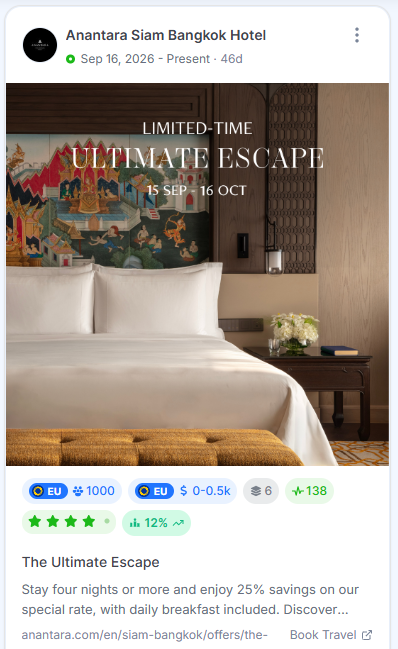
Anantara Siam Bangkok Facebook ad promoting a limited-time Ultimate Escape offer from Sept 15 to Oct 16.
Adding exact dates to a limited-time offer tells travelers precisely how long they have to book. (Image source: GetHookd)

Anantara Siam Bangkok’s “The Ultimate Escape” ad proves a strong offer doesn’t need flashy language to work. It simply states, “Stay four nights or more and enjoy 25% savings on our special rate, with daily breakfast included.”

The qualifying action, booking four nights, sits in the same sentence as the reward, so travelers immediately understand what they need to do to unlock the discount. This pairing matters because separating the condition from the benefit forces readers to hunt for fine print, and most will scroll past before they find it. 

Breakfast inclusion adds a second, tangible value on top of the percentage discount, giving budget-conscious travelers two reasons instead of one to book directly.

2. Hilton: Turning Loyalty Points Into Hotel Stays

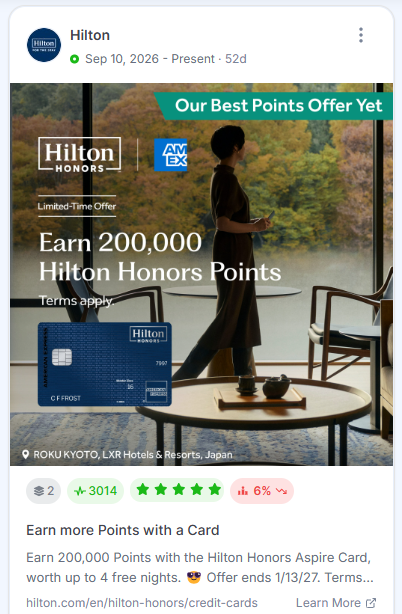
Hilton Honors Facebook ad for an Amex card offering 200,000 points, showing a woman in a lounge at ROKU KYOTO in Japan.
Naming the property shown in the photo turns a lifestyle image into a destination viewers can look up. (Image source: GetHookd)

Hilton’s “Our Best Points Offer Yet” ad skips abstract loyalty jargon and translates rewards into something guests can actually picture: “Earn 200,000 Hilton Honors Points,” described plainly as worth “up to 4 free nights.” That conversion from points to nights is why this ad earns attention, because most travelers have no intuitive sense of what a six-figure points balance is worth until someone spells it out in hotel stays.

What the headline doesn’t shout is that this is a co-branded credit card acquisition offer, not a simple loyalty bonus. Earning the full 200,000 points requires $6,000 in eligible purchases within six months of account opening, and the card carries a $550 annual fee that stays in effect every year the cardholder keeps the account open.

3. The Fife Arms: Promoting Family Suites With Playful Messaging

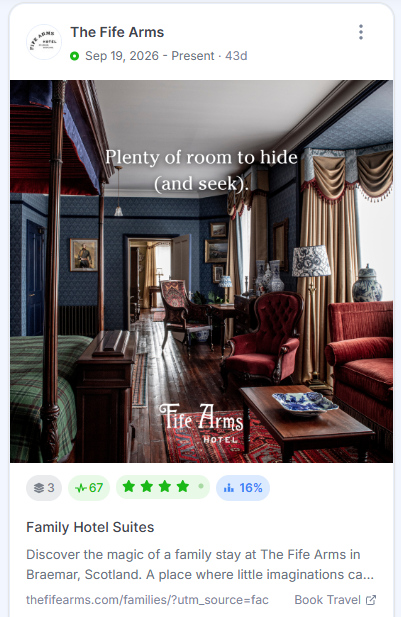
The Fife Arms Facebook ad showing a spacious, traditionally decorated family suite with the line Plenty of room to hide and seek.
A wide shot of the whole suite shows guests how much space they’ll have, so the copy doesn’t have to. (Image source: GetHookd)

The Fife Arms shows that personality and clarity don’t have to compete. Its “Family Hotel Suites” ad opens with the line “Plenty of room to hide (and seek),” a playful nod to family downtime that still sits directly beneath a headline stating exactly what’s being sold. That structure matters: the wordplay draws the eye, but the explicit headline keeps the message from getting lost in cleverness.

Beyond the suite itself, the ad points to real activities families can book during their stay, including treasure hunts, nature trails, foraging walks, and art classes. Naming these experiences gives the “family-friendly” label something concrete to stand on, rather than leaving parents to guess what a family suite actually includes once they check in.

4. Xenones Filotera Santorini: Highlighting the Destination & Luxury Experience

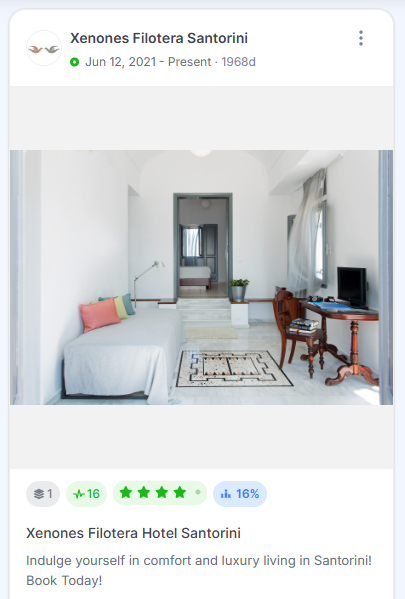
Xenones Filotera Santorini Facebook ad showing a bright whitewashed room with a daybed, desk, and steps leading to a second room.
When the destination is already famous, showing the room helps travelers see what they’re paying for beyond the view. (Image source: GetHookd)

Sometimes the destination does most of the selling. Xenones Filotera Santorini keeps its Facebook ad short and direct, letting the location carry the emotional weight.

Headline: “Xenones Filotera Hotel Santorini”

Copy: “Indulge yourself in comfort and luxury living in Santorini! Book Today!”

There’s no discount, no points system, and no complicated conditions to decode, just a straightforward invitation paired with a destination that’s already doing the heavy lifting in the traveler’s imagination. The simplicity works because Santorini itself is the hook.

5. Four Seasons Hotels and Resorts: Inspiring Holiday Stays With Loved Ones

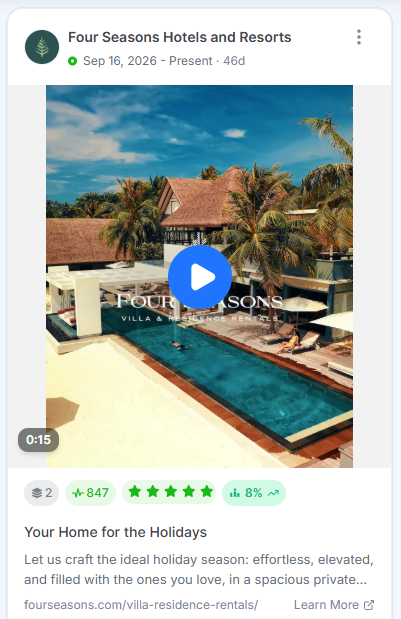
Four Seasons Villa and Residence Rentals video ad showing an aerial view of a private pool surrounded by thatched-roof villas and palm trees.
Promoting holiday stays in September reaches families while they’re still planning, before most dates are booked. (Image source: GetHookd)

Four Seasons leans fully into emotional appeal with its “Your Home for the Holidays” campaign, describing an “effortless, elevated” season “filled with the ones you love.” Rather than pushing a discount, the ad sells a feeling, then backs it up with specifics about Villa and Residence Rentals: generous space, privacy, a dedicated residential team, and a personal chef. 

Those four details transform “luxury” from a buzzword into a list of services a family can actually picture using during a holiday stay. The ad’s “Learn More” call to action fits this approach, inviting a closer look than demanding an immediate booking decision, which suits a higher-consideration purchase like a multi-week villa rental.

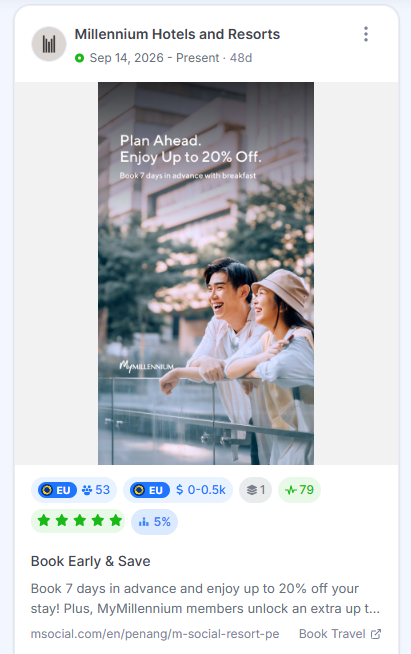
6. Millennium Hotels and Resorts: Rewarding Early Bookings With Savings

Millennium Hotels Facebook ad of a smiling couple on a balcony with the text Plan Ahead, Enjoy Up to 20% Off for bookings 7 days in advance.
Bundling breakfast into the offer adds value without cutting the room rate any further. (Image source: GetHookd)

Millennium’s “Book Early & Save” ad follows the same pairing principle seen in Anantara’s campaign: state the reward and the requirement together. “Plan Ahead. Enjoy Up to 20% Off” comes with a clear condition, booking at least seven days in advance, so travelers know exactly what action unlocks the savings.

The offer applies to room-only or breakfast-inclusive rates, and the exact inclusion varies by property. That distinction matters because assuming every booking under this promotion comes with complimentary breakfast could set the wrong expectation. Millennium’s ad works because it rewards planning behavior directly tied to hotel revenue management, filling rooms further out from the stay date, while staying upfront about what varies between properties.

Hotel Ad Examples: Side-by-Side Comparison

HotelAd AngleKey Takeaway
Anantara Siam Bangkok25% off stays of four nights or morePut the condition and the reward in one sentence
Hilton200,000 points worth up to 4 free nightsTranslate points into stays guests can picture
The Fife ArmsFamily suites with playful copyBack personality with a clear headline and named activities
Xenones Filotera SantoriniDestination-led luxury stayLet a famous location carry the message
Four SeasonsHoliday villa rentalsSell a feeling, then list specific services
Millennium HotelsUp to 20% off when booking 7 days aheadReward the booking behavior you want

Build Your Next Hotel Campaign Faster with GetHookd

Every example here proves the same point: the gap between a scroll-past ad and a booked room comes down to specificity, clear conditions, and real guest motivations, not just polished visuals or clever copy. The clearer the reason to book, the less travelers hesitate.

We built GetHookd to help hoteliers find and study exactly these kinds of ads before building their own. With access to 22M+ live Meta ads, Brand Spy competitor tracking, and Clone Ads for generating new variations, we make it easier to launch 2026 campaigns backed by evidence instead of guesswork. Try GetHookd for free now.

Frequently Asked Questions (FAQs)

What are some effective hotel advertising campaigns?

Effective hotel ad campaigns pair a specific guest benefit with a clear condition, like Anantara Siam Bangkok’s 25% discount for four-night stays with breakfast included, or Hilton’s points-to-nights conversion. Clarity and tangible value consistently outperform vague luxury messaging across hotel brands.

How much should a hotel discount to attract bookings on Facebook?

Discounts vary by brand strategy. Anantara Siam Bangkok offers 25% savings for stays of four nights or more, while Millennium Hotels offers up to 20% off for bookings made at least seven days in advance. The right percentage depends on the booking behavior being rewarded.

Are loyalty point offers better than percentage discounts in hotel ads?

Neither is universally better. Hilton’s offer converts 200,000 points into up to 4 free nights but requires $6,000 in card spending and a $550 annual fee, making it suited to frequent travelers, while straightforward percentage discounts like Anantara’s appeal to a broader, less committed audience.

Can a long-running Facebook ad be trusted as proof of a hotel’s success?

Not on its own. A long run only shows the hotel keeps paying for the ad, which may mean it’s performing or simply that nobody has reviewed the campaign. Treat run time as one signal among several, then compare it with how many ads the hotel runs and how often it launches new ones.

How can GetHookd help hoteliers create better Facebook ad campaigns?

GetHookd tracks millions of live Meta ads daily, letting hoteliers browse niche-specific examples, monitor competitor launches with Brand Spy, save ads for reference, and generate new creative variations with AI tools and templates, replacing guesswork with evidence-based campaign decisions.

*Note: Pricing and/or product availability mentioned in this post are subject to change. Please check our website for current pricing and stock information before making a purchase.