Key Takeaways
- Five Facebook feed ads worth studying in 2026 come from TYMO Beauty, ORIRI, Rufa Beauty, HighLevel, and Jaggad, each committing to a primary message per creative rather than stacking a discount, a feature list, and a brand story into one caption.
- Leading with a benefit before showing the price gives shoppers a reason to want the product first, so the discount reads as a bonus instead of the whole pitch.
- Ads styled as personal picks, like Rufa Beauty’s casual video naming a favorite lipstick, blend into the feed and read as recommendations, so viewers are more likely to engage.
- Concrete proof beats vague claims: ORIRI naming a client’s starting revenue, ending revenue, and timeframe in one line gives the result a shape readers can picture and trust.
- GetHookd cuts hours of manual ad research down to minutes, from spotting what competitors keep running to building your own ad variations and scripts.
What Do Successful Facebook Feed Ads Have in Common?
Successful Facebook feed ads in 2026 give viewers one primary reason to stop scrolling, not five competing ones. Feed placements sit beside friends’ photos and reels, so clarity wins over cleverness every time. Most brands lose that moment by mixing a discount, a brand story, and a feature list into one caption, leaving viewers unsure what to actually believe.
Getting this wrong costs more than one missed click. Meta’s A/B testing guidance is built around isolating one variable at a time, which is hard when a single creative carries a discount, a brand story, and a feature list at once.
Finding these patterns across millions of live ads manually is not realistic for most teams. GetHookd tracks over 22 million live Meta ads, updated daily, so marketers can find comparable ads in their niche and build new creatives from those ideas in minutes.
GetHookd: Give Your AI
22 Million Live Meta Ads

Your AI cannot see Meta's ad library. Now it can. Connect GetHookd to Claude, ChatGPT, Gemini, Cursor or Perplexity in about 30 seconds, no code needed. Ask in plain English what your market is running and get back the live Facebook and Instagram ads. Every answer comes back with the source ad attached, so you can check it yourself.
What You Get:- Brand Spy: Get told every time a competitor launches, with the launch date and how many ads they have live
- Shops: Open any Shopify store to see its monthly visitors, best sellers, and every Meta ad it runs
- Clone Ads: Turn any winning ad into new statics built off a creative already running in your market
Prefer clicking? Search and filter the library yourself in the app, on any plan.
Start a 7-Day Trial for $05 Facebook Feed Ads Examples Worth Studying in 2026
1. TYMO Beauty Turns Curls Into a 10-Minute Promise
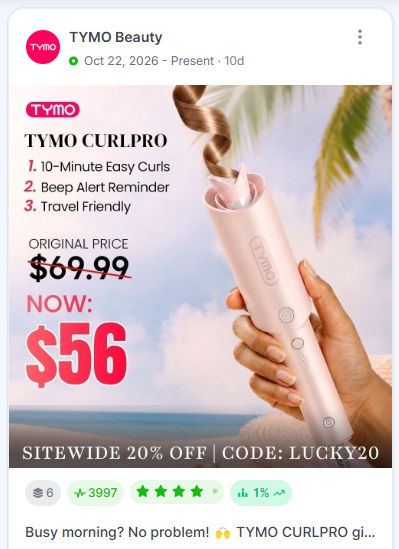
TYMO Beauty’s CURLPRO ad stacks three separate benefits into one feed post: “10-Minute Easy Curls,” “Beep Alert Reminder,” and “Travel Friendly.” The headline benefit comes first and gives a clear outcome with a defined time commitment, rather than opening with a spec sheet about barrel size or heat settings. Pricing sits below the benefits, dropping the advertised cost from $69.99 to $56, with a sitewide 20% off code, LUCKY20, layered on top for anyone who wants an extra reason to buy now.
The order matters here. Benefit first, convenience second, discount third means the audience already has a reason to want the product before they ever see a price, so the 20% off reads as a bonus instead of the entire pitch.
Anyone borrowing this structure for a different product should keep the same sequence: translate features into answers to questions shoppers are already asking, then let price do secondary work. The code itself also has to be unambiguous about the final price and whether it stacks with other sitewide offers, since confusion at checkout undoes everything the headline built.
2. ORIRI Sells Results With a Six-Month Revenue Jump
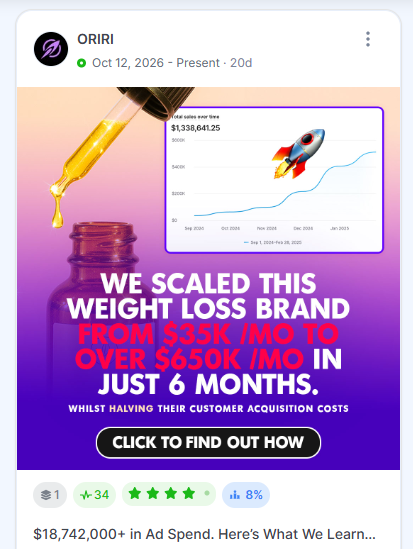
ORIRI’s feed ad does not mention the weight-loss product it helped scale at all. Instead, it leads with a client outcome, taking a weight-loss brand “from $35K/mo to over $650K/mo in just 6 months,” while also claiming it cut that client’s customer acquisition costs in half. The copy packs four details into one line: the client’s industry, the starting revenue, the ending revenue, and the timeframe, giving the claim a shape a reader can picture immediately.
The second metric, the drop in acquisition cost, does more work than it first appears to. It signals the revenue growth did not come from simply spending more on ads, but from getting more efficient at the same time.
The call to action, “Click to find out how,” invites an explanation rather than pushing straight into a sales conversation, which fits an offer where the reader needs proof before a pitch. Be ready to show how the number was measured and what specifically changed, since a strong case study needs to back up a headline this bold.
3. Rufa Beauty Makes Lipstick Feel Like a Daily Habit
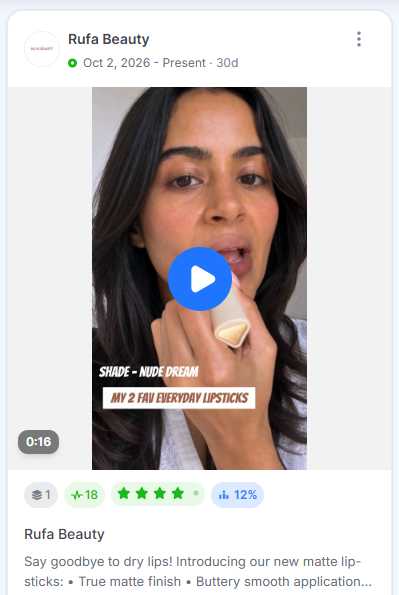
Rufa Beauty’s ad runs as a 16-second video with on-screen text reading “My 2 fav everyday lipsticks.” Instead of listing multiple product claims, the ad positions the lipstick through personal preference and routine, turning the word “everyday” into the center of the pitch. That one word moves the conversation away from what the product is and toward where it fits into a viewer’s existing routine.
Calling it “my 2 fav” frames the video as a shortlist, not a sales pitch, while naming the exact shade gives an interested shopper something concrete to search for. The format works because it reads like a recommendation rather than an advertisement, a pattern that transfers well to any product tied to a recurring task, whether that is a morning skincare step, a work bag, or a weeknight dinner shortcut.
4. HighLevel Pairs an AI Feature With an Emotional Hook
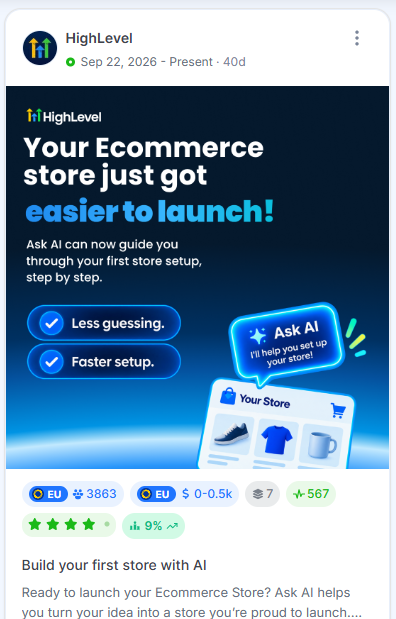
HighLevel’s feed ad opens with “Your Ecommerce store just got easier to launch!” before explaining that its Ask AI tool can guide a new user through store setup “step by step.” The copy wraps up with two short phrases, “Less guessing” and “Faster setup,” which name the emotional payoff rather than just the feature. That pairing matters because the ad is not selling an AI capability in the abstract; it is addressing the specific dread of staring at a blank store builder with no idea where to start.
The phrase “step by step” works because it is more concrete than a general claim about artificial intelligence, giving a first-time store owner a clear sense of what help actually looks like. HighLevel’s own documentation notes that some setup, like creating a new domain and connecting a payment provider, still has to happen manually. That is not a flaw in the ad, but a reminder that a step-by-step promise only holds up if the product actually gives users a defined starting point to follow.
5. Jaggad Lets a $19 Price Tag Do the Talking
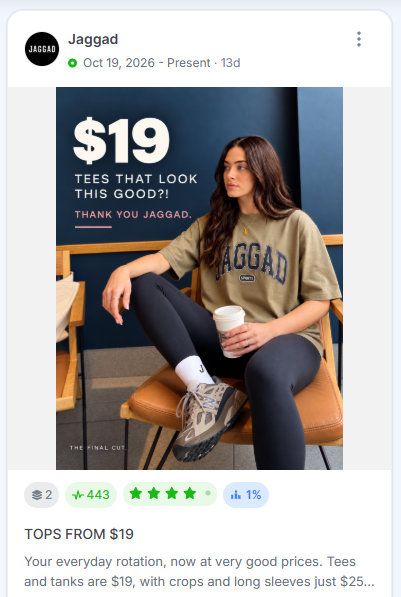
Jaggad’s ad opens with a number, “$19,” followed by “Tees that look this good?!” and “Thank you, Jaggad.” Nothing else competes for attention in the copy. No mention of fabric, no seasonal campaign, no loyalty program, just a price and a question that frames that price as a surprise given how the product looks.
The ad is not simply stating that a shirt costs $19. It argues that $19 is a good deal for something that looks this good, shifting the number from a fact into a value judgment. Any brand borrowing this format needs the price itself to be the actual reason to buy, and needs to spell out the details that usually trip up checkout, including currency, which sizes qualify, shipping costs, and whether the price applies storewide or to one style only.
5 Facebook Feed Ad Examples: Summary Table
| Brand | Main ad hook | Key takeaway |
| TYMO Beauty | Promises 10-minute curls, followed by convenience benefits and a discount. | Lead with a specific outcome, then use pricing as an additional incentive. |
| ORIRI | Claims monthly client revenue grew from $35K to over $650K in six months. | Pair measurable results with supporting evidence; distinguish advertised claims from verified outcomes. |
| Rufa Beauty | Presents lipstick as an everyday favorite through a casual application video. | Show how the product fits naturally into a familiar routine. |
| HighLevel | Promises easier store setup through step-by-step AI guidance. | Translate technical features into practical help and emotional relief. |
| Jaggad | Leads with a $19 price and on-body product imagery. | Make value immediately visible and clarify offer conditions. |
Spot & Recreate Winning Feed Ads in One Place With GetHookd
Every example above shares the same backbone: one clear message, shown the moment the ad hits the feed. The hard part isn’t understanding that once you see it, but finding these patterns in your own niche and turning them into briefs a design or copy team can use week after week.
That’s the gap GetHookd closes. We track 22M+ live Meta ads, updated daily, so patterns like these surface in minutes instead of hours of scrolling the Ad Library one brand at a time. Clone Ads turns a winning static into new variations, and Video Scripts writes new scripts built around your product, using a winning ad as inspiration. Start your 7-day free trial and find the angle for your next ad.
Frequently Asked Questions (FAQs)
What makes a Facebook feed ad successful in 2026?
A successful Facebook feed ad gives viewers one clear reason to stop scrolling, built around a single message rather than several competing claims. The five examples above each commit to one angle, whether that is a discount, a client result, a routine, a feature, or a price.
How long should a Facebook feed ad video be?
There’s no fixed length, but shorter videos usually suit the feed, where people scroll quickly. Show the product and the main message in the first few seconds, so the ad still works if someone stops watching early. Longer videos can work too, as long as every second gives viewers a reason to keep watching.
Should I test discounts or benefits first in my Facebook ads?
Test both, but lead with whichever one answers the shopper’s main hesitation. TYMO Beauty led with a 10-minute curl benefit before mentioning its price drop from $69.99 to $56, which gave shoppers a reason to want the product before the discount ever entered the conversation.
How does Meta recommend measuring ad test results?
Meta recommends changing one variable at a time during A/B testing while holding every other campaign element constant. It also advises choosing a single key metric tied to your campaign objective before the test starts, and judging the result against that metric.
How does GetHookd help me create winning Facebook ad examples?
GetHookd lets you search live Meta ads by niche, format, and run time, and Brand Spy lets you follow competitors and turn on alerts for their new ads. Clone Ads, Video Scripts, and ready-to-use templates then help you build your own version without a designer. You can also connect GetHookd to AI assistants like ChatGPT or Claude and ask what your market is running in plain English.
*Note: Pricing and/or product availability mentioned in this post are subject to change. Please check our website for current pricing and stock information before making a purchase.