Static vs Video Ads for Facebook: Pricing, Pros & Cons
Key Takeaways
- Video ads generate higher engagement on average, but static ads consistently outperform them in direct-response and retargeting campaigns where speed and clarity matter most.
- Match your format to your funnel stage: use video to build awareness and trust with cold audiences, and static to drive conversions with warm audiences who already know your offer.
- Production cost is where static and video ads diverge most significantly: static ads can launch the same day, while non-user-generated (non-UGC) video ads require a production investment.
- Running both formats together and A/B testing them against the same audience is the fastest way to identify which creative approach drives the best results for your specific objective.
- GetHookd gives you access to 65M+ real Meta ads so you can see which format competitors in your niche are actively scaling, then use our Video Scripts, Clone Ads, and Image Ad Templates to build both formats.
Static or Video Ads: Which Performs Better on Facebook?
Facebook gives advertisers two dominant creative formats, and both can work brilliantly or flop completely.
Video ads generate higher engagement on average, but static ads consistently outperform them in direct-response campaigns where speed and clarity matter most.
The difference comes down to understanding what each format is built for, where it fits in your funnel, and what your audience actually responds to at that moment. Marketers who treat this as a binary choice and pick one while ignoring the other leave serious performance gains on the table.

GetHookd: Turn Competitor Intelligence Into Your Next Winning Ad
GetHookd reveals which ads your competitors are actively scaling—not just running. Spy on their best-performing creatives, landing pages, and traffic strategies, then turn proven concepts into testable campaigns in seconds with AI-powered script generation and creative cloning.
What You Get:- ✓ Brand Spy to decode competitor ad strategies in real-time
- ✓ AI script generation and ad cloning for instant variations
- ✓ Performance scoring based on actual ad behavior, not vanity metrics
- ✓ Creative Analyzer to identify and scale your top performers
Static Facebook Ads Explained
Static Facebook ads are single-image or graphic ads that display a fixed visual with no motion, sound, or video. They appear across Facebook’s placements, including the News Feed, Stories, Marketplace, and the right-hand column on desktop. One image, a headline, body copy, and a call-to-action button.
Despite being the older format, static ads are far from obsolete. They load instantly, communicate a message in a fraction of a second, and are significantly easier and cheaper to produce than video. For direct-response campaigns where clarity and speed matter more than storytelling, static ads consistently hold their own.

Pros of static Facebook ads
- Fast production turnaround with same-day launch capability
- Lower creative costs with no video production, editing, or audio licensing required
- Instant loading regardless of connection speed
- Strong performance in retargeting campaigns where warm audiences need a direct, clear message
- Easy to A/B test at scale by swapping headlines, images, or offers
- Effective at the bottom of the funnel, where a simple, frictionless design supports conversion
Cons of static Facebook ads
- Narrower attention window, since the scroll stops for motion rather than stillness
- Weaker stopping power when the visual isn’t immediately arresting
- Faster creative fatigue when shown to the same audience over an extended period
- Limited storytelling capacity for products that need demonstration or emotional context
- Less algorithmic favor, as Facebook tends to reward motion-based content with broader reach
Facebook Video Ads Explained
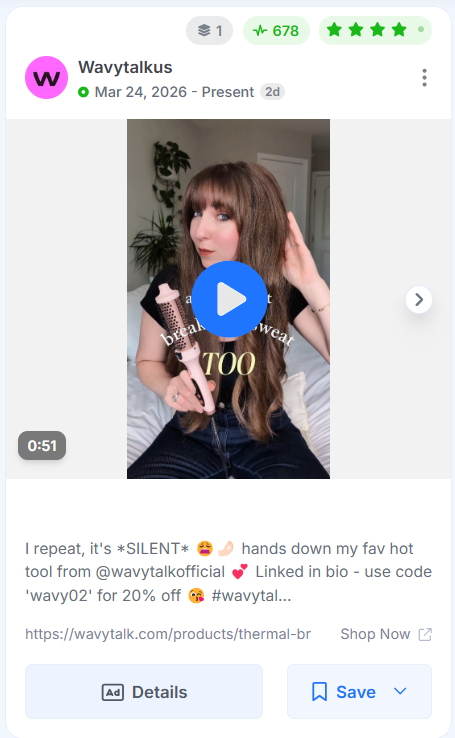
Facebook video ads use motion-based creative to deliver a message across Facebook’s placements, ranging from short clips to longer uploads.
They autoplay silently in the feed, which means the first few frames carry enormous weight. Formats include in-feed video, Stories, Reels, and in-stream ads that play during other video content.
Video has become Facebook’s preferred format. The platform’s algorithm actively rewards video content with broader reach, and that bias carries into paid placements.
Pros of Facebook video ads
- Higher engagement rates with more clicks, shares, and comments than static on average
- Stronger brand recall through the combined effect of motion and sound
- Better for storytelling, product demos, testimonials, and emotional narratives
- Best for retargeting segmentation. You can build custom audiences based on how much of your video someone watched
Cons of Facebook video ads
- Higher production investment, with shooting, editing, and revisions required before media spend
- Slower turnaround times make it harder to pivot quickly when offers or messaging change
- Ongoing creative refresh costs, as a video that performs one quarter may need a full rework the next quarter
- Compounding costs at scale for businesses running multiple campaigns simultaneously
- Higher skill requirements across scripting, filming, editing, and music licensing
Static vs Video Ads for Facebook: Pricing Structure
Static and video ads run through the same Meta auction system, so your Cost Per Mille (CPM) and Cost Per Click (CPC) are governed by the same variables regardless of format. These variables include audience, industry, placement, objective, and creative quality.
That said, industry reports from Wordstream, analyzing data from over 1,000 campaigns, show that the average CPC for traffic campaigns is $0.70, while the average CPC for lead campaigns is $1.92. Competitive verticals like finance, insurance, and legal services push costs higher than these averages.
Where the two formats diverge most significantly is in production costs. Static ads can go from concept to live campaign the same day with no crew, licensed audio, or editing required. Video ads that are not UGC-style may carry a significantly higher upfront investment in scripting, filming, editing, and music licensing, all of which need to be factored into your true cost-per-result, not just your media spend.
When to Use Static Ads vs Video Ads on Facebook
Funnel position is the single most important factor in deciding which format to use. Cold audiences who have never heard of your brand need context, story, and trust-building. That’s video’s territory. Warm audiences who already know your offer and just need a nudge toward conversion respond well to the directness and clarity of a static ad.
Using video at the bottom of the funnel to someone ready to buy can actually slow down the decision, while using a static ad at the top of the funnel to someone who doesn’t know you yet rarely gives them enough reason to care.
Your campaign objective matters just as much. Awareness and consideration objectives benefit from the video’s depth of engagement. Conversion and catalog sales objectives, especially with retargeting, tend to perform strongly with static. Traffic campaigns can go either way depending on the creative quality and audience temperature.
The most effective Facebook advertisers use both formats strategically and let the data decide. A/B testing lets you run two versions of an ad simultaneously against the same audience, with equal budget allocation, giving you a clear read on which format drives better results for a specific objective.
Static vs Video Ads for Facebook: Comparison Table
| Factor | Static Ads | Video Ads |
| Best Funnel Stage | Bottom and mid-funnel | Top and mid-funnel |
| Best Objective | Conversions, retargeting, and catalog sales | Awareness, consideration, brand building |
| Creative Fatigue | Fatigues faster, requires frequent rotation | Slower to fatigue due to format variety |
| Best Audience | Warm, already aware of your offer | Cold, needs context and trust-building |
| Pros | Fast to produce, lower creative cost, clear and direct messaging | Stronger storytelling, higher engagement, algorithm-favored |
| Cons | Limited storytelling, narrower attention window | Higher production investment, harder to pivot quickly |
Build High-Performing Static & Video Ads With GetHookd
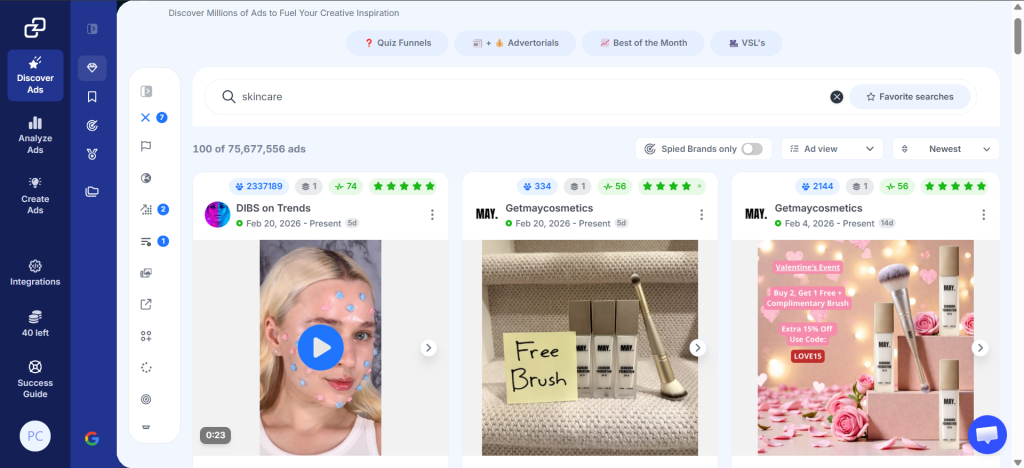
Most advertisers understand the difference between static and video in theory. The harder question is knowing which specific creatives, formats, and angles are actually converting in your niche right now, before committing budget to production. That is exactly what GetHookd is built to answer.
Our Explore Ads feature gives you access to 65M+ real Meta ads searchable by niche, format, and performance signals, so you can see exactly what your competitors are running and which ad format they are putting serious budget behind. Once you know what is working, our Video Scripts and Clone Ads features let you move from research to production without switching platforms.
Are you ready to create Ads that convert? Start your GetHookd free trial today!
Frequently Asked Questions (FAQs)
Are video ads more expensive than static ads on Facebook?
Video ads are typically more expensive to produce, but your CPM and CPC are not automatically higher for video. In awareness and engagement campaigns, video ads can actually achieve a lower cost-per-result because their higher interaction rates improve relevance scoring, which Facebook rewards with better auction positioning. The most meaningful number to track is always cost-per-result, not production cost in isolation.
Do static ads still work on Facebook in 2026?
Yes. Static ads remain one of the most effective formats for retargeting, direct-response campaigns, and bottom-of-funnel conversions. For high-volume eCommerce campaigns in particular, static product ads are a reliable driver of catalog retargeting performance because their simplicity and speed align with buyers who are already close to a purchase decision.
How long should a Facebook video ad be?
For in-feed video ads targeting cold audiences, 15 to 30 seconds is the sweet spot, enough time to hook attention, deliver your core message, and include a clear CTA. Warm and retargeting audiences can sustain 60 to 90 seconds, especially for product demonstrations or testimonials. Reels and Stories placements perform best at 15 seconds or under, given the fast-paced, full-screen context of those placements.
Can I use both static and video ads in the same Facebook campaign?
Yes, and in most cases you should. Facebook’s Advantage+ creative features let you upload multiple formats within a single campaign, and the platform will automatically serve the format most likely to perform for each user. The full-funnel approach of using video for awareness and static for conversion remains one of the most reliable campaign structures across industries and budget levels.
How does GetHookd help you choose between static and video ads?
GetHookd gives you direct access to 65M+ real Meta ads so you can see exactly which format competitors in your niche are actively scaling before you commit to production. Our Brand Spy feature lets you study their top-performing static and video creatives side by side, so your format decision is grounded in real market data. From there, our Clone Ads and Video Scripts tools let you produce both formats without switching platforms.
*Note: Pricing and/or product availability mentioned in this post are subject to change. Please check our website for current pricing and stock information before making a purchase.