Key Takeaways
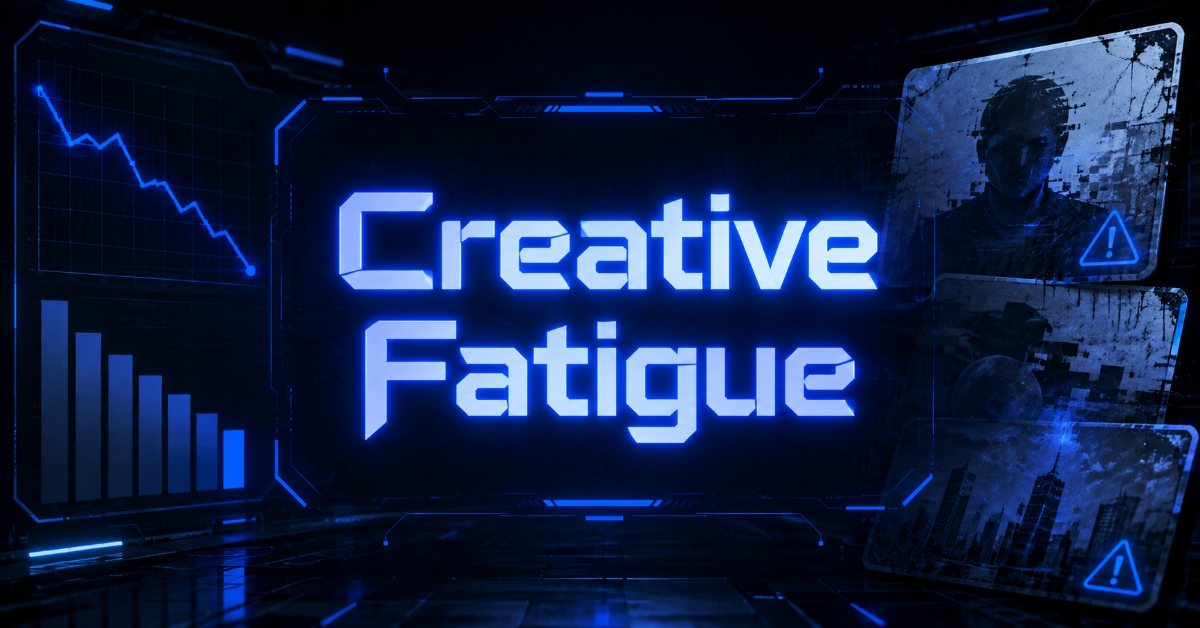
- Creative fatigue is confirmed by comparing each ad’s rolling seven-day performance against its own first-week baseline, not against campaign averages that hide single-ad declines.
- Frequency, link CTR, video hook and hold rate, CPM, CPC, and CPA make up the full metric set, with engagement metrics shifting days before cost metrics catch up.
- Creative fatigue is confirmed when frequency passes roughly 2.5 to 3 on cold audiences, and CTR falls 20% to 30% for several consecutive days.
- Swapping the message angle instead of the artwork, rebuilding video hooks on existing bodies, and keeping three to five tested variants on hand are the fastest fixes for creative fatigue.
- GetHookd keeps that variant queue supplied by surfacing top-performing competitor ads across Meta and TikTok, so replacements are briefed before rotation is urgent.
Catching Creative Fatigue Before It Hurts Ad Spend
Creative fatigue is measured by tracking an ad’s rolling seven-day performance against its own first-week baseline, one ad at a time rather than at the campaign level. Most advertisers notice it by gut feel, watching overall account numbers dip before tracing the drop back to a single tired creative. By then, several days of spend have already been wasted.
Reading the metrics in the wrong order is the bigger mistake. Cost metrics like CPA move last, so waiting for CPA to confirm fatigue means the ad has already been underperforming for days before anyone acts. Catching the signal in engagement metrics first buys time to test a replacement before you waste spend on a creative that has already stopped working.
That timing gap is where GetHookd fits. It tracks which competitor ads are actively scaling across Meta and TikTok, so a tested replacement angle is ready before a fatigue trigger fires, not after.

GetHookd: Turn Competitor Intelligence Into Your Next Winning Ad
GetHookd reveals which ads your competitors are actively scaling—not just running. Spy on their best-performing creatives, landing pages, and traffic strategies, then turn proven concepts into testable campaigns in seconds with AI-powered script generation and creative cloning.
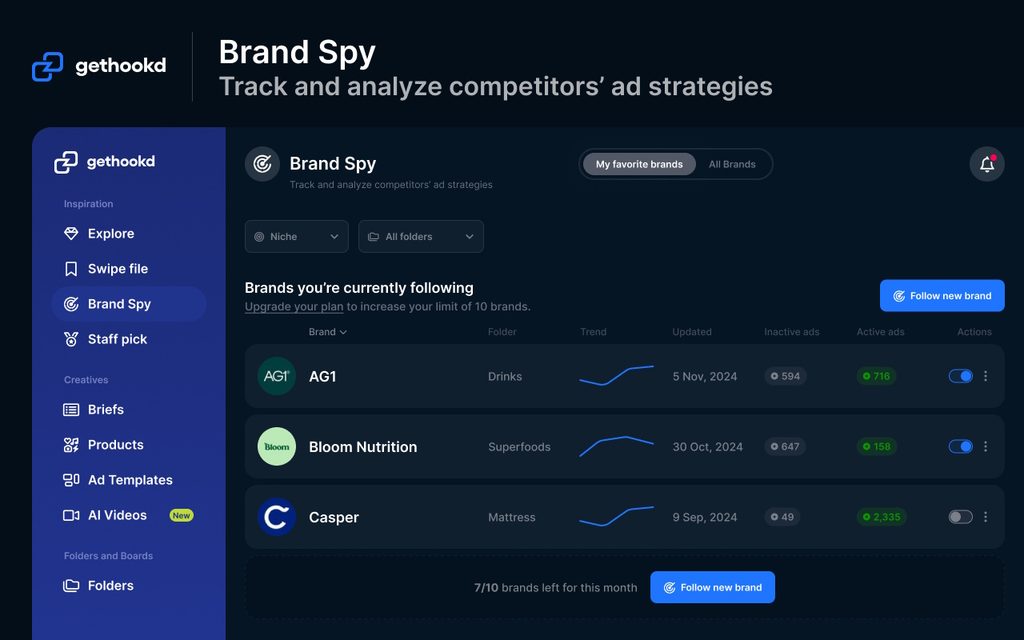
What You Get:- ✓ Brand Spy to decode competitor ad strategies in real-time
- ✓ AI script generation and ad cloning for instant variations
- ✓ Performance scoring based on actual ad behavior, not vanity metrics
- ✓ Creative Analyzer to identify and scale your top performers
What are the Key Metrics to Measure Creative Fatigue?
Frequency
Frequency counts average impressions per person over a set period, and it should be read over a rolling window rather than lifetime. On cold prospecting audiences, accounts reviewed at GetHookd typically show a seven-day frequency above roughly 2.5 to 3 as the point to start checking response metrics. Retargeting tolerates more, often 4 to 6, because intent is higher.
How fast an ad reaches those levels depends on daily reach relative to audience size, not on calendar time. An ad at low spend against a broad audience can hold for weeks, while the same ad at high spend against a one-million-person audience reaches fatiguing frequency in days.
Frequency alone does not prove fatigue. It establishes that exposure has reached the level where fatigue becomes possible, which is the trigger to look at everything else.
CTR & Hook Rate
Link Click-Through Rate (CTR) measures whether the creative still earns attention. A sustained fall of 20% to 30% below the ad’s first-week average, held for several days, is a reliable fatigue signal.
For video, hook rate (three-second views divided by impressions) and hold rate (ThruPlays divided by three-second views) narrow the problem further. A falling hook rate points to the opening seconds. A stable hook rate with a falling hold rate points to the middle of the ad, which changes what you rebuild.
Read these against frequency. Rising frequency with falling CTR indicates fatigue. Flat frequency with falling CTR usually indicates an audience or auction issue instead.
CPM & CPC
Cost Per Thousand Impressions (CPM) rises when the auction gets more expensive or when relevance signals weaken. Fatigued creative earns fewer positive interactions per impression, and delivery cost drifts upward as a result.
Cost Per Click (CPC) rises faster than CPM during fatigue, because it absorbs both the higher impression cost and the lower click rate. Tracking CPC without CPM makes seasonal auction spikes look like creative problems, so read the two as a pair.
CPA & ROAS
Cost Per Acquisition (CPA) and Return On Ad Spend (ROAS) move last, so they confirm rather than detect. If CTR fell first and CPA followed, fatigue is confirmed.
If CPA rose while CTR held steady, the cause sits downstream of the ad, in the landing page, checkout, or offer. Rotating creative in that situation replaces a working asset and leaves the actual problem untouched.

How to Measure Creative Fatigue: Step by Step
- Set a Baseline: Record CTR, hook rate, CPM, CPC, frequency, and CPA across the ad’s first stable week at consistent spend, once the ad set has exited the learning phase. Every later reading is compared against this, not against account averages or other ads. Baselines taken during the learning phase are unreliable, since delivery is still adjusting. Waiting for the exit confirmation in the Delivery column produces a figure worth measuring against.
- Use a Rolling Seven-Day Window: Daily figures swing too much to act on, particularly at lower spend where a handful of conversions moves CPA sharply. A rolling seven-day view smooths that noise while still reacting quickly enough to matter. The same window applies to every metric in the set. Mixing a three-day CTR against a fourteen-day frequency produces comparisons that mean nothing.
- Compare Ad by Ad: Calculate the change for each metric at the ad level, not the campaign level. Campaign averages hide individual declines, especially when one strong creative is carrying the spend. An ad set can look stable while two of its four creatives are well past their useful life. Only ad-level review surfaces that.
- Segment Frequency by Audience and Placement: Break frequency down by audience and placement before drawing conclusions. Fatigue often concentrates in one segment while the blended figure looks healthy. A creative can be exhausted on Facebook feed while barely delivered on Reels. Excluding the saturated placement is usually cheaper than replacing the creative.
- Rule Out the Alternatives: Confirm that budget, bid strategy, audience size, and landing page have not changed during the comparison period. Any of these will move the metrics independently of fatigue. Then check whether CPM has risen across every ad in the account or only this one. An account-wide rise points to the auction, not the creative.
- Set the Rotation Trigger in Advance: Define the rule before you need it, for example, CTR down 25 percent with frequency above 3 for three consecutive days. Written thresholds prevent the judgment calls that keep declining ads alive because they were once profitable. Review the trigger every few months against what actually happened. Accounts with faster reach accumulation need tighter thresholds.

Tips for Fixing Creative Fatigue
Change the Angle, Not the Artwork
Recoloring a static or swapping a caption buys days. A new pain point, proof type, or offer framing buys weeks because the audience reacts to the message rather than the styling.
Treat visual refreshes as a way to extend a working angle, not as a fix for one that has stopped landing.
Rotate Hooks on Video First
Rebuilding the opening three seconds over an existing body is the cheapest test available, and it directly targets a falling hook rate. Production cost is minimal because you reuse the rest of the asset.
Three hook variants against one proven body will usually tell you within a week whether the angle still has life.
Keep a Queue Ready
Hold three to five tested variants behind every scaling ad. Rotation carried out under pressure produces untested replacements, which is how a fatigue problem becomes a performance gap.
The queue only works if you’ve already validated the variants at low spend. Untested assets in the queue are not replacements.
Widen the Audience Before Pausing
If the creative still converts at target CPA but frequency is climbing, a broader audience often extends its life without any new production. The asset was never the problem.
This works best on prospecting campaigns with narrow interest stacks, where the audience ceiling arrived before the creative wore out. David, who manages a Google Ads agency, says, “We check audience size before we touch the creative. Half the time the ad is fine, the pool just ran out”.
Stagger Launch Dates
Creatives launched together fatigue together, which produces sharp account-wide drops rather than gradual ones. Spacing new assets across the month keeps declines staggered and manageable.
It also makes attribution cleaner, since concurrent launches make it difficult to tell which change moved performance.
Log Every Rotation
Record the date, the trigger metric, and the reason each time a creative comes out. After several cycles, this produces an account-specific fatigue window you can plan production against.
Without the log, every rotation is a fresh judgment call, and the same lessons get relearned each quarter.
Stay Ahead of Creative Fatigue with GetHookd
Creative fatigue is predictable once you know where to look. Frequency and CTR move first, cost metrics confirm it days later, and a written rotation trigger turns that signal into action instead of guesswork. Advertisers who catch it early are already running a pipeline, not scrambling for a replacement mid-decline.
At GetHookd, we keep that supply moving by showing which ads competitors in your niche are actively scaling across the Meta Ad Library, so each rotation starts from an angle with evidence behind it. Start your GetHookd 7-day free trial and have the next creative briefed before the current one fades.
Frequently Asked Questions (FAQs)
How long before an ad creative fatigues?
There is no fixed lifespan. Broad prospecting audiences at moderate spend can support a strong creative for several weeks, while narrow pools at high spend may decline within days. Audience size relative to daily reach predicts this better than any calendar rule.
Should I pause a fatigued ad or let it run?
Pause once CPA passes target, and the trend has held for three or more days. Reducing budget instead slows the decline while preserving the ad’s delivery history. Reintroducing the same creative several weeks later often performs again, since audience recall fades over time.
How to check ad fatigue in Meta?
To check ad fatigue in Meta Ads Manager, compare frequency, CTR, and CPA against the ad’s recent baseline. Rising frequency alongside falling CTR and increasing CPA is a strong fatigue signal. Don’t rely on frequency alone, as high frequency does not automatically mean an ad is fatigued.
Why does my Facebook ad show creative fatigue?
Your Facebook ad shows creative fatigue when repeated exposure causes performance to decline. Typically, frequency rises while CTR falls and CPA increases, indicating the creative is losing effectiveness with the audience.
How does GetHookd help me find replacement angles?
GetHookd shows which competitor ads are still active and performing across Meta and TikTok, not just live, so you start with angles backed by evidence. Its Brand Spy feature runs checks every few minutes and needs no technical skills.
*Note: Pricing and/or product availability mentioned in this post are subject to change. Please check our website for current pricing and stock information before making a purchase.