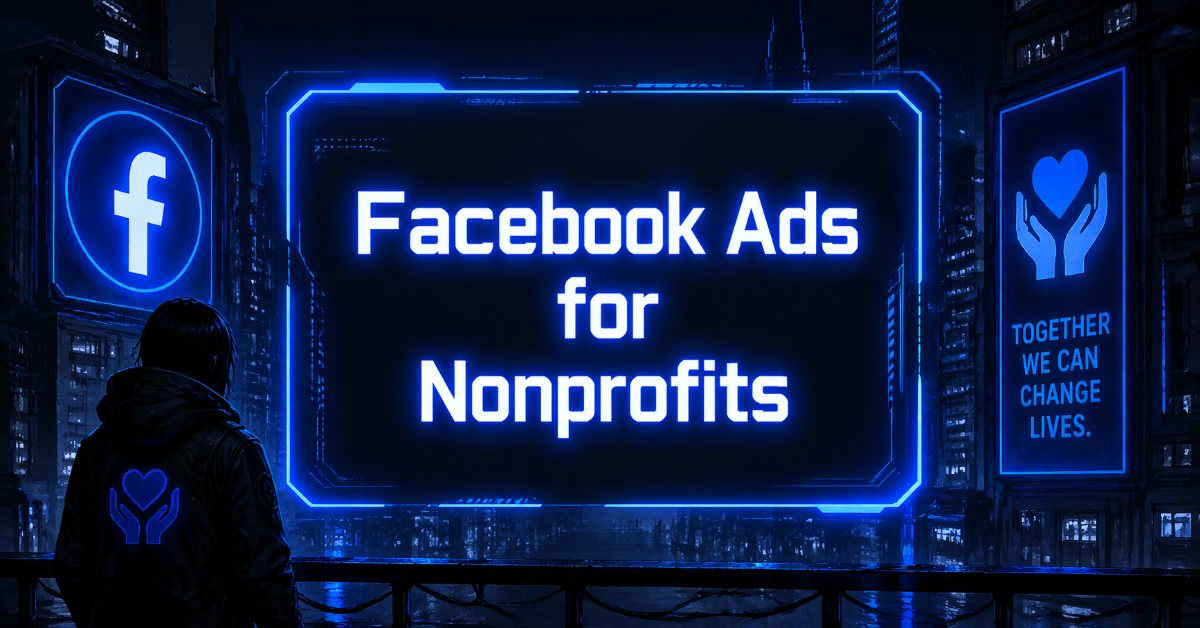
Facebook Ads for Nonprofits: Examples, Cost & Tips
Key Takeaways
- Facebook does not offer ad discounts for nonprofits. Every campaign competes in the same auction as commercial advertisers, which means cost discipline and creative quality matter just as much as mission.
- Most nonprofit campaigns underperform not because of small budgets but because they mix goals. Running one campaign for donations, another for volunteer sign-ups, and a third for event awareness means each gets a focused algorithm, not a compromised one.
- GetHookd, the Meta Ad Library, and your own donor data are the three research inputs that separate tested campaigns from guesses. GetHookd surfaces which creatives similar organizations are actively scaling before you spend a dollar building your own.
- Nonprofit Facebook ads averaged a $0.39 median CPC in 2025, well below the platform-wide average, but that figure jumps to $0.54 in November when retail advertisers flood the auction during the holiday giving season.
- GetHookd gives nonprofit marketing teams access to 65M+ analyzed Meta ads so they can identify winning creatives and spy on competitor ad strategies before launch.
What Nonprofits Need to Know About Facebook Ads
GetHookd, the Meta Ad Library, and a clear campaign goal are the three things nonprofit teams need to get real results from Facebook ads. Facebook offers no grants or discounts for nonprofits, so every organization competes in the same auction as commercial advertisers. The advantage nonprofits do have is a consistently lower cost per click than most industries, averaging $0.39 in 2025, which stretches a tight budget further than most paid channels.
While Facebook does not have special ad programs for nonprofits, the upside is that nonprofit campaigns consistently see lower costs per click and per impression than most commercial industries. Understanding what these campaigns look like in practice, what they cost, and how to build them effectively is the starting point for any organization ready to move beyond organic posts.

GetHookd: Turn Competitor Intelligence Into Your Next Winning Ad
GetHookd reveals which ads your competitors are actively scaling—not just running. Spy on their best-performing creatives, landing pages, and traffic strategies, then turn proven concepts into testable campaigns in seconds with AI-powered script generation and creative cloning.
What You Get:- ✓ Brand Spy to decode competitor ad strategies in real-time
- ✓ AI script generation and ad cloning for instant variations
- ✓ Performance scoring based on actual ad behavior, not vanity metrics
- ✓ Creative Analyzer to identify and scale your top performers
What Nonprofit Facebook Ads Actually Look Like
The format and objective behind a nonprofit Facebook ad depend on what action you are trying to drive. Three categories cover the majority of what well-run nonprofit campaigns focus on.
Fundraising and Donation Ads
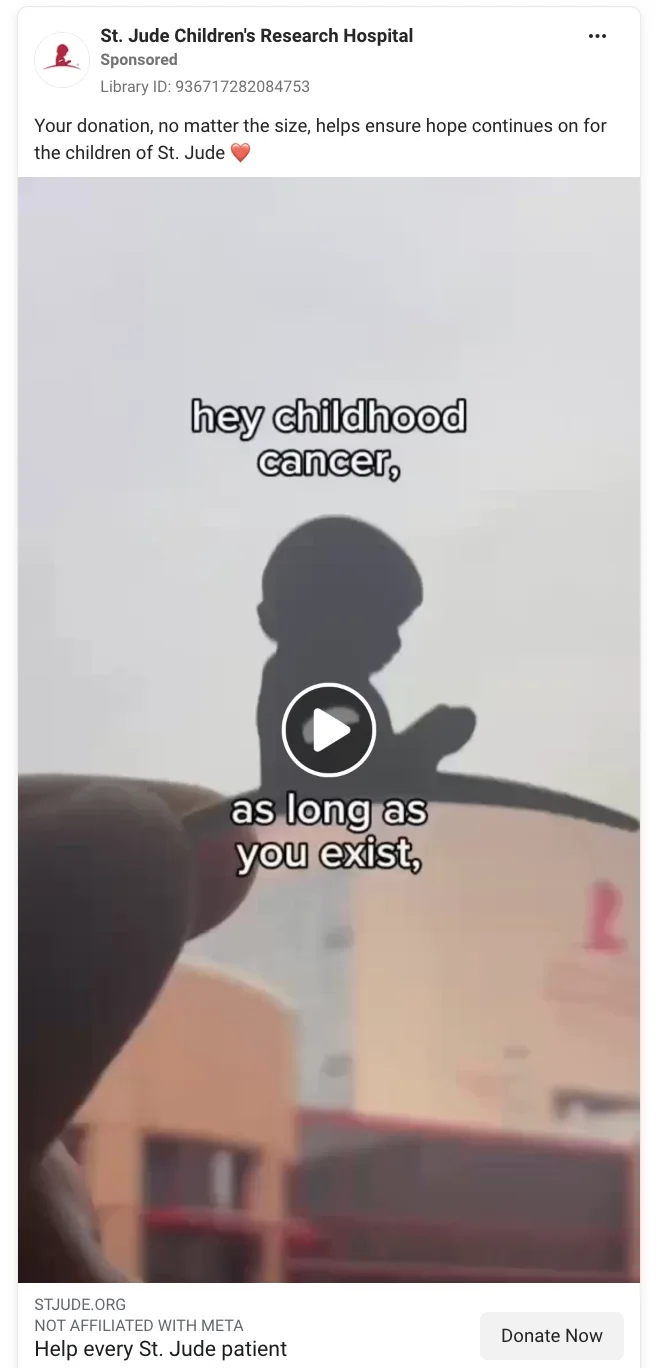
Donation ads are built for one outcome: getting someone to complete a financial contribution. They typically feature a real, specific impact statement in the headline (“$25 feeds a child for a week”), a compelling photo or short video showing actual program outcomes, and a “Donate Now” CTA button that leads directly to a donation page.
These campaigns run under the “Sales” objective in Meta Ads Manager. The label feels counterintuitive for a nonprofit, but the Sales objective tells Meta’s algorithm to prioritize users likely to complete a transaction, which aligns directly with online donation behavior. Generic objectives like Traffic or Engagement deliver lower-quality results for donation-focused campaigns.
The creatives that perform best in this format tend to avoid polished stock imagery. Real photos of program beneficiaries, specific donation goals tied to tangible outcomes, and copy that focuses on impact rather than organization history consistently outperform brand-heavy messaging.
Volunteer Recruitment Ads
Volunteer recruitment ads prioritize leads over immediate financial transactions. These ads typically drive traffic to a sign-up form, either hosted on your website or through Meta’s native Instant Forms, which pre-fill contact information from a user’s Facebook profile and dramatically reduce drop-off in the sign-up process.
The most effective volunteer ads are specific about the role, location, and time commitment involved. “Join us every Saturday morning at our East Side food pantry” performs better than “Volunteer with us.” Specificity filters out unqualified interest and attracts people with genuine interest, improving conversion rates without requiring a larger budget.
Event and Awareness Ads
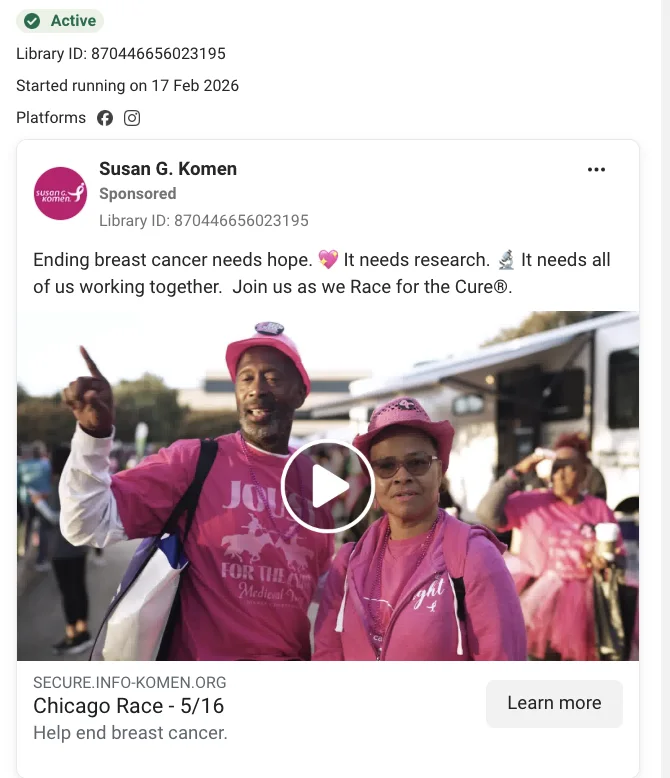
Event ads promote fundraising galas, community drives, and charity campaigns tied to a specific date or window. They work best in the two to three weeks leading up to the event with urgency built into the copy and a clear, frictionless RSVP or ticket path.
Awareness ads operate differently. They are not built to drive immediate action but to introduce a cold audience to your cause before a campaign launch or giving season. A short video that tells your organization’s story, followed by a retargeting campaign that asks viewers to donate, is one of the more reliable full-funnel approaches for nonprofits with a modest budget.
How Much Do Facebook Ads Cost for Nonprofits?
Nonprofit ad costs on Facebook sit comfortably below the platform’s global averages across most metrics, but they are not immune to seasonal pressure or creative quality issues. Here is what to expect across the three most relevant cost metrics.
Cost Per Click
Nonprofit Facebook campaigns averaged a median CPC of $0.39 in 2025, with costs ranging from a low of $0.28 in January to a Q4 peak of $0.54 in November. The end-of-year spike is driven by retail advertisers flooding the auction during the holiday shopping season, which directly compresses nonprofit budgets during the most important giving window of the year.
Planning for higher costs in October through December and front-loading audience-building in Q2 and Q3 can protect campaign efficiency when competition peaks. If your organization’s biggest giving push is in December, warming up your audience months earlier with awareness content reduces the cost of converting that audience once the campaign goes live.
Cost Per Acquisition
The average cost per acquisition (CPA) for nonprofit Facebook campaigns is often cited at around $96.55, reflecting the longer decision path typical of charitable giving compared to a product purchase. This number shifts significantly based on creative quality, audience targeting, and how well the landing page converts traffic into completed donations.
Organizations that invest in strong creative and test multiple angles consistently bring their CPA below the sector average. The campaigns with the weakest CPAs are usually those running a single creative against a broad, untested audience with no retargeting layer in place.
Typical Nonprofit Ad Budgets
The median annual spend on paid advertising across nonprofits is $13,000, or roughly $1,000 per month. Smaller organizations often allocate a higher share of their budgets to advertising than larger nonprofits, focusing that spend on tightly targeted campaigns rather than broad reach. Starting with a daily budget allows more control over total spend and makes it easier to pause or adjust underperforming campaigns before they exhaust a monthly limit.
Tips for Running Nonprofit Facebook Ads That Actually Perform
Getting results from nonprofit Facebook ads comes down to strategy, creative, and consistency. These five practices separate campaigns that generate real outcomes from those that drain budget without meaningful returns.
- Set one goal per campaign. Each campaign should drive a single conversion: a donation, a sign-up, or an event registration. Mixing goals across one campaign splits the algorithm’s focus and makes it nearly impossible to measure what is working.
- Use Custom and Lookalike Audiences. Custom Audiences built from website visitors, email subscribers, or past donors are the most reliable starting point for retargeting. Lookalike Audiences modeled on those same high-value contacts let you reach cold prospects with similar behaviors at a fraction of the cost of broad-interest targeting.
- Lead with impact, not mission. Copy that opens with a specific, measurable outcome (“your $40 provides school supplies for one child for a full year”) outperforms copy that leads with organizational history or broad values statements. Donors give to outcomes.
- Test at least two creative formats simultaneously. Single static images, short videos, and carousel formats behave differently across audiences. Running two to three variations from the start helps you identify which format your audience responds to before you commit the bulk of your budget to one approach.
- Research what similar organizations are running before you build. The Meta Ad Library (also called the Facebook Ad Library) is a free tool that shows every active ad for any public Facebook Page. Reviewing long-running ads from organizations in your sector is one of the fastest ways to understand which creative patterns, copy structures, and formats are already connecting with your shared audience.
Where Nonprofit Facebook Ads Win and Lose
Nonprofit Facebook campaigns work when the creative is specific, the goal is singular, and the audience is built from real data rather than broad interest targeting. Costs are genuinely lower than most industries, but that advantage disappears quickly when campaigns run untested creative against cold audiences with no retargeting layer.
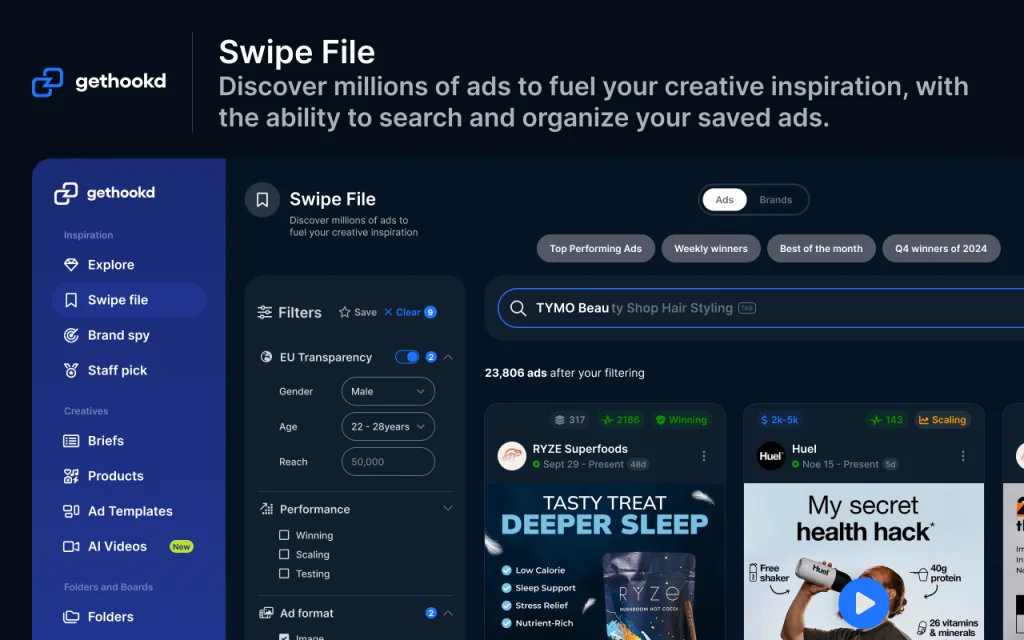
GetHookd gives media buyers and nonprofit marketing teams a shortcut through the testing phase. Instead of building from scratch, your team can see which creatives similar organizations are actively scaling on Meta, clone proven ad structures, and use AI script generation to produce variations in minutes. That research-to-creative workflow, backed by 65M+ analyzed ads, is what gets nonprofit campaigns to results faster without burning through a limited budget.
Start your GetHookd free trial today
Frequently Asked Questions
Does Facebook offer free advertising for nonprofits?
No. Facebook does not have a grant or subsidy program for nonprofits, unlike Google’s Ad Grant, which provides $10,000 per month in free search advertising to eligible organizations. All Facebook ads require payment through a connected ad account. Nonprofits do, however, benefit from lower-than-average costs per click and per impression compared to most industries.
What campaign objective should a nonprofit choose for donation ads?
The “Sales” objective in Meta Ads Manager is the most effective for donation campaigns. Despite the commercial label, this objective instructs Meta’s algorithm to find users most likely to complete an online financial transaction, which directly aligns with the behavior you want from a donation campaign. The Traffic or Engagement objectives typically deliver lower-quality results for direct-response giving campaigns.
How much should a small nonprofit spend on Facebook ads per month?
Most small nonprofits start with a monthly budget between $300 and $1,000. At that range, the priority is testing two to three audiences and multiple creative formats before scaling. The sector’s median monthly ad spend sits around $1,000, but organizations that run tightly targeted campaigns consistently outperform those that spread that same budget across a broad, undifferentiated audience.
Can the Facebook Ad Library help improve nonprofit ad campaigns?
Yes. The Meta Ad Library (Facebook Ad Library) is a publicly accessible tool that shows all currently active ads for any Facebook Page. Nonprofits can use it to review what similar organizations are running, identify which ad formats have been live for extended periods (a strong signal of performance), and inform their own creative and copy decisions. Ad intelligence platforms like GetHookd extend this capability with performance scoring, Brand Spy data, and AI creative tools.
How does GetHookd help teams running nonprofit Facebook ad campaigns?
AtGetHookd, we give media buyers and nonprofit marketing teams access to 65M+ analyzed Meta ads so they can identify winning creatives before building campaigns from scratch. Our Brand Spy feature reveals which ads similar organizations are actively scaling, including ones they launched and quietly dropped. With AI script generation, Clone Ads, and Creative Analyzer connected to your Meta account, GetHookd gives your team a complete research-to-production workflow backed by real performance data.
*Note:Pricing and/or product availability mentioned in this post are subject to change. Please check our websitefor current pricing and stock information before making a purchase.