Facebook Ads for Books: Examples & Best Practices
Key Takeaways
- The three Facebook ad formats that consistently sell books are book cover ads, social proof ads, and free sample ads, each suited to different stages of a title’s lifecycle (new vs. established).
- High-performing ads rely on a strong visual (usually the book cover) and short, genre-specific copy with a clear call to action.
- Traffic campaigns with broad targeting tend to perform best, while over-targeting and boosted posts usually lead to weaker results.
- Ongoing testing and creative refreshes are necessary to remain profitable, with metrics like CTR and CPC guiding what to keep and what to change.
- At GetHookd, we help media buyers and agencies identify which book ads are actively scaling on Meta, so every campaign starts with real competitive intelligence.
What Facebook Ads for Books Actually Look Like (And What Works)
The three Facebook ad formats that consistently sell books are the book cover focus ad, the social proof ad, and the free sample ad. Each works differently depending on your genre, your review count, and whether you are running a standalone title or a series.
Getting results from any of them comes down to three decisions: the right creative, the right copy structure, and the right campaign objective inside Meta Ads Manager. This article breaks down real examples of each format, explains the campaign settings that give Meta’s algorithm the best chance to convert readers, and covers the testing and optimization practices that separate profitable book ad campaigns from ones that drain budget without producing sales.

GetHookd: Turn Competitor Intelligence Into Your Next Winning Ad
GetHookd reveals which ads your competitors are actively scaling—not just running. Spy on their best-performing creatives, landing pages, and traffic strategies, then turn proven concepts into testable campaigns in seconds with AI-powered script generation and creative cloning.
What You Get:- ✓ Brand Spy to decode competitor ad strategies in real-time
- ✓ AI script generation and ad cloning for instant variations
- ✓ Performance scoring based on actual ad behavior, not vanity metrics
- ✓ Creative Analyzer to identify and scale your top performers
What Makes a Facebook Ad Work for Books
Every effective Facebook book ad is built on two things: a visual that stops the scroll and copy that earns the click. Both need to work together and be tailored to the specific genre and audience you are targeting.
The Creative
The image or video is the first element a reader encounters in their feed, and it determines whether they pause or keep scrolling. For books, the most effective creatives center on the book cover itself, displayed clearly and at high resolution. The cover should be genre-appropriate: a thriller cover signals completely different reader expectations than a self-help title, and readers recognize those signals almost immediately.
Background color and supporting design choices matter more than most authors expect. Dark backgrounds with contrasting text tend to perform well in fiction, particularly in mystery and thriller. For non-fiction, clean layouts with the book prominently placed alongside a short benefit statement are a reliable starting point, and adding a reader quote or milestone review count can meaningfully increase credibility before a reader has even processed the copy.
Video ads are worth testing, especially for narrative-heavy fiction or non-fiction with a strong transformation angle, but static image ads remain the primary and most consistent format for book advertising on Facebook.
The Copy
Ad copy for books works best when it is short and genre-specific. A long sales pitch in the primary text consistently underperforms compared to a short tagline followed by a clear call to action. Authors who see repeatable results from Facebook ads typically use a two- to three-line formula: a hook that speaks to the genre or theme, a brief tension point or a premise tease, and a direct call to action such as “Get your copy on Amazon.”
Headlines deserve careful and ongoing testing: trope-driven options like “Second chance romance. One last shot.” outperform generic titles in fiction, while benefit-driven headlines such as “Master your mornings in 21 days” produce stronger click-through rates for non-fiction. The description field, visible primarily on desktop, is a natural place to add a secondary incentive, such as “Free with Kindle Unlimited” or a limited-time price point.
Facebook Ad Examples for Books
The following three formats represent the most used and most effective approaches for book ads currently running on Meta. Each has a specific use case and a distinct performance profile.
The Book Cover Focus Ad
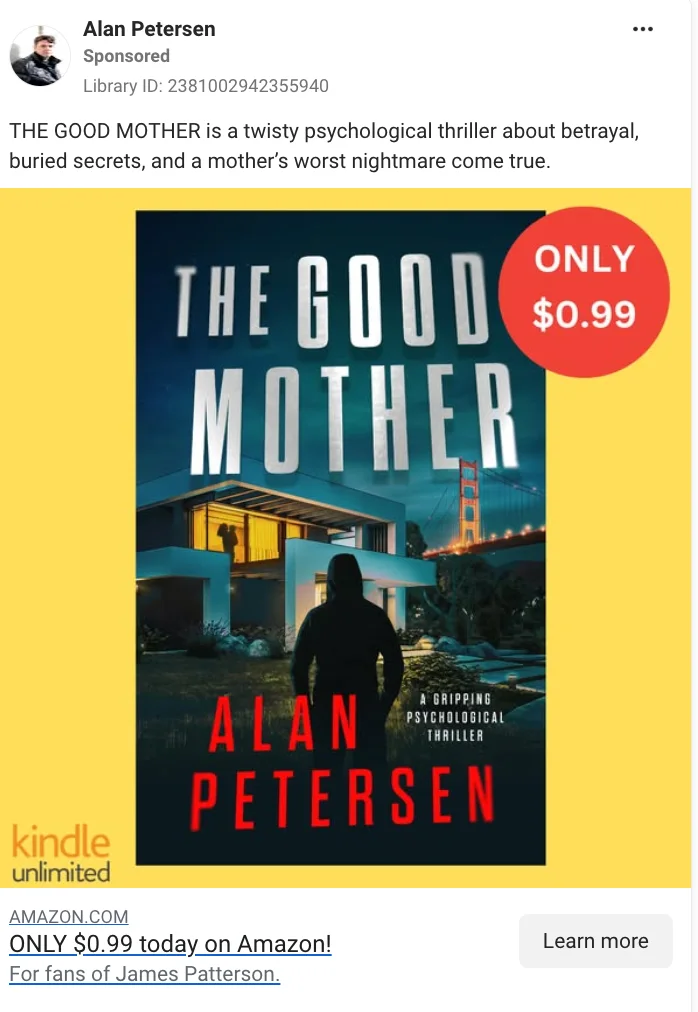
The simplest and most widely used format places the book cover front and center against a complementary background. The primary text teases the plot or premise in two to three short lines, and the headline reinforces the genre or a key reader benefit. This format performs strongly for fiction with professionally designed covers because the cover itself carries most of the persuasive load.
The creative signals genre immediately, and readers who recognize the visual style as matching their preferences are already primed to click before they even read the copy. Authors commonly pair this format with a “Shop Now” or “Learn More” CTA button that links directly to the book’s Amazon page. A dark background, high-resolution cover, complementary font, and two to three lines of descriptive primary text form a proven starting template.
The Social Proof Ad
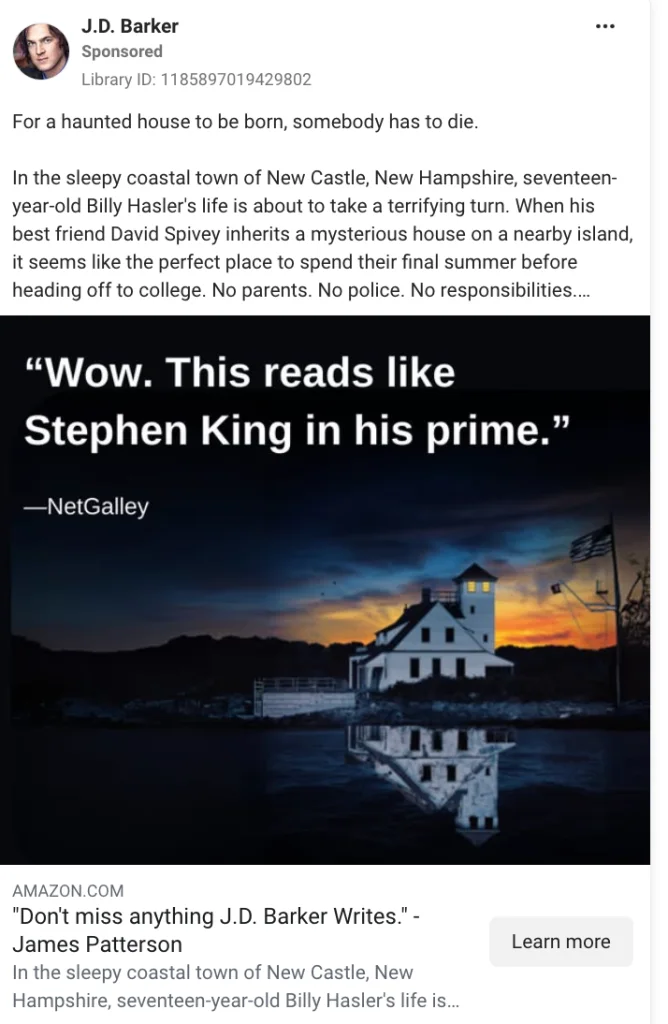
Social proof ads lead with reader reactions or review data rather than a plot summary. The image typically features the book cover alongside text such as “Over 2,000 five-star reviews” or a short, punchy reader reaction like “I had to call in sick to finish this.” This format performs especially well for books with strong review counts on Amazon or Goodreads.
The messaging shift is deliberate. Instead of telling readers what the book is about, a social proof ad shows them what other readers experienced, which lowers the perceived risk for a cold audience. For first-time buyers in a genre, proof from other readers often matters more than a plot summary or blurb.
The Free Sample or Giveaway Ad
Offering a free first chapter, or promoting a discounted first book in a series, is a proven way to drive high-volume clicks at a lower cost per click. This format asks less of the reader upfront and makes the first conversion much easier to earn. For authors with a series, a free or discounted entry-point title significantly increases the probability of sell-through to subsequent books.
The copy leads directly with the offer: “Download Chapter One free today” or “Book One in the series is now free.” This approach also works as a list-building tool, collecting reader email addresses in exchange for the free download and creating a warm audience for future retargeting campaigns.
Best Practices for Running Facebook Book Ad Campaigns
Campaign Structure and Objective
For most book campaigns, the Traffic objective is the right starting point. It tells Meta’s algorithm to optimize for clicks, directing it to target users who have a history of clicking on ads similar to yours. Running one campaign per book per country, with a small number of ad sets, gives the algorithm the focused data it needs to perform.
Avoid using the “Boost Post” button on your author page. It restricts the targeting and bidding options available in Meta Ads Manager and typically delivers lower-quality traffic at a higher cost. For authors selling directly through their own website with the Meta Pixel installed, the Conversions objective becomes a stronger option once sufficient conversion data is accumulated.
Audience Targeting
Broad targeting has outperformed narrow interest-based targeting for many book advertisers in recent years. Meta’s algorithm, given adequate budget and enough time to collect data, identifies patterns in who clicks and converts without needing heavy manual restrictions. Starting broad and letting the algorithm self-optimize tends to produce better long-term results than over-specifying detailed targeting combinations from the outset.
If you have a clear picture of your reader’s demographic profile, for example, a romance readership that skews heavily female and aged 25 to 60, applying those known parameters as a starting filter is a reasonable adjustment. The key is avoiding over-restriction before the algorithm has enough data to make confident decisions.
Testing and Optimization
Run each ad variation for at least five to seven days before drawing performance conclusions. Change only one variable at a time, such as the headline, image, or primary text, so any shift in results can be attributed to that specific change. The key metrics to monitor are click-through rate (CTR) and cost per click (CPC).
Consistently rising CPCs or falling CTRs over multiple days are reliable signals that the creative needs refreshing. Most authors running active campaigns rotate new creative variations every three to six weeks, introducing new images or copy while keeping the campaign structure intact to preserve what the algorithm has already learned.
How GetHookd Helps You Run Smarter Facebook Book Ad Campaigns
Running effective Facebook ads for books comes down to knowing which creative approaches are already working in your category and building on them, rather than starting from a blank slate with every new campaign. The fastest path to profitable campaigns is research, not guesswork.
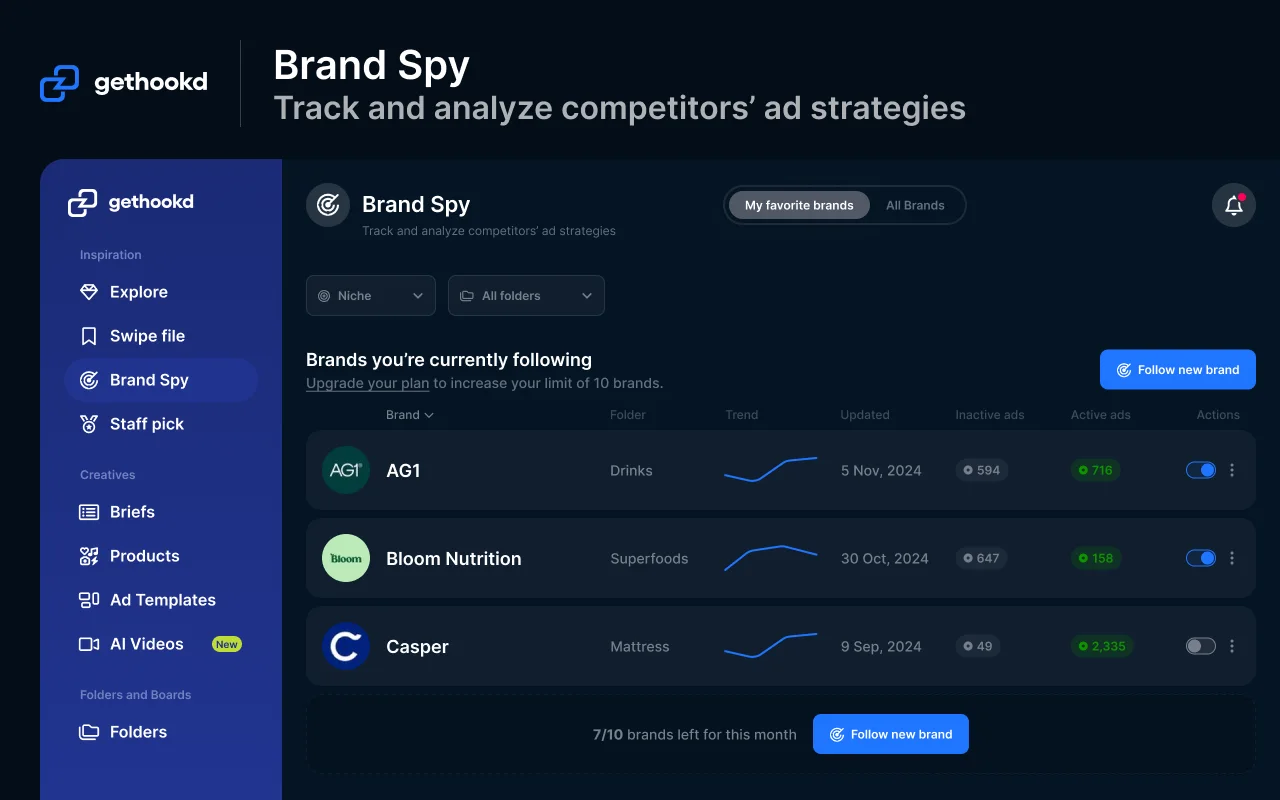
At GetHookd, we give media buyers, agencies, and performance marketers access to over 65 million ads analyzed across the Facebook Ad Library and Meta platforms. Our Brand Spy feature lets you see which publishers, authors, and book marketing brands are actively scaling their ads right now, including the creatives they are running and the landing pages receiving their traffic. Our Creative Analyzer connects directly to your Meta ad account to surface which of your own book ads are performing and which need to be replaced, backed by real performance data.
Start your GetHookd free trial today
Frequently Asked Questions (FAQs)
What campaign objective should I use for book ads on Facebook?
The Traffic objective is the most practical starting point for authors who want to send readers to a book page on Amazon or another retailer. It tells Meta’s algorithm to optimize for clicks from users with a history of engaging with ads like yours. The Conversions objective becomes a stronger option once you are selling directly through your own website and have the Meta Pixel installed with sufficient conversion data.
How do I find out which book ads are performing well on Facebook?
The Facebook Ad Library shows which ads a page is currently running, but it does not surface performance data or tell you which creatives are being actively scaled. Ad intelligence platforms built on the Meta ecosystem can identify which ads have been running the longest and with the most consistent spend, which are more reliable indicators of what is actually working.
How often should I refresh my Facebook ad creative for books?
Creative fatigue typically sets in when an ad has been running for several weeks without performance improvements. The most consistent signals to act on are a rising cost per click and a declining click-through rate over multiple days. Most authors running active campaigns refresh their creatives every three to six weeks, introducing new images or copy variations without disrupting the overall campaign structure.
How does GetHookd help with Facebook ad research for books?
At GetHookd, our platform gives media buyers and agencies access to 65+ million ads analyzed across Meta, including those from book publishers and direct-to-consumer publishing brands. Our Brand Spy feature tracks which creatives competitors are actively scaling right now, and our AI tools generate scripts, hooks, and ad variations based on what is already working in your market.