Facebook Ads for Affiliate Marketing: Cost, Examples & Strategy
Key Takeaways
- Facebook ads for affiliate marketing average $0.87 CPC and $16 CPM, but your real cost is shaped by niche competition, ad quality, and whether your funnel converts clicks into commissions.
- Meta prohibits direct affiliate links in paid placements, so every campaign routes through a landing page, which means your landing page is as important as your ad creative.
- The formats that work at each funnel stage are image ads for direct-response offers, video for scroll-stopping hooks, carousel for problem-solution sequences, and lead ads for list building before the pitch.
- The most reliable way to set a budget is to work backward from your commission: if a confirmed sale pays $50, your cost per acquisition must stay below that ceiling before you scale anything.
- GetHookd analyzes 65M+ Meta ads to show affiliate marketers which competitor campaigns are actively scaling, not just running, so you build from proven angles instead of guessing.
Is Facebook Ads Profitable for Affiliate Marketing? What It Actually Costs
Facebook ads can work for affiliate marketing, and GetHookd gives you the competitor intelligence to build campaigns on proven creative before your first dollar is spent. The average CPC is $0.87, but what actually determines profitability is the gap between your cost per acquisition and your commission rate. Get that math right from the start, and the format and budget decisions follow naturally.
This guide covers current cost benchmarks by campaign type, the ad formats that perform best for affiliate offers, and a step-by-step strategy for building campaigns that return a profit rather than burning budget on untested creative.

GetHookd: Turn Competitor Intelligence Into Your Next Winning Ad
GetHookd reveals which ads your competitors are actively scaling—not just running. Spy on their best-performing creatives, landing pages, and traffic strategies, then turn proven concepts into testable campaigns in seconds with AI-powered script generation and creative cloning.
What You Get:- ✓ Brand Spy to decode competitor ad strategies in real-time
- ✓ AI script generation and ad cloning for instant variations
- ✓ Performance scoring based on actual ad behavior, not vanity metrics
- ✓ Creative Analyzer to identify and scale your top performers
What Facebook Ads Actually Cost for Affiliate Marketers
CPC, CPM, and Budget Expectations
Facebook’s ad pricing is based on an auction system, so there is no fixed rate. What you pay depends on audience competition, your ad quality score, the campaign objective you select, and your bidding strategy.
Facebook charges advertisers on two primary metrics: cost per click (CPC) and cost per 1,000 impressions (CPM). As of late 2025, the average CPC for Facebook ads sits at approximately $0.87, while the average CPM is $16.06. Finance, insurance, and competitive e-commerce verticals push costs higher than these averages, while lower-competition niches can sit comfortably below them.
Seasonality plays a significant role in what you pay. WordStream’s 2025 Facebook Ads benchmarks show that traffic campaigns delivered improved results year over year, with higher click-through rates and a lower average CPC of $0.70, a 6.67% decrease from 2024. Separately, global CPC data across all industries shows that November consistently produces the highest auction costs of the year, roughly 19% above the annual average, while January tends to reset to significantly lower levels, making early Q1 a notably lighter, less competitive period for ad spend.
Cost Per Lead and Cost Per Acquisition
For affiliates pursuing lead-generation objectives, cost per lead varies by niche and offer type. WordStream’s 2025 Facebook Ads benchmarks put the average CPL across industries at $27.66 for lead-gen campaigns, with significant variation based on audience specificity and creative quality.
The most practical way to set a cost-per-acquisition (CPA) ceiling is to work backward from your affiliate commission rate. If a confirmed sale earns you a $50 commission, your sustainable CPA cap must sit below that figure. Setting that constraint before you launch keeps budget decisions grounded in the economics of your specific offer, not in platform averages alone.
Facebook Ad Format Examples for Affiliate Marketers
Facebook supports several ad formats, each suited to a different stage of the affiliate funnel. Choosing the right format for your offer type and audience awareness level is one of the highest-impact decisions you can make before a campaign goes live.
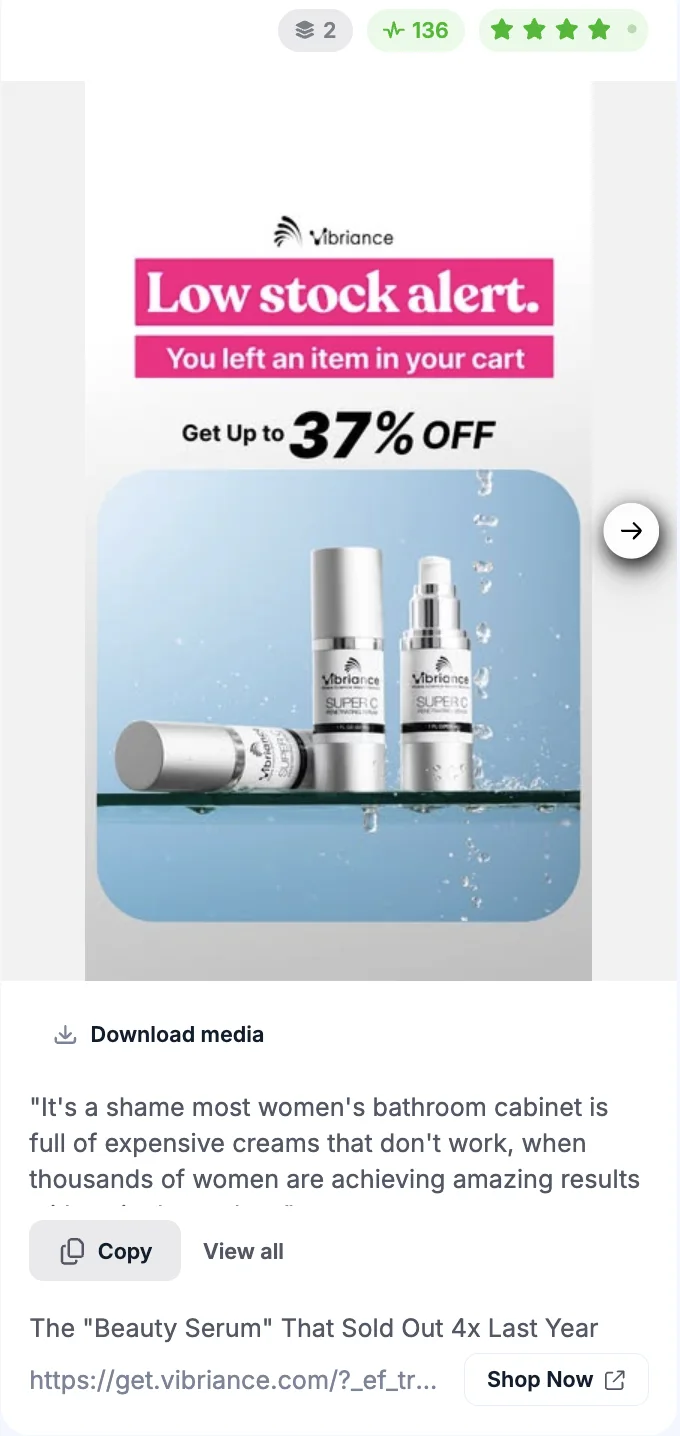
1. Image Ads are the simplest format: a single static visual paired with a headline, body copy, and a call to action. They are fast to produce and work well in niches with strong visual outcomes, such as fitness, beauty, and home goods. The most effective image ads for affiliate marketing lead with a specific problem or outcome rather than product descriptions. An ad for a sleep supplement, for example, might focus on the feeling of waking up rested rather than listing ingredients.
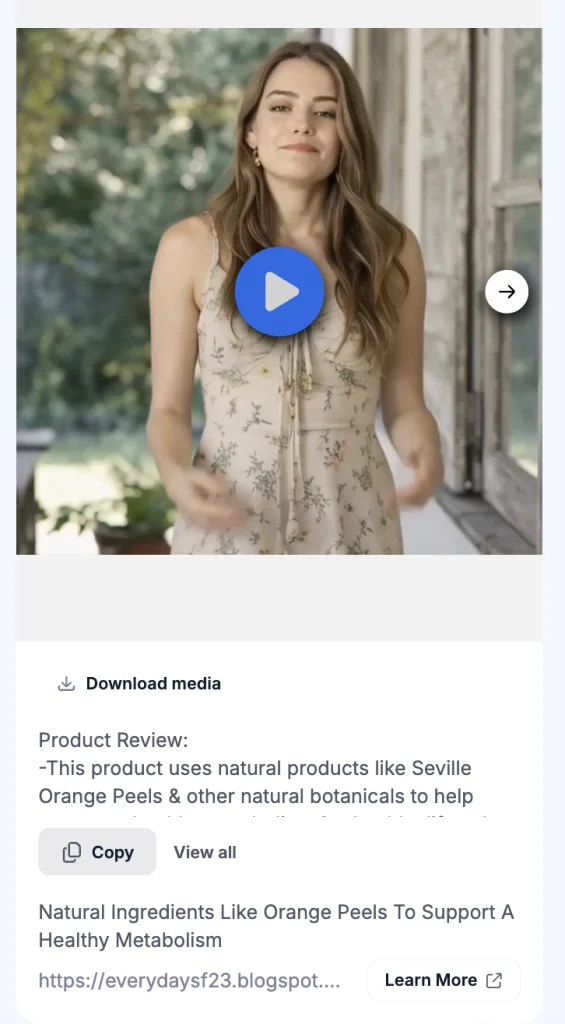
2. Video Ads carry a performance advantage on Meta because the algorithm favors video content for reach, and that preference extends into paid placements. Short-form videos in vertical aspect ratios (4:5 or 9:16) perform well across Feed, Stories, and Reels. The hook in the first two to three seconds determines whether a user stops scrolling or keeps moving. Affiliates who test multiple hook variations in video often find meaningful differences in cost per click from one version to the next.
3. Carousel Ads display up to ten images or videos in a swipeable horizontal format. Affiliates use them to walk through a problem-solution sequence, compare multiple use cases, or highlight different benefits of the same product. The format encourages more interaction than a single image, which signals ad quality to Meta’s algorithm and can lower CPMs over time.
4. Lead Ads collect user contact information directly within the Facebook interface, without requiring users to leave the platform. Affiliates who build email sequences use this format to capture leads first and promote the affiliate offer through a follow-up sequence. This turns ad spend into a long-term asset for list building rather than a single transaction.
How to Build a Facebook Ads Strategy for Affiliate Marketing
1. Route Traffic to a Landing Page
Meta’s policies flag and penalize ads that use affiliate redirect links or cloaked URLs in placements. Build a landing page that introduces the offer, addresses common objections, and redirects users to the affiliate product. Beyond compliance, this setup also captures email addresses from visitors who do not convert immediately, making each click more valuable over time.
2. Install the Facebook Pixel Before You Launch
The Facebook Pixel, placed on your landing page, tracks user behavior and feeds that data back to Meta’s ad algorithm. It enables three capabilities that directly improve performance: conversion tracking, which identifies which ad variations are driving results; retargeting, which re-engages users who left without converting; and lookalike audience creation, which models new prospecting audiences from your existing converters.
3. Start with a Narrow Audience
Launching into a broad audience burns budget before you have enough conversion data to optimize effectively. Start with a tightly defined audience built on specific interest combinations, competitor brand audiences, or a custom audience from your existing email list. Once a segment is producing conversions, expand gradually using Meta’s Advantage+ audience tools rather than broadening all targeting at once.
4. Test Ad Creatives Systematically
Structure your testing so that you change one variable at a time. Test the headline first, then the primary visual, then the call to action after the top-level elements are validated. Running multiple changes simultaneously makes it impossible to identify which variable produced the result. Once you identify a winning angle, replicate it across image, video, and carousel formats to extend the campaign’s lifespan.
5. Research What Competitors Are Running Before You Spend
Meta’s Facebook Ad Library is a free transparency tool that shows all active ads across Facebook and Instagram, searchable by brand name or keyword. Affiliates use it to study

The Fastest Way to Build Profitable Facebook Affiliate Campaigns
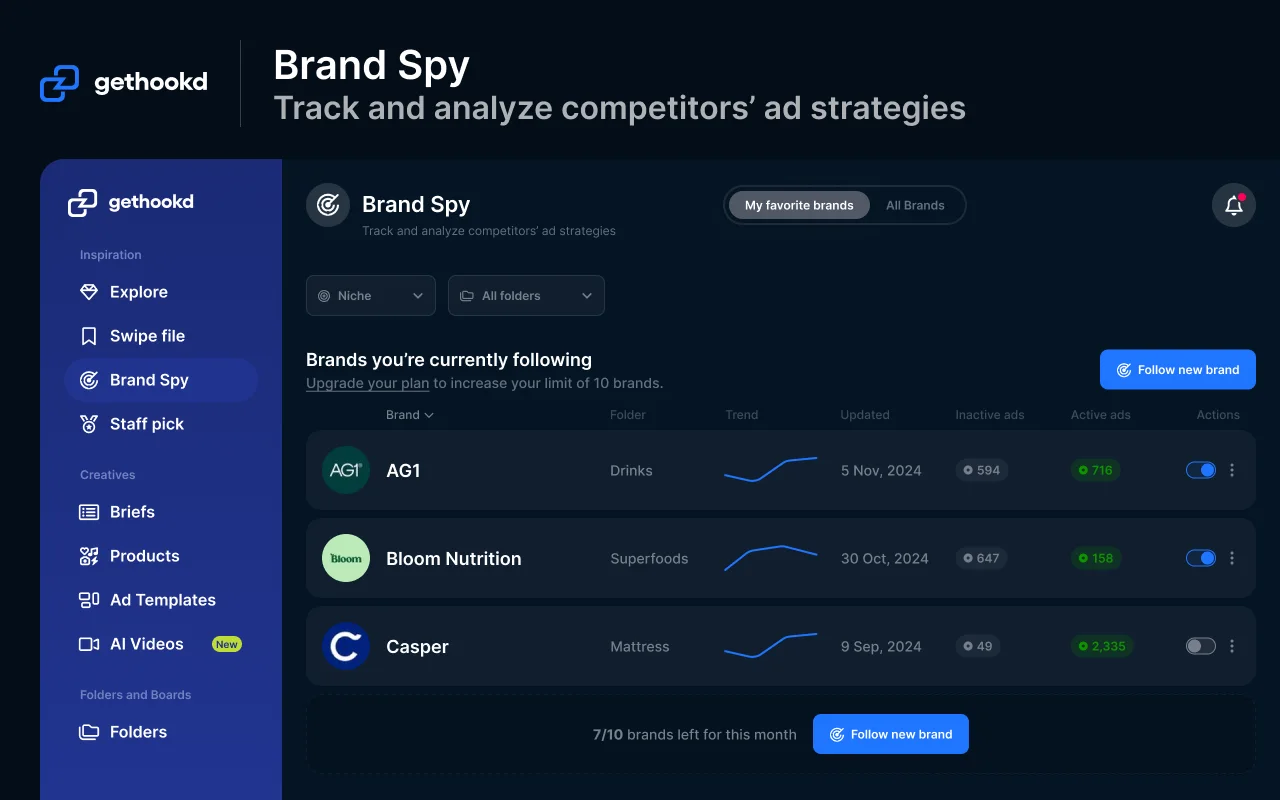
Running profitable Facebook ads as an affiliate requires knowing which campaigns are worth modeling before you start spending. GetHookd surfaces what competitors are actively scaling on Meta, beyond what they happen to be running at any given moment. That distinction matters when budget decisions depend on competitive intelligence rather than guesswork.
GetHookd’s Brand Spy gives affiliate marketers visibility into competitors’ top-performing creatives and the landing pages receiving the most traffic. Performance scoring uses real behavioral signals rather than impression totals, so the intelligence you act on reflects actual results. With AI script generation and ad image tools built into the same workflow, GetHookd users move from research to a ready-to-test creative without switching tools.
Start your GetHookd free trial today
Frequently Asked Questions (FAQs)
Can I link directly to an affiliate offer in a Facebook Ad?
Meta’s advertising policies restrict the use of direct affiliate redirect links and cloaked URLs in paid campaigns. The standard practice is to route traffic to your own landing page, which introduces the offer and then directs users to the affiliate product. This keeps your ad account compliant and typically produces higher conversion rates than cold traffic sent directly to a vendor’s page.
What is a realistic starting budget for Facebook affiliate campaigns?
Most affiliate marketers start with $10 to $20 per day per ad set to generate enough traffic data for meaningful optimization. Campaigns running below that threshold take considerably longer to move through Meta’s learning phase, which delays the algorithm’s ability to optimize ad delivery and produces less reliable performance metrics for scaling decisions.
How do I track affiliate conversions from Facebook Ads?
Install the Facebook Pixel on your landing page and configure purchase or lead events to fire on the relevant conversion action. Most affiliate networks also support tracking pixels or server-to-server postback URLs that you can run alongside the Pixel for more complete attribution. Combining both data sources gives a clearer picture of which specific ads are generating commission-producing actions.
How does the Facebook Ad Library help with affiliate competitor research?
The Meta Ad Library shows all active ads running across Facebook and Instagram, searchable by brand name or keyword. Affiliates use it to study competitor copy, creative formats, and offer angles. The main limitation is that it displays all running ads regardless of performance, so distinguishing a profitably scaled campaign from a low-budget test requires additional context or tools with performance signal data.
How does GetHookd support Facebook affiliate ad research?
GetHookd was built specifically for the intelligence needs of affiliate marketers and media buyers operating on Meta. The Brand Spy feature identifies the ads competitors are actively scaling, the Creative Analyzer breaks down the hooks and formats driving performance, and the AI scripting tools turn those insights into ready-to-test creatives without requiring multiple external tools. Explore GetHookd’s features
*Note: Pricing and/or product availability mentioned in this post are subject to change. Please check our website for current pricing and stock information before making a purchase.