Key Takeaways
- The five standout course ads breaking through in 2026 come from Roger Gracie, Bela Beauty College, Digital Scholar, Musora, and Simplilearn.
- Winning course ads follow a six-part structure: hook, problem, solution, proof, offer, and a call to action matched to the buyer’s readiness to commit.
- Each of the five ads uses a different proof type: Roger’s instructor reputation, Bela Beauty College’s 4.7 Trustpilot rating, Digital Scholar’s stacked credibility markers, Simplilearn’s Premier Authorized Training Partner badge, and Musora’s free trial.
- Stating price or terms upfront, like Bela Beauty College’s $15 per week or Musora’s seven-day free trial, lets prospects self-qualify before they click.
- GetHookd gives course sellers a searchable library of 65M+ Facebook ads plus AI tools and templates, so you can see which hooks competitors are scaling and build your own version.
What Makes a Course Ad Stop the Scroll in 2026
The best Facebook ads for courses open with a learner’s desired outcome or current frustration, then back it up with proof and a clear offer. Many course creators lead with modules, hours of content, or credentials instead, assuming more detail builds more trust. Those details still matter, but they carry more weight once the hook has earned the viewer’s attention.
An ad that opens with course features can still get clicks, though not always from people ready to enroll, which can drive up the cost of each sign-up. GetHookd helps course sellers avoid that by showing which hooks and offers other creators are using in course ads currently running on Facebook.

GetHookd: Turn Competitor Intelligence Into Your Next Winning Ad
GetHookd reveals which ads your competitors are actively scaling, not just running. Spy on their best-performing creatives, landing pages, and traffic strategies, then turn proven concepts into testable campaigns in seconds with AI-powered script generation and creative cloning.
What You Get:- ✓ Brand Spy to decode competitor ad strategies in real-time
- ✓ AI script generation and ad cloning for instant variations
- ✓ Performance scoring based on actual ad behavior, not vanity metrics
- ✓ Creative Analyzer to identify and scale your top performers
Top Facebook Ads Examples for Courses
1. Roger Gracie
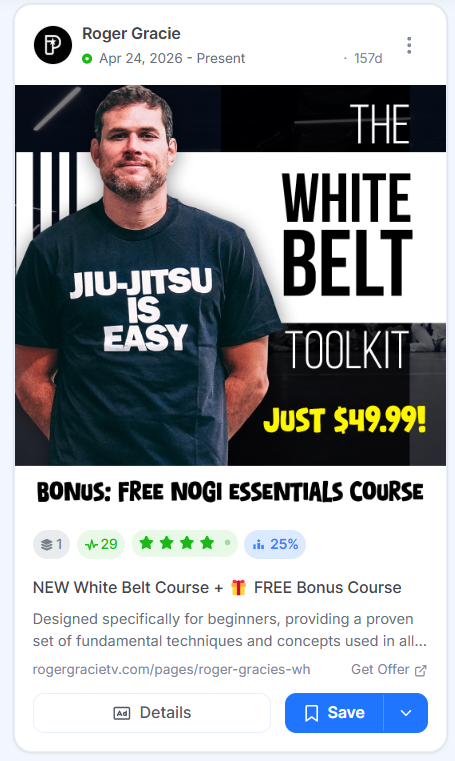
Roger Gracie, a multiple-time world champion in jiu-jitsu, fronts his own beginner course wearing a shirt that reads “Jiu-Jitsu Is Easy.” That line addresses newcomers’ biggest worry, while his reputation lends credibility to the promise.
The offer is just as clear: The White Belt Toolkit for $49.99, plus a free NoGi Essentials course as a bonus. A low price and a closely related bonus make the first purchase feel like a small, safe step.
Course creators can borrow this by pairing reassurance with a clear offer. Phrases like “No prior experience required” or “Start with the fundamentals” suit courses built for complete beginners.
2. Bela Beauty College
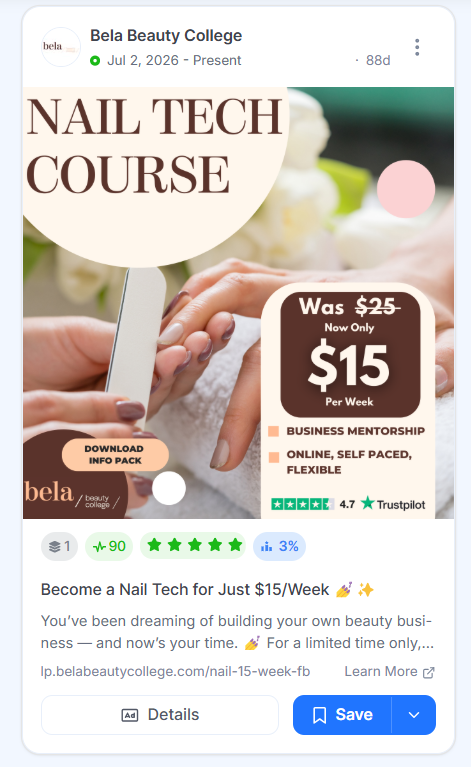
Bela Beauty College promotes its Nail Tech Course at $15 per week, down from $25. The ad also lists business mentorship and an online, self-paced format, with a 4.7 Trustpilot rating in the corner as social proof.
Splitting the price into a weekly figure makes a full vocational course feel affordable, and the post copy frames the purchase as a step toward “building your own beauty business.” A “Download Info Pack” button also gives prospects who are still comparing schools a low-commitment next step before enrolling.
3. Digital Scholar

Digital Scholar sells its four-month digital marketing course as a career move, with a headline that puts the viewer’s future ahead of the curriculum. Placement assistance, an early-bird saving, and a 4.8 Google rating then give a high-stakes decision several reasons to feel safe.
The wording around jobs is worth noting. “100% Placement Assistance” promises help finding work without guaranteeing a job, which keeps a career-focused ad credible. Naming the Purasaiwalkam, Chennai location also tells viewers upfront that this is an in-person course for people nearby.
4. Musora
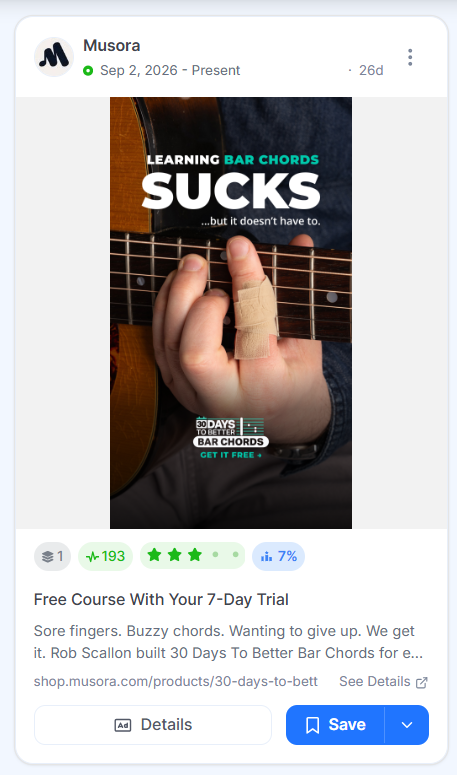
Musora’s ad names the problem before the product. The headline admits that learning bar chords “sucks,” and the post copy follows with “Sore fingers. Buzzy chords. Wanting to give up. We get it.” Guitar learners recognize each line, so the ad earns attention by showing empathy first.
The course, 30 Days to Better Bar Chords, targets one specific skill, and naming Rob Scallon as its creator adds credibility. That narrow scope feels more achievable than a broad “learn guitar” program.
The copy also answers a common worry about time by promising just 10 minutes a day. Viewers can then try Musora free for seven days and keep the course for life, which lowers the risk of starting.
5. Simplilearn
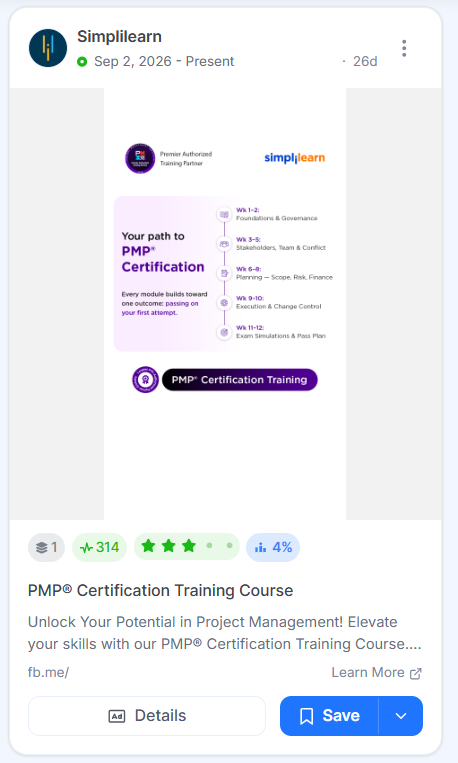
Simplilearn turns its PMP course into a 12-week roadmap, showing what each stage covers, from foundations and governance to exam simulations. Prospects can see the whole journey at a glance, which answers two early questions: how long prep takes and what it involves.
The ad ties every module to one goal: passing the exam on the first attempt. A Premier Authorized Training Partner badge also shows the course is recognized by PMI, the organization behind the certification. For certification courses, a week-by-week outline like this gives prospects a clearer picture than a feature list.
How Do You Structure a Facebook Ad for a Course?
Hook: Desired Outcome or Frustration
The opening line has to name either what the learner wants or what’s currently frustrating them, immediately. Roger Gracie’s ad leads with “Jiu-Jitsu Is Easy,” directly countering the belief that jiu-jitsu is too hard for beginners.
Musora goes the opposite direction, opening with the frustration itself: “Sore fingers. Buzzy chords. Wanting to give up.” Both work because they skip the warm-up and go straight to what the scrolling viewer is already thinking.
Problem: Naming the Obstacle
Once the hook lands, the ad needs to show it understands exactly what’s blocking the learner. Musora’s copy does this most explicitly by naming bar chords as the obstacle between a guitar student and progress. This step matters because it builds the sense that the course was built for this specific sticking point.
Solution: The Specific Transformation
The solution step introduces the course, but the strongest versions describe a transformation. Bela Beauty College doesn’t say “12 modules on nail application.” It says the course is about “building your own beauty business.” Digital Scholar frames its program around “Your Future in Digital Marketing.”
Proof: Credibility That Backs the Claim
Proof makes the transformation believable. The five examples each lean on a different type:
- Instructor authority, with Roger Gracie’s name and reputation carrying the jiu-jitsu course
- Third-party ratings, with Bela Beauty College’s Trustpilot score reinforcing its career promise
- Stacked credibility markers, with Digital Scholar pairing placement assistance and a 4.8 Google rating
- Accreditation, with Simplilearn’s Premier Authorized Training Partner badge showing PMI recognizes the course
- Risk reversal, with Musora’s free trial and lifetime access signaling confidence in the course
High-consideration purchases, especially career courses, often need more than one proof point before a prospect feels ready to click.
Offer: Pricing & Terms Made Clear
Most of the examples state their price or terms upfront, from Bela Beauty College’s $15 weekly rate to Musora’s seven-day free trial. Showing the cost early helps prospects decide whether to click, so fewer visitors leave the landing page surprised by the price.
Call to Action: One Clear Next Step
Bela Beauty College uses “Download Info Pack,” a low-commitment step for someone still comparing schools. Musora invites viewers to try the platform free for seven days, which suits someone ready to test the course. Matching the CTA to the viewer’s readiness makes the next step easy to take.
Best Facebook Ads Examples for Courses: Summary Table
| Ad | Content strategy | Why it works |
| Roger Gracie | Reassures beginners, then offers a $49.99 toolkit with a related bonus course. | Makes starting feel approachable and adds value. |
| Bela Beauty College | Promotes a beauty-business goal, flexible study, $15 weekly pricing, and a low-commitment info pack. | Makes the investment feel manageable and the next step easy. |
| Digital Scholar | Frames a four-month course as a career move, supported by placement assistance and a 4.8 Google rating. | Combines aspiration with credibility and local relevance. |
| Musora | Names the frustration of learning bar chords, then offers a focused course, 10-minute daily practice, and a free trial. | Shows empathy and makes progress feel achievable. |
| Simplilearn | Maps PMP preparation across 12 weeks and highlights PMI training-partner recognition. | Makes the learning journey and course credibility clear. |
Find & Script Launch-Ready Course Ads With GetHookd
The course ads above follow a certain structure, from the opening hook to the final call to action. Each part answers a question prospects have before buying, such as whether the course suits them and what happens after they click. Planning those answers in advance makes each new ad easier to write and test.
GetHookd lets course creators search a library of 65M+ ads by keyword, niche, and format to see which hooks and offers competitors are running. Our AI tools and templates then help you build your own version in minutes. Start your 7-day free trial and write your next course ad with a working example beside you.
Frequently Asked Questions (FAQs)
What is the best Facebook ad format for online courses?
There’s no single format that outperforms all others across every course niche. What matters more than the format is whether the ad follows the hook, problem, solution, proof, offer, and CTA structure, as shown in the examples above, whether it’s a single image, carousel, or video.
How much does a course ad cost to run on Facebook?
Cost depends on targeting, competition in your niche, and campaign objective, and Meta doesn’t publish a fixed rate. Since you choose a daily or lifetime budget in Ads Manager, you can start small and increase spend once an ad starts bringing in enrollments.
How do I write a Facebook ad hook for a course?
Start with the learner’s desired outcome or current frustration, not a description of the course. A career course, for example, might open with the job the learner wants, while a music course might open with the struggle beginners face when learning to play.
Do free trials work better than discounts for courses?
It depends on the objection you’re solving. Musora’s seven-day free trial with lifetime access reduces financial risk for a skill-based course, while Bela Beauty College’s weekly discount framing shrinks sticker shock for a higher-ticket vocational program. Match the offer type to whichever objection, cost or commitment, is stronger for your audience.
How does GetHookd’s Brand Spy work?
GetHookd’s Brand Spy tracks a competitor’s ads over time, showing the formats they rely on, how their ad volume changes, and the landing pages and hooks they use most. For course creators, that reveals which angles competitors keep investing in. You can then plan your own hooks, offers, and launch timing with that evidence in hand.
*Note: Pricing and/or product availability mentioned in this post are subject to change. Please check our website for current pricing and stock information before making a purchase.