Key Takeaways
- Your Instagram ad hook lives in the first 125 characters of your primary text that stops the scroll, and getting it right matters more than any feature or benefit you list later.
- The four most widely used hook types are curiosity, pain-point, benefit, and urgency.
- Specificity is what separates a hook that works from one that’s been burned out. “You won’t believe this” falls flat, whereas “Most Facebook ad budgets are wasted on this one mistake” is more effective.
- Keep hooks under ~125 characters so they land before Instagram truncates the text, match your hook to your creative, and test questions against bold statements.
- GetHookd lets you see the hooks your competitors are using, so you can build openers based on what’s already proven to stop the scroll.
Why Your Instagram Ads Need Good Hooks
The hook is the opening line of your ad, the first thing a viewer reads before your creative, headline, or offer ever registers. Your Instagram ads need good hooks because if that line doesn’t stop the scroll, nothing else gets seen.
An Instagram ad hook doesn’t close the sale. Instead, it creates enough tension, recognition, or intrigue that moving on feels like a loss. This could be through curiosity, pain, potential benefits, or urgency.
The challenge is that great hooks are hard to write on demand, and guessing wastes budget on openers that don’t capture your audience. Tools like GetHookd let you see the exact hooks your competitors are scaling right now, so you can build openers grounded in proven performance.

GetHookd: Turn Competitor Intelligence Into Your Next Winning Ad
GetHookd reveals which ads your competitors are actively scaling—not just running. Spy on their best-performing creatives, landing pages, and traffic strategies, then turn proven concepts into testable campaigns in seconds with AI-powered script generation and creative cloning.
What You Get:- ✓ Brand Spy to decode competitor ad strategies in real-time
- ✓ AI script generation and ad cloning for instant variations
- ✓ Performance scoring based on actual ad behavior, not vanity metrics
- ✓ Creative Analyzer to identify and scale your top performers
4 Best Instagram Ad Hooks to Try
1. Curiosity Hooks
Curiosity hooks work by creating an information gap in the form of a question or incomplete thought that the reader’s brain instinctively wants to resolve. The discomfort of not knowing the answer is more powerful than almost any feature benefit you could list.
Why It Works
The human brain is wired to close open loops. When you introduce a question or a surprising claim without immediately resolving it, you create cognitive tension. The reader has to keep going to relieve that tension. This is the same mechanism behind clickbait, except when your ad actually delivers on the promise, it builds trust instead of eroding it.
How to Execute It
The key to a strong curiosity hook is specificity. Vague curiosity hooks (“You won’t believe this…”) have been burned out by years of overuse. Specific ones still cut through, for example: “Most Facebook ad budgets are being wasted on this one mistake,” or “The skincare ingredient dermatologists don’t talk about enough.”
2. Pain-Point Hooks
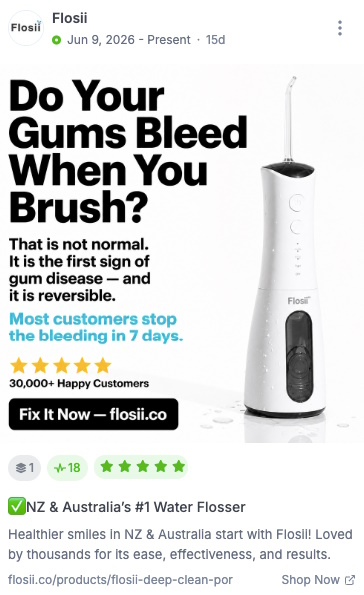
Pain-point hooks work because recognition is magnetic. When someone reads a line that names exactly what they are struggling with, their brain registers it as a signal amidst an Instagram feed full of noise.
Why It Works
When your hook names the problem before you name the solution, you are speaking the reader’s internal monologue back to them. The reader thinks, “This is for me,” and that thought is worth more than any impression metric.
Pain-point hooks also naturally pre-qualify your audience. Only the people who feel that specific pain will stop. That means the clicks you get are far more likely to convert, because you attract people who actually have the problem you solve.
How to Execute It
Be specific and be direct. Name the exact frustration your best customer complains about. For example, use hooks like “Still manually resizing every ad for every placement?” or “Your email open rates dropped, and you have no idea why.”
3. Benefit Hooks
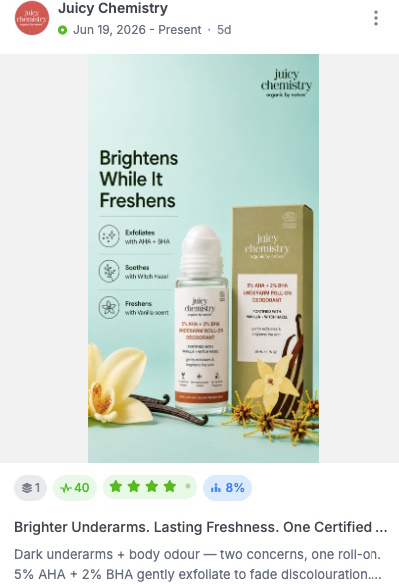
Benefit hooks flip the usual ad structure. Instead of describing what your product is, you describe what the reader’s life looks like after they use it. The product becomes secondary to the transformation.
Why It Works
When a scroller sees a benefit hook, they are imagining themselves experiencing that benefit. That imagination is the first step in every purchase decision because you are selling the version of their life where the problem is already solved.
The strongest benefit hooks are specific enough to be believable but broad enough to apply to a large segment of your audience. “Lose weight” is too vague. “Drop 12 pounds without cutting carbs” is specific, visual, and loaded with implied permission.
How to Execute It
Write the outcome your customer actually wants, not the outcome your product technically delivers. Then strip out every word that points back to you and leave only what points forward to them. For example, use hooks like “What if your ads wrote themselves before your morning coffee?” or “More leads. Half the ad spend. Here’s exactly how.”
4. Urgency Hooks
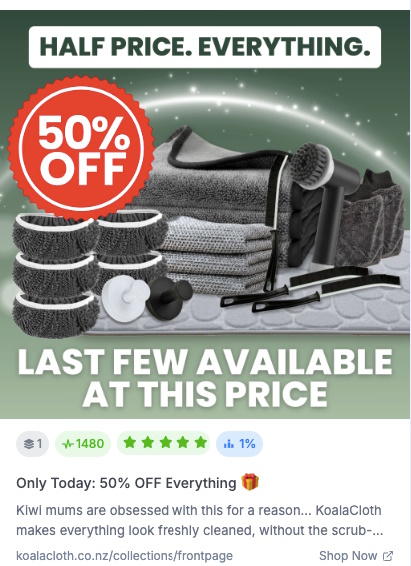
Urgency hooks create a window. They signal that waiting has a cost, which could be a price increase, a closing offer, or a shrinking opportunity. When done right, they compress the reader’s decision timeline from “maybe later” to right now.
Why It Works
Loss aversion is one of the most well-documented forces in consumer psychology. People are more motivated to avoid losing something than to gain something of equal value. Urgency hooks trigger that exact mechanism. When the reader believes the opportunity is closing, inaction suddenly feels like a choice with consequences.
The risk with urgency hooks is that false urgency destroys trust the moment the reader catches it. Urgency only works when it is real, specific, and verifiable.
How to Execute It
Tie your urgency to something concrete, such as a date, a quantity, a seasonal event, or a price change. Then name it explicitly in the hook so the reader understands exactly what they stand to lose if they scroll past. For example, use hooks like “Price goes up Friday. Lock in your rate today,” or “Only 3 onboarding slots left for November.”
Tips for Writing Attention-Grabbing Instagram Ad Hooks
- Keep It Short: Instagram truncates primary text at approximately 125 characters on most mobile devices before displaying a “more” link. Whatever falls after that threshold is invisible to the majority of your audience. Your hook must be complete, compelling, and self-contained within that window. This doesn’t mean your entire ad needs to be 125 characters. The hook needs to land its full punch within that limit.
- Know When to Use Questions or Bold Statements: Questions pull the reader in by implicating them directly. Bold statements, on the other hand, project confidence and work well for brands with a strong point of view. Both responses keep them reading. The right choice depends on whether your brand earns more trust by asking or by asserting, and testing both is the only way to know for certain.
- Match Your Hook Copy to Your Creative: Your hook and your visual need to tell the same story. When a pain-point hook names a frustration, the creative should reflect that frustration, whether through facial expression, a relatable scene, or a before-state visual. Misalignment between copy and creative is one of the most common reasons a well-written hook still underperforms.
Best Instagram Ad Hook Examples: Summary Table
| Hook Type | Psychological Trigger | Example |
| Curiosity | Information gap | “We ran the same ad for 90 days. Something strange happened on day 47.” |
| Pain-Point | Recognition & relief | “You’ve tried every skincare routine on TikTok and your skin is worse than when you started.” |
| Benefit | Desire for transformation | “Cut your weekly reporting from 4 hours to 20 minutes.” |
| Urgency | Fear of missing out (specific) | “Price increases Friday at midnight. No extensions.” |
Why Smart Marketers Choose GetHookd for Creating Winning Instagram Ads
No matter how strong your product or how polished your visual, a weak hook means the rest of your ad never gets seen. The four types covered above (curiosity, pain point, benefit, and urgency) provide a framework for almost any audience and offer. The fastest way to write hooks that work, though, is to start from ones that already do, and that’s what GetHookd makes possible.
It lets you study the precise hooks and ad openers competitors are actively scaling across 65M+ high-performing ads on Instagram, Facebook, and TikTok, so you can see which angles are stopping the scroll in your niche right now. It reveals the creatives and copy behind those winning ads, and then turns that intelligence into ready-to-use hooks and scripts in seconds. Start a free GetHookd trial today to find your next winning Instagram hook.
Frequently Asked Questions (FAQs)
What is an Instagram ad hook?
An Instagram ad hook is the opening line of your ad’s primary text. It appears in the feed before your creative context, headline, or CTA, and its sole job is to stop the scroll and pull the viewer into the rest of your ad. A strong hook speaks directly to something the viewer already feels, wants, or wonders about, making it feel less like an ad and more like a message written specifically for them.
How long should an Instagram ad hook be?
Keep your Instagram ad hook under 125 characters. That’s the approximate cutoff on most mobile devices before the feed displays a “more” link. Since most users never tap through, your hook needs to be complete and compelling within that window. Front-load your core message so the full point lands even if nothing else gets read.
Which hook type works best for Instagram ads?
There is no single best hook type; the right choice depends on your audience’s level of awareness, your offer category, and your campaign objective. Cold audiences who have never encountered your brand tend to respond best to curiosity and pain-point hooks. Warm audiences and retargeting segments often respond better to emotion and benefit hooks, which build on an existing connection and push toward a decision.
Can the same hook work for both feed ads and Stories?
The hook principle applies to both placements, but the execution differs. In feed ads, your hook lives in the primary text above the creative. In Stories, the hook is most often delivered as on-screen text or spoken in the first two seconds of a video, because Stories are immersive and full-screen, the visual and the hook work even more tightly together than they do in the feed.
How does GetHookd help me create more effective Instagram ads?
GetHookd draws on a library of 65M+ high-performing ads and shows you which Instagram ads and hooks competitors are actively scaling. Instead of guessing which opener will stop the scroll, you can build hooks around angles already working in your niche. Features like Brand Spy and AI Video Scripts then turn that intelligence into scripts, helping you launch stronger ads faster.
*Note: Pricing and/or product availability mentioned in this post are subject to change. Please check our website for current pricing and stock information before making a purchase.