
Key Takeaways
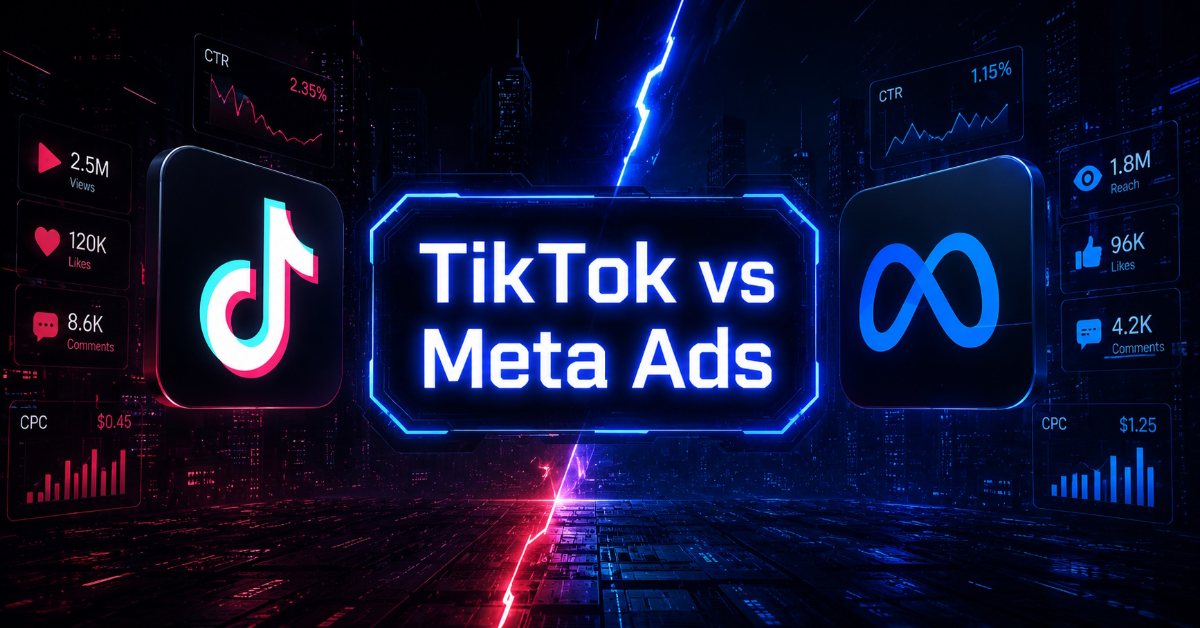
- TikTok wins on top-of-funnel cost, delivering lower top-of-funnel CPMs (around $0.32 on Reach campaigns) and CPCs that make it more affordable to reach and engage cold audiences.
- Meta has a slightly higher CPM of ~$0.33, but wins on conversions, with a lower CPA driven by its optimization engine and industry-leading tracking.
- The platforms serve different funnel stages: TikTok excels at awareness and discovery with raw, native video, while Meta excels at mid- to bottom-funnel conversion and retargeting.
- Audiences differ, too. TikTok skews 18–34 (Gen Z and Millennials), while Meta offers breadth across all ages, with stronger reach among the higher-spending crowd.
- Whichever platform you run on, performance starts with the creative. GetHookd shows you which TikTok and Meta ads competitors are actively scaling, so your campaigns launch on proven concepts rather than guesswork.
What Are the Differences Between TikTok & Meta Ads?
TikTok and Meta ads are the two dominant forces in paid social advertising. Meta Ads operates across Facebook, Instagram, Messenger, and the Audience Network, giving advertisers access to one of the largest and most data-rich advertising ecosystems on the planet. On the other hand, TikTok Ads Manager gives brands access to one of the fastest-growing ad platforms, and its algorithm is uniquely interest-driven rather than social-graph-driven.
Metricool’s Social Ads report shows that TikTok delivers lower CPMs and CPCs than Meta. That sounds like a clear win until you look at cost per action (CPA). Meta’s more mature optimization engine means that even though you pay more to reach people, those people are significantly more likely to convert.
TikTok gets you in front of more eyes for less money, but Meta converts the click. Neither stat alone tells you where to put your budget. Understanding how they interact is what separates average campaigns from efficient ones.

GetHookd: Turn Competitor Intelligence Into Your Next Winning Ad
GetHookd reveals which ads your competitors are actively scaling—not just running. Spy on their best-performing creatives, landing pages, and traffic strategies, then turn proven concepts into testable campaigns in seconds with AI-powered script generation and creative cloning.
What You Get:- ✓ Brand Spy to decode competitor ad strategies in real-time
- ✓ AI script generation and ad cloning for instant variations
- ✓ Performance scoring based on actual ad behavior, not vanity metrics
- ✓ Creative Analyzer to identify and scale your top performers
TikTok vs Meta Ads: Cost Breakdown
Metricool’s Social Ads report shows that TikTok delivers lower reach costs, while Meta delivers more efficient conversion costs.
In Metricool’s data, TikTok’s Reach campaigns posted the lowest CPM at about $0.32, close to Meta’s lowest of about $0.33 on Awareness campaigns. On Traffic campaigns, TikTok’s CPC ran about $0.01 versus roughly $0.05 on Meta.
On conversions, the advantage reverses: for lead-generation campaigns, Meta’s CPA was about $1.34 versus TikTok’s $3.57.
CPM
TikTok’s CPM (cost per thousand impressions) is lower than Meta’s across most verticals and campaign types. This makes it more cost-effective for brand awareness campaigns where the goal is maximum reach per dollar spent.
For advertisers looking to build top-of-funnel visibility, especially among younger demographics, TikTok consistently delivers more eyeballs for less money.
CPC
TikTok also wins on CPC (cost per click) in most categories. The lower competition in certain niches, combined with the algorithm’s ability to serve highly engaging content, means users click through at a lower cost on TikTok than on Meta.
However, click quality matters. TikTok users who click through to a landing page don’t always have the same purchase intent as Meta users, which affects what happens next in the funnel.
CPA
This is where the story flips. Meta’s CPA (cost per action or cost per acquisition) is typically lower than TikTok’s for direct-response campaigns. Meta’s advanced optimization algorithms are better at identifying users who will complete a transaction rather than just click an ad.
TikTok drives traffic more cheaply, but Meta turns that traffic into revenue more efficiently. That gap is the single most important number to understand when comparing these two platforms.
TikTok vs Meta: Which Platform Performs Better for Conversion?
TikTok’s Conversion Attribution
TikTok’s Pixel and Events API have improved considerably, but the platform still struggles to accurately attribute off-platform purchases. TikTok users predominantly find products on the platform but tend to complete purchases elsewhere. This often creates a gap between ad exposure and measurable conversion that’s difficult to close cleanly.
TikTok also faces a unique challenge: its algorithm prioritizes content engagement over purchase intent. This means the users the algorithm targets most aggressively are often those most likely to watch, share, and comment, not necessarily those most likely to buy.
For direct-response campaigns with a hard cost-per-acquisition target, this structural mismatch creates inefficiency that is clear in the numbers.
Meta’s Pixel & Conversion API
Meta’s tracking infrastructure is genuinely difficult to compete with. The Meta Pixel captures on-site behavior, including page views, add-to-carts, and purchases. It feeds that data directly back into the ad algorithm, allowing it to optimize in real time toward users most likely to convert.
Layer the Conversion API on top of that, and you get server-side event matching that bypasses browser-based tracking limitations caused by iOS privacy changes and ad blockers. The result is a closed-loop attribution system that accurately connects ad spend to revenue with a level of reliability that continues to set the industry standard.
TikTok vs Meta: Audience Comparison
TikTok’s Core Demographics
TikTok’s user base skews younger, with its strongest concentration among 18- to 34-year-olds. Gen Z remains the platform’s core audience, but millennial adoption has grown significantly, making TikTok a viable channel for brands targeting adults with real purchasing power.
Geographically, TikTok’s reach in Southeast Asia, Latin America, and parts of Europe has expanded considerably, making it particularly powerful for brands with global growth ambitions.

Meta’s Audience Reach
Meta’s core strength from an audience perspective is its unmatched breadth. Facebook alone has over 3 billion monthly active users globally, covering virtually every age group, geography, and income bracket in a way no other single platform can match.
Instagram skews younger and more visually driven, while Facebook captures older demographics, particularly the 25–54 age group that holds significantly more purchasing power and is considerably harder to reach on TikTok.
TikTok vs Meta Ads in 2026: Comparison Table
| Category | TikTok Ads | Meta Ads |
| CPM | Lower, more affordable reach | Higher, premium audience cost |
| CPC | Lower across most verticals | Higher, but higher intent clicks |
| CPA | Higher, fewer direct conversions | Lower, stronger purchase optimization |
| Conversion Tracking | Improving but still limited | Industry-leading Pixel + CAPI setup |
| Core Audience Age | 18–34 (Gen Z & Millennials) | All ages, strongest 25–54 |
| Best Funnel Stage | Top-of-funnel awareness | Mid-to-bottom funnel conversion |
| Ad Creative Style | Raw, fast, content-native video | Versatile, video, image, carousel |
| Targeting Precision | Interest and behavior-based | Advanced, lookalike, custom, CAPI-fed |
| Retargeting Capability | Basic but improving | Best-in-class dynamic retargeting |
| Algorithm Driver | Content engagement signals | Purchase intent and behavioral data |
| Cross-Platform Role | Attract and build awareness | Convert and retain |
Why Choose GetHookd for TikTok & Meta Ad Intelligence?
If you need conversions and revenue now, start with Meta, but if you’re building brand awareness or targeting a younger demographic at scale, TikTok offers the reach and engagement efficiency you need. For most growth-stage and scaling brands, the winning strategy is to run TikTok as a cold-audience discovery layer that continuously feeds warm traffic into Meta’s retargeting system, effectively letting TikTok handle prospecting and Meta handle conversion.
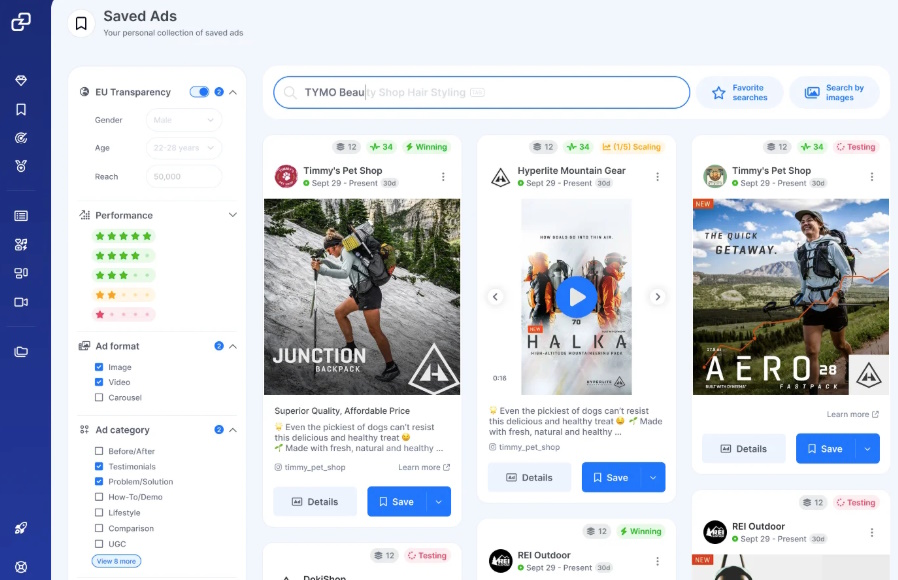
Whichever platform you prioritize, starting from proven creative means fewer failed tests and a faster path to ads that convert, and that’s where GetHookd supports the workflow. Our platform lets you study the exact ads competitors are actively scaling across both TikTok and Meta, drawing on a library of 65M+ high-performing ads. This way, you can see which hooks, formats, and angles are already converting in your niche before you spend a dollar testing your own. Start a free GetHookd trial to find your next winning ad.
Frequently Asked Questions (FAQs)
Are TikTok ads or Meta ads cheaper in 2026?
TikTok is cheaper at the top of the funnel. Based on Metricool’s report, TikTok consistently delivers lower CPMs and CPCs than Meta, meaning you pay less to reach people and less to get them to click. However, Meta’s cost per action (CPA) is lower because its conversion optimization engine is more mature and its audience data runs deeper.
So the real answer is: TikTok is cheaper for awareness; Meta is cheaper for conversions. Which one is “cheaper” depends entirely on what you’re measuring.
Is TikTok better than Facebook ads?
Neither is universally better; they’re built for different jobs. TikTok is stronger for top-of-funnel awareness, reaching younger audiences, and driving discovery with native video at a lower cost.
Facebook (Meta) is stronger for conversions, retargeting, and precise targeting across a much broader age range, so the right choice depends on your goal and audience.
How to run ads on TikTok in 2026?
Start by creating a TikTok Ads Manager account and installing the TikTok Pixel (or Events API) on your site to track actions. Then build a campaign by selecting your objective, defining your audience, setting your budget and bid strategy, and uploading a native, content-style video creative that doesn’t look like a traditional ad.
Launch, let the algorithm exit its learning phase over about 7 days, then review performance before optimizing.
Which platform has better targeting, TikTok or Meta?
Meta has significantly more advanced targeting capabilities in 2026. Its ecosystem allows advertisers to target by interests, behaviors, life events, purchase history, lookalike audiences, and custom audiences built from CRM data or website traffic.
TikTok’s targeting is improving, but it operates on an interest graph model, where the algorithm distributes content based on predicted engagement rather than on granular audience inputs. That means less advertiser control, but sometimes better organic discovery for cold audiences.
How does GetHookd work?
GetHookd is an ad intelligence platform that lets you search, filter, and analyze competitor ads across TikTok and Meta. Drawing on a library of 65M+ high-performing ads, it shows which creatives competitors are actively scaling, how long each has been running, and the landing pages behind them.
Features like Brand Spy and AI Video Scripts then turn that intelligence into ready-to-use creative, so you build campaigns from what’s already proven rather than testing blind.
*Note: Pricing and/or product availability mentioned in this post are subject to change. Please check our website for current pricing and stock information before making a purchase.