5 Best E-commerce Facebook Ads Examples (2026)
Key Takeaways
- The best e-commerce Facebook ads use five proven formats: hook-first videos, social proof, UGC-style content, problem-first messaging, and product demos.
- These ads work because they capture attention early, address real customer concerns, and show the product in action or through real experiences.
- Each format aligns with a specific goal, from grabbing cold audience attention to building trust and driving conversions.
- Brands get better results by learning from proven ad structures and adapting them rather than testing random creatives.
- GetHookd gives e-commerce teams access to 65M+ analyzed Meta ads, helping identify winning Facebook ad formats before spending on guesswork.
What the Best E-commerce Facebook Ads Have in Common
The five e-commerce brands covered here, Dollar Shave Club, Ridge Wallet, Gymshark, Purple Mattress, and BlendJet, each built high-converting Facebook campaigns around a single repeatable format: hook-first video, stacked social proof, UGC creative, problem framing, and product demo. Each example below breaks down the structural mechanics behind the ad and what makes it work for e-commerce.
Most e-commerce advertisers spend more time testing than studying. Learning what already works, both in your own account and in competitor ad libraries, is a faster path to profitable creative than running blind tests on unproven formats. The goal here is not to copy these ads but to understand what makes each format work.

GetHookd: Turn Competitor Intelligence Into Your Next Winning Ad
GetHookd reveals which ads your competitors are actively scaling—not just running. Spy on their best-performing creatives, landing pages, and traffic strategies, then turn proven concepts into testable campaigns in seconds with AI-powered script generation and creative cloning.
What You Get:- ✓ Brand Spy to decode competitor ad strategies in real-time
- ✓ AI script generation and ad cloning for instant variations
- ✓ Performance scoring based on actual ad behavior, not vanity metrics
- ✓ Creative Analyzer to identify and scale your top performers
5 E-commerce Facebook Ad Examples Worth Studying
Not every great Facebook ad is a creative breakthrough. The most consistent performers share a structural foundation: a clear format, a specific audience problem, and a mechanic that moves the viewer from attention to intent.
The five examples below each demonstrate one of those mechanics in action, with context on why each format works and how it can be adapted across different products and audiences.
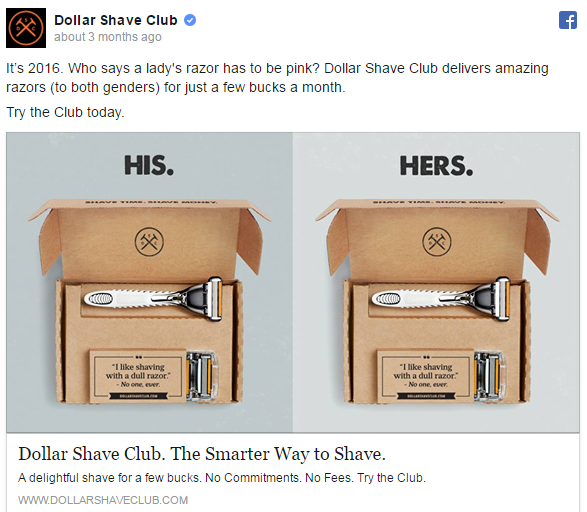
1. Dollar Shave Club: The Hook-First Video
Dollar Shave Club’s Facebook video ads are among the most studied examples in direct-to-consumer advertising. Their approach centers on a single principle: the first three seconds must stop the scroll, and they do so by leading with bold, unexpected statements that challenge viewers’ assumptions about the product category.
The format works by creating a pattern interrupt. Instead of opening with a product shot or a lifestyle montage, the ad opens with something the viewer doesn’t expect, which earns the attention needed to deliver the offer. Dollar Shave Club combined this with dry humor that felt at odds with how most razor brands communicated, making their ads memorable without requiring high production budgets.
The lesson for e-commerce brands is direct: your hook is the most important element in your ad. If the opening doesn’t earn the viewer’s attention, the offer never gets seen.
2. Ridge Wallet: Stacked Social Proof
Ridge Wallet has built one of the most recognized Facebook ad strategies in the DTC hardware space. Their ads rely on a stacked social proof structure: layering customer testimonials, press mentions, and specific product claims together into a compact creative that answers skepticism before it builds.
The effectiveness comes from specificity. Ridge ads don’t use generic five-star endorsements. They pull real customer language that mirrors actual objections, things like bulky wallets, lost cards, and stitching that falls apart, and position the product as the direct answer to each one. This alignment between stated objection and product solution creates an immediate sense of relevance for the target buyer.
Media buyers studying Ridge’s Meta Ad Library will also notice the brand runs a high volume of ad variations, testing different social proof combinations while keeping the same underlying format. High variation within a proven structure is one of the most efficient ways to scale creative testing on Facebook without rebuilding from scratch each cycle.
3. Gymshark: UGC That Looks Organic
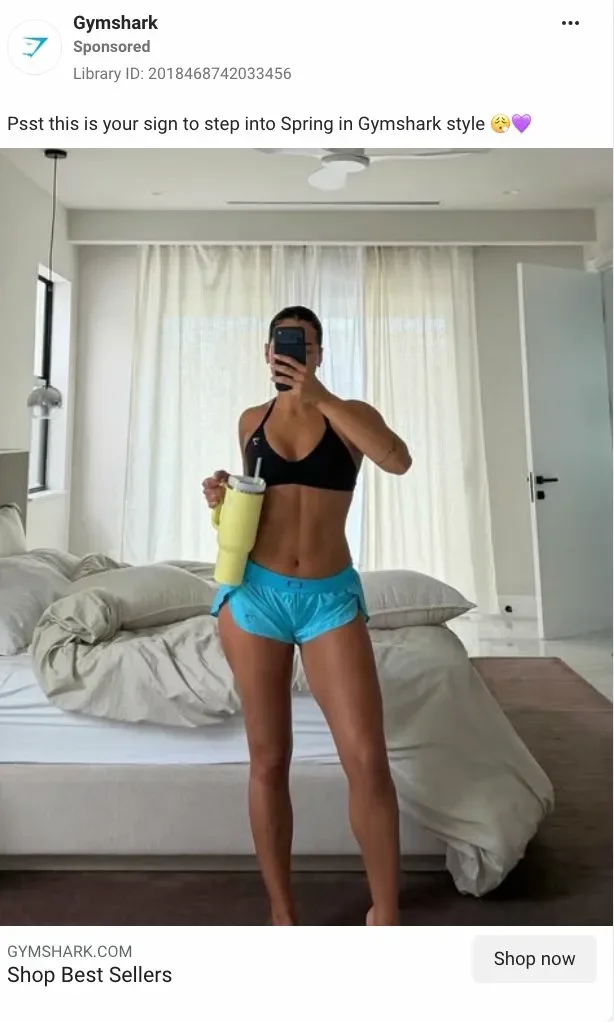
Gymshark became one of the fastest-growing fitness apparel brands in the world using a Facebook ad strategy built almost entirely around UGC-style creative. Their ads feature real customers, athletes, and community members in authentic, unscripted settings, making them difficult to distinguish from organic social content at first glance.
The mechanic at work is a trust transfer. Polished brand ads signal “this is an advertisement,” which triggers the natural resistance most users apply to commercial content. UGC creative bypasses that resistance because the viewer processes it like a post from someone they follow, which tends to yield lower cost per acquisition and higher click-through rates than studio-produced alternatives.
Gymshark also manages ad fatigue actively. By continuously refreshing UGC content with new faces, environments, and seasonal hooks, the brand avoids the performance drop that comes from running the same creative too long. For e-commerce brands that can source authentic customer content, this model is one of the most scalable on Meta.
4. Purple Mattress: Problem Framing That Clicks
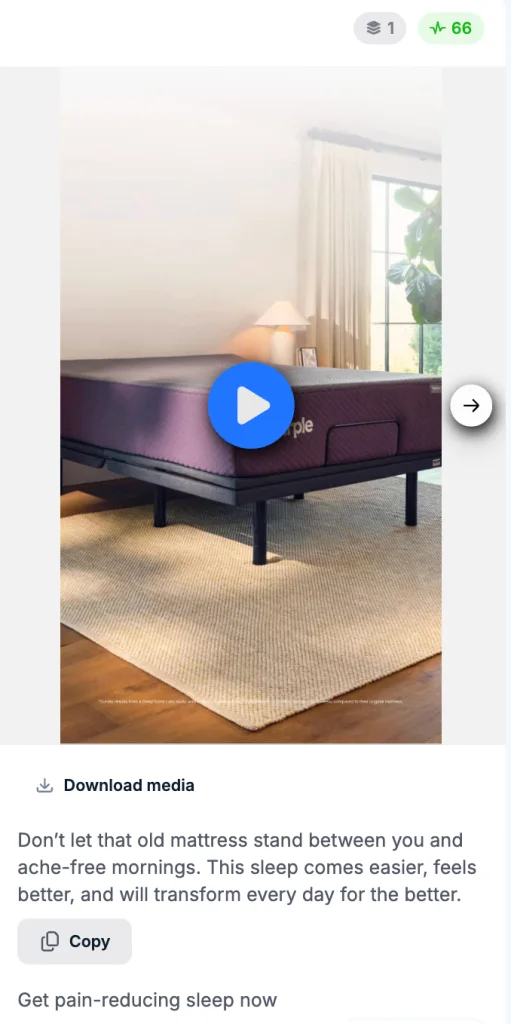
Purple’s best-performing Facebook ads don’t open with a mattress. They open with a problem: disrupted sleep, chronic back pain, mattresses that lose their shape within a year. By the time the product appears on screen, the viewer is already looking for a solution.
This problem-first structure works because buyers in considered categories like mattresses are more motivated by eliminating pain than by adding a benefit. Meeting them at the point of frustration creates a stronger emotional connection than any feature list, and it filters the audience naturally toward people who are already in a purchase mindset.
Purple’s raw egg test creative became one of the most talked-about Facebook ads in the home category. The concept is simple: a grid of raw eggs survives a heavy-weight press on Purple’s mattress without breaking, while the same test destroys eggs on a standard foam surface. A single visual communicates the core product benefit without the viewer needing to read a word of copy.
5. BlendJet: The Product Demo Formula
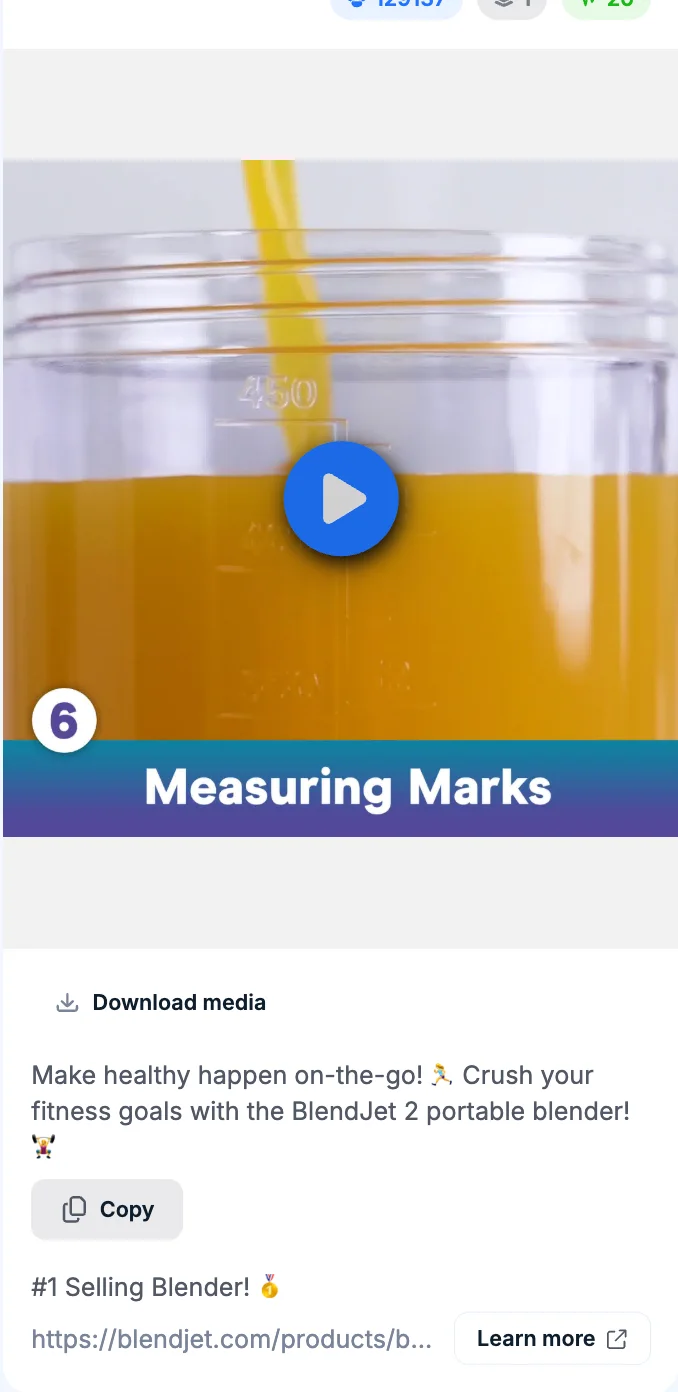
BlendJet’s Facebook ads follow a formula that works especially well for one-product stores: show the product being used in the most relatable situation possible. Smoothies on a hiking trail, protein shakes at the gym, fresh juice in a hotel room. Each scene speaks directly to a specific segment of their customer base.
The demo format addresses the buyer’s most immediate objection before it forms. Seeing the product perform in settings the viewer already imagines themselves in removes friction and shortens the path to purchase intent more effectively than a feature explanation would.
BlendJet also keeps its Facebook videos short, typically under 30 seconds, which respects the viewer’s attention and delivers the core message before engagement drops. Ending with a direct, specific call to action reinforces the next step without leaving the viewer to figure it out on their own. For compact product categories, brevity paired with strong product-in-use footage is often more persuasive than a longer explanation.
Top 2026 E-commerce Facebook Ads Examples: At-a-Glance Summary
| Brand | Ad Format | Core Mechanic | Best Used For |
| Dollar Shave Club | Hook-first video | Pattern interruption | Cold audience awareness |
| Ridge Wallet | Stacked social proof | Objection-led testimonials | Mid-funnel conversion |
| Gymshark | UGC organic style | Trust and authenticity | Lower CPA, broad targeting |
| Purple Mattress | Problem framing | Pain-first messaging | High-consideration products |
| BlendJet | Product demo | Show, don’t tell | One-product stores |
Why GetHookd Is the Smarter Way to Study Facebook Ads Examples
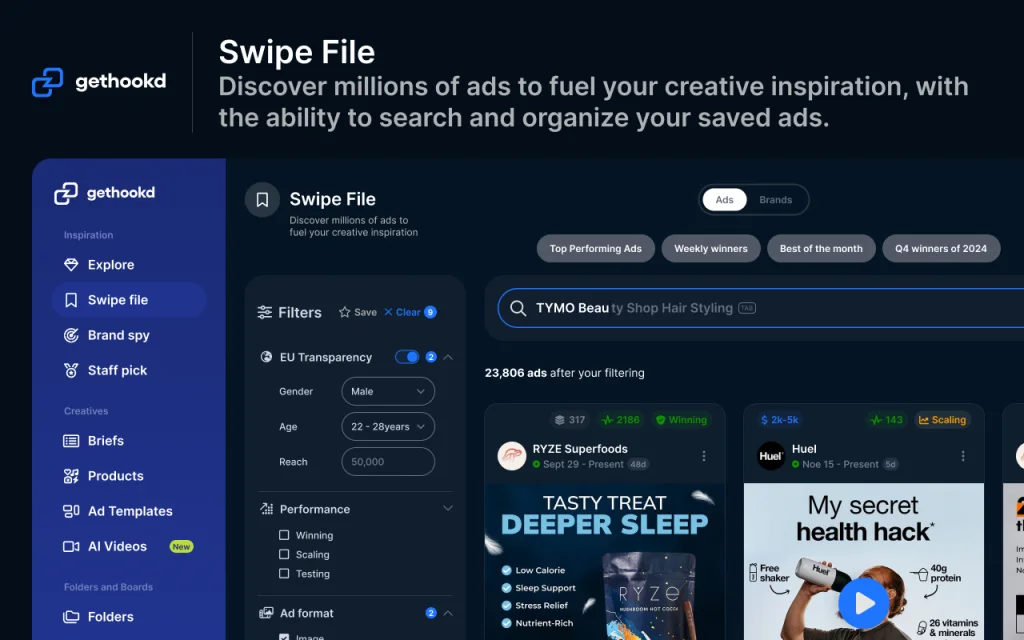
The brands above didn’t stumble onto their best formats by accident. They found them through structured testing, competitor research, and the discipline to scale what worked consistently. At GetHookd, we built our platform to give media buyers and e-commerce teams the same intelligence, enabling them to identify which ad formats are worth testing and which competitors are already scaling in their niche.
Our Brand Spy feature shows which ads your competitors are actively scaling, complete with landing page data and performance signals based on real ad behavior, not vanity metrics. With 65M+ ads analyzed across the Meta Ad Library and tools like our Creative Analyzer, AI Video Scripts, and ad cloning, GetHookd replaces scattered, multi-tab research with a single focused workflow, so you spend less time hunting and more time building.
Frequently Asked Questions (FAQs)
What is the most effective Facebook ad format for e-commerce?
There’s no single format that wins across every category, but product demos, UGC-style creative, and stacked social proof consistently produce strong results for direct-to-consumer brands. The most effective format depends on the product price point, brand awareness level, and the specific objection the buyer needs addressed before purchasing.
How many Facebook ad creatives should an e-commerce brand run at once?
Most performance marketers maintain five to ten creative variations per offer at any given time. This gives the algorithm enough variety to optimize effectively and reduces the risk that a single creative’s fatigue will hurt campaign performance. Creative refresh cadence matters more than the total number of ads in rotation.
How do I know if a competitor’s Facebook ad is actually performing well?
The Meta Ad Library shows which ads are currently active but doesn’t include performance data. Tools like GetHookd go further by surfacing performance signals based on real ad behavior, including how long ads have been running and where competitors are directing their spend.
Can I research competitor Facebook ads without technical knowledge?
Yes. Platforms built for competitive ad research don’t require any technical skills to use. At GetHookd, our Brand Spy feature was designed for media buyers and e-commerce operators who need to move fast. You search for a brand, see their active ads, landing pages, and scaling signals, and act on the insight directly.
How does GetHookd help e-commerce teams build better Facebook ads?
At GetHookd, we give teams access to 65M+ analyzed winning ads across Meta, real-time competitor scaling signals, and AI-powered tools to generate scripts and clone winning creatives. Our platform supports media buyers, agencies, and performance marketers who need faster research and fewer wasted tests.
*Note: Pricing and/or product availability mentioned in this post are subject to change. Please check our website for current pricing and stock information before making a purchase