Key Takeaways
- Story ads run on a 9:16 vertical canvas near 1080 × 1920 pixels, while Feed ads perform best at 4:5 or 1:1.
- Stories are full screen and fast-paced, built for instant reactions. Feed ads sit in a scrollable space that invites pausing and comparing.
- Story ads suit impulse buys like food, beauty, and fashion that read well in seconds; Feed ads suit products needing explanation, like software or health items.
- Story text and CTAs must stay in the center safe area to avoid interface overlap, while Feed captions have room for proof points and offer details.
- GetHookd lets advertisers filter 65 million+ ads by placement, track competitor Story and Feed creatives, and build format-matched variations with AI creative tools.
Instagram Story vs Feed Ads: Which Is Better?
Neither Instagram Story ads nor Feed ads outperform the other by default. The right pick depends on how fast you need a viewer to act and how much explanation your product requires before someone trusts it enough to buy. Most advertisers get this wrong by dropping the same square or vertical asset into both placements, assuming visibility matters more than format fit, and that mismatch shows up as lower completion rates in Stories and fewer saves or comments in Feed.
Getting the split wrong is not just a cosmetic problem. A Story ad crammed with paragraph-length copy gets skipped in under a second, while a Feed ad that rushes through product details without giving people time to read loses the shoppers who wanted proof before buying. GetHookd helps advertisers build placement-specific creative variants instead of stretching one asset across formats it was never designed for, with 65 million+ ads to study by format and performance signals.

GetHookd: Turn Competitor Intelligence Into Your Next Winning Ad
GetHookd reveals which ads your competitors are actively scaling, not just running. Spy on their best-performing creatives, landing pages, and traffic strategies, then turn proven concepts into testable campaigns in seconds with AI-powered script generation and creative cloning.
What You Get:- ✓ Brand Spy to decode competitor ad strategies in real-time
- ✓ AI script generation and ad cloning for instant variations
- ✓ Performance scoring based on actual ad behavior, not vanity metrics
- ✓ Creative Analyzer to identify and scale your top performers
Core Differences Between Instagram Story & Feed Ads
Aspect Ratio
Story ads are built for a 9:16 vertical canvas, most commonly produced at 1080 × 1920 pixels, filling the entire phone screen with no competing content around it.
Feed ads work best in 4:5 vertical or 1:1 square formats. A 4:5 asset covers more of the screen than a square post without behaving like a full-screen takeover the way a Story does.
Time & Pace
Stories move fast. A static Story image gets a few seconds before a viewer taps forward, so video needs to deliver its point immediately rather than building up to it. Feed ads live in a slower environment where someone can pause a video, reread a caption, inspect product photos, or come back to a post later, which gives longer-form video and detailed copy room to work.
Text & Product Detail Placement
Instagram’s native interface elements and the ad’s own call-to-action sit near the top and bottom edges of a Story. This means any essential text or product detail has to stay inside the center safe area or risk getting covered. Feed ads do not face that same interface overlap, so captions can carry proof points, objections, or offer terms without competing with on-screen navigation elements.
User Engagement Patterns
A Story is consumed like watching a moment unfold: quickly, immersively, and with an expectation of an immediate next step. A Feed ad is browsed more deliberately, often alongside posts from accounts a person already follows. This opens the door to pausing, commenting, saving the post for later, or clicking through to an advertiser’s profile before deciding anything.
Instagram Story vs Feed Ads Examples
Instagram Story Ad Examples
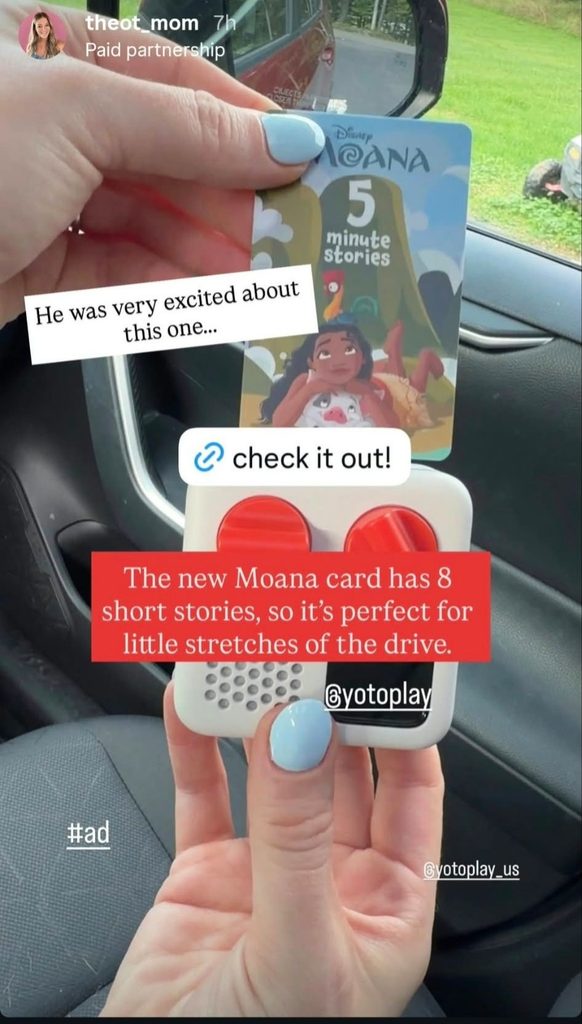
Example 1: Yoto, Creator-Led Partnership That Feels Like a Personal Recommendation
Yoto ran a paid partnership with pediatric occupational therapist and content creator Olivia Powers, with the latter posting a sponsored Story for the brand’s Disney Moana stories. Rather than listing features, the creative reframed “eight short stories” as a practical solution for short drives, and used first-person, experience-led language instead of polished brand copy.
That approach borrowed the tone of a creator sharing something personal, which fits how people expect Stories to feel.
Example 2: Dairy Queen Canada, Appetite-First Close-Up with a Native Poll
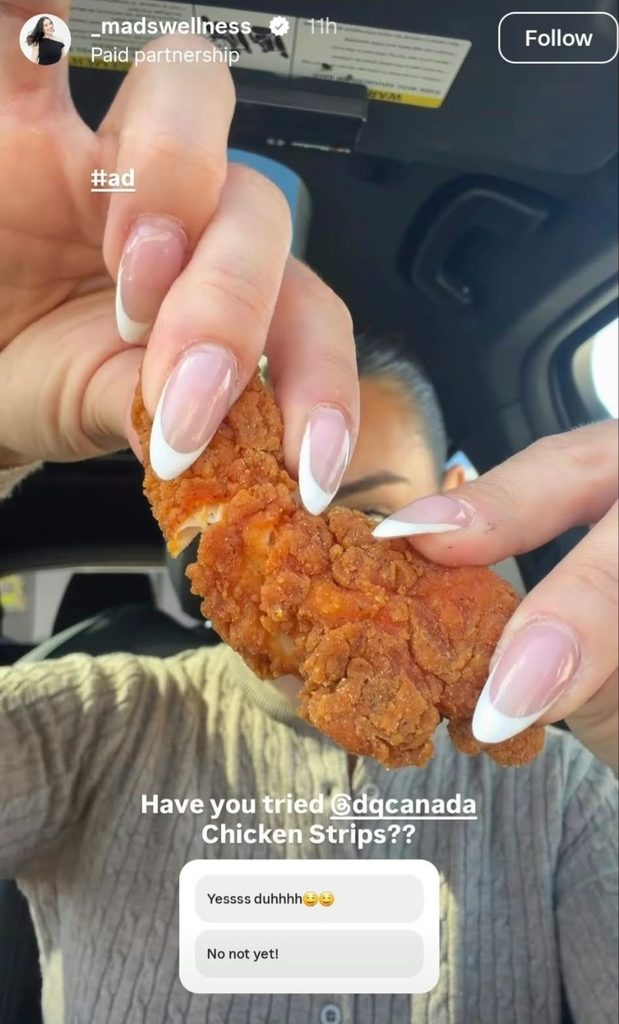
Dairy Queen Canada partnered with Toronto content creator Maddi Cerasuolo to promote its Chicken Strips. The sponsored Story opened on a close-up of browned, crunchy breading and a visible bite, shot in a selfie-style angle from inside a car.
The framing mimicked an authentic food recommendation rather than an ad, and the post added a native poll asking “Have you tried @dqcanada Chicken Strips??” with playful response options. Appetite-first close-ups paired with quick interactive elements like polls tend to perform well in Instagram’s fast, tap-through Story environment.
Instagram Feed Ad Examples
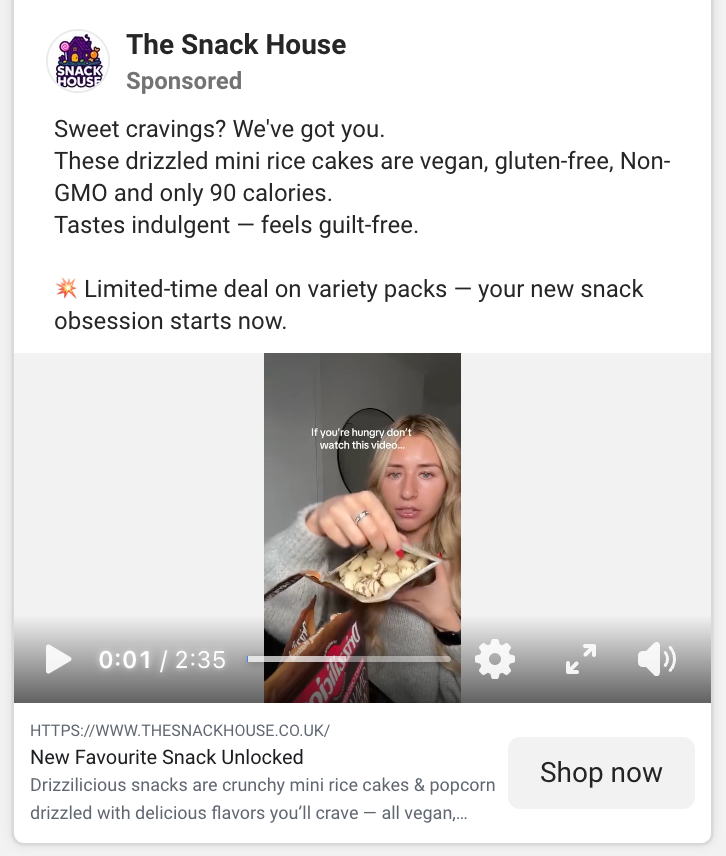
Example 1: The Snack House, Dietary Proof Points That Reward a Slower Scroll
The Snack House used its Feed placement to promote the Drizzilicious rice cakes it stocks, slowing a scrolling viewer down with the on-screen hook “If you’re hungry don’t watch this video…” The caption then did what a Story couldn’t: name dietary attributes like vegan, gluten-free, and non-GMO; include a specific 90-calorie claim; and offer a limited-time variety pack to drive urgency. That combination of detail and proof works because Feed viewers are more likely to pause and read before deciding.
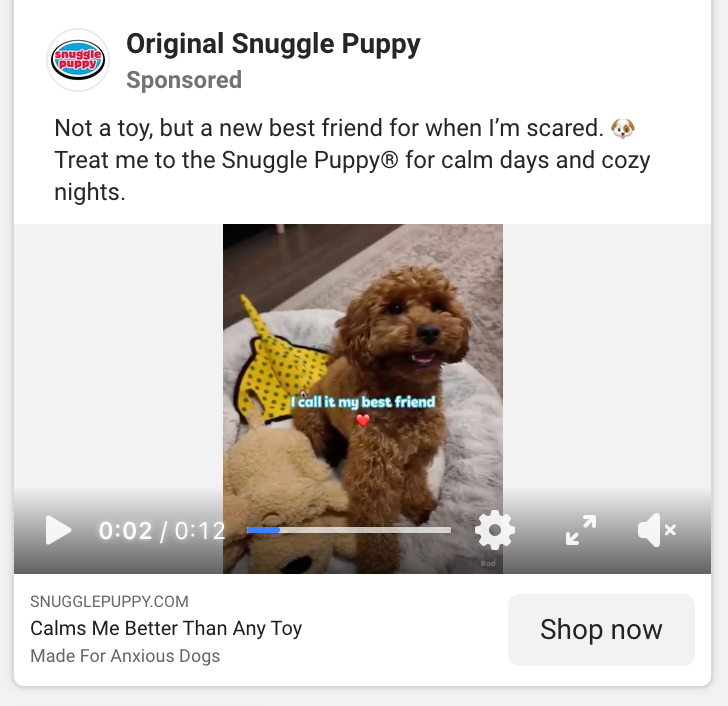
Example 2: Original Snuggle Puppy, Problem-to-Solution Copy Written in the Dog’s Voice
Original Snuggle Puppy structured its Feed ad around a problem before a product, opening with “Not a toy, but a new best friend for when I’m scared” alongside video of a dog resting with its plush toy. The copy positioned the product as “a new best friend” for “calm days and cozy nights.” It wrote the whole caption in the dog’s voice, so the pitch arrived as the pet speaking rather than the brand.
That problem-to-solution structure suits products solving a specific frustration, which is easier to build out in Feed’s slower, more explanatory format.
When Should You Use These Ad Formats?
When to Use Instagram Story Ads
Instagram Story Ads are the best fit for the following situations:
- The goal is fast attention and an immediate next step
- Creative involves creator partnerships, testimonials, or casual first-person demonstrations
- The campaign supports a new-product launch, limited-time offer, flash sale, or event reminder
- The product looks compelling within seconds, such as food, beauty, fashion, toys, or small consumer devices
- Visuals benefit from full-screen, mobile-first immersion
- The format calls for an interactive element, specifically the poll sticker Meta supports in Stories ads
- The message is short and single-purpose: one product, one benefit, one CTA
- The audience already knows the brand and just needs a simple prompt to revisit or buy
When to Use Instagram Feed Ads
Brands should consider using Instagram Feed Ads for these cases:
- The product needs explanation, social proof, or consideration before purchase
- Viewers are likely to pause, watch, read, compare, or evaluate before buying
- The product has several decision factors, such as ingredients, pricing, bundles, or compatibility
- The audience needs education or reassurance before committing to a purchase
- The ad relies on problem-solution storytelling, customer stories, or demonstrations
- The launch needs both a visual hook and a longer supporting explanation
- The campaign targets consideration or conversion, where profile visits and saved posts matter
- The video needs enough time to establish context and explain what makes the product different
Instagram Story vs Feed Ads: Comparison Table
| Feature | Instagram Story Ads | Instagram Feed Ads |
| Aspect ratio | 9:16 vertical, around 1080 × 1920 pixels | 4:5 vertical or 1:1 square |
| Viewing environment | Full screen, between organic Stories | Scrollable feed alongside followed accounts |
| Pace | Fast, tap-through, seconds to react | Slower, allows pausing and rereading |
| Text placement | Center safe area only, edges covered by UI and CTA | No interface overlap on captions |
| Interaction style | Poll sticker (the interactive element supported in Stories ads) | Comments, saves, profile visits |
| Best suited for | Impulse-friendly, visually immediate products | Products needing explanation or proof |
Launch Smarter Instagram Ad Campaigns with GetHookd

Both placements have their place. Fast, visual, impulse-friendly products earn attention inside a Story’s full-screen, tap-through pace, while products that need explanation or proof do better in Feed’s slower scroll and roomier captions. The budget leak happens when you treat the two as interchangeable and run one asset in a space it was never built for.
That’s the gap we built GetHookd to close. We let you filter 65 million+ ads by placement, use Brand Spy to see exactly which Story and Feed creatives your competitors are actively scaling, and then spin up format-matched variations with our AI creative tools, so you brief each placement correctly from the first draft instead of stretching one asset across both. Get started with GetHookd and build your next Instagram campaign around placements that fit your product.
Frequently Asked Questions (FAQs)
What is the difference between a story and a feed on Instagram?
A Story is a full-screen, vertical, temporary post viewed one tap at a time in a fast, immersive format built around a 9:16 canvas. A Feed post sits in a scrollable timeline alongside content from followed accounts, giving viewers time to pause, read captions, and inspect a post at their own pace.
Should I post on my story or feed?
Post to Stories when the content is time-sensitive, visually immediate, or benefits from interactive elements like polls or link stickers. Post to Feed when the content needs explanation, product detail, or is meant to be discovered later through saves, comments, or profile visits rather than consumed in the moment.
What are Instagram story ads?
Instagram Story ads are paid placements that appear between organic Stories in a full-screen, 9:16 vertical format. They are built for fast consumption, with essential text and CTAs kept in the center safe area to avoid being covered by Instagram’s native interface elements near the top and bottom of the screen.
Are Instagram ads worth it?
Instagram ads can be worth it when the creative is matched to the placement it runs in. Story ads work well for products that sell on sight, while Feed ads work well for products needing more context before a purchase decision, so return depends heavily on whether the creative fits the format rather than the platform alone.
What does GetHookd do?
GetHookd is a competitive ad research and creative intelligence platform with a database of 65 million+ ads. Brand Spy shows what competitors are actively scaling, including their top ads, landing pages, and traffic sources. Clone Ads generates new variations from a winning image, and AI scripts write fresh hooks from proven angles, so jewelry brands can build campaigns from tested concepts instead of starting from scratch.
*Note: Pricing and/or product availability mentioned in this post are subject to change. Please check our website for current pricing and stock information before making a purchase.