8 Best Facebook Event Ads Examples to Try in 2026
Key Takeaways
- The 8 best Facebook event ads to try in 2026 are countdown ads, social proof ads, speaker spotlight ads, behind-the-scenes teasers, early bird offers, video recaps, UGC-style ads, and carousel ads, with each format solving a different stage of the attendee journey.
- Countdown and early bird ads work best for bottom-funnel conversions, social proof and speaker spotlights drive mid-funnel consideration, and behind-the-scenes teasers, video recaps, UGC-style, and carousel ads build top-of-funnel awareness and warm cold audiences.
- To make these ads convert, anchor every creative to a specific date and dollar value, replace “Learn More” with action CTAs like “Get Tickets” or “Register,” use captions for sound-off viewing, and lead with your strongest visual hook in the first three seconds.
- Start running event ads 4 to 6 weeks before the event for most campaigns, or 8 to 10 weeks out for large conferences and festivals, layering ad formats in sequence rather than relying on one creative type.
- GetHookd gives event marketers access to 65M+ Meta ads to study which event campaigns competitors are actively scaling, plus AI creative tools to turn that research into branded ads in minutes.
What are Facebook Event Ads That Actually Fill Seats?
Facebook event ads fill seats when the creative format matches the audience’s position in the funnel, and the offer is built around concrete urgency rather than generic promotional language.
The eight formats that consistently outperform in 2026 are countdown ads for last-minute conversions, social proof ads for credibility, speaker spotlight ads for warm audiences, behind-the-scenes teasers for anticipation, early bird offers for mid-funnel commitment, video recaps for repeat events, UGC-style ads for skeptical niches, and carousel ads for events with multiple selling points.
Most event campaigns fail because marketers pick a single ad format and run it to every audience. The campaigns that fill venues do the opposite. They sequence creative across cold, warm, and retargeting audiences, then time each ad to the registration window so urgency lands when it actually matters.
The eight examples below show how to execute that sequencing in practice, drawn from real ads currently running on Meta.

GetHookd: Turn Competitor Intelligence Into Your Next Winning Ad
GetHookd reveals which ads your competitors are actively scaling—not just running. Spy on their best-performing creatives, landing pages, and traffic strategies, then turn proven concepts into testable campaigns in seconds with AI-powered script generation and creative cloning.
What You Get:- ✓ Brand Spy to decode competitor ad strategies in real-time
- ✓ AI script generation and ad cloning for instant variations
- ✓ Performance scoring based on actual ad behavior, not vanity metrics
- ✓ Creative Analyzer to identify and scale your top performers
8 Best Facebook Event Ad Examples in 2026
1. The Countdown Ad
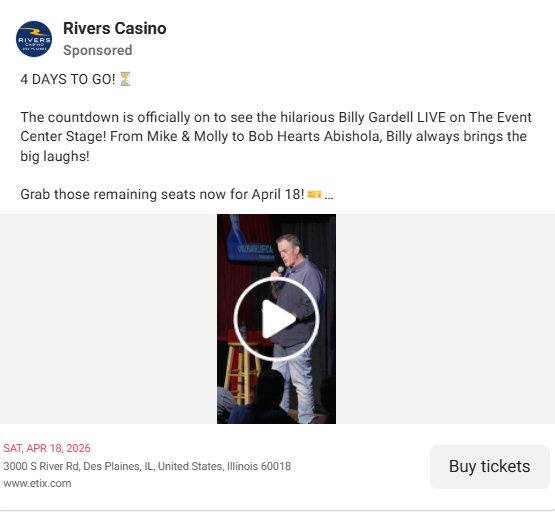
Countdown ads are one of the highest-converting formats in event marketing because they make inaction feel costly. When someone sees “Only 48 hours left to grab your early bird ticket,” the weight of missing out becomes a purchase trigger. This is FOMO working exactly as intended, and Facebook’s ad tools make it straightforward to execute.
The most effective countdown ads combine a bold timer visual, a clear savings or exclusivity hook, and a direct CTA like “Secure My Spot.” Keep the copy short, with a maximum of three lines above the fold.
Pair this with a retargeting audience of people who have already visited your event page but have not converted, and your cost per registration drops significantly.
2. The Social Proof Ad
Nothing sells an event like other people already being sold on it. Social proof ads pull from attendee numbers, testimonials from past events, recognizable sponsor or speaker logos, and star ratings to build instant credibility.
Lead with a bold attendee stat like “Over 2,000 marketers attended last year,” follow with a short testimonial quote from a recognizable name in your industry, then drive to the registration. The visual can be a clean, branded graphic paired with a real photo from a past event, since authenticity outperforms polish every time in social proof formats.
3. The Speaker or Guest Spotlight Ad
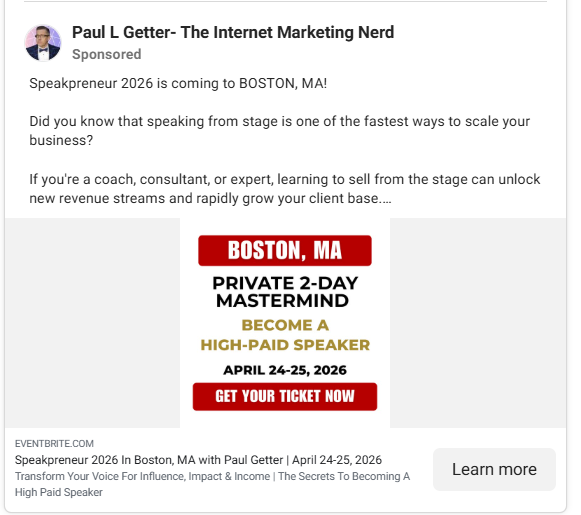
If your event features a well-known speaker, performer, or panelist, that person is your single most powerful marketing asset. A speaker spotlight ad puts a recognizable face front and center with a simple message: this person is coming, will you be there?
These ads work especially well in the consideration phase, when a warm audience already knows about the event but has not committed to a ticket yet.
4. The Behind-the-Scenes Teaser Ad
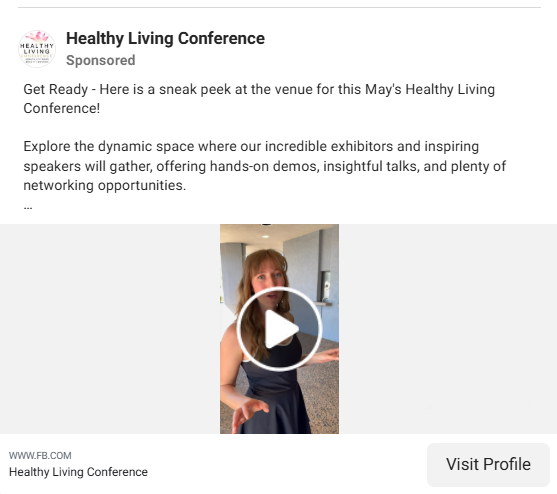
Behind-the-scenes content works because it makes people feel like insiders before the event even happens. A short video clip of the venue being set up, a quick interview with an organizer walking through what attendees can expect, or a sneak peek at the swag bags builds anticipation in a way polished promotional content cannot replicate. The raw, unfiltered quality is part of the appeal.
Keep these ads short, with 15 to 30 seconds being the sweet spot. Use captions so the ad works without sound and close with a direct registration link. The goal is not to give everything away. Make the audience feel like something exciting is happening, and they need to be part of it.
5. The Early Bird Offer Ad
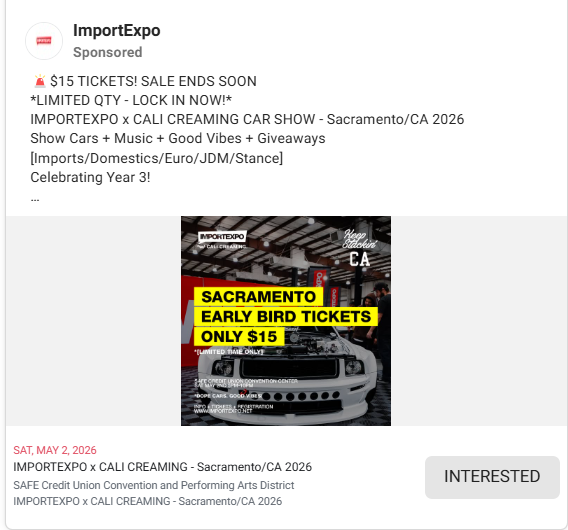
Early-bird ads are conversion machines when built around a real deadline and a meaningful discount. The formula is straightforward: lead with the saving like “Save $150, Early Bird Ends Friday,” show the original price crossed out next to the discounted rate, and use a hard cutoff date that actually holds.
A specific date and a specific dollar amount create the concrete stakes that drive clicks. Pair this format with a warm custom audience of people who have engaged with your page or watched more than 25% of a previous event video, and you are targeting people who are already interested but need one final reason to commit.
6. The Video Recap Ad
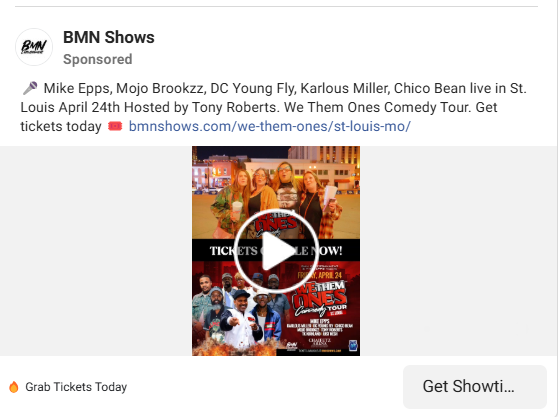
If you have run the event before, a highlight reel from a previous edition is one of your most underused assets. A 60 to 90-second video recap showing packed rooms, high-energy moments, candid attendee reactions, and memorable speaker soundbites does what no other ad format can. It provides undeniable proof that the event delivers on its promise.
The structure that works follows a simple arc. Open with the most visually exciting moment from the event rather than a logo or title card, build through a series of quick cuts that showcase variety and energy, and close on a clear attendee reaction or quote before hitting the CTA.
7. The UGC-Style Event Ad
UGC-style ads, where the creative looks like it was filmed by a real attendee on their phone rather than produced by a marketing team, are among the top-performing ad formats.
If you do not have existing UGC from past attendees, you can create UGC-style content yourself. Film a team member or a speaker on a smartphone in a natural setting. Keep the lighting imperfect, skip the branded lower thirds, and write a script that sounds like something a real person would say unprompted. The lo-fi aesthetic is the point because it signals realness, and realness converts.
8. The Carousel Event Ad
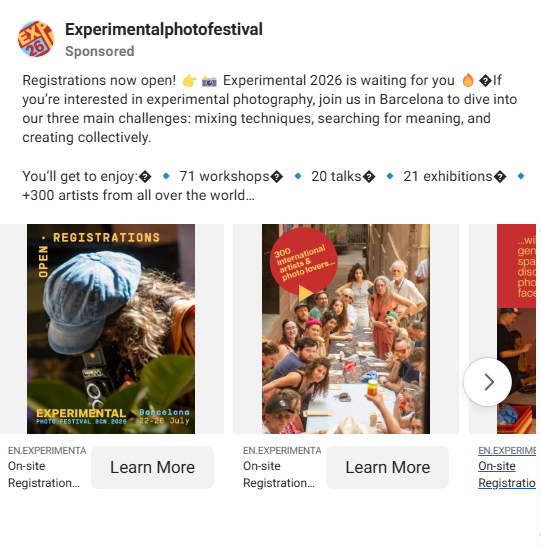
Carousel ads give you up to 10 cards to tell a story, and for event promotion, that is valuable. Each card can spotlight a different reason to attend. The key to a high-performing carousel event ad is treating each card as both a standalone piece and part of a larger narrative.
Someone might only see cards three through six, so each card needs to communicate value independently while still flowing logically from the previous one. Use consistent visual branding across all cards, keep headlines tight, and make sure the final card’s CTA is impossible to miss.
Top 8 Facebook Event Ad Examples: Summary Table
| Format | Best For | Core Strength |
| Countdown Ad | Retargeting warm audiences before a deadline | Turns FOMO into a concrete purchase trigger |
| Social Proof Ad | Repeat events with strong attendance or testimonial data | Borrows credibility from past attendees to convert new ones |
| Speaker or Guest Spotlight Ad | Events built around a recognizable name | Puts star power at the center of the pitch |
| Behind-the-Scenes Teaser Ad | Pre-event awareness and anticipation building | Makes viewers feel like insiders before doors open |
| Early Bird Offer Ad | Mid-funnel audiences weighing the ticket decision | Pairs a real deadline with a specific dollar-value hook |
| Video Recap Ad | Events with prior editions and usable footage | Delivers undeniable proof that the event is worth attending |
| UGC-Style Event Ad | Events in skeptical or saturated niches | Sidesteps ad fatigue with authentic attendee storytelling |
| Carousel Event Ad | Events with multiple selling points | Turns a single ad unit into a mini landing page |
Build Winning Facebook Event Ads with GetHookd
Facebook event ads succeed when format, timing, and audience targeting work together. The eight examples above cover every stage of the attendee journey, but the marketers who consistently fill seats are the ones who study what actually converts in their niche before they build a single ad.
That research step is where most teams lose days they cannot afford. At GetHookd, we built a 65M+ Meta ad database paired with AI creative tools so you can spot the event ads competitors are scaling and turn that intelligence into your own branded campaigns in minutes. If you want to start building event ads that fill seats, our platform is ready when you are.
Start your GetHookd free trial today.
Frequently Asked Questions (FAQs)
What is the best Facebook ad format for promoting events?
The best Facebook ad format depends on your campaign objective. Video ads work best for awareness, carousel ads excel at the consideration stage, and single-image urgency ads drive the most conversions close to the event date.
If you can only run one format, a short video ad between 30 and 60 seconds with captions and a specific CTA covers the most ground across the funnel.
Can I use the same event ad on Instagram and Facebook?
Technically, yes, but you should adjust the creative for each placement rather than running identical assets everywhere.
Facebook feed ads support longer copy and descriptive captions, while Instagram Stories and Reels demand vertical 9:16 formats, faster pacing, and on-screen text. The core message, offer, and CTA can stay consistent.
How early should I start running Facebook event ads before the event?
For most events, a 4 to 6 week runway is the sweet spot. Start with awareness and speaker spotlight ads early, move into early bird offers and social proof in the middle weeks, and close with countdown urgency and retargeting reminders in the final 5 to 7 days.
Large-scale conferences or festivals with higher ticket prices benefit from starting 8 to 10 weeks out to give the algorithm time to learn.
What is the best call-to-action for a Facebook Event Ad?
The best CTA is specific, benefit-led, and matched to where the audience sits in the funnel. Generic CTAs like “Learn More” underperform, while “Get Tickets,” “Sign Up,” and “Register” consistently drive higher conversions for event campaigns.
At GetHookd, our platform shows you the exact CTAs used in top-performing ads across niches, including event ads, so you can model what actually converts.
*Note: Pricing and/or product availability mentioned in this post are subject to change. Please check our website for current pricing and stock information before making a purchase.