7 Effective Facebook Messenger Ad Examples to Copy in 2026
Key Takeaways
- The 7 most effective Facebook Messenger ad examples to copy in 2026 are lead generation, promotional offer, event registration, engagement and insight, direct sales, retargeting, and menu-based chatbot ads, each pairing a click-to-Messenger ad with an automated chat flow tailored to a specific business objective.
- What makes a Facebook Messenger ad effective is the chat flow behind the click, since the creative earns the click, but the qualification logic, value delivered, and data captured inside the flow determine whether that click turns into a qualified lead or a sale.
- The best-performing Messenger ad formats share four traits: a benefit-driven hook, a clear promise of what users get when they click, a low-friction qualification step (typically two to four questions), and a contact capture before the offer is delivered.
- Messenger ads suit businesses where a short conversation can shorten the buying cycle, including service providers, B2B lead generation, eCommerce brands with products under $200, event organizers, and any team that normally relies on a sales call, demo, or consultation.
- GetHookd gives you access to 65M+ Meta ads to study which click-to-Messenger ads competitors are actively scaling, plus AI creative tools and templates to build your own branded versions in minutes.
What Makes a Facebook Messenger Ad Effective?
Seven Facebook Messenger ad examples are worth copying in 2026: lead generation, promotional offers, event registration, engagement and insight, direct sales, retargeting, and menu-based chatbot ads.
Every one of them is built on the same engine, which is a click-to-Messenger ad wired to an automated chat flow, then shaped around a specific outcome the advertiser actually wants.
The reason most Messenger campaigns waste budget is the flow, not the ad. A creative that earns the click is the easy part. The work that turns that click into a qualified lead, a booked call, or a completed checkout happens after the user opens the conversation, inside the qualification logic, the value delivered in the first message, and the data captured before the offer drops.
The seven examples below show what that looks like in practice, and where each format earns its keep.

GetHookd: Turn Competitor Intelligence Into Your Next Winning Ad
GetHookd reveals which ads your competitors are actively scaling—not just running. Spy on their best-performing creatives, landing pages, and traffic strategies, then turn proven concepts into testable campaigns in seconds with AI-powered script generation and creative cloning.
What You Get:- ✓ Brand Spy to decode competitor ad strategies in real-time
- ✓ AI script generation and ad cloning for instant variations
- ✓ Performance scoring based on actual ad behavior, not vanity metrics
- ✓ Creative Analyzer to identify and scale your top performers
7 Best Facebook Messenger Ad Examples to Copy in 2026
1. Lead Generation Click-to-Messenger Ads
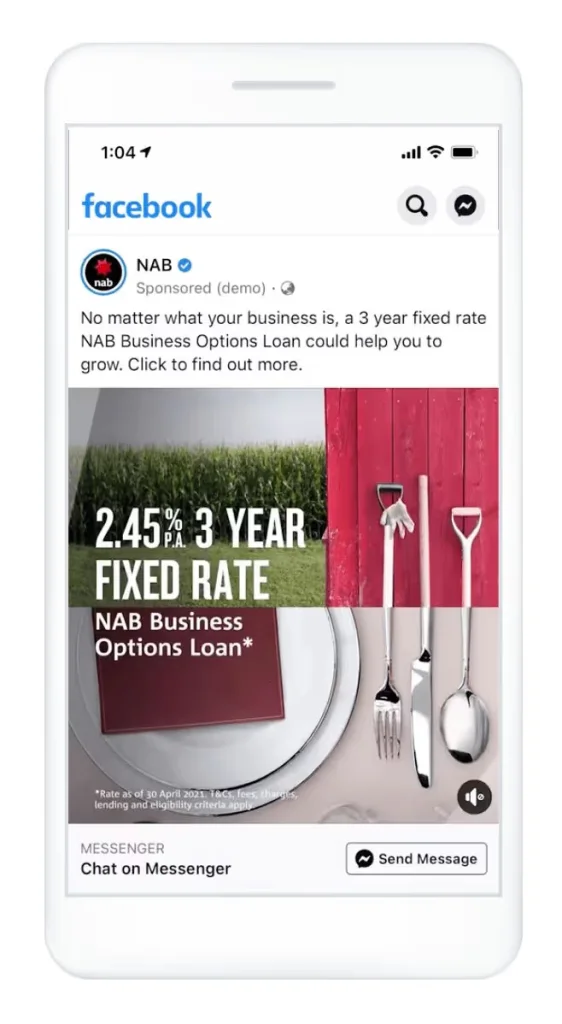
Lead generation ads are the foundation of any Messenger advertising strategy. The ad looks identical to a standard Facebook feed ad, with an image or video, headline, body copy, and CTA button. The only difference is that the CTA opens a Messenger conversation instead of a landing page.
The structure that consistently performs:
- The hook. A scroll-stopping visual paired with a single, benefit-driven headline.
- The promise. Clear CTA copy that tells users exactly what they will get when they click, such as “Get Your Free Quote in 60 Seconds.”
- The opener. A Messenger greeting that immediately delivers value and sets expectations.
- The qualification. Two to four quick questions that segment the lead and gather useful data.
- The capture. An automated request for email or phone before delivering the promised resource.
This format works exceptionally well for service businesses, B2B lead generation, and any offer where a conversation naturally leads to a sale.
2. Promotional Offer Messenger Ads
Promotional offer Messenger ads are built around a specific deal, discount, freebie, or limited-time bundle. The logic here is simple. Users who click a promotional ad are already in buying mode. Routing them to Messenger instead of a product page captures their contact information before the purchase, which means you can still follow up if they do not convert on the first visit.
A high-performing promotional flow in practice:
- Ad creative puts the offer front and center, with the discount percentage or freebie impossible to miss.
- The opening Messenger message confirms the offer and creates urgency with a countdown or limited quantity mention.
- One qualifying question personalizes the experience, such as “Which product are you most interested in?”
- The promo code or offer link is delivered inside Messenger after the user provides their email.
- An automated follow-up message is sent after 24 hours if no purchase is made.
One detail to lock in: the offer has to be compelling. Vague promises like “save big today” do not cut through. Specificity wins. “Get 30% off your first order, today only” is the kind of copy that actually drives clicks.
3. Event Registration Messenger Ads
Event registration is one of the most underutilized use cases for Messenger ads, and one of the highest-converting. Whether you are promoting a webinar, live workshop, in-person event, or product launch, Messenger ads remove the friction that kills registrations on traditional sign-up pages.
Instead of sending traffic to a form with five fields, a click-to-Messenger event ad collects a name and email in two conversational steps. The user barely notices they have registered because the process feels like a natural back-and-forth rather than a data-extraction exercise.
Here’s a sample flow that gets people to register:
- Step 1 (the ad). Lead with the transformation, not the event itself. “Learn how to generate 200 leads a week using Messenger” beats “Join our free webinar” every time.
- Step 2 (the opener). The Messenger greeting confirms the event details (date, time, what they will learn) in no more than 3 bullet points.
- Step 3 (the commitment). One simple yes-or-no question: “Does [date and time] work for you?” The micro-commitment lifts follow-through rates.
- Step 4 (the capture). Collect the email to send the calendar invite and joining link. Frame it as a benefit: “Drop your email, and I’ll send the link plus a free pre-event resource.”
- Step 5 (the reminder). Automated Messenger reminders 24 hours before and one hour before the event. Show-up rates improve significantly with this step alone.
4. Engagement & User Insight Messenger Ads
Engagement-focused Messenger ads are designed to start meaningful conversations, gather qualitative insights, and build the kind of relationship that eventually leads to a sale.
These work particularly well for brands in competitive markets where trust is the primary purchase barrier. Financial services, health and wellness, high-ticket coaching, and B2B software all fit this mold.
A simple quiz-style chatbot flow, like “What’s your biggest challenge with [topic]?” followed by two or three multiple-choice responses, gives you behavioral and preference data. That data then feeds your segmentation, email sequences, and future ad targeting with a level of precision that third-party data simply cannot match.
5. Direct Sales Messenger Ads
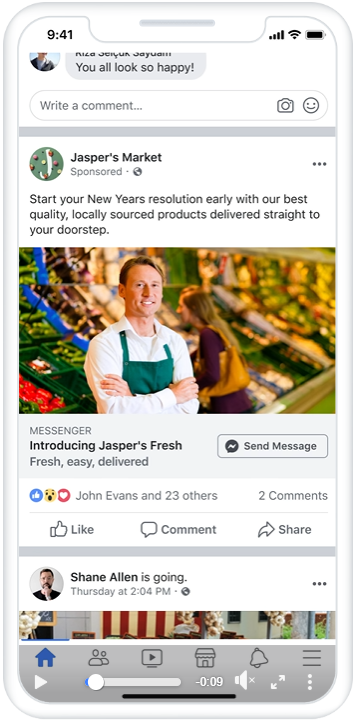
For products with a short consideration cycle and a price point under $200, a well-built Messenger sales flow can guide a user from a cold click to a completed purchase without ever leaving the app.
The flow presents the product, handles common objections through pre-written responses, shares social proof, and delivers a direct purchase link at the moment of peak interest.
The sweet spot for this format is products that benefit from a little education before the sale. Think supplements, skincare, specialty food products, and anything where “why this works” is part of the buying decision.
6. Retargeting & Re-Engagement Messenger Ads
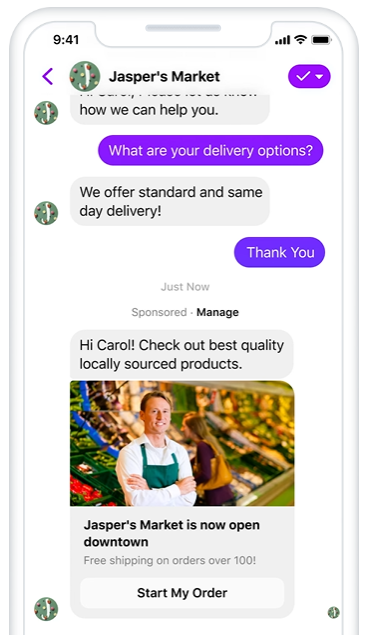
Retargeting through Messenger is a different beast from standard retargeting campaigns. Instead of showing someone the same product image they already ignored twice, a Messenger retargeting ad opens a conversation that directly addresses why they did not convert the first time. It is the difference between chasing someone and actually talking to them.
Who to target and how:
- Website visitors who did not convert. Target with a click-to-Messenger ad that offers a specific reason to come back, like a limited-time bonus or a free consultation.
- Abandoned cart users. Use a flow that acknowledges the abandoned cart, handles the most common objections (price, shipping, uncertainty), and offers a small incentive to complete the purchase.
- Past customers. Re-engage with a click-to-Messenger ad introducing a complementary product, a loyalty reward, or an exclusive early-access offer.
- Video viewers. Users who watched 50% or more of a video ad are warm leads. Retarget them with a Messenger ad that picks up where the video left off.
- Lead form openers who did not submit. These users showed intent but dropped off. A Messenger ad that offers to “answer any questions” is often enough to bring them back.
Timing also matters. Wait longer than a week, and the user’s intent has usually cooled to the point where re-engagement requires significantly more effort.
7. Menu-Based Chatbot Click-to-Messenger Ads
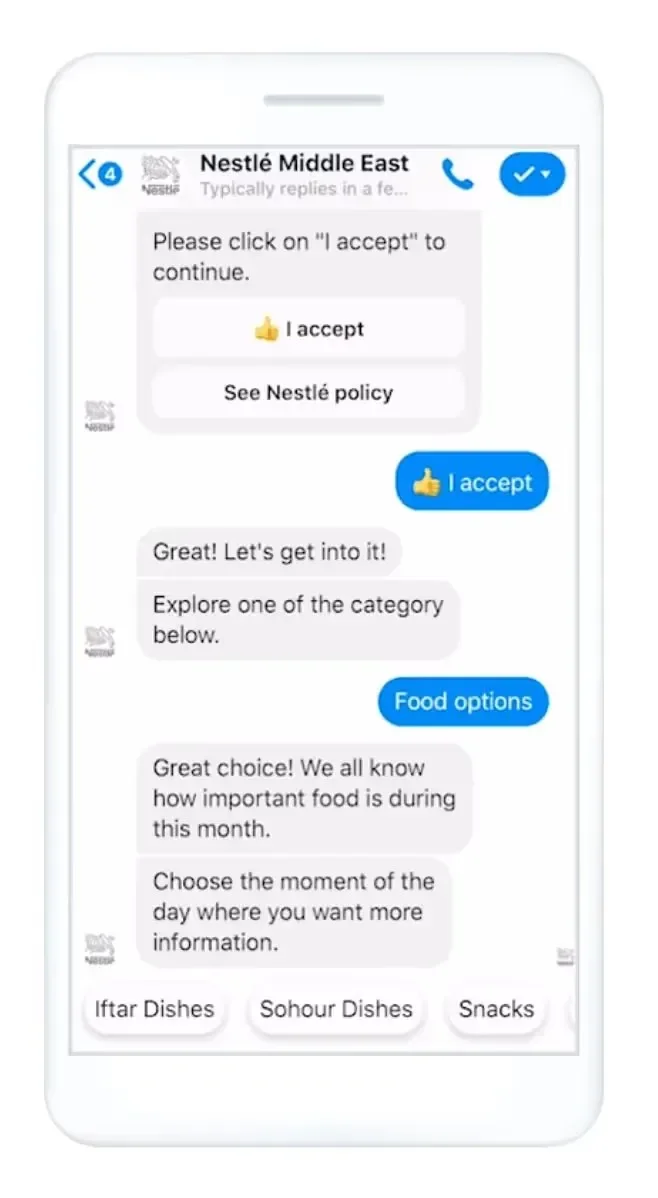
Menu-based chatbot ads give users a structured set of options the moment they open Messenger. It is essentially a self-service navigation system that routes each user to the content or offer most relevant to them. Instead of a linear, one-size-fits-all flow, the user chooses their own path, making the experience feel personalized rather than forced.
These work exceptionally well for businesses with multiple products, services, or audience segments. A digital marketing agency might offer options like “SEO Services,” “Paid Ads,” “Social Media Management,” and “Book a Free Call.” Each selection triggers a tailored sub-flow with relevant case studies, pricing information, and a specific CTA.
Top 7 Effective Facebook Messenger Ad Examples: Summary Table
| Format | Best For | Core Strength |
| Lead Generation Click-to-Messenger | Service businesses and B2B brands | Captures contact info through a conversational flow, not a form |
| Promotional Offer Messenger Ad | eCommerce and local brands running time-sensitive deals | Secures contact info before the purchase to power follow-up |
| Event Registration Messenger Ad | Webinars, workshops, launches, and live events | Removes sign-up form friction and enables automated reminders |
| Engagement and User Insight Ad | Trust-heavy niches like finance, wellness, and B2B SaaS | Gathers first-party data that no pixel can capture |
| Direct Sales Messenger Ad | Products under $200 with short consideration cycles | Closes the sale inside Messenger without leaving the app |
| Retargeting and Re-Engagement Ad | Abandoned carts, past visitors, and warm audiences | Opens a conversation around why the user did not convert |
| Menu-Based Chatbot Ad | Businesses with multiple products, services, or segments | Lets each user self-select into their most relevant flow |
Launch High-Converting Facebook Messenger Ads With GetHookd
The strongest Messenger ads are reverse-engineered, not invented. Teams pulling real returns from the format study the exact click-to-Messenger ads already converting in their niche, then rebuild the hook, flow, and offer around their own product before they spend a dollar.
At GetHookd, we give you the 65M+ Meta ad database to surface those winning Messenger ads in minutes, plus the AI creative tools and templates to turn them into your own branded versions just as fast. If you want to launch Messenger ads with proof behind every test, start your GetHookd free trial today.
Start your GetHookd free trial today.
Frequently Asked Questions (FAQs)
What is a Facebook Messenger ad and how does it work?
A Facebook Messenger ad is a paid ad that opens a Messenger conversation when clicked, instead of sending users to a website.
An automated chatbot flow then greets the user, qualifies them, delivers an offer, or guides them toward a purchase. The entire interaction takes place in Messenger, making it faster and more conversational than a landing page.
Are Facebook Messenger ads still effective in 2026?
Yes, Messenger ads remain effective in 2026, especially as cookie-based tracking continues to erode and first-party data becomes more valuable. The format has matured, which means the teams still running it have gotten significantly better at execution.
Results depend entirely on the chatbot flow behind the ad, since a weak flow with a vague offer will underperform on any platform.
How much do Facebook Messenger ads cost?
Facebook Messenger ad costs follow the same auction-based pricing model as all Meta advertising, so there is no flat rate. Your actual cost depends on audience, ad quality, industry, and competition at any given moment.
What type of business should run Facebook Messenger ads?
Facebook Messenger ads work best for businesses where a short conversation can shorten the buying cycle. Service businesses, B2B lead generation, eCommerce brands with products under $200, and event organizers all see strong results because the flow does the heavy lifting that the ad copy cannot.
Any business that normally relies on a sales call, a demo booking, or a consultation can run a version of that conversation inside Messenger instead.
How does GetHookd help me build better Facebook Messenger ads?
At GetHookd, our 65M+ Meta ad database lets you filter by niche and format to see exactly which click-to-Messenger ads competitors are actively scaling. Once you spot a winning hook or CTA, our AI creative tools and templates turn that insight into your own branded ad in minutes.
*Note: Pricing and/or product availability mentioned in this post are subject to change. Please check our website for current pricing and stock information before making a purchase.