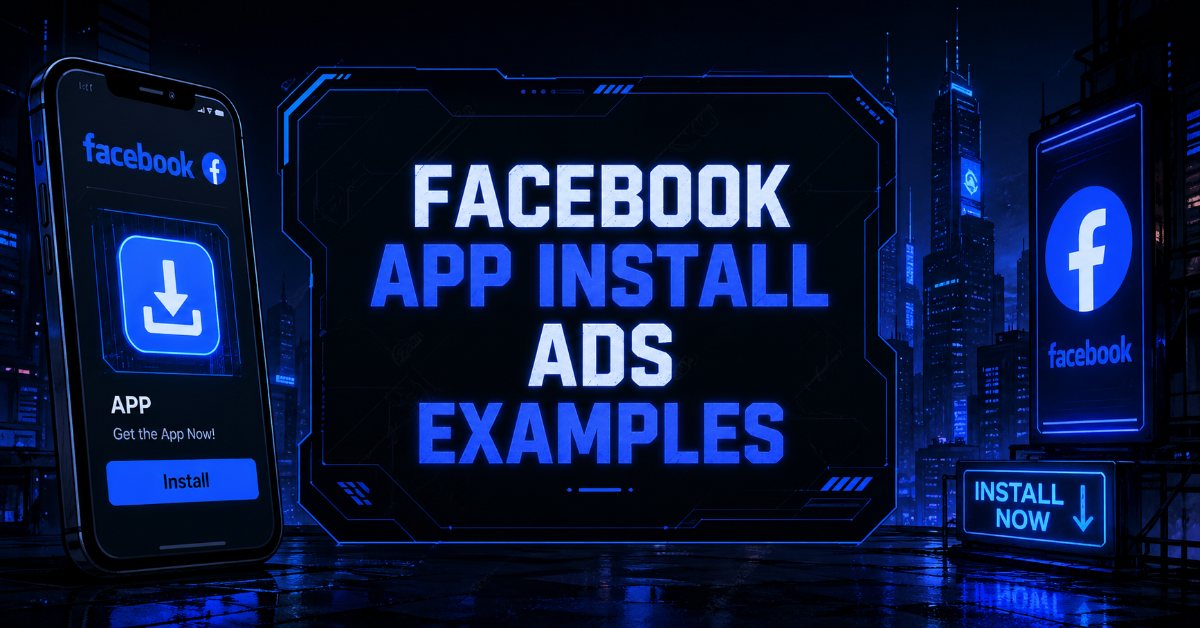
5 Facebook App Install Ads Examples & Tips for 2026
Key Takeaways
- The five Facebook app install ad formats winning in 2026 are gameplay preview videos, UGC testimonials, carousel feature highlights, before-and-after transformations, and interactive playables. Each pairs a two-second hook with a clear value promise and a direct path to the App Store or Google Play.
- Creative fatigue hits app install campaigns faster than eCommerce campaigns. Refreshing creatives every 7 to 10 days and keeping three to five active variants per ad set prevents Cost per Install (CPI) spikes and keeps campaigns in a stable learning phase.
- Optimizing for installs alone attracts low-quality users. App Event Optimization (AEO) and Value Optimization (VO) target users likely to take deeper actions, such as subscribing or purchasing, but both require clean SDK or Conversions API data flowing back to Meta before they work effectively.
- iOS and Android campaigns should always run separately. The platforms behave differently post-install, carry different attribution setups, and often require different bids, budgets, and creative strategies to measure and scale accurately.
- At GetHookd, we help media buyers and agencies uncover which app install ads competitors are actually scaling across Meta, using our 65M+ ad database.
The 2026 Playbook for Lower CPI on Meta
Lower CPI on Meta in 2026 starts with running the right ad format for your app category and pairing them with bidding setups that target real in-app value, not just downloads. The brands hitting strong CPI numbers right now lean on five proven ad examples, refresh creatives before fatigue sets in, and split iOS and Android campaigns so each platform gets the budget and bid strategy it needs.
This guide breaks down five Facebook app install ad examples driving the strongest results today, including gameplay previews, UGC testimonials, carousel highlights, before-and-after transformations, and interactive playables. It also covers creative refresh cycles, App Event Optimization, Value Optimization, Advantage+ audience layering, and why running iOS and Android separately matters for clean attribution and scale.
We will go into more detail on each ad example and tactic below, with brands executing them well and practical tips you can apply to your next campaign launch.

GetHookd: Turn Competitor Intelligence Into Your Next Winning Ad
GetHookd reveals which ads your competitors are actively scaling—not just running. Spy on their best-performing creatives, landing pages, and traffic strategies, then turn proven concepts into testable campaigns in seconds with AI-powered script generation and creative cloning.
What You Get:- ✓ Brand Spy to decode competitor ad strategies in real-time
- ✓ AI script generation and ad cloning for instant variations
- ✓ Performance scoring based on actual ad behavior, not vanity metrics
- ✓ Creative Analyzer to identify and scale your top performers
5 Facebook App Install Ads Examples That Convert
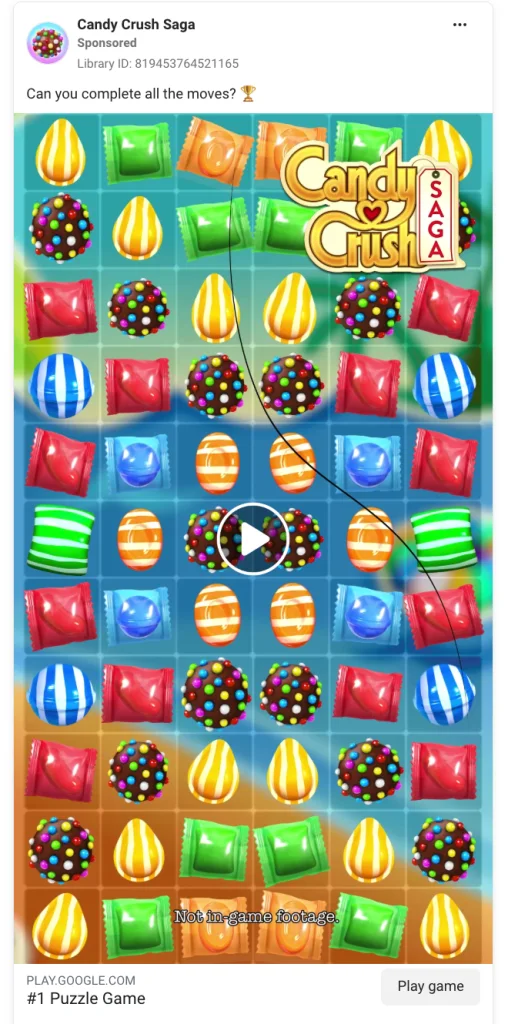
1. Gameplay Preview Video Ads (Mobile Gaming)
Gaming apps dominate Facebook’s app install category, and gameplay preview ads remain the strongest format. These ads show five to fifteen seconds of actual gameplay, often with an overlay prompting users to “beat this level” or “try if you can solve it.”
The hook works because it triggers curiosity and a challenge response. Puzzle, match-three, and hyper-casual games use this format heavily, often A/B testing different levels to find which gameplay moment drives the lowest Cost per Install (CPI).
Tip: Test gameplay clips from mid-game difficulty rather than tutorials. Users respond better to content that looks achievable but engaging.
2. User-Generated Content (UGC) Testimonial Ads
UGC-style ads look like a real person recording themselves on their phone, talking about how the app solved a problem. Finance apps, fitness apps, and productivity tools use this format because it builds trust faster than a polished brand video.
A strong UGC app install ad runs between fifteen and thirty seconds, opens with a pattern-interrupt question, and ends with the creator showing the app on their screen. The soft-sell tone feels native to the feed, which keeps thumb-stop rates high.
Tip: Hire three to five creators per campaign and rotate creatives weekly. Creator diversity helps avoid audience burnout.
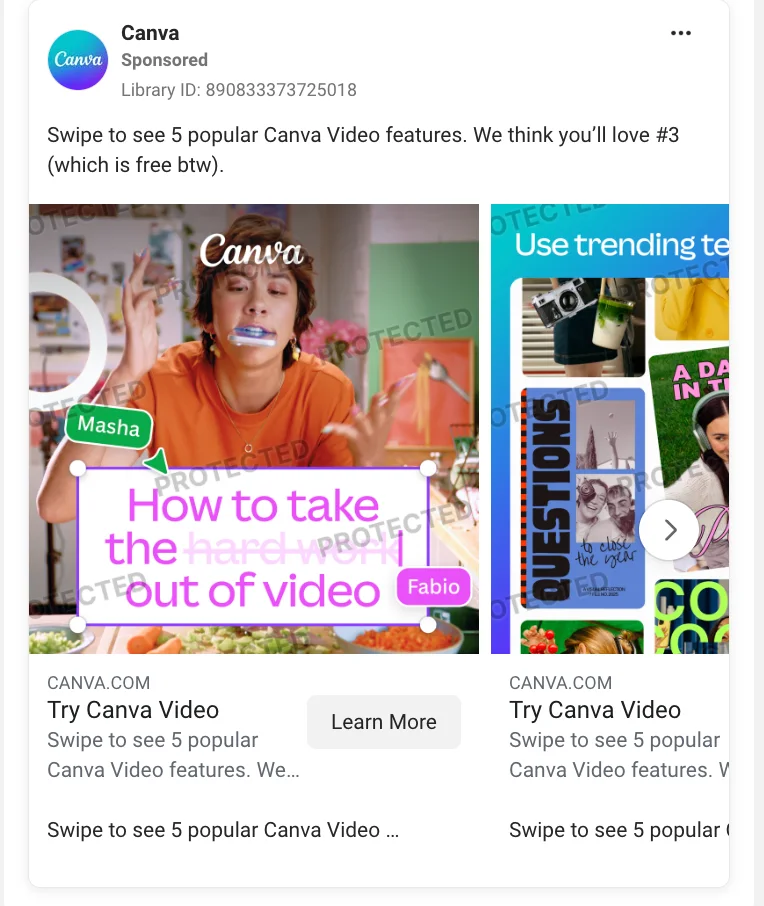
3. Carousel Feature Highlight Ads
Carousel ads let you showcase multiple app screens in one unit. Each card highlights a single feature, benefit, or screenshot, with the final card acting as the install CTA.
This format works well for productivity, dating, travel, and eCommerce apps where users need to see several features before committing to a download. Carousel ads also generate lower Cost Per Mille (CPM) in some verticals because Meta rewards interactive formats with more placements.
Tip: Keep headlines under six words per card and use consistent design across all cards for a clean scroll experience.
4. Before-and-After Transformation Ads
Fitness, language-learning, finance, and beauty apps use before-and-after visuals to show results. These ads work because they anchor a specific result in the viewer’s mind before asking for the install.
A good transformation ad pairs the visual with a short caption explaining the timeframe (“7 days using this app”) and a soft CTA like “see how it works.” The format converts especially well with cold traffic because it front-loads the benefit.
Tip: Use real outcomes only. Meta’s policy team flags exaggerated transformation claims, especially in health and finance verticals.
5. Interactive Playable Ads
Playable ads let users try a mini version of your app in the Facebook feed before installing. Casual and hyper-casual games rely heavily on playables because users who interact with the demo install at a far higher rate than passive viewers.
While playables require more production work, the install quality tends to be stronger. Users who play a demo before installing are more likely to complete onboarding and hit early retention milestones.
Tip: Keep the playable under thirty seconds of gameplay. Longer demos reduce install conversion.
Tips to Scale Facebook App Install Ads in 2026
Refresh Creatives Every 7 to 10 Days
Creative fatigue hits app install campaigns faster than eCommerce campaigns because mobile audiences cycle through content quickly. A creative that performs on day three often sees CPI double by day twelve.
Build a rolling content calendar with fresh hooks, new UGC creators, and seasonal angles. Keeping three to five ad variants active per ad set gives Meta’s algorithm room to optimize without starving any single creative.
Set a weekly review cadence where underperforming ads are paused and replaced with new hooks. This prevents sudden CPI spikes and keeps campaigns in a stable learning phase.
Use App Event Optimization (AEO) & Value Optimization (VO)
Optimizing for installs alone often produces low-quality users. App Event Optimization lets Meta target users who are likely to take deeper actions, such as subscribing, completing a level, or making a purchase.
Value Optimization goes further by bidding for users most likely to spend. Both require the Meta SDK or the Conversions API to be properly configured in your app, with sufficient event volume for the algorithm to learn.
Start with AEO once your app has at least fifty event conversions per week per ad set. Move to VO only after you have clean revenue data flowing back to Meta for at least thirty days.
Layer Advantage+ Audiences With Lookalikes
Meta’s Advantage+ audience expansion now outperforms manual interest targeting in most verticals. Combine Advantage+ with one-percent lookalikes of your highest-value installers (purchasers, subscribers, or high retention users).
This combination gives the algorithm broad reach while still anchoring learning around your best-performing user profile. Avoid stacking too many narrow-interest layers on top of Advantage+, as this limits the algorithm’s ability to find new pockets of high-value users.
Study Competitor Ad Strategies
Watching what competitors are actively scaling is one of the fastest ways to shortcut creative research. Meta Ad Library shows you which ads are running, but it does not tell you which ones are being scaled or winning.
Dedicated competitive intelligence tools like GetHookd surface scaling signals, landing page data, and creative patterns across Facebook Ad Library so you can prioritize the hooks and formats worth testing in your own account. This saves hours of manual scrolling and keeps your test pipeline filled with concepts that already have proof of performance.
Run Separate Campaigns for iOS & Android
iOS and Android users behave differently post-install. iOS 14.5+ privacy changes still affect attribution, while Android delivers cleaner event signals through Google Play Install Referrer.
Running separate campaigns per platform lets you set different bids, budgets, and creative strategies. This is especially important for subscription apps where iOS users often show higher LTV but require stricter SKAdNetwork setups to measure accurately.
Facebook App Install Ads Examples: Quick Reference Table
| Ad Format | Best For | Avg Video Length | Key Strength |
| Gameplay Preview | Mobile games | 5 to 15 seconds | High curiosity hook |
| UGC Testimonial | Finance, fitness, productivity | 15 to 30 seconds | Trust and native feel |
| Carousel Feature | Productivity, travel, dating | Static images | Multi-feature storytelling |
| Before-and-After | Fitness, finance, language | 10 to 20 seconds | Outcome anchoring |
| Playable Ad | Casual and hyper-casual games | Under 30 seconds | High-quality installs |
Why We Built GetHookd for Facebook Ad Research
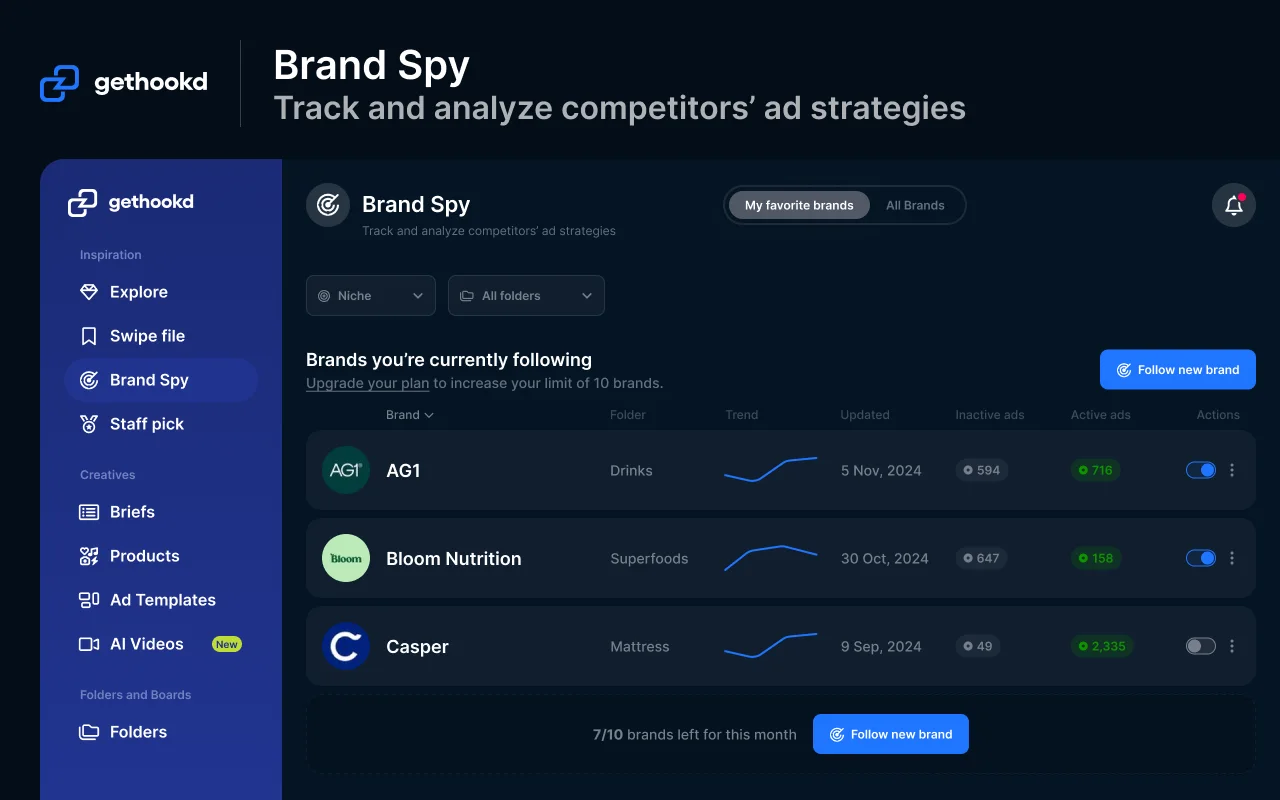
Winning on Facebook app install ads in 2026 comes down to choosing the right creative for your category, refreshing often enough to outrun fatigue, and bidding for users who actually generate value in your app. The teams scaling profitably treat competitor research as a continuous input, not a one-time exercise, and that is exactly the gap we built GetHookd to close. Our platform holds over 65 million ads analyzed across Meta and Facebook Ad Library, and our Brand Spy feature shows you which creatives competitors are actively scaling versus the ones that quietly stopped performing, so you stop wasting test budget on noise.
For app marketers, that means AI-powered creative analysis to break down hooks, formats, and angles, plus ad transcription and script generation tools that turn proven concepts into testable variations in seconds. Less time digging through the Ad Library, more time launching tests backed by real scaling signals.
Start your GetHookd free trial today.
Frequently Asked Questions (FAQs)
What is a good CPI benchmark for Facebook app install ads in 2026?
CPI varies by vertical and region. Gaming apps in Tier 1 markets often sit between $2 and $6, while finance and subscription apps run higher due to competitive auction pressure. Emerging markets deliver lower CPI but require tighter event optimization to maintain strong install quality.
How long should I run a Facebook app install campaign before judging performance?
Give each campaign at least seven days and fifty optimization events per ad set before making major changes. Meta’s algorithm needs time to exit the learning phase, and pausing too early often kills campaigns that would have stabilized. After fourteen days, CPI trends become reliable enough to act on.
Do Facebook app install ads still work after iOS privacy changes?
Yes, but attribution is less precise on iOS. Using SKAdNetwork alongside Meta’s Aggregated Event Measurement helps recover signal. Many app marketers also run separate iOS and Android campaigns with platform-specific bidding strategies to handle the differences in measurement windows and event volume.
Should I run app install ads or website conversion ads for my mobile app?
Run app install ads when your goal is downloads and deep in-app events like subscriptions or purchases. Website conversion ads work well for apps with strong web funnels or email capture flows. Most teams get better results from app install campaigns because Meta optimizes directly for in-app behavior through the SDK.
Does GetHookd help with Facebook app install ad research and brand spying?
Yes, brand spying is a core part of what we do at GetHookd. Our platform lets you track competitor app install ads, see which creatives are actively scaling, analyze landing pages, and use AI to generate script variations. Visit our FAQ section for details on how we support app marketers and agencies.
*Note:Pricing and/or product availability mentioned in this post are subject to change. Please check our websitefor current pricing and stock information before making a purchase.