Key Takeaways
- The strongest life insurance Facebook ads connect one emotional or practical tension to a single, credible call to action.
- Ethos, Veteran Life Insurance, USAA, and Dave Ramsey/Zander each demonstrate a distinct and repeatable ad strategy: simplicity, identity, convenience, and trust.
- Copying an ad’s structure (audience, hook, benefit, CTA) is a safer starting point than copying exact claims or visuals, which can carry both copyright and insurance-advertising compliance risk.
- Process ease, life-stage and identity relevance, and social proof are the three most common high-performing hooks across these examples.
- GetHookd lets you search a database of over 65 million Facebook ads by niche, format, and run time, then save them into a swipe file your next brief can start from.
Which Life Insurance Facebook Ads Actually Work?
Ethos, Veteran Life Insurance, USAA, and Dave Ramsey/Zander are four clear examples of what separates a forgettable insurance ad from one that generates real leads. Most life insurance ads fail because they treat the product as the hero instead of the person seeing the ad. The result is generic creative that blends into the feed and earns a scroll rather than a click.
What these four examples get right is specificity. Each one speaks to a defined person in a defined situation: a veteran, a busy parent, someone putting off a purchase that feels complicated. Getting this wrong means spending on traffic that never converts, because the ad promise does not match what the audience needs to hear.
GetHookd is built for this kind of research. You can pull real Facebook ad examples by industry, save the ones worth studying, and build a brief from the patterns.

GetHookd: Turn Competitor Intelligence Into Your Next Winning Ad
GetHookd reveals which ads your competitors are actively scaling, not just running. Spy on their best-performing creatives, landing pages, and traffic strategies, then turn proven concepts into testable campaigns in seconds with AI-powered script generation and creative cloning.
What You Get:- ✓ Brand Spy to decode competitor ad strategies in real-time
- ✓ AI script generation and ad cloning for instant variations
- ✓ Performance scoring based on actual ad behavior, not vanity metrics
- ✓ Creative Analyzer to identify and scale your top performers
4 Life Insurance Facebook Ad Examples to Study
1. Ethos: Make Buying Feel Simple
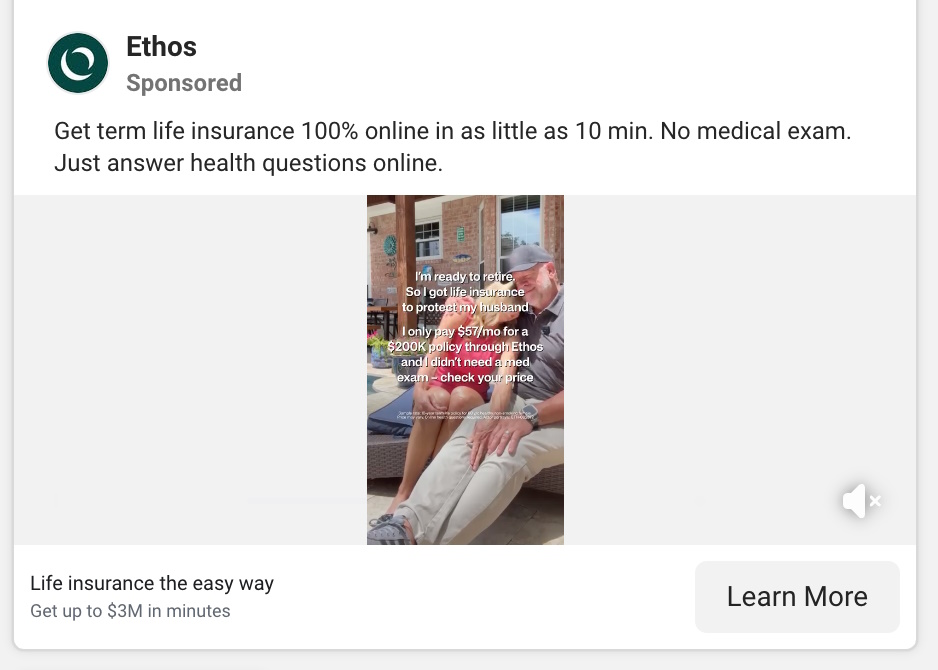
Ethos built its brand on removing the friction that keeps most people from buying life insurance. Rather than leading with coverage amounts or actuarial language, Ethos ads lead with speed and ease: no medical exam, fast approval, done from your phone. The hook addresses the number-one reason people delay buying: the process feels complicated and time-consuming.
The creative typically features a clean visual with a real person, no jargon, a short headline that frames the product as accessible, and a low-commitment CTA that invites the reader to learn more. The copy does not try to explain term vs. whole life. It simply removes the obstacle between the reader and the action.
2. Veteran Life Insurance: Lead With Relevance
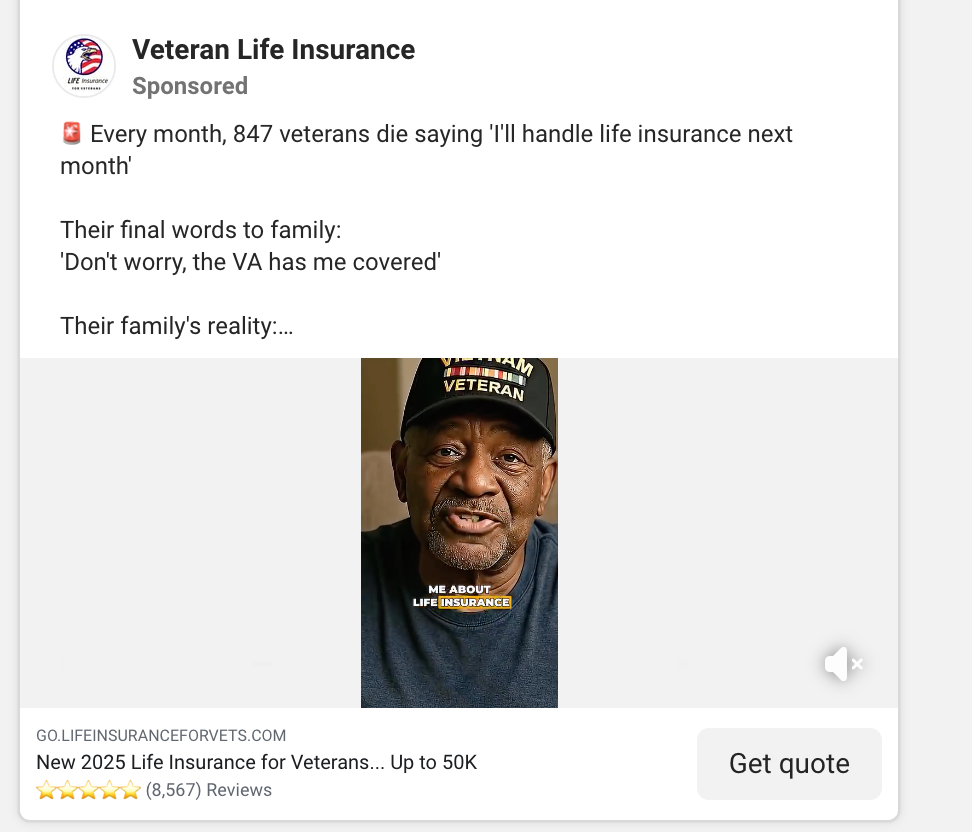
The Veteran Life Insurance ad works because it speaks directly to veterans and uses visual and copy cues that make that audience feel immediately recognized. When someone who served sees an ad that opens with language or imagery tied to military service, the relevance signal is instant.
Identity-based targeting like this is one of the highest-return moves in direct response advertising. The product itself does not have to be dramatically different.
What changes is the frame. Life insurance for a veteran carries different considerations (service-related health history, specific benefit structures, existing coverage through the VA), and an ad that acknowledges those specifics earns trust before the landing page even loads.
3. USAA: Use Trust, Service, & Family Protection
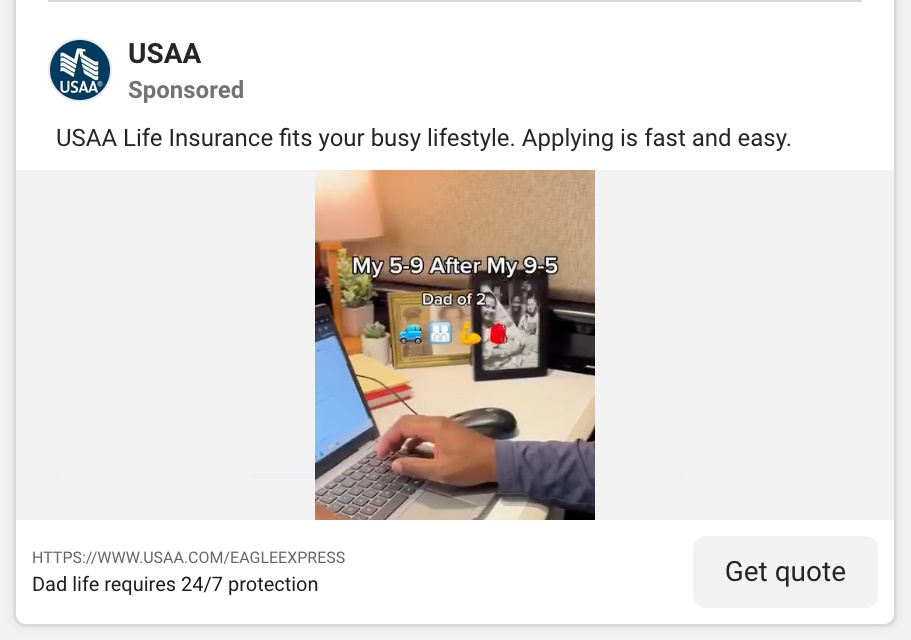
USAA’s ad strips everything back to convenience and credibility. The copy reads: “USAA Life Insurance fits your busy lifestyle. Applying is fast and easy.”
The visual centers on a working father, overlaying the line “My 5–9 After My 9–5,” followed by “Dad life requires 24/7 protection.” In two lines, the ad earns relevance with a specific life stage, reframes the product as a fit for real life rather than a financial obligation, and removes the process barrier.
USAA benefits from strong brand recognition with its core audience, but this ad’s structure works independently of brand equity. The formula is simple: name a recognizable role, acknowledge its demands, and position the product as the logical protection layer. No feature list, no coverage amounts, no fear-based urgency.
4. Dave Ramsey: Educational, Principle-Led Ads
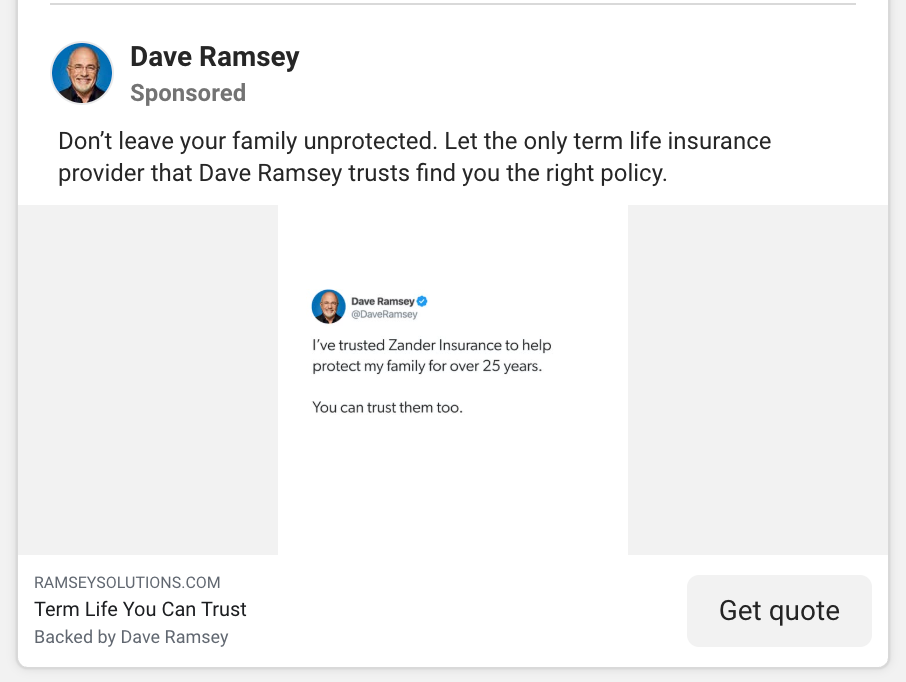
The Dave Ramsey/Zander Insurance example operates on borrowed trust. Ramsey’s audience already follows his financial philosophy, so an ad with his endorsement arrives with built-in credibility.
The message focuses on term life, family protection, and help finding a policy: straightforward, principle-aligned, and consistent with the financial advice Ramsey has built his audience on. That longevity signal does real work in an ad format where credibility is hard to establish quickly.
The lesson here is that social proof, expert alignment, and track record can all function as trust shortcuts in life insurance advertising. An independent agent with 200 five-star reviews has the same asset available.
4 Life Insurance Ads Worth Following: Summary Table
| Brand | Primary Hook | Audience Type | Core Benefit Framed | CTA Style |
| Ethos | Simplicity / No exam | Cold / Problem-aware | Fast, easy approval | Learn more |
| Veteran Life Insurance | Identity / Military service | Cold / Identity-targeted | Coverage built for veterans | Get quote |
| USAA | Convenience / Life stage | Warm / Brand-aware | Fits for working fathers and breadwinners | Get quote |
| Dave Ramsey/Zander | Trust / Endorsement | Warm / Brand-aware | Trusted family protection | Get quote |
How to Copy These Ads Without Copying Them
The goal is to extract the structural logic behind each ad and rebuild it around your own offer, audience, and compliance requirements. Every high-performing life insurance ad in this set follows the same underlying pattern: one audience, one tension, one benefit, one action. The execution changes, but the pattern holds.
Here is a repeatable process for turning these examples into original creative:
- Define one audience segment: a life stage, profession, or identity group your offer genuinely serves.
- Name the tension: the specific fear, inconvenience, or confusion that keeps that person from acting.
- Choose one benefit: the single product truth that resolves the tension you named.
- Write a headline that connects the two: tension on one side, resolution on the other.
- Set a CTA that matches awareness level: cold audiences need low-commitment asks like “Learn more” or “See what coverage may cost”; warm audiences can go straight to “Get a quote” or “Apply online.”
- Run compliance review before launch: confirm every claim, disclosure, and targeting parameter with licensed insurance and legal stakeholders before publishing.
Find & Build Winning Life Insurance Ads with GetHookd
The evidence for what works in life insurance advertising is already in the market. Brands spending real budget have tested the hooks, formats, and audience angles. What most agents and media buyers lack is a structured way to find those patterns and turn them into original creative without starting from scratch.
At GetHookd, we give you both sides of that workflow. Search and save real Facebook ads by niche, format, and run time to build a brief grounded in evidence, then move straight into production. Clone Ads turns a top-performing image into dozens of on-brand variations, Ads Transcription pulls hooks and CTAs from video ads into ready-to-use copy, and our image template library lets you produce launch-ready creatives across multiple formats. Try GetHookd and start building your next life insurance campaign today.
Frequently Asked Questions (FAQs)
Can you advertise life insurance on Facebook?
Yes, life insurance can be advertised on Facebook, but it falls under Meta’s Special Ad Category for financial products. This means certain targeting options (including age, zip code, and some interest-based filters) are restricted. Advertisers must select the correct special category when setting up campaigns and ensure all claims meet both Meta’s advertising policies and applicable state insurance regulations before running.
How can you promote insurance on social media?
The most effective approach is to match the message to the audience’s awareness level. Cold audiences respond to emotional hooks tied to a life stage or identity: a new parent, a veteran, a small business owner. Warm audiences respond to comparison, price transparency, and process ease.
What are some of the best insurance ads?
Standout life insurance ads include Ethos for simplicity-led creative, USAA for life-stage relevance, and the Dave Ramsey/Zander Insurance ads for trust-based framing. Each works because it leads with a single, specific benefit that is immediately credible to the audience it targets.
How can you get people interested in life insurance?
Make the consequence of inaction concrete without relying on fear. The most effective life insurance ads lead with the recognizable life the audience already has and the specific people depending on them. A working father, a veteran with a family, a first-time homeowner: frame the product as protection for something they already value, and the relevance takes care of the interest.
How does GetHookd help with advertising?
GetHookd is an ad intelligence platform that lets you search, save, and organize real ads by niche, ad format, performance, and run time. It also provides a structured swipe file: a place to collect examples like the ones covered earlier, tag them by strategy, and build creative briefs grounded in what is already working in the market.
*Note: Pricing and/or product availability mentioned in this post are subject to change. Please check our website for current pricing and stock information before making a purchase.