Key Takeaways
- GetHookd, the Meta Ad Library, Foreplay, and AdSpy are the top four social media ad library tools, covering everything from free transparency data to paid creative intelligence.
- GetHookd indexes ads with performance scoring and Brand Spy, while the free Meta Ad Library shows every active ad with no signal on what is scaling.
- GetHookd adds AI scripts, ad cloning, and creative analysis; Foreplay adds swipe files, Spyder competitor tracking, and creative analytics; and AdSpy adds comment and demographic search.
- GetHookd rates 4.8 on G2 for research speed, Foreplay also rates 4.8 on G2, and AdSpy rates 4.3 on Capterra, where cost is the recurring complaint.
- GetHookd is the only one of the four that scores competitor ads on live campaign behavior, turns a winner into scripts and cloned variations, and stores saved ads permanently.
What Does a Social Media Ads Library Tool Do?
GetHookd, the Meta Ad Library, Foreplay, and AdSpy are the four social media ads library tools most worth using in 2026, and each one lets you search the ads competitors are running right now. Finding a live ad is the easy part, though, because a live ad says nothing about whether it is making money. A tool earns its place by how well it helps you separate short-lived tests from real winners.
That distinction matters because no tool can show a competitor’s commercial ad spend, since Meta only discloses spend on political and social issue ads. How long an advertiser keeps funding a creative is the closest proxy available. Tracking that by hand means rechecking the same brands every week, and a paused ad can vanish before you save it.
GetHookd is built around this problem. It weighs campaign longevity, testing patterns, and engagement velocity, so your shortlist starts with the creatives competitors are actively scaling.

GetHookd: Turn Competitor Intelligence Into Your Next Winning Ad
GetHookd reveals which ads your competitors are actively scaling, not just running. Spy on their best-performing creatives, landing pages, and traffic strategies, then turn proven concepts into testable campaigns in seconds with AI-powered script generation and creative cloning.
What You Get:- ✓ Brand Spy to decode competitor ad strategies in real-time
- ✓ AI script generation and ad cloning for instant variations
- ✓ Performance scoring based on actual ad behavior, not vanity metrics
- ✓ Creative Analyzer to identify and scale your top performers
Top 4 Social Media Ads Library Tools
1. GetHookd: Best for Turning Competitor Research Into Testable Creatives
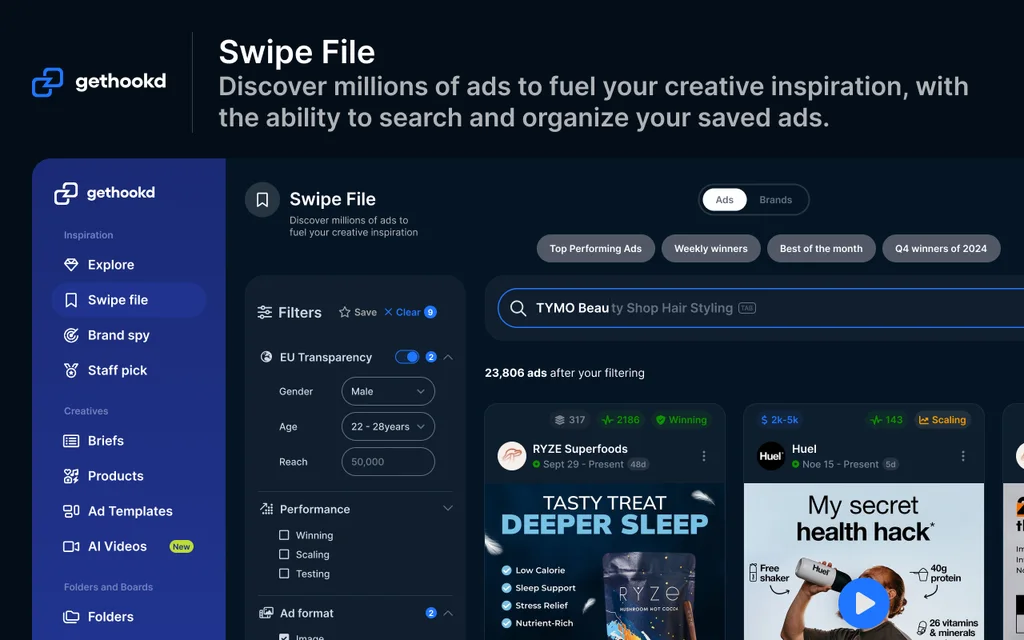
GetHookd is an ad research and creative intelligence platform, built for media buyers, performance marketers, agencies and eCommerce operators. It tops the list because it analyzes over 65 million high-performing ads across Meta and TikTok, indexes them continuously, and retains historical ads going back as far as 2018. One search covers all three platforms at once, so results come back together instead of requiring separate passes through each surface.
Filters narrow results by industry, campaign objective, creative format, engagement signals, and launch timeframe, keeping a broad niche search down to a workable shortlist. A performance scoring layer separates GetHookd from a plain library, weighing campaign longevity, creative testing patterns, and engagement velocity to surface ads that are scaling profitably instead of every ad that happens to be live the day you search. Brand Spy applies the same scoring to a single competitor, returning their active campaigns, top creatives, landing pages, traffic sources, and audience approaches in one view.
It stores every saved ad permanently, even after the advertiser switches the campaign off, which matters because a paused campaign otherwise erases the reference you were working from. GetHookd then continues into ad production, with Video Scripts generating hooks and scripts from a winning ad plus your product details, and Clone Ads producing color, format, and avatar variations of a static creative you want to test at volume.
GetHookd Reviews
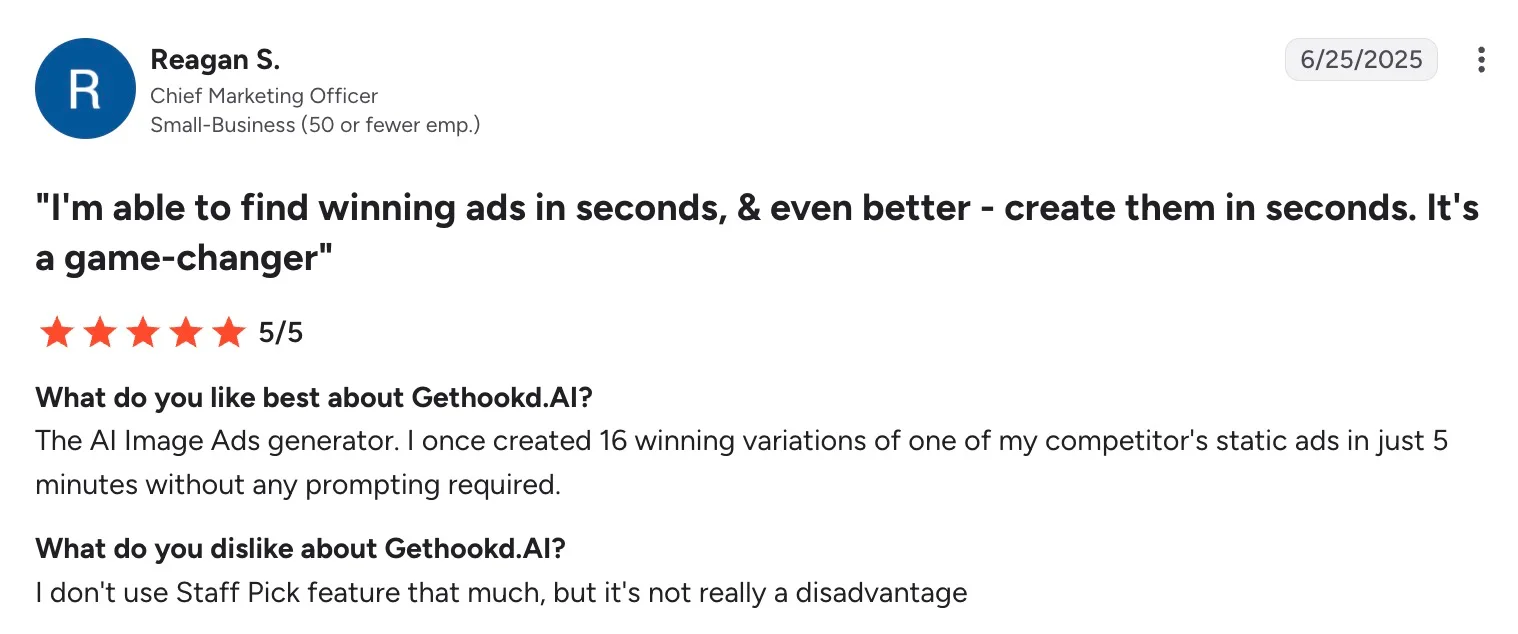
GetHookd holds a 4.8 out of 5 rating on G2. Reviewers praise how quickly the platform surfaces winning ads, identifies scaling brands, and turns competitor research into testable creative. The AI Image Ads generator also gets strong feedback for producing multiple variations quickly without requiring detailed prompting.
2. Meta Ad Library: Best for Free Spot Checks on a Named Competitor
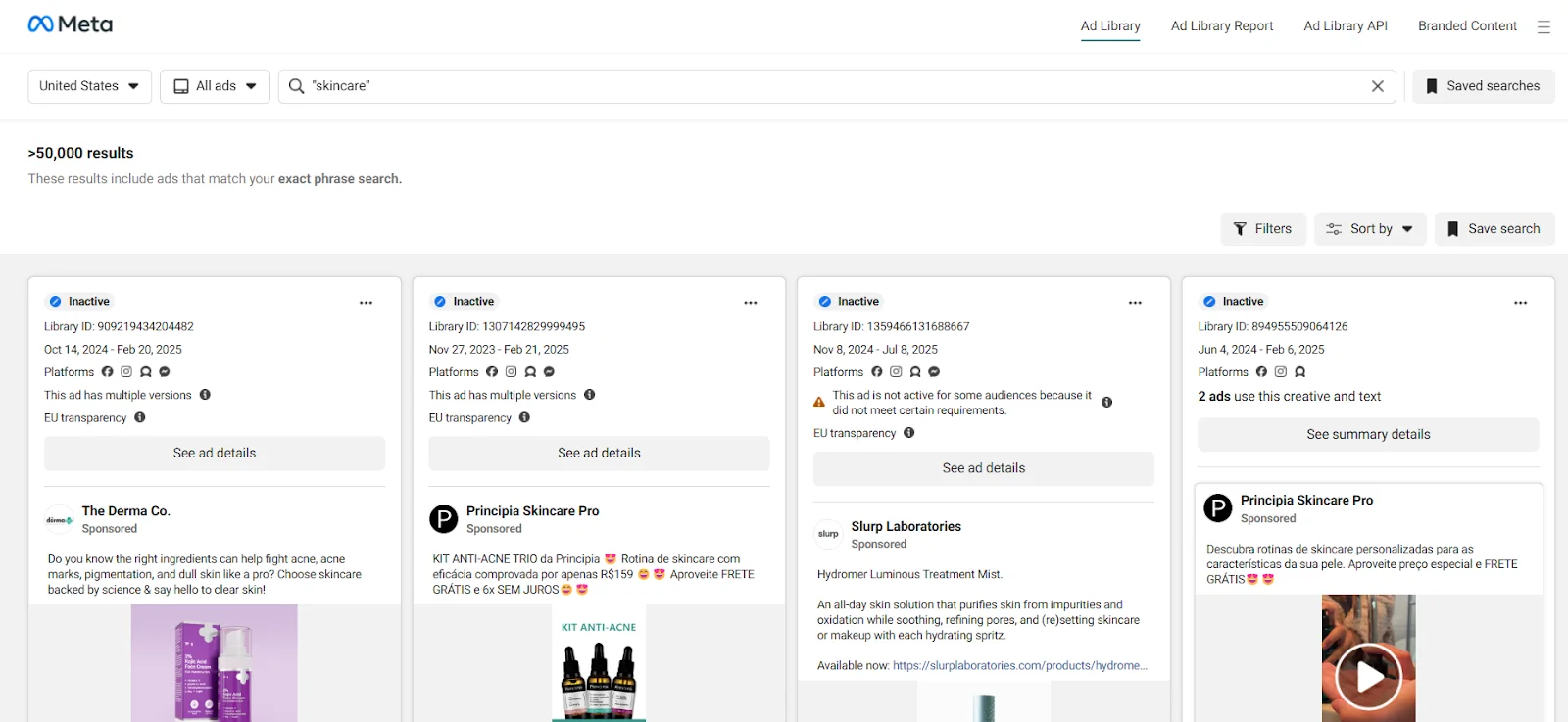
The Meta Ad Library, still widely called the Facebook Ad Library, is Meta’s own free, publicly searchable database built for advertising transparency. No account or payment is needed, and even signed-out visitors can search for all active ads running across Meta products. You can search by advertiser page name, keyword, or country, then review the creative, copy, start date, and the placements each ad runs on.
Coverage rules differ by ad type, and the split is wide. Political, electoral, and social issue ads carry extra disclosure, covering spend ranges, reach, and the entity that paid, and Meta keeps them on file for seven years. Commercial ads work differently, since standard ads are displayed only while active and are not archived once they stop running. Ads delivered to the EU, its associated territories, or the UK sit in the archive for one year after their final impression, with extra detail attached.
The trade-offs follow directly from that transparency purpose. A standard commercial ad has no performance signal, no way to save or organize what you find, and nothing to stop a creative from disappearing once the advertiser stops running it. That makes it a reliable free check on a competitor you can already name, and a weak foundation for research a team needs to return to.
Meta Ad Library Reviews
The Meta Ad Library is a free feature of Meta’s advertising platform and is not listed as a product on G2, Capterra or Trustpilot, so no independent aggregate score exists for it. Marketer commentary generally treats it as an accurate baseline for what is running, with recurring criticism about the lack of performance data and saving tools.
3. Foreplay: Best for Creative Teams That Brief & Report on Ads
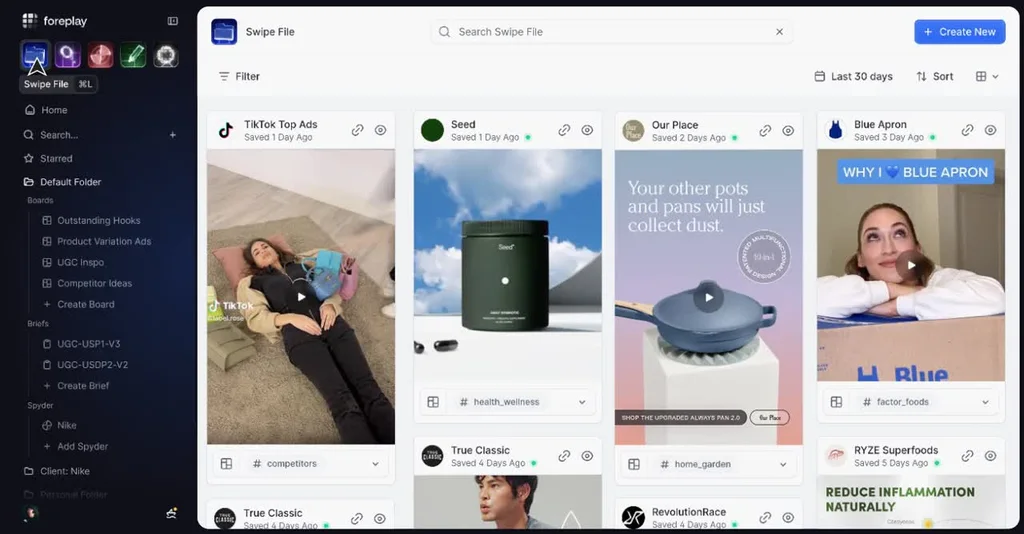
Foreplay is a creative workflow platform aimed at social ad teams and agencies. The research side is built around three products: Swipe File for saving and organizing ads, Discovery, which Foreplay describes as an ad search engine with over 100 million ads, and Spyder, a tracking tool that follows selected competitor brands and surfaces new launches and top hooks as they appear.
A free Chrome extension saves ads from the Meta, TikTok, and LinkedIn ad libraries, and a mobile app extends the same saving behavior to phones, which suits strategists collecting references away from a desk. Past the research stage, Lens handles creative analytics and reporting on your own campaign results, while Briefs turns saved references into storyboards and scripts for production teams to work from.
Foreplay Reviews
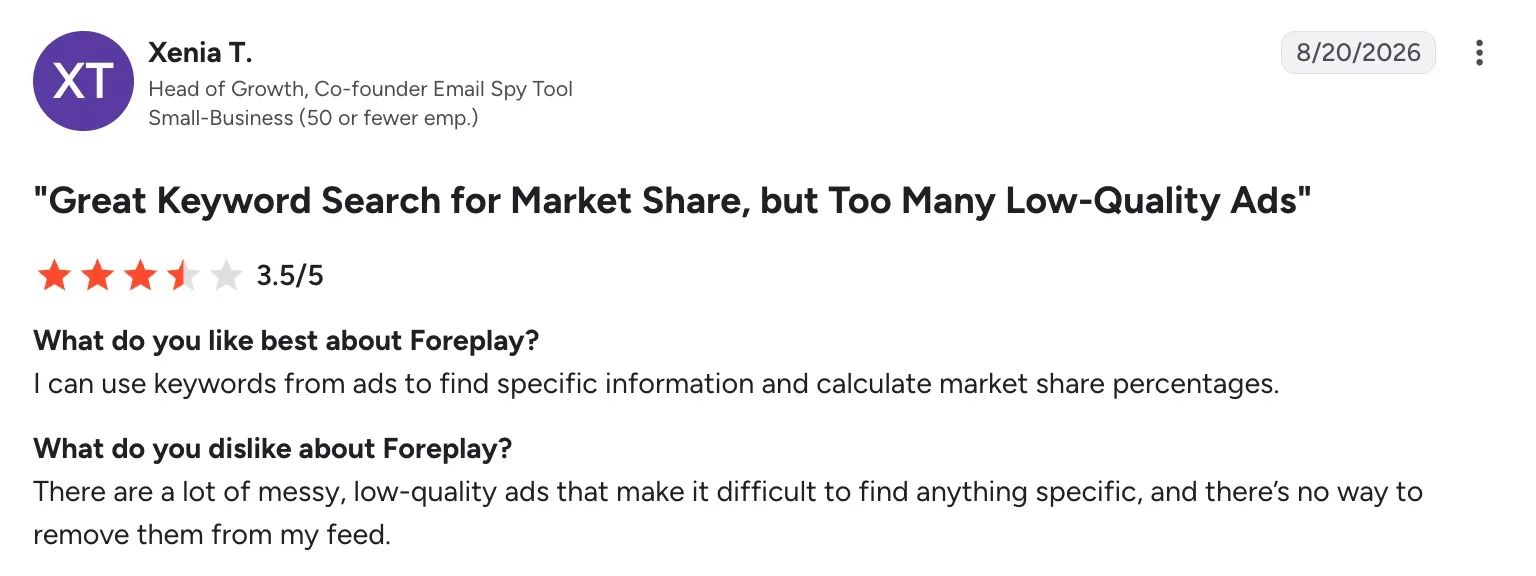
Foreplay holds a 4.8/5 rating on G2. Reviewers praise Spyder, the clean interface, and the ability to keep saved ads accessible after campaigns end. Criticism focuses on price, limited discovery filters, underwhelming briefs, and some billing complaints. One review also notes that low-quality ads can clutter results and make specific searches harder.
4. AdSpy: Best for Comment-Level & Demographic Ad Search
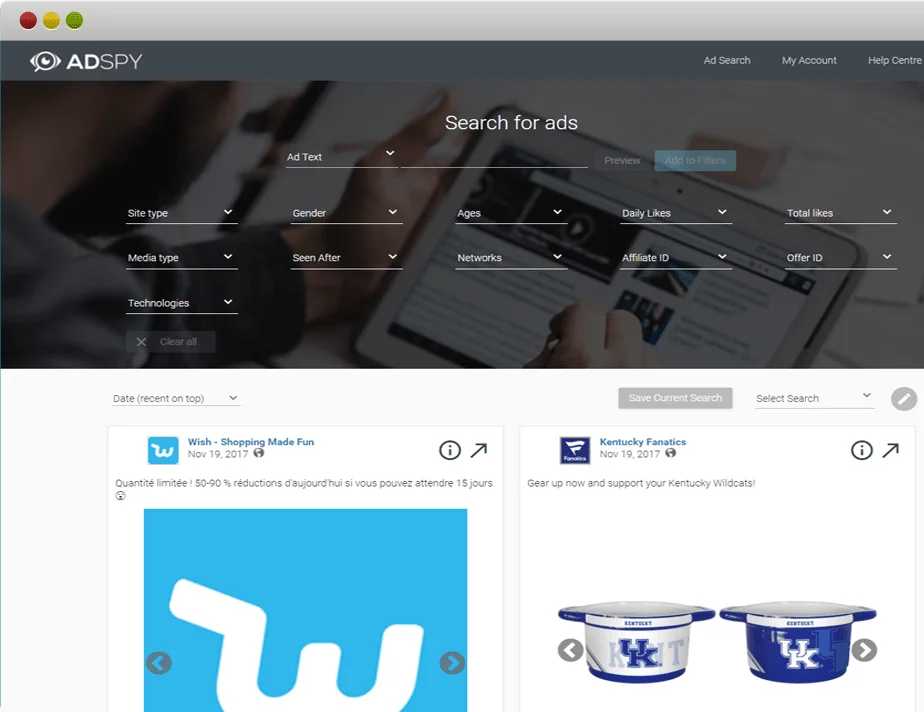
AdSpy describes itself as the world’s largest searchable database of Facebook and Instagram ads, and its site currently reports more than 210.7 million ads from over 30.1 million advertisers across 225 countries and 88 languages. The product is built for depth of search on Meta placements alone, with no coverage of other networks and no tooling past the point of discovery.
Search options go beyond keyword matching. You can search ad text, URL, and page name; search comments left on an ad to see how audiences responded; and filter by affiliate network, affiliate ID, offer ID, and landing page technology.
AdSpy also estimates who an ad targets by location, gender and age range, which is mainly relevant to affiliates testing the same offer across several international markets.
AdSpy Reviews
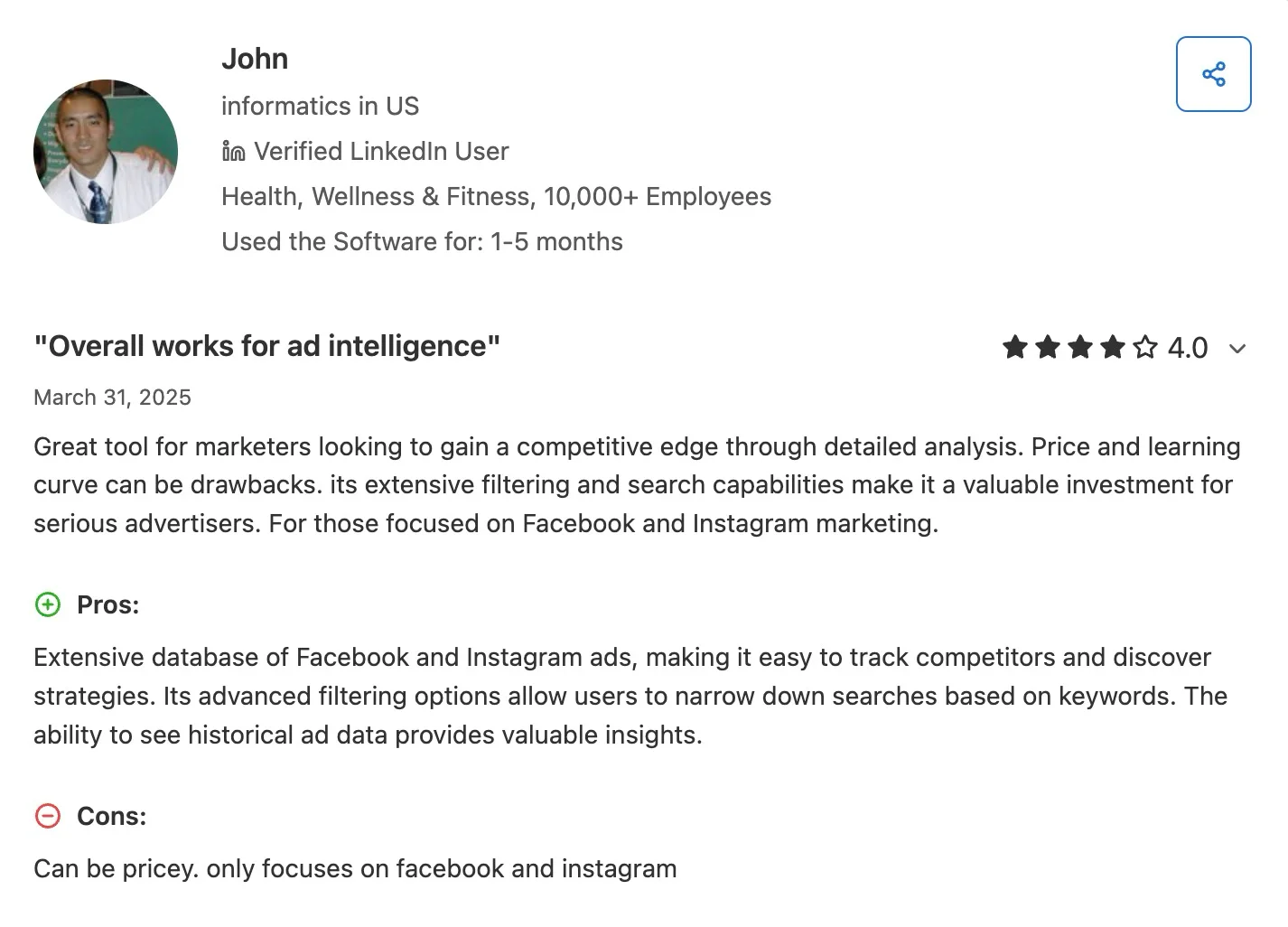
AdSpy holds a 4.3/5 rating on Capterra. Reviewers praise the large Facebook and Instagram ad database, advanced keyword filtering, and historical ad data for competitor research. Criticism focuses on price, a noticeable learning curve, limited platform coverage, short trial access, and slow support responses. Its Trustpilot score is lower, though based on relatively few reviews.
4 Best Social Media Ads Library Tools: Summary Table
| Tool | Ad Coverage & Quality | Performance Signal | Saved Ads | Creative Production | Review Score |
| GetHookd | 65M+ high-performing Meta ads, filtered by performance scoring | Yes, scoring on campaign longevity, testing patterns, and engagement velocity | Permanent, organized in folders | Yes, AI video scripts, ad cloning and creative analysis | 4.8 on G2 |
| Meta Ad Library | All active ads across Meta technologies, free | No, for standard commercial ads | No saving tools | No | No independent listing |
| Foreplay | 100M+ ads in Discovery (stated by Foreplay), with reviewers noting low-quality ads in results | Creative analytics on your own ads only, via Lens | Swipe file | Briefs and storyboards only | 4.8 on G2 |
| AdSpy | 210.7M+ Facebook and Instagram ads (stated by AdSpy), no performance filtering | No, engagement and demographic data only | Yes | No | 4.3 on Capterra |
Turn Ads Library Research Into Winning Creatives with GetHookd
All four tools show what competitors are running today, and the larger indexes add longer history and faster search. The deciding factor is what happens after the results load, since a page of live creatives still leaves you guessing which ones deserve budget and which will be switched off next week.
At GetHookd, we score every ad on live campaign behavior, so your shortlist starts with the creatives competitors keep funding month after month. Saved ads stay on file permanently, and you can turn any winner into scripts and cloned variations without leaving the platform. Start your free trial this week.
Frequently Asked Questions (FAQs)
How often should you check competitor ads?
Weekly is enough for most advertisers, since creative rotations and offer changes rarely move faster than that. Brands in seasonal categories or running aggressive testing cycles benefit from daily checks during peak periods.
Do you need technical skills to use an ads library tool?
No technical background is required for any of these platforms, since search works the same way as a normal website search: use a brand name, keyword, or product category, then narrow results with dropdown filters. The skill that matters is interpretation, because recognizing why a creative converts is harder than retrieving it.
Can you download videos from the Meta Ad Library?
The Meta Ad Library has no native download button, so you can only view videos in the browser while the campaign stays active. Third-party tools and browser extensions fill that gap, and paid ad libraries store a copy of the creative in your saved collection instead.
Can an ads library tool show how much a competitor spends?
Commercial ad spend is not published anywhere, so no tool can show it. Spend and reach figures appear only on ads about social issues, elections, and politics, where Meta must disclose them, so performance scoring based on how long an ad keeps running is the closest available proxy.
Can you see which ads a specific competitor is scaling?
Yes. GetHookd’s Brand Spy shows a single competitor’s active campaigns, top-performing creatives, landing pages, and traffic sources in one view. Because each ad is scored on campaign longevity and testing patterns, you can tell which creatives the brand keeps funding and which are short-lived tests.
*Note: Pricing and/or product availability mentioned in this post are subject to change. Please check our website for current pricing and stock information before making a purchase.