Key Takeaways
- The best home improvement Facebook ads in 2026 combine a clear offer or benefit, a proof point that lowers risk, and one action.
- Window Nation and West Shore Home use large offers, buy-four-get-four windows and a free shower, backed by fast installation and financing.
- Gutter Guard by Gutterglove uses seasonal timing and a Home Depot link, and Semper Fi Heating and Cooling uses a promo-code hook.
- The Meta Ad Library shows which competitor ads run and for how long, but duration is not performance, so a long run only hints at results.
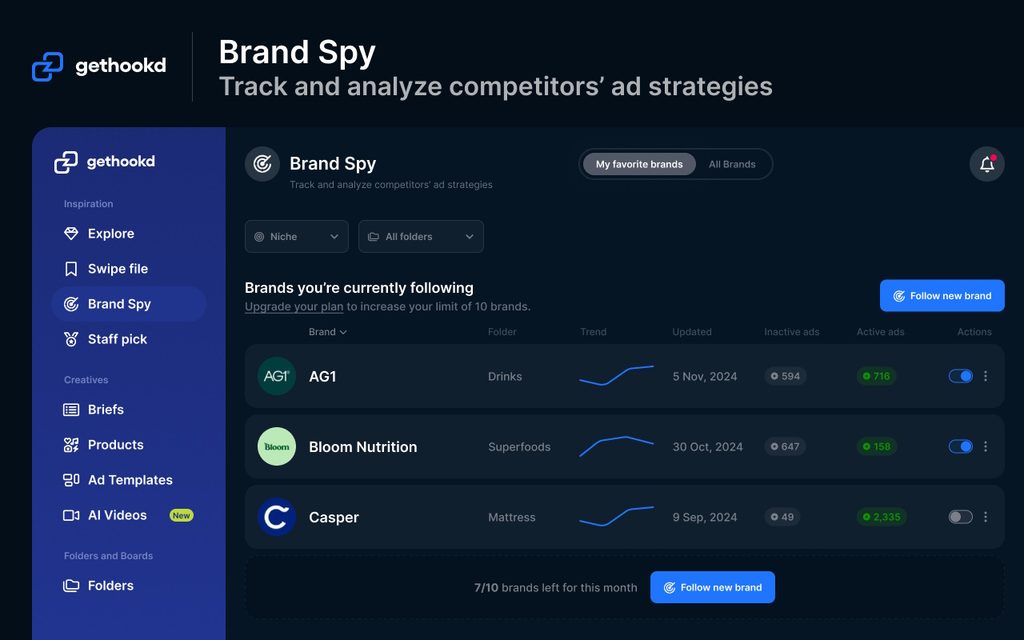
- GetHookd goes further with performance scoring based on real ad behavior, Brand Spy to see which creatives get budget, and AI cloning to rebuild proven winners into new variations.
How Home Improvement Facebook Ads Are Built to Convert
Four home improvement Facebook ads show the range of what works in 2026: Window Nation’s window deals, West Shore Home’s free-shower remodel offer, Gutter Guard by Gutterglove’s seasonal hook, and Semper Fi Heating and Cooling’s promo code. Each takes a different angle, but they share the same build: one clear offer or benefit, a proof point that lowers risk, and a single action.
Copying an ad because it looks polished is a common mistake, since a slick ad may never have made money in the first place. What matters is the structure underneath. These four examples make that structure easy to see. Studying how each advertiser states its benefit, backs it up, and asks for a single action gives you a proven template to test, rather than a guess about what might work in your own category.

GetHookd: Turn Competitor Intelligence Into Your Next Winning Ad
GetHookd reveals which ads your competitors are actively scaling—not just running. Spy on their best-performing creatives, landing pages, and traffic strategies, then turn proven concepts into testable campaigns in seconds with AI-powered script generation and creative cloning.
What You Get:- ✓ Brand Spy to decode competitor ad strategies in real-time
- ✓ AI script generation and ad cloning for instant variations
- ✓ Performance scoring based on actual ad behavior, not vanity metrics
- ✓ Creative Analyzer to identify and scale your top performers
Top 4 Home Improvement Facebook Ads to Learn From in 2026
1. Window Nation
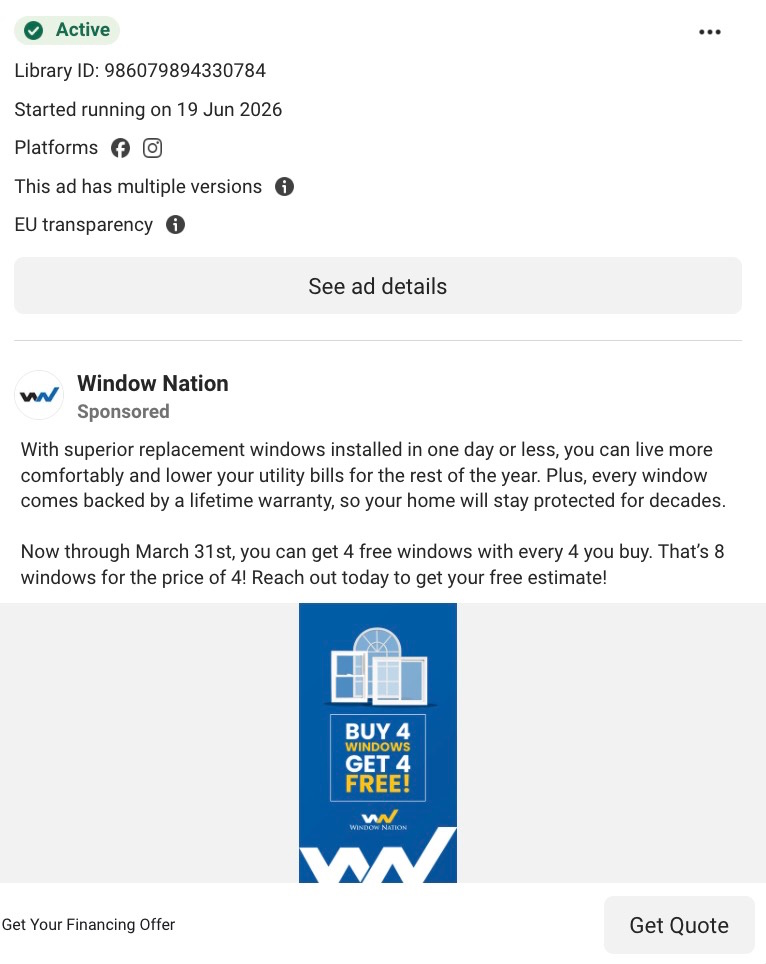
Window Nation advertises replacement windows using a benefit-first structure. The opening line states the result for the homeowner, a more comfortable home and lower utility bills, before any product detail. Two supporting facts follow: installation in a day or less and a lifetime warranty on every window. Each claim is short, so the benefit and the proof are read at a glance.
The offer appears after the benefit. A buy-four-get-four-free promotion reframes a large project as a limited deal, and a financing option addresses the high upfront cost that stops many window shoppers. Related versions test sharper offer lines, including 50 percent off all styles and zero down with no payments for two years, which keep the same benefit-and-offer order.
The call to action is a free estimate reached in one click. This matches the buying pattern for windows, where a homeowner requests a price before committing, so the low-pressure ask fits the stage the buyer is at.
2. West Shore Home
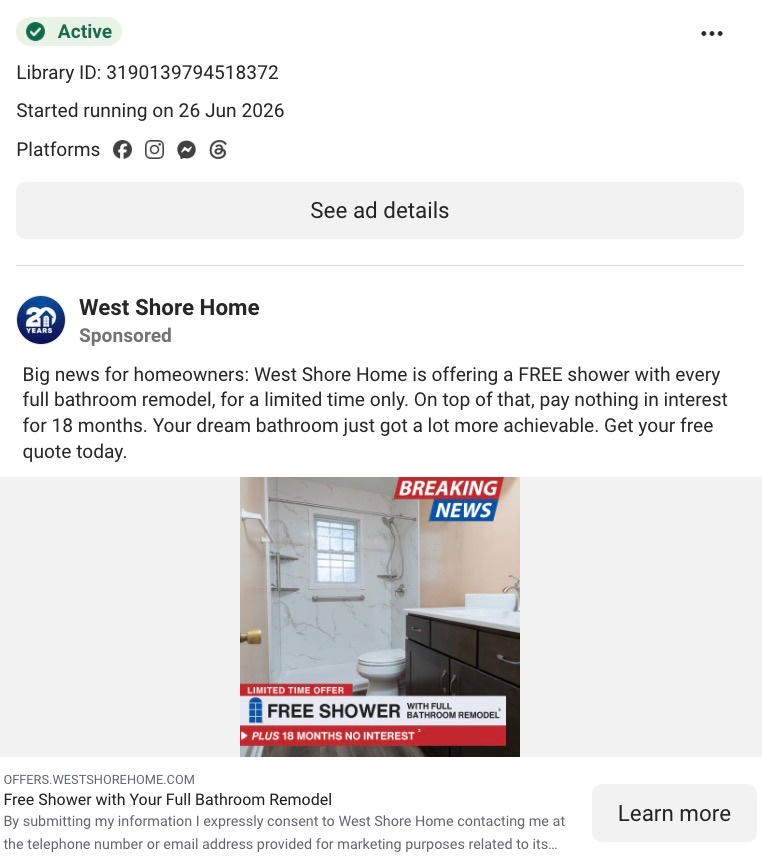
West Shore Home advertises full bathroom remodels and targets two common objections, cost and disruption. The main offer is a free shower with every full bathroom remodel, combined with no interest for 18 months. Neither element quotes a fixed price, so the ad reads as an incentive rather than a rate card, and the offer is stated before any brand messaging.
The disruption objection is handled through speed and process. Related versions state that a remodel can be completed in two to three days, and that crews arrive on schedule and leave the home clean. A separate version markets walk-in showers with built-in seating and grab bars, aimed at accessibility without a medical tone.
The call to action is a single free quote. West Shore Home also runs a sweepstakes version that gives one winner a free remodel, which collects leads from people who are interested but not ready to buy.
3. Gutter Guard by Gutterglove
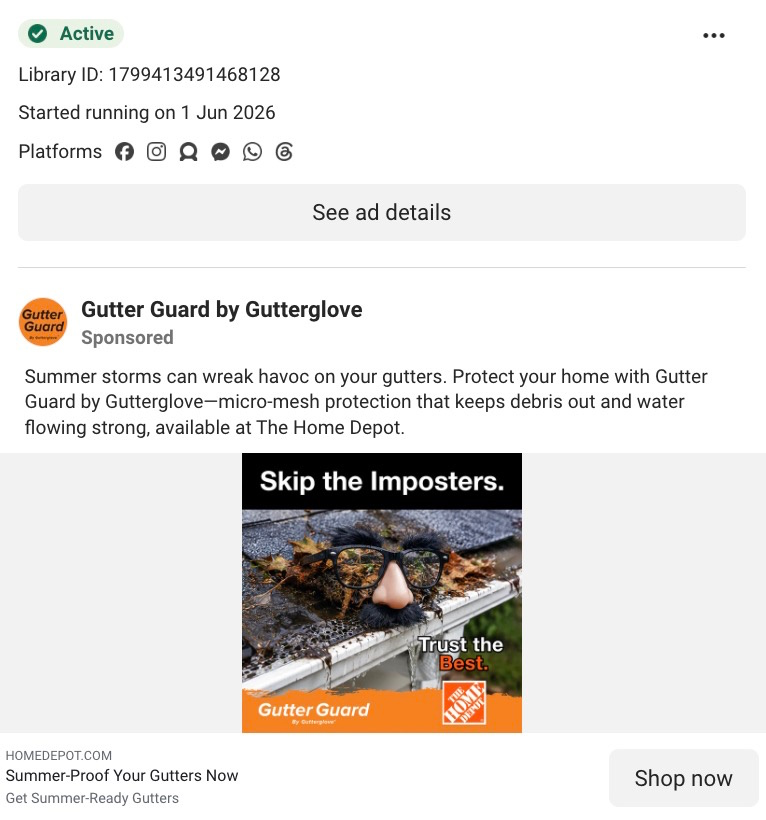
Gutter Guard by Gutterglove advertises a micro-mesh gutter guard sold through The Home Depot. The ad opens with a seasonal trigger, noting that summer storms can overload clogged gutters, which gives the reader a timing-based reason to act. The product benefit is then stated in one sentence: micro-mesh protection keeps debris out and water flowing.
The ad adds no technical specifications beyond that single benefit, which keeps the message short and readable in the feed. Credibility comes from the retailer rather than from claims in the copy, a lower-effort route to trust for a product brand. The advertiser runs several near-identical versions at once, a common method for spreading delivery while testing small differences.
The click leads to a Home Depot product page, and the button text reads Summer-Proof Your Gutters Now, which repeats the seasonal frame. The retailer link also supports a direct purchase, which suits a lower-cost product that does not require a quote.
4. Semper Fi Heating and Cooling
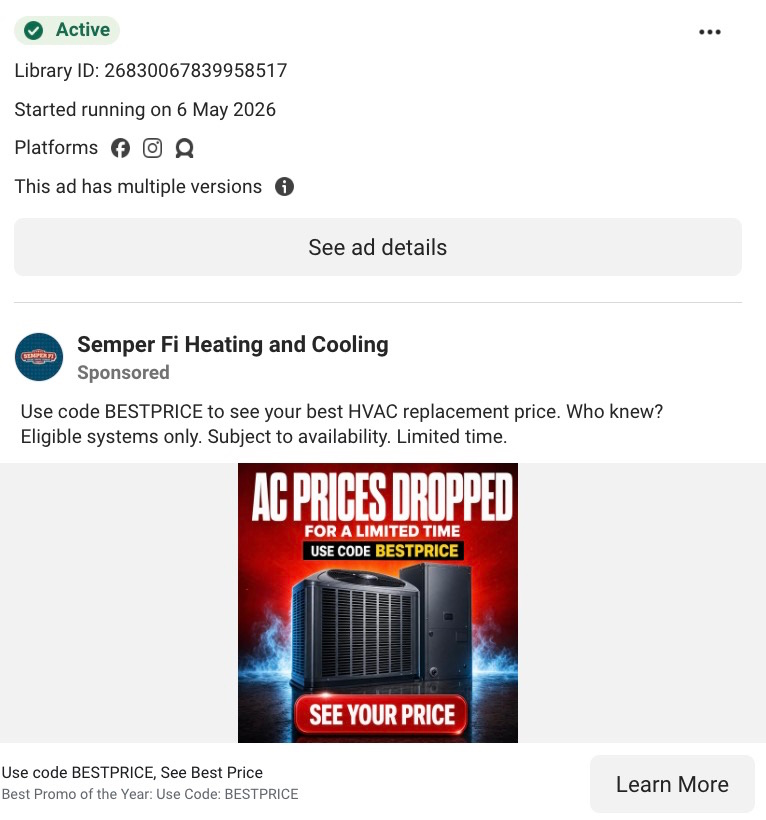
Semper Fi Heating and Cooling advertised HVAC replacement using short, curiosity-based copy. The ad instructed the reader to use the code BESTPRICE to see their best replacement price, followed by the line Who knew. The promo code was the main mechanic and gave the reader a single, specific action.
Two short lines added scarcity, stating that only eligible systems qualified and that the offer ran for a limited time. The copy was brief because the objective was the click, not an immediate sale, which fits a service that homeowners research before buying. The ad is no longer active, which is what a limited-time offer should do, since an end date that actually arrives keeps the scarcity honest.
That follow-through matters more than it looks. When a limited deal genuinely closes, the next promo from the same advertiser carries weight, because the audience has already seen that the deadline was real.
Home Improvement Facebook Ads at a Glance
| Advertiser | Service | Main Angle | Offer or Hook |
| Window Nation | Replacement windows | Comfort and lower energy bills | Buy 4, get 4 free, plus financing |
| West Shore Home | Bathroom remodels | Fast, low-disruption remodel | Free shower, 18 months no interest |
| Gutter Guard by Gutterglove | Gutter protection | Seasonal, storm-ready home | Micro-mesh, sold at The Home Depot |
| Semper Fi Heating and Cooling | HVAC replacement | Curiosity and savings | Promo code BESTPRICE, limited time |
Turn Proven Home Improvement Ad Angles Into Your Next Campaign With GetHookd
The four ads all win the same way: one clear benefit, a proof point that lowers the risk of clicking, and a single next step for the reader to take. That build is the template, and any home improvement advertiser can apply it to their own offer.
The harder question is which angle to run first. Guessing is expensive when home improvement leads already cost more than most e-commerce clicks, so the safer move is to base the decision on what competitors are actually funding. GetHookd scores competitor ads on real behavior and shows which creatives are getting budget, then lets you clone the winners into your own variations. Start a trial with GetHookd and build scaling ads from angles that are already proven.
Frequently Asked Questions (FAQs)
Do image ads or video ads perform better for home improvement?
Both formats work, and the result depends on the service and the offer. Before-and-after images perform well for visual projects such as bathrooms and windows, while short video suits demonstrations and customer testimonials. Testing one image ad and one video ad against the same offer is the most reliable way to find the stronger format for a specific audience.
Should a home improvement ad send traffic to a form or a website?
The right choice depends on the goal. A lead form suits service quotes, since it captures contact details quickly for follow-up and works for high-cost projects that need a consultation. A website or product page suits lower-cost items a homeowner can buy directly, such as a retail gutter guard, where no quote is required before purchase.
How much budget do I need to test a home improvement Facebook ad?
Enough to gather stable results before deciding, which depends on the audience size and the cost per lead in the category. Home improvement leads are often expensive compared with low-cost e-commerce products, so a test usually needs more spend to reach a reliable read on performance and to avoid judging an ad on too few conversions.
How often should I refresh my ad creative?
Creative fatigue sets in when the same audience sees an ad too many times, which raises the cost per result and lowers response. A common practice is to introduce new images, hooks, or offers every few weeks, and sooner for small local audiences that see the same ads more frequently than a large national audience does.
How can I tell if a competitor’s ad is actually working before I copy it?
A long run suggests an ad hasn’t been shut off, but it isn’t evidence of profit. GetHookd adds performance scoring based on real ad behavior and shows which creatives a competitor is putting budget behind through Brand Spy, so you can separate a scaled winner from a short test before spending on your own version.
*Note: Pricing and/or product availability mentioned in this post are subject to change. Please check our website for current pricing and stock information before making a purchase.