8 Effective UGC Facebook Ad Examples to Try in 2026
Key Takeaways
- UGC Facebook ads outperform studio creatives because they look organic even when the content is carefully structured.
- Never open a UGC ad with the brand or product name. Lead with the problem, a surprising result, or an unexpected statement that earns attention before any selling begins.
- Source before and after content directly from customers who documented their own journey, and use raw, unedited photos wherever possible, since dramatized transformations destroy trust.
- Run partnership ads through a creator’s handle rather than your brand page to make paid promotions feel indistinguishable from organic content.
- GetHookd gives you access to 65M+ real Meta ads to study which UGC formats competitors are scaling, plus AI-powered features like Video Scripts and Clone Ads to brief, build, and launch faster.
UGC Facebook Ads Are Outperforming Studio Creative in 2026
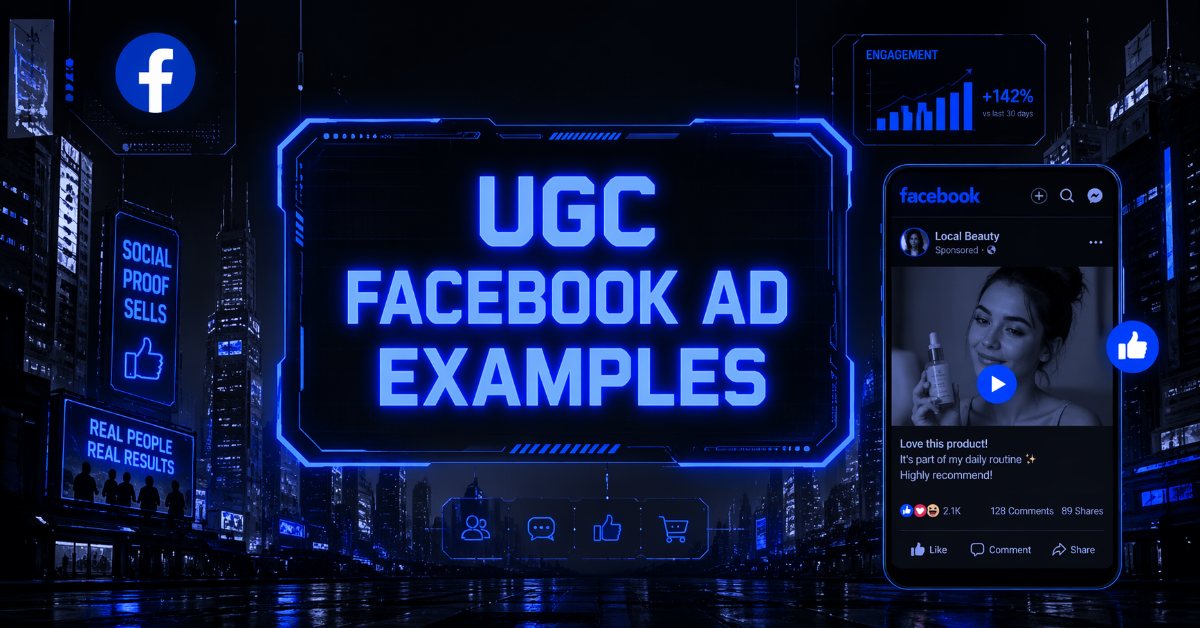
UGC ads consistently outperform studio-produced creative on Meta, and the performance gap is wide enough that brands still defaulting to polished brand content are leaving meaningful results on the table.
The reason is straightforward. Meta’s algorithm rewards content that earns genuine interactions, and UGC earns more of them because it does not look like an ad. Performance UGC is more deliberate than a customer simply filming themselves with a product.
The best-performing formats are carefully briefed and structured to look spontaneous while being engineered for conversion. Below are examples worth trying in 2026 and how to make them work.

GetHookd: Turn Competitor Intelligence Into Your Next Winning Ad
GetHookd reveals which ads your competitors are actively scaling—not just running. Spy on their best-performing creatives, landing pages, and traffic strategies, then turn proven concepts into testable campaigns in seconds with AI-powered script generation and creative cloning.
What You Get:- ✓ Brand Spy to decode competitor ad strategies in real-time
- ✓ AI script generation and ad cloning for instant variations
- ✓ Performance scoring based on actual ad behavior, not vanity metrics
- ✓ Creative Analyzer to identify and scale your top performers
8 High-Performing UGC Facebook Ad Examples to Test in 2026
1. The “Raw Unboxing” Ad
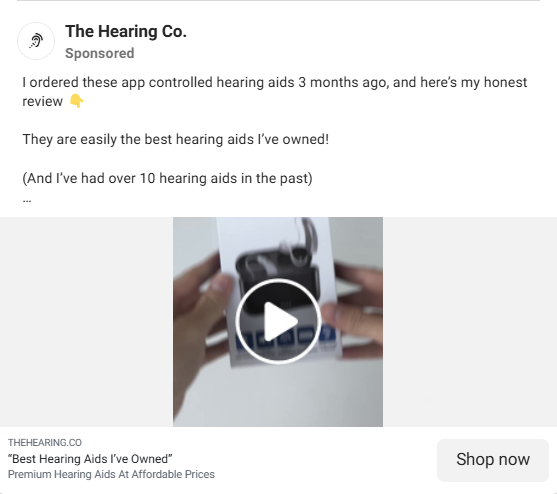
Few formats build excitement and trust as quickly as a raw unboxing video. Watching someone open a product for the first time feels unscripted, which is exactly why it converts. The format showcases physical product quality while letting the creator’s reaction do the selling.
The psychological mechanism is social proof in motion. Viewers are not reading a review; they are watching someone experience the product in real time, which creates vicarious excitement and lowers purchase hesitation. Unboxing ads also naturally demonstrate value through the packaging, the presentation, and the product itself, without ever feeling like a formal product demo.
2. The “Before and After” Transformation Ad
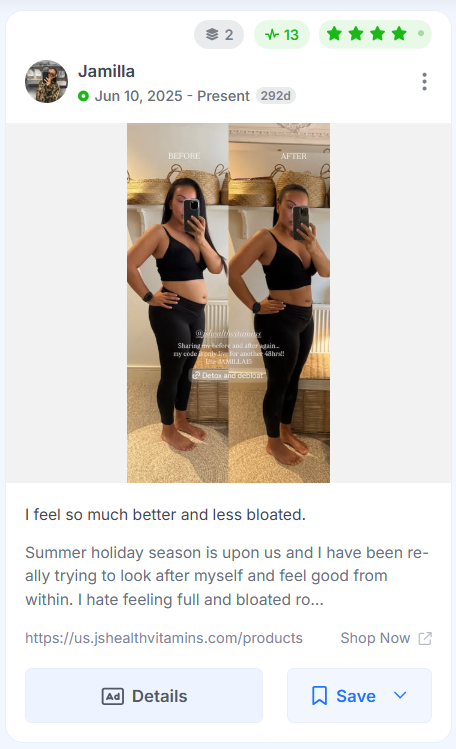
Before and after ads are experiencing a resurgence on Facebook in 2026. When a person shows a real result, it collapses skepticism faster than any brand claim could.
The format works across almost every category: skincare, fitness, home organization, and software tools. If your product creates a measurable or visible change, there is a before-and-after story worth telling.
The biggest mistake brands make with this format is over-editing. The moment a before photo looks suspiciously bad or an after photo looks suspiciously perfect, trust evaporates.
Real results, even modest ones, consistently outperform dramatized transformations because audiences are trained to spot manipulation. Source content directly from customers who have documented their own journey, use raw photos wherever possible, and if any lighting adjustment is needed, keep it minimal and consistent across both images.
3. The “Talking Head” Review Ad
A creator looking directly into the camera and talking about a product is the most versatile UGC format on Facebook and still one of the top performers in 2026. It is simple, scalable, and when structured well, feels completely organic.
The format mimics how people naturally talk about products they love. A high-converting talking head ad follows a simple arc:
- Open with a bold statement, a surprising claim, or a relatable pain point
- Validate the viewer’s frustration or desire
- Introduce the product naturally through personal experience
- A specific result, timeframe, or sensory detail
- A direct, low-friction CTA
The most important scripting principle is to never open with the brand or product name. Lead with the problem, the result, or an unexpected statement.
4. The “Day in My Life” Integration Ad
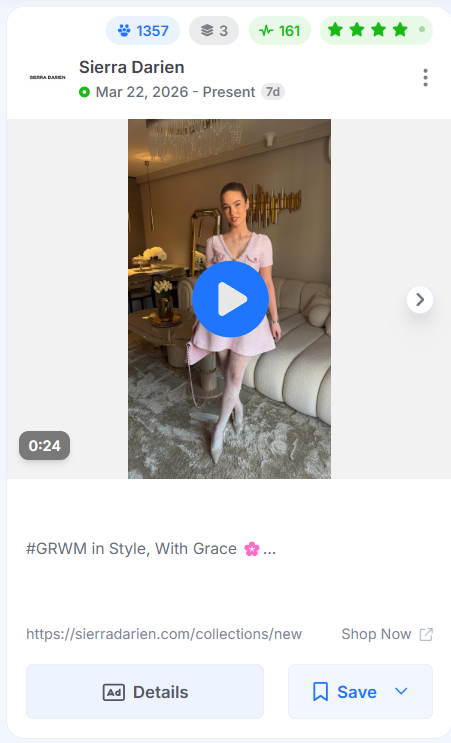
This Facebook ad format naturally embeds the product into a creator’s daily routine rather than presenting it as the ad’s subject. The result feels less like advertising and more like content someone chose to watch.
The key is product placement that feels incidental. The creator should not stop the narrative to talk about the product at length.
A brief, natural mention combined with a clear visual of the product is often more persuasive than a direct promotion. When briefing creators for this format, share detailed audience personas rather than product talking points and let them build the narrative around their actual routine. The more the creator’s life matches your audience’s reality, the stronger the ad will perform.
5. The “Problem-Solution” Story Ad
The problem-solution format is built on empathy first. The ad earns the viewer’s trust by proving it understands their frustration before mentioning a product.
What separates a good problem-solution ad from a great one is how precisely the pain is named. “I was always tired” does not convert as well as “I was crashing at 2 pm every single day, no matter how much coffee I drank.”
The product should appear no earlier than the 30% to 40% mark of the video. Everything before that builds emotional investment. After the reveal, move quickly into proof: a specific result, a timeframe, or a sensory detail that makes the benefit tangible.
6. The “Skeptic Turned Believer” Ad
The skeptic-turned-believer format is one of the most psychologically effective UGC formats available. The creator opens by expressing genuine doubt about a product, then documents what happened when they actually tried it.
This works because it preemptively handles objections. By the time the viewer hears the creator’s initial skepticism, they are already nodding along.
When the creator’s doubts are resolved by real experience, the viewer’s objections get resolved simultaneously. A creator who opens with “I honestly thought this was going to be another overhyped product” comes out as more credible than one who leads with unbridled enthusiasm.
7. The “Text Overlay Only” Static Ad
The text overlay static format, such as a customer photo or authentic lifestyle image paired with review-style text, is a growing ad format on Meta. It is low-cost to produce, fast to test, and performs comparably to other formats in certain audience segments.
The structure mimics the visual language of screenshots, which triggers the same trust response as reading a real review. The image should look like something a customer would post organically.
What makes this format especially valuable is speed. You can produce multiple variations in the time it takes to brief a single video creator, making it ideal for rapidly testing different angles, pain points, and benefit claims before scaling the winners into your broader creative pipeline.
8. The “Partnership Ad” Run Through a Creator Handle
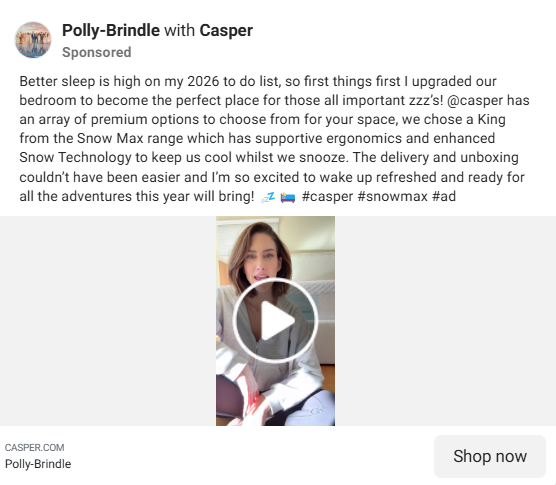
Partnership ads are an underutilized format in UGC advertising. Instead of running an ad from your brand’s Facebook page, you run it directly from the creator’s personal account, with their name and face attached to every impression.
From the viewer’s perspective, it looks exactly like an organic post from someone they may already follow, because technically it is.
Meta has reported that partnership ads with testimonial elements deliver 7.5% higher conversion rates than standard ads. The setup runs entirely through Meta’s partnership ad hub inside Business Manager, where the creator enables permissions and the brand gains full targeting control without requiring further input from the creator.
Effective UGC Facebook Ad Examples Summary Table
| Format | Best For | Key Strength |
| Raw Unboxing | Products where packaging, presentation, and physical quality drive purchase decisions | Unscripted first impressions that create vicarious excitement |
| Before and After Transformation | Any product that creates a measurable or visible change | Visual contrast that communicates value instantly |
| Talking Head Review | Brands needing a scalable, versatile format that feels organic | Direct-to-camera delivery that mimics a personal recommendation |
| Day in My Life Integration | Products that fit naturally into a daily routine or lifestyle | Embeds into a real person’s life, making it feel like content rather than advertising |
| Problem-Solution Story | Products solving a specific pain point | Empathy-first structure that earns trust before the product is revealed |
| Skeptic Turned Believer | Products in skeptical or saturated categories where trust is the primary conversion barrier | Preemptive objection handling disguised as authentic personal storytelling |
| Text Overlay Static | Brands needing fast, low-cost creative | Screenshot-style aesthetic that feels like reading a real review |
| Partnership Ad | Brands with established creator relationships looking to scale reach | Runs from a creator’s handle, making paid content feel indistinguishable from organic posts |
GetHookd: All-In-One Solution for UGC Facebook Ads
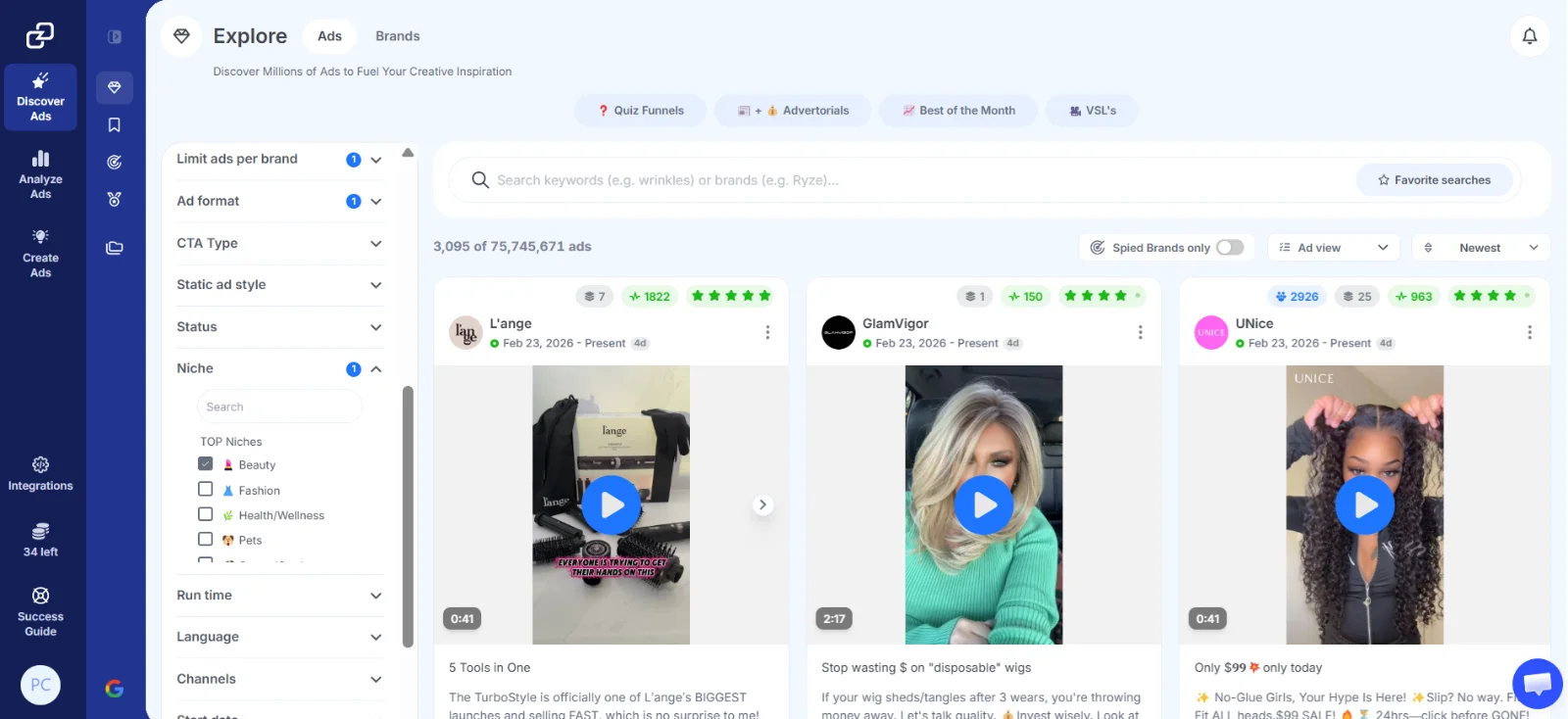
Finding UGC formats that convert in your niche takes more than scrolling through a feed and hoping something stands out. The faster path is studying what competitors are already scaling, understanding which creative angles are driving results, and building your own variations from a foundation of real market intelligence.
GetHookd’s Explore Ads feature gives you access to 65M+ real Meta ads so you can search by niche and format. When you are ready to produce, our Ads Transcription tool extracts hooks and copy frameworks from any video ad so you can identify the language patterns driving engagement. Our Clone Ads and Image Ad Templates let you generate multiple winning static creatives instantly, while our Video Scripts tool builds full ad scripts from your product details so your creators always have a strong brief to work from.
Start your GetHookd free trial today!
Frequently Asked Questions (FAQs)
What makes a UGC Facebook ad different from a regular Facebook ad?
A UGC Facebook ad features content created by customers, creators, or brand fans, rather than produced by a brand’s marketing team. The visual language and delivery are designed to look organic rather than advertised, which drives the core performance advantage.
Do I need to hire creators, or can I use real customer content?
Both work. Real customer content carries the highest authenticity signal and costs nothing to produce, but it is unpredictable in quality and volume. Hiring UGC creators gives you control over format, pacing, and hook structure while maintaining the authentic visual style that makes the format perform. The practical approach is to use customer content when it meets a quality threshold and supplement with briefed creators to maintain a consistent pipeline.
How long should a UGC Facebook ad video be?
For feed placements, 30 to 45 seconds works for most product categories, long enough to deliver a complete hook-problem-solution-CTA narrative and short enough to retain most viewers. That said, the video should be exactly as long as the story requires. If you are consistently losing viewers before the halfway mark, that is a pacing problem, not a length problem.
How does GetHookd’s Brand Spy help me find and launch better UGC Facebook ads?
GetHookd’s Brand Spy tool lets you track any competitor’s full ad strategy over time, including which UGC formats they are testing, how their creative direction shifts week to week, and which formats they are scaling versus pausing. For brands running UGC at volume, that competitive visibility means you are never the last to know when a new format or angle starts gaining traction in your market.
*Note: Pricing and/or product availability mentioned in this post are subject to change. Please check our website for current pricing and stock information before making a purchase.