Key Takeaways
- Some of the best Facebook Audience Network ad formats are native, interstitial, and rewarded video, each designed for different levels of user attention.
- Use native ads for awareness and engagement, and interstitial ads for full-screen visibility at natural app breaks without disrupting the user experience.
- Rewarded video ads stand out by giving users a clear value exchange, encouraging voluntary engagement through in-app rewards.
- GetHookd simplifies Audience Network advertising by showing which Meta ads competitors are actively scaling through features like Brand Spy, Creative Analyzer, and Landing Page Insights, so that you can build campaigns around proven strategies.
Why Should You Use Audience Network Facebook Ads?
Running ads only on Facebook and Instagram can limit how many potential customers you reach. Audience Network extends your Meta campaigns into thousands of third-party mobile apps and websites while using the same targeting, optimization, and measurement tools available in Meta Ads Manager, helping you find additional conversion opportunities without creating separate campaigns.
This additional reach matters because Meta’s family of apps serves 3.43 billion daily active users, and its recommendation systems have continued increasing engagement across Facebook and Instagram, creating more opportunities for advertisers to scale successful campaigns.
Choosing the right placements is only part of the equation. Understanding when each Audience Network ad format works best, along with the creative and campaign strategies that support it, can help you get more value from every Meta advertising dollar. GetHookd helps you make those decisions with real competitor insights.

GetHookd: Turn Competitor Intelligence Into Your Next Winning Ad
GetHookd reveals which ads your competitors are actively scaling—not just running. Spy on their best-performing creatives, landing pages, and traffic strategies, then turn proven concepts into testable campaigns in seconds with AI-powered script generation and creative cloning.
What You Get:- ✓ Brand Spy to decode competitor ad strategies in real-time
- ✓ AI script generation and ad cloning for instant variations
- ✓ Performance scoring based on actual ad behavior, not vanity metrics
- ✓ Creative Analyzer to identify and scale your top performers
Top 3 Audience Network Facebook Ads Examples
1. Native Ads: A Content-Like Advertising Approach
Native ads are designed to match the look, feel, and format of the content where they appear, making them feel less like traditional ads and more like part of the experience.

What Makes Native Ads Effective
Effective native ads focus on simplicity, relevance, and seamless integration. On Facebook, they often resemble organic posts while still clearly communicating value through image ads, short videos, and feed-style copy.
Key elements include:
- Matching Facebook’s native feed style
- Clear, relevant messaging
- Simple, content-like creative
- Transparent but non-disruptive presentation
2. Interstitial Ads: Full-Screen Ads Between Natural App Breaks
Interstitial ads are full-screen ads that appear inside mobile apps at natural transition points, such as between game levels, after completing an action, or during loading screens. They temporarily take over the entire screen, giving users a focused moment where the ad is the only visible content before they continue their activity.
On Meta’s Audience Network, which extends Facebook advertising into third-party apps, interstitial ads are commonly used because they fit naturally into mobile app flows while still using Facebook’s targeting and delivery system to reach relevant audiences.

What Interstitial Ads Look Like in Apps
Interstitial ads appear as full-screen static images, videos, or interactive creatives with a clear close option after a short delay. Unlike Facebook Feed or banner placements, they don’t compete with surrounding content since the entire screen is dedicated to the ad experience.
They are typically built with simple creative elements, a strong visual, a short message, and a clear call-to-action, making them easy to understand quickly in a mobile environment.
3. Rewarded Video Ads: Opt-In Ads Driven by Value Exchange
Rewarded video ads are a mobile ad format where users choose to watch a video in exchange for an in-app reward such as extra lives, virtual currency, or accessible features. On Meta’s Audience Network, which extends Facebook advertising into third-party apps, this format is fully opt-in, meaning users only engage when they see clear value in doing so.
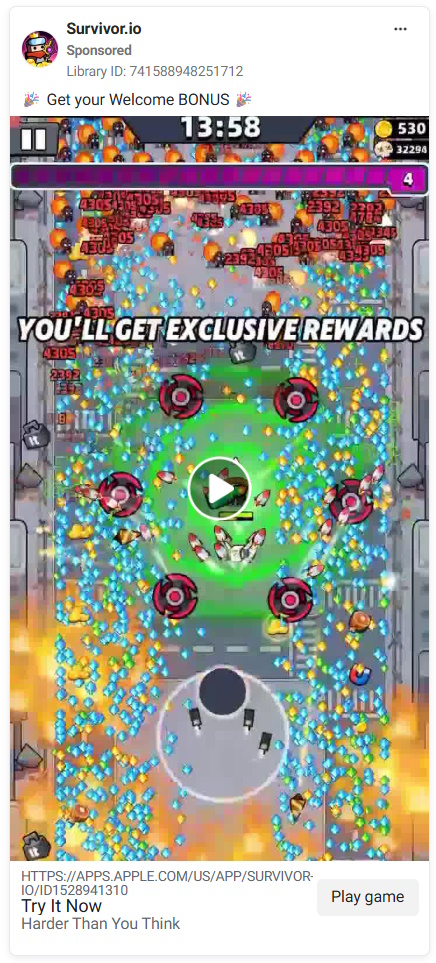
How Rewarded Video Ads Are Structured
Effective rewarded video ads are short, focused, and designed to deliver the main message early. The strongest results typically come from clear hooks in the first few seconds, followed by a simple value explanation and a direct call-to-action like “Install Now” or “Claim Reward.”
Overly long introductions or heavy branding at the start can reduce effectiveness, especially in fast-paced mobile environments where users expect quick value delivery.
Audience Network Facebook Ad Examples: Summary Table
| Feature | Native Ads | Interstitial Ads | Rewarded Video Ads |
| Ad Experience | Blends into Facebook Feed and app content, feels like organic posts | Full-screen ads shown between app actions or transitions | Opt-in video ads, users choose to watch for a reward |
| Facebook Integration | Common in Feed, Stories, and in-app placements | Delivered via Meta Audience Network in third-party apps | Part of Meta Audience Network, shown inside mobile apps |
| Creative Style | Simple, feed-style images, videos, and copy | Full-screen visuals with a short message and CTA | Short video with early hook and clear CTA |
| Best Use Case | Awareness, engagement, and traffic on Facebook | Transition moments in apps | App installs, engagement, and awareness in mobile gaming apps |
| Key Strength | Feels native to the Facebook browsing experience | Captures full attention during natural pauses | High engagement through the value exchange model |
Tips to Get More From Your Audience Network Facebook Campaigns
1. Keep Your Creative Simple
Audience Network ads appear inside apps where users are focused on something else, so you only have a split second to capture attention. Keep creatives simple: one strong visual, one headline, one message.
Avoid cluttered layouts or heavy text; clean, high-contrast creatives consistently perform better in mobile app environments.
2. Use the Same Targeting as Your Facebook Campaigns
Audience Network uses the same Meta targeting system as Facebook and Instagram, so you don’t need to rebuild audiences. Custom audiences, lookalikes, and exclusion lists all carry over directly.
This continuity lets you extend existing targeting strategies into off-platform placements without changing your setup.
3. Monitor Ad Frequency
Because Audience Network expands reach across many apps, users may see your ads multiple times across different environments. Without control, this can quickly lead to fatigue and performance drops.
Watch frequency closely in Ads Manager, rotate creatives every few weeks, and adjust targeting if frequency rises too high while CTR declines.
4. You Can’t See Exact Ad Placements
Unlike some display networks, Audience Network doesn’t show exact apps or websites where ads appear. You only get aggregated placement-type reporting (native, interstitial, etc.).
To manage brand safety, use Meta’s block lists to exclude specific apps or sites from showing your ads.
5. Use Lookalike Audiences
Lookalike audiences help you scale reach across the Audience Network using data from your best customers or converters.
Stronger seed audiences lead to stronger results; smaller, high-quality conversion-based seeds usually outperform broad traffic-based lists.
6. Test Multiple Ad Formats Before Scaling
Performance varies across formats like native, interstitial, and rewarded video, so testing is essential before scaling.
Run separate ad sets for each format with equal budgets and compare results. Scale only the best-performing format instead of guessing early.
7. Use the Facebook SDK for Accurate Tracking
For app campaigns, the Facebook SDK is critical for tracking real in-app events like installs, purchases, and engagement actions.
Without it, you only see surface-level metrics. With proper SDK setup, you can attribute results back to Audience Network placements and optimize based on real conversions.
How to Build Smarter Audience Network Campaigns with GetHookd
The most effective way to improve Audience Network performance is to stop relying on guesswork and instead base decisions on proven creative and funnel patterns already working across Meta placements. Since results vary by format and context, success comes from identifying what’s already being scaled before you start testing.
At GetHookd, we remove much of the guesswork from Audience Network advertising by helping you base every decision on proven market data. Features like Explore Ads help you discover high-performing creatives across Meta, Creative Analyzer uncovers the hooks, formats, and messaging behind their success, and Landing Page Insights shows where traffic is being sent. This way, you can build Audience Network campaigns around strategies already proven to work, helping you reduce wasted ad spend, launch faster, and scale with greater confidence.
Frequently Asked Questions (FAQs)
What is Facebook Audience Network?
Facebook Audience Network is Meta’s off-platform mobile advertising system that extends Facebook campaigns into third-party apps and websites using the same targeting and measurement tools from Ads Manager. It includes native, interstitial, rewarded video, and banner ads designed to fit naturally into mobile app environments.
Is Facebook Audience Network worth using for small budgets?
Yes, but only when structured properly, as smaller budgets often need focused placement strategies first before expanding into Audience Network, since optimization works best when there is enough data to guide decisions.
Can I control which apps my ads appear in on Audience Network?
You cannot select specific apps, but you can exclude certain apps, websites, or categories using Meta’s block list in Ads Manager, giving partial control over where ads appear for brand safety.
Does Facebook Audience Network work for lead generation campaigns?
It can support lead generation, but it performs better for awareness and consideration since traffic is usually sent to external landing pages rather than in-app lead forms, making it more effective when paired with retargeting on Facebook and Instagram.
How can I optimize Facebook Audience Network campaigns more effectively?
Optimizing Audience Network works best when you rely on proven creatives, formats, and audience patterns instead of guesswork, since performance varies across placements like native, interstitial, and rewarded video. GetHookd helps by analyzing millions of Meta ads to show what competitors are scaling, making it easier to identify proven creatives, hooks, and offers worth testing.
*Note: Pricing and/or product availability mentioned in this post are subject to change. Please check our website for current pricing and stock information before making a purchase.