Key Takeaways
- Plastic surgery ads on Meta must target adults aged 18 or older and cannot use messaging that makes viewers feel bad about how they look.
- Before-and-after images are high-risk. Meta permits them for cosmetic surgery only when they avoid negative self-perception and target adults.
- The best-performing ads lead with natural results, patient confidence, and a clear consultation offer instead of shame-based hooks or exaggerated claims.
- Real ads from Sono Bello, ART Plastic Surgery, and Dr. Itay Wiser win with procedure detail, surgeon credibility, and a clear consultation offer.
- At GetHookd, we help surgeons and agencies find the competitor ads that are actually scaling and rebuild them as compliant, testable campaigns.
What Plastic Surgeons Need to Get Right on Facebook Ads
Meta allows plastic surgeons to advertise cosmetic procedures on Facebook, but the health advertising rules are strict and enforced before an ad goes live. A campaign has to reach an adult audience, describe procedures without portraying the viewer as flawed, and handle before-and-after imagery with care, since Meta treats surgical results as a sensitive case. A rule violation means rejection, not a warning, so policy shapes creative from the start.
Within those limits, a consistent set of approaches performs. Live ads from practices such as Sono Bello, ART Plastic Surgery, and individual surgeons show how procedure detail, credibility, consultation offers, and realistic results turn into compliant campaigns.
The Meta and Facebook Ad Library shows which ads ran and for how long, but long run time is a hint, not evidence. It never reveals how much a competitor spends to keep a commercial ad live. GetHookd is the better option. It scores ads on real behavior and flags the creatives a competitor is actively funding, so you model a durable winner instead of a long-running test that may be barely breaking even.

GetHookd: Turn Competitor Intelligence Into Your Next Winning Ad
GetHookd reveals which ads your competitors are actively scaling—not just running. Spy on their best-performing creatives, landing pages, and traffic strategies, then turn proven concepts into testable campaigns in seconds with AI-powered script generation and creative cloning.
What You Get:- ✓ Brand Spy to decode competitor ad strategies in real-time
- ✓ AI script generation and ad cloning for instant variations
- ✓ Performance scoring based on actual ad behavior, not vanity metrics
- ✓ Creative Analyzer to identify and scale your top performers
Meta’s Facebook Ad Policies for Plastic Surgeons
Age targeting & the self-perception rule
Ads promoting cosmetic products, procedures, or surgeries must target people at least 18 years old. That age gate is fixed for surgical practices. Alongside this, ads must not claim there is a perfect body type or appearance one should aspire to in order to promote a procedure.
In practice, the copy and visuals cannot exploit insecurities or suggest the viewer has a flaw that needs fixing. Meta’s stated goal is to promote healthy body image and to stop paid ads from reinforcing unrealistic or harmful beauty standards. Ads built around patient confidence and natural outcomes clear this bar more easily.
Before-and-after images
Meta prohibits before-and-after transformation comparisons for weight-loss products and for anti-aging or wrinkle treatments, but permits before-and-after imagery for general cosmetic procedures and surgeries when the ad targets adults 18 and older and avoids negative self-perception tactics.
The pre-treatment state cannot be shown in a way that shames the viewer or exploits insecurity. Meta’s Personal Health guidance is stricter still, stating that ads may not use before-and-after images to display idealized results. Because of this, many practices keep results off the ad and show them on the landing page, where standards are less restrictive.
What gets plastic surgery ads rejected
Some recurring reasons for rejection are consistent across the health category:
- Copy or visuals that make the viewer feel negatively about their appearance.
- Zooming in on a “problem area” or framing that highlights body fat or wrinkles.
- Missing the 18-plus age gate on cosmetic and surgical campaigns.
- Overstated results presented as typical for every patient.
Targeting & optimization limits
Medical advertisers have less control than most other categories. Meta’s 2025 policy updates removed lower-funnel optimization for healthcare advertisers, which limits how campaigns can optimize toward sensitive actions. Practices should plan around this with strong creative and clear consultation offers rather than narrow conversion targeting.
Best Facebook Ad Examples for Plastic Surgeons
1. Sono Bello: procedure benefit ad
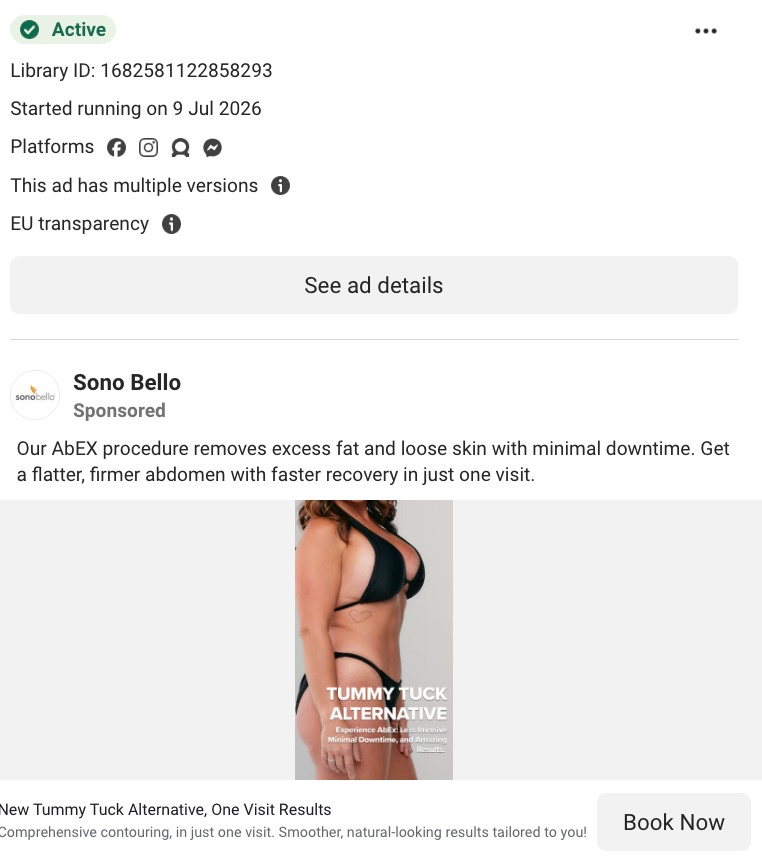
Sono Bello advertises its AbEX procedure with a benefit-led message: the procedure removes excess fat and loose skin with minimal downtime and recovery in a single visit. The ad names one procedure and states a measurable benefit, and it contains no language about flaws, which keeps it within Meta’s self-perception rule.
2. ART Plastic Surgery: credibility & confidence
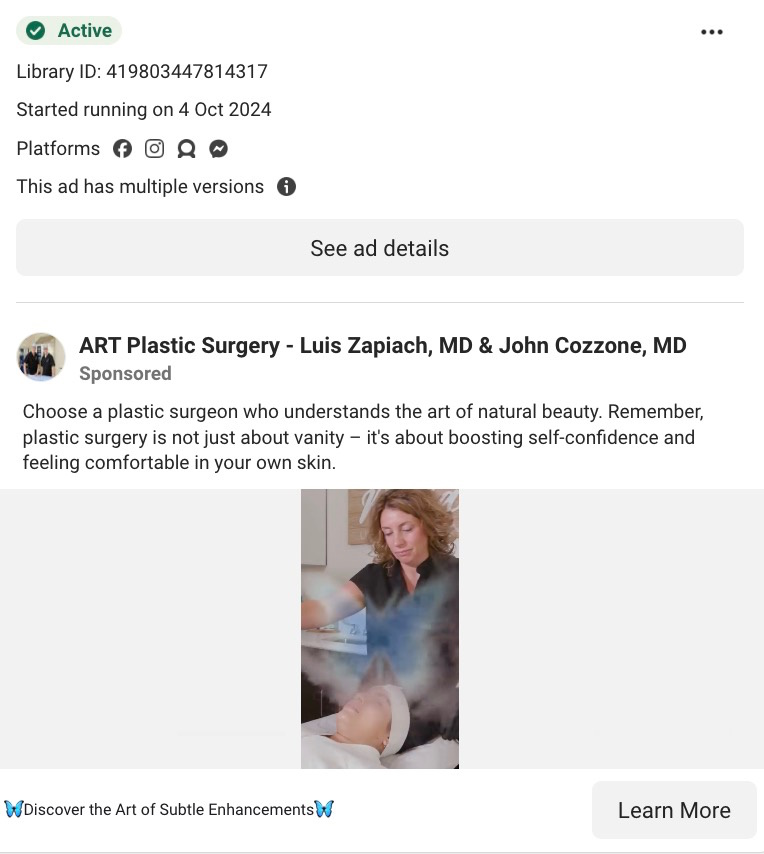
Board-certified surgeons Luis Zapiach and John Cozzone frame the decision around natural-looking results and patient confidence. The copy is reassuring rather than critical, and stating surgeon credentials adds trust for an audience comparing providers before booking.
3. Dr. Itay Wiser: consultation lead-gen
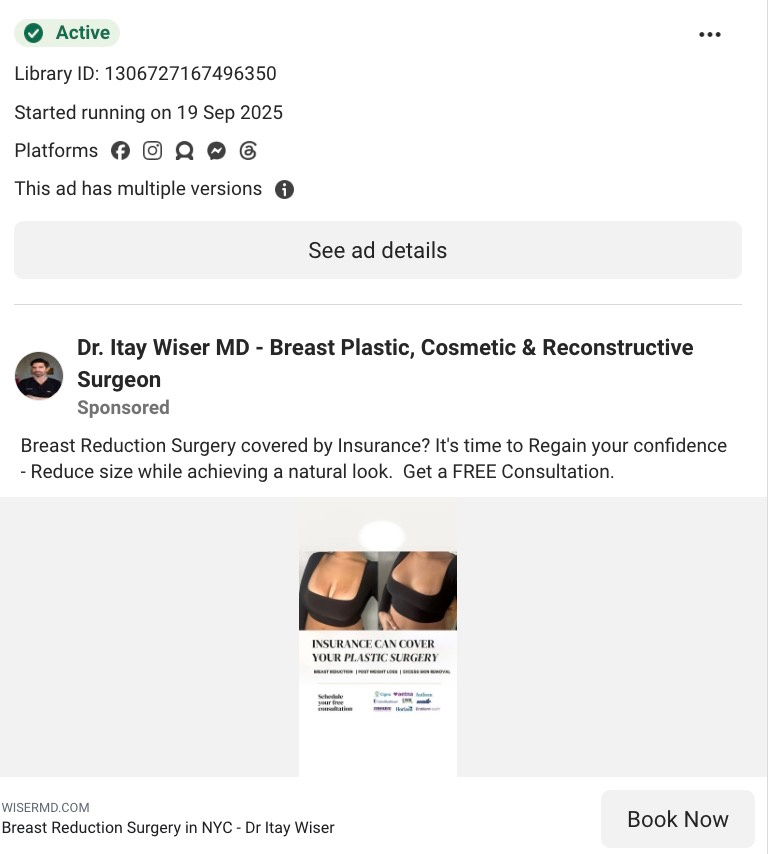
Breast plastic surgeon Dr. Itay Wiser opens with an insurance-coverage question for breast reduction, then offers a free consultation. The ad addresses cost early, focuses on one procedure, and offers a single low-friction action, which fits a consultation-led booking model.
Leading with insurance is a deliberate choice, because breast reduction is one of the few This speaks directly to patients who assume the surgery is out of reach because of cost, which widens the pool of people who click through.
Plastic Surgery Ad Examples at a Glance
| Advertiser | Procedure | Ad angle | Why it works |
| Sono Bello | Body contouring (AbEX) | Procedure benefit | Clear benefit, minimal downtime, no shaming |
| ART Plastic Surgery | General cosmetic surgery | Trust and confidence | Natural-results framing, named surgeons |
| Dr. Itay Wiser | Breast reduction | Consultation lead-gen | Handles cost objection, free consult |
Building Compliant Plastic Surgery Ads With GetHookd
Compliant plastic surgery ads on Facebook come down to two jobs: staying inside Meta’s rules on age, self-perception, and before-and-after images, and pairing that with creative built on trust and realistic outcomes. The accounts that win treat policy and persuasion as one task.
The hard part is knowing which ads are worth modeling, since the real winners are already scaling quietly somewhere in your market. GetHookd surfaces them: Brand Spy flags the creatives and landing pages a competitor is actively funding, and performance scoring reads real ad behavior, so you back a durable winner rather than a passing test. Its AI tools then rework that proven angle into fresh, compliant variations in minutes. Start finding proven plastic surgery angles with GetHookd today.
Frequently Asked Questions (FAQs)
How long does Meta’s ad review take for cosmetic surgery ads?
Most Meta ads clear review within about 24 hours, but cosmetic and surgical ads sit in a sensitive category and can take longer or face manual checks. Submit new creative a few days before your campaign start date, and avoid editing an approved ad, since edits trigger a fresh review cycle.
Should plastic surgery ad traffic go to a landing page or a lead form?
Both work, and the choice depends on your goal. Instant lead forms lower friction and suit high-volume consultation booking, while a dedicated landing page gives room to show results, credentials, and financing that build trust before a patient calls. Many practices test both against cost per booked consult.
Can I name specific procedures or make results claims in a cosmetic ad copy?
Yes, you can name procedures such as rhinoplasty or a facelift. Results claims are riskier, because Meta and advertising regulators expect shown outcomes to be realistic and typical rather than idealized. Keep claims modest, avoid guaranteeing a specific result, and note that individual results vary.
How often should I refresh my plastic surgery ad creative?
Refresh before results decline, not after. Most practices rotate hooks and visuals every few weeks, once ad frequency rises and cost per lead climbs. Tracking how long competitor ads stay active also shows which angles have staying power, so you replace tired creative using evidence rather than guesswork.
How can GetHookd help my practice research plastic surgery ads?
At GetHookd, we give practices and agencies a faster way to research the Meta and Facebook Ad Library, and our AI tools rework a proven angle into fresh, compliant variations in minutes. That shortens the gap between spotting an idea and testing it.
*Note: Pricing and/or product availability mentioned in this post are subject to change. Please check our website for current pricing and stock information before making a purchase.