Key Takeaways
- Pair every deadline with a concrete loss, such as a price that jumps back (Summet), a preferred size running out (Lifely Home), or a seasonal product leaving again (18 Chestnuts).
- Keep a product benefit next to the urgency cue so shoppers have a reason to want the item, not just a reason to hurry (SilkSilky, toddla.co).
- Frame offers around what the shopper gains, like stacked gifts (Quasi) or a free second item instead of a percentage discount (Korean Skin Therapy).
- Only run deadlines, scarcity claims, and performance statistics you can back up, since the FTC treats false urgency as deceptive.
- At GetHookd, we track 22M+ live Meta ads, updated daily, and give you Brand Spy alerts, AI tools, and templates to study competitors’ FOMO strategies and build your own.
Scarcity Only Works When Customers Know What They’ll Miss
Scarcity only drives clicks when shoppers can picture the specific thing they would lose by waiting, whether that is a restocked flavor, a size running low, or a price about to jump. Many “ends soon” banners fall flat because they describe the clock rather than the loss.
A shopper scrolling past a vague countdown has no more reason to act than they would for any other ad in their feed. Fake urgency carries real risk, since the FTC considers false deadlines and scarcity claims deceptive.
We built Explore Ads so you can browse live Meta ads in your niche and see how other brands time and word their offers. You can also connect GetHookd to AI tools like ChatGPT or Claude to track the urgency angles your market is running, with every answer linked to the live ad behind it.
GetHookd: Give Your AI
22 Million Live Meta Ads

Your AI cannot see Meta's ad library. Now it can. Connect GetHookd to Claude, ChatGPT, Gemini, Cursor or Perplexity in about 30 seconds, no code needed. Ask in plain English what your market is running and get back the live Facebook and Instagram ads. Every answer comes back with the source ad attached, so you can check it yourself.
What You Get:- Brand Spy: Get told every time a competitor launches, with the launch date and how many ads they have live
- Shops: Open any Shopify store to see its monthly visitors, best sellers, and every Meta ad it runs
- Clone Ads: Turn any winning ad into new statics built off a creative already running in your market
Prefer clicking? Search and filter the library yourself in the app, on any plan.
Start a 7-Day Trial for $07 FOMO Ads Examples to Inspire Your Next Campaign
1. Quasi Stacks: Make the Whole Offer Worth Claiming
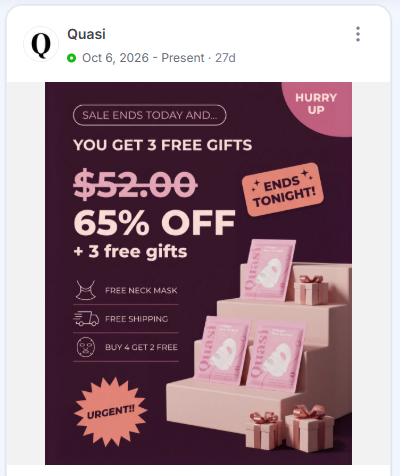
Quasi’s ad stacks three separate reasons to buy into a single creative: “65% OFF,” “YOU GET 3 FREE GIFTS,” and “ENDS TONIGHT!” sit alongside supporting offers for a free neck mask, free shipping, and a “BUY 4 GET 2 FREE” deal.
The caption reinforces the stack by calling it the “BIGGEST SALE IN QUASI HISTORY!” rather than leaning on a single discount percentage. Stacking works here because each element gives a different type of shopper a reason to convert, whether they care more about the discount, the free gifts, or the bundle math.
2. 18 Chestnuts: Bring Back a Fan-Favorite Flavor
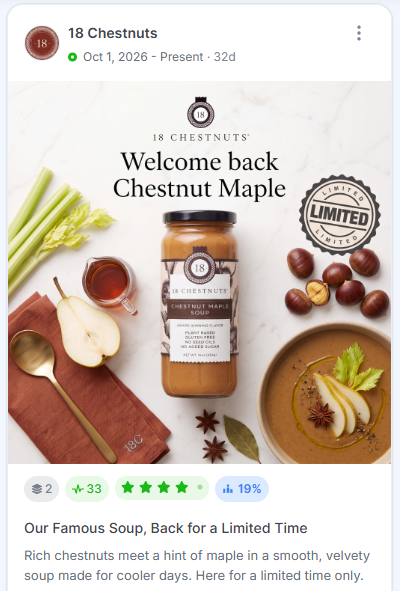
18 Chestnuts opens with “Welcome back Chestnut Maple” paired with “Our Famous Soup, Back for a Limited Time,” framing the product as something customers may already recognize and have missed rather than something brand new. That “welcome back” language does more work than a standard restock notice because it assumes familiarity instead of explaining the product from scratch.
The ad backs up the nostalgia angle with a sensory description: “Rich chestnuts meet a hint of maple in a smooth, velvety soup made for cooler days.” Pairing the “famous” positioning with a seasonal cue gives the limited-time framing an actual reason to matter, instead of relying on the word “limited” to carry the whole message.
3. Lifely Home: Tie Scarcity to the Customer’s Preferred Option
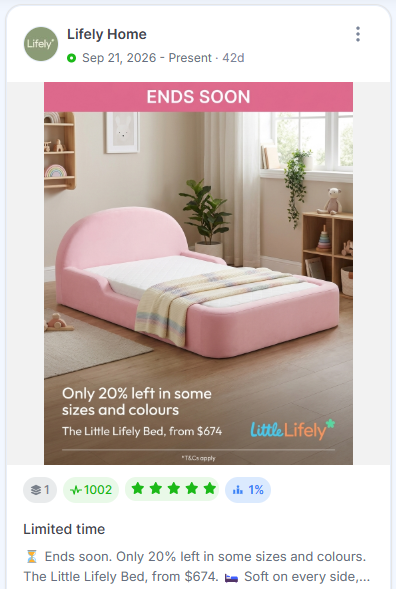
Lifely Home’s ad for The Little Lifely Bed, priced from $674, states “Only 20% left in some sizes and colours” alongside “ENDS SOON.” That phrasing ties the scarcity to specific options instead of total stock.
A customer who wants a particular size or color could miss out even if the bed itself is far from selling out. The caption adds “Soft on every side” as a product benefit, keeping a tactile reason to buy next to the urgency cue so the countdown doesn’t stand alone.
4. toddla.co: Connect a Restock to a Recognizable Parenting Problem
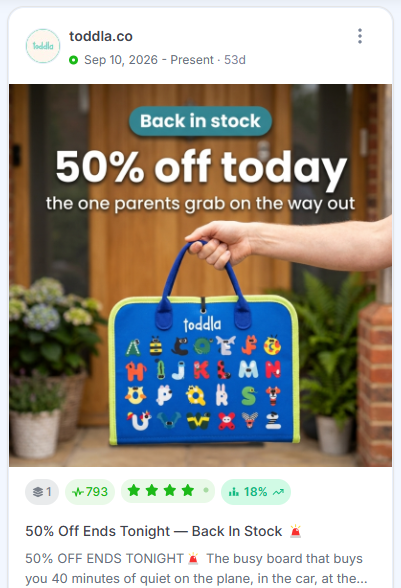
toddla.co’s ad combines three signals in one headline: “Back in stock,” “50% off today,” and “the one parents grab on the way out.” That last phrase does the heaviest lifting because it names a situation, not just a discount. Parents scrolling past the ad do not need the product explained; they recognize the scenario immediately.
The caption extends that scenario with a concrete outcome: the busy board “buys you 40 minutes of quiet on the plane, in the car.” Naming a specific context, whether that is travel, commuting, or another everyday moment, gives the restock and the discount a real moment to attach to, instead of relying on “today only” language to do all the convincing.
5. Korean Skin Therapy: Pair a Free-Product Offer With Reassurance

Korean Skin Therapy leads with “THE SECOND ONE’S FREE” and “LIMITED TIME,” followed by the claim “94% SAW VISIBLE TIGHTENING IN THE FIRST WEEK” and a direct “CLAIM OFFER” button. Calling the deal “the second one’s free” instead of “50% off two” makes it feel like a gift, even though the math works out the same.
The 90-day money-back guarantee lowers the risk of trying the product, which makes the limited-time offer easier to act on. If you borrow this approach, keep in mind that a guarantee does not replace evidence for a performance claim. FTC guidance requires statistics like “94% saw visible tightening” to be substantiated before the ad runs.
6. SilkSilky: Keep the Product Benefit Beside the Discount
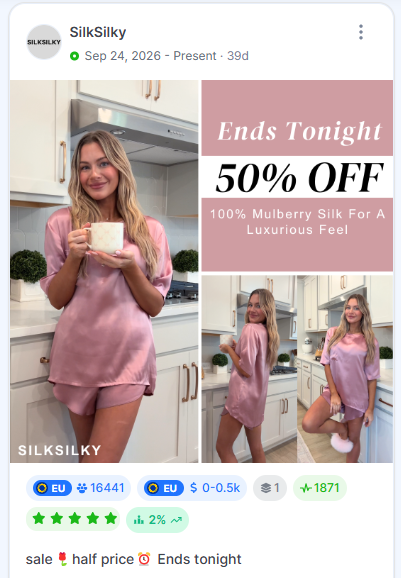
SilkSilky pairs “Ends Tonight” and “50% OFF” with “100% Mulberry Silk For A Luxurious Feel,” placing the material quality directly beside the price cut instead of letting the discount stand on its own. The caption reinforces both the price and the deadline, presenting the pajamas as available “at HALF PRICE” while repeating “FINAL DAY” to close the loop. Keeping one product benefit next to the promotional offer gives shoppers a reason to want the item, not just a reason to act before midnight.
7. Summet: Show the Financial Consequence of Waiting
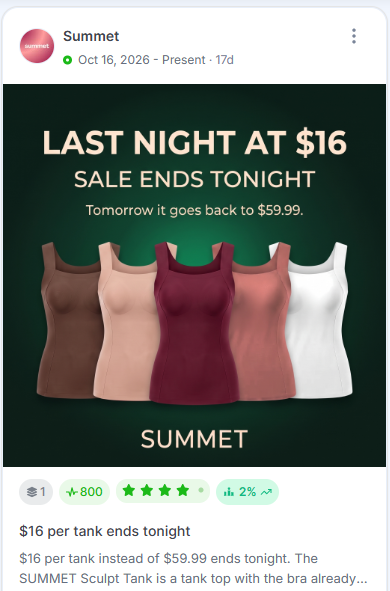
Summet’s ad spells out the cost of delay in plain numbers: “LAST NIGHT AT $16,” “SALE ENDS TONIGHT,” and “Tomorrow it goes back to $59.99.” The headline repeats the same math, “16 per tank ends tonight,” so the consequence of missing the deadline is unmistakable rather than implied.
That approach illustrates a simple rule worth copying: when a deadline carries a real financial consequence, state the number instead of leaning on generic “hurry” language. The ad introduces the product itself, the “SUMMET Sculpt Tank,” as a tank top with built-in support, giving the price jump a specific product to anchor against.
Top 7 FOMO Ad Examples: Summary Table
| Brand | FOMO Strategy | Replicable Takeaway |
| Quasi | Expiring discount, gifts, and free shipping | Build a compelling package, then make the deadline apply to the combined value |
| 18 Chestnuts | Returning favorite available briefly | Connect limited availability to distinctive benefits and a relevant seasonal occasion |
| Lifely Home | Limited remaining sizes and colors | Make scarcity about losing the customer’s preferred option, not generic popularity |
| toddla.co | Restock plus a same-day discount | Remind customers which everyday problem the product solves before adding urgency |
| Korean Skin Therapy | Limited-time free second bottle | Frame a bundle as a free item instead of a percentage discount |
| SilkSilky | Half-price offer ending tonight | Keep the product’s desirable benefit beside the discount |
| Summet | Explicit price increase tomorrow | Explain the genuine financial consequence of waiting |
Spot Competitor Sales Early & Create Your Own FOMO Ads With GetHookd
FOMO ads work when the deadline or limit is genuine, and customers can see exactly what they’d miss. Every example above pairs urgency with a clear reason to want the product. Copying the tactic means copying that pairing, along with an offer you can stand behind.
We track 22M+ live Meta ads in GetHookd, updated daily, so you can study the sales your competitors are running. Turn on Brand Spy to get notified when a competitor launches, then use our AI tools and templates to build your own FOMO ad. Try GetHookd free for 7 days before your next sale.
Frequently Asked Questions (FAQs)
What is a FOMO ad?
A FOMO ad uses fear of missing out by highlighting scarcity, a closing deadline, or limited availability to prompt an immediate purchase decision. The strongest versions pair that urgency with a specific benefit the customer already wants, such as a discount, a restock, or a free bundled item.
Why do limited-time offers work in advertising?
Limited-time offers give shoppers a reason to decide now instead of putting it off. They work best when the deadline is genuine, and the ad makes clear what the shopper would miss. Urgency without a clear reason behind it is easy to ignore.
How long should a FOMO deadline run?
A FOMO deadline should run only as long as the actual offer does. Turn ads off the moment a promotion ends, update stock messaging as availability changes, and make sure the landing page matches the claim in the ad.
Can FOMO ads violate FTC rules?
Yes. The FTC requires advertisers to substantiate objective claims before publishing them and specifically flags false limited-time offers and unsubstantiated scarcity claims as problematic. An ad claiming “tonight only” while running for several weeks carries real compliance risk, regardless of how well it converts.
How does GetHookd help with FOMO ad research?
At GetHookd, you can search live Meta ads by niche, format, and run time to find the FOMO ads running in your market. Brand Spy notifies you whenever a competitor launches and shows how many ads they have live. Our Ads Transcription feature also pulls the copy from video ads, so you can study how other brands word their urgency.
*Note: Pricing and/or product availability mentioned in this post are subject to change. Please check our website for current pricing and stock information before making a purchase.