6 Best SaaS Ad Examples in 2026
Key Takeaways
- SaaS brands winning on Meta in 2026 aren’t relying solely on product demos; they’re using static-image ads built around curiosity, data, free resources, and personality to drive signups and downloads.
- The strongest SaaS ads lead with a single, specific benefit or outcome rather than trying to explain the entire product in one frame.
- Illustrated and branded visuals are outperforming generic stock photography in B2B campaigns, especially for brands competing in crowded categories.
- Lead magnet ads that offer free templates, guides, or tools consistently deliver a lower cost-per-lead than direct signup campaigns in SaaS verticals.
- GetHookd lets you track which SaaS ad creatives competitors are actively scaling across Meta, plus AI-powered creative tools, so you can study what’s converting and recreate them in minutes.
SaaS Advertising on Meta in 2026: What’s Actually Converting
Most people associate Facebook and Instagram ads with e-commerce, but SaaS brands are spending on Meta and seeing strong results.
The strategy differs from physical product advertising. Software cannot rely on visual product appeal alone to capture attention in-feed. SaaS creatives must communicate outcomes, value, and transformation within seconds.
Below, we break down 6 real SaaS ad examples running on Meta right now, covering what makes each one work and how you can apply the same approach to your campaigns.
GetHookd: Turn Competitor Intelligence Into Your Next Winning Ad
65M+ Ads Analyzed | 4.8★ G2 Rating | 4.4★ Trustpilot Rating

Stop Guessing. Start Scaling:
GetHookd reveals which ads your competitors are actively scaling—not just running. Spy on their best-performing creatives, landing pages, and traffic strategies, then turn proven concepts into testable campaigns in seconds with AI-powered script generation and creative cloning.
What You Get:
- ✓ Brand Spy to decode competitor ad strategies in real-time
- ✓ AI script generation and ad cloning for instant variations
- ✓ Performance scoring based on actual ad behavior, not vanity metrics
- ✓ Creative Analyzer to identify and scale your top performers
6 Best Ad Examples for SaaS in 2026
1. The Integration Showcase
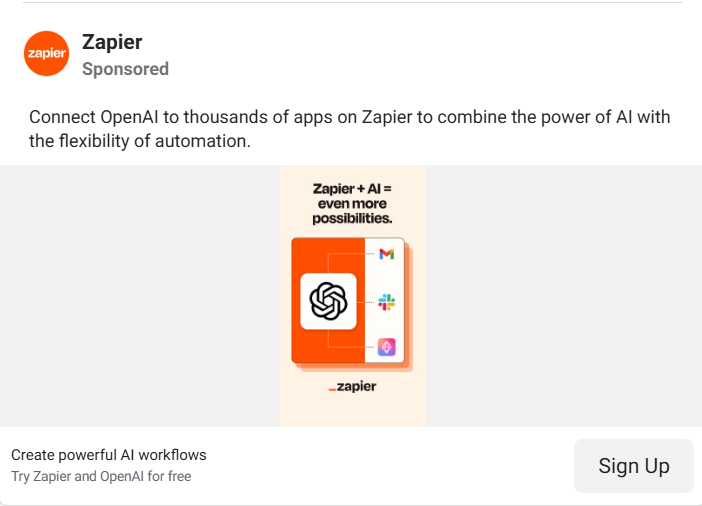
Zapier’s ad doesn’t try to explain how workflow automation works. Instead, it shows a cluster of recognizable app icons (OpenAI, Gmail, Slack) alongside the headline “Zapier + AI = even more possibilities.” The message is instant: you already use these tools, and Zapier connects them.
This format works for SaaS brands that operate as connectors or platforms. Instead of explaining your product’s functionality, you leverage the credibility of tools your audience already knows and trusts.
Why it converts: Showing familiar logos immediately establishes relevance. The viewer thinks “I use that” before reading the copy. The “Sign Up” CTA and the “Try Zapier and OpenAI for free” headline eliminate risk. There’s nothing to lose, and the visual has already proven its relevance.
How to apply it: If your SaaS integrates with popular tools, lead with those logos. Don’t bury integrations on a features page. The more recognizable the icons, the faster the connection happens.
2. The Bold Value Proposition
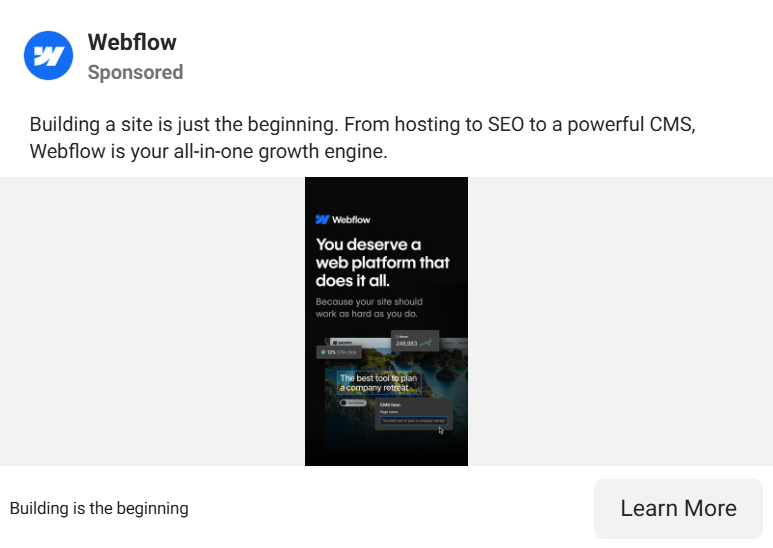
Webflow runs with a single bold claim front and center: “You deserve a web platform that does it all.” No product screenshots, no feature lists, no customer testimonials. Just a confident statement aimed directly at the pain of juggling hosting, CMS, SEO, and design in separate tools.
This approach works when your product solves a fragmentation problem: when your audience is tired of stitching together multiple solutions. The ad doesn’t need to explain what Webflow does feature by feature. The value proposition alone qualifies the right viewer and repels the wrong one.
Why it converts: Bold, specific claims cut through feed noise faster than detailed explanations, and the dark background makes the white text pop on mobile screens. The “Learn More” CTA aligns with the awareness stage. This isn’t a purchase request; it’s an invitation to curiosity.
How to apply it: Distill your product’s value into one sentence that your ideal customer would immediately agree with. Put it on a clean, high-contrast background with your logo. Test it against your more detailed creatives. You may be surprised how well simplicity performs.
3. The Curiosity Hook
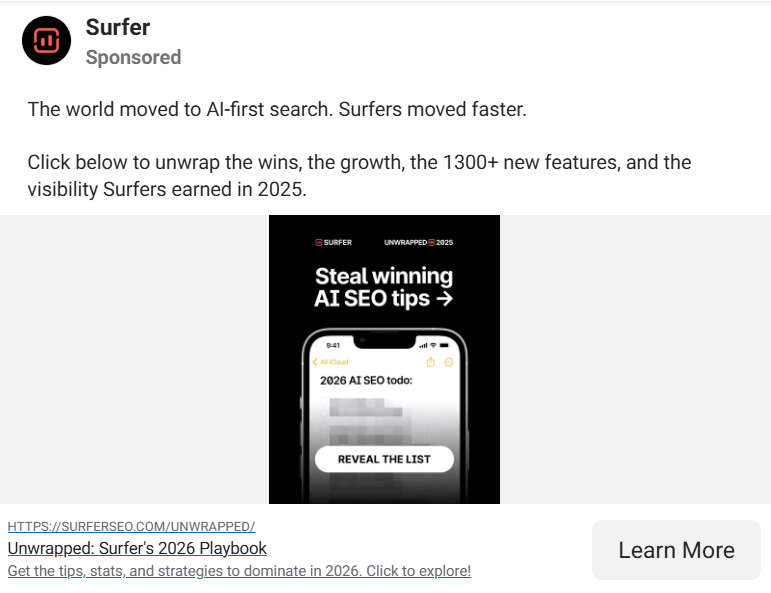
Surfer’s ad teases content without giving it away: “Steal winning AI SEO tips →” with a phone mockup showing a blurred list titled “2026 AI SEO todo: REVEAL THE LIST.” Everything about this ad is designed to create an information gap that the viewer can only close by clicking.
This format is particularly effective for SaaS brands in content marketing, analytics, or any category where the audience is actively seeking tactical knowledge. You’re not selling the product directly. Instead, you’re offering valuable intel, and the product naturally becomes part of the conversation once they’re on your page.
Why it converts: The blurred content creates genuine curiosity. The copy (“The world moved to AI-first search. Surfers moved faster.”) positions the brand as ahead of the curve, which appeals to early-adopter SaaS buyers.
How to apply it: Package your best-performing content, internal data, or industry insights into a teaser format. Show enough to prove value, but blur or withhold the specifics. The click becomes irresistible because the viewer already believes the content is worth seeing.
4. The Lead Magnet
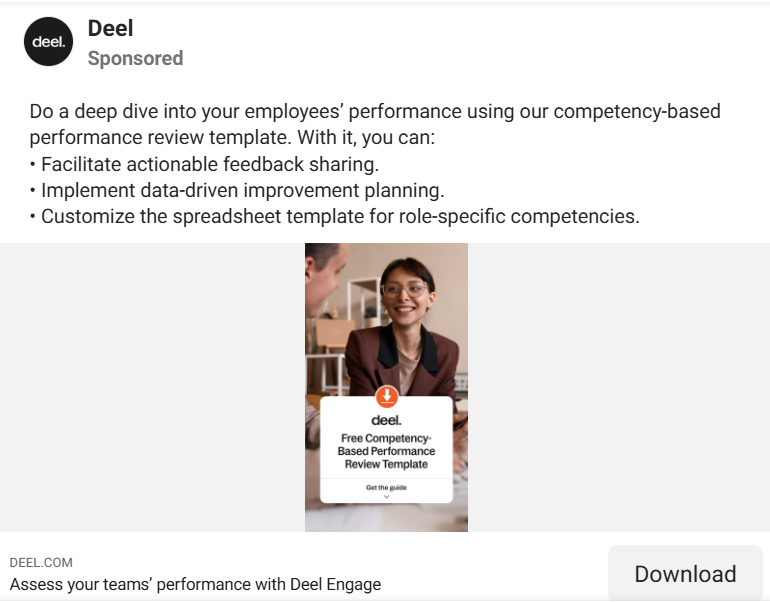
Deel offers a free competency-based performance review template, shown alongside a professional lifestyle image. Lead magnet ads consistently outperform direct signup campaigns in SaaS because they lower the barrier to commitment. The viewer is being offered something immediately useful for free. Once they download, they’re in your funnel.
Why it converts: The offer is tangible and specific. It’s not a vague “free guide.” The lifestyle image humanizes a category (HR software) that often feels cold and corporate. The bullet-point structure makes the benefits easy to scan.
How to apply it: Identify the templates, checklists, or frameworks your target audience would actually use in their day-to-day work. Package them as a free download and run it as a lead gen campaign. Lead magnet ads are everywhere in SaaS right now, so differentiating on the quality of the offer matters. GetHookd’s Brand Spy can show you exactly which lead magnet creatives your competitors are actively scaling, so you can study what’s converting before you build your own.
5. The Data-Driven Proof
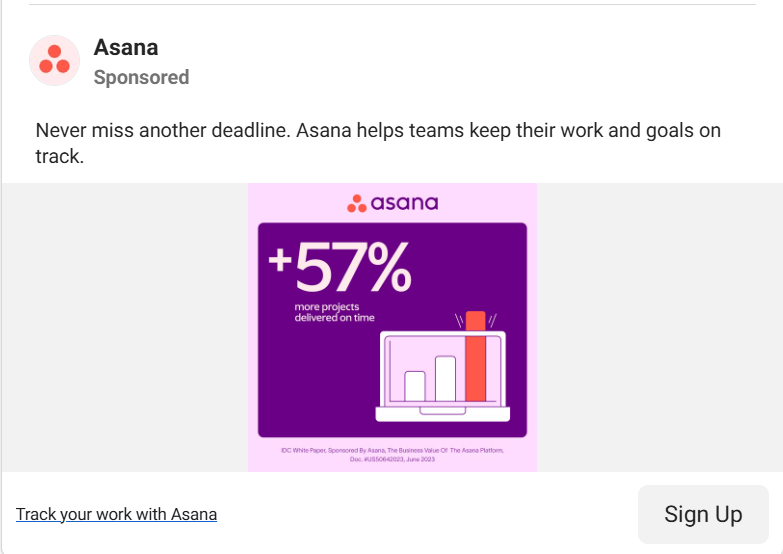
Asana leads with a single stat: “+57% more projects delivered on time.” It’s displayed in large type on a purple-branded background, with a simple bar chart visualization. Data-driven ads work in SaaS because the buying decision is rational rather than emotional. Your audience wants to know that your product delivers measurable results. A specific, credible number communicates more value in one second than a paragraph of copy ever could.
Why it converts: The stat is specific. The visual hierarchy is also flawless. You see the number before anything else. The purple background is distinctly Asana, reinforcing brand recognition.
How to apply it: Pull your strongest outcome metric from customer data, case studies, or third-party research. Make it the entire ad: one number, one supporting line, one CTA. If the stat is genuinely impressive, it needs no decoration.
6. The Personality Play
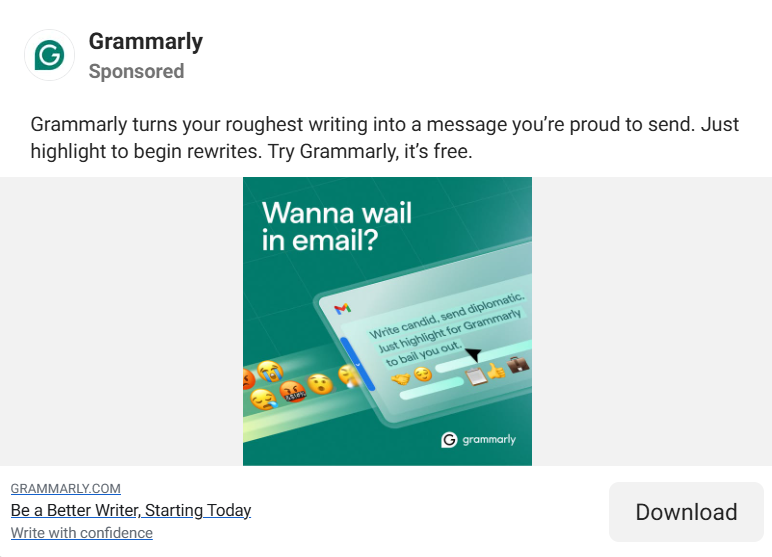
Grammarly’s ad opens with “Wanna wail in email?” — a playful hook that uses humor and emojis to make a productivity tool feel fun and relatable. The image shows a stylized email interface with floating emojis and a casual, conversational tone throughout.
Most SaaS ads default to a professional, polished tone. Grammarly goes the other direction, injecting personality into a category (writing tools) that could easily feel dry.
Why it converts: The humor elicits an emotional response that halts scrolling. The playful tone makes the product feel approachable rather than intimidating. The copy nails a relatable pain point (writing emails that sound too harsh or too casual).
How to apply it: If your brand voice allows for humor, test it in your ads. The bar is low because so few SaaS brands try it. A genuinely funny or clever ad in a feed full of corporate messaging will naturally stand out. Just make sure the humor ties back to a real use case.
Top 6 SaaS Ad Examples: Summary Table
| Ad Format | Core Tactic | Key Takeaway |
|---|---|---|
| Integration Showcase | Borrowed credibility from recognizable app logos | Lead with tools your audience already uses to create instant relevance |
| Bold Value Proposition | Single confident claim on a clean, high-contrast background | Distill your product into one sentence your ideal customer would agree with |
| Curiosity Hook | Blurred content teaser that creates an information gap | Withhold just enough to make the click irresistible |
| Lead Magnet | Free template offer that lowers the barrier to commitment | Offer something immediately useful to enter the funnel before the sale |
| Data-Driven Proof | Single stat in large type on a branded background | One credible number communicates more than a paragraph of copy |
| Personality Play | Humor and emojis to stand out in a sea of corporate ads | A genuinely fun ad in a serious feed will always stop the scroll |
Find Winning SaaS Ads with GetHookd
Every ad style in this article is already being tested and scaled by SaaS brands across Meta. The challenge is finding the specific creatives that are working in your category right now.
That’s where GetHookd comes in. Our platform tracks over 65 million ads across Meta and uses performance scoring to surface those with real traction. With our Brand Spy feature, you can monitor any SaaS competitor’s ad account, see which creatives they’re scaling, and study the landing pages they’re driving traffic to.
Once you find an ad worth replicating, our Clone Ads feature lets you replicate it for your service. With over 100 static ad templates, you can produce high-performing creatives in minutes without starting from scratch.
We built GetHookd to close the gap between seeing what competitors run and knowing what actually works. The faster you move from research to testable creative, the less budget you waste on unproven concepts.
Start your GetHookd free trial today!
Frequently Asked Questions (FAQs)
Do Facebook ads work for SaaS companies?
Yes. Meta’s targeting capabilities and creative flexibility make it one of the strongest platforms for driving signups, trial starts, and lead magnet downloads. The key is leading with outcomes and value rather than product features, since you’re selling something people can’t see or hold. Every brand featured in this article is currently running ads on Meta, which indicates the channel is delivering results worth scaling.
What are some popular SaaS ad examples?
The SaaS ads that perform best on Meta right now all have one thing in common. They sell a single, specific outcome rather than trying to explain the entire product in one frame. Whether that’s a bold stat, a free resource, or a curiosity-driven hook, the creative focuses on one reason to click. Every example we’ve covered in this article follows that principle.
How do I find the SaaS ads my competitors are running?
GetHookd’s Brand Spy tool lets you track any competitor’s ad and see their full creative library. You can monitor which ads they’re actively scaling, the hooks and copy angles they’re using, and the landing pages behind them. It goes beyond showing you what’s live and tells you what’s actually performing, so you can study creatives worth replicating.
*Note: Pricing and/or product availability mentioned in this post are subject to change. Please check our website for current pricing and stock information before making a purchase.