5 Insurance Facebook Ad Examples in 2026
Key Takeaways
- Five Facebook ad formats are driving insurance results in 2026. Lead form quizzes, short videos, carousels, testimonials, and urgency ads each target different funnel stages.
- Creative matters more than targeting now. Meta’s Special Ad Category limits audience targeting, so ad copy, visuals, and format do the heavy lifting.
- High-performing ads focus on clarity and trust. Simple explanations, specific results (e.g., savings), and real customer stories improve engagement and conversions.
- Conversion comes from intent and timing. Pre-qualifying leads, letting users self-select, and using deadlines help turn interest into action.
- GetHookd helps media buyers and agencies research 65M+ ads across the Facebook Ad Library to find proven insurance ad concepts and generate testable creatives with AI.
What’s Working for Insurance Advertisers on Facebook
The five insurance Facebook ad formats generating the strongest results in 2026 are lead form quiz ads, short video explainers, carousel comparison ads, customer testimonial ads, and urgency-driven enrollment deadline ads. Each format solves a specific problem: qualifying leads before they reach your pipeline, building trust through real customer outcomes, or creating time pressure around enrollment windows.
What all five share is a focus on creative quality rather than audience-targeting precision. Since Meta expanded its Special Ad Category to include all insurance products in January 2025, lookalike audiences, narrow age brackets, and ZIP code targeting are no longer available.
That shift means your ad copy, visuals, and format selection now determine whether the right prospects stop scrolling and take action. Below is a breakdown of each format with examples of what makes them work.

GetHookd: Turn Competitor Intelligence Into Your Next Winning Ad
GetHookd reveals which ads your competitors are actively scaling—not just running. Spy on their best-performing creatives, landing pages, and traffic strategies, then turn proven concepts into testable campaigns in seconds with AI-powered script generation and creative cloning.
What You Get:- ✓ Brand Spy to decode competitor ad strategies in real-time
- ✓ AI script generation and ad cloning for instant variations
- ✓ Performance scoring based on actual ad behavior, not vanity metrics
- ✓ Creative Analyzer to identify and scale your top performers
GetHookd: Turn Competitor Intelligence Into Your Next Winning Ad
65M+ Ads Analyzed | 4.8★ G2 Rating | 4.5★ Trustpilot Rating
Stop Guessing. Start Scaling:
GetHookd reveals which ads your competitors are actively scaling—not just running. Spy on their best-performing creatives, landing pages, and traffic strategies, then turn proven concepts into testable campaigns in seconds with AI-powered script generation and creative cloning.What You Get:
- ✓ Brand Spy to decode competitor ad strategies in real-time
- ✓ AI script generation and ad cloning for instant variations
- ✓ Performance scoring based on actual ad behavior, not vanity metrics
- ✓ Creative Analyzer to identify and scale your top performers
Replace guesswork with intelligence. Build profitable ads that actually convert.
5 Insurance Facebook Ad Formats That Convert
1. The Lead Form Quiz Ad
This format uses Facebook’s native lead-generation objective, paired with a quiz-style form. Instead of asking users to fill out a generic contact form, the ad frames the process as a quick self-assessment. A typical headline reads something like: “Answer 3 questions to see if you’re overpaying for coverage.”
The quiz approach works because it reduces friction. Users feel they’re getting a personalized answer rather than having to hand over their information. The best-performing versions include two or three qualifying questions, such as “Are you a homeowner?” or “What type of coverage are you looking for?” These pre-qualifiers filter out low-intent leads and improve close rates for agents who follow up.
The ad creative is usually a clean, single-image with bold text overlay and a “Get Started” CTA button. Keep the copy focused on a single question or pain point rather than listing multiple services.
2. The Short Video Explainer
Video ads under 45 seconds are among the strongest performers in the insurance vertical on Facebook. These typically explain a single concept, such as changes to Medicare Advantage plans for 2026, or a breakdown of how much term life insurance costs per day.
The most effective versions follow a tight structure. They open with a problem or fear-based hook in the first three seconds (“Most families don’t realize how much a funeral costs in 2026”). The middle section delivers a clear, simple explanation. The close ends with a single call-to-action, usually a link to get a free quote or schedule a call.
Subtitles are a must. A large share of Facebook users watch videos with the sound off, and subtitled insurance explainers consistently outperform those without captions. Agents who use on-camera footage tend to build trust faster than those relying on stock animation.

3. The Carousel Comparison Ad
Carousel ads let insurance brands showcase multiple policy options or coverage tiers in a single ad unit. Each card in the carousel highlights a different plan, with a short benefit statement and a CTA linking to a dedicated landing page.
This format is especially effective for health insurance brokers or agencies offering auto, home, and life bundles. A carousel might show three cards: “Auto Coverage from $XX/mo,” “Home Protection Made Simple,” and “Life Insurance for Less Than Your Daily Coffee.” Each card carries its own image and link.
The strength of carousels is that they let users self-select based on their needs. Someone scrolling past an auto card might stop on the life insurance card and click through. This passive filtering mimics the effect of demographic targeting that Meta’s Special Ad Category restrictions have removed.
4. The Customer Testimonial Ad
Social proof remains one of the most reliable conversion drivers in insurance advertising. Testimonial ads feature a real customer story, either as a short quote overlaid on an image or as a brief user-generated video.
A common structure for the copy reads: “I saved $480/year by switching my homeowner’s policy. The whole process took 10 minutes.” The visual pairs a photo of the customer (or a representative lifestyle image) with a headline that highlights the specific result.
What separates strong testimonial ads from weak ones is specificity. Vague claims like “great service” don’t move the needle. Numbers, timelines, and concrete outcomes (“10 minutes,” “$480/year”) are what stop the scroll.
Insurance brands that collect short video testimonials from satisfied clients have an advantage here, as video testimonials outperform static versions in engagement and conversion rate.

5. The Urgency & Enrollment Deadline Ad
Insurance has natural deadline-driven moments throughout the year. Open enrollment periods for health insurance, Medicare Annual Enrollment (October 15 to December 7), and storm-season windows for homeowner’s coverage all create built-in urgency.
These ads pair a bold countdown-style visual with direct copy: “Open Enrollment ends in 7 days. Don’t miss your chance to lock in coverage.” The CTA is usually “Enroll Now” or “Get Your Free Quote Before [Date].” The image often uses a clock, calendar, or countdown graphic to reinforce the time pressure.
The urgency format works because insurance is a category where procrastination is common. People know they need coverage, but delay action until a deadline forces their hand. These ads perform best when launched 7 to 14 days before a key enrollment window closes.
Top 5 Insurance Facebook Ad Examples: Summary Table
| Ad Format | Best For | Key Element | CTA Style |
|---|---|---|---|
| Lead Form Quiz | Auto, health, life insurance | Pre-qualifying questions in native form | “Get Started” / “See My Results” |
| Short Video Explainer | Medicare, life, and health insurance | 45-second video with subtitles | “Get a Free Quote” / “Schedule a Call” |
| Carousel Comparison | Multi-line agencies and brokers | Multiple coverage options in one ad | “View Plans” / “Compare Now” |
| Customer Testimonial | All insurance types | Specific dollar savings or timeline | “See How Much You Save” |
| Urgency/Enrollment Deadline | Health, Medicare, homeowner’s | Countdown visual with deadline copy | “Enroll Now” / “Lock In Coverage” |
How GetHookd Helps You Build Better Insurance Ads
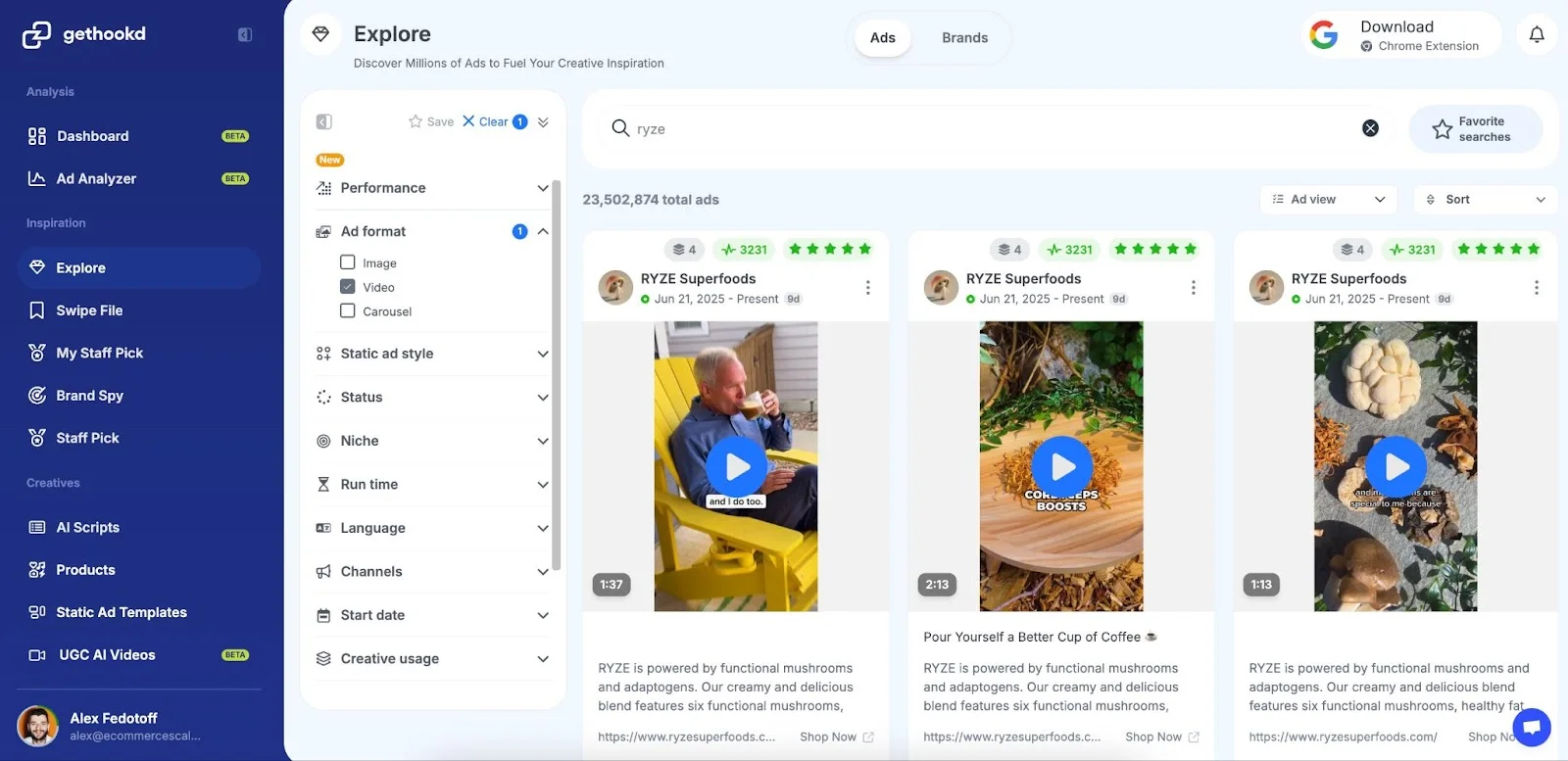
At GetHookd, we built our platform for media buyers, agencies, and performance marketers who need to move from research to ready-to-test creatives without wasting time or budget. Our database includes over 65 million ads across the Facebook Ad Library and Meta platforms, and we help you find the insurance ad concepts that are already converting.
With our Brand Spy feature, you can track any insurance brand’s ad activity and see which creatives they are actively scaling. Our AI-powered tools then let you transcribe winning video ads, generate new hooks and scripts, and clone static ad variations in minutes. For insurance advertisers operating under Meta’s tighter restrictions, the fastest path to better results is to build on concepts that already work.
Start your GetHookd free trial today!
Frequently Asked Questions (FAQs)
Do insurance ads on Facebook require a Special Ad Category?
Yes. Since January 2025, Meta has required all insurance-related ads to be classified under the “Financial Products and Services” Special Ad Category. Failing to select this category can result in ad rejection or account suspension.
What type of Facebook ad works best for life insurance?
Short video explainer ads and testimonial ads tend to perform strongest for life insurance. Video ads that address cost misconceptions or highlight simple application processes reduce buyer hesitation and drive quote requests.
How long should an insurance video ad be on Facebook?
Keep insurance video ads under 45 seconds. The first three seconds should feature a strong hook, and the entire video should focus on one benefit or pain point. Always include subtitles for sound-off viewers.
Can I target specific age groups with insurance Facebook ads?
Meta’s Special Ad Category rules restrict age targeting to a broad 18 to 65+ range for insurance campaigns. You can no longer target narrow age brackets, so your ad copy needs to attract the right audience through messaging rather than demographic filters.
How does GetHookd help with insurance ad research?
GetHookd gives you access to 65M+ ads across the Meta Ad Library, with filters for niche, format, and engagement. Our Brand Spy shows which insurance ads competitors are scaling, and our AI tools let you generate scripts, clone creatives, and build new ad variations from proven concepts.
*Note: Pricing and/or product availability mentioned in this post are subject to change. Please check our website for current pricing and stock information before making a purchase.