Article-At-A-Glance
- Five SaaS Facebook ad tactics convert in 2026: Webflow’s customer proof, monday.com’s live demo, Notion’s low-risk trial, ClickUp’s pain-led hook, and Slack’s named testimonial.
- The shared pattern is specificity, since concrete promises like “demo conversions up 40%” earn attention while vague benefit language gets scrolled past.
- Proof-led ads from Webflow and Slack work best when the audience distrusts vendor claims, while pain-led ads like ClickUp’s earn attention before the product has to sell.
- Notion and monday.com each remove a different signup barrier: Notion lowers financial and switching risk in one frame, while monday.com shows an abstract feature in action.
- GetHookd’s Brand Spy shows you a breakdown of competitors’ ads scaling across formats, hooks, and landing pages, then our AI tools and templates help you build your own version fast.
What Makes a SaaS Facebook Ad Stop the Scroll
Most SaaS ads fail because they describe the product instead of showing the buyer what changes for them. A feature list assumes interest that hasn’t been earned yet, and vague benefit language like “grow faster” blends into everything else in the feed. The ads that convert do the opposite: they lead with something the buyer can picture, measure, or feel before the product ever enters the frame.
The five examples in this breakdown each use a different entry point to earn that attention, from a customer’s results to a live product demo to a frustration the viewer deals with every week. What connects them is that none rely on the brand’s own claims to carry the pitch. Each one anchors the ad in something external: a number, a face, a pain, or an offer too low-risk to ignore.
GetHookd lets SaaS marketers see how these tactics compare across 65 million analyzed Meta ads, then turn a proven format into a testable creative using Clone Ads and AI scripting without leaving the platform.

GetHookd: Turn Competitor Intelligence Into Your Next Winning Ad
GetHookd reveals which ads your competitors are actively scaling—not just running. Spy on their best-performing creatives, landing pages, and traffic strategies, then turn proven concepts into testable campaigns in seconds with AI-powered script generation and creative cloning.
What You Get:- ✓ Brand Spy to decode competitor ad strategies in real-time
- ✓ AI script generation and ad cloning for instant variations
- ✓ Performance scoring based on actual ad behavior, not vanity metrics
- ✓ Creative Analyzer to identify and scale your top performers
Best SaaS Facebook Ad Examples That Convert in 2026
1. Webflow: Results as Proof
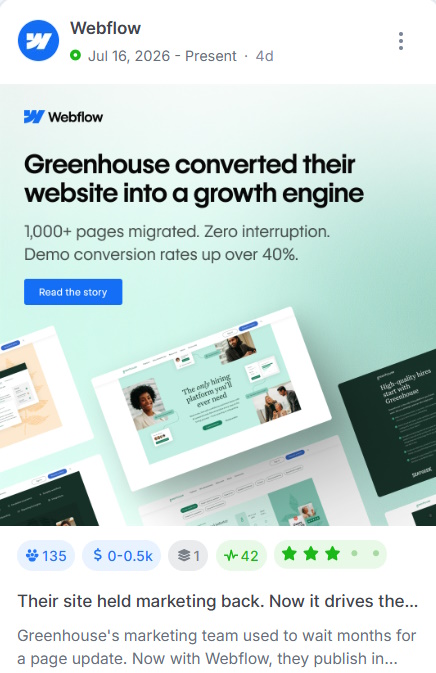
Webflow skips the feature pitch and lets a customer’s numbers do the talking. The headline frames Greenhouse turning their site into a growth engine, then the subtext stacks three concrete proof points: 1,000+ pages migrated, zero interruption, and demo conversion up over 40%. For a skeptical SaaS buyer, a specific result from a recognizable company carries more weight than any claim Webflow could make about itself.
The visual reinforces this by showing polished, finished pages rather than the editor interface. That choice signals the outcome a buyer wants, a professional site, without asking them to picture the work involved. A “Read the story” CTA invites the interested buyer deeper without demanding a signup upfront.
Takeaway: Lead with a named customer’s concrete numbers when your audience distrusts vendor claims.
2. Monday.com: The Live Demo
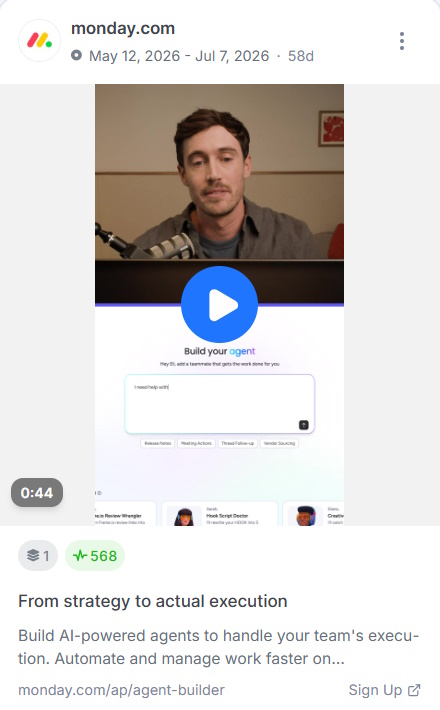
Monday.com sells its core promise by demonstrating it instead of merely describing how it works. The video has a person talking to the camera with a clear view of the product in action, showing the “Build your agent” screen where a plain-language request becomes a working AI agent. For a capability as abstract as AI agents, seeing it happen on screen does more than the brand’s feature list could.
The talking-head format is the quiet strength here. A real face makes software feel human and approachable, which softens the coldness of a straight screen recording. The copy ties it to a concrete outcome, moving from strategy to execution, and a low-friction “Sign Up” CTA closes it.
Takeaway: Demonstrate an abstract capability with a short screen-in-action video. Put a real person on camera to lower the barrier to trust.
3. Notion: The Irresistible Offer
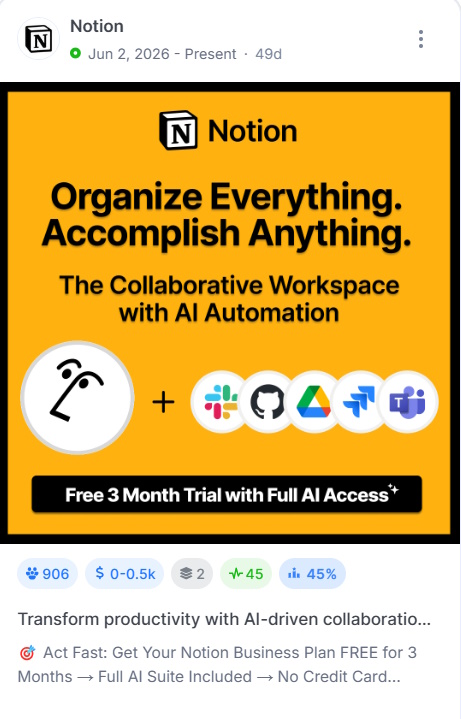
Notion builds this ad around an offer most SaaS users find hard to pass up: a free three-month trial with full AI access, stated plainly in a black CTA bar that anchors the whole design.
A long, genuinely useful free window lowers the risk of trying the product to almost nothing, which matters when a buyer is weighing yet another tool. The bold benefit headline above it (“Organize Everything. Accomplish Anything.”) gives them the reason to care before the offer seals it.
The integration logos do quiet but important work here. Showing Notion connecting to Slack, GitHub, Google Drive, and other everyday tools answers the unspoken question every team asks before switching: will this fit what we already use? Placed right above the offer, it removes a final objection just before the CTA.
Takeaway: Pair a low-risk offer with proof you fit the buyer’s existing tools. Remove the money objection and the switching objection in the same ad, then let the CTA close.
4. ClickUp: Lead With the Pain
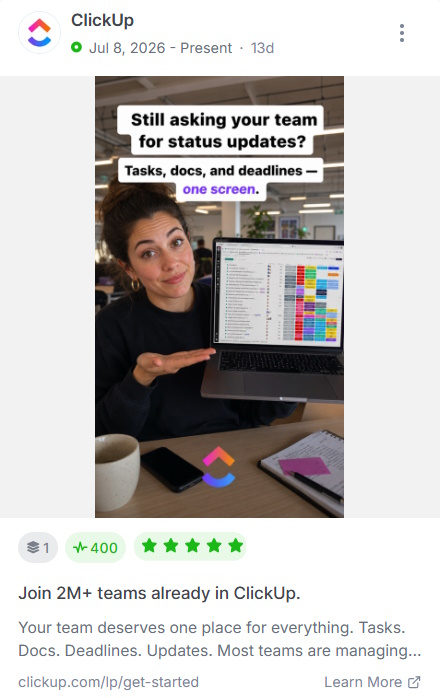
ClickUp opens with a frustration its buyer feels every week: “Still asking your team for status updates?” Naming the pain first pulls in anyone tired of chasing people for progress, before ClickUp has said a word about itself. The answer follows in one tight line: tasks, docs, and deadlines on one screen, so the solution feels like relief from the exact problem just named.
A real person in a casual setting, gesturing toward the product on her laptop, gives the ad an organic, word-of-mouth feel rather than a corporate pitch. A social proof line (“Join 2M+ teams already in ClickUp”) closes it, making the solution feel safe to choose.
Takeaway: Open with the specific problem your buyer lives with, worded as they would say it themselves. Earn the attention with the pain, then present your product as the direct fix.
5. Slack: The Named Testimonial
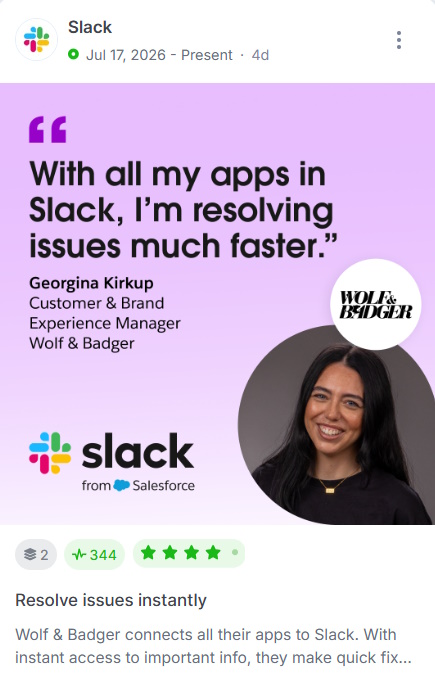
Slack hands the whole ad over to a customer. The quote does the selling (“With all my apps in Slack, I’m resolving issues much faster”), and it carries full attribution: a name, a specific title, the company, and a photo. That specificity is what makes the testimonial believable, since a buyer can see exactly who said it and trust the person exists.
The detail underneath keeps the claim grounded. The quote points to a concrete result, resolving issues faster, tied to the use case of connecting a team’s apps in one place. A clean “Sign Up” CTA closes it, letting the customer’s credibility carry the buyer forward.
Takeaway: Attach a name, title, company, and face to every testimonial you run. The more identifiable the person, the more their result reads as proof instead of marketing.
Successful SaaS Facebook Ads Examples at a Glance
| Brand | Tactic | Takeaway |
| Webflow | Results as proof | Lead with a named customer’s concrete numbers when your audience distrusts vendor claims. |
| Monday.com | The live demo | Demonstrate an abstract capability with a short screen-in-action video and a person on camera. |
| Notion | The irresistible offer | Pair a low-risk offer with proof you fit the buyer’s existing tools, then let the CTA close. |
| ClickUp | Lead with the pain | Open with the specific problem your buyer lives with, worded as they would say it. |
| Slack | The named testimonial | Attach a name, title, company, and face to make a testimonial read as proof. |
How to Scale Your SaaS Facebook Ads With GetHookd
Studying strong ads is the easy part. The harder challenge for most SaaS teams is turning that understanding into a repeatable process that produces winners and then scales them. Knowing what a good ad looks like means little without a system to generate more of them on demand.
GetHookd provides access to 65M+ Meta ads, so you can study how competitor ads are actually performing, as well as the formats, hooks, and offers that are already working. We don’t stop there; our AI creative tools and ready-to-use templates then help you produce your own versions without starting from scratch. Start free today and shorten the distance between a proven idea and a campaign you can scale.
Frequently Asked Questions (FAQs)
What is a good Facebook ad CTR for SaaS?
A good click-through rate (CTR) varies by industry, campaign objective, and audience. Rather than comparing against a single benchmark, track improvements over your own historical performance alongside metrics like cost per lead, conversion rate, and customer acquisition cost.
Why are my SaaS Facebook ads not converting?
Most conversion problems trace to one of four issues: a weak hook, a mismatch between the ad and the landing page, an offer with too much friction, or the same creative shown to both cold and warm audiences. In most cases, fixing the hook alone produces a measurable lift within the first week of testing.
What is the best Facebook ad format for a SaaS free trial offer?
Short-form video works best for cold traffic, opening with a pain-point hook, showing the product solving that pain point, and closing with a free-trial CTA. Single-image ads suit retargeting, since a clean visual and one direct CTA convert well with audiences who already know you. For most self-serve products, pairing a cold-traffic video with a static retargeting ad is the highest-performing combination.
Should SaaS startups invest in Facebook ads or organic marketing?
Both, since they do different things: organic marketing builds a long-term asset, while paid ads buy fast data on what messaging and audiences convert. Early-stage founders often lean on ads first because the feedback comes in weeks, not the months it takes organic to gain traction.
What’s the best Facebook ad spy tool for SaaS marketers?
GetHookd’s Brand Spy tool is built for this. Turn on the Brand Spy feature for any brand, and you see exactly how their advertising breaks down, from their image, video, and carousel creative to their most-used hooks and landing pages. That turns a competitor’s entire strategy into a clear picture you can learn from before you spend a dollar of your own.
*Note: Pricing and/or product availability mentioned in this post are subject to change. Please check our website for current pricing and stock information before making a purchase.