Key Takeaways
- Each ad (Kappa, Pure Encapsulations, OM STYLE, Halara) commits to one selling angle and builds the headline, copy, and CTA around proving it.
- Kappa and Halara lead with price or discount, while Pure Encapsulations and OM STYLE open with credibility/personal meaning. The right angle depends on what your audience already knows.
- AI handles creative volume like headline variations and visual settings, but every claim, price, and qualifier still needs human fact-checking before the ad goes live.
- A brief with a real price, verified ingredients, or an actual review source produces usable ads. A vague brief forces the AI to guess, which is where inaccurate claims appear.
- GetHookd gives you access to over 22 million live Meta ads, so your brief starts with competitor data and turns that research into ready-to-run ads with AI tools and templates.
Do AI-Generated Facebook Ads Actually Work?
AI-generated Facebook ads like those from Kappa, Pure Encapsulations, OM STYLE, and Halara perform well when the model has something real to work from: a defined price, a specific benefit, or a believable reason to trust the brand. Most marketers hand the AI a vague brief and expect a finished ad, then blame the tool when the output reads generic. The actual skill sits in the brief, not the generation step.
A weak brief produces copy that blends into a feed full of similar claims, or worse, a benefit the AI invented that the product cannot back up once a shopper clicks through. Studying ads that already work solves both problems. GetHookd shows which ads your market keeps running, then uses AI tools like Clone Ads to turn the strongest ones into new variations for your brand.
GetHookd: Give Your AI
22 Million Live Meta Ads

Your AI cannot see Meta's ad library. Now it can. Connect GetHookd to Claude, ChatGPT, Gemini, Cursor or Perplexity in about 30 seconds, no code needed. Ask in plain English what your market is running and get back the live Facebook and Instagram ads. Every answer comes back with the source ad attached, so you can check it yourself.
What You Get:- Brand Spy: Get told every time a competitor launches, with the launch date and how many ads they have live
- Shops: Open any Shopify store to see its monthly visitors, best sellers, and every Meta ad it runs
- Clone Ads: Turn any winning ad into new statics built off a creative already running in your market
Prefer clicking? Search and filter the library yourself in the app, on any plan.
Start a 7-Day Trial for $04 AI-Generated Facebook Ads Examples
1. Kappa: Iconic Style at an Accessible Price
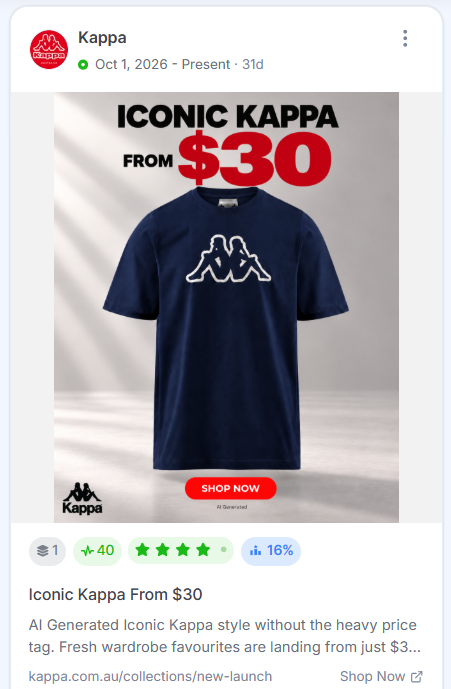
Kappa’s ad pairs a price with a brand it assumes the shopper already recognizes: the headline reads “Iconic Kappa From $30,” backed by copy that promises “Iconic Kappa style without the heavy price tag.”
The CTA simply says “Shop Now.” Neither line introduces a new idea; the headline states the price and the brand, and the copy restates the same value proposition in a second way. That repetition works because “From $30” only means anything once it’s attached to a brand people already want; a starting price alone rarely moves anyone. One qualifier matters here too: “from” signals an entry price, not the cost of every item in the range, so the ad stays accurate without overpromising.
For an AI brief, this means settling on the offer before asking for variations, then letting the tool experiment with phrasing around that fixed number and brand name rather than inventing a new price point.
2. Pure Encapsulations: Science-Led Messaging That Builds Trust
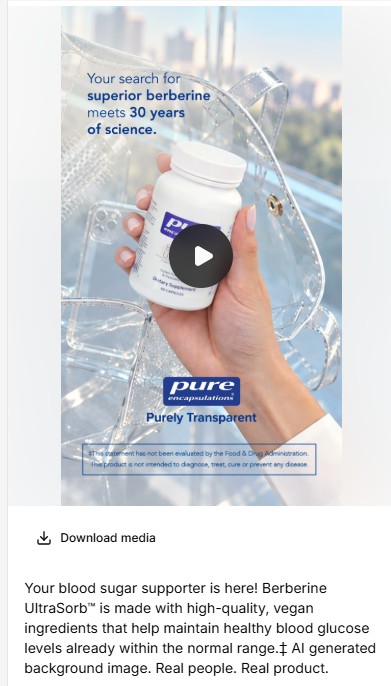
Pure Encapsulations opens its ad for Berberine UltraSorb with “Your search for superior berberine meets 30 years of science,” acknowledging that the shopper is already comparing options rather than discovering the category for the first time. The supporting copy describes vegan ingredients that help maintain blood glucose levels already within the normal range, a precise claim that stops short of suggesting the product treats diabetes or replaces medical care.
The ad works because the benefit (support for glucose levels already in range) and the reason to believe it (30 years of formulation experience) are kept separate, and each one is specific enough to be checked against the label.
Anyone generating a health or wellness ad with AI needs to hand over the approved claim language first, then ask the tool to refine the phrasing, never to supply the clinical backing or research citation on its own.
3. OM STYLE: Turning Personal Meaning Into Purchase Motivation
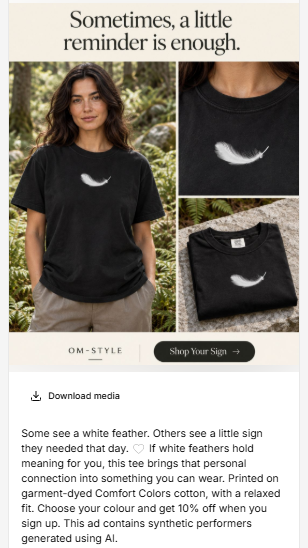
OM STYLE’s ad for its white feather tee opens with “Sometimes, a little reminder is enough,” followed by “Some see a white feather. Others see a little sign they needed that day.” Neither line mentions the product yet. The ad spends its first two sentences on meaning, not merchandise.
The conditional phrasing in the next line, “If white feathers hold meaning for you, this tee brings that personal connection into something you can wear,” invites the reader in without claiming everyone shares that belief. Only after that does the copy shift to practical details: Comfort Colors cotton, a relaxed fit, color options, and 10% off for signing up by email.
The CTA, “Shop Your Sign,” stays tied to the same idea introduced in the headline rather than defaulting to a generic “Buy Now.” The sequence, feeling first and fabric and fit second, is the part worth copying. Let an AI tool build the emotional opening first, then follow with concrete product information once the reader is already engaged.
4. Halara: Everyday Comfort With a Limited-Time Offer
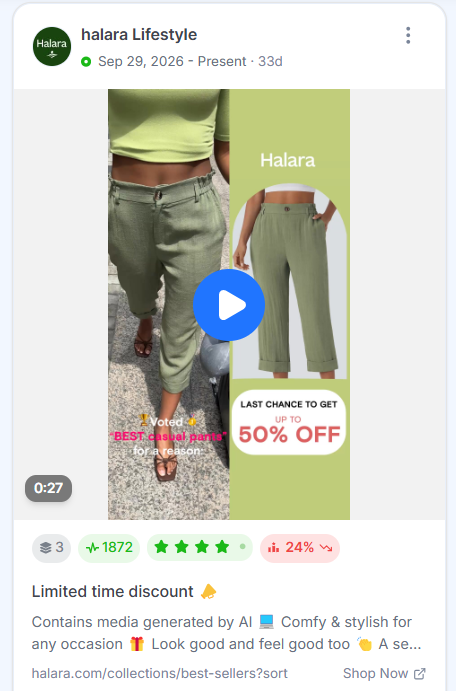
Halara’s ad for its casual pants leads with “Comfy & stylish for any occasion” and “Look good and feel good too,” addressing comfort and appearance in the same breath instead of forcing the shopper to pick one. A discount, “Last chance to get up to 50% off,” sits underneath that core message rather than replacing it; the urgency supports the proposition instead of becoming the whole ad.
The ad also says the pants were “Voted BEST casual pants,” a claim that should always trace back to a source the brand can show. When using AI to write ads, every award, ranking, and number should come from the brand’s own data, never from the AI tool.
How to Create Your Own AI-Generated Facebook Ads
1. Start With a Specific Creative Brief
A brief that says “write a Facebook ad for running shoes” gives the AI nothing to differentiate the ad from thousands of others in the same niche. A brief that says “write a Facebook ad for a running shoe with a carbon-fiber plate, priced at $140, aimed at runners training for a half marathon” gives the model actual material to work with. The more specific the input, the less the AI has to guess.
2. Build Each Ad Around One Main Reason to Buy
Every example pulled above, from Kappa’s price to OM STYLE’s emotional hook, and Halara’s comfort plus urgency, commits to one proposition and builds the whole ad around proving it. None of them try to cover five benefits in one headline. Asking an AI tool to generate an ad covering price, quality, sustainability, and limited stock all at once usually produces copy that reads cluttered and convinces nobody.
3. Give the AI Verified Product Information Only
Hand the AI only what’s been checked: the real price, the actual ingredient list, the genuine award or review source. If a fact can’t be verified, leave it out of the brief rather than hoping the AI fills the gap responsibly, because it won’t flag the gap on its own.
4. Generate Multiple Selling Angles
Once the reason to buy and the proof point are locked, the AI’s real value shows up in volume: generating ten different headlines around the same fixed proposition, or five different opening lines that lead into the same offer. This is where testing happens cheaply. Instead of guessing which angle will perform, a marketer can generate a batch of variations, run them against each other, and let the data decide.
5. Fact-Check Every Claim Before You Publish
Every number, percentage, and qualifier in an AI-generated ad needs a second look before it goes live. “Up to 50% off” needs to match the actual maximum discount available, not round up to a bigger number because it sounds better. AI tools will write with confidence regardless of whether the claim is accurate, so the fact-checking step has to happen on the human side every time.
6. Never Let AI Invent a Customer Testimonial
If real testimonials exist, feed them to the AI directly and ask it to format or shorten them. If they don’t exist yet, leave testimonials out of the ad entirely rather than risking a fabricated quote that could expose the brand to real liability.
Write AI-Generated Facebook Ads That Convert With GetHookd
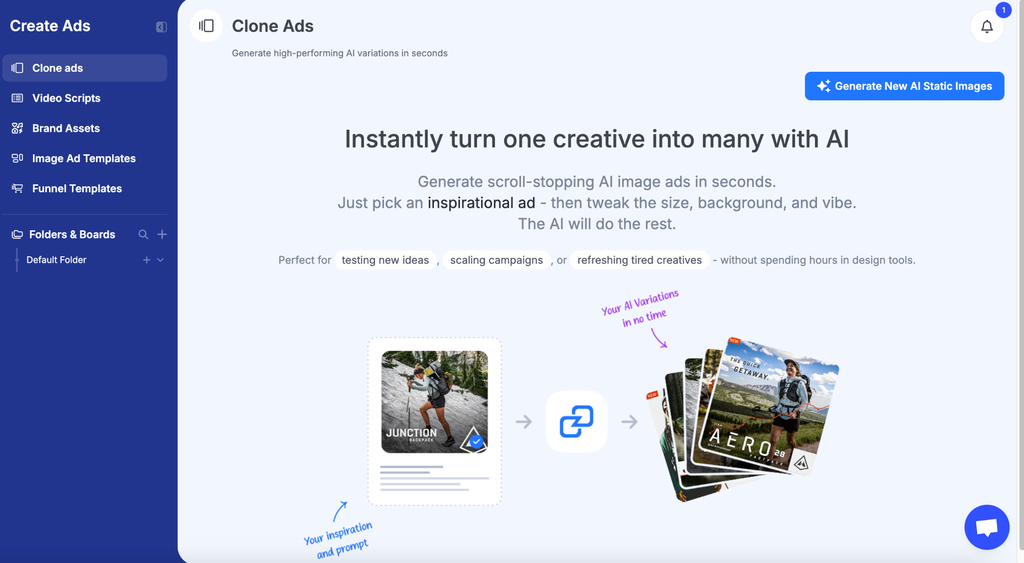
A strong AI-generated ad starts with a clear brief. Each example above commits to one message, backs it with details the brand can prove, and uses AI for the creative work around it. The tool speeds up production, but the strategy still has to come first.
GetHookd shows you which ads your market keeps running across over 22 million live Meta ads, so your brief starts from data. Our AI tools and ready-to-use templates then turn that research into new ads and scripts for your product, no designer needed. Try GetHookd free for 7 days.
Frequently Asked Questions (FAQs)
Are AI-generated Facebook ads allowed on Meta?
Yes, Meta allows ads written or designed with AI, as long as they follow its usual rules on claims, prohibited products, and community standards. Ads about social issues, elections, or politics must also disclose realistic AI-created images, video, or audio. For other ads, Meta may add an “AI info” label automatically.
What is the best AI tool for Facebook ads?
The best AI tool depends on whether you need copy, visuals, or insight into what’s already running in your market. Most AI tools create ads from a blank prompt, while GetHookd starts from live Meta ads, then uses Clone Ads and Video Scripts to build your own versions. That way, each new ad builds on what competitors are already scaling.
Can AI generate Facebook ad images?
Yes, AI tools can generate Facebook ad images, though the examples broken down above focus on ad copy rather than imagery. Tools built specifically for ad creative, including GetHookd’s Clone Ads feature, take an existing high-performing ad and turn it into new static variations rather than generating an image from scratch.
Are AI-generated Facebook ads effective?
AI-generated Facebook ads are effective when built from a specific brief with a clear price, benefit, or proof point, as shown by the Kappa, Pure Encapsulations, OM STYLE, and Halara examples. They become ineffective when the brief is vague, since the AI then has to guess at claims, which is where inaccurate or unverifiable statements tend to appear.
Can I connect GetHookd to ChatGPT to plan my ads?
Yes, AI agent access is included with any annual plan, and with the Team and Agency monthly plans. GetHookd connects to ChatGPT, plus Claude, Gemini, Cursor, and Perplexity, in about 30 seconds with no code required. You can then ask questions in plain English, like which angles your market is running, and every answer comes back with the source ad attached.
*Note: Pricing and/or product availability mentioned in this post are subject to change. Please check our website for current pricing and stock information before making a purchase.