Coaching Facebook Ads: Examples & Strategy
Key Takeaways
- Webinar ads, lead magnets, testimonials, and direct offers are the main coaching Facebook ad formats used, each fitting a different stage of the funnel.
- Cold audiences respond better to free value, while warm audiences are more likely to convert on direct offers.
- Coaching Facebook ads that highlight clear, specific results perform better than those focused on credentials or program details.
- Consistent testing and competitor research help improve performance and reduce wasted ad spend.
- GetHookd gives media buyers and coaches access to over 65 million analyzed Meta ads to quickly find and model top-performing coaching creatives.
What Coaching Facebook Ads Look Like (And How to Run Them)
The most effective coaching Facebook ad formats are free webinar ads, lead magnet ads, client testimonial ads, and direct offer ads. Each one serves a specific stage of the buyer journey, and knowing which to run and when is the difference between a profitable campaign and wasted budget.
The strategy behind each format follows the same core logic: match the offer to the audience’s familiarity with you, lead with a specific client transformation rather than credentials, and research what competitors are already scaling before you spend. Coaches who follow this framework consistently outperform those who launch ads without a tested creative direction.

GetHookd: Turn Competitor Intelligence Into Your Next Winning Ad
GetHookd reveals which ads your competitors are actively scaling—not just running. Spy on their best-performing creatives, landing pages, and traffic strategies, then turn proven concepts into testable campaigns in seconds with AI-powered script generation and creative cloning.
What You Get:- ✓ Brand Spy to decode competitor ad strategies in real-time
- ✓ AI script generation and ad cloning for instant variations
- ✓ Performance scoring based on actual ad behavior, not vanity metrics
- ✓ Creative Analyzer to identify and scale your top performers
Coaching Facebook Ad Examples
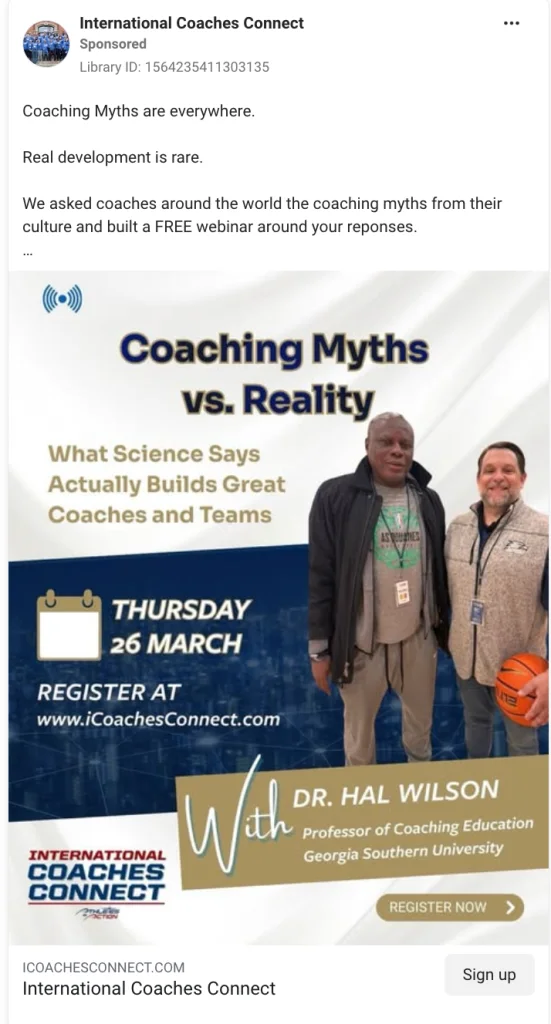
Free Webinar & Training Ads
The free webinar ad is one of the most widely used formats in the coaching space, and it remains effective for a straightforward reason. It removes the financial barrier for cold audiences while the webinar itself serves as the primary sales vehicle.
Effective webinar ads open with a specific outcome in the first line: “Learn how to close three new coaching clients this week without cold outreach.” The hook targets a real pain point, the offer costs the viewer nothing, and the call to action directs to a registration page. Ads in this format typically use short-form video or a clean static image with a benefit-driven headline.
Lead Magnet Ads
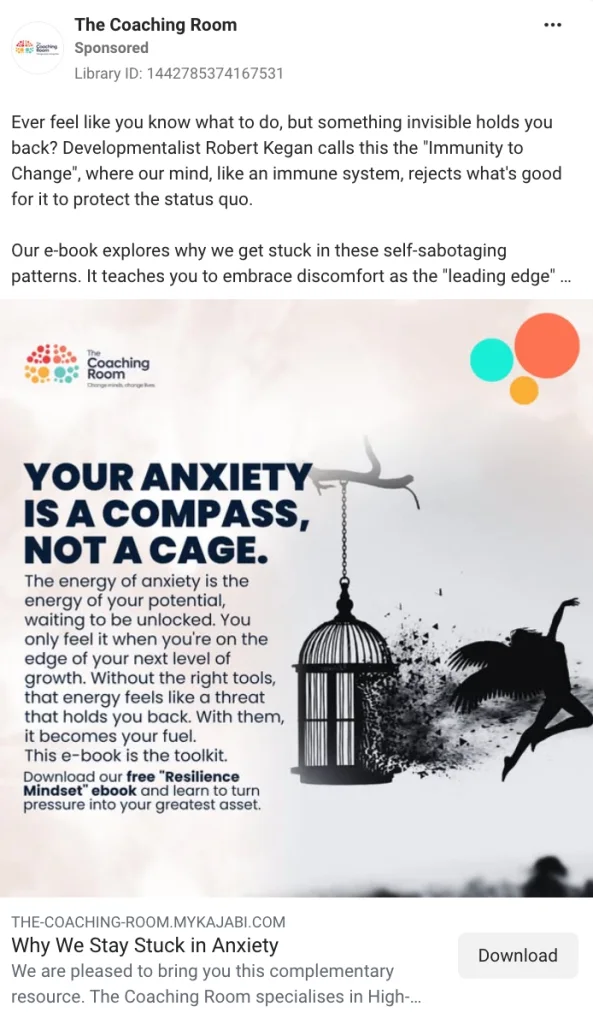
Lead magnet ads work well for coaches who want to build an email list and warm up prospects before presenting a paid offer. Common formats include free guides, checklists, mini-courses, swipe files, and strategy templates.
The key to a high-converting lead magnet ad is specificity in both the resource and the headline. A business coach offering “The 5-Step Client Acquisition Checklist for Freelance Consultants” will consistently outperform a generic “Free Business Guide.” The creative typically pairs a clean visual of the downloadable resource with a short headline and a “Download Now” call to action.
Keep the ad copy short and the benefit clear. Three to four lines focused on what the viewer will gain from the resource consistently outperforms longer, feature-heavy descriptions. The goal is to get the click, not describe the entire contents of the resource.
Testimonial & Social Proof Ads
Social proof ads use documented client results to validate the coaching offer. These perform particularly well for warm retargeting audiences who have already watched a video, visited the website, or engaged with a previous ad in the sequence.
A strong testimonial ad stays tightly focused: one client, one specific result, delivered in under 30 seconds. Video testimonials outperform text-based formats in most niches, especially when the client describes both the specific problem they had before working with the coach and the concrete outcome they reached afterward. Vague praise rarely converts; measurable, specific results do.
A two-step retargeting sequence works well here: serve a free webinar or lead magnet ad first to build the warm audience, then follow with a testimonial ad within seven to fourteen days. This structure allows the social proof to reach people who already have some context about the coaching offer. Conversion rates on testimonial ads improve significantly when the audience has prior exposure to the brand.
Direct Offer Ads
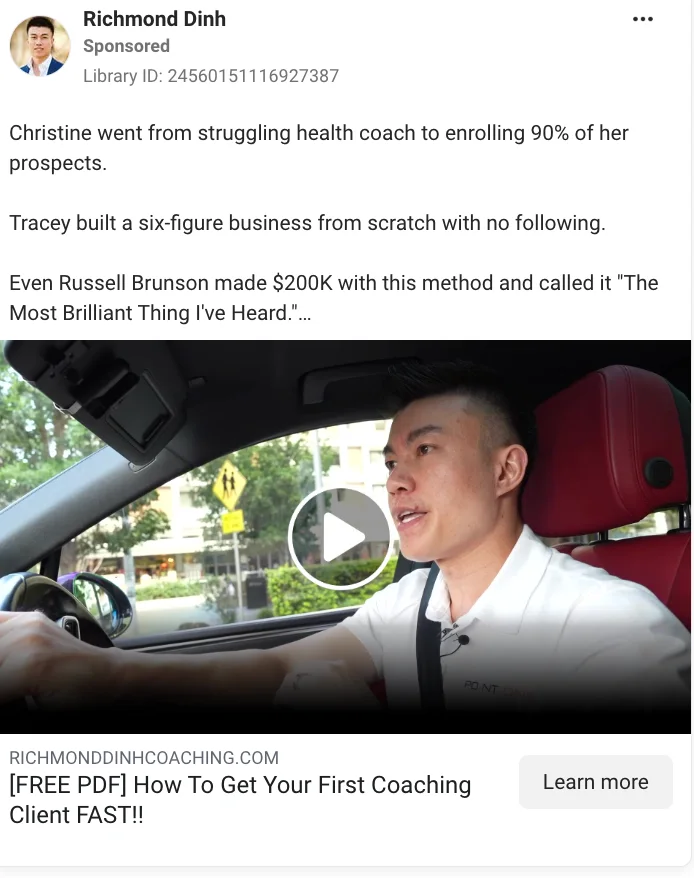
Direct offer ads skip the free entry point and promote the coaching program or service outright. These perform better with warm audiences who are already familiar with the coach, or in lower-competition niches where purchase intent is higher.
The headline should lead with the transformation rather than the program title. “Get Your First 10 Clients in 60 Days” outperforms “Join My Business Coaching Program” with most audiences. Supporting copy should briefly address the most common objections and direct users to a booking page or discovery call form.
Coaching Facebook Ad Strategy
1. Lead with Transformation, Not Features
Before writing a word of ad copy, get clear on the specific and measurable outcome your coaching delivers. Ads that describe what a program includes rarely outperform ads that describe what a client’s situation looks like after completing it.
Write the transformation in concrete terms. “Go from zero clients to a fully booked calendar in 90 days” outperforms “Learn proven business strategies from an experienced coach” in nearly every test. The more precise the promised outcome, the more the right audience will engage with the message.
2. Match Your Offer to the Funnel Stage
Cold audiences have no prior relationship with the coach. They need a low-risk entry point: a free training, a downloadable resource, or a short video that demonstrates expertise before asking for money. Warm audiences, retargeted after viewing content or visiting the site, are better positioned to receive a direct offer.
Running the same ad to cold and warm audiences simultaneously is a common and expensive mistake in coaching campaigns. Structuring campaigns so each segment sees an offer appropriate to their level of familiarity with the brand dramatically improves efficiency. Testing both segments with different creatives from the start gives you better data and faster results.
3. Test Creatives Systematically
Most coaching ad failures come from testing too few creatives and drawing conclusions prematurely. The first version of an ad is almost never the best-performing version, and treating an early result as a final verdict wastes real potential.
Build a structured testing process: start with three to five variations of the hook (the opening line or the first frame of a video), identify the top performer, then test body copy and call to action separately. Video hooks, static images, and carousel formats each produce different results depending on the niche and audience type. Testing one variable at a time keeps the data clean and actionable.
Most campaigns need at least two to three weeks of consistent spend before performance data becomes reliable enough to scale on. Rushing a scaling decision based on two or three days of data is one of the most common reasons coaching campaigns fail to reach their potential.

4. Research Competitor Ads Before You Spend
Reviewing competitor ads before launching your own is the fastest way to compress the creative testing phase. Media buyers and coaches who analyze what is already scaling in their niche arrive at a winning creative faster than those who build from scratch.
The Facebook Ad Library gives basic visibility into what competitors are running across Meta. For more depth, including performance signals, creative format analysis, and landing page data, a dedicated competitive intelligence tool provides a meaningful advantage. Starting with knowledge of what is already working means every test is better informed from day one.
Look for patterns across multiple competitors rather than focusing on any single brand. When several coaches are running the same hook angle or creative format, that is a strong signal that the approach is working well with that audience. The goal of competitor research is to inform your strategy, not to copy specific ads.
Build Better Coaching Facebook Ads With GetHookd
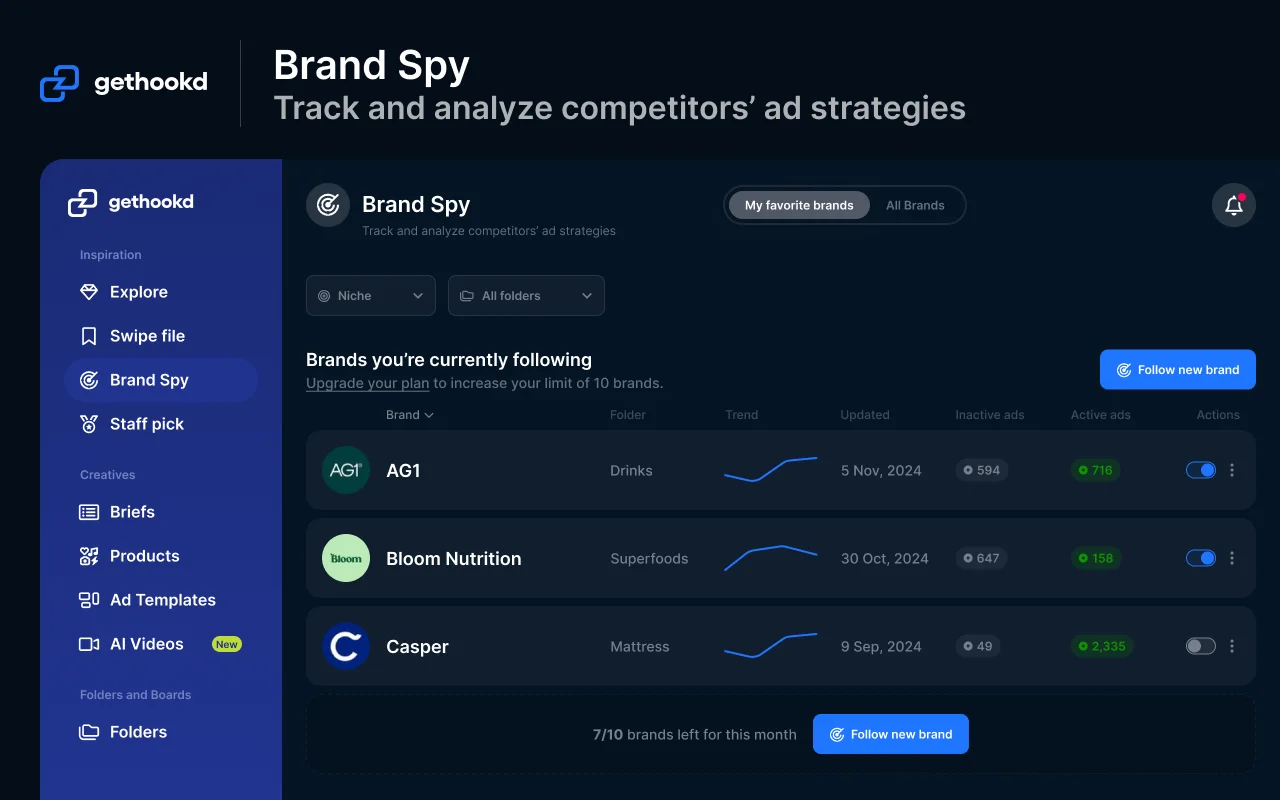
At GetHookd, we built our platform for media buyers, performance marketers, and agencies managing Meta campaigns across any niche, including those running ads for coaching businesses. With over 65 million ads analyzed, we provide direct visibility into which coaching ads are actively scaling, giving you a real competitive edge before your first test runs. We go beyond the basic visibility of the Facebook Ad Library to show you what is actually performing, rather than simply what has been published.
Our Brand Spy feature shows exactly what competitors are promoting, which landing pages they are driving traffic to, and how their creatives are structured across formats and placements. Our AI-powered script generation and Creative Analyzer tools mean you can go from research to a testable ad concept faster than building from scratch, with confidence backed by real performance data.
Start your GetHookd free trial today!
Frequently Asked Questions (FAQs)
What Facebook ad format works best for coaching businesses?
Lead generation and free webinar ads consistently perform well for coaching businesses targeting cold audiences on Facebook. They lower the barrier to entry by delivering value before any purchase is required. Video formats tend to drive stronger engagement across most coaching niches, particularly when the hook addresses a specific pain point in the first three seconds.
How do I find coaching ad ideas without starting from zero?
The Facebook Ad Library gives a basic view of what competitors are currently running across Meta. For more detailed research, including performance signals and landing page data, platforms like GetHookd let you search over 65 million Meta ads by niche to identify what is already driving results before writing a single line of copy.
How often should coaching Facebook ads be refreshed?
Ad fatigue develops when the same audience sees the same creative too many times over a short period. Most campaigns benefit from a fresh creative every two to four weeks, depending on audience size and daily spend. Monitoring frequency and click-through rate helps catch early signs of fatigue before they translate into significant budget loss.
Can GetHookd help build better coaching ads faster?
Yes. At GetHookd, our Brand Spy tool shows which coaching ads competitors are actively scaling on Meta, so you can model proven formats rather than building from guesswork. Our AI script tools turn top-performing ads into new creative variations in minutes. By analyzing 65 million-plus ads and including performance scoring, we help coaches and media buyers significantly reduce research and ad creation time.