Key Takeaways
- The best 2026 babysitting ads come from three advertisers: Wyndy, Care.com, and Sittercity, with Wyndy running two creatives that test different hooks. Each angle is one you can rebuild for your own service.
- Wyndy and Care.com commit to a single concern, then answer it with proof like background-checked college sitters or a fast fix when a nanny quits.
- Sittercity uses a parent creator’s first-person story instead of a direct pitch, borrowing that credibility to build trust for in-home care.
- Every active babysitting ad is free to study in the Meta Ad Library, but keyword searches return thousands of related results and won’t show which ads competitors are scaling.
- GetHookd is built for the research step these ads reward: we surface proven babysitting creative across 65 million analyzed Meta ads and rebuild it into testable variations in minutes.
How Babysitting Ads Hook Parents on Meta
The strongest babysitting ads on Meta work because they lead with one emotional hook, back it with a single proof point, and point to one clear action. Parents deciding on childcare weigh trust first, so the opening line has to match a worry or a wish, not list features.
Most advertisers weaken their ads by stacking several angles into one creative, which splits the parent’s attention and dulls every message. The four ads below avoid that. Each commits to a single motivation, whether safety, an urgent problem, a testimonial, or time saved, which is what makes them easy to study and copy.
GetHookd makes that study faster by pulling active babysitting ads into one searchable library, showing how long each has run, and turning any winner into new creative variations you can test in minutes.

GetHookd: Turn Competitor Intelligence Into Your Next Winning Ad
GetHookd reveals which ads your competitors are actively scaling—not just running. Spy on their best-performing creatives, landing pages, and traffic strategies, then turn proven concepts into testable campaigns in seconds with AI-powered script generation and creative cloning.
What You Get:- ✓ Brand Spy to decode competitor ad strategies in real-time
- ✓ AI script generation and ad cloning for instant variations
- ✓ Performance scoring based on actual ad behavior, not vanity metrics
- ✓ Creative Analyzer to identify and scale your top performers
4 Babysitting Ad Examples Running on Meta
1. Wyndy: Safety-Led Hook
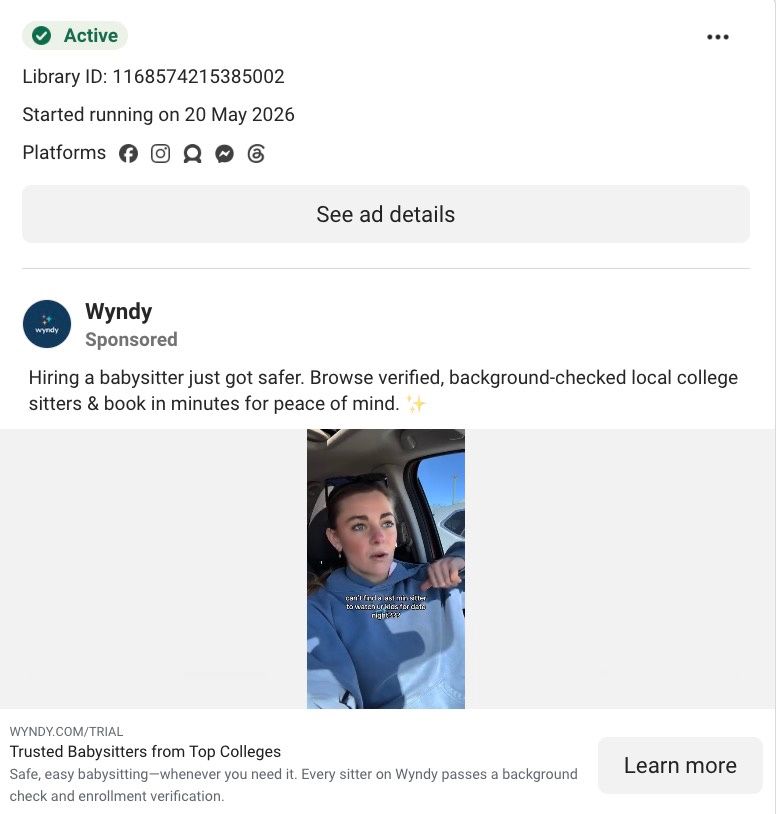
Wyndy runs a video ad that opens with the line “hiring a babysitter just got safer.” The copy states that sitters are verified, background-checked local college students and that parents can book in minutes. The headline reads “Trusted Babysitters from Top Colleges,” and the button links to a free trial at wyndy.com/trial.
The ad presents one proof point, background checks with enrollment verification, and one low-commitment action. There is no price and no feature list. Safety-led framing fits childcare because trust is the first barrier parents weigh.
2. Care.com: Problem-First Hook
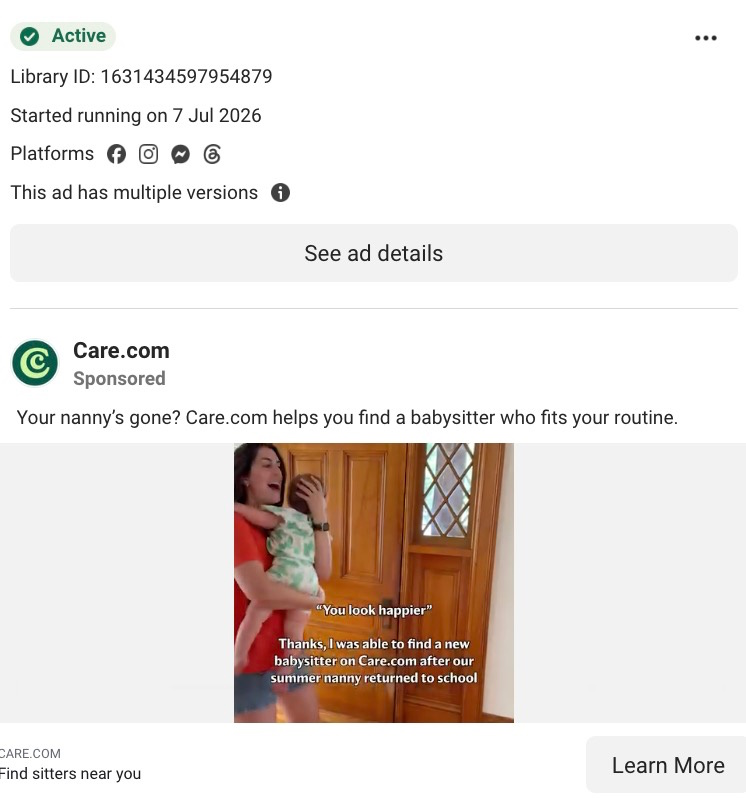
Care.com’s video ad opens with a question, “Your nanny’s gone?” The line names an urgent situation rather than a feature. The ad then offers to help find a babysitter who fits the parent’s routine, under the headline “Find sitters near you,” and links to Care.com.
The opening line carries the persuasion, and the offer only has to confirm the fix. The structure is a moment, a solution, and one action, with nothing else competing for attention.
3. Sittercity: Creator Testimonial
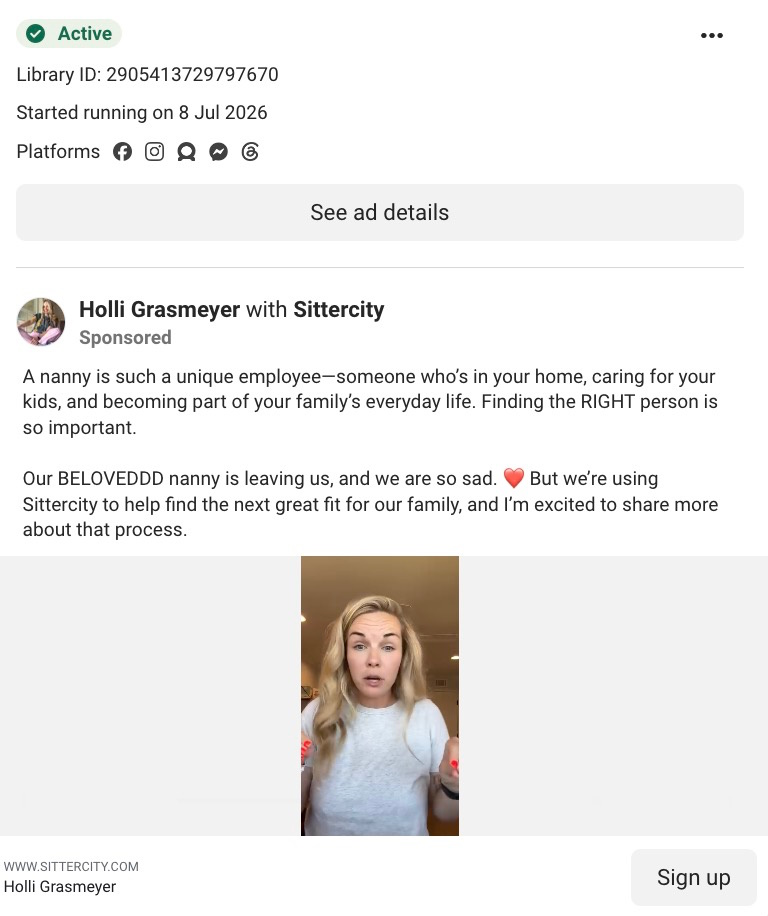
Sittercity runs ads through parent creators rather than from its own brand account. In this one, the creator says her nanny is leaving and that she is using Sittercity to find the next fit, and she describes a nanny as someone who becomes part of the family. The format is a first-person video, and the button links to sittercity.com.
Testimonial framing borrows the creator’s credibility, which can raise trust for a service that places someone inside the home. The ad sells the search process itself, not a discount or a feature.
4. Wyndy: Time-Saved Hook
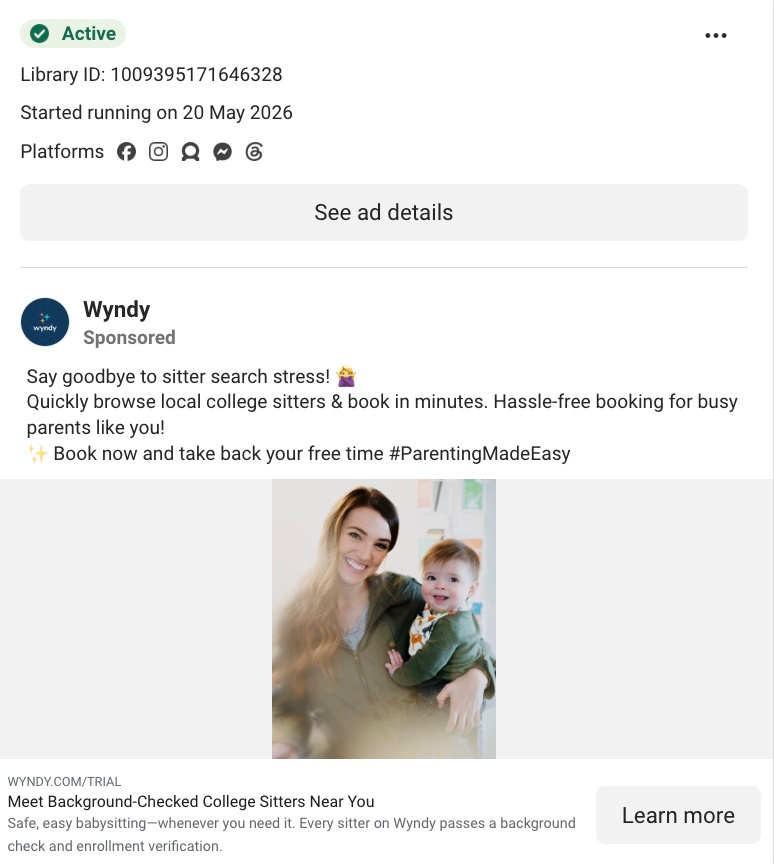
Wyndy also runs a second creative with a different angle. It opens with “say goodbye to sitter search stress,” promises quick browsing of local college sitters and booking in minutes, and closes by telling parents to take back their free time. The headline reads “Meet Background-Checked College Sitters Near You.”
Running a safety hook and a time-saved hook side by side shows one advertiser testing two motivations: trust against convenience. The same product is sold on a different emotion.
How to Copy These Babysitting Ads
Copying a winning ad means reusing its hook, offer, and audience, then producing original creative. Work through these steps in order:
- Pick one hook per ad. Choose a single angle: safety, an urgent problem, a testimonial, or a benefit such as time saved, rather than combining several in one creative.
- Open with that angle. Put it in the first line so it matches the parent’s state, for example, a worry like “your nanny’s gone” or a benefit like “take back your free time.”
- Support it with one proof point. Use a concrete signal such as background checks, enrollment verification, or a real parent’s account.
- Set one action. Send clicks to a single step, a free trial, a local search, or a signup, and remove competing links.
- Test angles against each other. Run safety, problem, testimonial, and benefit versions, as Wyndy does, and keep the ones that hold. An ad-research tool like GetHookd can generate these variations from a chosen ad in seconds.
Babysitting Ads at a Glance
| Ad | Angle | Core hook | Call to action |
| Wyndy | Safety/trust | “Hiring a babysitter just got safer” | Free trial |
| Care.com | Problem-first | “Your nanny’s gone?” | Find sitters near you |
| Sittercity | Creator testimonial | Nanny leaving, finding the next fit | Sign up |
| Wyndy | Time saved | “Say goodbye to sitter search stress” | Book now / free trial |
Finding Babysitting Ads to Copy Faster With GetHookd
The four ads share one lesson: a single hook, one proof point, and one clear action beat a creative that tries to say everything at once. The slow part is not copying that structure. It is finding the ads worth copying, since a keyword search in the Facebook Ad Library returns thousands of results that are only slightly relevant to your niche.
That is the step we built GetHookd for. We filter the noise, surface the babysitting ads competitors are actively scaling, then turn any winner into fresh, testable variations in minutes. Run your niche search inside GetHookd and start rebuilding proven hooks into your own campaigns today.
Frequently Asked Questions (FAQs)
Do babysitting ads fall under Facebook’s special ad categories?
Babysitting job and recruitment ads can fall under Meta’s Employment special ad category, which limits age, gender, and detailed targeting. Ads that sell a booking service to parents usually do not. Check the category before launch, because misclassification can cause rejection or restricted delivery.
How often should I review competitor babysitting ads?
A weekly review suits most childcare advertisers, since creative in this niche changes gradually. Increase the frequency during seasonal peaks such as back-to-school and the holidays, when demand rises. Focus on ads that keep running, because sustained spend is a reliable signal that an ad is profitable.
Should a babysitting ad use video or a static image?
Both work, and the four examples here are mostly short videos. Video suits testimonials and step-by-step booking demos, while a single image suits a sharp problem-first line. Test one of each against the same audience and let cost per result decide, rather than assuming one format wins.
Do I need technical skills to research babysitting ads?
No. Tools like GetHookd are easy to use and searchable by keyword or advertiser, so anyone can study active ads without code. Research platforms add filters, saved collections, and performance signals, but the core skill is reading ads closely and noting which hooks and offers repeat.
How does GetHookd support brand spying on babysitting competitors?
GetHookd’s Brand Spy shows which of a competitor’s babysitting ads are being scaled, plus the landing pages and traffic sources behind them. You can save those ads, review the angle, and track which offers hold over time.
*Note: Pricing and/or product availability mentioned in this post are subject to change. Please check our website for current pricing and stock information before making a purchase.