Before and After Facebook Ads: Examples & Tips
Key Takeaways
- Show a specific, measurable result in the after state. “Lost 14 lbs in 30 days” converts better than “lost weight” because viewers can picture themselves in that outcome.
- Include a defined timeframe directly in the creative, whether in the image label or the copy, to add credibility without extra claims.
- Real customer submissions outperform model-based creative because authenticity is the entire point of the format, and audiences can tell the difference.
- Design every before-and-after Facebook ad for sound-off mobile viewing so the transformation is visually obvious without audio or interaction.
- GetHookd gives you access to 65M+ real Meta ads filtered by niche so you can study which transformation angles competitors are scaling and build your own with our Image Ad Templates, Clone Ads, and Video Scripts tools.
What Makes a Before & After Facebook Ad Work?
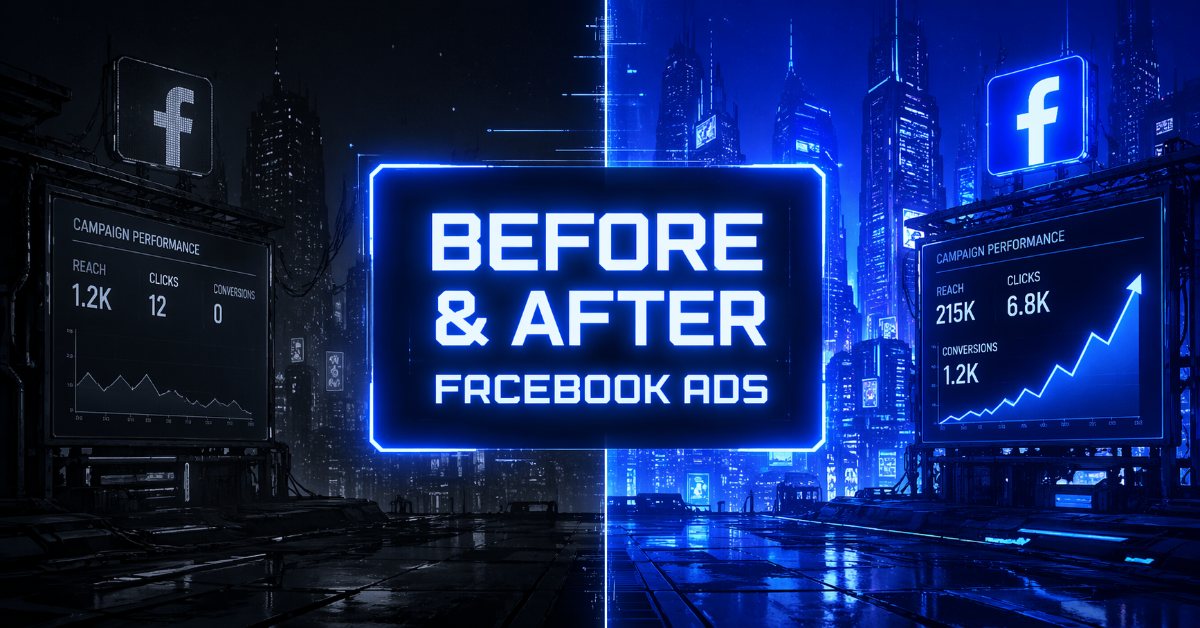
Before and after Facebook ads convert because they show proof before asking for trust; the transformation is visible, and viewers can picture themselves in the outcome before committing to anything.
The ads that fail typically skip one of four structural elements: a relatable before state, a specific measurable result, a defined timeframe, and a clear call to action. The three examples covered here, Mane Strong, Goettl, and SheVitality, each nail this structure differently, from stacking social proof onto the creative to embedding the timeframe directly into the visual.
Six actionable tips for building your own high-converting before and after ads are covered in full below, along with how GetHookd allows you to use competitor intelligence to skip the guesswork entirely.

GetHookd: Turn Competitor Intelligence Into Your Next Winning Ad
GetHookd reveals which ads your competitors are actively scaling—not just running. Spy on their best-performing creatives, landing pages, and traffic strategies, then turn proven concepts into testable campaigns in seconds with AI-powered script generation and creative cloning.
What You Get:- ✓ Brand Spy to decode competitor ad strategies in real-time
- ✓ AI script generation and ad cloning for instant variations
- ✓ Performance scoring based on actual ad behavior, not vanity metrics
- ✓ Creative Analyzer to identify and scale your top performers
3 Examples of Before and After Facebook Ads
These examples represent different industries, formats, and strategies, but each one nails the core transformation structure in its own way.
1. Mane Strong: Stacking Proof Inside the Before and After
.
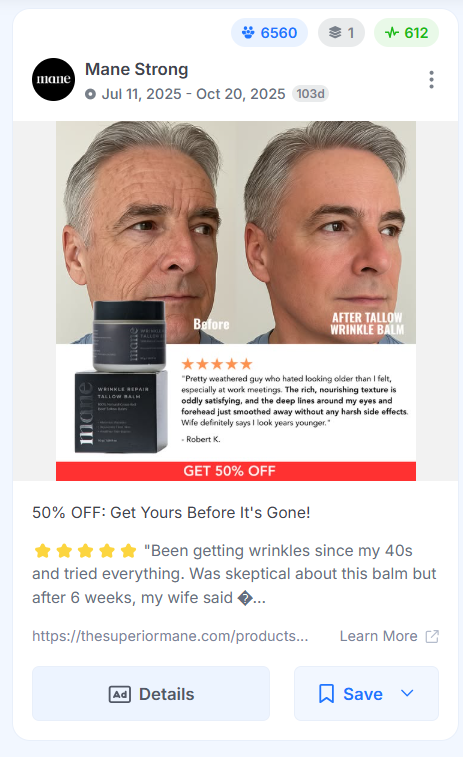
Mane Strong does not rely solely on visual transformation. The before and after image is the foundation, but the ad stacks a five-star customer quote directly onto the creative, a real name, a specific outcome, and a mention of the wife’s reaction, which turns a single transformation photo into a multi-layered proof asset. The urgency lever, “GET 50% OFF” in a bold red bar, appears at the bottom of the creative where the eye lands after processing the transformation.
The body copy reinforces the pattern with another customer testimonial that opens by acknowledging skepticism, which directly addresses the objection most viewers bring to before and after ads.
2. Goettl Air Conditioning & Plumbing: Price-Led Before and After
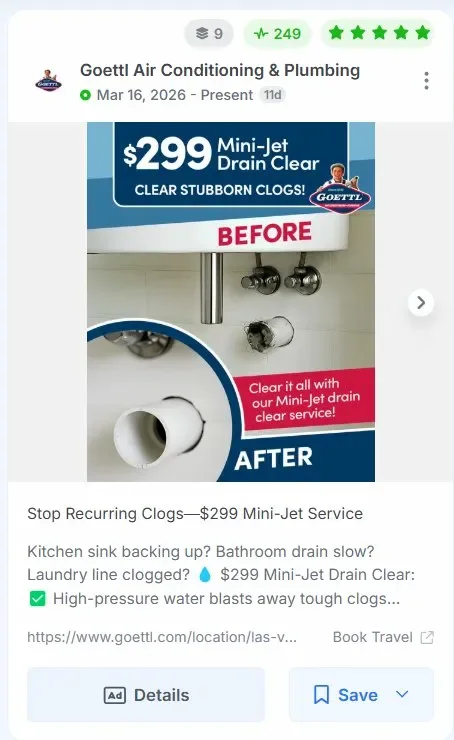
Goettl leads with the price before the transformation, which is an unusual but effective move in the home services category.
“$299 Mini-Jet Drain Clear” anchors the offer immediately, removing the most common objection in service-based ads before the viewer has even processed the visual.
The before and after images then do the proof work, showing a clogged drain pipe transformed to a clear one, a result that is unglamorous but instantly recognizable to anyone who has dealt with the problem.
The body copy reinforces the hook with three specific pain points in quick succession: kitchen sink backing up, bathroom drain slow, laundry line clogged. That list makes the ad feel relevant to a much wider pool of homeowners without losing specificity.
3. SheVitality: Building Credibility Through a Timeframe
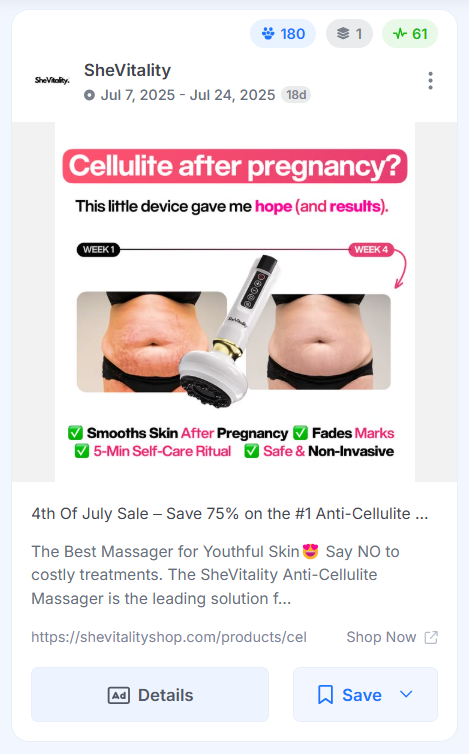
SheVitality makes the timeframe part of the visual itself. “Week 1” and “Week 4” are labeled directly on the creative, which manages expectations and adds credibility without requiring the viewer to read the copy.
The transformation shown is realistic rather than dramatic, which actually works in its favor. An understated result is easier to believe than a headline-grabbing one.
The hook “Cellulite after pregnancy?” qualifies the audience in four words, and the subheading “This little device gave me hope and results” immediately frames the product through a customer’s emotional experience.
The benefit bullets at the bottom (smooths skin, fades marks, five-minute ritual, safe and non-invasive) address the practical objections a skeptical buyer might raise in this category.
Tips to Make Your Before and After Facebook Ads Convert
These six tips are the difference between a before and after ad that gets ignored and one that scales.
1. Make the “Before” Feel Relatable
The before is your hook, and it only works if your audience sees themselves in it. Spend time making it as specific and emotionally accurate as possible. The more precisely you mirror their daily reality, the stronger the pull toward the resolution.
2. Use Real Customers Instead of Models Where Possible
UGC ads consistently outperform model-based creative in this format because authenticity is the whole point. Real customer submissions, even if slightly lower in visual quality, carry credibility that no professional shoot can replicate.
Reach out to existing customers, offer a small incentive, and build a library of genuine transformation content to test and scale.
3. Add Social Proof
A before and after image is compelling on its own, but adding a star rating overlay, a short customer quote, or a review count turns compelling into convincing. This is especially important for cold audiences who have never heard of your brand.
4. Include a Clear CTA
After you’ve shown the transformation and built the desire, you need to tell the viewer exactly what to do next. Always include one clear CTA. Ads that offer multiple next steps or use vague language after a strong transformation sequence give viewers a reason to hesitate rather than act.
5. Optimize Every Ad for Mobile First
The majority of Facebook users are on mobile, so your creative needs to be designed for a small screen. Use vertical or square formats, keep text overlays large enough to read without zooming, and ensure the transformation reads clearly without sound.
If using video, try to add captions. Also, ensure your landing page loads fast and continues the transformation story your ad started.
6. Test Multiple Creatives to Find Your Winning Version
No matter how confident you are in your creative, you won’t know what actually converts until you test it. Before and after ads are no different.
Run at least three to five variations of the same transformation story. You can change the “before” image, swap the headline, try a video versus a static split-screen, or adjust the timeframe in your copy. Small changes can produce dramatically different results, and the only way to find your winner is to let the data tell you.
GetHookd: Research & Launch High-Performing Before and After Ads
GetHookd’s Explore Ads feature puts 65M+ real Meta ads at your fingertips, filtered by niche, format, and performance signals, so you can study which transformation angles competitors are actively allocating budget to and which proof formats are driving results. Our Brand Spy feature lets you go deeper on any specific competitor, revealing the creatives, landing pages, and offers behind their top performers.
From there, our Image Ad Templates and Clone Ads tools get your static before and after creatives into testing faster, while our Video Scripts tool handles the scripting work for video formats, so you are never starting from a blank page.
Ready to Create Ads that Convert? Start your GetHookd free trial today!
Frequently Asked Questions (FAQs)
Does Meta allow before-and-after ads?
Yes, but with restrictions that vary by industry. Meta prohibits ads that frame the before state in a way that implies shame or embarrassment, and restricts dramatic health and weight loss claims without disclaimers.
Adding “results may vary” is standard practice. Side-by-side product results, realistic skincare transformations, and honest customer submissions with accurate timeframes are generally allowed. When in doubt, review Facebook’s advertising policies before launching.
Should I use video or images for before-and-after Facebook ads?
Both work but serve different purposes. Static split-screen images deliver the transformation instantly and perform well for warm retargeting audiences. Video works better for cold audiences who need more context before they act. Test both formats against the same audience and let cost-per-result guide your decision.
What industries work best for before-and-after Facebook ads?
The format works best where the transformation is visual, specific, and emotionally meaningful. Skincare and beauty, home services, health and fitness, fashion, pet care, interior design, and SaaS products showing workflow improvements all perform strongly.
GetHookd’s Explore Ads feature lets you search 65M+ real Meta ads by niche so you can see exactly which transformation angles are working in your specific industry before you build anything.
How do I get real, before-and-after customer content?
Start with your most satisfied customers, identified through reviews or repeat purchases, and make the process easy by giving them a clear brief. Specify exactly what to photograph or film, at what stage, and offer a small incentive. For physical products, a post-purchase email at the 30 or 60-day mark is the most reliable trigger since results are typically visible and enthusiasm is still high.
*Note: Pricing and/or product availability mentioned in this post are subject to change. Please check our website for current pricing and stock information before making a purchase.