5 Best Salon Facebook Ads Examples
Key Takeaways
- Five proven ad formats drive salon bookings. Coupons, service videos, niche targeting, new client offers, and loyalty ads each target a specific stage of the customer journey.
- Clarity and simplicity win conversions. Strong visuals (showing results), a clear offer, and a direct booking CTA reduce friction and boost bookings.
- Targeting and segmentation improve efficiency. Narrowing audiences and excluding existing clients helps lower costs and attract higher-quality bookings.
- Retention ads are just as valuable as acquisition. Loyalty and retargeting campaigns bring back past clients without heavy discounts, improving long-term ROI.
- GetHookd gives salon marketers access to 65M+ analyzed Meta ads to identify which competitor creatives are being scaled and build new campaigns based on what is already working.
What Salon Facebook Ads That Actually Drive Bookings Look Like
Coupon-led offers, service spotlight videos, niche audience targeting, new client incentives, and loyalty retargeting are the five formats that consistently produce bookings for salon brands on Facebook. The examples below come from Great Clips, Drybar, Sport Clips, Supercuts, and Ulta Beauty Salon, each of which has built a repeatable ad structure around one of these approaches.
The difference between ads that fill appointments and ads that get scrolled past usually comes down to three things: a visual hook that shows a result, an offer specific enough to act on, and a creative that speaks to a defined audience. Each example below breaks down exactly how one brand gets this right, and how you can apply the same logic to your own campaigns.

GetHookd: Turn Competitor Intelligence Into Your Next Winning Ad
GetHookd reveals which ads your competitors are actively scaling—not just running. Spy on their best-performing creatives, landing pages, and traffic strategies, then turn proven concepts into testable campaigns in seconds with AI-powered script generation and creative cloning.
What You Get:- ✓ Brand Spy to decode competitor ad strategies in real-time
- ✓ AI script generation and ad cloning for instant variations
- ✓ Performance scoring based on actual ad behavior, not vanity metrics
- ✓ Creative Analyzer to identify and scale your top performers
5 Best Salon Facebook Ads Examples
1. Great Clips: The Coupon-Led Acquisition Ad
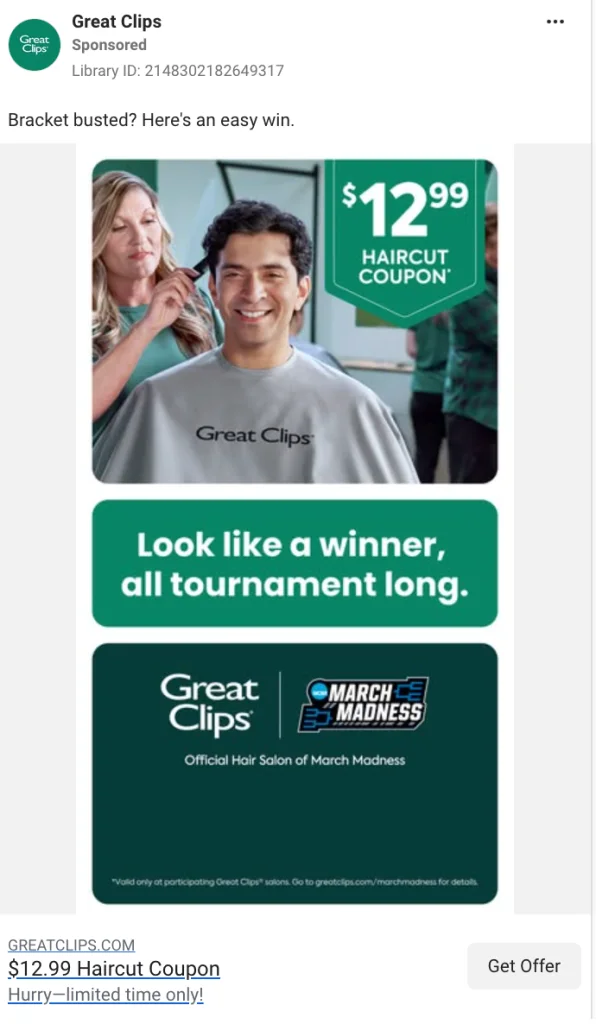
Great Clips runs Facebook ads built around a single, clean offer: a discounted haircut with a fast redemption path. The creative is minimal, the headline leads with the saving or price point, and the click goes directly to a booking page or digital coupon. The lack of extra context keeps the decision simple for the viewer.
This format works because it removes friction at every step. The viewer understands the offer in under two seconds, and the CTA gives them one clear action. That directness reduces the gap between impression and conversion.
Great Clips uses simple graphics rather than lifestyle photography because the offer carries the message on its own. For salons competing on price or targeting first-time clients in a competitive local market, this remains a reliable format. Keep copy short, the CTA direct (“Get Coupon” or “Book Now”), and the landing page focused on a single action.
Redemption friction also matters on the back end. If the link goes to a homepage rather than a dedicated booking or coupon page, a significant portion of clicks will not convert. The simpler the path from ad click to confirmed booking, the stronger the results.
2. Drybar: The Service Spotlight Video Ad
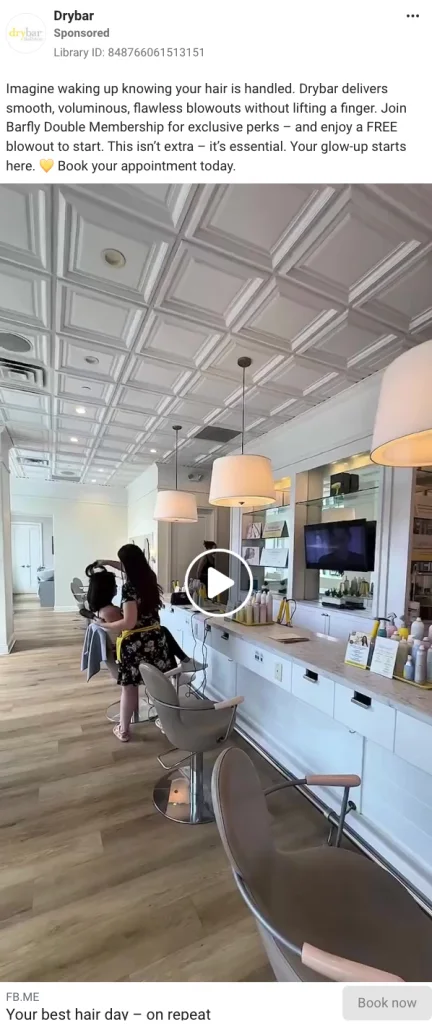
Drybar’s Facebook video ads focus on a single service, typically their signature blowout, filmed in their recognizable yellow and white branded environment. The video runs under 30 seconds and opens on the finished look rather than the beginning of the styling process. That sequencing decision is what drives performance.
Facebook users scroll fast. An ad that leads with the outcome, a polished, completed style, captures attention before the viewer moves on. The branded setting reinforces quality without requiring copy to explain it. And because the ad focuses on one service, it speaks directly to viewers who already want that outcome.
Salons do not need a full production setup to replicate this structure. A phone camera, a ring light, and a 20- to 25-second clip of a completed service can follow this format. The sequence matters most: result first, brief process second, booking CTA at the end.
The service focus also removes price objections from the equation. A viewer who wants exactly that blowout outcome is less likely to comparison-shop on cost. The creative handles qualification, which increases conversion rates among interested viewers.
3. Sport Clips: The Audience-First Targeting Ad
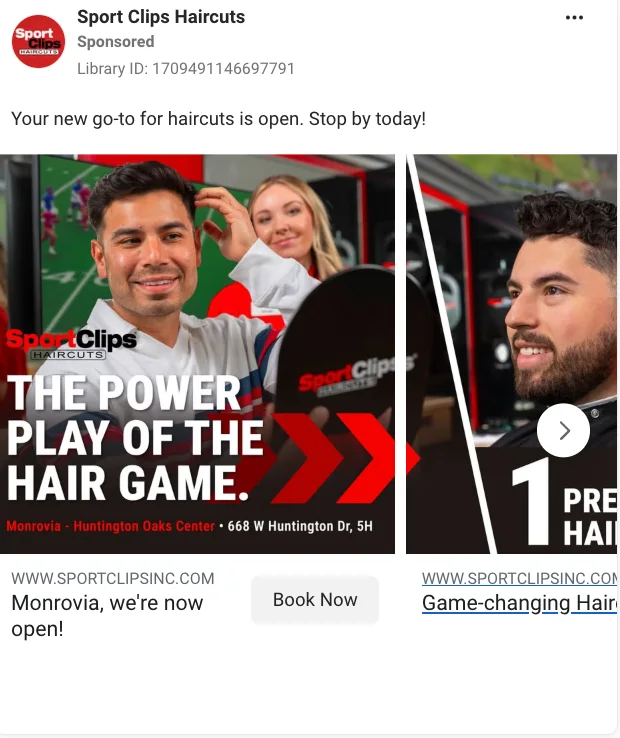
Sport Clips runs Facebook ads designed around tight demographic targeting rather than creative complexity. The ads feature sports imagery, short copy, and a direct booking CTA. The goal is not to reach the widest possible audience but to speak directly to men who want a fast, sports-themed haircut experience.
That focus produces better click quality. The ad signals clearly who it is for, and viewers self-select quickly. This clarity improves ad relevance and lowers the cost of reaching the right people.
Most salon ads try to reach a broad audience, which dilutes the message and raises the cost per booking. Sport Clips shows that a narrower, more specific campaign outperforms a general one on efficiency. Salons with a defined niche can apply this by building separate campaigns for each audience segment, with its own creative and targeting, rather than running a single campaign for everyone.
This structure also applies beyond gender. A salon specializing in color correction, keratin treatments, or natural hair styles should build separate campaigns for each audience with specific creative and messaging, rather than running a single ad set trying to cover all of them.
4. Supercuts: The New Client Offer Ad
Supercuts runs Facebook ads targeting people who have not yet visited one of their locations. The offer is specific, either a flat rate or a percentage off a first visit, and the copy stays short. The click goes directly to a booking page or coupon.
What separates this from a standard discount ad is the audience segmentation behind it. Supercuts excludes existing clients from seeing the offer, keeping spend focused on acquisition rather than discounting visits that would happen anyway. That targeting decision improves return on ad spend by directing the budget toward people who have the most to gain from the incentive.
Setting this up requires creating an exclusion audience from a current client or email list. The result is a more efficient campaign with a lower cost per first booking. Salons running a standalone acquisition campaign should measure cost per first booking, not cost per click, to stay aligned with actual business outcomes.
Salons can build this exclusion list by uploading an email subscriber list to Facebook as a custom audience and excluding it from the acquisition campaign. The setup takes under an hour and measurably improves spend efficiency from the first week of running.
5. Ulta Beauty Salon: The Loyalty Upsell Ad
Ulta runs Facebook ads that connect their in-store salon services to their loyalty program. The ad targets existing Ultamate Rewards members and leads with the points-earning benefit tied to a salon booking, surfacing a service the viewer may not know is available.
This format works because the audience already trusts the brand. The ad does not need to build credibility or convince anyone of quality. It only needs to surface a service the viewer has not tried, and for loyalty members motivated by rewards, that reminder is often enough to prompt a booking.
No discount is required. The loyalty benefit itself serves as the offer, protecting margin and avoiding training customers to wait for deals. Salons with a loyalty program or gift card system can adapt this by retargeting existing clients around an unredeemed benefit, an upcoming reward milestone, or a service they have not booked before.
This ad type also works well as part of a re-engagement sequence. If a client has not booked in 60 or 90 days, a retargeting ad built around a loyalty reminder or a specific reward hook can bring them back at a fraction of the cost of acquiring a new client.
How GetHookd Takes Salon Ad Research Further
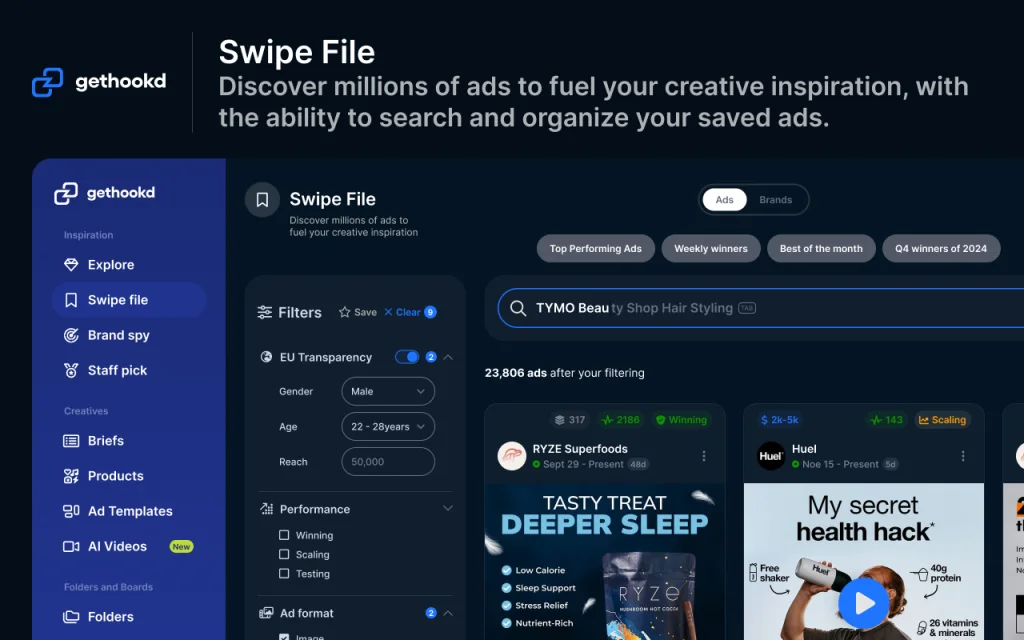
The Facebook Ad Library shows you what ads are running, not which ones are actually producing results. At GetHookd, we close that gap by giving media buyers and salon marketers access to over 65 million winning Meta ads, with performance signals that show which creatives competitors are actively scaling. Our Brand Spy feature reveals the top-performing ads for any salon brand on Meta, along with the landing pages driving that traffic.
Once you identify the formats driving bookings for competing salons, our AI-powered tools help you act on that research fast. Our Video Scripts feature generates hooks, angles, and full scripts based on a winning ad in seconds, and our Clone Ads tool produces dozens of new image variations in different colors, formats, and styles. For salon marketers running active campaigns, that combination means fewer wasted tests and more confident decisions.
Start your GetHookd free trial today.
Frequently Asked Questions (FAQs)
What type of Facebook ad works best for a hair salon?
Short video ads and before-and-after transformation posts tend to perform strongest for hair salons. Both formats present results visually, reducing hesitation and making the offer more concrete. Pairing either format with a specific CTA and a time-limited incentive improves conversion rates. Service-specific creative almost always outperforms general brand awareness campaigns on cost per booking.
How much should a local salon spend on Facebook ads per month?
Most local salons can start testing with $300 to $600 per month, though costs vary based on location, targeting, and competition. That budget is typically enough to gather useful data on one or two ad formats and audience combinations. Scaling makes sense once a specific creative and targeting setup is producing bookings at a cost that fits the client acquisition budget.
How often should salon Facebook ad creative be refreshed?
Creative fatigue sets in faster than most advertisers expect. For campaigns running to the same audience, refreshing the creative every three to four weeks helps maintain click-through rates. Monitoring frequency data, which shows how often the same viewer sees the same ad, is the clearest signal that a rotation is overdue.
Can I use competitor salon ads as inspiration without copying them?
Yes. Studying competitor ad formats, offers, and hooks to understand what is working in your market is standard practice among media buyers. The goal is to identify patterns and use them to build your own brief, not to copy the creative directly. Analyzing several competing salons gives a broader picture than focusing on a single brand.
How does GetHookd help salon marketers work with competitor ad data?
At GetHookd, our Brand Spy tool shows which ads any salon competitor is actively scaling on Meta, including the landing pages behind those ads. Our Creative Analyzer surfaces the formats driving real performance. Our Video Scripts and Clone Ads tools then produce new creative variations quickly, cutting the time between research and launch.
*Note: Pricing and/or product availability mentioned in this post are subject to change. Please check our website for current pricing and stock information before making a purchase.