Key Takeaways
- GetHookd, Canva, Artlist, OpenArt, and AdAmigo are the top AI user-generated content (UGC) image generators in 2026, each built for a different stage of ad production.
- All five offer free access: GetHookd and OpenArt run seven-day trials, Canva’s free plan caps monthly AI uses, Artlist allows two generations, and AdAmigo’s image tool is free.
- Entry paid plans range from $14 per seat on OpenArt to $99 per workspace on AdAmigo, though OpenArt’s starter tier excludes commercial use rights..
- GetHookd holds a 4.8-star G2 rating, ahead of Canva at 4.0 on Trustpilot, Artlist at 3.9 on G2, and OpenArt at 3.6 on Trustpilot.
- GetHookd never charges credits for browsing or searching ads, so credits stay free for actions like Clone Ads, which turns a winning reference into new UGC-style statics.
Why the Starting Point Matters More Than the Generator
Most AI UGC image generators produce similar-looking output once you feed them the right input. The difference between a static that tests well and one that wastes ad spend usually sits upstream, in whether the concept behind the image was built on a proven angle or a blank prompt. A tool that generates from a blank text field puts the entire creative direction on the person typing. A tool that starts from an ad already scaling in your niche gives the generator a reference that has already survived the market.
Credit structure is the second variable most teams underestimate. Canva’s free tier caps AI use at 20 per month, OpenArt’s seven-day trial runs out after 40 credits, and Artlist’s free account allows just two image generations, all of which can disappear in a single session under real production volume. AdAmigo’s UGC image tool is free with no credit cap, but the broader platform starts at $99/month per workspace.
GetHookd approaches UGC generation from the research side. Its Clone Ads feature builds new statics from a reference ad drawn from 22 million live Meta ads, and browsing and searching that library never costs a credit, so the research that feeds the generator does not drain your credit store.
GetHookd: Give Your AI
22 Million Live Meta Ads

Your AI cannot see Meta's ad library. Now it can. Connect GetHookd to Claude, ChatGPT, Gemini, Cursor or Perplexity in about 30 seconds, no code needed. Ask in plain English what your market is running and get back the live Facebook and Instagram ads. Every answer comes back with the source ad attached, so you can check it yourself.
What You Get:- Brand Spy: Get told every time a competitor launches, with the launch date and how many ads they have live
- Shops: Open any Shopify store to see its monthly visitors, best sellers, and every Meta ad it runs
- Clone Ads: Turn any winning ad into new statics built off a creative already running in your market
Prefer clicking? Search and filter the library yourself in the app, on any plan.
Start a 7-Day Trial for $0Top AI UGC Image Generators to Use in 2026
1. GetHookd (Paid)
GetHookd operates as an advertising intelligence platform first and an image generator second, built around a searchable library of more than 22 million ads. Instead of generating images from a blank prompt, users search for proven creative within a niche, then use the Clone Ads feature to turn a reference ad into new static variations.
Beyond cloning, GetHookd includes Explore Ads to filter ads by niche, format, and performance signals; Brand Spy to monitor competitor launches; and Boards to organize saved inspiration across a team.
Pricing
New users get a seven-day trial for $0, with full platform access. Paid plans start at Starter for $29 per month (or $19 billed yearly) with one seat and 50 credits, with Clone Ads beginning on Pro at $49, scaling up to Agency at $129 (or $83 billed yearly) with ten seats and 800 credits. Browsing and searching never consume credits; only actions do.
User Reviews
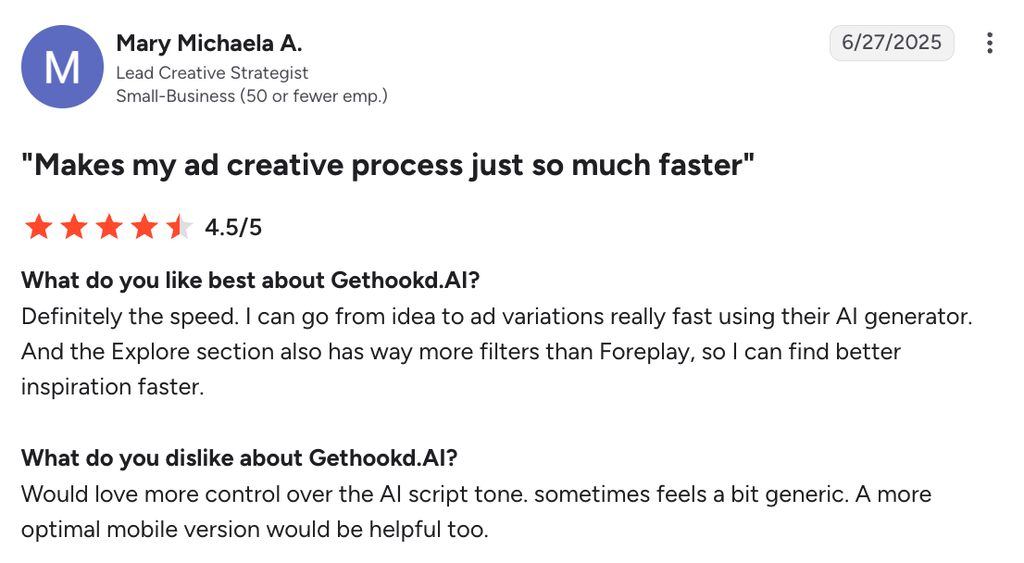
GetHookd has a 4.8-star rating on G2. Reviewers point to speed as GetHookd’s biggest strength, describing a faster path from spotting a competitor’s ad to producing their own variation. Onboarding and the guided walkthrough also come up favorably.
2. Canva (Free Version)
Canva is a drag-and-drop design platform with two built-in AI image tools. Magic Media sits inside the editor and turns a text prompt into an image in styles like photography, digital art, or fine art. Dream Lab works separately from the Canva homepage, generates up to four image options from a single prompt, and lets you upload a reference image to guide how the result looks.
Both tools are available on the free plan and share the same monthly AI allowance, so every generation from either one draws from the same pool. Canva permits generated images for personal and commercial use but notes that users may not hold exclusive rights to the output.
Pricing
The Canva Free version includes a shared monthly allowance of up to 20 Standard or Premium AI uses, plus 5GB of cloud storage, though more complex generations may draw down that allowance faster. Ultra AI tools sit outside the free tier.
User Reviews
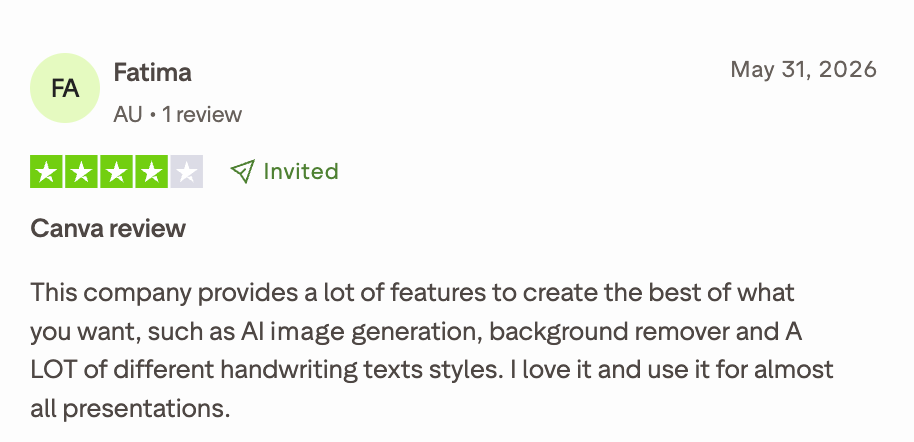
Canva has a 4.0-star rating on Trustpilot. Reviews highlight its ease of use and the creative variety available for everyday social content and ads. The recurring complaint centers on premium feature restrictions, alongside mixed experiences with customer support response times.
3. Artlist (Paid)
Artlist is a broader creative platform that combines AI image generation with video, voiceover, and music tools inside a single subscription. Its Bonkers UGC Ads app adds a product-to-video workflow, turning an uploaded product photo into a UGC-style video advertisement through preset-driven options rather than detailed creative direction.
A free trial account requires no payment details and includes two AI image generations, one AI video generation, three AI voiceover generations, and two AI music tracks, plus unlimited watermarked previews of Artlist’s music and footage.
Pricing
Paid access starts with the AI Starter plan at $19.99 per month, or $11.99 per month billed annually, for 16,500 monthly credits with commercial usage rights. Higher tiers, including the AI Core plan at $39.99 per month with 40,000 credits and the AI Creator plan at $69.99 per month with 80,000 credits, add more credits, unlimited generations on select models, and a monthly allowance of fast generations.
User Reviews
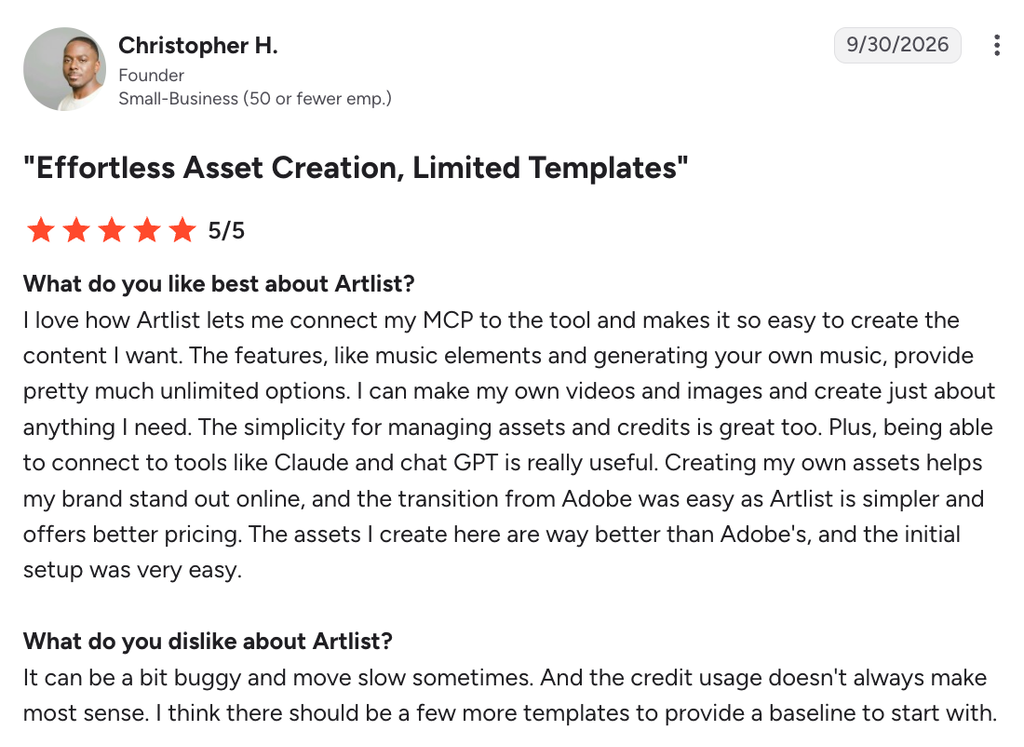
On G2, Artlist has a 3.9-star rating. Reviewers note Artlist’s creative asset quality and the convenience of finding music, footage, and visual tools in one subscription instead of switching providers. Some users note credit consumption adds up quickly and describe occasional bugs or slow performance within AI-specific tools, alongside requests for more starting templates.
4. OpenArt (Paid)
OpenArt is a creative platform for images, video, characters, and personalized models, with access to 100+ premium image, video, and audio models on paid plans. Its Director tool handles video specifically, offering quick-start categories like UGC Ads, Product Ads, and Ad Remake, while the core platform handles still-image generation and editing separately.
New users get 40 trial credits during a seven-day trial period to test premium features and advanced models.
Pricing
Paid plans start at $14 per seat monthly, or $13 annually, for the Starter tier with 4,000 monthly credits and watermark-free output. Commercial use rights begin on the Plus plan at $34 per seat monthly, or $27 annually, with 12,000 monthly credits. Pro and Wonder tiers scale up to $240 per seat monthly for 106,000 credits and priority support.
User Reviews
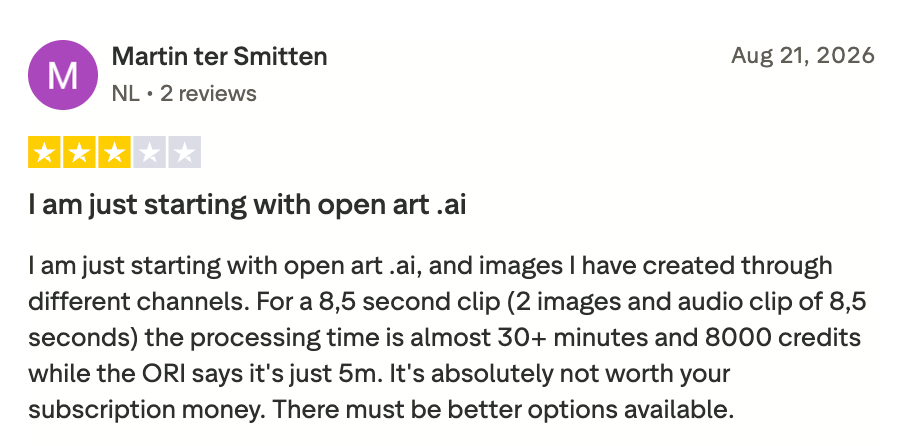
OpenArt has a 3.6 rating on Trustpilot. Reviewers note model variety and flexibility, along with a clean interface and fast performance for everyday creative work. Recurring complaints center on credit consumption outpacing expectations, occasional billing confusion, and platform loading time.
5. AdAmigo (Free)
AdAmigo’s Free AI UGC Image Generator is built specifically around a single task: turning an uploaded product photo into photorealistic UGC-style images featuring real-looking people. It skips the broader creative suite approach used by platforms like Artlist and OpenArt, focusing instead on fast, narrowly scoped UGC image output.
The UGC image generator itself is free to use, with watermark-free downloads, while the wider AdAmigo platform includes a free trial with no credit card required.
Pricing
The wider platform’s paid plans for ads and marketing start at $99/month per workspace on the Entry plan, aimed at accounts spending under $2,000 a month. Its Unlimited plan runs $349/month per workspace.
User Reviews
AdAmigo holds a 5.0-star rating on G2, but those reviews cover its Meta ads management platform rather than its UGC image tool, so there is no independent review data for the image generator on its own. Test the tool directly before relying on it for a purchasing decision.
Best AI UGC Image Generators: Summary Table
| Tool | Free Option | Starting Paid Price | Key Feature |
| GetHookd | 7-day free trial | $29/month ($19/month annual); Clone Ads from $49/month | Clone Ads from 22M+ live Meta ads |
| Canva Free | Up to 20 AI uses/month | Permanently free version | Magic Media and Dream Lab text-to-image |
| Artlist | 2 AI image generations | $19.99/month ($11.99/month annual) | Bonkers UGC video app, bundled AI suite |
| OpenArt | 40 trial credits, 7 days | $14/month/seat ($13/month annual) | Director chat-based UGC video generation |
| AdAmigo | Unlimited free UGC image generator | $99/month per workspace | Product photo to UGC image, no credits |
Generate Winning UGC Ads with GetHookd
The right AI UGC image generator depends on your workflow. Prompt-based tools suit teams with strong creative direction, product photo converters handle quick variations, and a general design platform covers everyday social content. The real question is where you want to start: a blank prompt, or creative that’s already proven.
Starting from evidence cuts the guesswork. GetHookd surfaces the static ads already winning in your niche, then turns them into new UGC-style creative through Clone Ads. Browsing and searching never cost credits. Start your seven-day trial today.
Frequently Asked Questions (FAQs)
What are UGC ads?
UGC ads are advertisements styled to resemble content created by real customers rather than polished brand productions. They typically feature casual, authentic-looking visuals or video, often shot on a phone or designed to mimic that aesthetic. This style tends to build trust and feel less like traditional advertising.
What is an AI UGC ad?
An AI UGC ad is a UGC-style advertisement created using AI generation instead of a real customer or hired creator. Dedicated tools can generate these visuals from prompts, product photos, or existing ad references, aiming to replicate the authentic look of genuine user-generated content.
Can you create AI UGC ads?
Yes, AI UGC ads can be created using platforms built for this purpose, including GetHookd, Canva, Artlist, OpenArt, and AdAmigo.
Do AI UGC images perform better than real customer content?
Available source material does not provide direct performance comparisons between AI-generated UGC images and real customer content. Marketers should test both formats directly within their own campaigns rather than assuming one consistently outperforms the other.
Does GetHookd generate UGC ads?
GetHookd generates UGC-style static ad creative through its Clone Ads feature, which builds new variations from real ads in its 22 million-ad library. It also supports the broader ad research process through Explore, Brand Spy, and Boards, making it useful for both sourcing inspiration and producing new creative.
*Note: Pricing and/or product availability mentioned in this post are subject to change. Please check our website for current pricing and stock information before making a purchase.