Key Takeaways
- Competitor ad spend is never public, so trackers estimate it from proxy signals like active ad count, creative run time, and how many platforms and new creatives a rival produces.
- GetHookd tracks Meta and TikTok scaling, SEMrush and SpyFu model Google paid search, and Adbeat estimates display and native spend, so the channel decides the tool.
- Entry pricing spans $29 a month for GetHookd and $39 for SpyFu up to $139 for SEMrush and $249 for Adbeat, reflecting how narrow each dataset runs.
- A rising active ad count, creatives that stay live longer, and expansion into new platforms are the clearest signals a competitor is increasing ad budget.
- GetHookd tracks daily snapshots of any advertiser on Meta and TikTok, then turns a scaling creative into a transcript, an AI script, and a cloned ad to test same day.
What Tracking Competitor Ad Spend Actually Means
Competitor ad spend can only be tracked indirectly, through signals like active ad count, creative run time, and how many platforms a rival advertises on. Ad platforms keep real budgets private, so any figure a research tool reports is a model built from public activity, not a leaked number. Marketers expecting an exact dollar amount from these tools are usually disappointed, since the goal is a directional read, not an audit.
The bigger risk is picking the wrong tool for the channel. A search-focused platform like SpyFu will miss a competitor’s entire Meta strategy, and a Meta-only tool shows nothing about their Google Ads footprint, so the coverage gap can hide where most of a rival’s budget actually goes.
For competitors who lean on Meta and TikTok, GetHookd tracks daily snapshots of their ad accounts and turns a scaling creative straight into a testable script, closing the gap between research and action.

GetHookd: Turn Competitor Intelligence Into Your Next Winning Ad
GetHookd reveals which ads your competitors are actively scaling—not just running. Spy on their best-performing creatives, landing pages, and traffic strategies, then turn proven concepts into testable campaigns in seconds with AI-powered script generation and creative cloning.
What You Get:- ✓ Brand Spy to decode competitor ad strategies in real-time
- ✓ AI script generation and ad cloning for instant variations
- ✓ Performance scoring based on actual ad behavior, not vanity metrics
- ✓ Creative Analyzer to identify and scale your top performers
How to Track Competitor Ad Spend?
Here are the five practical steps marketers can use to track competitor ad spend across Meta, Google Search, and display networks.
- Pick the channels that matter. Decide if your competitors spend mostly on Meta, Google Search, or display and native networks, since each needs a different tool.
- Start with free libraries. Check Meta Ad Library and Google’s Ads Transparency Center to see which ads a rival is running right now.
- Track ad volume and run time. Count how many active ads a competitor has and how long each has stayed live, since longevity usually signals budget.
- Add an estimate tool for depth. Use a paid platform to model PPC or display spend and to save research that the free libraries discard.
- Turn signals into action. Note which creatives are being scaled, then build your own tests around the angles that are clearly working.
That said, this entire process can be simplified by using a dedicated competitor ad tool, which we will discuss below.

4 Top Tools to Track Competitor Ad Spend
1. GetHookd – Best for Meta & TikTok Ad Research & Creative Testing
GetHookd is a competitive ad research and creative intelligence platform built for media buyers, agencies, and eCommerce operators. Instead of showing raw dollar figures, we track the signals that reveal where competitors put their budget on Meta and TikTok. Our Brand Spy feature lets you follow any advertiser over time and see which creatives they run, which landing pages they use, how long each has been active, and which ads are pulling the most budget.
With our Brand Spy feature, select a competitor from our library of 20,000+ pre-spied brands or paste their Meta Ad Library URL, and we’ll start taking daily snapshots of their account. The Active Ad Trends chart plots how many ads that brand had live each day across a 7-, 30-, or 90-day window, so you can see whether a competitor is ramping spend up, winding it down, or holding steady.
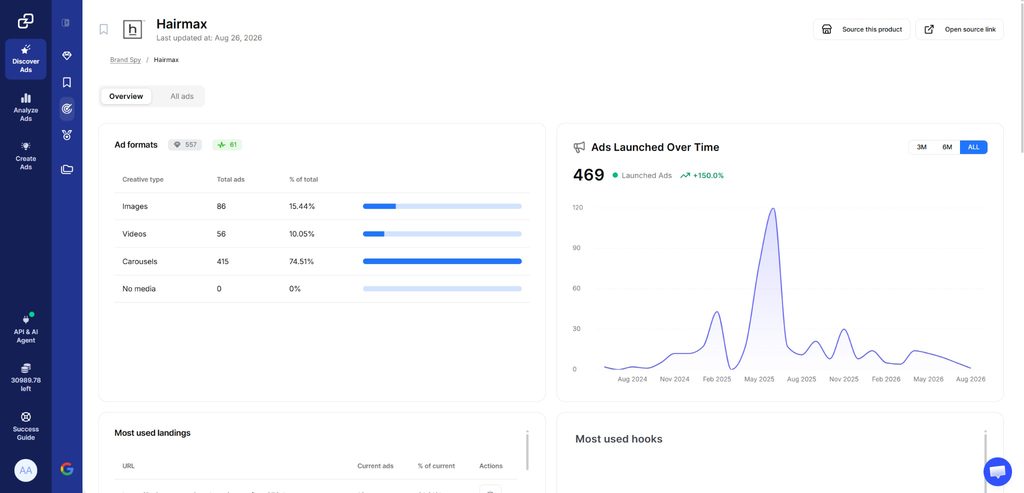
You can break the same trend down by ad format or landing page type, showing where new budget is going rather than only how much there is. Hover any point on the line for the exact active ad count on that date, then export the window to CSV for a client report.
Most Used Landings feature then shows where that traffic is being sent, so you can read the funnel behind the spend. Once you find a pattern worth testing, Ad Transcription pulls the full script out of any video ad, AI Script Generation writes new variations from it, and Clone Ads rebuilds a winning concept as a fresh creative in your own branding.
Our Performance score ranks each creative by how the ad actually behaves (runtime, Meta impression rank, creative reuse, and active ad-count), not vanity metrics. So, you test the strongest signals first, and anything worth keeping goes into your Swipe File. Ad research and production stay in one place.
Pricing
Plans start at $29 per month for Starter and $49 per month for Pro, rising to $79 for Team and $129 for Agency. Annual billing saves about 35% on every tier, bringing Starter to $19 per month, Pro to $32 per month, Team to $52 per month, and Agency to $83/month.
All four plans: Starter, Pro, Team, and Agency include a 7-day free trial. Each plan includes a monthly credit allowance, and spying on a brand costs 2 credits, so the 50 credits on Starter cover roughly 25 competitors a month.
Reviews
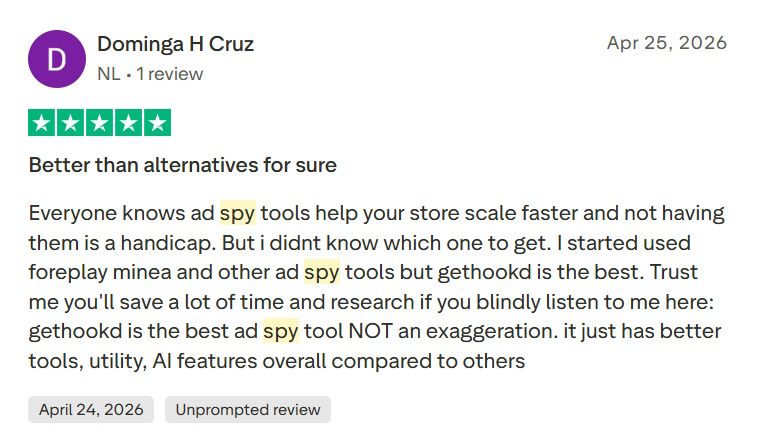
GetHookd holds a 4.8/5 rating on G2 and 3.8/5 on Trustpilot. The featured Trustpilot review from Dominga H Cruz gives GetHookd 5 stars and says it stood out from Foreplay, Minea, and other ad spy tools for its broader utility and AI features. The review specifically highlights saving time on ad research and finding better insights in one platform.
2. SEMrush – Best for SEO & Paid-Search Intelligence
SEMrush is an all-in-one SEO and advertising research suite. For competitor spend tracking, its advertising tools estimate how much rivals invest in Google Search and display, along with the keywords they bid on and the ad copy they run.
The Advertising Research report is the core of this. It estimates a competitor’s monthly paid search traffic and budget, lists every keyword they bid on, and shows the ad copy running against each one. Ad History extends that backward month by month, so a rising count of paid keywords over two or three quarters reads as a budget increase rather than a one-off test.
AdClarity covers display, video, and social ad intelligence including creatives, placements, and spend, and PLA Research handles shopping ads, which matters if your eCommerce competitors run Google Shopping.
The data is modeled rather than exact, since platforms keep real budgets private, but it gives a directional read on paid-search investment. SEMrush suits teams that already use it for keyword research and want spend estimates in the same dashboard. Its weakness for this task is coverage, since it centers on Google and search, not the creative-level Meta detail that performance teams often need.
Pricing
Plans start at $139 per month for the SEO plan, then $199 for Starter, $299 for Pro+, and $549 for Advanced. Annual billing saves up to 17%, which brings the entry SEO plan to $117.33 per month and Starter to $165.17. The free plan covers 1 project and 10 reports per day, and the SEO, Starter, and Pro+ plans include a 7-day free trial. Add-ons are billed separately, including extra user seats from $45 per month and white-labeled Pro Reports at $20 per month.
Reviews
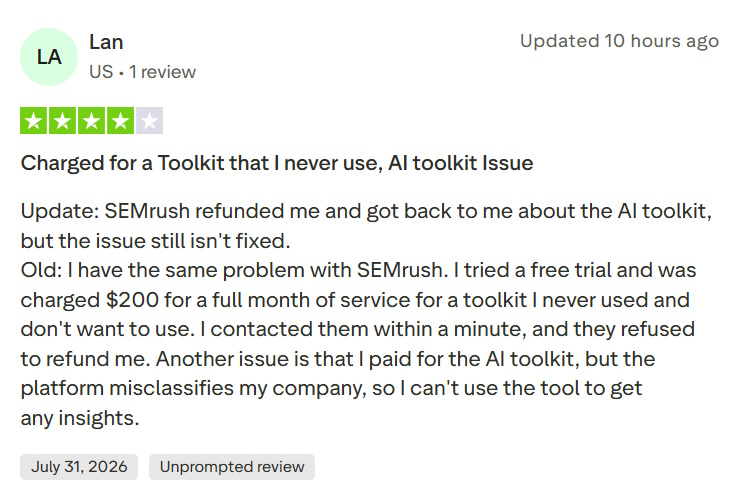
Semrush has a 4.4/5 rating on G2 and 1.7/5 on Trustpilot. The featured Trustpilot review from Lan gives Semrush 4 stars but describes an issue with being charged after a free trial for an AI toolkit they did not use. The reviewer later updated the post to say Semrush refunded the charge, although they said the underlying toolkit issue remained unresolved.
3. SpyFu – Best for Long-Term Google Ads Competitor Research
SpyFu is a competitive intelligence tool focused on search. It shows the keywords a competitor buys on Google Ads, their historical ad copy, and how their paid strategy has shifted over years. Because SpyFu keeps long historical records, going back more than a decade on higher tiers, it is useful for spotting how a rival’s search spend rises or falls over time.
Its PPC Research tools list every keyword a competitor buys on Google Ads, the estimated monthly budget behind them, and the ad copy for each. Ad History matters most for spend tracking because it charts, month by month, which keywords a rival kept bidding on and for how long.
A keyword a competitor has held for 60 straight months is a keyword that pays for itself. Kombat compares your domain against three competitors by default, and more if you add them, returning the keywords all of them buy, which is a fast way to find where budget concentrates in a niche.
Pricing
Plans start at $39 per month for Basic and $119 per month for Pro + AI, with a Team/Agency tier at $249. Annual billing cuts costs by about 25%, bringing Basic to roughly $29 per month. SpyFu does not offer a free trial, but paid plans include a 30-day money-back guarantee, and a free account lets you run limited searches without paying.
Reviews
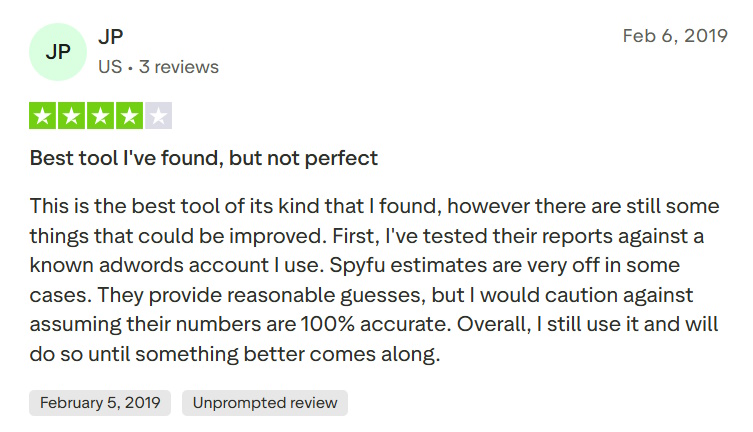
SpyFu has a 4.6/5 rating on G2 and 4.4/5 on Trustpilot. The featured review from JP gives SpyFu 4 stars, noting that some of its estimates can be inaccurate. The reviewer says they still use SpyFu despite those limitations, pointing to its usefulness for competitor research.
4. Adbeat – Best for Display & Native Ad Intelligence
Adbeat is a competitive intelligence platform for display, native, and programmatic advertising. It estimates how much advertisers spend across display networks, shows the publishers running their ads, the placements they buy, and the creatives behind each campaign.
Its advertiser reports estimate spend across display networks, then break it down by publisher, placement, ad network, and device, so you can see where the money actually lands rather than just how much there is.
Every creative running against those placements is stored alongside its landing page, and the top publishers view ranks the sites carrying most of a competitor’s inventory. Competitor alerts flag when an advertiser launches new creative or moves into a new network, with 5 alerts on Standard, 10 on Advanced, and unlimited on Enterprise, which turns a one-time pull into ongoing monitoring.
Pricing
Plans start at $249 per month for Standard and $399 per month for Advanced, with custom pricing for Enterprise. Standard holds 90 days of data and caps results at 1,000 per query.
Advanced extends that to a year of data with unlimited results and 10 alerts, and Enterprise adds three years of history and unlimited alerts. Adbeat Basic is free, and paid tiers have no free trial, so the free account is the main way to test the data, though paid plans include a 30-day satisfaction guarantee.
Reviews
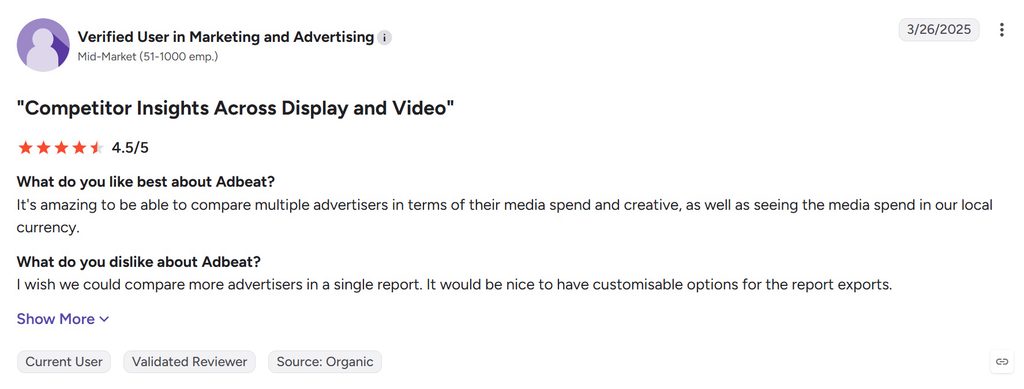
Adbeat holds a 4.1/5 rating on G2 from 9 reviews. A verified user gives Adbeat 4.5/5 and highlights its ability to compare advertisers by media spend and creative, including spend in local currency. The main limitation noted is that the reviewer wanted to compare more advertisers in a single report and have more customizable export options.
Top 4 Competitor Ad Spend Tools: Comparison Table
| Tool | Best For | Coverage | Spend signal | Starting price |
| GetHookd | Best for media buyers, eCommerce brands, and agencies focused on Meta ad research, competitor intelligence, and creative testing | Meta (Facebook/Instagram), TikTok | Which creatives and landing pages are scaled | $29/mo |
| SEMrush | Best for marketers who need broader SEO and paid-search competitor research alongside their ad intelligence | Google search & display | Estimated PPC/display budget | $139/mo |
| SpyFu | Best for paid-search marketers who want deep historical Google Ads and keyword competitor data | Google search/PPC | Estimated PPC budget + history | $39/mo |
| Adbeat | Best for media buyers and advertisers researching display and native advertising strategies across competitor campaigns | Display, native, programmatic | Estimated display/native spend | $249/mo |
GetHookd Reads the Ad Signals a Budget Number Can’t Show
Competitor ad spend will never be an exact number, since platforms keep it private and every tool works from public signals instead. The value comes from picking a tool that matches where competitors actually advertise, then acting on what it finds instead of just collecting data. Coverage matters more than any single spend estimate.
For teams whose competitors run on Meta and TikTok, we built GetHookd to close that gap. Our Brand Spy tracks daily ad snapshots, so you see exactly which creatives a rival keeps scaling, then turn that insight into a script and a cloned ad the same day. Start your 7-day free trial and see what your competitors are really doing.
Frequently Asked Questions (FAQs)
Is brand spying legal?
Yes. Brand spying uses data from public sources such as Meta Ad Library and Google’s Ads Transparency Center. You are viewing ads that platforms already publish, not private account data or user information, which makes competitor ad research a standard and accepted marketing practice.
How often should you check competitor ads?
For active testing, check weekly to stay current without adding noise. Fast-moving eCommerce niches may need more frequent monitoring, while slower categories can be reviewed every few weeks. Tools with tracking and alerts flag new creatives automatically, which removes the need to check manually.
Do you need technical skills to use ad spy tools?
No. Most ad intelligence tools are built for marketers, not developers. You search an advertiser or keyword, apply filters, and read the results in a dashboard. You don’t need coding, scraping setup, or account connections to start reading competitor activity.
Can you track a competitor’s ad spend on more than one platform at once?
Not usually with a single tool. Most platforms specialize by channel, so cross-platform tracking means combining sources, such as a Meta tool with a search or display tool. A few broad suites cover several channels, but the depth on any one channel is often thinner than a specialist provides.
What signals suggest a competitor is increasing their ad budget?
Look for a rising count of active ads, creatives that stay live longer, the same offer repeated across several variations, and expansion into new placements or regions. GetHookd surfaces these through Brand Spy, so you can see which creatives a competitor keeps scaling instead of tracking each signal by hand.
*Note: Pricing and/or product availability mentioned in this post are subject to change. Please check our website for current pricing and stock information before making a purchase.