Facebook vs Instagram Ads: Cost, Pros & Cons
Key Takeaways
- Facebook averages $1.06 to $1.72 CPC versus Instagram’s $1.83 to $3.35, while CPMs sit nearly level at $7.47 for Facebook and $6.25 to $7.68 for Instagram, making Facebook the cheaper option for click-driven campaigns and Instagram a viable pick for impression-led awareness work.
- Facebook gives advertisers advanced targeting depth, broader demographic reach across age groups, and lower click costs, while Instagram delivers higher engagement, native visual formats like Reels and Stories, and strong purchase intent among 18 to 34-year-olds.
- Facebook struggles with ad saturation, faster creative fatigue, and weaker traction with users under 25, while Instagram suffers from higher CPCs, demands stronger creative quality to keep costs down, and has a thin audience over 45.
- Running both platforms together through Meta’s Advantage+ Placements lets the algorithm shift delivery toward whichever placement performs best, which usually lowers cost-per-result by giving Meta more inventory to optimize against.
- With over 65 million analyzed Meta ads, Brand Spy for tracking competitor scaling activity, and AI tools like Clone Ads and Video Scripts, GetHookd helps you turn competitor intelligence into testable Meta campaigns in minutes.
Facebook vs Instagram Ads: An Overview
For most performance marketers, the choice between Facebook and Instagram ads is not either-or.
Facebook averages $1.06 to $1.72 CPC with broader demographic reach, deeper targeting layers, and CTRs between 0.72% and 1.49%, making it the stronger pick for direct response and lead generation.
Instagram runs higher at $1.83 to $3.35 CPC but delivers better engagement, native Reels and Stories formats, and stronger purchase intent among 18 to 34 year olds. CPMs sit nearly level across both ($7.47 for Facebook, $6.25 to $7.68 for Instagram), so the cheaper platform really comes down to whether you optimize for clicks or impressions.
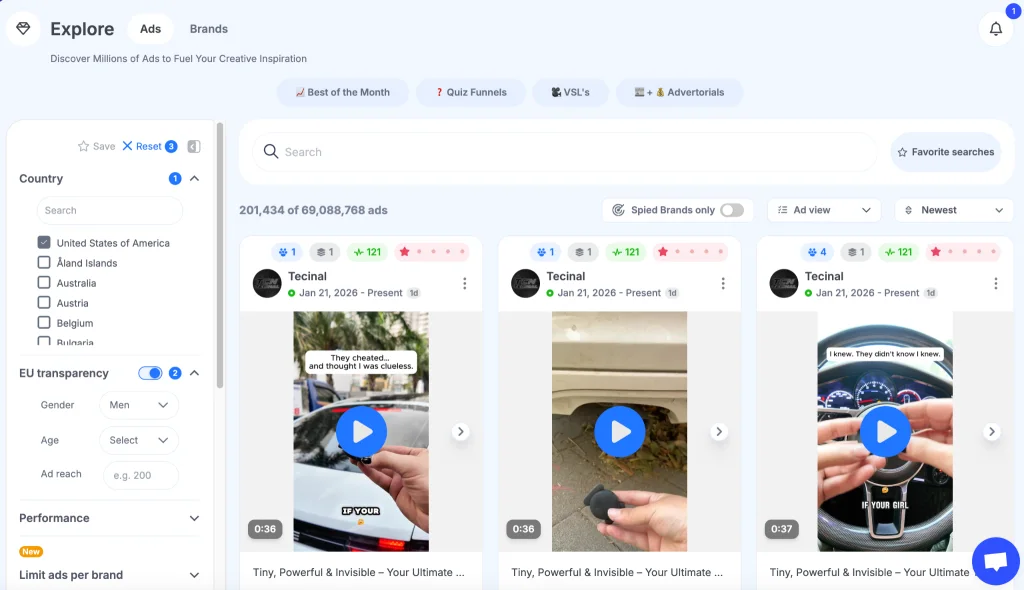
The sharper question is which competitors are scaling on each platform and which creative angles are working right now. Tools like GetHookd close that gap by surfacing 65 million analyzed Meta ads, so you can see what is already winning in your niche before you spend a dollar testing your own.
The breakdown below covers real cost benchmarks, the strengths and weaknesses of each platform, and how to combine them for better results.

GetHookd: Turn Competitor Intelligence Into Your Next Winning Ad
GetHookd reveals which ads your competitors are actively scaling—not just running. Spy on their best-performing creatives, landing pages, and traffic strategies, then turn proven concepts into testable campaigns in seconds with AI-powered script generation and creative cloning.
What You Get:- ✓ Brand Spy to decode competitor ad strategies in real-time
- ✓ AI script generation and ad cloning for instant variations
- ✓ Performance scoring based on actual ad behavior, not vanity metrics
- ✓ Creative Analyzer to identify and scale your top performers
What is the Cost of Running Facebook vs Instagram Ads?
Ad costs on both platforms fluctuate based on industry, audience size, ad format, and seasonal demand. Benchmark averages give a solid starting point for budget planning, even if your actual spend will vary.
Cost-Per-Click (CPC) Comparison
Facebook’s average CPC ranges from $1.06 to $1.72, which is significantly lower than Instagram’s. Instagram CPC sits at $3.35 for Feed placements and $1.83 for Stories, reflecting higher competition for attention on a visual-first platform.
For traffic and click-driven campaigns, Facebook tends to be the more efficient buy. Instagram’s higher CPC reflects faster, more casual scrolling, which means fewer clicks for the same budget than on Facebook.
Cost-Per-Thousand-Impressions (CPM) Comparison
CPM rates are far more comparable between the two platforms. Facebook’s CPM averages $7.47, while Instagram’s CPMs are $7.68 for Feed and $6.25 for Stories.
Instagram Stories carries the lowest CPM of the three placement options, making it a reasonable choice for top-of-funnel awareness work where impression volume matters more than click-through.
The narrower CPM gap means most advertisers no longer rely on a strict “Facebook for conversions, Instagram for awareness” split. Instead, the better strategy is to test creatives across both platforms and let performance data guide budget allocation.
Click-Through Rate (CTR) Comparison
CTR tells you what percentage of users actually click on your ad after seeing it, and the gap between platforms is meaningful.
Facebook click-through rates average between 0.72% and 1.49%, compared to 0.22% to 0.88% for Instagram Feed ads and 0.33% to 0.54% for Stories.
Facebook’s stronger CTR performance is one of the key reasons its CPCs come in lower. More clicks at the same impression volume drives down the cost per click. Instagram’s lower CTR reflects how users engage with the platform: heavier on visual browsing and lighter on outbound actions.
Pros & Cons of Facebook Ads
Pros of Facebook Ads
- Facebook’s targeting capabilities are among the most advanced of any social platform. Advertisers can layer demographics, interests, behaviors, life events, and custom audiences built from their own customer data, all within a single campaign.
- The platform also supports the widest variety of ad formats, from static images and video to carousel ads, lead forms, and dynamic product ads that automatically personalize to each viewer.
- Cost efficiency is another major advantage. With an average CPC ranging from $1.06 to $1.72, Facebook generally delivers cheaper clicks than Instagram. For businesses running e-commerce, lead generation, or app install campaigns, the combination of reach, targeting depth, and lower click costs makes Facebook a foundational part of most paid social strategies.
Cons of Facebook Ads
- Facebook’s biggest drawback has grown more pronounced over time: declining organic reach and an increasingly saturated ad environment. Users see more ads than ever, and creative fatigue sets in faster on Facebook than on almost any other platform. Advertisers need to rotate fresh ad creatives consistently to maintain performance, which adds time and production costs to campaigns.
- The platform also skews older. While Facebook still commands massive overall reach, the 18- to 24-year-old demographic has been steadily migrating to Instagram, TikTok, and YouTube. If your target customer is Gen Z or younger Millennials, Facebook may deliver volume but miss the mark on audience quality.
Pros & Cons of Instagram Ads
Pros of Instagram Ads
- Engagement is Instagram’s defining strength. Users on Instagram interact with content at significantly higher rates than on Facebook, which translates directly into better ad performance for brands that invest in quality visuals and video. Story ads, Reels ads, and carousel formats all feel native to the platform experience, making them less disruptive and more likely to capture genuine attention.
- Instagram also dominates with younger audiences. The 18 to 34 demographic makes up 62.3% of Instagram’s global user base, a high-value, high-purchasing-power segment that many brands actively want to reach.
- Purchase intent on the platform is also notably strong. 81% of Instagram users research new products on the platform. For e-commerce brands, especially, Instagram’s shopping features, combined with its ad formats, create a nearly frictionless path from discovery to purchase, all within the app.

Cons of Instagram Ads
- The higher CPC ceiling is Instagram’s most obvious limitation. With Feed CPCs averaging $3.35, poorly optimized Instagram campaigns can quickly drain the budget without delivering proportional returns.
- This makes creative quality critical. Weak visuals on Instagram trigger lower Quality Rankings in Meta’s auction system, which pushes costs even higher for the same audience.
- Instagram also has a narrower demographic range than Facebook. If your product or service targets users over 45, Instagram’s audience composition works against you.
- The platform lacks the same density of older users, and forcing campaigns toward that demographic on Instagram often results in higher costs and lower conversion rates.
Why Running Ads on Both Platforms Works Best
The Facebook vs Instagram debate is often a false choice. The most effective paid social strategies use both platforms deliberately, leveraging Meta’s automation to find the best inventory across the entire ecosystem.
Meta’s Advantage+ Placements makes this straightforward. With one setting, your ads can run across Facebook, Instagram, Messenger, and the Audience Network.
Meta’s algorithm shifts delivery toward whichever placements perform best for your specific objective and audience. This typically reduces the overall cost-per-result because the algorithm has more inventory to work with, creating more opportunities to find the right person at the right price.
Facebook vs Instagram Ads: Comparison Table
| Factor | Facebook Ads | Instagram Ads |
| Average CPC | $1.06 – $1.72 | $1.83 – $3.35 |
| Average CPM | $7.47 | $6.25 – $7.68 |
| CTR Range | 0.72% – 1.49% | 0.22% to 0.88% (Feed) 0.33% to 0.54% (Stories) |
| Best For | Direct response, lead generation, e-commerce | Brand awareness, visual storytelling, product discovery |
| Top Audience | Users aged 35 and above | Users aged 18 to 34 |
| Strongest Industries | Broad range across B2B and B2C | Beauty, fashion, fitness, food, lifestyle |
| Key Strength | Advanced targeting, lower click costs | Higher engagement, native visual formats |
| Key Weakness | Ad saturation, creative fatigue | Higher CPCs, thin audience over 45 |
How GetHookd Helps You Win on Facebook & Instagram
Choosing between Facebook and Instagram is rarely the right question. Both platforms reward strong creative, smart targeting, and consistent testing, and the brands winning on Meta run both together while adapting faster than the auction can catch up.
At GetHookd, we give you access to over 65 million analyzed Meta ads to see what your competitors are scaling, plus AI tools like Clone Ads, Video Scripts, and Brand Spy to launch your own versions in minutes. If you want to turn competitor intelligence into winning Meta campaigns, start with GetHookd today.
Start running smarter Meta ad campaigns with GetHookd.
Frequently Asked Questions (FAQs)
Is it better to run ads on Instagram or Facebook?
It depends on your goal and audience. Instagram works better for visual brands targeting 18 to 34 year olds, while Facebook delivers cheaper clicks, broader demographic reach, and stronger performance among audiences aged 35 and above. For most businesses, running both platforms together outperforms either one alone.
Are Facebook ads cheaper than Instagram ads?
On a cost-per-click basis, yes. Facebook’s CPC ranges from $1.06 to $1.72, while Instagram sits at $3.35 for Feed and $1.83 for Stories. CPMs are far closer between the two, so the cheaper platform really depends on whether your campaign optimizes for clicks or impressions.
Can you run Facebook and Instagram ads at the same time?
Yes. Meta’s Advantage+ Placements lets you run a single campaign across both platforms, with the algorithm shifting delivery to whichever placement performs best. At GetHookd, we make this even easier by showing you which ads competitors are actively scaling on Facebook and Instagram simultaneously, so you can model your own creative on what is already winning across both platforms.
How can I see which Facebook and Instagram ads my competitors are actually scaling?
Meta’s public Ad Library shows you which ads are running, but not which ones are working. GetHookd’s Brand Spy surfaces the ads competitors are actively scaling, the landing pages they push traffic to, and the creative angles driving their best results, so you can model your next campaign on proven winners instead of guessing.
How much should I budget for Facebook or Instagram ads?
Meta’s technical minimum is $1 per day for impression-based campaigns and $5 per day for conversion-optimized campaigns, but realistic testing budgets start around $20 to $50+ per day to give Meta enough data to exit the learning phase within 7 to 14 days. Once you identify a winning ad set, you can scale daily spend by 20% to 30% every 3 to 5 days to avoid resetting the learning phase.
*Note: Pricing and/or product availability mentioned in this post are subject to change. Please check our website for current pricing and stock information before making a purchase.