9 Best Facebook Webinar Ad Examples to Copy in 2026
Key Takeaways
- The 9 best Facebook webinar ad examples to copy in 2026 are the authority hook, specific transformation, social proof, curiosity gap, limited seats urgency, short video teaser, problem-first, free resource combo, and carousel ad, with each format solving a different audience objection at a different stage of the funnel.
- Facebook remains the top paid channel for webinar registrations because its targeting depth lets a single campaign serve awareness creative to cold audiences, trust-building ads to warm video viewers, and last-chance urgency ads to landing page visitors who have not yet registered.
- To copy these ads effectively, match each format to the funnel stage. Run authority, transformation, and problem-first ads to cold audiences, then serve social proof, urgency, and free resource combo ads to warm audiences already aware of your webinar.
- Swap generic CTAs like “Learn More” for action-specific buttons such as “Save My Seat” or “Register Free”, and launch on a four to six-week runway that opens with awareness creative and closes with urgency and retargeting reminders in the final week.
- GetHookd gives you access to 65M+ Meta ads to study which webinar ads competitors are actively scaling, plus AI creative tools to build your own versions in minutes.
Why Facebook Is Still Where Webinar Ads Convert
The Facebook webinar ad examples worth copying in 2026 are the authority hook, specific transformation, social proof, curiosity gap, limited seats urgency, short video teaser, problem-first ad, free resource, and carousel ads.
Facebook remains the most efficient paid channel for webinar registrations because its targeting is so deep. You can serve an awareness ad to a cold interest-based audience, retarget video viewers with a trust-building testimonial, and hit warm visitors with a last-chance urgency ad inside the same campaign.
That full-funnel flexibility is what makes Facebook webinar ads worth your investment.

GetHookd: Turn Competitor Intelligence Into Your Next Winning Ad
GetHookd reveals which ads your competitors are actively scaling—not just running. Spy on their best-performing creatives, landing pages, and traffic strategies, then turn proven concepts into testable campaigns in seconds with AI-powered script generation and creative cloning.
What You Get:- ✓ Brand Spy to decode competitor ad strategies in real-time
- ✓ AI script generation and ad cloning for instant variations
- ✓ Performance scoring based on actual ad behavior, not vanity metrics
- ✓ Creative Analyzer to identify and scale your top performers
9 Best Facebook Webinar Ad Examples in 2026
1. The Authority Hook Ad
Authority hook ads lead with the credentialed host or recognized expert teaching the webinar. “Taught by [Name], [Credential]” does the trust work in the first line, borrowing the speaker’s reputation to justify the time investment. This format works best for premium webinars, masterclasses, and industry-specific training where audience skepticism is high.
The creative usually pairs a clean headshot with a short credibility stack, such as years of experience, company affiliations, or a specific outcome the host has produced. Keep the copy short and let the credentials do the selling.
2. The Specific Transformation Ad
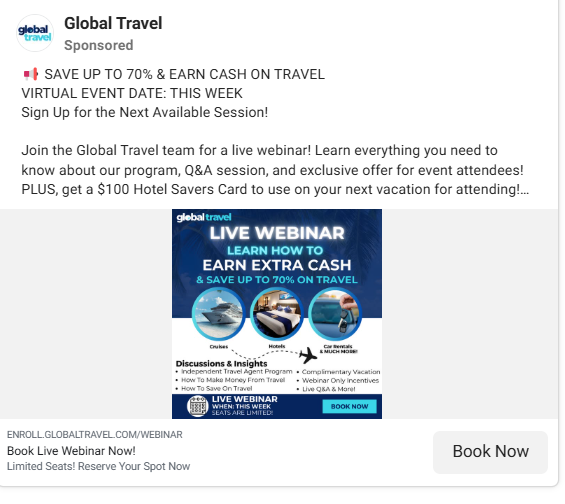
The transformation ad sells the result, not the webinar itself. “Learn how to generate 200 leads a week using Meta Ads” converts better than “Join our free marketing webinar” every time, because one promises something concrete and the other asks for a favor.
Strong transformation ads lead with an outcome the audience can picture themselves achieving, then back it up with a tight agenda of three to four bullets. The more specific the claim, the more credible the ad feels.
3. The Social Proof Ad
Social proof ads reduce perceived risk by showing that others have already signed up or benefited. Lead with a specific attendee number like “Join 2,400 founders already registered” or a short testimonial from a recognizable name in the industry. Past event photos, sponsor logos, and star ratings all serve the same trust-building function.
This format performs especially well for repeat webinars, established programs, or any campaign where you have actual data to pull from. Fabricated or vague proof is worse than no proof at all.
4. The Curiosity Gap Ad
Curiosity gap ads open an information loop that the viewer needs to close. “The one email sequence that tripled our conversion rate. Here is exactly how it works.” The copy deliberately withholds the answer, forcing the click.
This format converts well when the implied information is specific and unusual. Generic curiosity, like “The secret to better marketing,” reads as clickbait. A narrow, unusual claim reads as insider knowledge worth registering for.
5. The Limited Seats Urgency Ad
Urgency ads frame the webinar as an exclusive live event with scarcity cues like “Only 500 seats available” or “Starts at 2 PM EST today.” The deadline or cap creates a reason to act now rather than later, which is especially important for same-day and final-push retargeting campaigns.
For the urgency to work, the scarcity has to be real. False caps or fake countdowns undermine credibility the moment a viewer catches on. Pair this format with a warm audience who has already engaged with your webinar content but has not registered.
6. The Short Video Teaser Ad
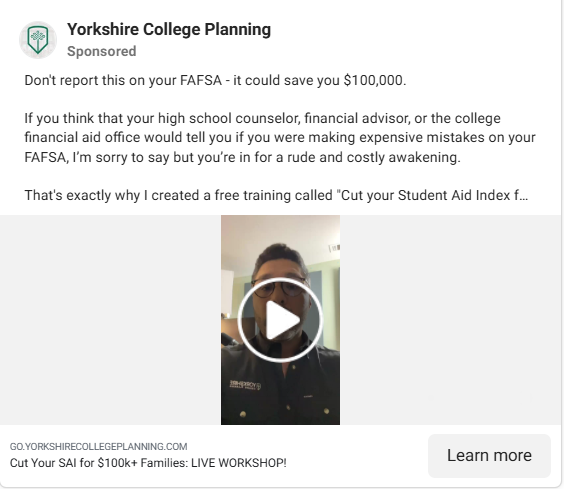
Short video teaser ads feature the host speaking directly to the camera for 30 to 60 seconds, previewing what attendees will learn. The format works because it feels like a personal invitation, and it gives cold audiences a sense of the host’s delivery style before committing.
The structure that consistently performs: a three-second hook naming the specific problem, a mid-clip preview of one valuable insight, and a close that sets up what attendees will get by showing up live.
7. The Problem-First Ad
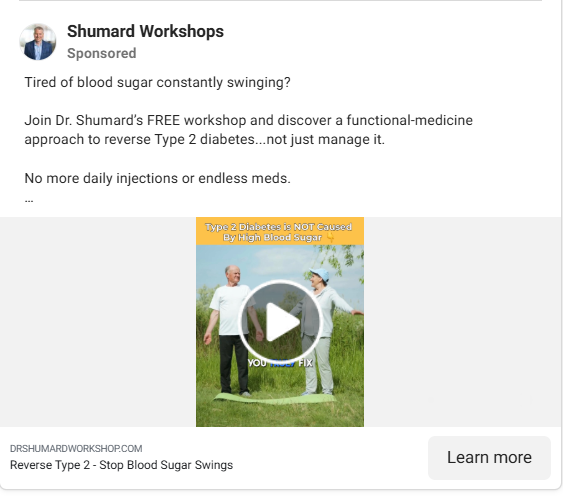
Problem-First ads lead with a recognizable pain point, sharpen it, then position the webinar as the solution. “Still losing enterprise deals at the proposal stage?” does more work in one line than three paragraphs of feature copy ever will.
The ad works because it qualifies the right audience in the opening frame and filters out the wrong ones. Readers who do not have the problem scroll past, which is exactly what you want. The right readers feel seen, and the webinar becomes the obvious next step.
8. The Free Resource Combo Ad
Resource combo ads pair the webinar registration with a free downloadable asset, such as a template, checklist, swipe file, or PDF guide. The added incentive lifts registration rates and captures the lead even for people who never show up live.
The framing matters. Lead with the resource as the primary draw, then mention the webinar as an additional benefit (“Register for the webinar and get our 2026 Facebook Ad Template Pack free”). That order converts better than the reverse.
9. The Carousel Ad
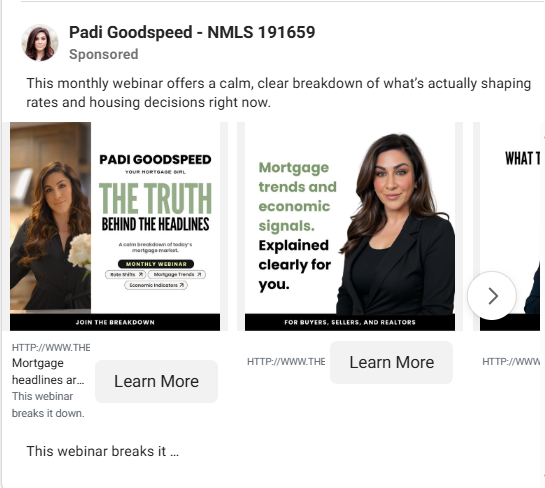
Carousel ads are underused in webinar campaigns, which gives anyone willing to use them properly a competitive advantage. Most marketers default to a single image or video. A well-built carousel does something neither of those formats can: it lets you walk the audience through a mini-story, one card at a time, building curiosity with every swipe.
The mechanics are straightforward. Each card in the carousel represents one lesson, insight, or outcome from the webinar, but it only reveals enough to make the next card irresistible.
Treat each card like the first line of a sentence that doesn’t finish until the next card. The moment a carousel ad becomes a list of bullet points with stock images, it loses its power entirely. Each card needs a visual that supports the copy and a single line of text that makes swiping feel mandatory, not optional.
Top 9 Facebook Webinar Ad Examples: Summary Table
| Format | Best For | Core Strength |
| Authority Hook Ad | Premium webinars with a credentialed host | Borrows speaker credibility to justify the time ask |
| Specific Transformation Ad | Outcome-driven training and lead-gen webinars | Sells the result rather than the event |
| Social Proof Ad | Repeat webinars with attendance or testimonial data | Reduces perceived risk through third-party validation |
| Curiosity Gap Ad | Cold audiences in content-heavy niches | Forces the click to close an open information loop |
| Limited Seats Urgency Ad | Final-push retargeting and same-day registrations | Creates a concrete reason to act now |
| Short Video Teaser Ad | Cold audiences that need to trust the host first | Feels like a personal invitation rather than a paid ad |
| Problem-First Ad | Niche webinars solving a specific, painful problem | Qualifies the right audience in the opening frame |
| Free Resource Combo Ad | Lead generation with follow-up nurture sequences | Lifts sign-ups by adding immediate tangible value |
| Carousel Ad | Webinars with multiple angles or outcomes to cover | Tells a mini-story across cards to build curiosity with every swipe |
Ready to Build High-Converting Facebook Webinar Ads with GetHookd?
The nine ad formats above each solve a specific friction point in the webinar funnel, from cold-traffic skepticism to last-minute hesitation. Picking the right format for the right audience is what separates campaigns that fill seats from campaigns that burn budget.
At GetHookd, we built a searchable database of 65M+ Meta ads so you can see exactly which webinar campaigns competitors are scaling right now. If you want to copy what is already working in your niche, start your free trial today.
Start your GetHookd free trial today.
Frequently Asked Questions (FAQs)
How early should I start running webinar ads before the event?
A four to six-week runway is the sweet spot for most webinars. Start with awareness and authority ads early, move into social proof and transformation ads in the middle weeks, and close with urgency and retargeting reminders in the final five to seven days. Large-ticket or B2B webinars can benefit from starting eight weeks out to give the algorithm more time to optimize.
What is the best CTA for a webinar ad?
The highest-converting CTAs are specific and match the action. CTAs like “Save My Seat,” “Register Free,” and “Reserve My Spot” outperform generic options like “Learn More” because they make the next step clear. The CTA button inside Meta Ads Manager should match the copy exactly, so the ad and the button reinforce each other rather than competing.
Should I run different Facebook ads for cold and warm audiences?
Yes. Cold audiences respond best to authority, transformation, and problem-first ads that introduce the offer from scratch. Warm audiences, like past video viewers or landing page visitors, respond better to social proof, urgency, and resource combo ads that assume awareness and push toward a decision.
How do I choose the right webinar ad type?
Start by studying what is already converting in your niche rather than guessing. AtGetHookd, our 65M+ Meta ad database lets you filter by niche, format, and performance signals to see which webinar ad types competitors are actively scaling. From there, our AI creative tools and templates let you build your own version from what is already working.
*Note:Pricing and/or product availability mentioned in this post are subject to change. Please check our websitefor current pricing and stock information before making a purchase.