Key Takeaways
- The top four Meta ads competitor analysis tools in 2026 are GetHookd, Foreplay, AdSpy, and Atria, each built for a different research job.
- Foreplay converts saved competitor ads into structured creative briefs and tracks brands continuously, holding up to three years of ad history per advertiser.
- AdSpy indexes more than 200 million Facebook and Instagram ads and lets you search by ad comments, affiliate network, and offer ID.
- Atria connects to your Meta and TikTok ad accounts, so competitor data sits alongside performance readings from creative you are already running.
- GetHookd gives you a searchable library of 65 million ads across Facebook, Instagram, and TikTok, and includes Brand Spy plus AI creative production on every plan.
The Four Tools & What Each One Does Best
The four best Meta ads competitor analysis tools in 2026 are GetHookd, Foreplay, AdSpy, and Atria, each built for a different research job. GetHookd is the strongest all-round pick, pairing Brand Spy competitor research with AI creative production in one workspace on every plan, so a scaling ad you spot becomes a variation you can test.
Foreplay suits creative strategists who brief designers, with Spyder tracking and up to three years of ad history per advertiser. AdSpy fits affiliates and buyers who need a deep archive, indexing over 200 million Facebook and Instagram ads with search by comment, affiliate network, and offer ID.
Atria works for teams whose own ad accounts already generate performance data, since its Radar engine reads that data alongside the competitor brands you follow. The right choice depends on which of those jobs matches your workflow.

GetHookd: Turn Competitor Intelligence Into Your Next Winning Ad
GetHookd reveals which ads your competitors are actively scaling, not just running. Spy on their best-performing creatives, landing pages, and traffic strategies, then turn proven concepts into testable campaigns in seconds with AI-powered script generation and creative cloning.
What You Get:- ✓ Brand Spy to decode competitor ad strategies in real-time
- ✓ AI script generation and ad cloning for instant variations
- ✓ Performance scoring based on actual ad behavior, not vanity metrics
- ✓ Creative Analyzer to identify and scale your top performers
The 4 Best Meta Ads Competitor Analysis Tools in 2026
1. GetHookd
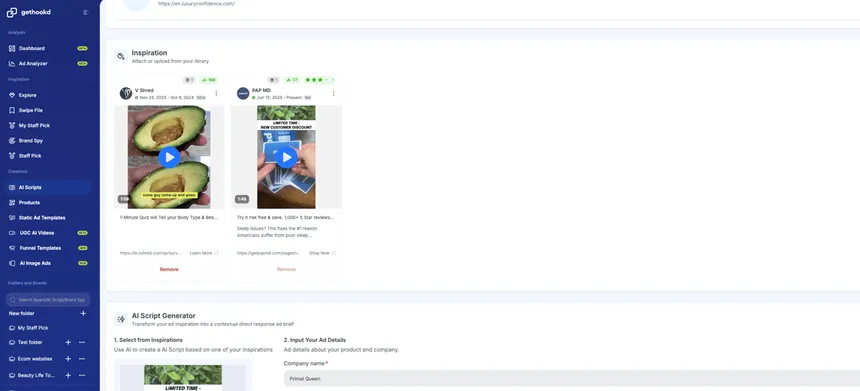
GetHookd is a competitor ad research and creative intelligence platform for media buyers, agencies, and eCommerce operators running Meta and TikTok ads. You search through 65 million ads across Facebook, Instagram, and TikTok, filter by niche and format, and identify which creatives competitors are actively scaling rather than simply running.
Brand Spy handles the competitor workflow. It returns a brand’s top ads, landing pages, and traffic sources in a single view, which shows the funnel behind the creative rather than the creative alone. Performance scoring surfaces which ads are actively running and scaling, rather than which ones collected engagement.
GetHookd’s production tools work directly on what the research returns. Ads Transcription converts competitor video into usable copy, Video Scripts generates hooks and angles from an uploaded winning ad, and Clone Ads produces multiple image variations from a single static. Saved ads remain in your library permanently, including ads that later go inactive.
Brand Spy, API access, and MCP access are included on every plan, which means a solo operator on the entry tier runs the same competitor research an agency does.
User Reviews
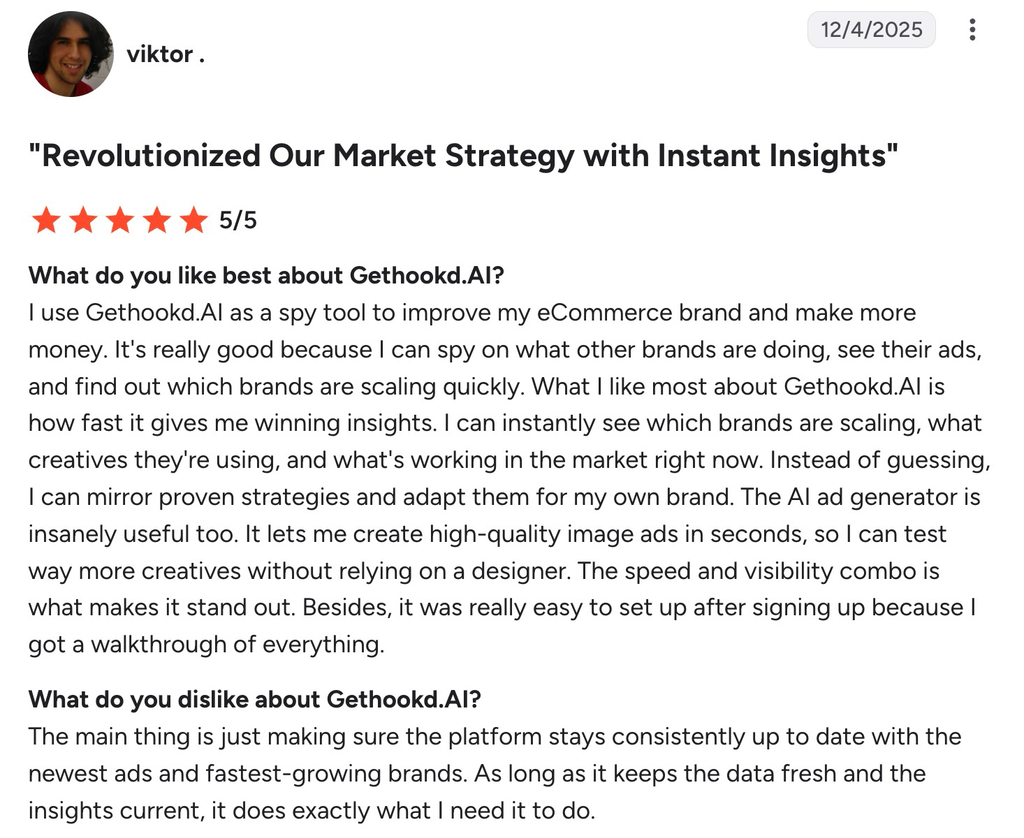
GetHookd holds a 4.8/5 rating on G2. Reviewers highlight how quickly the platform identifies which brands are scaling and which creatives drive that growth, the depth of filtering in the ad search compared with alternatives they’ve used, and AI image generation that produces testable variations without prompt engineering or a designer.
2. Foreplay
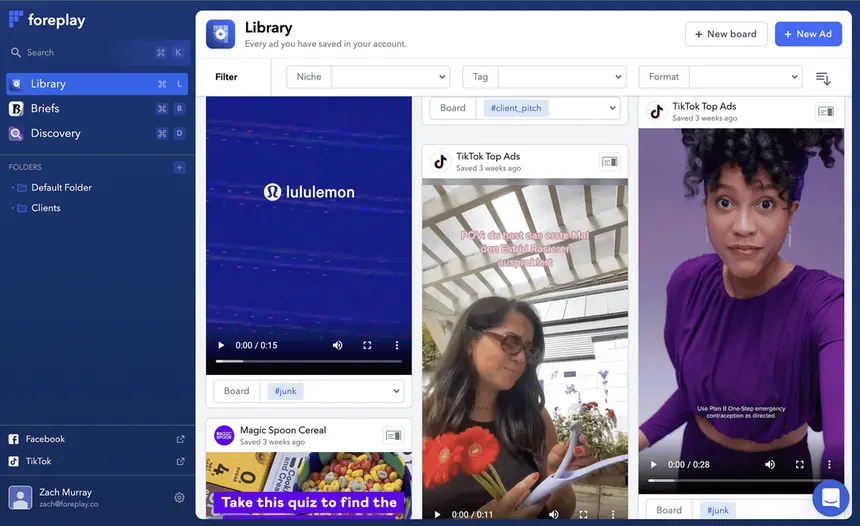
Foreplay is a creative research and swipe file platform. Its core function is to collect ads, organize them into boards with tags and ratings, and convert them into briefs designers can work from. Teams that separate the strategist role from the production role get the most out of it.
Spyder handles competitor tracking, monitoring brands around the clock and holding up to three years of ad history per advertiser. It surfaces media mix analysis, competitor creative tests, top-performing hooks, and landing page insights on a creative timeline that shows how a brand’s approach shifted over time.
Discovery adds a large community-curated library with AI-powered search, emotional analysis, and persona detection. Lens reads performance from connected ad accounts without pricing tied to ad spend. Coverage extends past Meta into TikTok, LinkedIn, and YouTube Shorts, which matters when your media mix runs wider than Meta alone.
Foreplay’s creative output stops at briefs and AI storyboards, so another tool produces the finished asset.
User Reviews
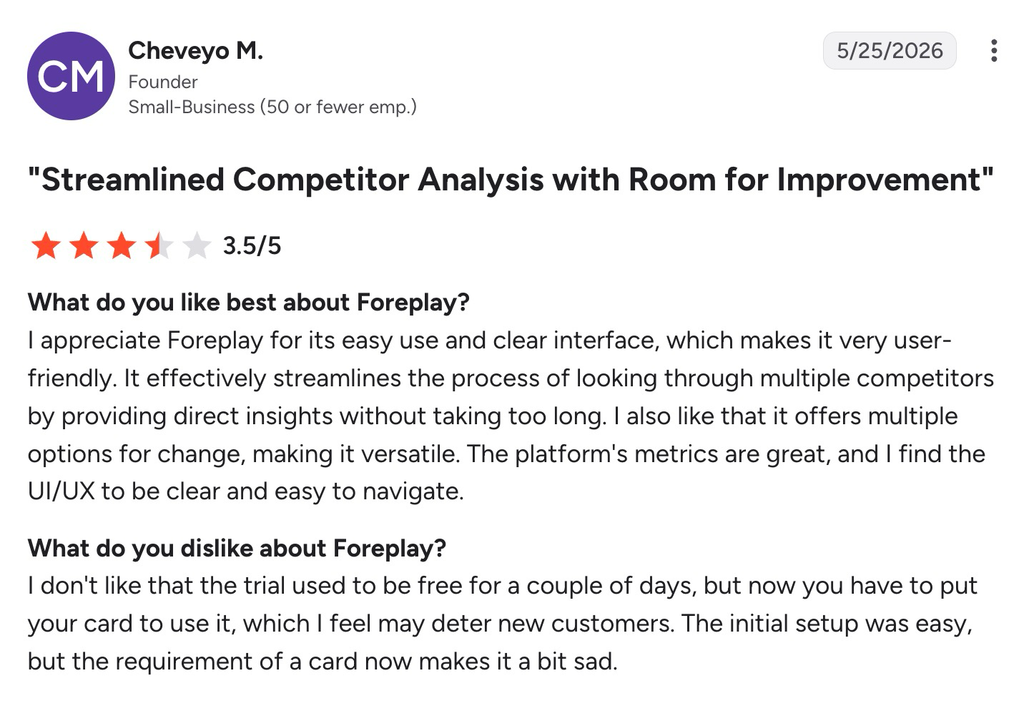
Foreplay carries a 4.8 out of 5 rating on G2. Reviewers praise its clean interface, fast competitor research, useful metrics, and straightforward Spyder tracking. Criticism centers on pricing, occasional Chrome extension issues, limited value for search campaigns, and requiring a payment card to access the trial.
3. AdSpy
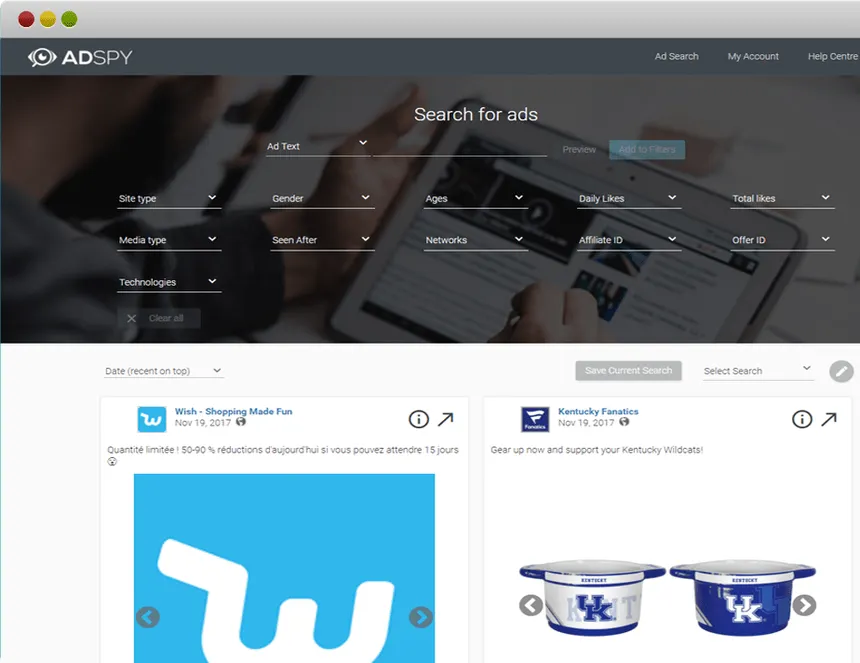
AdSpy is a searchable database of Facebook and Instagram ads, with no production layer. It currently indexes more than 200 million ads from over 30 million advertisers across 225 countries and 88 languages, making it one of the deepest historical archives.
You can query ad text, advertiser name, URL, and landing page technology, then filter by affiliate network, affiliate ID, or offer ID. Comment search is the feature affiliates cite most, since it exposes audience reaction directly rather than through engagement counts alone.
Demographic estimates cover location, gender, and age range, built from a contributor network, which helps identify regions where a competitor is active and you are not. The platform also bypasses cloakers, so the landing page you inspect is the one real traffic sees.
Coverage stops at Facebook and Instagram, which rules AdSpy out as a single research tool for cross-platform teams.
User Reviews
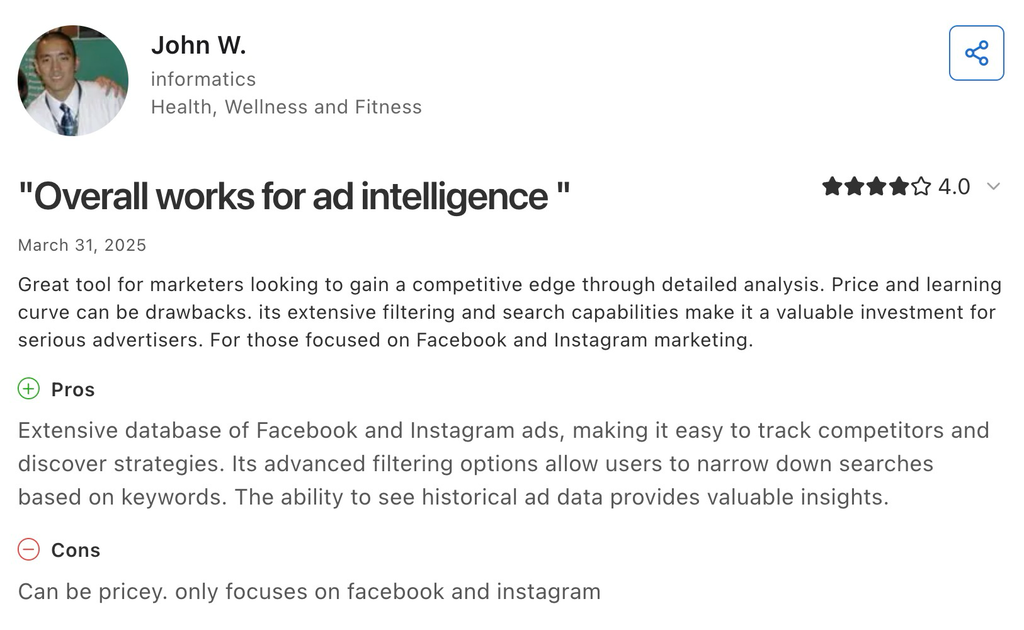
AdSpy holds a 4.3/5 rating on Capterra. Reviewers rate the database size, advanced filtering, and historical ad data highly, describing it as a strong fit for serious advertisers focused on Facebook and Instagram. Consistent complaints include cost for smaller budgets, coverage limited to those two platforms, a short trial window, and slow support responses.
4. Atria
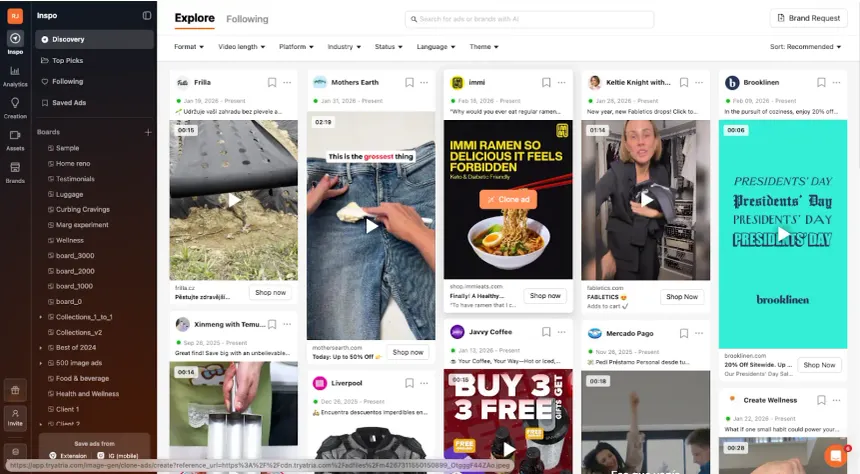
Atria is an AI creative intelligence platform that connects directly to your Meta and TikTok ad accounts. It combines a library of roughly 25 million ads with Radar, an AI engine that continuously reviews your ad performance and recommends what to produce next.
Competitor research works through brand following rather than open search. You follow a set number of brands depending on tier, and higher tiers attach AI-tagged hooks, ad angles, personas, USPs, and top landing pages to those brands, with weekly email updates.
Review mining extracts ad angles from customer testimonials, and AI URL analysis builds briefs from a product page. The platform generates scripts, copy, and image variations from those inputs.
The link between competitor data and first-party data defines who Atria suits: teams already spending enough for their own performance data to carry signal. Advertisers starting from scratch give Radar little to read.
User Reviews
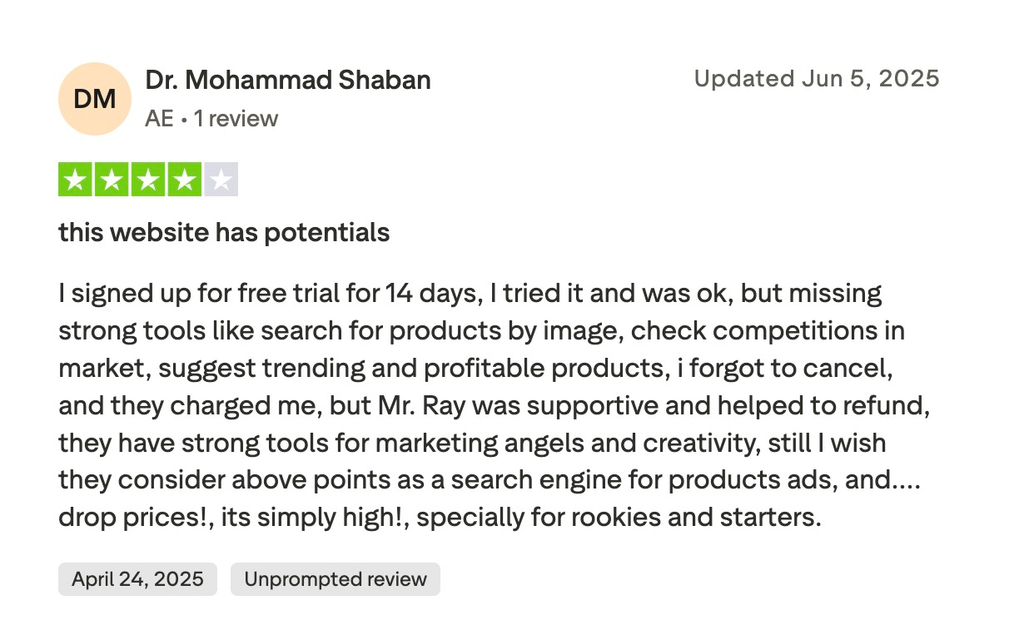
Atria AI holds a 5.0 out of 5 rating on G2, where reviewers praise the depth of competitor breakdowns, customizable analytics dashboards, and how quickly the platform turns proven performers into new concepts. Its Trustpilot TrustScore sits at 2.6 out of 5, with complaints centered on unexpected trial upgrades, a failed cancellation flow, and unanswered support requests.
Meta Ads Competitor Analysis Tools Compared
| Tool | Built for | Ad coverage | Competitor feature | Creative output | User rating |
| GetHookd | eCommerce brands and agencies researching and producing Meta ads in one place | 65M ads across Facebook, Instagram, and TikTok | Brand Spy on every plan, covering top ads, landing pages, and traffic sources | AI scripts, transcription, ad cloning, image generation | 4.8 G2, 4.1 Trustpilot |
| Foreplay | Creative strategists briefing designers | Meta Ad Library plus TikTok, LinkedIn, YouTube Shorts | Spyder tracking with three years of ad history | Briefs and AI storyboards | 4.8 G2 |
| AdSpy | Affiliates and buyers needing deep historical search | 200M+ Facebook and Instagram ads | Comment search, affiliate network and offer ID filtering | None | 4.3 Capterra |
| Atria | Teams pairing competitor research with first-party analytics | 25M+ ads across Meta and TikTok | Brand following with AI-tagged hooks and angles | AI scripts, copy, image variations | 5.0 G2, 2.6 Trustpilot |
GetHookd Keeps Competitor Research & Ad Production in One Place
Competitor research pays off when a scaling ad you spot becomes a test running in your own account. Foreplay stops at briefs and AdSpy has no creative output, so with either one you need a second tool to produce the ad. Every extra tool between finding a winner and launching your version adds cost and pushes the test back.
GetHookd works like the Facebook Ad Library with a performance layer on top. You search 65 million Meta ads, use Brand Spy to see which creatives and landing pages a competitor is scaling, then turn those winners into new scripts and image variations with AI in the same workspace. Dropshippers and agencies use it to go from a competitor insight to a testable ad in minutes. Start your 7-day free trial and see what your competitors are scaling this week.
Frequently Asked Questions (FAQs)
Is spying on competitor Facebook ads legal?
Yes, reviewing ads in Meta’s public Ad Library is generally legal. Meta publishes active ads in its public Ad Library for transparency, and mosts ad tools reads from that public source. Copying a competitor’s exact creative assets raises copyright issues, but studying hooks, angles, offers, and formats is standard competitive practice.
How often should I check competitor ads?
Weekly works for most advertisers. Creative cycles on Meta move quickly, and a weekly review catches new launches while filtering out short-lived tests. Brands in seasonal categories benefit from daily checks during peak periods, when competitors rotate offers more frequently.
Do I need technical skills to use a Meta ad research tool?
No. These platforms run in a browser with search filters and saved boards. Some add API or MCP access for teams that want programmatic queries, but the core research workflow needs no coding, scraping setup, or developer involvement.
Does GetHookd limit competitor tracking by plan?
No. GetHookd includes Brand Spy on every tier, so competitor tracking is available from the entry plan upward. Higher plans add monthly credits and additional seats rather than unlocking the research capability itself, which keeps full competitor analysis available to solo operators and small teams.
*Note: Pricing and/or product availability mentioned in this post are subject to change. Please check our website for current pricing and stock information before making a purchase.