Key Takeaways
- The four best ad spy tools for finding competitor ads in 2026 are GetHookd, AdSpy, Minea, and Foreplay, each differing in the networks they index and how much creative work they support.
- GetHookd indexes 65M+ ads across Facebook, Instagram, and TikTok, pairing Brand Spy with AI scripts and Clone Ads that turn competitor ads into testable creative, starting at $29/month.
- AdSpy holds one of the largest Facebook and Instagram databases (200M+ ads) for a flat $149/month fee, while Minea covers Meta, TikTok, and Pinterest ads plus product research for $49/month.
- Foreplay organizes ad creative across Meta, TikTok, and LinkedIn with tagged swipe boards and a 200M+ community-curated Discovery library, starting at $59/month.
- GetHookd stands out for keeping ad research and creative production in one platform, so you can move from spotting a competitor’s ad to testing your own version the same day.
What Separates One Ad Spy Tool From Another
Ad spy tools all read from the same public ad libraries, so what separates them is how far back their history goes, which networks they index, and what you can do with an ad once you find it. Most buyers overpay by choosing on database size alone, when coverage and workflow usually matter more.
A live ad is not the same as a winning ad. Browsing a library shows only what a brand runs today, which says nothing about spend or how long a creative has lasted. Tools that track one advertiser over weeks give a far better read on what is actually working.
Below, we break down the top options on these three criteria: coverage, tracking depth, and what each tool lets you do with an ad once you’ve found it.

GetHookd: Turn Competitor Intelligence Into Your Next Winning Ad
GetHookd reveals which ads your competitors are actively scaling—not just running. Spy on their best-performing creatives, landing pages, and traffic strategies, then turn proven concepts into testable campaigns in seconds with AI-powered script generation and creative cloning.
What You Get:- ✓ Brand Spy to decode competitor ad strategies in real-time
- ✓ AI script generation and ad cloning for instant variations
- ✓ Performance scoring based on actual ad behavior, not vanity metrics
- ✓ Creative Analyzer to identify and scale your top performers
The 4 Best Ad Spy Tools to Find Competitor Ads in 2026
1. GetHookd
GetHookd is our ad research and creative intelligence platform for media buyers, agencies, and eCommerce brands running paid social. We index ads across Facebook, Instagram, and TikTok, searchable from a single dashboard.
The Brand Spy feature identifies which of a competitor’s ads are being scaled, along with their landing pages and traffic sources. This separates ads a brand is actively spending on from ads that are simply live, which is a more reliable signal of performance.
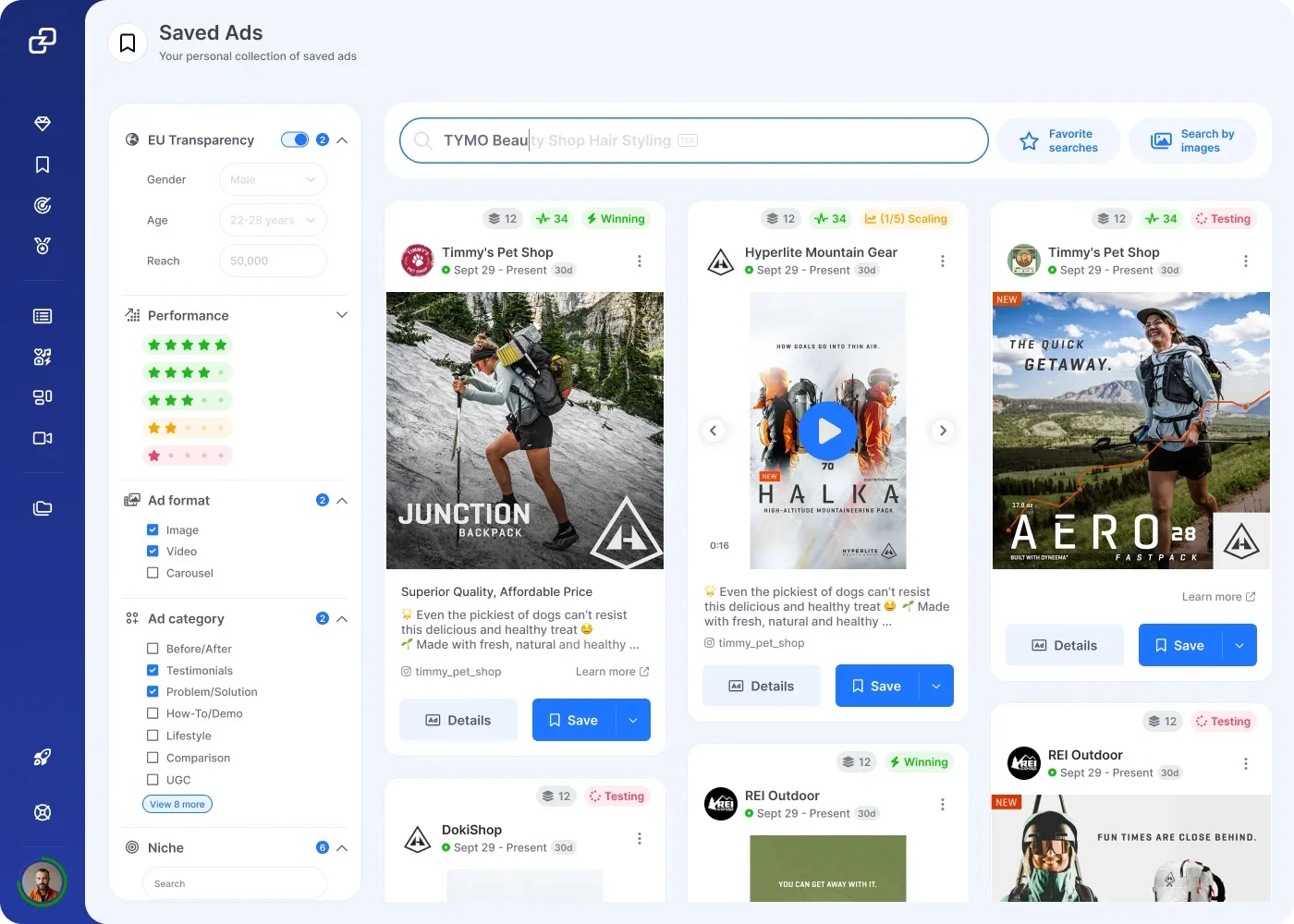
GetHookd also includes creative production tools. After locating an ad, a user can transcribe it, generate a script with the built-in AI copywriter, and produce image variations with Clone Ads. Research and creative work stay in one platform, which is the main structural difference between GetHookd and research-only tools. Performance scoring and the Creative Analyzer rank saved ads by real ad behavior, not surface metrics.
GetHookd Key Features
- Brand Spy: separates ads a competitor is actively scaling from ads merely running live, with landing pages and traffic sources
- 65M+ ads across Facebook, TikTok, Instagram
- Ads Transcription for extracting hooks, copy, and CTAs from video ads
- AI Video Scripts generated from existing ads
- Clone Ads for producing image variations from a single static ad
- Creative Analyzer and performance scoring based on ad behavior
GetHookd pricing starts at $29 per month for the Starter plan, with a Pro tier at $49, a Team tier at $79, and an Agency tier at $129 for larger teams. Every plan includes a 7-day free trial.
What reviewers say
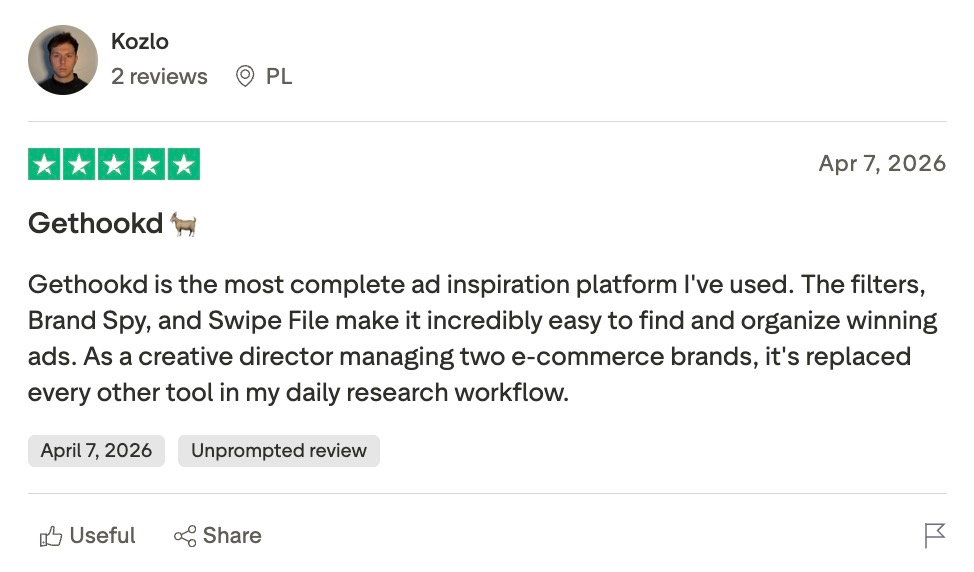
GetHookd holds solid ratings on Trustpilot. Reviewers repeatedly point to the same feature set: the filters, Brand Spy, and a permanent swipe file that replaces a mix of spreadsheets, Drive folders, and browser bookmarks.
A creative director running two eCommerce brands calls it the only tool left in their daily research workflow, and several reviewers highlight the ability to see which competitors are scaling up and which are scaling down.
2. AdSpy
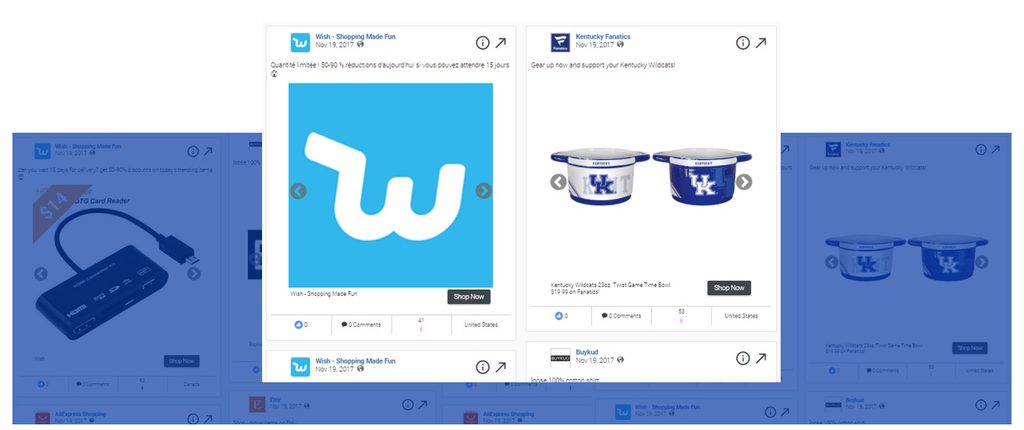
AdSpy is a Facebook and Instagram ad intelligence tool aimed at affiliates and eCommerce operators. It has operated for years and has one of the largest Meta ad databases, with over 200 million ads indexed across 225 countries and 88 languages.
The core function is search depth. Users can filter ads by keyword, advertiser, affiliate network, demographics, and engagement, and the comment search feature returns what real users posted about an ad, surfacing objections and social proof.
The trade-offs are cost and scope. AdSpy runs on a single flat plan at $149 per month with no tiered options, and it covers Meta only, so it lacks TikTok, Pinterest, and built-in creative production. It also has no ongoing free tier, only occasional short trials. Once a user finds an ad, they still need separate software to write scripts or build variations.
AdSpy Key Features
- One of the largest Facebook and Instagram ad databases, with deep historical data
- Advanced filters: keyword, advertiser, affiliate network, demographics, engagement
- Comment search: surfaces buyer objections and social proof from real ad comments
- Landing page URL tracking to see where traffic is sent
- Single flat plan with unlimited searches and no creative or AI tools
What reviewers say
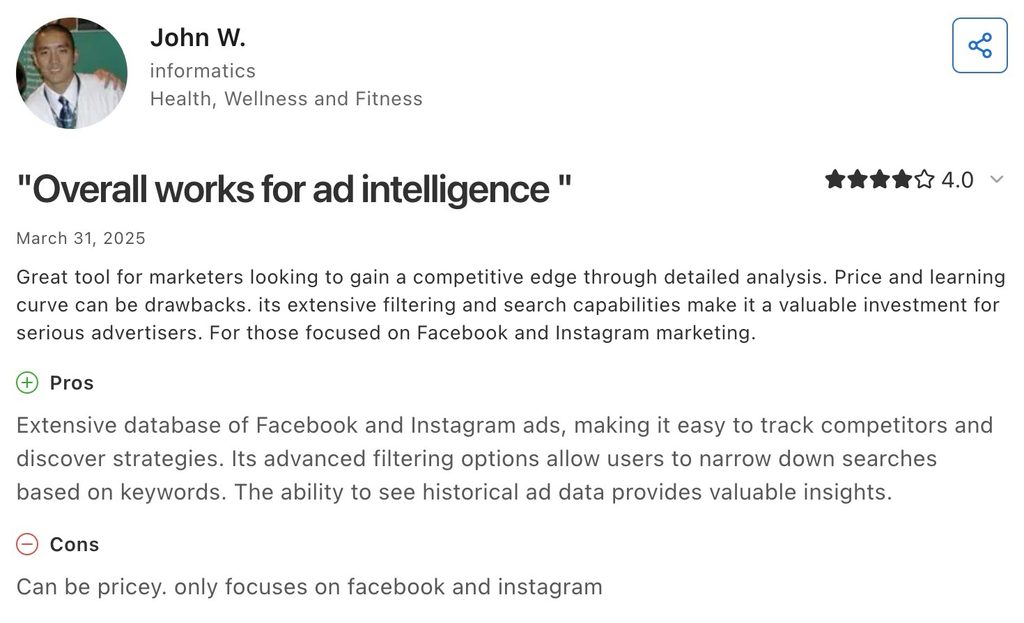
AdSpy holds a 4.3 rating on Capterra, with sub-scores of 4.2 for ease of use and 4.0 for both value for money and customer service. Across its Capterra reviews, users credit the size of the Facebook and Instagram database, the advanced filtering, and access to historical ad data, calling it a worthwhile investment for advertisers focused on those two platforms.
Cost and support are the recurring criticisms. Reviewers describe the price as hard to justify for anyone still building sales volume, and one flags that coverage stops at Facebook and Instagram.
3. Minea
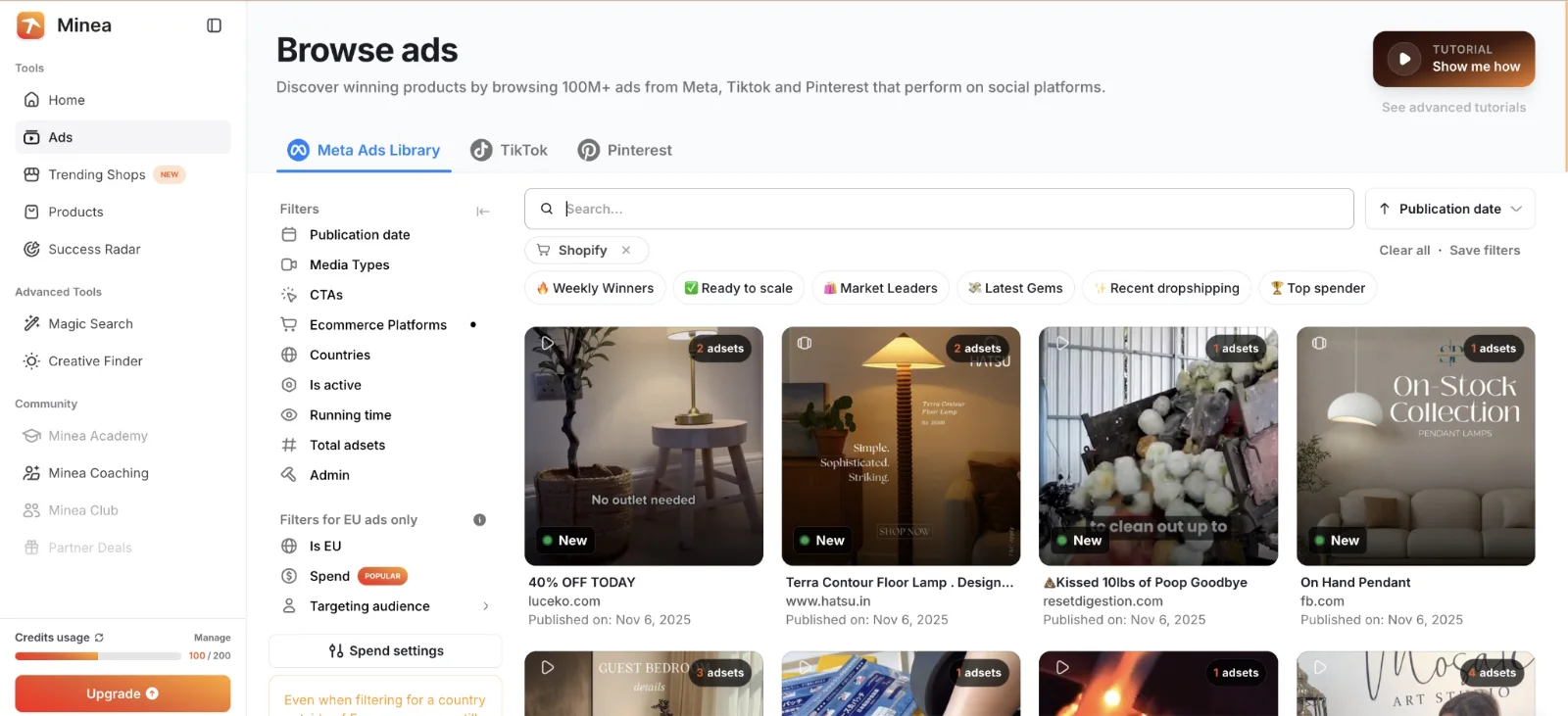
Minea is an ad spy and product research tool built for dropshippers and eCommerce sellers. It tracks ads across Facebook, Instagram, TikTok, and Pinterest from one dashboard and adds influencer campaign tracking that standard ad-library tools don’t cover.
Beyond ad search, Minea ties research to products. It links winning ads back to the stores and suppliers running them, with store detection and a Shopify store analyzer, and it scores items so a seller can gauge demand before committing. This makes it relevant to product sourcing, not just research work.
Minea meters its heavier features by plan. AI ad analysis, AI transcripts, and Magic Search have capped monthly uses on Starter, so an entry plan can run out quickly during active research. Its stronger product features sit on higher tiers, and the platform leans toward discovery rather than converting an ad into a finished, testable creative.
Minea’s Key Features
- Ad tracking across Facebook, Instagram, TikTok, and Pinterest in one place
- Influencer and UGC ad tracking beyond standard paid ad libraries
- Product research: links winning ads to their stores and suppliers, with a Shopify store analyzer
- Success score signals and trending product feeds for demand checks
- Credit-based plans with a free trial for testing the platform
Minea pricing starts at $49 per month for Starter, with Premium at $99 per month and Business at $199 per month. Paying quarterly lowers the monthly rate on each tier.
What reviewers say
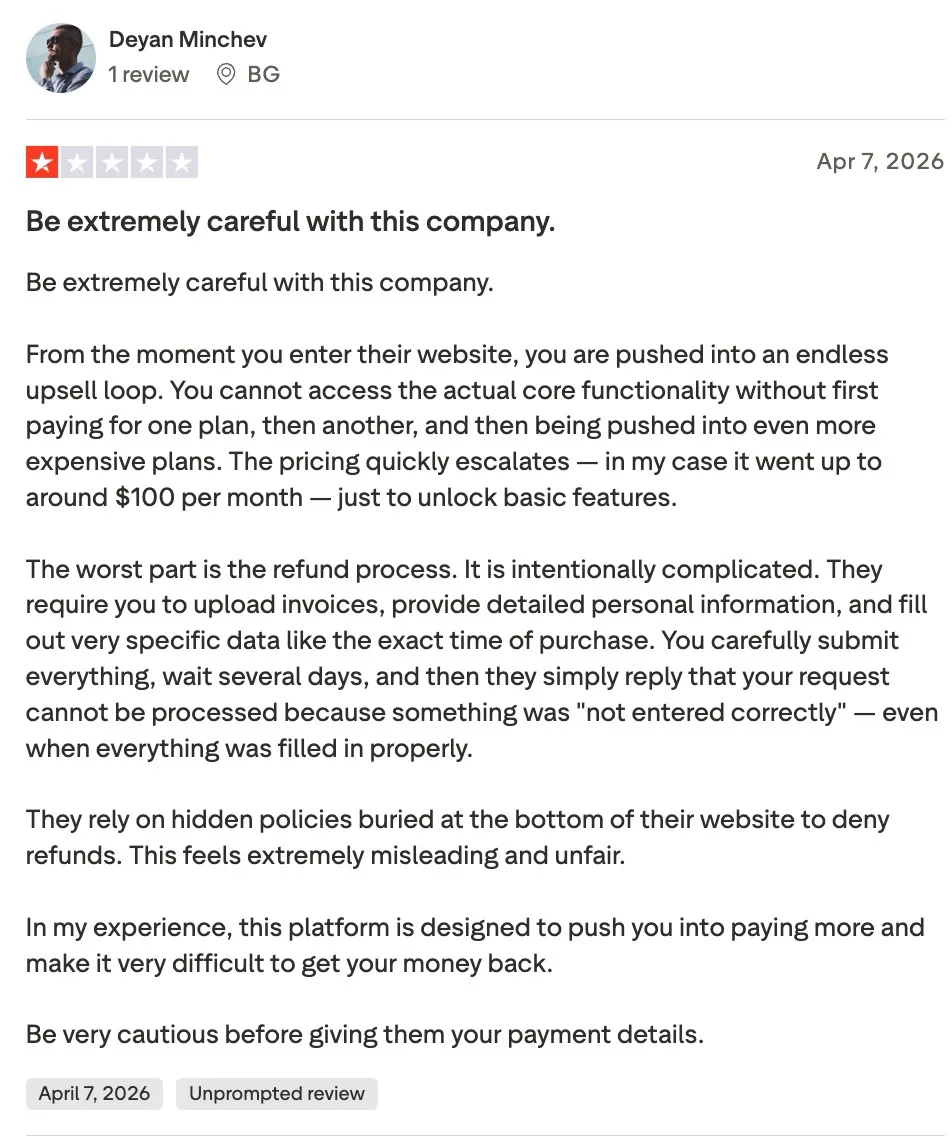
Minea carries a 3.8 rating across hundreds of Trustpilot reviews. Reviewers credit it with speeding up product research, and complaints center on how the plans are structured.
Several reviewers report paying for an entry plan and then finding the features they wanted one or two tiers higher, with upgrade prompts appearing during normal use; others describe a refund process that requires detailed documentation and is often refused. A separate thread of one-star reviews relates to the paid coaching program rather than the software itself.
4. Foreplay
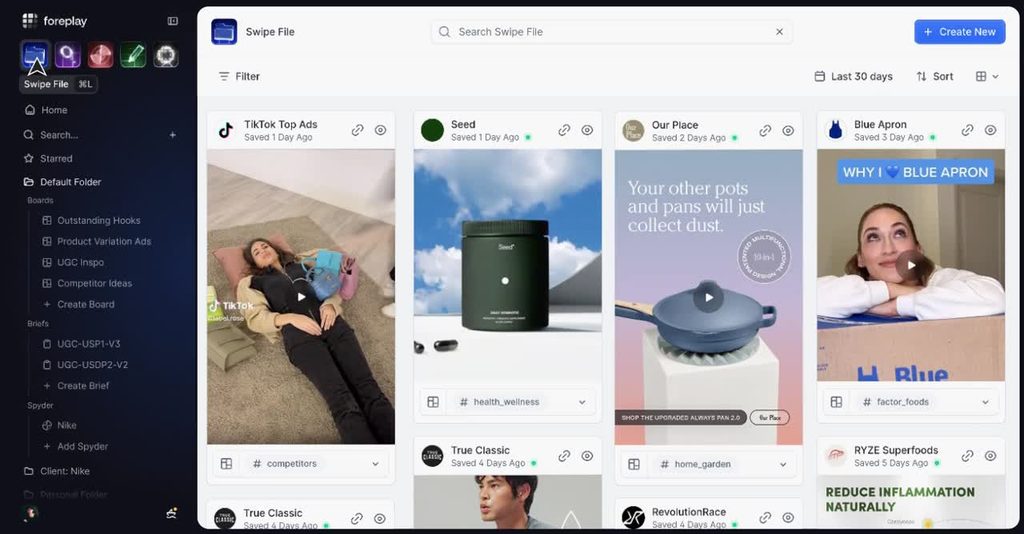
Foreplay is a creative workflow platform for agencies and in-house creative teams, built around a swipe file rather than a raw ad database. Its Discovery library holds more than 200 million community-curated ads, and a Chrome extension saves ads from the Meta Ad Library, the TikTok Ad Library, LinkedIn, Instagram, and YouTube Shorts into shared boards that survive after the original campaign ends.
Production runs through Briefs, which turn saved ads into structured creative briefs, storyboards, and AI-generated scripts designers or editors can use. Competitor tracking sits in a separate product called Spyder, which monitors selected brands around the clock and surfaces new ads, creative tests, hooks, and landing pages as they launch, and Lens reports on how a team’s own creatives performed.
Foreplay Key Features
- 200M+ community-curated ad library with AI search, longest-running sort, and emotional and persona analysis
- Chrome extension and mobile app for one-click saving from Meta, TikTok, LinkedIn, Instagram, and YouTube Shorts
- Spyder: 24/7 Meta competitor tracking with up to three years of ad history, media mix analysis, and hook breakdowns, from the Workflow plan
- Briefs: AI script generator, storyboards, brand profiles, and shareable brief pages
- Lens creative analytics, priced by brand rather than by ad spend, from the Workflow plan
Foreplay pricing starts at $59 per month for Basic with one seat, $175 per month for Workflow with five seats and 15 tracked brands, and $459 per month for Agency with ten seats and 50 tracked brands. Each includes a 7-day free trial and requires a card.
What reviewers say
Users praise the clean interface, the one-click Chrome extension for saving ads before they disappear, and Spyder for making competitor research straightforward to organize.
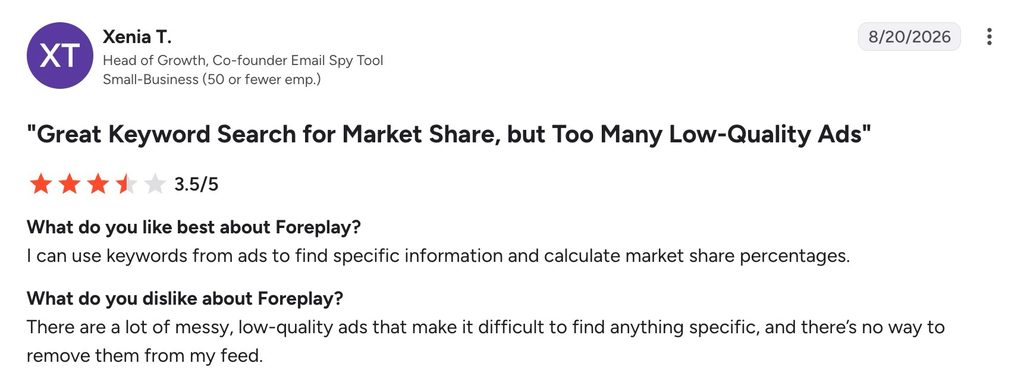
Price is the leading complaint in G2’s pros-and-cons breakdown, and reviewers who run ads occasionally describe the platform as overkill. Others report a feed cluttered with low-quality ads that cannot be filtered out, search filters that do not stack cleanly across large backlogs, and a Briefs feature that underdelivers.
Ad Spy Tools Compared: GetHookd vs AdSpy vs Minea vs Foreplay
| Tool | Best for | Coverage | Competitor tracking | AI creative tools | Starting price |
| GetHookd | Meta and TikTok research plus creative testing | Meta and TikTok 65M+ ads | Brand Spy, on every plan | AI scripts, Clone Ads, Creative Analyzer | From $29/mo, 7-day free trial |
| AdSpy | Affiliate and comment-level Meta research | Meta only, 200M+ ads | Advertiser search only | None | $149/mo flat, no free tier |
| Minea | Product and shop research for dropshippers | Facebook (including Instagram, via Meta’s network), TikTok, and Pinterest | Brand tracker, capped on entry plan | AI analysis and transcript, metered | From $49/mo |
| Foreplay | Agency swipe file and creative briefing | Meta, TikTok, LinkedIn, YouTube Shorts, 200M+ curated | Spyder, from the $175 plan | AI scripts and storyboards in Briefs | From $59/mo, 7-day free trial |
Choose GetHookd to Turn Ad Research Into Your Next Winning Test
The right tool depends on where you run ads and how much of the creative process you want in one place. Deep Meta archives, multi-network product research, and agency briefing workflows each cover only a slice of the job.
At GetHookd, we close the gap between finding a winning ad and building your own. Brand Spy comes on every plan, AI scripts and Clone Ads turn research into testable creative, and a 7-day free trial runs across all tiers. Try it on your own niche and see which competitor ads are actually scaling.
Frequently Asked Questions (FAQs)
Is it legal to spy on competitor ads?
Yes. Ad spy tools index ads that are already public through official channels such as the Meta Ad Library, using the same data any user can view. They do not access private accounts or restricted information. Using this data to guide your own ad strategy is a standard practice among brands, agencies, and media buyers.
What is brand spying, and how is it different from browsing an ad library?
Browsing an ad library shows what a competitor is running right now. Brand spying tracks one advertiser over weeks, so you see which ads survive longest and which get scaled. Duration is the signal a single snapshot can’t give you: an ad that stays live for months is far more likely to be profitable than one that just went up.
How often should I check or scrape competitor ads?
For active accounts, a weekly review is a reasonable baseline, with more frequent checks during product launches or seasonal periods. Ads that stay live over a long period are the strongest signal of profitability, so tracking how long a competitor’s ad runs is more informative than counting how many they publish.
Do I need technical skills to use an ad spy tool?
No. Most tools rely on dashboards and filters, so searches run by keyword, brand, or niche without any code. Tools that include AI creative features generate scripts or ad variations automatically, which keeps them usable for beginners and small teams without a technical background.
How does GetHookd handle AI ad creation?
With GetHookd, we pair AI creative tools with our research data. After a user finds a relevant ad, they can transcribe it, generate scripts from it, and produce image variations with Clone Ads. Saved ads also remain accessible after they go offline, so earlier references stay available for later campaigns.
*Note: Pricing and/or product availability mentioned in this post are subject to change. Please check our website for current pricing and stock information before making a purchase.