AI-driven ad strategies from Gethookd elevate creative optimization to unprecedented levels. By integrating cutting-edge analytics, AI-powered creatives, and instant competitor performance analysis, we eliminate guesswork, weak formatting, and uncertainties from every ad, making sure every element of your campaigns is as effective as possible.
Traditionally, e-commerce brands and marketers were limited by outdated tools like Facebook Ads Library, which offered fragmented data and incomplete reports. Marketers had to sift through vast libraries of ads with no smart filtering, limited intelligence, and no ready-made templates to create high-performing campaigns quickly and efficiently.
Gethookd has poured our expertise into developing the best AI for ad creative optimization. This technology doesn’t replace your expertise or brand knowledge; it enhances your performance, amplifies returns, and accelerates your growth from day one.
What Is Gethookd, and Why Is It a Better Solution Than Facebook Ads Library?
Without diving too deeply into the limitations of Facebook Ads Library, it's clear that the creative space has been desperately searching for tools that align with the needs of fast-paced, competitive marketers. Whether it's about the lack of responsive tools, doubts about the accuracy of analytics, or struggling to find the right strategy to maximize reach, the demand for a smarter, more agile solution is undeniable.
In simple terms, Gethookd is Facebook Ads Library supercharged. It delivers more data, better precision, unparalleled flexibility, and a suite of tools that make it the ultimate one-stop solution for everything–from creative development to competitor analytics and ongoing optimization.
Our goal is to help you fine-tune your campaigns, leverage data intelligence, and take control of optimization, all while using the latest AI-powered features to gain a competitive edge.
Features to Look for in Top-Performing Facebook Ads Library Alternatives
We understand the headaches Facebook Ads Library presents. This is why we’ve designed a powerful end-to-end platform that integrates the best of AI, offering intuitive, user-friendly tools to make ad creation and optimization as straightforward as possible.
At Gethookd, we believe that amazing ad creatives should never be complex, and we ensure that every piece of valuable data is accessible to you. Our platform streamlines the entire creative lifecycle, cutting down on wasted spending, identifying high-performing ads, centralizing key insights, and enabling scalable concept testing.
User-generated content videos utilizing your media assets and AI scripts
Static templates pre-designed for polished, high-impact visuals
Brand Spy: Real-time competitor campaign analysis
Advanced performance insights for hyper-efficient strategy updates and optimization
Each feature is designed with simplicity in mind, making it easier for you to achieve scalability, minimize manual work, and rapidly enhance your returns. Whether you're looking to scale fast, reduce manual efforts, or optimize for maximum profitability, we’re here to help you do it efficiently.
How Can Gethookd Make a Difference to My Ad Performance?
By examining the results, you'll quickly see why high-growth brands are turning to Gethookd. With our proven templates, creative features, high-context competitor research, and precise filtering, campaign management becomes faster and less effort-intensive.
Here’s what we can help you achieve:
Increase ad profitability by 50% or more
Test ad concepts and variations three times faster
Accelerate ad creation tenfold
Cut acquisition costs by 24%
No matter your current brand lifecycle, we've designed Gethookd to scale with businesses of all sizes. With more than one hundred ready-to-use jumpstart campaigns and ad templates, and a searchable library of more than fourteen million ads (and counting), you can quickly access strategies that drive results.
Choose from a range of growth packages tailored to your needs, from starter plans to enterprise-level solutions. And with a fourteen-day free trial, you can experience the power of Gethookd risk-free!
Some of the best AI ad optimization tools in 2026 are GetHookd, Cometly, Madgicx, and Revealbot (Birch).
GetHookd gives you 65M+ analyzed Meta ads, competitor tracking, and AI creative tools to go from research to ready-to-test ads in minutes.
Cometly focuses on multi-touch attribution and revenue tracking, but it doesn’t help you decide what creative to run next.
Madgicx improves Meta campaign management with automation; however, it offers limited competitor insight and creative research.
Revealbot (Birch) automates rules and budget adjustments across ad platforms, but it lacks built-in creative intelligence and production tools.
What AI Ad Optimization Tools Actually Do
Not all AI ad optimization tools solve the same problem. Some, like Madgicx and Revealbot, automate bids and budgets. Others, like Cometly, focus on attribution and mapping customer journeys across platforms.
Then there are platforms like GetHookd, which center on creative intelligence: analyzing which ads competitors are scaling, what hooks and formats are converting in your niche, and turning those insights into testable creatives with AI.
The common thread is replacing slow, manual decision-making with data-driven action. And what makes these tools different from the native automation inside Meta Ads Manager or Google Ads is the scope.
Platform-native tools optimize within their own walls. Third-party AI ad optimization tools operate across broader datasets and deliver insights that a single ecosystem can't provide on its own.
GetHookd: Turn Competitor Intelligence Into Your Next Winning Ad
GetHookd reveals which ads your competitors are actively scaling—not just running. Spy on their best-performing creatives, landing pages, and traffic strategies, then turn proven concepts into testable campaigns in seconds with AI-powered script generation and creative cloning.
What You Get:
✓ Brand Spy to decode competitor ad strategies in real-time
✓ AI script generation and ad cloning for instant variations
✓ Performance scoring based on actual ad behavior, not vanity metrics
✓ Creative Analyzer to identify and scale your top performers
Replace guesswork with intelligence. Build profitable ads that actually convert.
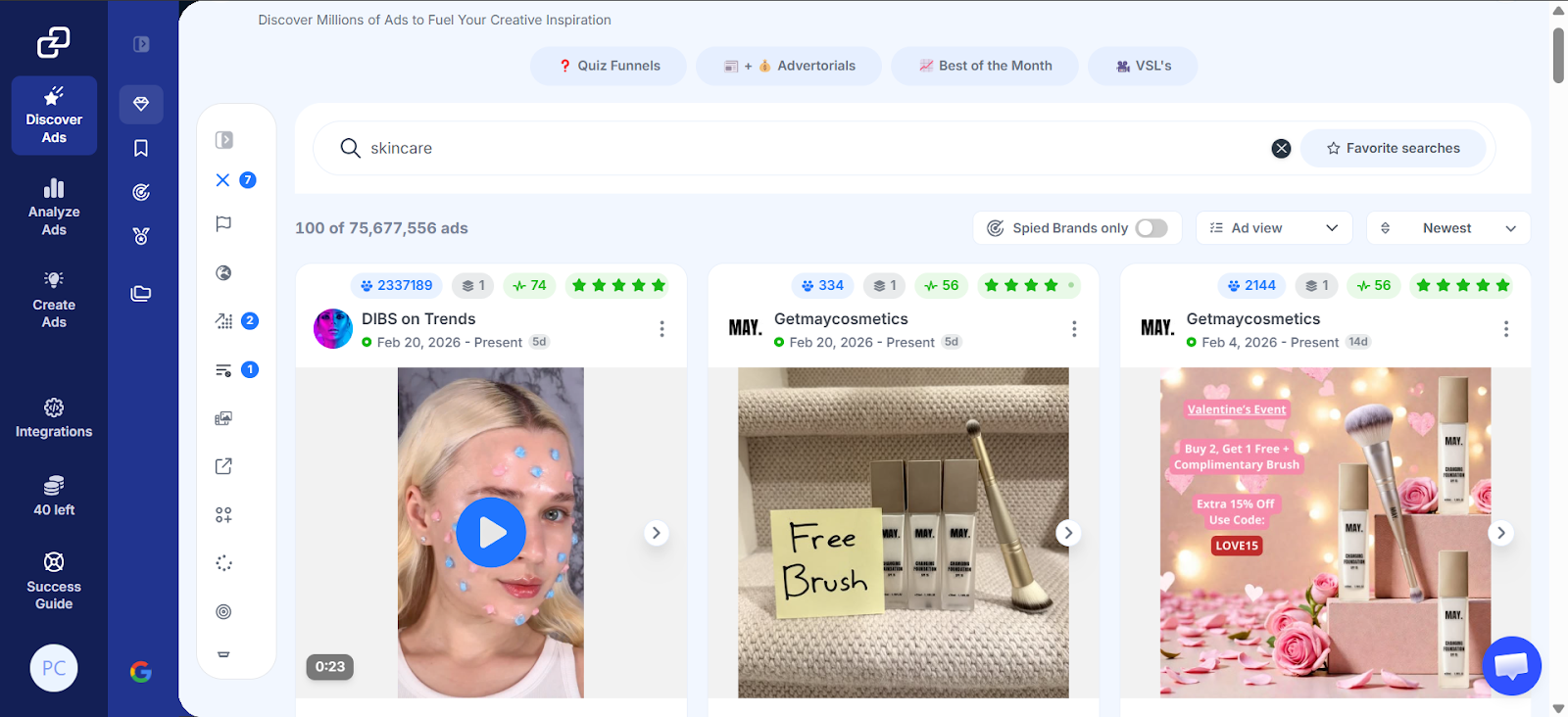
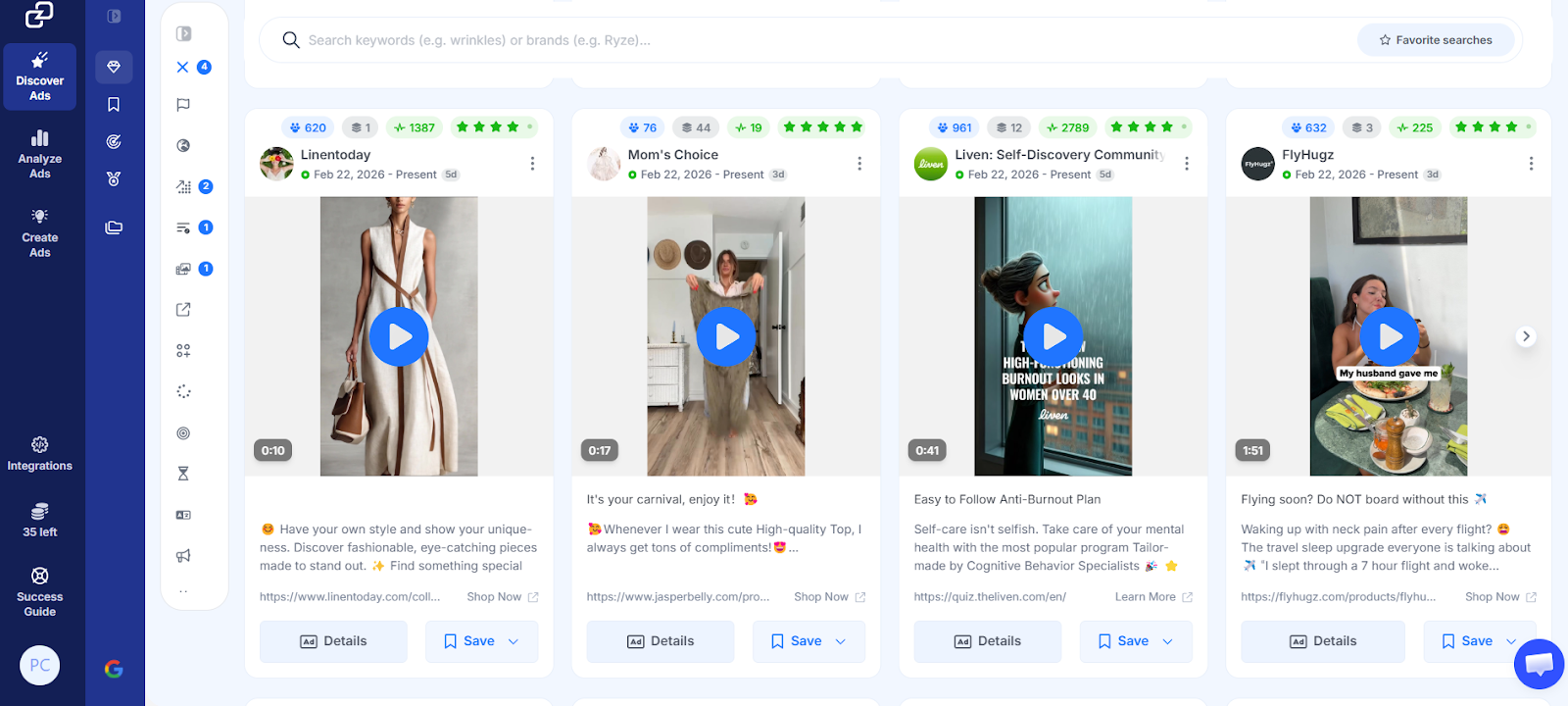
Search and filter millions of high-performing ads by niche, format, and engagement metrics.
GetHookd is built for one of the hardest parts of paid advertising: figuring out what creative actually works before you spend money testing it yourself. With a library of over 65 million analyzed ads, we’ve become a go-to research and creative intelligence tool for performance marketers who want to move faster.
Our platform lets you search competitor ads by industry, format, engagement metrics, and running duration. You're not just browsing; you're also identifying patterns in what's working right now. Long-running ads are especially valuable to flag, since advertisers don't keep spending on ads that aren't converting.
Where GetHookd separates itself from basic ad library tools is in what happens after you find an ad. We provide AI-powered creative tools that help you build new ad concepts inspired by top performers, dramatically cutting the time between research and production.
Key Features of GetHookd
Explore Ads: Search and filter 65M+ high-performing Meta ads by niche, format, country, demographics, and engagement level to surface winning creatives in seconds.
Brand Spy: Track competitor ad accounts to see which creatives they're actively scaling, what landing pages they're driving traffic to, and how their strategy shifts over time.
Swipe File: Bookmark any ad into an organized swipe file by brand, client, or campaign type. Your saved library stays intact permanently, even after the original ad goes offline.
Clone Ads: Upload any high-performing image ad and generate dozens of AI-powered variations with new colors, avatars, formats, and styles — without touching design software.
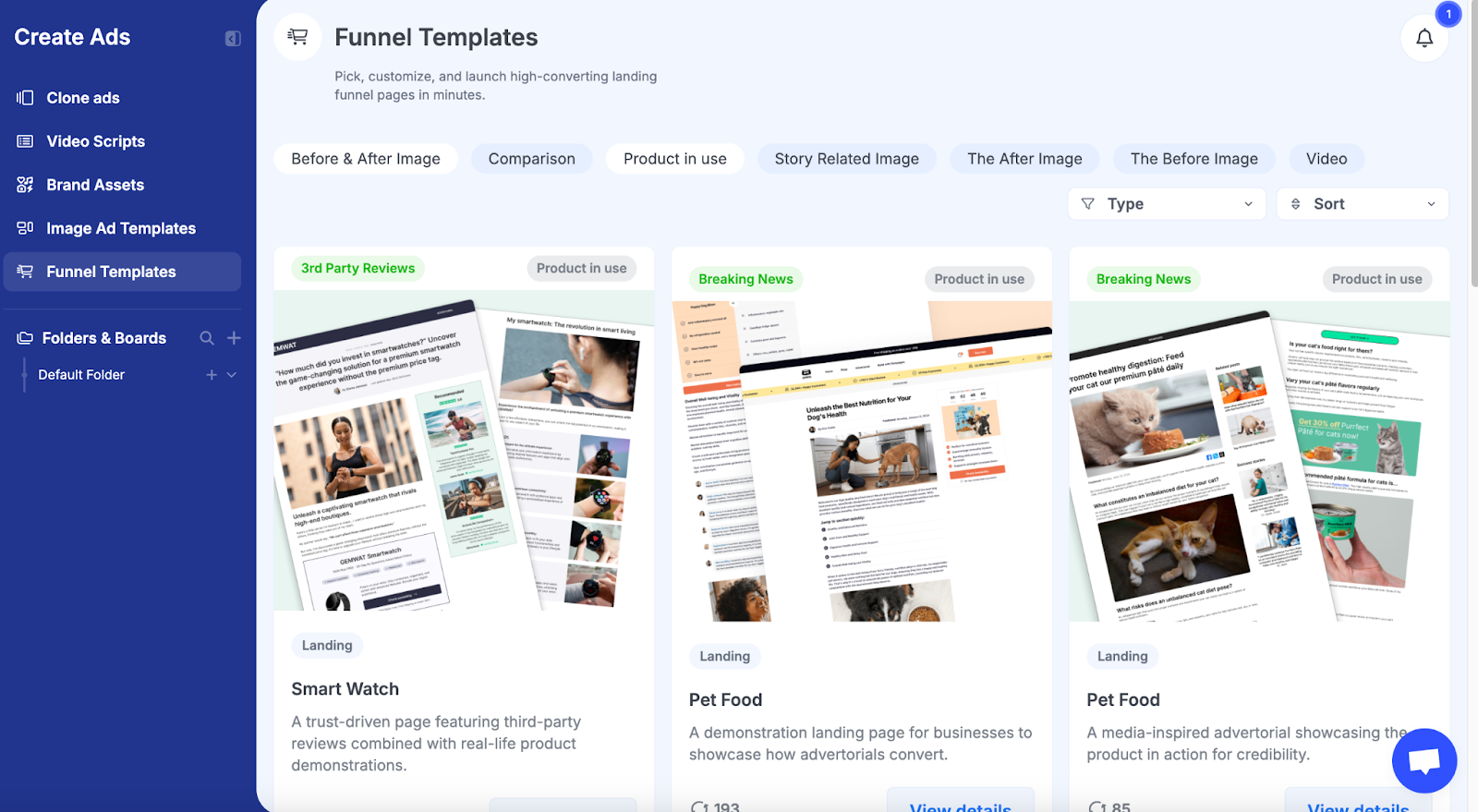
Launch high-converting landing pages in minutes with ready-made funnel templates.
Funnel & Ad Templates: Access ready-to-use static ad templates and high-converting landing page layouts modeled on proven DTC funnels, ready to customize and deploy in minutes.
Video Scripts: Input a winning ad concept and your product details to generate hooks, angles, and complete video scripts built on proven direct-response frameworks.
Ads Transcription: Automatically extract the hooks, CTAs, and copy structure from any video ad so you can study what's converting and adapt it for your own campaigns.
Creative Analyzer: Connect your Meta ad account to measure your own creative performance, identify which ads are worth scaling, and spot underperformers before they drain budget.
Connect your Meta ad account to track creative performance.
GetHookd Pricing
GetHookd plans start at $19/month with a 7-day free trial, and annual billing saves you 25%.
2. Cometly
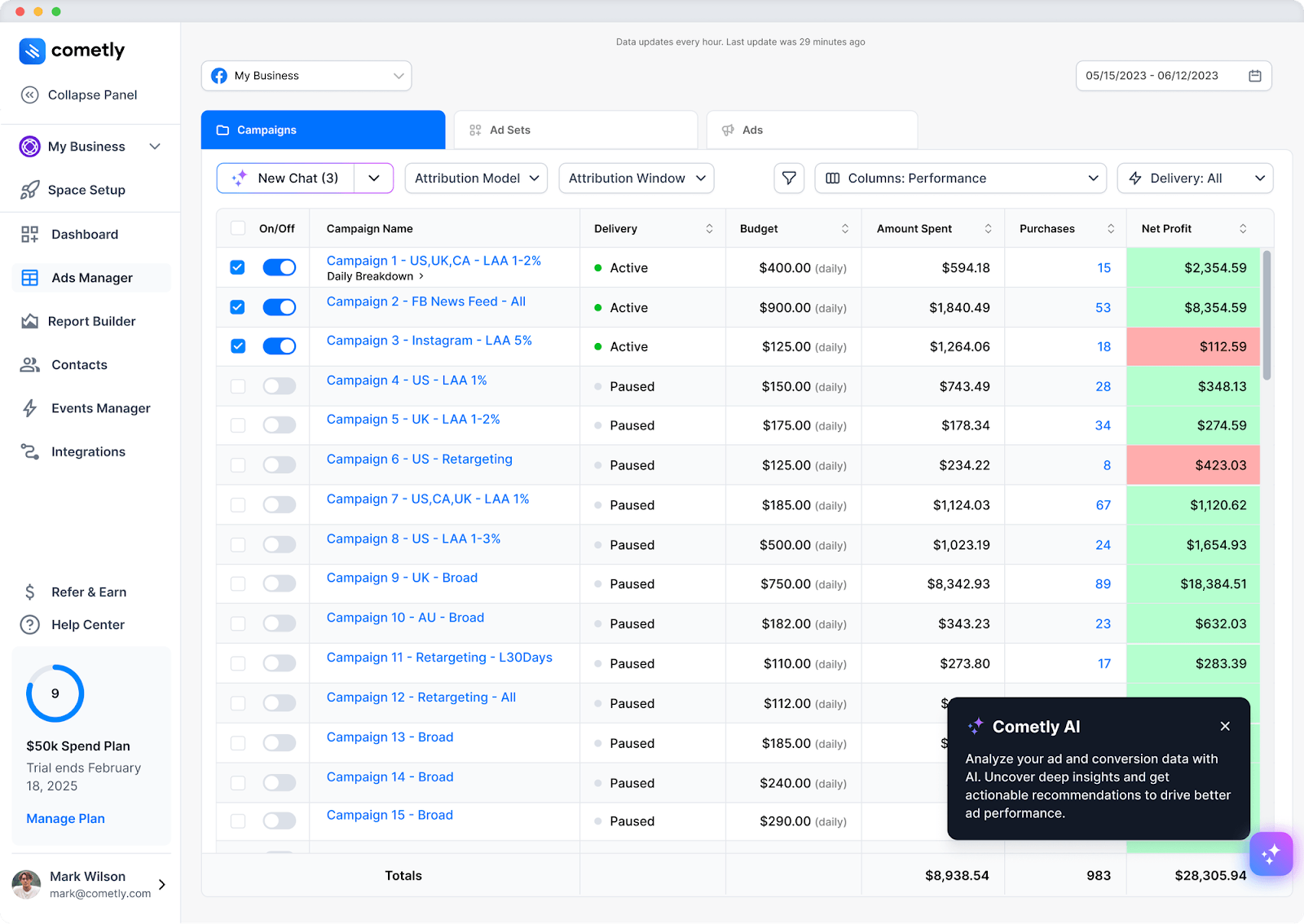
Cometly's Ads Manager showing campaign performance and net profit tracking. (Image source: Cometly)
Cometly is a marketing attribution platform that tracks which ads drive conversions across multiple channels. It follows customers from the first click to the final purchase, so you can see where revenue is coming from.
The tool is designed for advertisers who need visibility into what's working across their funnel. That said, Cometly focuses entirely on what happens after your ads are live. It tells you which campaigns drove revenue, but it doesn't help you figure out what creative to run in the first place, which competitors are scaling, or how to generate new ad concepts.
If your bottleneck is knowing what to build next rather than tracking what already ran, you'll need a separate tool to fill that gap.
Key Features of Cometly
Multi-Touch Attribution: Tracks every touchpoint in the customer journey using multiple attribution models.
Conversion Tracking & Sync: Captures conversion data and feeds it back to ad platforms like Meta to improve their targeting algorithms.
AI Ads Manager: Surfaces campaign-level performance data and provides recommendations on what to scale and what to cut.
Cometly Pricing
Cometly doesn't list pricing publicly. You'll need to book a demo to get a quote. Based on third-party reviews, plans reportedly start around $199–$500/month and scale with your monthly ad spend.
3. Madgicx
Madgicx's AI Marketer surfaces daily recommendations and tracks monthly goals. (Image source: Madgicx)
Madgicx is an ad management platform focused on Meta advertising. It combines campaign automation, audience targeting, and budget optimization into a single dashboard.
The platform's core value is in its automation layer. It surfaces recommendations for improving performance, and lets you set rules that automatically adjust bids and budgets based on the conditions you define.
However, Madgicx doesn't offer meaningful competitor intelligence or a way to research what's working across your niche before you build a campaign. There's no equivalent to tracking a specific brand's ad strategy or identifying which creatives are receiving the most spend in your market.
Key Features of Madgicx
AI Marketer: Analyzes your Meta ad account daily and delivers actionable recommendations, functioning as an automated account auditor that flags opportunities and inefficiencies.
Automation & AI Bidding: Set rule-based automations for campaign management, paired with AI bidding that optimizes budget allocation across audience segments within ad sets.
Audience Targeting: Provides pre-built audience segments and lookalike options designed to expand reach while keeping acquisition costs in check.
Ad Library & AI Ad Generator (Add-on): Offers a basic Meta ad browsing tool and AI ad generator for creating variations.
Madgicx Pricing
Madgicx's Pro Complete plan starts at $99/month and scales based on your monthly Meta ad spend.
Its ad library and AI ad generator are also sold as separate add-ons rather than included in the base plan, which means the cost of accessing creative tools adds to an already spend-based pricing model.
4. Revealbot (Birch)
Revealbot's creative insights showing ad spend, clicks, and CTR over time. (Image source: Revealbot)
Revealbot, now rebranded as Birch, is a rule-based ad automation platform built for managing campaigns across Meta, Google, and other ad networks. Its primary function is letting you set conditional rules that automatically adjust bids.
If you're running dozens of campaigns simultaneously and can't monitor each one manually, Revealbot's automation rules execute decisions on your behalf based on the performance thresholds you set.
Where Revealbot falls short is that it lacks competitive intelligence tools and AI-powered production features. The platform assumes you already have the data to make decisions and just need help with the operational side.
Key Features of Revealbot
Automated Rules & Strategies: Build conditional automations using custom metrics and timeframes.
Bulk Campaign Creation: Launch multiple ad variations simultaneously using creative set components.
Custom Metrics: Define your own KPIs by combining platform data with external sources, giving you more granular control over what triggers your automation rules.
Revealbot Pricing
Revealbot’s plan starts at $49/month and includes core features like workspaces, post boosting, and reporting.
Best AI Ad Optimization Tools in 2026 Compared
Feature
GetHookd
Cometly
Madgicx
Revealbot (Birch)
Best For
Ad research, competitor tracking, and AI creative production
Multi-platform ad attribution
Meta ad management and campaign automation
Rule-based ad automation
Starting Price
$19/month
~$199/month (demo required)
$99/month (add-ons extra)
$49/month
Ad Library
65M+ winning ads across Meta
Not available
Add-on ($29/month)
Not available
Competitor Research
Brand Spy with ads, landing pages, and traffic sources
Not available
Not available
Not available
AI Creative Tools
Script generation, Clone Ads, ad templates, funnel templates
Not available
AI Ad Generator (add-on)
Not available
Creative Analytics
Creative Analyzer connected to your Meta account
Basic creative reporting
Creative insights
Creative reporting
Best Use Case
Going from ad research to ready-to-test creatives and optimized campaigns
Tracking which ads drive revenue
Automating and optimizing existing Meta campaigns
Automating campaign management
GetHookd: AI Ad Optimization Tool for Performance Marketers
Most ad optimization tools start working after your campaign is already live. GetHookd starts before you ever hit publish. Our platform is built on the idea that the fastest way to improve ad performance is to launch stronger creatives from day one.
With over 65M+ analyzed ads across Meta, GetHookd gives you a direct window into what's actually scaling in your niche. When you find a concept worth testing, our AI-powered tools let you move from insight to execution without leaving the platform.
We also built Creative Analyzer so the optimization doesn't stop at launch. Connect your Meta ad account, identify which creatives are driving results or underperforming, and use those insights in your next round of tests. It's a closed loop: research what's working, produce new creatives, measure performance, and iterate, all in one place.
For ecommerce brands, dropshippers, agencies, and media buyers who want to stop cycling through tools and start shipping better ads faster, GetHookd is the platform built to make that happen.
AI ad optimization tools use artificial intelligence to improve the performance of your paid advertising campaigns. Depending on the tool, this can mean automating bids and budgets, tracking which ads drive revenue, analyzing competitor creatives, or generating new ad variations.
The goal is to replace slow, manual decision-making with faster, data-driven action so you spend less time guessing and more time scaling what works.
Can small businesses benefit from AI Ad optimization tools?
Absolutely. Small businesses often benefit the most because they have less budget to waste on underperforming creatives and blind testing.
Tools like GetHookd are designed to be accessible: no technical skills required, and plans start with a 7-day free trial so you can try the platform before committing.
How does GetHookd help optimize ad performance?
GetHookd optimizes your ad performance by helping you launch stronger creatives from the start. Instead of running blind tests, you can research what's already converting in your niche across 65M+ Meta ads, track competitors with Brand Spy, and use AI tools like Clone Ads and Video Scripts to produce ready-to-test variations in minutes.
Creative Analyzer then connects to your Meta account so you can measure performance and feed those insights back into your next round of tests.
*Note: Pricing and/or product availability mentioned in this post are subject to change. Please check our website for current pricing and stock information before making a purchase.
Creating a video ad that converts isn’t just about flashy visuals or catchy music—it’s about understanding how to grab attention, maintain interest, and guide your audience to take action, all within a matter of seconds. In this guide, we’ll break down the essential components of a high-converting ad and show you how to use GetHookd to streamline your ad creation process, ensuring every second of your video counts.1. Always Start with a Powerful HookThe first few seconds of your video are crucial. This is your chance to stop the scroll and make viewers want to watch more. The goal here is to immediately captivate your audience and qualify them without them even realizing it.
How to Create an Effective Hook
Targeted Visuals: The hook should feature visuals that resonate directly with your target audience. For example, if your product is aimed at women looking for beauty solutions, show a relatable woman achieving the desired result—like a glowing tan from using your product.UGC Content: User-Generated Content (UGC) is powerful because it feels authentic and trustworthy. A hook that incorporates UGC can make your ad appear more organic, encouraging viewers to stick around longer.Product Demonstration: Show how the product works right away. This not only grabs attention but also begins to address any objections the viewer might have.
2. Keep the Audience Engaged
Once you’ve hooked your viewers, the next challenge is to keep them engaged. This is where the body of your ad comes into play. The body should build on the promise made in the hook, providing more information while keeping the viewer interested.
Tips for an Engaging Ad Body
Show the Product in Use: Demonstrating your product in action can help answer potential questions and objections. For example, if you’re selling a kitchen gadget, show how it simplifies cooking tasks.Social Proof: Include testimonials or user-generated content (UGC) to build trust. Seeing others benefit from your product can be a powerful motivator for viewers.Keep It Concise: Every second counts in a video ad. Avoid unnecessary details and focus on the key points that will drive your audience towards the desired action.GetHookd’s AI Script Generator can assist in crafting concise, effective scripts that keep viewers engaged from start to finish. It helps you ensure that every part of your ad is purposeful and compelling.
3. The CTA: Directing Your Audience
After capturing attention and building interest, the final step is guiding your audience toward a specific action. The Call to Action (CTA) should be clear and compelling, making it easy for viewers to know what to do next.
Creating an Effective CTA
Be Direct: Tell your viewers exactly what you want them to do—whether it’s “Shop Now,” “Learn More,” or “Sign Up Today.”Create Urgency: Adding phrases like “Limited Time Offer” or “While Supplies Last” can prompt immediate action.Ensure Consistency: The CTA should align with the overall message of the ad. If your ad focuses on product benefits, the CTA should encourage viewers to explore those benefits further.Here's a link to a winning ad >>
Putting It All Together with GetHookd.ai
Crafting a high-converting video ad doesn’t have to be a guessing game. GetHookd offers the tools and insights you need to create ads that not only capture attention but also convert.
Ad Library Exploration
Discover what’s working in your niche by exploring GetHookd’s extensive library of top-performing ads. Use this as inspiration to refine your creative approach.
AI-Script Writing
Simplify the ad creation process with GetHookd’s AI-Script Generator, which helps you craft scripts that are tailored to engage and convert your audience.
Competitive Insights
Stay ahead of the competition by using GetHookd’s Brand Spy feature, which lets you analyze your competitors’ ads and strategies, helping you refine your own campaigns for better results.Every second of your video ad counts. From the initial hook to the final CTA, each component plays a critical role in capturing attention, engaging your audience, and driving conversions. By leveraging GetHookd’s powerful tools and insights, you can create high-converting video ads that not only stand out but also deliver real results.
Retargeting ads consistently outperform cold-traffic campaigns because the audience already has prior exposure to your brand.
Segmenting your audience by awareness stage is what separates average results from strong ones.
Match your creative to where each audience sits in their journey: cart abandoners need urgency and objection removal, while problem-unaware audiences need education, not a buy-now message.
Implement sequential retargeting, dynamic product ads, frequency capping, and exclusion lists to improve retargeting ROI without increasing budget.
GetHookd's Explore Ads and Brand Spy show which retargeting creatives are already converting in your market, so every campaign starts from intelligence rather than guesswork.
How Effective Are Retargeting Ads?
Retargeting ads are effective because familiarity reduces friction. A visitor who has already seen your product or engaged with your content is meaningfully closer to a purchase decision than someone encountering your brand for the first time.
The gap between teams that see strong retargeting results and those that do not comes down to segmentation.
Most campaigns target a single audience (recent website visitors) with a single creative, regardless of what those visitors actually did. This approach captures the smallest and most obvious segment while leaving the rest of the potential customers completely unaddressed. This article shows you how to change that.
GetHookd: Turn Competitor Intelligence Into Your Next Winning Ad
GetHookd reveals which ads your competitors are actively scaling—not just running. Spy on their best-performing creatives, landing pages, and traffic strategies, then turn proven concepts into testable campaigns in seconds with AI-powered script generation and creative cloning.
What You Get:
✓ Brand Spy to decode competitor ad strategies in real-time
✓ AI script generation and ad cloning for instant variations
✓ Performance scoring based on actual ad behavior, not vanity metrics
✓ Creative Analyzer to identify and scale your top performers
Replace guesswork with intelligence. Build profitable ads that actually convert.
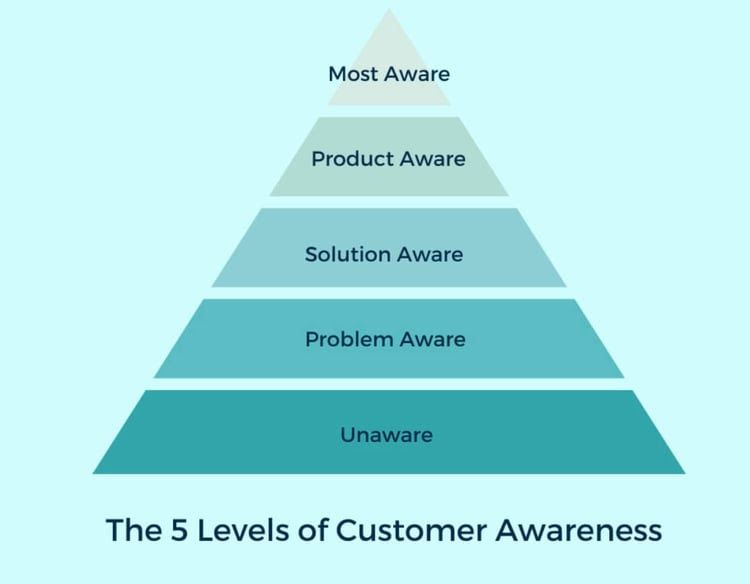
The five levels of customer awareness determine which retargeting message each audience segment needs.
Stage 1: Problem Unaware
These audiences have not yet connected a frustration or gap in their life to a solvable problem. They are the hardest to reach with direct response advertising because they are not actively looking for anything.
Content that names and describes the problem in terms they recognize is the entry point here, not a product pitch.
Stage 2: Problem Aware
This segment knows something is not working, but has not started evaluating solutions. They respond to messages that validate the problem and open the door to solutions.
Educational content, storytelling, and problem-framing ads perform well at this stage because they meet the audience where they are rather than pushing them toward a purchase they are not ready to make.
Stage 3: Solution Aware
These audiences are actively researching options. They know solutions exist, but have not committed to one.
Comparison content, proof points, and messaging that position your product as the superior choice within a category they are already considering works here. Social proof and third-party validation carry significant weight at this stage.
Stage 4: Product Aware
This is the segment most retargeting campaigns are built around exclusively. These are visitors who have seen your product, browsed your site, or engaged with your content.
They need a reason to act now rather than continue considering. Urgency, incentives, testimonials, and objection-handling copy are the most effective tools here.
Stage 5: Most Aware
Cart abandoners and high-intent visitors who have reached checkout or a pricing page without converting sit in this segment. The barrier to purchase is rarely awareness at this point. It is usually hesitation around price, trust, or timing.
Direct offers, guarantees, and strong CTAs with minimal friction work best here.
Real Retargeting Ad Examples That Convert
Awareness-to-Consideration
A visitor who read a blog post or watched a video ad but never visited a product page sits in the problem-aware or solution-aware stage.
Retargeting this segment with educational or comparison content rather than a direct purchase offer aligns with where they are in the journey. The goal is moving them to consideration, not immediate conversion.
Product Page Retargeting
A visitor browses a skincare product page, spends time reading the description, but leaves without adding it to the cart. A retargeting ad served within 24 to 48 hours, showing the exact product they viewed, paired with a social proof hook such as customer results or a review, closes the loop on that intent signal.
The creative mirrors what they saw on-site rather than introducing something new, which keeps the decision path short.
Post-Purchase Upsell
Retargeting does not stop at acquisition. Customers who have completed a purchase represent a high-trust segment that is significantly more likely to buy again than a cold prospect.
Post-purchase retargeting introduces complementary products, consumable replenishment reminders, or loyalty incentives within a window when the brand is still top of mind. The creative tone shifts from persuasion to relationship, which requires a different approach than standard conversion-focused ads.
Cart Abandonment
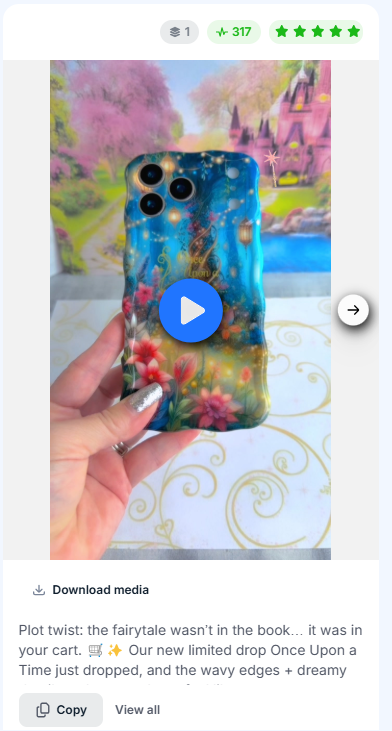
A cart abandonment ad using humor and urgency to bring high-intent shoppers back to checkout. (Source: GetHookd)
Cart abandonment retargeting targets the highest-intent segment in any eCommerce funnel. A visitor who added a product to the cart and left has already made a partial commitment.
The ad creative here does not need to sell the product again. It needs to remove the final objection, whether that is price, shipping, or hesitation. A time-limited offer, a free shipping threshold, or a simple reminder with a direct CTA to complete the purchase are the most common formats that convert at this stage.
How to Set Up Your Retargeting Ads Campaign
Install Your Tracking Pixel on Every Key Page: Go to Meta's Events Manager, create a pixel, and add it to every page on your site. If you use Shopify, WordPress, or Webflow, each platform has a native integration that handles this without touching code. Beyond the base pixel, set up standard events on your highest-value pages: ViewContent, AddToCart, InitiateCheckout, and Purchase. Use Meta's Pixel Helper Chrome extension to verify every event is firing correctly before moving forward.
Build Segmented Audience Lists: Create separate custom audiences for each key behavior: all website visitors, product page viewers, cart abandoners, checkout initiators, and past purchasers. In Ads Manager, go to Audiences, Create Audience, Custom Audience, Website, then filter by specific pixel events. Do not combine all visitors into one audience. Segmentation is what allows you to tailor messaging and bids to each group's proximity to conversion.
Create Multiple Campaigns for Different Awareness Stages: Map your audience segments to separate campaigns, each with its own objective, budget, and creative. Cart abandoners get a conversion objective with direct-response copy. Blog readers get a traffic campaign with educational content. Past purchasers get an upsell campaign. Separate campaigns give you clean performance data per segment and make optimization straightforward.
Write Ad Copy That Matches Where Each Audience Is in the Journey: A user who reads a blog post is not ready for a "Buy Now, 20% Off" message. That same message is exactly right for a checkout abandoner who has already decided they want the product. Match the intensity and intent of your copy to the awareness stage of each audience segment.
Retargeting Strategies to Maximize ROI
Sequential Retargeting
Sequential retargeting serves a planned series of ads to the same audience over time, moving them through the awareness stages rather than showing the same creative repeatedly.
A visitor who sees an educational video first, then a product comparison ad, then a testimonial-focused ad is being guided through a structured decision path.
Sequential retargeting requires more creative assets upfront, but produces significantly lower frequency fatigue and stronger conversion rates over the full campaign window.
Dynamic Retargeting
Dynamic retargeting automates personalization by pulling product data directly from your catalog and assembling individualized ads based on what each user actually browsed. On Meta, this runs through the Catalog Sales objective with a connected product catalog in Commerce Manager. Once set up, the platform handles creative assembly automatically.
The advantage over static retargeting is relevance. Instead of showing a generic brand ad to someone who spent time on a specific product page, you show them that exact product at the current price with a direct link back to it.
Frequency Capping
Retargeted audiences are smaller than prospecting audiences by definition, which means the same people see your ads repeatedly without frequency controls.
Meta allows frequency capping on Reach campaigns using the Reservation buying type. For other objectives, frequency is managed indirectly through audience size, budget, and campaign duration.
A general benchmark for retargeting is 5 to 8 impressions per person per week for product-aware and most-aware segments, with lower caps of 3 to 5 per week for earlier-stage audiences where the relationship is less established.
Exclusion Lists
Exclusion lists prevent your retargeting budget from reaching audiences that no longer need to see your ads.
Exclude recent purchasers from product-focused retargeting ad sets.
Exclude high-frequency non-converters who have seen your ads many times without engaging to stop wasting impressions.
Exclude audiences from ad sets that are not relevant to their awareness stage.
Clean exclusion lists are one of the fastest ways to improve retargeting efficiency without changing creative or increasing budget.
Scale Your Retargeting Ad Results with GetHookd
Showing the wrong retargeting message to the right audience will produce nothing. What your cart abandoners, product page visitors, and awareness-stage audiences need to see should be informed by what is already working in your market, and that is where most teams are flying blind.
Search GetHookd's Explore Ads to find high-performing ad concepts across any niche.
Our Explore Adsdatabase gives you visibility into 65M+ scored and winning Meta ads so you can identify which retargeting concepts are converting in your niche before committing to production. Brand Spy shows which creatives competitors are actively scaling at each stage of their funnel, while Creative Analyzer identifies which of your own running creatives are outperforming, so you know what to scale and what to cut.
When you build your retargeting creatives, our Ads Transcription tool extracts proven hooks and copy structure from any high-performing retargeting ad. Clone Ads produces dozens of variations (e.g., new colors, formats, and styles) in minutes. Every part of that workflow, from the research to the creative to the post-click experience, stays inside one platform.
What is the difference between retargeting and remarketing?
Retargeting refers to serving paid ads to users who previously visited your site or engaged with your content. Remarketing originally referred to re-engaging existing customers through email.
Google blurred the line by labeling its pixel-based ad product "remarketing," which is why both terms are now used interchangeably.
How long should a retargeting campaign run before seeing results?
The right window depends on your product's purchase cycle. For lower-ticket impulse purchases, a 3 to 7-day retargeting window captures the bulk of intent.
For higher-consideration products, a 30 to 60-day window is more appropriate. Beyond that window, the intent signal weakens, and you are effectively targeting cold traffic with warm creative, which rarely performs well.
How much should I budget for retargeting ads?
There is no fixed rule, but a commonly cited starting point among performance marketers is allocating 20%–30% of your total paid advertising budget to retargeting. Higher AOV products can justify more, since recovering a small number of abandoned purchases can deliver strong ROAS on its own.
Start conservatively, scale the segments that consistently hit your target ROAS, and reduce spend on those that don't convert within the first 30 days.
How can GetHookd help with retargeting campaigns?
GetHookd’s Explore Ads database lets you filter by niche, format, and performance signals to identify which retargeting ad styles are gaining traction in your market.
Our Brand Spy feature shows which creatives your competitors are scaling at each stage of their funnel. From there, Ads Transcription and Video Scripts help you adapt proven concepts into your own creatives without having to start from scratch.
*Note: Pricing and/or product availability mentioned in this post are subject to change. Please check our website for current pricing and stock information before making a purchase.