Facebook Ads for Therapists: Examples & Best Practices
Key Takeaways
- Free consultation offers, educational content, specialty service campaigns, retargeting, and community awareness are Facebook campaign types that consistently work for therapists.
- The most effective therapist ads feel human, warm, and calm, with natural lighting and relaxed body language, since staged imagery undermines the trust mental health audiences seek.
- Lead your ad copy with the client’s problem rather than your credentials, so a potential client reading the ad thinks “that’s exactly how I feel” before they even reach the CTA.
- Replace high-commitment CTAs like “Register Now” with softer, lower-stakes phrasing, such as “See If We’re a Good Fit,” to reduce friction at the point of click.
- GetHookd gives therapists and agencies serving them access to high-performing Meta ads and AI creative tools to generate image ads in minutes, write video scripts, and monitor competitor strategies.
Why Facebook Works for Therapists
Facebook works for therapists because it offers a level of audience precision that traditional marketing channels cannot match, letting you reach the right people based on age, location, life events, and behaviors, then stay visible to them throughout the long, private process of deciding to seek help.
The campaigns that consistently perform fall into five clear types: free consultation offers, educational content, specialty service ads, retargeting, and community awareness. Pair those with copy that leads with the client’s problem, plain non-clinical language, and low-friction CTAs, and you have a foundation that turns cold scrollers into booked clients. Facebook also supports several ad formats that suit therapy marketing, including image, video, carousel, and lead generation ads, each with its own strengths depending on the offer.
Below, we will walk through real Facebook Ads examples, break down each ad type, and share the copywriting practices that drive conversions.

GetHookd: Turn Competitor Intelligence Into Your Next Winning Ad
GetHookd reveals which ads your competitors are actively scaling—not just running. Spy on their best-performing creatives, landing pages, and traffic strategies, then turn proven concepts into testable campaigns in seconds with AI-powered script generation and creative cloning.
What You Get:- ✓ Brand Spy to decode competitor ad strategies in real-time
- ✓ AI script generation and ad cloning for instant variations
- ✓ Performance scoring based on actual ad behavior, not vanity metrics
- ✓ Creative Analyzer to identify and scale your top performers
5 Facebook Ad Campaign Examples That Work for Therapists
1. The Free Consultation Offer
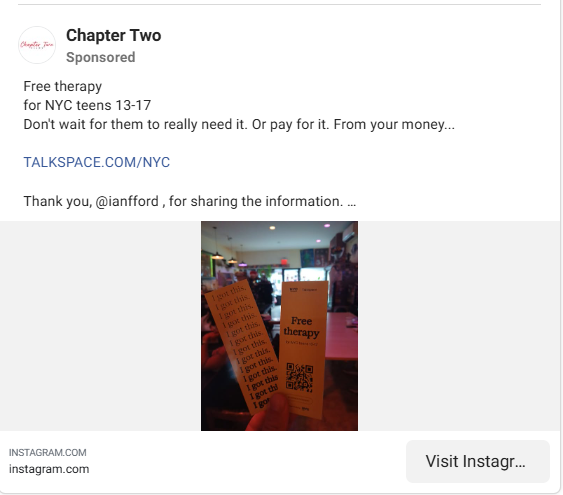
The free consultation campaign is the most straightforward and widely used approach in therapy marketing, and for good reason. It lowers the single biggest barrier most potential clients face: the fear of committing to something unknown. By offering a no-cost, no-pressure first conversation, you shift the ask from “hire me” to “just talk to me,” which is a much easier yes.
This campaign works best as a lead-generation ad or an image ad that points to a simple landing page with one clear action. Your headline should speak directly to a pain point, not your credentials. Something like “Feeling overwhelmed and not sure where to start? Let’s talk, first session is on us.”
Keep the form short. Name, email, and a single qualifying question (like “What brings you here today?”) is all you need. The longer the form, the lower the completion rate.
2. The Educational Content Campaign
People who are considering therapy but haven’t committed yet are often in research mode. They’re reading articles, watching videos, and quietly trying to understand what’s wrong and whether help is available.
An educational content campaign meets them exactly there. Instead of asking for a booking, you’re offering something useful: a blog post, a short video, a checklist, or a guide that addresses a specific struggle, such as anxiety management, relationship conflict, or burnout recovery.
The goal of this campaign is trust-building, not immediate conversion. Someone who reads your anxiety guide today and finds it helpful is far more likely to book with you next week than someone who saw a generic “book now” ad they didn’t connect with.
3. The Specialty Service Campaign
If your practice focuses on a specific population or issue such as couples counseling, trauma recovery, adolescent therapy, or grief support, a specialty campaign is one of the fastest ways to attract highly qualified leads.
Generic therapy ads compete with every other practice in your area. A targeted specialty ad speaks directly to a person’s specific situation, dramatically increasing relevance and click-through rates.
Facebook’s targeting tools make this even more powerful. A couples therapy campaign, for example, can be targeted to married adults aged 30 to 55 within a 15-mile radius of your office who have expressed interest in relationship advice.
4. The Retargeting Campaign for Warm Leads
Retargeting is where a significant portion of your potential revenue quietly slips away. When someone visits your website, reads your about page, or watches 50% of your video ad, and then leaves without booking, they are not a lost cause. See them as a warm lead who just needed more time.
A retargeting campaign lets you show a follow-up ad specifically to those people. Because they’ve already encountered your practice once, they recognize you. That familiarity reduces resistance and significantly increases the likelihood they’ll take the next step.
Keep your retargeting ads simple and direct. A short message like “Still thinking about it? Your first consultation is free, and completely confidential” paired with a single CTA button is often all it takes to convert a hesitant visitor into a booked client.
5. The Community Awareness Campaign
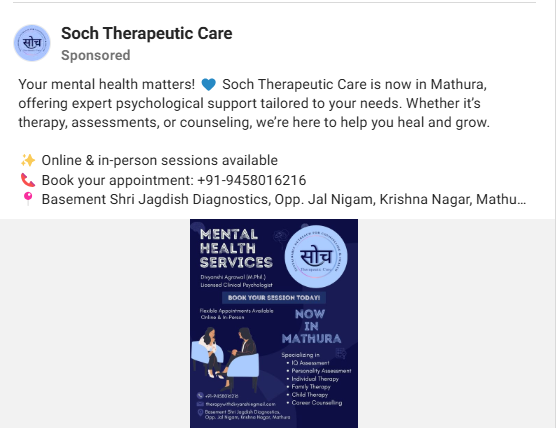
Not every Facebook ad needs to drive immediate bookings. A community awareness campaign focuses on building your practice’s local presence and reputation over time.
The goal is to position you as a trusted mental health voice in your area rather than just another service provider. These ads might promote a free mental health workshop, share a resource during Mental Health Awareness Month, or simply introduce who you are and what your practice stands for.
The payoff is slower but compounding. People remember names and faces they’ve seen consistently, and when they’re finally ready to seek help, your practice is the one they think of first.
5 Facebook Ad Campaigns for Therapists: Summary Table
| Campaign Type | Best For | Funnel Stage | Key Strength |
| Free Consultation Offer | Practices ready to book new clients quickly | Bottom | Lowers commitment barrier with a low-stakes first ask |
| Educational Content | Reaching prospects in early research mode | Top | Builds trust through value before any booking ask |
| Specialty Service | Practices focused on a specific population or issue | Middle | Speaks directly to a defined situation, increasing relevance |
| Retargeting | Practices with website traffic or video viewers | Middle to Bottom | Recovers warm leads who left without booking |
| Community Awareness | Practices building long-term local presence | Top | Builds recognition and trust that compounds over time |
Facebook Ad Types Therapists Should Know
Image Ads
Image ads are the simplest format: a single photo or graphic paired with headline text, body copy, and a call-to-action button. They are quick to produce and work well for straightforward offers, such as a free consultation or a direct service promotion. Avoid images that look overly staged or corporate, as they tend to underperform in mental health contexts where trust is everything.
Video Ads
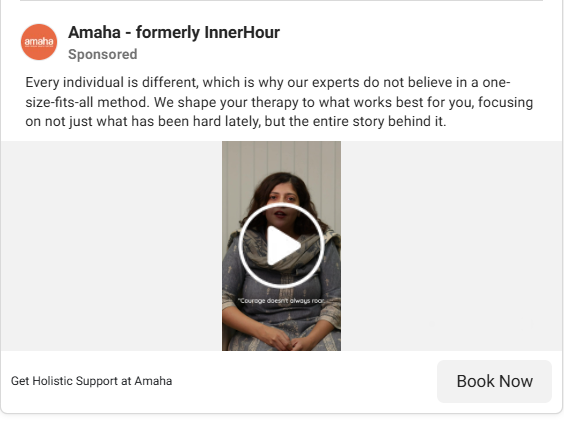
Video ads outperform static images in terms of engagement. For therapists, they carry an added benefit: they let potential clients hear your voice, see your face, and begin forming a sense of who you are before they ever reach out. Even a 30-to-60-second video where you speak directly to a common struggle your clients face can dramatically improve click-through rates.
Carousel Ads
Carousel ads display multiple images or cards in a single ad unit that users can swipe through. They work well for therapists who want to highlight several specialties (anxiety, couples therapy, trauma) or walk a potential client through a short educational sequence. Each card can have its own headline and link, giving you more storytelling flexibility than a single image allows.
Lead Generation Ads
Lead generation ads are built differently from other formats. Instead of sending users to your website, they open a pre-filled form directly inside Facebook. This removes the friction of leaving the app, leading more people to complete the form.
For therapists offering a free consultation or downloadable mental health resources, lead-gen ads can deliver contact information directly to your inbox.
Best Practices for Writing Therapist Ad Copy
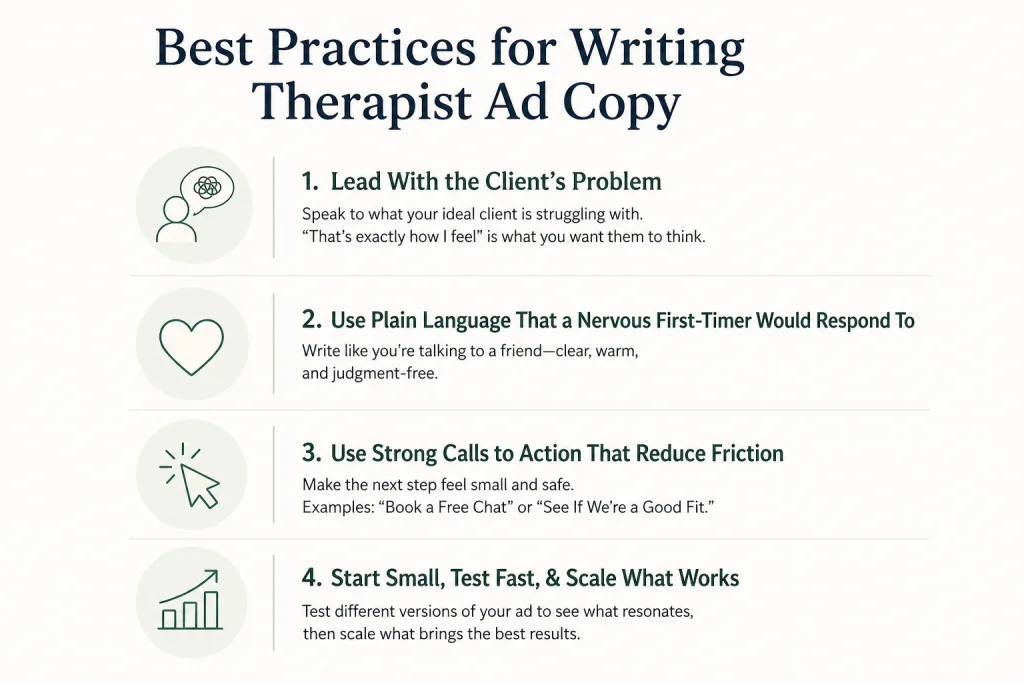
Lead With the Client’s Problem
The single most effective shift you can make in your ad copy is moving your credentials and your practice description to the background and putting the client’s experience front and center. When a potential client reads your ad and thinks “that’s exactly how I feel,” you’ve already done the hardest part of the job.
Use Plain Language That a Nervous First-Timer Would Respond To
Many people who need therapy have never been before and carry real anxiety about what it involves. Clinical terminology, formal language, and therapy jargon create distance rather than connection. Write as if you’re talking to a friend who’s struggling: clear, warm, and judgment-free.
Use Strong Calls to Action That Reduce Friction
Your call to action should make the next step feel small and safe. Avoid high-commitment language like “Sign Up” or “Register Now” in favor of softer, lower-stakes options like “Book a Free Chat,” “See If We’re a Good Fit,” or “Claim Your Free Consultation.” The easier and less intimidating the CTA feels, the more people will click it.
Start Small, Test Fast, & Scale What Works
Even the best-written ad copy needs to be tested before you commit significant budget to it. Facebook’s split testing tools let you run two or more versions of an ad simultaneously. Change one variable at a time to identify which headline, image, or CTA resonates most with your audience.
Research & Create Your Next Winning Therapy Ad with GetHookd
With billions of people active on Facebook, ads remain one of the most effective ways to connect with potential clients who would never have found your practice otherwise. Therapists looking for a stronger ROI on those campaigns can launch smarter with GetHookd. Our platform gives you access to over 65 million Meta ads searchable by industry, angle, and format, so you can find the therapy ads currently winning attention in your category.
Once you know what is working, GetHookd makes it just as fast to build your own version. You can generate high-quality image ads in minutes, write video scripts tailored to your practice, and use Brand Spy to monitor the competitors worth tracking, including the landing pages and traffic sources behind their top-performing ads. The result is a research-to-launch workflow that fits within a single platform, so your next test is faster, sharper, and rooted in real data.
Start your GetHookd free trial today
Frequently Asked Questions (FAQs)
How much should therapists spend on Facebook ads?
There is no universal recommendation, but most therapists starting out commit to a sustained daily budget rather than a large upfront spend. Cost per lead in healthcare-adjacent categories typically sits on the higher end of Facebook’s broader lead-generation benchmarks, which average $27 to $42. Whatever budget you commit to, plan to run it for at least 60 days before judging performance, since pulling the plug too early is a common reason advertisers conclude that Facebook ads do not work.
Can therapists advertise on Facebook without a website?
Yes, Facebook’s Lead Generation ad format lets you capture a potential client’s name, email, and phone number directly inside the Facebook app without sending them to an external website. That said, having a professional website improves conversion rates across all other campaign types and gives you far more control over the client journey.
Are Facebook ads or Google ads better for therapists?
Google ads capture people actively searching for a therapist right now, which means higher intent but generally higher cost-per-click than Facebook in most markets. Facebook ads reach people earlier in the process, before they have decided to seek therapy, which makes them better for awareness, retargeting, and warming leads over time. Many successful therapy practices run both simultaneously, but if you are starting with one, Facebook offers a lower barrier to entry and more creative flexibility.
What images work best in therapist Facebook ads?
The strongest therapist ads feel human, warm, and calm, with natural lighting, relaxed body language, and environments that suggest comfort and safety, such as a cozy office, a quiet outdoor setting, or someone who looks at ease. To find the visual approaches actually working in your niche, GetHookd gives you over 65 million ads filterable by industry and format, so you can study the imagery, framing, and design choices behind therapy ads currently winning attention in the feed.
*Note: Pricing and/or product availability mentioned in this post are subject to change. Please check our website for current pricing and stock information before making a purchase.