

Facebook has become the most important digital marketing channel for marketers worldwide, and car dealerships are a big part of that story. With over 3.29 billion monthly active users as of late 2024, you're not broadcasting into the void; you're reaching real buyers while they scroll through their feeds.
What separates Facebook from platforms like Google or traditional media is its targeting precision. You can narrow your audience by location, age, household income, car ownership status, purchase intent, and even recent life events such as a new job or a move. That specificity means every dollar in your ad budget is working harder, something a billboard on the interstate simply cannot offer.
Many dealerships still aren't using Facebook ads to their full potential, which leaves a genuine competitive advantage open for those who do. Running smarter campaigns while your competitors run generic ones is one of the fastest ways to increase market share without increasing your overall marketing spend.
65M+ Ads Analyzed | 4.8★ G2 Rating | 4.5★ Trustpilot Rating
GetHookd reveals which ads your competitors are actively scaling—not just running. Spy on their best-performing creatives, landing pages, and traffic strategies, then turn proven concepts into testable campaigns in seconds with AI-powered script generation and creative cloning.
What You Get:
Dynamic inventory ads are the closest thing to a set-it-and-let-it-run solution in Facebook advertising. They automatically pull vehicles from your existing inventory feed and display them to users who have already shown interest, whether that's visiting your website, browsing similar vehicles on third-party platforms, or engaging with previous ads.
The system matches the right vehicle to the right buyer at the right time without requiring you to manually create individual ads for every car on your lot.
For a dealership with a large or frequently rotating inventory, these ads should be the first format you test. They're especially powerful for retargeting, re-engaging shoppers who visited your site but didn't convert.
Lead form ads solve one of the biggest friction points in digital advertising: the click-away drop-off. Instead of directing a user to your dealership website, where they might get distracted or leave, lead ads present a pre-filled contact form directly inside Facebook.
The user's name, email, and phone number are often auto-populated from their profile, making it a one-tap process to submit their information.
This format works exceptionally well for specific offers, trade-in valuations, test drive bookings, financing pre-approvals, and limited-time promotions. The lower the friction, the higher the conversion rate, and lead form ads are purpose-built around that principle.
Video ads outperform static images in engagement across nearly every industry, and automotive is no exception. A well-produced walk-around video of a featured vehicle, a time-lapse of a detailing job, or even a simple testimonial from a recent buyer can stop a user mid-scroll in a way that a single photo rarely does.
Facebook's algorithm also tends to reward video content with broader organic reach, which means your paid video ads often carry extra mileage.
You don't need a Hollywood budget to make effective video ads. Smartphone footage with good lighting and a clear message consistently outperforms over-produced content that feels like a traditional TV commercial. Authenticity performs on social media; a genuine walk-around of a 2023 Ford F-150 with real footage from your lot will outperform a generic stock video every time.
This ad format shows a side-by-side comparison of a used vehicle before and after your service team worked on it. A scratched-up bumper transformed to showroom condition, a dull exterior brought back to life with a full detail, or a worn interior restored to near-new quality, these visuals do the convincing without any written claims.
They demonstrate the quality of your reconditioning process without saying a word about it, and they build confidence among buyers who are skeptical about buying a used vehicle.
The Car of the Week format is a recurring campaign that highlights one featured vehicle each week with a dedicated ad. What makes this approach powerful is the consistency, buyers begin to look forward to the weekly feature, and it creates a pattern of regular engagement with your dealership's Facebook presence.
Over time, this builds an audience of warm followers who are already invested in what you're selling before they ever walk through the door.
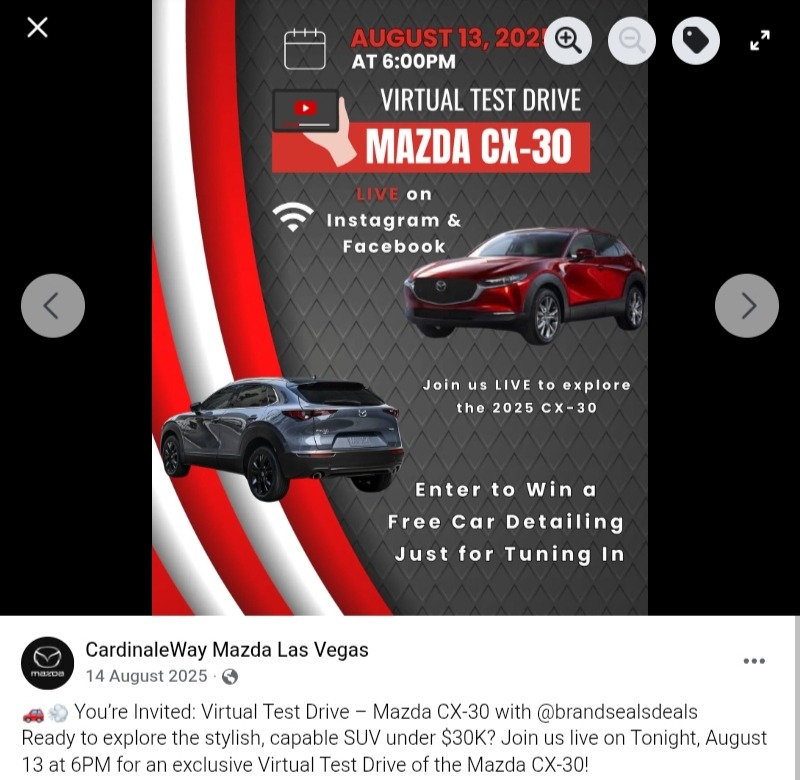
A virtual test drive ad is a first-person or walk-around video that simulates the experience of being in and around the vehicle. Think interior shots from the driver's seat, a slow walk around the exterior highlighting key features, and a brief on-road clip if possible.
This format bridges the gap between online browsing and the physical dealership experience, and it's especially effective for buyers who are still in the research phase and haven't committed to visiting a lot yet.
Stock photos are the fastest way to kill credibility in a car dealership Facebook ad. Buyers have seen the same generic showroom images recycled across dozens of dealer ads, and they've learned to tune them out completely.
Real photos of real vehicles, your actual inventory, shot on your actual lot, create immediate authenticity and tell the buyer that what they're seeing is available right now.
The dealerships that outperform their competition on Facebook aren't necessarily running the most sophisticated campaigns. They're the ones who test systematically and let performance data make the decisions rather than gut instinct.
Start by running two or three different formats simultaneously with the same audience and budget allocation. A dynamic inventory ad, a lead form ad, and a single-image ad targeting the same used SUV buyer segment will give you direct, side-by-side performance data within the first two weeks.
From there, you double down on what's converting and cut what isn't. That process compounds over time into a highly optimized, efficient ad account.

Ad fatigue is one of the most common and most costly mistakes dealerships make on Facebook. When the same creative runs to the same audience for too long, engagement drops, cost per click rises, and the algorithm starts deprioritizing your ads in favor of fresher content from other advertisers.
The rule of thumb is to refresh your creative every 3 to 4 weeks, or sooner if you notice your click-through rate falling or your cost per lead rising without a corresponding increase in lead quality.
Rotating in new vehicle photos, updated headlines, or a different promotional angle is often all it takes to reset performance and re-engage your audience effectively.
The dealerships generating the most leads on Facebook aren't winning because of bigger budgets; they're winning because they know exactly what to do. That intelligence is what GetHookd delivers. For automotive marketers and agencies managing multiple dealership clients, or operators testing new inventory campaigns, GetHookd removes the trial-and-error phase that quietly drains ad budgets.
Search 65M+ real ads across Facebook to see what competing dealerships and automotive brands are actively running. Use Brand Spy to uncover their top-performing creatives, offers, and landing pages, then build your own campaigns with certainty rather than assumptions. Generate scripts and clone winning ad variations directly inside the platform without the guesswork or wasted spend.
Start your GetHookd free trial today!
Dynamic inventory ads consistently deliver strong performance for dealerships with an active inventory feed, with higher engagement and conversion rates than static ads in most reported cases. That said, the best format depends on your goal.
Yes, and often with a structural advantage. Facebook's targeting tools let any dealership reach exactly the right local buyers regardless of overall marketing budget. This precision targeting removes the structural advantage larger dealers have always relied on. Small dealerships can also move faster, testing new creative and updating offers without the approval layers that slow down larger organizations.
Most dealerships see initial lead activity within the first few days of launch, but lead quality and volume improve significantly over the first two to four weeks as Facebook's algorithm completes its learning phase.
Expect the first two weeks to serve primarily as a data-collection and refinement period. By weeks three and four, the cost per lead typically starts to drop, and lead quality improves noticeably. A well-structured campaign should be producing a predictable, scalable lead flow by month two.
GetHookd gives automotive marketers and agencies direct access to 65M+ real ads running across Facebook, searchable by niche, format, and performance signals. Use Brand Spy to see exactly what competing dealerships are running right now: which offers they're leading with, what creative formats they're using, and which landing pages they're sending traffic to.
From there, generate scripts and clone top-performing ad variations directly inside the platform, so every campaign you launch is grounded in proven competitive intelligence rather than guesswork.


