

Most advertisers approach Black Friday the same way every year: slap a discount on a product image, write "HUGE SALE" in the headline, and hope for the best. A great ad with the right strategy does far more — it drives outsized revenue from a market already primed to spend.
In 2026, with ad costs spiking sharply during the November shopping window, that approach will burn your budget fast. This article breaks down 5 real Black Friday Facebook ad examples, what made each one work, and exactly how to apply those lessons to your own campaigns.
65M+ Ads Analyzed | 4.8★ G2 Rating | 4.5★ Trustpilot Rating
GetHookd reveals which ads your competitors are actively scaling—not just running. Spy on their best-performing creatives, landing pages, and traffic strategies, then turn proven concepts into testable campaigns in seconds with AI-powered script generation and creative cloning.
What You Get: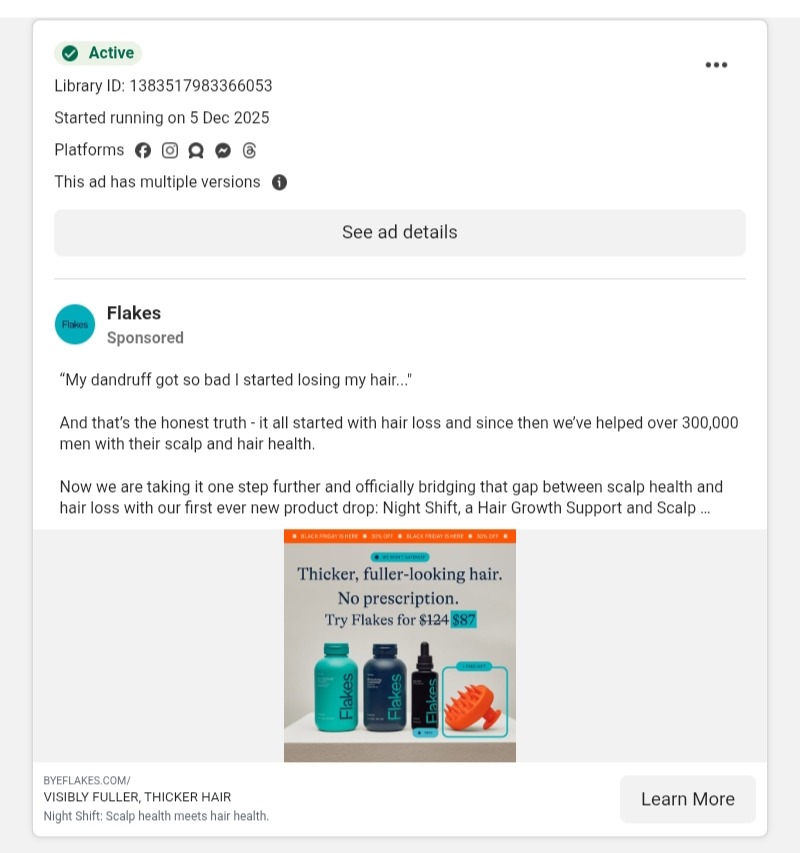
Flakes ad doesn't open with a discount or a product shot. It opens with a confession: "My dandruff got so bad I started losing my hair." That vulnerability does real conversion work because it mirrors exactly what their target audience is experiencing.
Most Black Friday ads scream about discounts. Flakes takes a different approach: it opens with a personal story that stops the scroll before any selling begins. Problem-led copy works because it triggers recognition.
When someone struggling with hair loss reads that opening line, they don't see an ad; they see their own experience reflected back at them. that emotional identification is far more powerful than any percentage-off headline in a crowded Black Friday feed.
The credibility marker of "over 300,000 men" reinforces that this isn't an untested product riding a seasonal discount. Social proof at that scale shifts the reader from curiosity to trust before the offer is even introduced.
On Black Friday, when buyers are bombarded with claims from brands they've never heard of, established credibility is the difference between a click and a scroll-past.
Few conversion tools are as immediately effective, or as easily misused, as the countdown timer. When used correctly in a Black Friday Facebook ad, a live countdown to deal expiration can dramatically compress the decision-making timeline and push hesitant buyers over the edge. When used carelessly, it signals desperation and destroys the brand credibility you've spent months building.
Countdown timers activate loss aversion, the well-documented psychological principle that people are more motivated by the fear of losing something than by the prospect of gaining it.
A ticking clock reframes the decision from "should I buy this?" to "if I don't act now, I lose this deal forever." That reframing alone can lift click-through rates, particularly in the final 24 hours of a Black Friday sale when deal urgency is already high in the buyer's mind.
The rule is simple: use only real scarcity. Countdown timers that reset when they hit zero, "limited stock" claims on products with unlimited inventory, and "last chance" messaging repeated across multiple campaigns all train your audience to ignore urgency signals entirely.
Once buyers learn that your scarcity isn't genuine, no amount of countdown timers will move them.
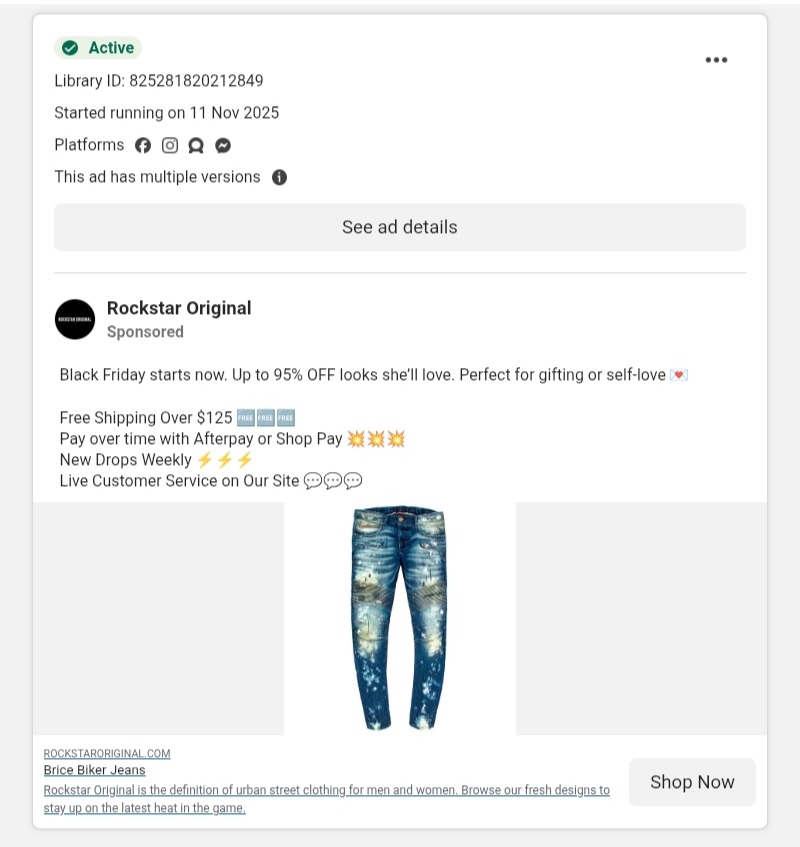
Rockstar Original Black Friday Facebook ad promotes their Brice Biker Jeans at up to 95% off, stacked with free shipping for items over $125, buy-now-pay-later options through Afterpay and Shop Pay, and live customer service. The result is a value proposition so layered that every possible purchase objection is addressed before the buyer even clicks through.
95% off is not a number buyers encounter often, and that rarity is exactly what makes it effective. Extreme discounts trigger a scarcity-driven response: "This can't be real, but if it is, I need to act now."
On Black Friday, when shoppers are conditioned to expect 20–40% off, a 95% discount earns a second look simply because it breaks the pattern of what feels normal. The risk for the brand is appearing cheap, but Rockstar counters this by framing the offer around specific products and reinforcing brand identity with language like "the definition of urban street clothing."
The ad also doesn't rely solely on the discount. Free shipping over $125 nudges cart values upward. Afterpay and Shop Pay remove the upfront cost objection; even a deeply discounted item feels easier to buy when split into installments.
Each incentive addresses a different reason someone might not buy. The discount handles price sensitivity. Free shipping removes friction. Pay-later options lower commitment anxiety. Customer service builds trust. Stacked together, they create an ad where almost every reason not to buy has been removed.
Bundle ads are one of the most underused Black Friday Facebook ad formats. Brands using AI-powered ad research to identify what competitors are bundling consistently report higher average order values than single-item discount campaigns
The core mechanic is straightforward: group complementary products together at a combined price that feels significantly more valuable than buying each item separately.
A single-item discount competes purely on price, which means you're in a race to the bottom against every other advertiser offering the same or a similar product. A bundle shifts the conversation entirely. The buyer's question shifts from "who has the cheapest price?" to "where do I get the most complete solution?" That is a competition you can win on value rather than margin.
Bundles also increase perceived generosity without requiring you to slash your margin as deeply as a straight percentage discount implies. A $150 bundle priced at $99 feels like an extraordinary deal, even if your margin on the bundle is healthier than a 40% discount on a single $60 item.
The buyer sees total value delivered, not the underlying cost structure. Structure your Black Friday bundle ads to prominently emphasize the combined retail value, then reveal the bundle price as the payoff.
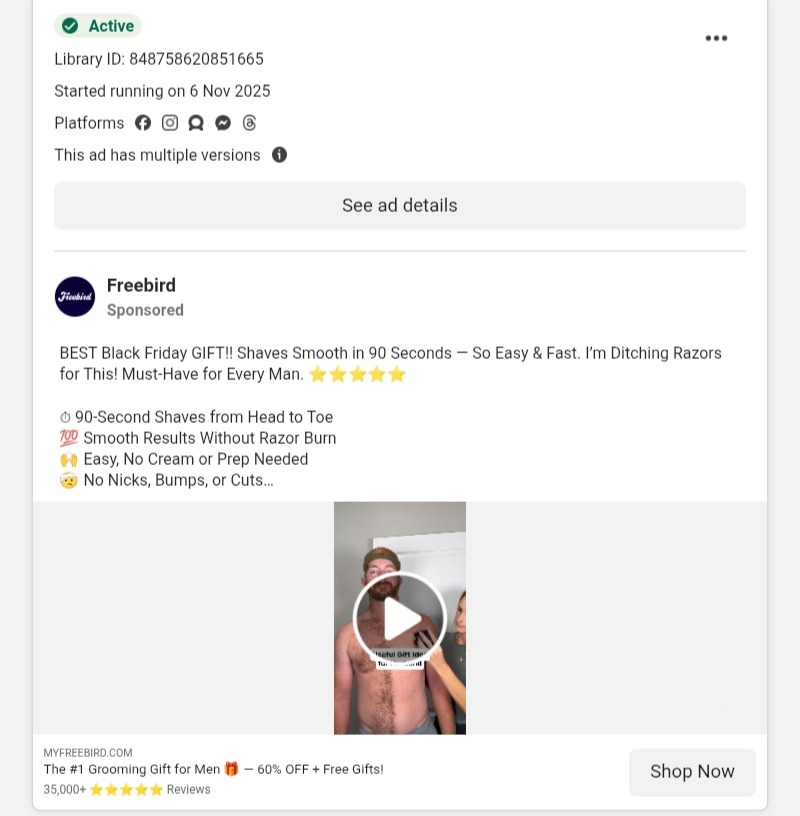
When every brand is claiming their product is the best at the lowest price, buyer skepticism peaks. A real customer explaining in their own words why a product changed their life cuts through that skepticism in a way no brand claim can match.
Every brand says its product works. A customer saying it works, unprompted, in their own words, with their face visible, is a different category of persuasion. The psychological mechanism here is social proof: humans naturally look to others for behavioral cues, especially in uncertain situations.
A buyer considering a new product during Black Friday is uncertain. A testimonial from someone who already made that decision and benefited from it removes that uncertainty directly.
The specificity of the testimonial matters. Vague praise like "I love this product, it's amazing!" does almost nothing. Specific results — "I used this for 90 seconds and shaved all unwanted hair from my body” — create belief because they're verifiable and detailed. Generic testimonials are background noise. Specific ones are conversion assets.
When sourcing testimonials for your Black Friday video ads, filter specifically for customers who can speak to a measurable outcome, a before-and-after transformation, or a specific problem the product solved. Those are the stories that stop the scroll and close the sale.
The brands that win Black Friday aren't guessing; they're studying what already works and executing faster than everyone else. That's exactly where GetHookd gives you an edge. Whether you're a marketer managing your business or an e-commerce operator testing new creatives every week, GetHookd is built for how you actually work.
With access to 65M+ high-performing ads across Facebook and Google, you can instantly see which Black Friday creatives are running, what offers competitors are leading with, and which hooks are driving engagement in your niche, before you spend a single dollar. Pair that with AI-powered script generation and clone ads functionality, and you can move from research to launch faster than any manual process allows.
Start your GetHookd free trial today!
Launch at least two to three weeks before Black Friday. Use the first week for engagement-focused warm-up content, the second week to introduce your offer with teaser or early-access messaging, and arrive at Black Friday with loaded retargeting audiences and an optimized algorithm.
It depends on your objective. Video and carousel ads work best for cold audiences because they deliver more information. Single-image and dynamic product ads convert better for warm retargeting audiences who already know your brand and just need a direct path to purchase.
Yes, consistently. In a feed flooded with red starbursts and stacked discount callouts, a clean single-image ad with one bold offer and white space creates immediate visual contrast that earns the stop and triggers the click.
Yes. At minimum, adapt dimensions, vertical 9:16 for Instagram Stories and Reels, square or landscape for Facebook Feed. Beyond format, Instagram copy should be shorter and more visual; Facebook copy can be slightly longer and more benefit-driven.
GetHookd lets you search 65M+ real ads across Facebook and Google, filtered by niche, format, and performance signals. Use Brand Spy to see exactly what competitors are running, then generate scripts and clone ad variations directly in the platform, cutting your research-to-launch time dramatically.
*Note: Pricing and/or product availability mentioned in this post are subject to change. Please check our website for current pricing and stock information before making a purchase.


